The Bible Examiner — Vol. 9, No. 13 (July 1, 1854)
Download: PDF — The Bible Examiner — Vol. 9, No. 13 (July 1, 1854)
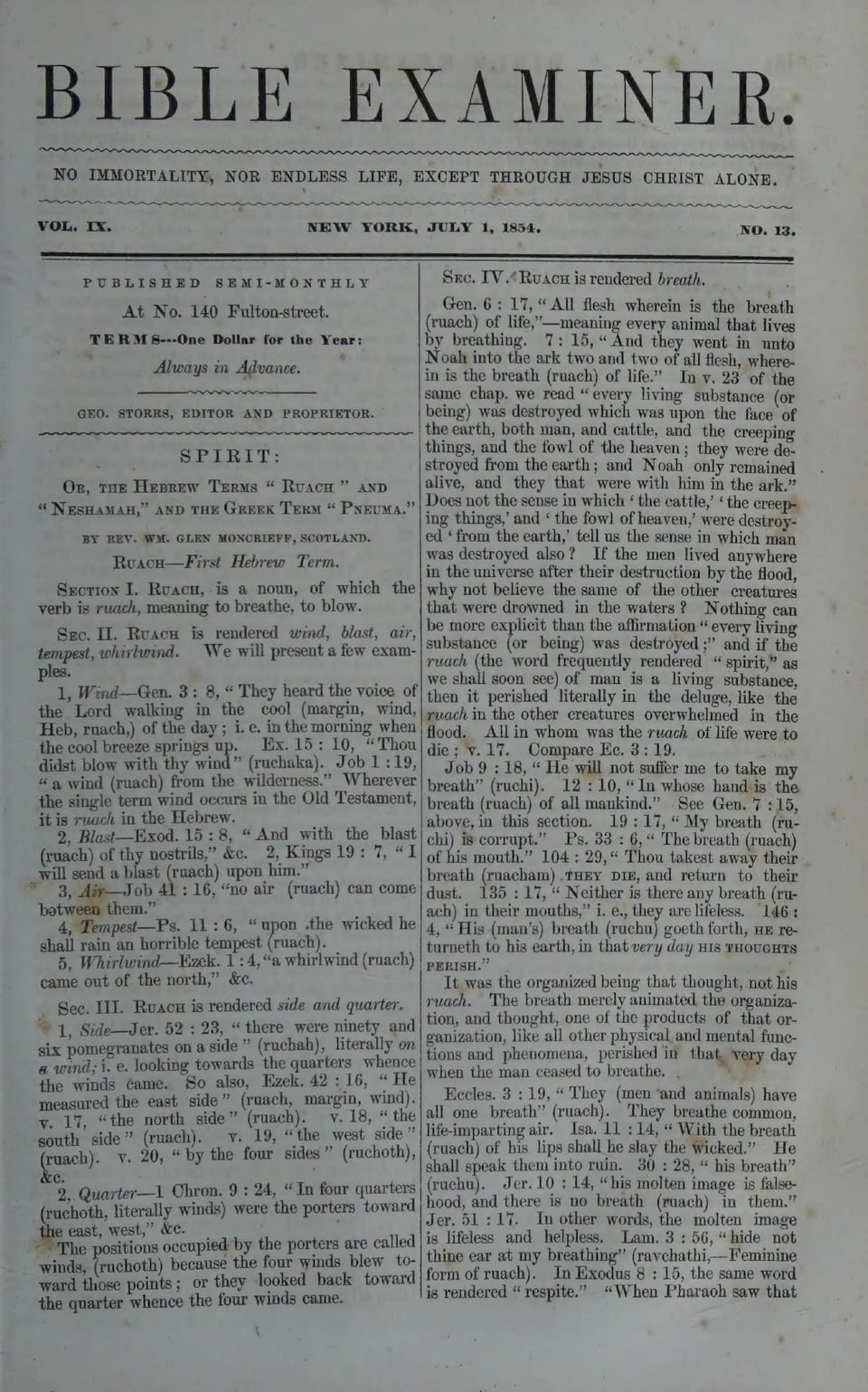
BIBLE EXAMINER.
NO IMMORTALITY, NOR ENDLESS LIFE, EXCEPT THROUGH JESUS CHRIST ALONE.
VOL. IX.
NEW YORK, JULY 1, 1854.
PUBLISHED SEMI-MONTHLY
At No.140 Fulton-street.
TERMS----One Dollar for the Year: Always in Advance.
GEO. STORRS, EDITOR AND PROPRIETOR.
SPIRIT:
OR, THE HEBREW TERMS "RUACH" AND "NESHAMAH," AND THE GREEK TERM "PNEUMA."
BY REV. WM. GLEN MONCRIEFF, SCOTLAND.
RUACH—First Hebrew Term.
SECTION I. Ruach, is a noun, of which the verb is ruach, meaning to breathe, to blow.
SEC. II. RUACH is rendered wind, blast, air, tempest, whirlwind. We will present a few examples.
1, Wind—Gen. 3:8, "They heard the voice of the Lord walking in the cool (margin, wind, Heb, ruach,) of the day; i.e. in the morning when the cool breeze springs up. Ex. 15:10, "Thou didst blow with thy wind" (ruchaka). Job 1:19, "a wind (ruach) from the wilderness." Wherever the single term wind occurs in the Old Testament, it is ruach in the Hebrew.
2, Blast—Exod. 15:8, "And with the blast (ruach) of thy nostrils," &c. 2, Kings 19:7, "I will send a blast (ruach) upon him."
3, Air—Job 41:16, "no air (ruach) can come bətween them."
4, Tempest—Ps. 11:6, "upon .the wicked he shall rain an horrible tempest (ruach).
5, Whirlwind-Ezek. 1:4, "a whirlwind (ruach) came out of the north," &c.
Sec. III. Ruach is rendered side and quarter.
1, Side—Jer. 52:23, "there were ninety and six pomegranates on a side" (ruchah), literally on a wind; i. e. looking towards the quarters whence the winds came. So also, Ezek. 42:16, "He measured the east side" (ruach, margin, wind). v. 17, "the north side" (ruach). v. 18, "the south side" (ruach). v. 19, "the west side" (ruach). v. 20, "by the four sides" (ruchoth), &c.
2, Quarter—1 Chron. 9:24, "In four quarters (ruchoth, literally winds) were the porters toward the east, west," &c.
The positions occupied by the porters are called winds, (ruchoth) because the four winds blew toward those points; or they looked back toward the quarter whence the four winds came.
SEC. IV. Ruach is rendered breath.
Gen. 6:17, "All flesh wherein is the breath (ruach) of life,"—meaning every animal that lives by breathing. 7:15, "And they went in unto Noah into the ark two and two of all flesh, wherein is the breath (ruach) of life." In v. 23 of the same chap. we read "every living substance (or being) was destroyed which was upon the face of the earth, both man, and cattle, and the creeping things, and the fowl of the heaven; they were destroyed from the earth; and Noah only remained alive, and they that were with him in the ark." Does not the sense in which 'the cattle,' 'the creeping things,' and 'the fowl of heaven,' were destroyed 'from the earth,' tell us the sense in which man was destroyed also? If the men lived anywhere in the universe after their destruction by the flood, why not believe the same of the other creatures that were drowned in the waters? Nothing can be more explicit than the affirmation "every living substance (or being) was destroyed;" and if the ruach (the word frequently rendered "spirit," as we shall soon see) of man is a living substance, then it perished literally in the deluge, like the ruach in the other creatures overwhelmed in the flood. All in whom was the ruach of life were to die; v. 17. Compare Ec. 3:19.
Job 9:18, "He will not suffer me to take my breath" (ruchi). 12:10, "In whose hand is the breath (ruach) of all mankind." See Gen. 7:15, above, in this section. 19:17, "My breath (ruchi) is corrupt." Ps. 33:6, "The breath (ruach) of his mouth." 104:29, "Thou takest away their breath (ruacham) THEY DIE, and return to their dust. 135:17, "Neither is there any breath (ruach) in their mouths," i. e., they are lifeless. 146:4, "His (man's) breath (ruchu) goeth forth, he returneth to his earth, in that very day HIS THOUGHTS PERISH."
It was the organized being that thought, not his ruach. The breath merely animated the organization, and thought, one of the products of that organization, like all other physical and mental functions and phenomena, perished in that very day when the man ceased to breathe.
Eccles. 3:19, "They (men and animals) have all one breath" (ruach). They breathe common, life-imparting air. Isa. 11:14, "With the breath (ruach) of his lips shall he slay the wicked." He shall speak them into ruin. 30:28, "his breath" (ruchu). Jer. 10:14, "his molten image is falsehood, and there is no breath (ruach) in them." Jer. 51:17. In other words, the molten image is lifeless and helpless. Lam. 3:56, "hide not thine ear at my breathing" (ravchathi,—Feminine form of ruach). In Exodus 8:15, the same word is rendered "respite." "When Pharaoh saw that there was respite," or breathing time, "he hardened his heart," &c.
Ezek. 37 : 5, "Thus saith the Lord God unto these bones, behold I will cause breath (ruach) to enter into, and ye shall live." Verse 8, "the skin covered them above, but there was no breath (ruach) in them." They were perfect men now, though unalive; as perfect as a watch is before its moving operations begin. Verse 9, "Thus saith the Lord God, come from the four winds (ruchoth) O breath (ruach), and breathe upon the slain, THAT THEY MAY LIVE." Up to this period they were lifeless, like Adam before God "breathed into his nostrils the breath of life," (Gen. 2:7) i.e. inflated his lungs with the vi-
ach, which, unfortunately for truth and piety, has been so magnified and mystified, turns out to be nothing more than just oxygenated, electrified atmosphere,—the air which, when inhaled, keeps men and the crowds of other breathing creatures alive. "They have all one breath," (ruach) v.19. We confess this is a very humble sense compared with the popular one, but candid, God-fearing minds neither seek for lofty meanings nor lowly ones; it is the true meaning they want in every case.
e. It may be stated that another exposition of the verse has been proposed, and, that the reader may be enabled to make his choice, we shall pre-
talizing atmosphere. Verse 10, "So I prophesied as he commanded me, and the breath (ruach) came into them and THEY LIVED." "They lived;" so Adam became alive and conscious as soon as the Creator made him inhale the life-kindling atmosphere. Gen. 2:7. Hab. 2:19, "Woe unto him that saith to the wood, awake, and to the dumb stone, arise, it shall teach! Behold it is laid over with gold and silver, and there is no breath (ruach) at all in the midst of it." "No breath in the midst of it" is equivalent to this—the idol is lifeless.
Here we may introduce a few passages where, though the word used to translate ruach is "spirit," the meaning, in our view, is simply "breath," i. e., "breath of life."
Ecc. 3 : 21, "Who knoweth the spirit (ruach) of man that goeth upward (margin," is ascending") and the spirit (ruach) of the beast that goeth
sent the one referred to, in an extract from that excellent work, "The Generations Gathered and Gathering," by Mr. Ham, of Bristol. "Instead of reading," says the author, "Who knoweth the spirit of a man that goeth upward, and the spirit of the beast that goeth downward to the earth?" Luther gives the correct reading as follows, "Who knoweth whether the spirit of man goeth upward," &c. This rendering is supported by the Septuagint and Vulgate, and instead of disagreeing with the former statements of the preacher,—as our English version,—is in perfect consistency with them. Thus, the meaning of this interrogatory is, "Who knoweth of any difference in the destinies of man and the beast?" There is no difference in respect to their destinies, although there is in respect to their natures. Their destiny is identical,—"ALL GO UNTO ONE PLACE"—so that a man hath NO PRE-EMINENCE above a beast."—p. 105.
a. Let the reader observe that, in verse 19 of this chapter, the same Hebrew word, ruach, is rendered "breath," "they"—men and animals—"have all one breath" (ruach); and why the English word "breath was used in translating the 19th verse, and "spirit" the 21st verse, is not easily accounted for, unless, perhaps, we bear in mind the creed of the translators about human spirits. The Hebrew term in both verses is the same, and there is not in the 21st verse, or in the context, anything that can warrant the supposition that it is not the same ruach which is spoken of in both. As far as we can determine, the meaning of verse 21 is this—Who knoweth the breath of man that, in consequence of his erect position, goeth upward from his nostrils; and the breath of the cattle that, in consequence of the drooping position of their heads, is expired toward the earth? Who knoweth it? Who approbends its wonderful life
Instead of wishing to point out a vast difference between the human beings and the inferior animals, founded on the ruach of each, the author of Ecclesiastes shows their perfect resemblance in that very respect; they have all ONE ruach—one breath, or spirit of life; they all live in the same manner, i. e. by breathing ruach or vital air. Read this entire passage about the resemblance in constitution and manner of life between man and the cattle, and we think you will be amazed at the extravagant elevation to which dust-formed men (Gen. 2:7,) in virtue of having ruach, have been ignorantly and superstitiously raised;—a ruach, be it carefully noted, common after all, to him with the beasts of the field, yea with the very humblest breathing animal on earth! "I said in my heart concerning the estate of the sons of men, that God might manifest them, and that they might see that they themselves are beasts (or are like the cattle.)
knoweth it? Who apprehends its wonderful misustaining powers? Who can explain why mere breathing should cause and preserve animation and all its astonishing phenomena?
b. Observe, there is nothing about death in the passage; the ascending of the one ruach and the descending of the other ruach is something that occurs during life, and is within the observation of any person.
c. Observe, also, there is nothing about an im-material and immortal human spirit here, as there is no where else in the sacred volume.
d. This ruach or "spirit," called in Gen. 6 : 17, "the breath (ruach) of life," and in Job 33 : 4, "the breath (ruach) of the Almighty."—this ru-
For that which befalleth the sons of men befalleth beasts; even one thing befalleth them; as the one dieth, so dieth the other; yea, they have all one breath; so that a man hath no pre-eminence above a beast; for all is vanity. ALL GO (at death) UNTO ONE place; ALL ARE OF THE DUST, AND ALL TURN TO DUST AGAIN," &c.
Another verse is Eccles. 12 : 7, "Then shall the dust return to the earth as it was, and the spirit (ruach) shall return to God who gave it."
a. The "spirit" here is just the ruach," breath," or "breath of life," common to man with the other breathing animals inhabiting the globe along with him. When it departs in the hour of dissolution then all is over; the man is for the time as if he had never been.
Job 10:19. Hence, and no wonder at it, the writer adds in verse 8, "vanity of vanities, all is vanity!" How could we account for such an exclamation, had we any reason to believe that Solomon understood the ruach of man to be actually an immortal living substance—the actual immortal man himself,—departing into the awful presence of the Eternal Judge? In the sense in which he used the word ruach, as being the breath of life departing from man, who was now to go down to the dust, the exclamation is easily understood. Thus the 7th verse, "Then shall the dust," &c., harmonizes completely with the account of man's creation, "The Lord God formed MAN of the DUST of the ground, and breathed into his nostrils the BREATH OF LIFE, and man became a living soul," person or being. Gen. 2:7. At the hour of death this life-giving breath returns to its Divine Owner; that, however, is no less true in regard to the breath of life possessed by all creatures on earth, whenever their last moment has arrived. Man's breath goes back to the Creator, in other words, it returns to the immense ocean of ruach surrounding our planet, belonging, like all things else, to the Almighty, and he gives it to other beings who he is daily summoning into existence, who, after using it, in their course restore it when they die to the charge of the great Proprietor. "If he sets his heart upon man, if he gather to himself His spirit, and His breath, all flesh shall perish, and man shall return to the dust." Job 34:1415. When God has recalled his life-giving breath from man, then the being man is numbered with the dead: it was not the man, since it merely made him alive. Forthwith he is in that condition in which, of necessity, he knows "not anything," his "love," his "hatred," and his "envy," are now "perished." Eccles. 9:5,6.
b. In confirmation of the doctrine just penned, that man descends to the dust, instead of departing at death to live in consciousness somewhere else in the universe, let the reader note it well, the author of Ecclesiastes affirms that at death both men and cattle go "unto one place," chap. 3:20. This is different from the teaching now popular in the world! "All go unto one place; all are of the dust; and all turn to dust again."
In connection with this text let us suppose one to say, man has an animal ruach, or a spirit that gives him animal life, similar to that of all breathing creatures; but he may also have a rational and immortal ruach, which, of course, will survive death, according to the prevailing opinion. To this we would reply,
1st. Were that the fact, then, as this rational spirit is truly the man, the body being merely the case which for a time fetters and imprisons it, or the organic medium through which are given its manifestations in the present term of existence; we say were this the fact, it would not be true, as the Book affirms that men die; and that the dead know not anything, and that at the final hour of a human being his very thoughts perish. Are we not assured, for example, that in the flood "every living substance" perished? How could the men perish,—and they perished just as the fowl and
creeping things—if immediately afterward, they were actually alive, and on to this hour have been exercising all the functions, and acquainted with the whole circle of experiences, belonging to conscious existence? In that case the flood set men free from bondage; it did not destroy them. Shall we hold by a conjecture—a fancy,-or the plain assertion of Holy Writ?
2nd. Again, if man has an animal ruach and a rational and deathless one, why do we never hear of the spirits of each member of our race? or why is there never some adjective prefixed to the word ruach, so as to lead us to draw the great distinction, and to know when the one is spoken of and when the other? Is it unreasonable to expect this? Is it conceivable that, had man possessed two spirits with such a vast difference betwixt them, the one living, the other life giving,—the one fleeting, the other immortal as God himself,—that we should not have had it distinctly pointed out, and that again and again in the Bible? On the subject the Record is as silent as the grave itself. "ALL FLESH is as grass, and all THE GLORY of man as the flower of grass." 1 Pet. 1:24. The very glory, and all the glory of man is like grass!
Another passage is Eccles. 8 : 8, " There is no man that hath power over the spirit (ruach) to retain the spirit (ruach); neither hath he power in the day of death; and there is no discharge in that war; neither shall wickedness deliver those that are given to it."
a. We cannot do better than quote the annotation of Dr. Clarke on this verse, which is far from being a plain passage. "The Chaldee," he says, has, 'there is no man who can rule over the spirit of the breath, so as to prevent the animal life from leaving the body.' Others translate to this sense, 'No man hath power over the wind to restrain the wind, and no one hath power over death to restrain him; and when a man engages as a soldier, he cannot be discharged from the war till it is ended, and by wickedness no man shall be delivered from any evil.' Taking it in this way, these,' continues Dr. C. "are maxims which contain self-evident truths. Others suppose the verse to refer to the King who tyrannizes over and oppresses his people. He shall also account to God for his actions; he shall die and he cannot prevent it; and when he is judged his wickedness cannot deliver him."
b. The exposition, mentioned by Dr. C., of ruach, which supposes it to import wind, seems to give the passage a natural and striking sense; but if ruach here refers to the "spirit" of man, the meaning is no less plain. Solomon is the best expositor of his own language, and when we read in the verses already explained, for instance chap. 3: 19, "They (men and animals) have all one breath" (ruach) of life, or spirit of life, we must understand him as referring to the same thing in passages that seem to be substantially parallel. Had he spoken of the immortal, the ever-living, the unquenchable spirit of man, the popular teaching about the human spirit would have had good support; but he obviously entertained no such opinion, and what inspired penman uses the language, or the most distant approach to it?
Among the sacred writers, says Lowth, in his Lectures on Hebrew Poetry, p. 78, "We find—no explicit mention of immortal spirits,"and if they make none, why should we?
At this stage of our progress it seems proper to make a brief reference to a passage in Genesis which has been variously understood by parties whose judgment cannot but be respected; on which, in consequence of the diversity of opinion regarding its meaning, we would not, however, lay any stress, though we cannot rafrain from stating some facts in connection with it. The verse is Gen. 6 : 3, "And the Lord said, my spirit shall not always strive with man, for that he also is flesh, yet his days shall be an hundred and twenty years."
a. It is clear that our translators understood by the "Spirit" in this text Jehovah's Holy, or the Divine Spirit, who was henceforth only to strive with the antediluvians for an hundred and twenty years, with a view to their conversion and restoration to piety and virtue. When so understood a parallel is found to it in the words of Stephen, Acts 7:51, "Ye stiff-necked and uncircumcised in heart and ears, ye do always resist the Holy Ghost, as your fathers did so do ye." Whether this is the correct sense in the passage or not, we have every reason to believe it is a truth. Then, as still, God's Holy Spirit was striving with sinful men, and the mercies given to the rebels in the days of Noah, and the warnings and calls to repentance addressed to their hearts, by that preacher of righteousness, were some of the modes in which the Spirit of God attempted to overcome their impiety.
b. The other exposition we shall mention refers the "Spirit," not to the Divine Spirit, but to the spirit of, or from God, which gives life to men; or the spirit or breath of God which is in man's nostrils. Parallels are found to this idea in Job 27:3, "all the while my breath is in me and the spirit (ruach) of God is in my nostrils;" and 34:14, 15, "If he (God) set his heart upon man, if he gather to himself his spirit (ruach—the spirit God gave him) and his breath (the breath God gave him) all flesh shall PERISH together, and MAN shall turn again unto dust." Viewing the passage thus, there is more meaning visible in the reason "for he also is flesh:" what bearing the reason in this clause can have on the foregoing statement, understanding it to refer to the Divine Spirit, "My Spirit shall not always strive with man," we cannot discover with any measure of satisfaction. This appears to be the meaning of the text; my spirit, that is, my life-giving spirit shall not always dwell with, or in, man, because he also is flesh, and therefore mortal; yet, or nevertheless, his days shall be continued for an hundred and twenty years.
c. Gesenius renders the clause, "my spirit shall not be made low in man forever." He says also most of the ancient versions give to the verb rendered "strive" in our Bible the sense of "remaining and dwelling." The Septuagint, the Greek translation of the Old Testament used in the days of our Lord and his Apostles, rendered the Hebrew
verb in question by katameine, which signifies to remain. In the Syriac and Arabic the same sense is given. The Vulgate has "non permanebit," shall not remain. And this, says Gesenius, is best adapted to the context.
[To be Continued.]
IS THE SOUL A DISTINCT ENTITY?
Affirmative by C. F. Hudson.
Dear Br. Storrs—Before proceeding with the argument, I find the question must be divested of certain appendages that are connecting themselves with it. Br. Grew asks, "Is it possible that our intelligent brother can suppose that such a declaration, (Gen. 2:7) is an adequate basis for the popular theory of a distinct, independent, indestructible entity?" Such allusion to the "popular theory" can only create false issues. Popular theories may be debated with those who hold them; this discussion is better confined to the question in hand. Why does Br. G. use the word "indestructible?" I hold with many others that the death of the body does not destroy the soul; but so far from having said that the soul is therefore indestructible, I hold that for that very reason it is destructible in a specially proper sense. Precisely because it is a distinct entity, it may be destroyed just when, and as, divine justice shall require. And hence the distinction made, and the warning given, in Mat. 10:28, on which passage I shall say more hereafter. Whereas, if soul is an attribute of matter, or an endowment of the body, the question of its destructibility is at once perplexed.
Again, the question between us is not whether the words nephesh and psuche might not often be translated or replaced by such terms as life, breath, blood, man, person, self, &c. It is doubtless so. But no philologist would infer that nephesh and psuche may not also mean 'soul,' and that soul be a distinct entity. Usage gives words their import, and not etimology. Few indeed are the words of any language, even of the sacred languages, which have not burst the bonds of their primary and physical meanings.
Nor are we disputing whether the soul is naturally mortal or immortal. Dodwell held that all souls are naturally mortal, but yet will be actually immortal. I on the one hand, query whether the soul is not naturally immortal, though I am sure the smaller number of human souls may be actually immortal. What is the law of nature in the case we may never know, because we cannot tell what, or how much, is law, and what, or how much, is miracle or an overruling of law, in the divine economy. The question in hand would not have suffered so sadly, if men had talked more modestly about the laws of nature; and this view I am happy to find stated by Whately, in his "Peculiarities of the Christian Religion," Essay 1. You see at once that such words as "naturally" or "by nature" will not help this discussion either way.
Nor are we debating whether the soul can act independently of the body, or of some body. Nor, whether the soul is asleep or awake, conscious or unconscious, in the intermediate state.
But, does the soul exist when the earthly body has decayed, and ere the spiritual body is assumed? I hold that it does then exist, not only potentially and virtually in the power and purpose of God, (for in such a sense it existed before the world was,) but properly and actually, so that the resurrection shall not be an absolutely new creation. And it is because my good friends seem to dissent from this opinion, that I offer my views.
And I regard this question as important because the question of personal identity and of a proper final judgment seems to me involved. And in giving the history of this discussion, I may show that the names of Democritus, Epicurus, Hobbes, Helvetius and Diderot, and the Epicurean philosophy of our own day, have much to do with it. Thus, by the oft noted inconsistency of human reasonings, Christians may hold opinions which give infidels serious advantage. And therefore it behoves Christians when they advance opinions respecting the nature of things, to be considerate how they appeal to a 'Thus saith the Lord,' lest perchance they have misinterpreted both nature and revelation, and the sacred Word which they offer be rejected.
Again, I should say just here, the idea that the soul may survive the body without being immortal, may be thought strange now-a-days; but I may show before I close, that it has been, both among the wise and the simple, one of the commonest of human beliefs.
In my last, I endeavored to show that a certain argument proved too much; viz.—that the incarnate Savior must have been Spirit and only such. Bro. G. replies by stating several facts which I have no occasion to deny; since, I think, they do not effect the reasoning by which I endeavored to refute the argument then in hand.
We are now, I trust, prepared for the Bible argument. And I wish first to examine those passages which I think indicate the independent existence of the soul, and afterwards those which may seem to indicate the contrary. It may be well to offer here a list of such texts, on either side, as are likely to decide the question.
I. Gen. 2 : 7; 37:35; 1 Sam. 28:12; Ps. 16:10; Eccl. 12:7; Isa. 10:18; Dan. 12:2; Mat. 10:28; 17:4; 22:32; Luke 16:22; Acts 7:59; 1 Cor. 15:18; 2 Cor. 5:4; 12:2; 1 Thes. 5:23; Heb. 12:23; 1 Pet. 3:19; Rev. 6:9.
Gen. 3 : 19 ; Job 10 : 19—22 ; Ps. 6 : 5 ; 30 : 3, 9 ; 88 : 11, 12 ; 146 : 4 ; Eccl. 9 : 4 ; Isa. 26 : 19 ; 38 : 18 ; 53 : 12 ; 1 Cor. 15 : 18, 36, 44, 47.
To forestall prejudice against any argument from the first class of passages, I should say that I am not responsible for popular inferences from any of them. I might also add to the second class, but that is Bro. G.'s right rather than mine. One text, (1 Cor. 15:18,) I have named in each list, because it is claimed on each side.
Upon Gen. 2:7, I shall say more when I come to the question whether the bodily organism produces the soul, or the soul in-forms and energizes the body.
In Gen. 37:35, Jacob says, "I will go down
into the grave, to my son, mourning." Joseph, he supposed, had been devoured by evil beasts. They were his sepulchre, if "grave" means sepulchre. But the tomb, or the place or state of burial, was not what Jacob had in mind. The Hebrew word here translated "grave" is not keber but sheol. And it was in sheol or hades that he expected to be gathered unto his son. But how could this be, if his son was out of existence? And he was utterly, if not for ever, destroyed, soul and body, if his being was dependent on his bodily organism; and Jacob's resolve must have contemplated simply a sharing of Joseph's annihilation. But did he not conceive of Joseph as still, somehow, existing?
The locality of Sheol is no part of the present argument, only it is proper to remark that neither sheol nor hades can be properly translated "grave," in any passage of the Bible. The condition of the dead in hades may be never so destitute, of thought or motion. But upon their distinct existence depends all the propriety of Jacob's language, and, as I think, all our hope of a proper resurrection.
The passage in 1 Sam. 28 : 12, is I know much disputed. But two or three circumstances indicate that it is to be understood as it reads. The terror of the witch of Endor seems real and not feigned. The prophecy uttered was a true one. And even if we yield to those interpreters who suppose it was only a phantasma Samuelis that appeared, the language of verse 19 indicates that Samuel was still in existence. "To-morrow shalt thou and thy sons be with me." We can hardly suppose that God would allow a phantom to speak true of Saul's fate, and to speak false of the intermediate state. The whole passage needs an abler solution than I know of, to disprove the survivance of the soul.
Ps. 16 : 10, is a prophecy of Christ's resurrection. Because he was to rise again, his soul should not be left in Hades, and because he should speedily rise, his body suffered no decay. But was his body in Hades? If not, his soul was in a separate state. And so may be the souls of all his followers, to whom, through death but not extinction, he has "shown the path of life."
On Eccl. 12 : 7, I am much pleased with a remark of Courtenay in his work on "The Future States." His view of the intermediate state differs somewhat from mine; but as I cannot think he pantheizes, or means that the soul is an emanation from God, and re-absorbed, at death, into the divine essence, I offer his language with little comment. He says:
"When therefore it is said, that on the return of the body to the dust, 'the spirit returns to God who gave it,' we ought not to imagine, as some do, an ascent of the spirit towards the skies; but simply an assertion of the fact, that the spirit, which when given by the Creator, and detached, as it were, from Him, constituted a living creature, has now reverted back to Him who gave it, and become, not by change of place but of ownership, His property again." p. 279.
If the spirit is owned by Him from whom it came, without having become a part of Him, it must have a separate existence.
The remaining passages must be reserved for another letter. Yours in the love of Christ,
C. F. HUDSON.
Response by Henry Grew.
Dear Bro. Storrs—Not learning from Bro. Hudson's former article, how far he accords with the popular theory, in advocating the distinct entity of the soul; I proposed the question he has quoted. As that theory implies the immortality of every human soul, either by nature or divine decree, it implies its indistructibility in respect to fact. We accord with him that no "false issues" shall be created, and that "this discussion is better confined to the question in hand." We hold our friend "responsible" only for what he avows to be his own sentiments.
That our discussion may be conducted intelligently and profitably, in christian love, for the truth's sake; we desire our brother to give us, as fully as he can, the ideas he attaches to his proposition of the soul being a distinct entity from the body or the material organism. "Usage" does not always "give words their (true scriptural) import." He remarks, "I hold with many others that the death of the body does not destroy the soul—I hold for that very reason it is destructible in a special proper sense. Precisely because it is a distinct entity, it may be destroyed," &c. "I on the one hand, query whether the soul is not naturally immortal," &c.
I ask our friend, if it is naturally immortal, is it not naturally indestructible?
"Nor are we debating" (Br. H. observes) "whether the soul can act independently of the body, or of some body.—Nor, whether the soul is asleep or awake, conscious or unconscious, in the intermediate state : But does the soul exist when the earthly body has decayed, and ere the spiritual body is assumed? I hold that it does exist—properly and actually," &c.
I ask if the proper and actual existence of the soul, as a distinct entity from the body, does not necessarily involve its consciousness? If we prove that no part of man has consciousness in the intermediate state, do we not prove that man possesses no such distinct entity from his material organism, as Br. H. supposes? Is that a distinct entity worthy of any man's advocacy, which has no knowledge, or thought, or affection? However, if Br. H. can prove, from the bible, that man possesses a distinct entity from his body which can exist in this dormant state, or in any other, far be it from us to deny it.
We gratefully accept the caution "to be considerate how (we) appeal to a 'Thus saith the Lord,'" but we must assure our friend, that we cannot reject any thing the Lord hath spoken to us, although the whole catalogue of Infidels and Satan himself should subscribe to it. See Math. 8:29. We admit that "the soul may survive the body without being immortal." The question is, does man possess such "a distinct entity," or soul, as Br. H. imagines?
I proceed to review our friend's remarks on "the Bible argument."
"Gen. 37: 35, Jacob says, 'I will go down into the grave, to my son mourning.' Br. H. asks, 'did he not conceive of Joseph as still, somehow, existing?' I reply, that the words imply no other conception than that of a dead man. Not the shadow of proof is here, that Jacob supposed any "entity," "distinct" from the dead body, existed, either conscious or unconscious. The word is sheol, but what does the patriarch say about any "distinct entity" of his son being there? Not a word. "It was in sheol or hades," Br. H. remarks, "that he expected to be gathered unto his son. But how could this be, if his son was out of existence?" I answer, if Jacob's idea of sheol was a scriptural one (which we have no right to question), he could have no other expectation of being "gathered unto his son" in sheol than of being gathered to him in a state where "there is no work, nor device, nor knowledge, nor wisdom," Eccles. 9:10. Against such a "distinct existence" we do not argue. The existence of an entity, distinct from the body, is a very different matter, and remains to be proved.
As Br. H. thinks it is proper to remark that neither sheol or hades can be properly translated 'grave' in any passage in the bible; I think it proper to remark, that Mr. G. Campbell, in his Dissertations, observes, contrary to his own opinion, that "it appears at present to be the prevailing opinion among critics, that the term, at least in the Old Testament, means no more than Keber, grave or sepulchre." After all his own ingenious reasonings, he approximates to the scriptural definition of sheol, Eccles. 9 : 10, by remarking, "Thus much in general seems always to have been presumed concerning it; that it is not a state of activity adapted for exertion, or indeed for the accomplishment of any important purpose, good or bad." "I freely acknowledge that, by translating sheol, the grave, the purport of the sentence is often expressed with sufficient clearness." For an example, he adduces the passage, "Ye will bring down my grey hairs with sorrow to the grave." (Sheol.) This, he affirms, "undoubtedly gives the meaning of the sentence in the original," &c.
I understand this to be the import of the term in Gen. 37:35, as our translators have given it. Be this, however, as it may, the clear representrtion of the Bible is, that whatever the precise meaning of the term (sheol) may be, that it is the place or state of dead men, where there is "no work, or device, or knowledge, or wisdom," and not any place or state of any distinct entity from the material man, which is the matter assumed by our friend and pertains to him to prove.
1 Sam. 28: 12 is referred to. Our friend remarks—“The whole passage needs an abler solution than I know of, to disprove the survivance of the soul.” I do not know that any writer has referred to it for this purpose. We have no need of it. We have plain positive divine declarations, which we have given, and which remain for Bro. H. to answer. But as our brother has adduced it, in proof of “the survivance of the soul,” as a distinct entity, we will examine his comments. He claims that “it is to be understood as it reads.” Let him then be consistent. How does it read? Does the woman propose to bring any disembodied spirit down from heaven or from any place of the survivance of such “a distinct entity?” Neither the king nor the woman propose any such thing. “Bring me up whom I shall name unto thee.”—“Whom shall I bring up?” is the language. What brought she up? “An old man cometh up; and he is covered with a mantle.” Now “if it is to be understood as it reads,” it must be understood that the veritable bodily man, Samuel, was raised from the dead and came up out of sheol, where “there is neither knowledge or device,” &c., clothed with a mantle! The representation, to answer our friend’s purpose, should have been a conference with a disembodied spirit, somewhat like the pretensions of the “seducing spirits” of our own times. As it is, it is entirely adverse to his purpose. He writes, “suppose it was only a phantasma Samuelis that appeared, the language of verse 19 indicates that Samuel was still in existence.” I affirm that it indicates nothing more than that Saul and his sons should be with Samuel in Sheol, where there is no knowledge or device, &c., i.e., in the state of the unconscious dead; which was not “to speak false [but truly] of the intermediate state.”
Ps. 16:10 is next introduced. "For thou wilt not leave my soul in hell, (sheol or hades) ; neither wilt thou suffer thine Holy One to see corruption. Thou wilt show me the path of life;" &c.
I understand our friend to admit that the soul
of our blessed Lord was actually in hades or sheol, for these are synonymous terms. It follows that his soul was in a state where "there is no work nor device, nor knowledge, nor wisdom." Eccl. 9:10; i.e., in a state of unconsciousness, for where there is consciousness there is knowledge. This settles the point, unless we deny the Bible definition of sheol and hades. Bro. H. asks, "But was his body in hades?" I answer yes, verily; his entire person was there, in the unconsciousness and insensible state of the dead. In marvellous wisdom and love, our Father gave his own Son, soul and body, to die for us. "By the sacrifice of himself," and not an inferior part of himself (a mere human body) hath he "put away sin." Heb. 9:26. His soul was made "an offering for sin;" Isa. 53:10. "His own self bare our sins in his own body on the tree;" 1 Peter 2:24. The import of these divine testimonies is, that THE ENTIRE LIFE of the Son of God was sacrificed for the sins of the world.
Eccl. 12 : 7, " Then shall the dust return to the earth as it was : and the spirit shall return to God who gave it." The reference is manifestly to Gen. 2 : 7. " And the Lord God formed man of the dust of the ground, and breathed into his nostrils the breath of life ; and man became a living soul.' Scripture is its own best interpreter. At death, " the dust, " of which MAN was " formed," returns to the earth as it was, and the spirit, i. e., the breath (by which the man became a living soul,) returns to God who gave it. Br. H. remarks, " If the spirit is owned by Him from whom it came, without having become a part of Him, it must have a separate existence." Certainly, the breath or spirit of life which, like all created things, " came" from God, is no part of the uncreated Jehovah. But I ask our brother, if he means to assert that the breath, or spirit breathed into man's nostrils as the cause of life, which leaves him at a particular period, and thus causes his death, is itself a surviving conscious soul, a distinct conscious entity? If not, the passage presents him no proof of his opinion.
The original terms, nesme, nephish, ruach, psyche, and pneuma, translated soul, spirit, mean breath or life. See Taylor, Parkhurst, &c., on the words. The terms translated soul and spirit, are applied to the lower animals, Gen. 1:20. In the 30th verse "every thing that creepeth on the earth, wherein there is life," is in the Hebrew said to have "a living soul." See margin. Ecel. 3:19, 21; the same term (ruach) is applied both to man and beast ; "yea, they have all one breath," which proves that the breath God breathed into man's nostrils originally, was the same which he gave the beasts.
If man has an independent, surviving, distinct, conscious entity, we must either deny the divine testimony that, in respect to death, "MAN hath no pre-eminence above a beast;" or that the latter also possesses such a distinct surviving entity.
We respectfully assure our brother that we humbly conceive, that, so far, he has offered us no evidence to induce us to accept an opinion which we believe to have originated in heathen philosophy, and which divests the glorious doctrine of the resurrection of its chief importance. We must still believe that as the dying Savior was shown no "path of life," but by a resurrection from the dead, Ps. 10:11; Acts2;31;so his followers will find none other. Yours for the truth,
HENRY GREW.
BIBLE EXAMINER.
NEW YORK, JULY 1, 1854.
THE DISCUSSION.
"DOES THE BIBLE TEACH THAT THE CREATURE MAN—WHICH the LORD GOD FORMED OF THE DUST OF THE GROUND—HAS A SUPERADDED ENTITY CALLED THE SOUL?"
The Affirmative by Prof. Mattison.
Mr. Editor.—Having proved from the Bible that God and angels are pure spirits, unconnected with bodily form or organs, I shall proceed in the present number to show that man is a compound being, consisting of a spirit united with a material body. But before I proceed it is at least respectful in me to notice your last rejoinder.
You still insist that the fact that there are pure spirits in the universe, has nothing to do with the question. And yet, you yourself show, by the arguments that immediately follow, that this is really the main question involved in the discussion. If there are no purely spiritual natures, how could such a nature be "superadded" to the material body of Adam? You, sir, hold that mind or intelligence is, in all cases, the result of animal organization, and that, consequently, when the human body is dissolved by death, the soul ceases to exist. In opposition to this, I affirm that mind or intelligence is not the result of animal organization, and that therefore the soul does not become extinct at the death of the body. And in proof of my first main position, I proceed to show that God is a spirit, without bodily form or organs; and that consequently your view of the nature and dependency of spirits must be false. And yet you assert over and over again that my argument has nothing to do with the question! But suppose it to be true, as the Bible declares, that "God is a spirit," that he maketh his angels spirits, and that devils are unbodied "spirits?" Would it
not be fully settled that spirits can and do exist without bodies? And if spirits can exist without bodies, and the Bible teaches that "there is a spirit in man," would it not be clear that his spirit also might exist still though the body was dissolved? Most assuredly; and I am at a loss to account for your repeated insinuations that the points I have hitherto urged have no bearing upon the question.
Of Jehovah you say—"His essential nature he has never seen fit to reveal." What then, does this passage mean, "God is a spirit," John 4, 24? To what does it refer? To the attributes of God, or to his essential nature? If this text does not reveal the "essential nature" of God as a pure spirit, unconnected with bodily form or organs, pray tell us what it does mean. It will avail you little to assert that you do not know what is here meant by the term "spirit," and to insinuate in every number that there is something peculiar in "my definition," or my "notion" of a spirit. You well understand my definition—that a pure spirit is an intelligent, conscious, entity or essence, unconnected with material form or organs. Such I affirm to be the nature of God, because it is said that he is "a spirit." And now you affect not to know what the word, "spirit" means! You know nothing of the nature of God, from the fact that he is a "spirit!" That term conveys no idea to your mind, above that of some refined material substance like light or electicity or magnetism!
If such are your views of the meaning of the term "spirit," I think you ought, before we go any further, to define the term "soul" which you have inserted in the proposition under discussion. What do you mean by a "soul?" Is this too, like one of your spirits, an entity with a body and its organs? And do you expect me to attempt to prove that such a soul was superadded to the body of Adam? i.e. one body added to another?
You say, "Suppose it was admitted that God is immaterial, uncompounded, &c., will that prove that created beings must be so too?" Certainly not, unless it be asserted that they too, are, in this respect like God. But it is asserted that angels and men, though created beings, are spirits as well as God. Hence if God is immaterial and uncompounded, because he is a spirit, men and angels as spirit must also be immaterial and uncompounded. My argument is based, not upon the single fact that God is a spirit, but also upon the revealed fact that angels and devils are spirits also, and as I shall hereafter show, that men are, in one nature, spirits.
After all, you proceed to argue that God has a body and parts, because he has manifested himself to the bodily senses of men. Well, which of the forms, in which he has manifested himself, will you select as the permanent or essential form of God? Is it the fire in the bush—the cloven tongues—the shekinah over the mercy seat—the cloudy pillar—the human form, or the dove? Is it possible that because God has condescended to address the eye and ear of mortals in order to communicate with them, that you have concluded that he is a material being, notwithstanding his express declaration that he is a spirit?
And if your logic as to the angels be sound, then God must be all he has appeared to be—a fire—a cloud—a dove—all these, or else he is a "hypocrite!" For if angels are "hypocrites" unless they are just what they appeared to be, then the Holy Ghost must be a fire and a dove, &c., unless he is a hypocrite. Such are the conclusions to which your logic inevitably conducts us.
That man is a compound being, consisting of two essentially different natures—a material body and an immaterial spirit—is proved first, by the history of the creation of the first man, and by every analysis of his nature furnished in the Holy Scriptures. The history of his creation is recorded Gen. ii. 7, in these words: "And the Lord God formed man of the dust of the ground, and breathed into his nostrils the breath of life, and man became a living soul." Here we have,
The body made of dust. There it lies, perfect in all its parts, but cold and motionless. The eye has not seen nor the ear heard. The nerves have never felt, the lungs respired, nor the heart throbbed. And why not? Is not the organism perfect? It is not like a watch that must first be wound up, for it is not a mere machine, driven by weights or springs, and if mind is the result of organization, and that is now perfect, why does not the brain think, the heart feel, and the eye see? For the same reason that telescopes never see, nor ear trumpets hear. The intelligent conscious spirit is not yet there. The "man" formed of dust is simply a human body, inanimate and lifeless.
The next step in the process is the vivifying or animation of this man of dust. God "breathed into his nostrils the breath of life, and he became a living soul." That this act was the infusion of a spiritual nature into the body of Adam, is evident from the following considerations :
(1.) The phrase "breath of life," is rendered "breath of Lives" by all Hebrewscholars. Not only did animal life then begin, but another and higher life which constituted him, not only a mere animal, but a "living soul." He was a body before,—he is now more than a body, a "soul" and body united. If he was a "soul" before, then how could he become such by the last act of his creation? And if he was not a soul before, but now became one, then the soul must have been "superadded" to his former material nature.
(2.) If it be said that "the breath of life" was simply his natural breath, with which God inflated his lungs, then a pair of bellows had answered just as good a purpose as the breath of the Almighty; and the whole transaction is degraded and caricatured.
(3.) As if to illustrate this very process of the first creation, when Christ would infuse the Holy Spirit upon his disciples he breathed upon them. "And when he had said this he breathed on them and saith unto them, Receive ye the Holy Ghost,' John xx. 22. Now if the Spirit of God infused to induce spiritual life, is communicated by breathing upon its recipients, is it unreasonable to suppose that the human spirit of Adam was thus infused at the first? Is not this the divine prosess
of superadding spirit to beings in whom it does not exist?
(4.) The Scriptures every where recognize the philosophical distinction between the body and the spirit, and the two-fold nature of man.
Isa. 31 : 3, "Now the Egyptians are men, and not God; and their horses flesh and not spirit."
Here the distinction between flesh and spirit is as strongly marked as that between man and God.
Job 32:8, "But there is a spirit in man : and the inspiration of the Almighty giveth him understanding." Here the material man is one thing, and the spirit "in" this man is another; and intelligence or "understanding" is not a result of animal organization, but of the inspiration of God. And what inspiration have all men in common, if it be not inspiring the mortal body with its tenant spirit.
Numbers 16 : 22, and 27 : 16, God is declared to be the "God of the spirits of all flesh." But what can this mean if spirit and flesh are the same? And what can the phrase "the spirits of all flesh" mean, if it be not that man has a spirit in him distinct from his "flesh" or "body."
Job. 14:22, "But his flesh upon him shall have pain, and his soul within him shall mourn." Here also the "flesh" and "soul" are distinct—the flesh is "upon him," or envelopes the soul, and the soul is "within him," or in his body. And these two the "flesh" without and the "soul" within constitute the man.
Zech. 12 : 1, it is said that God "formeth the spirit of man within him." The "spirit within him" and the "man" which it is in, are as distinct as the house and the person in the house.
Rom. 8:16, "The spirit itself beareth witness with our spirit," &c. But why speak of "our spirit" if we have no spirit distinct from the body? 1 Cor. 2:11, "For what man knoweth the things of a man, save the spirit of man which is in him?" Here, again, we have the same doctrine—the "spirit of man" distinguished from his body in which it dwells,—and intelligence wholly denied to the material organization, and attributed to the spirit alone.
1 Cor. 6 : 20, " For ye are bought with a price therefore glorify God in your body and spirit which are God's." The same distinction is here again repeated. The "body" and "spirit" are two different natures, both of which "are God's," and in both of which we are to glorify Him. So 2 Cor. 7:1, we are to cleanse ourselves from all filthiness of the flesh and spirit, &c."
2 Cor. 4:16, "For which cause we faint not; but though our outward man perish, yet the inward man is renewed day by day."
Now what could the apostle have meant by the "outward man," if it was not the body? and what by the "inward man" if it was not "the spirit of man that is in him?" How can such scriptures be reconciled to the idea that man has no soul distinct from his animal organization?
2 Cor. 12 : 23, " I knew a man in Christ above fourteen years ago, whether in the body, I cannot tell, or whether out of the body, I cannot tell: God knoweth, such a one caught up to the third heaven. And I knew such a man, whether in the body, or out of the body, I cannot tell : God knoweth."
But if theology of Paul was that men have no souls distinct from their bodies, how is it that he could not tell whether he was in the body or out? And what means this jargon about "in the body and out of the body," if the soul and body are one, and no soul ever got "out of" a body, or ever can?
But I must forbear for the present. Though the history of the creation of Adam does not in terms declare that the spirit was "superadded" to the body, yet it does declare that by the second act of God—the "inspiration of the Almighty"—he became what he was not before—a "living soul." Unless, therefore, he could be all that he was before, and "become" much more, without addition, it is demonstrated that his soul was "superadded" to the material body by this act of God.
So much for the synthetic argument, or that drawn from the history of the origin of man. Though brief, like the entire history of creation, it clearly teaches the two-fold nature of man. But the true method for determining the nature or composition of any substance is by resolution or analysis. Take it apart, and see if it consists of different elements. So of man: the history of his origin is contained in a few lines; but when we come to his analysis the scriptures are full and explicit. And if I can show that he now consists of two natures, essentially distinct—a material body and an immaterial spirit—it fully settles the question as to how he was made at the first; for if he is now a spirit and body united, they must have been united in the first man; and if his body of dust was first made, the spirit must have been superadded to the body.
Having adduced a specimen of those numerous passages which teach the distinction between the body and the soul, and the two-fold nature of man, I pause, and await your reply.
H. MATTISON.
New York, June 27.
Response by the Editor.
Our friend takes it upon himself, in every article, to tell what the Editor of the Examiner "holds." We really wish he would spare himself that trouble; especially when we have uttered no such sentiment as he attributes to us. For example—he says—at the opening of the foregoing article—"You hold that mind or intelligence is, in all cases, the result of animal organization." Now, we "hold" no such thing; and we never uttered such a sentiment. Again, the Prof. asks—"If there are no purely spiritual natures, how could such a nature be 'superadded' to the material body of Adam?" We have not said any such nature was superadded; or that any other nature entered into the constitution of the creature man than what the record affirms: it is for the Professor to establish that another nature, or entity, called the soul was superadded.
The Professor next "affirms that mind or intelligence is not the result of animal organization, and that therefore the soul does not become extinct at the death of the body." Thus he assumes that man has an entity called "the soul," instead of proving it, and if his affirmation is true all animals, which manifest "mind or intelligence," as certainly as man, have souls that do not become extinct at the death of their bodies. We will not say he "holds" that doctrine, but it is the legitimate result of his assumption.
The Professor manifests great anxiety to get us to admit "that spirits can and do exist without bodies." We neither admit nor deny it at this time, because we regard that as a distinct question. We think however we said enough in our last to show that some spirits—even angels—"eat;" and until he can show that "mind or intelligence" eats "fatted calves and manna"—which angels did eat—all his assumptions of their entire disconnection with matter will pass for what they are worth in thinking minds. We will, however, just name one text for Br. M.'s consideration, on the question of spirits. Our Savior saith, Luke 20th, "They which shall be accounted worthy to obtain that world and the resurrection from the dead . . . are equal unto the angels." Now, as the resurrected ones have some bodies, and are not "pure spirits," as the Professor defines that phrase, does it not seem to follow that angels have some kind of bodies, and are not those bodiless beings our friend supposes? This is only a hint to Br. M. that he may not think we intend to slight anything he says, even though it is foreign to the argument.
The Professor seems anxious that we should tell him what that " passage does mean, 'God is a spirit.'" Whatever it does mean, it does not mean that a " superadded entity called the soul " was placed in the man which the " Lord God formed of the dust of the ground :" nor is it any proof that Br. M.'s definition of spirit is a true one, but that point we shall not discuss now.
If the Professor wants a definition of "the term soul, inserted in the proposition under discussion," he is doubtless able to give one himself. So long as we have not undertaken to affirm there is any such superadded entity in the man, formed of the dust of the ground, it will not be expected we shall undertake to give a definition of it.
The Professor says, we have undertaken "to argue that God has body and parts." We have undertaken no such thing; and our readers will see, by referring to our last reply, that we undertook no such business; we only threw out a suggestion to show that the Prof.'s definition of spirit had another side to it, but declined all "argument" on that question.
He says, "If your logic as to the angels be sound, then God must be all he has appeared to be—a fire—a cloud—a dove—all three, or else he is a 'hypocrite!' For if angels are hypocrites," unless they are just what they appeared to be, then the Holy Ghost must be a fire, a dove, &c., unless he is a hypocrite!"
If we were disposed to enter into the discussion about God, we could easily show that Br. M. has dealt entirely in assumptions in these remarks. In the first place we did not say that angels "are just what they appeared to be;" but, "they did eat;" Gen. 18:8, and other places: and "man did eat angel's food;" Psa. 78:25. Hence, angels do the act of eating, and must have "organs" suited to such acts. As to God's "appearing to be a fire, a cloud, or a dove," if all that were true, it is no parallel to the case of angels we gave: but it may be a question admitting dispute whether God ever "appeared to be" any such thing; and if this were the place we should be perfectly willing to take issue with the Professor on that assumption of his; but as he has at length approached the question at issue we shall attend to the appropriate discussion before us.
On the question at issue the Professor seems to employ the terms soul and spirit as synonymous, or as expressing the same thing. We do not so regard them; nor does the Bible usage warrant such an amalgamation, in our judgment. Take three examples—"For the spirit should fail before me, and the souls I have made;" Isa. 57:16. Again, 1 Thess. 5:23 "Your whole spirit and soul." Also Heb. 4:12—"Dividing asunder of soul and spirit." Thus soul and spirit seem not to be what the Professor assumes—identical, or synonymous. It is not obligatory on us to show wherein the difference lies, it is enough to show there is a marked distinction, in Bible usage, between them. Other "Professors" admit this difference and contend for it; among them Prof. Bush. Hence, at the outset, if man is "a compound being" consisting of more than one "nature" he would seem to have three instead of "two," as Prof. M. affirms; but such an admission perhaps might not be acceptable to him.
The Professor's argument for a "superadded entity, called the soul," embraces two parts-first, The account of man's creation; and second, inferences drawn from certain expressions in Scripture; but not one positive text is produced to sustain him; he finally admits he must prove his position by "analysis," or taking man "apart;" and it is
quite likely by the time he has finished that work he may find nothing tangible left but the dust of the ground out of which "the Lord God formed man."
We now proceed with his view of man's creation. To save quoting his language the reader will observe that the figures, numbering our paragraphs are used corresponding to his figures, and so can refer back to his remarks.
"1." We never said that "mind is the result of organization" merely: we never held that the "in animate and lifeless" man could "think," &c.; but, Did that lifeless man need another "entity called the soul superadded" to cause him to think? or was the "breath of life," common to all other animals, sufficient, and alone the cause of a perfect organism evolving thought? If the Professor's reference to a telescope is valid, then the man, formed of the dust, never did see nor hear, either before he became living nor since; putting an astronomer to look through a telescope does not make it see. According to the Professor the man formed of the dust of the ground was the cage, and the "intelligent conscious spirit" is the prisoner, who however never did see nor hear, nor possess consciousness till it was caged. The cage then must be the most important part of the creation. A poor blind, deaf, and helpless soul that, truly. No wonder inspiration gives us a particular account of the creation of the cage, and says nothing of the creation of such a blind and sightless thing as this imaginary soul, that did not, and it seems could not, see till a cage was made for it. How unlikely to see when its cage is lost.
…