The Bible Examiner — Vol. 9, No. 14 (July 15, 1854)
Download: PDF — The Bible Examiner — Vol. 9, No. 14 (July 15, 1854)
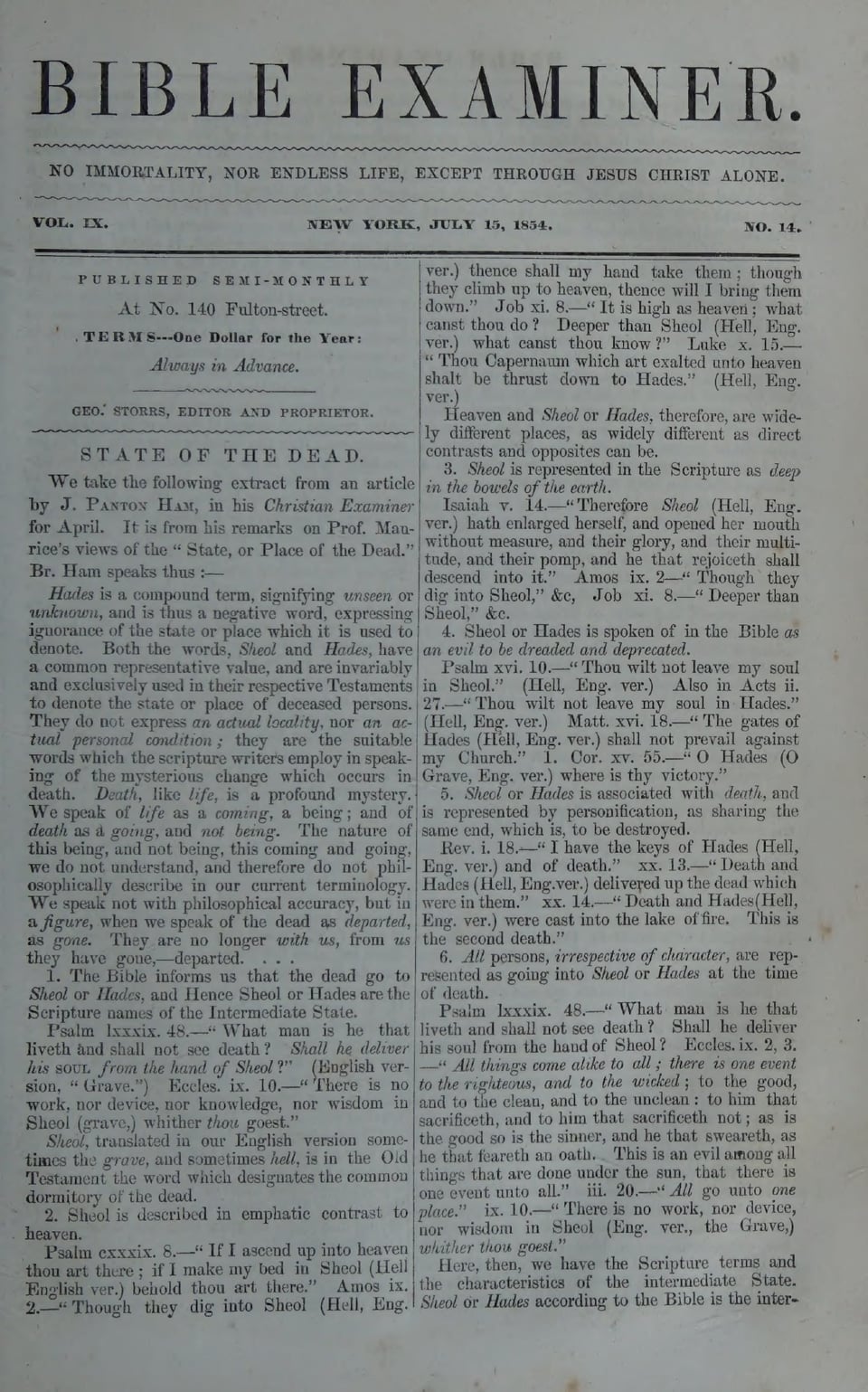
BIBLE EXAMINER.
NO IMMORTALITY, NOR ENDLESS LIFE, EXCEPT THROUGH JESUS CHRIST ALONE.
VOL. IX.
NEW YORK, JULY 15, 1854.
NO.14.
PUBLISHED SEMI-MONTHLY
At No.140 Fulton-street.
. TERMS----One Dollar for the Year:
Always in Advance.
GEO. STORRS, EDITOR AND PROPRIETOR.
STATE OF THE DEAD.
We take the following extract from an article by J. PANTON HAM, in his Christian Examiner for April. It is from his remarks on Prof. Maurice's views of the "State, or Place of the Dead." Br. Ham speaks thus :—
Hades is a compound term, signifying unseen or unknown, and is thus a negative word, expressing ignorance of the state or place which it is used to denote. Both the words, Sheol and Hades, have a common representative value, and are invariably and exclusively used in their respective Testaments to denote the state or place of deceased persons. They do not express an actual locality, nor an actual personal condition; they are the suitable words which the scripture writers employ in speaking of the mysterious change which occurs in death. Death, like life, is a profound mystery. We speak of life as a coming, a being; and of death as a going, and not being. The nature of this being, and not being, this coming and going, we do not understand, and therefore do not philosophically describe in our current terminology. We speak not with philosophical accuracy, but in a figure, when we speak of the dead as departed, as gone. They are no longer with us, from us they have gone,—departed. . .
The Bible informs us that the dead go to Sheol or Hades, and Hence Sheol or Hades are the Scripture names of the Intermediate State.
Psalm lxxxix. 48.—"What man is he that liveth and shall not see death? Shall he deliver his soul from the hand of Sheol?" (English version, "Grave.") Eccles. ix. 10.—"There is no work, nor device, nor knowledge, nor wisdom in Sheol (grave,) whither thou goest."
Sheol, translated in our English version sometimes the grave, and sometimes hell, is in the Old Testament the word which designates the common dormitory of the dead.
Sheol is described in emphatic contrast to heaven.
Psalm cxxxix. 8.—"If I ascend up into heaven thou art there; if I make my bed in Sheol (Hell English ver.) behold thou art there." Amos ix. 2.—"Though they dig into Sheol (Hell, Eng.
ver.) thence shall my hand take them; though they climb up to heaven, thence will I bring them down." Job xi. 8.—"It is high as heaven; what canst thou do? Deeper than Sheol (Hell, Eng. ver.) what canst thou know?" Luke x.15.— "Thou Capernaum which art exalted unto heaven shalt be thrust down to Hades." (Hell, Eng. ver.)
Heaven and Sheol or Hades, therefore, are widely different places, as widely different as direct contrasts and opposites can be.
Sheol is represented in the Scripture as deep in the bowels of the earth.
Isaiah v. 14.—"Therefore Sheol (Hell, Eng ver.) hath enlarged herself, and opened her mouth without measure, and their glory, and their multitude, and their pomp, and he that rejoiceth shall descend into it." Amos ix. 2—"Though they dig into Sheol," &c, Job xi. 8.—"Deeper than Sheol," &c.
Sheol or Hades is spoken of in the Bible as an evil to be dreaded and deprecated.
Psalm xvi. 10.—"Thou wilt not leave my soul in Sheol." (Hell, Eng. ver.) Also in Acts ii. 27.—"Thou wilt not leave my soul in Hades." (Hell, Eng. ver.) Matt. xvi. 18.—"The gates of Hades (Hell, Eng. ver.) shall not prevail against my Church." 1. Cor. xv. 55.—"O Hades (O Grave, Eng. ver.) where is thy victory."
Sheol or Hades is associated with death, and is represented by personification, as sharing the same end, which is, to be destroyed.
Rev. i. 18.—"I have the keys of Hades (Hell, Eng. ver.) and of death." xx. 13.—"Death and Hades (Hell, Eng.ver.) delivered up the dead which were in them." xx. 14.—"Death and Hades(Hell, Eng. ver.) were cast into the lake of fire. This is the second death."
All persons, irrespective of character, are represented as going into Sheol or Hades at the time of death.
Psalm lxxxix. 48.—"What man is he that liveth and shall not see death? Shall he deliver his soul from the hand of Sheol? Eccles. ix. 2, 3. "All things come alike to all; there is one event to the righteous, and to the wicked; to the good, and to the clean, and to the unclean: to him that sacrificeth, and to him that sacrificeth not; as is the good so is the sinner, and he that sweareth, as he that feareth an oath. This is an evil among all things that are done under the sun, that there is one event unto all." iii. 20.—"All go unto one place." ix. 10.—"There is no work, nor device, nor wisdom in Sheol (Eng. ver., the Grave,) whither thou goest."
Here, then, we have the Scripture terms and the characteristics of the intermediate State. Sheol or Hades according to the Bible is the intermediate dwelling-place of the dead.
Now all so-called Evangelical Christians believe in an intermediate state, both for the righteous and the wicked. They do not consider that the righteous either enter upon the full fruition of their bliss, nor that the wicked undergo the full severity of their torment until after the decisions of the Judgment. But they maintain that both classes have the full possession of their consciousness and all their characteristic qualities as human beings, and that to deny that the dead are conscious, is both repulsive and unscriptural. The doctrine of un-consciousness in death is pronounced repulsive and unscriptural; let us see whether the doctrine of consciousness in death is more attractive and scriptural.
The dead, we have seen, go to Sheol or Hades; and Sheol or Hades we have seen is not heaven, but the very contrast and opposite of heaven. The intermediate state, then, is as unlike heaven as an opposite or contrast can make it. If the righteous dead have consciousness in death, they dwell in a place or state the very reverse of heaven.
Sheol or Hades is deep down in the bowels of the earth, into which "they dig"—where a dying man says, "I make my bed"—whither persons "descend," and are "thrust down," and than which no place is "deeper." Here, then, is the dwelling-place of the righteous dead. If they have consciousness,—if they enter as living separate souls into their intermediate abode, then are they conscious of their deep descent, and their embowelled residence in the womb of the earth.
Again; if the righteous dead go consciously into Sheol or Hades, they go and remain where David and David's Lord rejoiced that they should not be left (Psalm xvi. 10); they enter within "gates" which presume to "prevail against the Church," as the Church's enemy (Matt. xvi. 18); they come within a power which struggles for the "victory" over the saints of the Most High, and which after the resurrection from the dead shall be hailed with the derisive and triumphant shout, "O Hades, where is thy victory?" (1 Cor. xv. 55.)
If the righteous go consciously into Sheol or Hades, they go into a state of association with death rather than life, for we have seen that Death is associated with Sheol or Hades, and both, as personified companions, are figuratively represented as hereafter destroyed together.
Finally, if the righteous go consciously into Sheol or Hades, then are they in personal companionship with the dead, bad as well as good, for "all go unto one place." The society they hate and dread there they commingle with, and must be the sad spectators and auditors of their woe. Weeping and wailing and gnashing of teeth add their woeful notes of discord to distract the harmony of the saints' praises. To sing the songs of Zion in such society, and under such circumstances! Who does not deprecate this?
If there is a state of conscious life for mankind in death, then that conscious life must be possessed IN SHEOL OR HADES; and we have seen what are the characteristics of this Intermediate State or Place. If we live in death as separate bodiless souls, we live in this dreaded Sheol, which is the very contrast of heaven; which is not above, but
deep down, below; where is not the one loved society of the faithful, but the mixed society of the condemned wicked and the righteous awaiting their full redemption. Will the candid and intelligent reader say that consciousness in death is a good, and to be desired? Will he not rather concur in the opinion that if the Bible declares that in death there is no conscious life for any man, whether righteous or wicked, it should be hailed as glad tidings of joy, and as a motive for devoutest gratitude to God, who has saved us from the consciousness of that gloomy condition into which sin has plunged us? To have consciousness in death, since all the dead go to Sheol or Hades, is to have a prospect more revolting than any it is possible to conceive on earth. The intermediate state, as it is exhibited in Scripture, if a conscious one, is a dismal purgatory, the anticipation of which invests the season of death with unspeakable gloominess. Let the believer in a state of life for the bodiless soul in an intermediate state, be apprized of this fact, that the intermediate state of the Bible is Sheol or Hades. He is accustomed, we know, to conceive of this state as one of purest and most felicitous enjoyment, and to describe it by the most glowing and beautiful imagery. Poetry has lent her creative imagination to portray its veiled glories, and by her fascinating genius has transformed the messenger of death into an angel of light, and corruption into the beauty and perpetuity of immortal being. But uninspired poetry must not be permitted to dictate our creed. The Bible exhibits another picture. It may, in the opinion of some, be a gloomier picture, but it is the true picture, of the state of the dead. The light which the Bible emits is the light of life and immortality beyond, not in death—a light whose glory shines even unto us on this side the grave, and cheers us in the view of the darkness of "the shadow of death," through which we must pass ere the full splendor of its brightness dazzles our waking vision. And is this a gloomier picture? Is it better that we should be conscious of the darkness of Sheol—of its distance from heaven—of its pit-like prison—of its resemblance to death—of its mixed society? Who will affirm this? Surely none? If I must die, let me not know what death is! Let the moment of its temporary victory be the moment when my consciousness shall expire, and my sleep be most perfectly sealed! If I must pass through "the valley of the shadow of death," let me not descend consciously into the gloom of its impenetrable darkness. Let the approach of death be the nearest point of conscious contact with it; let its grasp seize on inanimation and unconsciousness! Is not this the craving of instinct? Does not the personal history of Christ exemplify it? See the Divine Jesus on his way to the grave of Lazarus, twice does he "groan in himself," and express that he is "troubled." See him in Gethsemane, "in the days of his flesh offering up prayers with strong crying and tears to Him that was able to save him from death." . . .
And they who are most like Christ in spirit most participate in his estimate of death. "Not that we would be unclothed; but clothed upon," is the universal desire of the intelligent Church.
Let corruption put on incorruption, and mortality put on immortality. Let me be "absent from the body"—my present mortal and corruptible constitution—which holds me—my personal self—in bondage, even in the grave, and let me be reproduced in a new spiritual and immortal nature, that I may be "present with the Lord" when "mortality shall be swallowed up of life." This is the desire both of instinct and religion, and the mercy of God has granted this desire. "Man giveth up the ghost (expires) and where is he? As the waters fail from the sea, and the flood decayeth and drieth up, so MAN [not the body of man, but man] lieth down and riseth not; till the heavens be no more they shall not awake, nor be raised out of their sleep." Job xiv. 10—12. Sound and uninterrupted is the sleep of death. "There the wicked cease from troubling and the weary are at rest," During the sleeping time death reigns over all that constitutes the living, thinking being called man. But this reign over the saints of God shall be, once and forever, destroyed. . . .
We will conclude by requesting attention to a Scriptural exemplification of the soundness of the argument here set forth. In the 28th chapter of the first book of Samuel we have the account of King Saul's interview at Endor with a woman that had a familiar spirit. This monarch's repeated impieties induced the Lord finally to withdraw from and refuse any counsel to him at a time of eminent personal and national danger. Forsaken by the Lord, he had recourse as a last hope of deliverance to this reputed necromancer, by whose aid he hoped to communicate with his old counsellor and friend, the prophet Samuel, who was then dead. Now mark the phraseology of the narration, and observe how it agrees with the representation of the dead, which has been given above. Having come to the woman by night, Saul said, "I pray thee divine unto me by the familiar spirit, and bring me him up whom I shall name unto thee,"—verse 8. "Then said the woman, Whom shall I bring up unto thee? And he said unto her, bring me up Samuel," verse 11. "And the woman said unto Saul, I saw gods ascending out of the earth." "And he said unto her, What form is he of? And she said, An old man cometh up," 13, 14. "And Samuel said to Saul, why hast thou disquieted me, to bring me up?" verse 15. "To-morrow shalt thou and thy sons BE WITH ME,"—verse 19.
Here, then, the reader will observe, that we have an historical illustration of the state of the dead agreeing in all the chief particulars with the description of the place or state called Sheol or Hades, whither the dead are Scripturally described as going. We have remarked that the state or place of the dead is below, in the earth, not above, in the heavens, and hence Samuel is represented as "ascending out of the earth,"—as being brought up and coming up. Sheol or Hades is described as a place or state of profound silence and unconsciousnes,—stillness and repose reign there in undisturbed quietude; hence the appropriateness of the prophet's question—"Why hast thou disquieted me, to bring me up? Sheol or
Hades, the intermediate state or place of the dead, comprehends all the dead in one mixed society. There the righteous and the wicked dwell without distinction and separation; hence the consistency of the prophets language when he pronounced the solemn sentence of God upon the abandoned monarch—"To-morrow shalt thou and thy sons BE WITH ME." The wicked Saul and the righteous Samuel are here described as dwelling together in the intermediate state. The prophet Samuel was not in heaven when dead, he was below in the earth; he was not in the holy and active society of angelic beings; he was lying in stillness and quiet in the ground beneath; he was not yet gathered into the garner of God—separated as a sheep from the goats, he was in the one common dormitory of the dead, there awaiting in common with the righteous that potent voice which should bid him arise and enter into life.
We repeat, then, that if there is consciousness for mankind in death—if they go as personal existences in a disembodied form into an intermediate state,—they go into sheol or hades, for this is the Intermediate State or Place which the Bible only recognizes; and then so far from consciousness being desirable, it is most to be deplored and deprecated. The intelligent and candid reader will perceive that the terms sheol and hades, and the descriptions which the Bible gives of them are poetical or figurative,—they are images of the region of death. They suitably describe our return in death to our parent earth. "Dust thou art, and unto dust shalt thou return."
The following passages contain the Bible doctrine concerning the dead :
"The dead praise not the Lord, neither any that go down into silence."—Ps. 115 : 17. "His breath goeth forth, he returneth to his earth : in that very day his thoughts perish."—Ps. 146 : 4. "The living know that they shall die, but the dead know not anything."—Eccl. 9 : 5. "There is no work, nor device, nor knowledge, nor wisdom in the grave (Hebrew, Sheol,] whither thou goest."—Eccl. 9 : 10. "They that go down into the pit cannot hope for thy truth. The living, the living, he shall praise thee as I do this day."—Isa. 38 : 19. See also Ps. 6 : 5; 88 : 10-12; Dan. 12 ; 2: Ezek. 37 : 12-14, &c. &c.
Let believers in Christ, then, rejoice that they shall rest in unconscious repose in death, as it is written, "Blessed are the dead which died in the Lord, for they rest from their labor and their works do follow them." Soon shall their Lord, as the Resurrection and the Life, come with "the keys of Hades and of Death," to unlock their dark prison house, and set the captives free. "Behold I come quickly." Then will be the fulfillment of his gracious promise, "I go to prepare a place for you. And if I go and prepare a place for you I will come again and receive you to myself, that where I am there ye may be also."—John 14:3. "When Christ who is our life shall appear, then shall ye also appear with him in glory."—Colos. 3:3.
He is a great simpleton who imagines that the chief power of wealth is to supply wants. In a majority of cases it creates more wants than it supplies.
SPIRIT:
OR, THE HEBREW TERMS "RUACH" AND "NESHAMAH," AND THE GREEK TERM "PNEUMA."
BY REV. WM. GLEN MONCRIEFF, SCOTLAND.
[Continued from page 196.]
SEC. V. Ruach is rendered vain.
Job 15 : 2, "Should a wise man utter vain (ruach) knowledge," margin, "knowledge of wind." 16 : 3, "Shall vain (ruach) words (margin, "words of wind") have an end?"
SEC. VI. RUACH is rendered spirit.
Every time, with very few exceptions, the word spirit occurs in the Old Testament it is the translation of ruach. Our present design requires us only to view it as applied to man, and to attempt a settlement of its import when so used. For the sake of perspicuity we shall endeavor to classify the senses or modes in which it seems to be employed when the discourse is concerning human beings.
1st. Sometimes it imports life; meaning by this the animal life, common to man with all the breathing tribes.
Numbers 16 : 22, "O God, the God of the spirits (haruchoth) of all flesh," or men. See also chap. 27 : v. 16. In Ps. 104 : 29 we read, "Thou takest away their breath (rucham) they die and return to their dust," and putting these two verses together, it is not difficult to discover that the import of "spirits" in the first one is just lives. Instead of "spirits" the Hebrew term might have been rendered breaths, as in the passage from Psalms, where the singular form of the Hebrew word stands; but lives is clearly its meaning, lives resulting from breathing, as the radical meaning of ruach suggests.
Job 6 : 4, "The arrows of the almighty are within me, the poison whereof drinketh up my spirit" (ruchi,) or life. See Gesenius' Lexicon. 10 : 12, "Thou hast granted me life, and favor, and thy visitation hath preserved my spirit" (ruchi,) or life. See Gesenius' Lexicon. 27 : 3, "All the while my breath is in me, and the spirit (ruchi) of God is in my nostrils." "Once," says Gesenius, "the human spirit, or life, is called the 'spirit of God,' as being breathed into man by God, and again returning to God. Gen. 2 : 7, Eccles. 12 : 7, Ps. 104 : 29." The word "spirit" here might with perfect propriety have been exchanged for "breath," as in other places, having under it the idea of resulting life from the respiration of air. The verse might have stood thus, making the second clause a repetition and an expansion of the first—"all the while my breath is in me; and (or even) the breath of God is in my nostrils." His breath was God's breath, inasmuch as it came to him from the Creator, and by its agency he was preserved alive. The margin of the Bible explains the "spirit of God" in the text thus, "the breath which God gave him."
Ps. 76 : 12, " He shall cut off the spirit" (ruach,) or life, " of princes, he is terrible to the kings of the earth." To see that " spirit" here means life, we have only to refer to such expressions as these—Ps. 146 : 4, " His breath (ruchu) goeth
forth, he returneth to his earth, in that very day his thoughts perish; and Ezk. 37 : 5, "I will cause breath (ruach) to enter into you, and ye shall live," or, I will make you alive by causing you to breathe; and v. 8th of the same chapter—"There was no breath (ruach) in them;" i.e. they were still dead. To cut off the breath, or the spirit" of princes is to destroy them; and when their life is cut off, their breathing is of course suspended.
Ps. 104 : 4, " Who maketh his angels spirits" (ruchoth.) Who maketh his angels winds, that is like winds-in rapidity of motion. This seems to us the best interpretation, and the succeeding clause of the verse makes a parallel with it—" his ministers a flame of fire ;" i.e. swift as the lightning.
Zech. 12 : 1, "The Lord—which formeth the spirit (ruach) of man within him," literally, in his inwards, or in his belly. On this text we would observe,
a. Since there is no adjective such as living, rational, thinking, mortal, or immortal, prefixed to the ruach here, which observe, is not said to be man, but to be in his inwards, we must learn from the radical meaning of the Hebrew term itself, and from other passages, the idea which in a text like this it is employed to express.
b. In itself the word radically means breath, and in this sense the passage will run "the Lord formeth the breath of man within him."
c. But as the breath is vitalizing breath, and as whenever it is respired by the lungs, the man through its influence is maintained in life, we apprehend that the import of the term ruach in this case is life, and perhaps the prophet may have associated with this central thought, the mental and other internal and external phenomena which necessarily result from the respiration of ruach, or the life-causing atmosphere. When we find a verse such as this, Ps. 104:29, "Thou takest away their breath (rucham) they die and return to the dust," we need not experience difficulty in determining the meaning of the one before us, for it is the same word ruach, without the shadow of a discriminating qualification that stands in both texts, and if the removing of the ruach produces death to a man, then by its preservation within him, or by his being preserved breathing it, his life and all its functions and experiences are maintained, and prolonged. This is the ruach—life and its wonders—that the Creator forms in man; in other words, putting the secondary cause for the effect, the passage intimates that God makes living men by the simple process of their breathing, and thus also he preserves them manifesting all the various phenomena of animated, conscious existence.
d. Thus, manifestly, the ruach of a man is not the man himself, and, though necessary to his life, it has no life in itself, though sometimes, on the principle of putting the secondary cause for the effect, life is obviously designated by it. Moreover, were it removed he would remain a perfect man, though without a ruach, or spirit, just as the man Adam, who had been formed entirely of dust, was a complete human being before God breathed into his nostrils the breath of life, and so made him a living being, or an animated human soul.
Gen. 2:7.
e. To show the utter recklessness, and we can call it nothing else, which has characterized the common exposition of verses like the one before us, let us for an instant consider Ps. 33 : 15, "He fashioneth their hearts alike." Who would infer from this that his heart lives of itself,—that it is a distinct living entity—and is capable of surviving death in consciousness? And why not? Is not thought, purpose, reason, joy, and the like, ascribed to the heart of men? yes, a thousand times and more in the Bible, and no one deals with the term "heart" of man as the ruach, "breath" or "spirit" of man has been treated. What is more astonishing, all this exaltation, and sometimes almost deification, of the ruach of man, has been done to what is actually no part even of a human being, no more than the steam is a part of the engine, or the atmosphere is a part of the furnace it keeps blazing.
2nd. Sometimes "spirit," as the rendering of ruach, imports physical strength; inasmuch as physical strength results from breathing.
Gen 45 : 27. "The spirit (ruach) of Jacob their father revived." Judges 15:19, "When he had drunk, his spirit (ruchu) came again and he revived." 1 Sam.30:12," And when he had eaten his spirit (ruchu) came again to him, for he had eaten no bread, nor drunk any water, three days and three nights.
3rd. Often it designates mental or moral qualities or states, good or bad, in a man.
Gen. 26 : 35, "Which were a grief of mind" (ruchu)—or they caused grief—"unto Isaac and to Rebekah." The margin has, "bitterness of spirit." 41 : 8, "His spirit (ruchu) was troubled" his mind was agitated." Deut. 2 : 30, "God hardened his spirit (ruchu) and made his heart obstinate." The second clause here explains the first; under God's dealings the Egyptian monarch grew obstinate. Josh. 5 : 1, "neither was there spirit (ruach) in them any more"—they lost heart, or courage. Ps. 51 : 17, "The sacrifices of God are a broken spirit" (ruach,) i.e. genuine humiliation and contrition. The parallel in the verse is "a broken and a contrite heart, O God thou wilt not despise." Prov. 14 : 29, "He that is hasty of spirit (ruach) exalteth folly," i.e. he that is quick-tempered, or irrascible, does this. 17 : 22, "A merry heart doeth good like a medicine, but a broken spirit (ruach) drieth the bones;" i.e. excessive sorrow and care withers and emaciates the frame. 18 : 14, "The spirit (ruach) of a man will sustain his infirmity; but a wounded spirit (ruach) who can bear?" On this verse we shall quote a few words from Dr. Clarke—"a man sustains the ills of his body, and the trials of life, by the strength and energy of his mind. But if the mind be wounded, if this be cast down, if slow consuming care and grief have shot the dagger into the soul, what can then sustain the man? Nothing but the unseen God."
Prov. 25 : 28, "He that hath no rule over his own spirit (ruchu) is like a city that is broken down," i.e. he who does not command his temper. 29 : 11, "a fool uttereth all his mind" (ruach ;)
i. e., all his thoughts. Ecc. 1 : 14, "all is vanity and vexation of spirit" (ruach) or all produce vanity and vexation. Isa. 19 : 3, "The spirit" (ruach)—the courage—"of Egypt"—or the Egyptians—"shall fail." 61 : 3, "the spirit (ruach) of heaviness;" i. e., great depression and care. Ezek. 3 : 14, "in the heat of my spirit" (ruchi) or in my rage. Compare Judges 8 : 3, below. 20 : 32, "That which cometh into your mind" (rucachem,) meaning that which you think. Habak. 1 : 11, "Then shall his mind (ruach) change" —i. e. his purpose shall change. In a few instances the ruach is not translated as in the above passages, but the mental quality it expresses in the particular instances is given in its stead. Thus, Josh. 2 : 11, "Neither did there remain any more courage (ruach) in any man, because of you." Judges 8 : 3, "Then their anger (rucham—margin 'spirit') was abated toward him, when he had said that."
Note.—The process by which ruach came to express mental qualities or states, appears to be the following. The entrance of the ruach, the "breath of life," into the lungs causes vitality in the organized being man, or makes him alive, and the different mental phenomena evolved by his brain, or which the being man manifests when alive, receive the designation ruach, since it is by the influence of the ruach that all his essential functions, physical and mental, are performed. For instance, living men have passions and affections, and these are, in Prov. 25:28, quoted above, collectively called a man's ruch (same word as ruach,) inasmuch as it is by the constant reception of the ruach of life that these are excited and preserved in activity; or, as already stated, the secondary cause ruach becomes in these verses the designation of some of its sublimest effects.
4th. In many instances ruach translated "spirit" is obviously used like "Soul" and "Heart" to express the idea of self or personality. Some verses already quoted really belong to this classification, and for the sake of giving as much clearness as possible to this work, they will just be repeated under this head.
Gen. 41 : 8, "In the morning his spirit was troubled," or, he was troubled. Other forms are, Ps. 25 : 17, "The troubles of my heart are enlarged. John 12 : 27, "Now is my soul troubled;" i.e. now am I troubled. Gen. 45 : 27, "The spirit of Jacob their Father revived. Other forms are, Is. 57 : 15, "To revive the heart of the contrite ones;" i.e. to revive the contrite ones. Lam. 1 : 16, "The comforter that should relieve my soul," or me. Deut. 2 : 30, "God hardened his spirit" or him. Another form is, Exod. 7 : 13, "and he hardened Pharaoh's heart;" or made him obstinate. The opposite state of mind is thus expressed. Ps. 35 : 13, "I humbled my soul;" or myself. 1 Kings 21 : 5, "Why is thy spirit so sad?" i.e. why art thou so sad? 1 Chron. 5 : 26, "Stirred up the spirit of Pul," or simply stirred up Pul. 2 Chron. 21 : 16, "The spirit of the Philistines," or the Philistines, simply. Job. 7 : 11 "I will speak in the anguish of my spirit," or I will speak in my anguish. The parallel to this member immediately follows in the verse, "I will complain in the bitterness of my soul," or I will complain in my bitterness, 10:12, "thy visitation hath preserved my spirit," or me.
15:13, "turnest thy spirit," or turnest thyself, "against God." 32:18, "I am full of matter, the spirit within me (margin, 'of my belly,') constraineth me." The second clause is explained in this instance by the first, and the passage simply means, I am full of matter;—I am constrained from within, or I am constrained, i.e. to speak, as he says in verse 20, "I will speak," &c. Ps. 31:5, "Into thine hand I commit my spirit," or I commit myself, "thou hast redeemed me, O Lord." The "me" in the second clause is parallel to "my spirit" in the first. Ps. 32:2, "in whose spirit," in whom, "there is no guile." 51:10, "renew a right (margin, "constant") "spirit within me."
A right spirit is a right state of spirit, and a prayer for a right state of spirit is a desire to be made as a man right, or constant in the exercise of religion. The parallel to "spirit" here is "heart" in the first clause of the verse, "create in me a clean heart, O God renew," &c. The whole verse is a prayer from David that God would make him a morally pure and perseveringly religious man.
Ps. 76 : 12, "He shall cut off the spirit of princes," i. e., he shall cut off princes. 77 : 3, "my spirit," or I, "was overwhelmed." The parallel to this clause is in the first part of the verse, "I remembered God and was troubled; I complained and my spirit," &c. 77 : 6, "My spirit," or I, "made diligent search." 106 : 33, "They provoked his (Moses') spirit;" i. e. they provoked him. 142 : 3, "When my spirit," or when I "was overwhelmed." 143 : 7, "My spirit faileth," or I fail. Prov. 11 : 13, "He that is of a faithful spirit concealeth the matter," i. e. a faithful person concealeth the matter. 16 : 2, "The Lord weigheth the spirits," i. e. the Lord weigheth men. The same truth is sometimes expressed by another form, thus—"the Lord searcheth all hearts," 1 Chron. 28 : 9. Ecc. 7 : 8, "the patient in spirit"—or the patient—"is better than the proud in spirit," or the proud. 10 : 4, "If the spirit of the ruler"—i. e, if the ruler—"rise up against thee, leave not thy place." Isa. 38 : 16, "In all these things is the life of my spirit," or of me; or, In all these things is my life. Gesen. Lex. 54 : 6, "a woman forsaken and grieved in spirit,"—a forsaken and grieved woman. Dan. 2 : 1, wherewith his spirit"—or he—"was troubled." 7 : 15, "I Daniel was grieved in my spirit in the midst of my body," or, I Daniel was inwardly grieved; or just, I Daniel was grieved. Hag. 1 : 14, "The Lord stirred up the spirit of Zerubbabel"—or simply, Zerubbabel—"the son of Shealtiel, governor of Judah, and the spirit of Joshua," or simply, Joshua. Mal. 2 : 16, "take heed to your spirit," or to yourselves. Instead of "spirit" we have "mind" used to express personality in Dan. 5 : 20, "But when his heart"—or when he—"was lifted up; and his mind (ruch) hardened in pride," i. e. when he was hardened in pride.
Before concluding this section of our work, we may refer briefly to two passages in which ruach occurs, as they have sometimes been supposed to
look in favor of the prevailing opinion about the human spirit.
The first is Job 4:15, "Then ('when deep sleep falleth on men,' v.13) a spirit passed before my face, the hair of my flesh stood up." On which we remark,
a. That, as this forms part, not of Job's words but of a speech by "Eliphaz the Temanite" (v.1) whom we have no reason to view as an inspired man, his words, whatever they may express, are not to be held as bringing with them divine authority, no more than those of any other uninspired person.
b. But then, when Eliphaz declares he saw in vision "a spirit," he does not say it was a human spirit, and who would affirm that "a spirit" and "a human spirit" are the same thing?
c. The passage then contains nothing for the common idea about human spirits. That there are creatures called "spirits" in the universe we do not deny; but we assert, on extended scriptural authority, that man is not a spirit, for he is "flesh;" the ruach he possesses is only the spirit, or breath, of life from God. No wonder, then, we never read of disembodied human spirits in the Book. This language, with its kindred phraseology "deathless spirit of man," "immortal soul," &c., is common almost everywhere but in the Word of God! Even Eliphaz rebukes the idea, when he tells us that the voice he heard inquired, "Shall mortal man be more just than God? shall a man be more pure than his maker? Behold, he put no trust in his servants; and his angels he charged with folly: How much less in them that dwell in houses of clay, whose foundation is in the dust, which are crushed before the moth." Job 4:17, 18, 19.
This passage draws no contrast between flesh, and everything that bears the name of ruach; but between the creatures mentioned in ft,—"the Egyptians" and "their horses"—and the eternal God who is "a Spirit,"—whose nature is spiritual; who also is possessed of infinite power to aid his friends, and crush his enemies. Man is here represented as frail, for he is no less flesh than horses, "all flesh" being common scriptural designation of the whole terrestrial animal creation. God is a spirit, of unbounded, changeless, resistless energy. "This verse," says Professor Alexander, in his commentary on Isaiah, "repeats the contrast between human and divine aid, and the threatening; that the unbelievers and their foreign helpers should be involved in the same destruction. The antithesis of flesh and spirit, like that of God and man, is not metaphysical but rhetorical, and it is intended simply to express extreme dissimilitude or inequality."
Isa. 31:3, "Now the Egyptians are men and not God, and their horses flesh and not spirit (ruach.) When the Lord shall stretch out his hand, both he that helpeth shall fall, and he that is holpen shall fall down, and they all shall fail together " (or be destroyed.)
[To be Continued.]
Vice stings us even in our pleasures, but virtue consoles us even in our pains.
The just man will flourish in spite of envy.
From A. L. Hunt, Carbondale City, Pa.
Br. Storrs.For some time past I have been favored with the perusal of your invaluable paper, by a good brother here, but wishing to identify myself more closely with the friends and advocates of the cause of truth, and the Bible, hoping thereby to be instrumental in doing something, by the blessing of God, towards overthrowing the Babelistic utopian paradrome, by which theologians vainly attempt to span the period of time which comprehends eternity, by assuming that man is inherently immortal—that the creature man is unconditionally and unqualifiedly destined to live on throughout the countless ages of eternity, although
ly, without the aid of a commentary and the traditions of the Fathers. Now, God appears as He is represented in his word, a God of love, mercy, and justice; who willeth not the death of any, but rather that all would come unto him that they might have life.
The objector says, he would throw away the Bible entirely, ere he would believe in man's mortality. Yes, throw away the holy Book of God in a rage, rather than give up the Popish notion of inherent immortality. Strange, indeed, must be their views of the attributes of the Creator. If it is God's will, and he declares it is, that the wicked shall be destroyed, ought we not rather to rejoice
with the same breath they aver, that if God should withhold his sustaining hand for a moment, that moment we should be annihilated. The Book distinctly informs us that the wicked will "be punished with everlasting destruction from the presence of the Lord and the glory of his power." Does not the Almighty pervade the immensity of space? Is he not an everywhere present God? Can he not with one glance of his eye, so to speak, survey the universe? Where then are the wicked when destroyed? Why, doubtless, "beyond the bounds of time and space." That is—nowhere. I rejoice to say the cause of truth is advancing, although slowly, here. Men are beginning to dare to read and think for themselves on this all-important subject. Too long already have men blindly submitted to the supposed infallible teachings of their human spiritual advisers. Some features of the Gospel of Christ are in danger of being subat it? If our hope of life and happiness is based on native immortality, as many suppose, then with the apostle, we are of all men most miserable. Then Christ died and rose again, in a great measure, in vain; for the resurrection in that case is of minor importance, and a secondary consideration. Is it a virtue in man to delight in the sufferings of a fellow-creature, bone of our bone, and flesh of our flesh; especially when no benefit is derived to him or his fellow? How delightful and transporting the sight, from the Eden of bliss, to behold near and dear friends, a beloved father or mother, or peradventure a brother or sister, wailing in woe unutterable, without hope of mercy, and without end! And how much more entrancing, to view a husband or wife, son or daughter, vainly calling for help, and with outstretched arms imploring your aid!
verted by the manifold traditions of men. If the light that is in us become darkness, how great is that darkness. The principle objection urged against this doctrine by immortal soulists is, that if men gave universal credence to it, they will be content to live in sin, and never repent and give their hearts to God. This looks a little plausible, but men are not driven into Heaven by fright, either by preaching the terrors of the law or otherwise. It is not in accordance with God's dealings with men to coerce obedience. His subjects are volunteer subjects. His worship must be purely a free-will worship. The objector says, that man would be less concerned about his future destiny. Would it be possible for the generality of mankind to be apparently less concerned about what awaits them in the future than now? Furthermore, most men suppose that they shall in some way escape punishment, or if punished for a time that they will eventually be restored; and
From Jesse Broderick, St. Catherines, C. W.
Dear Friend:—Some months ago, your Six Sermons fell into my hands rather in a singular way. One of the clerks where I was at work was sweeping out the store. Amongst the leaves and papers I saw one with these words on the cover, "Are the Wicked Immortal?" Instead of throwing it in the stove along with the rest, I thought I would give it a reading. Accordingly I took it home, but it lay for some time before I read it, thinking it might not be well to spend my time on Sunday reading such a book as that. However, I am thankful that at last I spent time on a Monday; and from that day, neither Sunday nor any other day passed away, for some time, without spending a portion thereof in reading that valuable book; and, as M. Bachelor says, they (the Six Sermons,) have opened the eyes of thousands. I thank the good Lord that I am one of the number led to see
time, that they will eventually be restored, and some would prefer to live in misery rather than die, i.e., be destroyed. Here life and death are set before us by the great head of the church : the one contrasted with the other, and in opposition to it something tangible, zeal-inspiring. Life, life through Christ, is the heaven-appointed stimulus to Christian effort—a life of happiness unspeakable in the new Jerusalem, at his second coming.
By taking this view of the subject, a hundred vexed questions are immediately solved; whereas, the old Pagan notion rendered the interpretation contradictory in many instances, besides outraging reason and common sense. Now the mist is cleared away, and I can read the Bible understandingthat man is mortal; and an immoly mortar, and that Immortality can only be found in Christ.
A few week since, I had two numbers of the "Bible Examiner," for the month of May last, put into my hands, and from what I have read therein, I feel desirous to become a subscriber, and I enclose one dollar for payment, in advance. In case you should issue the Examiner weekly, I shall be glad to pay whatever more may be required.
Yours, in hope of immortality through Christ.
"The Discussion."—Owing to sickness in Prof. Mattison's family, he has not been able to furnish an article for this number of the Examiner.
BIBLE EXAMINER.
NEW YORK, JULY 15, 1854.
"Going to Heaven at Death."
The Louisville Journal gives the following account of a transaction which occurred ten miles from that city. The lad spoken of was thirteen years old. His name was Henry Merriman. The Journal says :
"This is one of the most mysterious as well as one of the most extraordinary cases of suicide ever committed in this country. Henry was a devout Christian. He had lost a little sister who belonged to the church. This sister had given him a prayer-book on her death-bed, and desired him to use it. He had become so interested in the book, and on the subject of meeting with a dear sister, that it was a subject of daily conversation and prayer with him. He appeared desirous to be with her. His mother had told him that he would meet his sister in heaven after death. He prayed nightly and daily to see her, and in his fit of religious insanity, he, upon his knees, cut his throat from ear to ear, severing both jugular veins. This was truly a sorry sight to look upon—a heart-broken mother, afflicted father, and distressed relatives—this was a scene to dissolve a heart of stone. Every one present was in tears; every man became as it were a child. The verdict of the jury was, that the child came to his death from the influence of the above facts, causing religious insanity."
The child was, no doubt, "insane;" but his desire to be with his sister in heaven—where his "mother told him he would meet her after death" —was perfectly natural from the love he had to her; and no wonder, with such instruction as he had, from the common theology, he should be anxious to go to her loved society; and as "insanity" can be plead for the suicidal act, why stands his mother there "heart-broken," and his father "afflicted?" Had not Henry and his sister met in that glorious heaven where his mother had told him they would meet after death? Why then is she heart-broken? Tell us, ye Philosophers, ye Divines! Summons all the priests of natural immortality, and of going to heaven at death, and before the resurrection at the last day, and see if you can all solve the mystery that a mother, full in your views, stands heart-broken that her two loved and loving ones were now enjoying their happy meeting in heaven!
Seriously—Had such a case of suicide occurred, which could as distinctly have been traced to the influence of the doctrine of no eternal life except through Jesus Christ, and by a resurrection at the last day, would not our theological opponents have shouted—"Behold the fruit of your doctrine!—
that's just what might have been expected!" However, we judge not the tendency of the common theory by an isolated case like that before us. We believe the notion of going to heaven at death is clearly subversive of the whole gospel scheme of redemption, is a practical denial of the resurrection of the dead, and the return of the Son of God "from heaven;" and is just as truly a fable as the Roman purgatory, and quite as pernicious in its effects. Saith Paul—"Ye turned to God from idols, to serve the living and true God; and to wait for His Son from heaven, whom He raised from the dead," &c. 1 Thes. 1:9,10. The true Christian is here characterised not as waiting to "go to heaven," but waiting for Christ to come from heaven, when the "Lord himself shall decend from heaven with a shout, and with the voice of the arch-angel and the trump of God;" then "the dead in Christ shall rise." See 1 Thess. 4:16,17.
The Bible hope—the gospel hope—is entirely a different matter from the fancy hope so pathetically urged upon our attention by the advocates of "going to heaven at death." Let these things be pondered well; and let us all see that our hope has for its foundation the words of God and not the words of man.
Intermediate State of the Dead.
Under the above head the "Rev. D. W. Clark, D.D.," of the Methodist Episcopal Church, is writing for the Christian Advocate of this city. Some of his statements and remarks we shall notice. He opens by saying:
"Job, speaking of the place of the dead, calls it a land of darkness, as darkness itself; and of the shadow of death, without any order, and where the light is darkness.'
From this starting point, Mr. Clark proceeds to speak as follows :
"In the early ages of the world, and even now in some heathen lands, the place of the dead is conceived of as a dark, indistinct, and dreamy region, situated somewhere beneath the earth. This was the first expression of the instinctive longing of the soul after immortality—the first rational or natural denial of the extinction of our being in death. It was natural that in the infantile state in which the human mind existed in the early ages of the world, that this childish conception should spring into existence, and exert a controlling influence over the imaginations of men. Their friends died, and their bodies were deposited in subterranean vaults and caves; hence arose the idea of the dark, underground region where they were supposed to live. This region was called among the Hebrews Sheol, and among the Greeks Hades—which terms mean a place of darkness, where nothing is seen, or, specifically, the place of departed spirits. In this land of darkness and silence the dead retained their living personality in the form of mysterious shadows, and hence, were called manes, or shades.
This land of shadows was to them desirable, because they expected there to meet again their departed friends, and to enjoy their companionship for ever. This was the dawning twilight of the glorious doctrine of the soul's immortality, now so clearly defined and so fully demonstrated."
Here we have the origin of the doctrine of the soul's immortality distinctly stated by an orthodox minister, "D.D." It is heathenism, or heathenish in its birth. The Doctor however affirms, in that "land of darkness and silence the dead retained their living personality," and "this land of shadows was to them desirable, because they expected there to meet again their departed friends," &c. A curious meeting that in darkness, "where nothing is seen." How "desirable" such a place must be! Again the doctor says:
"An offshoot, as it were, of this early conception of the state of the departed spirits has traveled down and been manifested in some instances in our own time. We refer to the idea that the spirits of the dead linger about the places where their bodies were buried. * Dr Knapp says 'that many of the ancients believed that the departed souls remain in or about the graves or dwellings of the dead, either for ever or for a long time.' He also says that the opinion widely prevailed that departed spirits sometimes return from the kingdom of the dead, and linger around the dead body or the place of burial. These ideas also prevailed, to some extent, among the Jews and early Christians; and thus it was forbidden, in the year 313, to kindle a light in the places of burial, lest the spirits of the saints should be disturbed."
Thus heathenism corrupted the Jews and Christians away from the simplicity of the Bible doctrine of a future life by a resurrection from the dead. It is a great pity that some one could not "kindle a light" that should not only "disturb" the heathen fable but drive the ghostly doctrine of life when dead from the minds of men, that they might see and feel the importance of the resurrection at the last day. The Doctor next says :
"A similar feeling still exists among the less intelligent people even in Christian countries. Hence the half-defined, the half-believed idea of the ghost of the murdered man or of the suicide haunting the place where the crime was perpetrated. Hence also that feeling when we approach the place where the bodies of our departed friends slumber as though they themselves were there. 'Hence it is common for persons, of all grades of cultivation, to seek beneath the willow where they lie a kind of lonely fellowship with their beloved dead. There is a sweet hope, at least, that there they are nearer to them than in all the world besides; and he is regarded as a cold and heartless intruder who would argue away from them the cherished dream. 'She
goeth to the grave to weep there.' Sweet mourner! Though we would not rudely drive her away from the spot which has embalmed all she held dear on earth, or forbid her to water with her tears, the earth which she expects will some day yield her back her own again, yet we would whisper softly and tenderly, 'He is not here. Why seek ye the living among the dead?' "
The most remarkable part of the preceeding extract is, that the "Rev. D.D." should give countenance to such a perverson of Scripture. To prove that the dead are not dead, or that their spirits are alive, the words of the angel at the tomb of Jesus are garbled. Why did the angel say, "He is not here?" and why did he seem to upbraid them with the question, "Why seek ye the living among the dead?" The Doctor seems to wish to make the impression that this language is appropriate to use to all persons who think their friends are dead because they are laid in the grave.
Let us look at the facts withheld by Mr. Clark. What are they? Jesus was dead—for "Christ died—and he was buried," so saith the Scriptures; and not till "the third day" did he live again, and then he "rose from the dead:" now he is alive for ever more. When the angel said, "He is not here," he spoke truth, because Jesus had arisen from the dead. But would it have been truth if he had spoken in this manner the day previous? Certainly not: it would have been untrue. Jesus, before his resurrection was "among the dead." Such is the testimony of the Bible; and to say the contrary is to be "infidel." The question of the angel to the woman at the sepulchre shows the fact beyond reasonable controversy, that had it not been for Christ's resurrection, he would still have been "among the dead;" and that consequently without a resurrection men remain among the dead, and are not among the living. A most fatal text this for the learned divine who garbled it to make it speak in favor of the heathen offspring, the "soul's immortality."
And then, who should his garbled extract have been "whispered softly" to? Only think, gentle reader, to Mary, the sister of Lazarus! for, "She goeth unto the grave to weep there." She howe- ever met Jesus, and said to him, "If thou hadst been here my brother had not died." She is on her way to the grave, is she, Doctor, to weep there over Lazarus? "Sweet mourner!" Why did not Jesus "whisper softly and tenderly" to mourning Mary and Martha, and say of Lazarus, "He is not here. Why seek ye the living among the dead?" What soft words these would have been! How consoling, but for the fact that they would have been words of falsehood!
Lazarus was there; and he was "among the dead." Jesus comforted these sisters with the only true words of comfort concerning "meeting again" those who had died in Christ—"Thy brother shall rise again:" not, "Thy brother has gone to heaven—he is alive:" No, such words would have been words palpably false. "Lazarus is dead," said Jesus to his disciples, and when he cried, "Lazarus come forth," he did not "whisper softly—'He is not here, why seek ye the living among the dead?" No; he really seemed to think Lazarus was there! and he spoke accordingly! and, strange to tell, "he that was dead came forth, bound hand and foot with grave clothes!" etc.
This whole transaction, together with the events at Jesus' own tomb, stamp for ever the whole fable, of a conscious entity surviving in death, as an enormous error. Are not the abettors of such an error the real "infidels?" They have substituted the traditions of men for the truth of God, and virtually deny the "resurrection of the dead"—the great cardinal doctrine of revelation. The Scriptures are garbled by them; the context, and the general teachings of the Bible are set at naught to sustain their theory of the "soul's immortality."
Mr. Clark proceeds as follows :
"While we cherish the spot where the dear departed lie as something sacred and holy in the heart's affections, and though we often go there to commune in our thoughts and feelings with them, yet it is well to dislodge from our minds so gloomy a thought as that their spirits are evermore hovering around the sad, mournful spot. Ah, who could cherish such an idea without a sensible augmentation of sorrow and of deep concern? The place is so cold and lonely. The night winds sigh so dolefully there. How dreadful, in the dead of night, is that dreary and dreamless silence! The snow lies so cold upon the grave; and fiercer than even the cutting anguish of your bereaved heart are the wintry storms that rave, and drift, and whirl around the monumental marble. Can any one, then wish the sainted dead to be there? No, no. We would not wish them to be there. They are not there; it is only inanimate mortality. It feels not its loneliness, and is not chilled by the coldness of the place. Banish, then, the thought from your mind; for they are not there. In happier society than that in the city of the dead they live; to sweeter sounds they listen; to the music of angelic choirs they bend an enraptured ear. In genial and stormless climes they have found a home."
This is such poetry that we feel almost inclined to pass it in silence. It is true the "spirits" of the dead are not "hovering around the sad, mournful spot"—the grave. That would be "mournful" indeed! No wonder such a thought is "dreadful" dreadful to think the spirits are where "the
snow lies so cold upon the grave!" and then, for them to stay out there "in the dead of night!"—and through "the wintry storms that rave, and drift, and whirl around the monumental marble!" Surely, "we would not wish for them to be there," for it must be fearful to think what those "immaterial immortals" must suffer from such "wintry storms!" What a penetrating material these storms must be charged with to make the immaterials feel that such a place is "dreadful!"—They are not there," cries out the Doctor. Truly, for once, he is right; but where are they, Br. C? He answers—"In happier society * to sweeter sounds they listen; to the music of angel choirs they bend an enraptured ear," &c. Here is enough of untruth, and we are glad he did not add, "They are praising the Lord," for that would be so palpable a falsehood that no mask could cover it: because the divine Spirit of God hath declared, by the mouth of the prophet, "The dead praise not the Lord, neither any that go down to silence." Psa. 115:17.
Mr. Clark next gives us some account of the doctrine of the " transmigration of souls," traveling through various bodies of animals, beasts, birds and fishes, till they reach the " pure world of blessed spirits." Possibly he had Pres. Beecher's " Conflict of. Ages" in his mind; but he calls this doctrine a " Dark and gloomy speculation," yet he admits it was " prevalent in the theology of the ancient Egyptians, in the philosophy of Pythagoras and of Plato, and has found advocates in nearly every age." So it must be true, if the advocates of the soul's immortality are correct in arguing the truth of their theory by telling us, " it must be true that the soul is immortal, because all nations have believed it so ;" and Plato has especially been appealed to in proof of the truth of their theory. Let them take the whole dose which Plato and his brother Philosophers have mixed for them, and not shrink from it because its dregs are bitter. We boldly assert the darling doctrine of the natural immortality of the soul has no higher origin than heathen philosophy : not one word of it in the Bible. Mr. Clark next speaks at follows :
"As science advanced and knowledge increased the old theory of an under-world region, where the dead were gathered, gave place to the more distinct theory of an intermediate abode. The poet thus describes this separate, intermediate abode :—
"O see! an awful world is this
"O see! an awful world is this Where spirits are detain'd. 'Tis half a heaven And half a hell! What horrid mixture here! I see before me, and along the edge Of rayless night, on either side the shades Of spirits move; as yet unjudged, undoom'd, Or unrewarded.
Some do seem to hope; Some sit in gloom; some walk in dark suspense; Some agonize to change their state. O, say, 'Is all this real, or but a monstrous dream?'
Having received the first indication of this doctrine from heathen philosophy, it was subsequently evolved in Christian light. It first became a part of Christian philosophy, and then a part of Christian faith. The Council of Florence, in 1439, established it as a doctrine of the Papal Church, and it was afterward reaffirmed by the Council of Trent. It is also recognised in the forms of the Episcopal Church. In the Papal Church this intermediate abode is connected with the idea of purgatory and the extension of man's probation to this middle abode. This privilege, however, does not extend to those who have not believed and been baptized into the Church; for all such, they believe, go immediately and without hope to hell. In the Episcopal Church this intermediate abode is regarded as a place where the spirit is detained till the resurrection of the body and its final glorification; and for these events they believe it to be undergoing a preparatory training while in its separate abode.
The special and insurmountable objections to this theory of an intermediate abode will more distinctly appear in our subsequent discussion; but we cannot fail here to remark, that, so far as it is connected with the idea of probation subsequent to this life, it is palpably opposed to the clearest teachings of divine revelation.
Here again Mr. Clark gives us a pretty fair account of the origin of the intermediate conscious state of the dead; and "the Poet's" description differs nothing essentially from the "orthodox" account of the same state; but he objects to the Papal part of the conscious state of the dead-alive ones.
…