The Bible Examiner — Vol. 9, No. 1 (January 1, 1854)
Download: PDF — The Bible Examiner — Vol. 9, No. 1 (January 1, 1854)
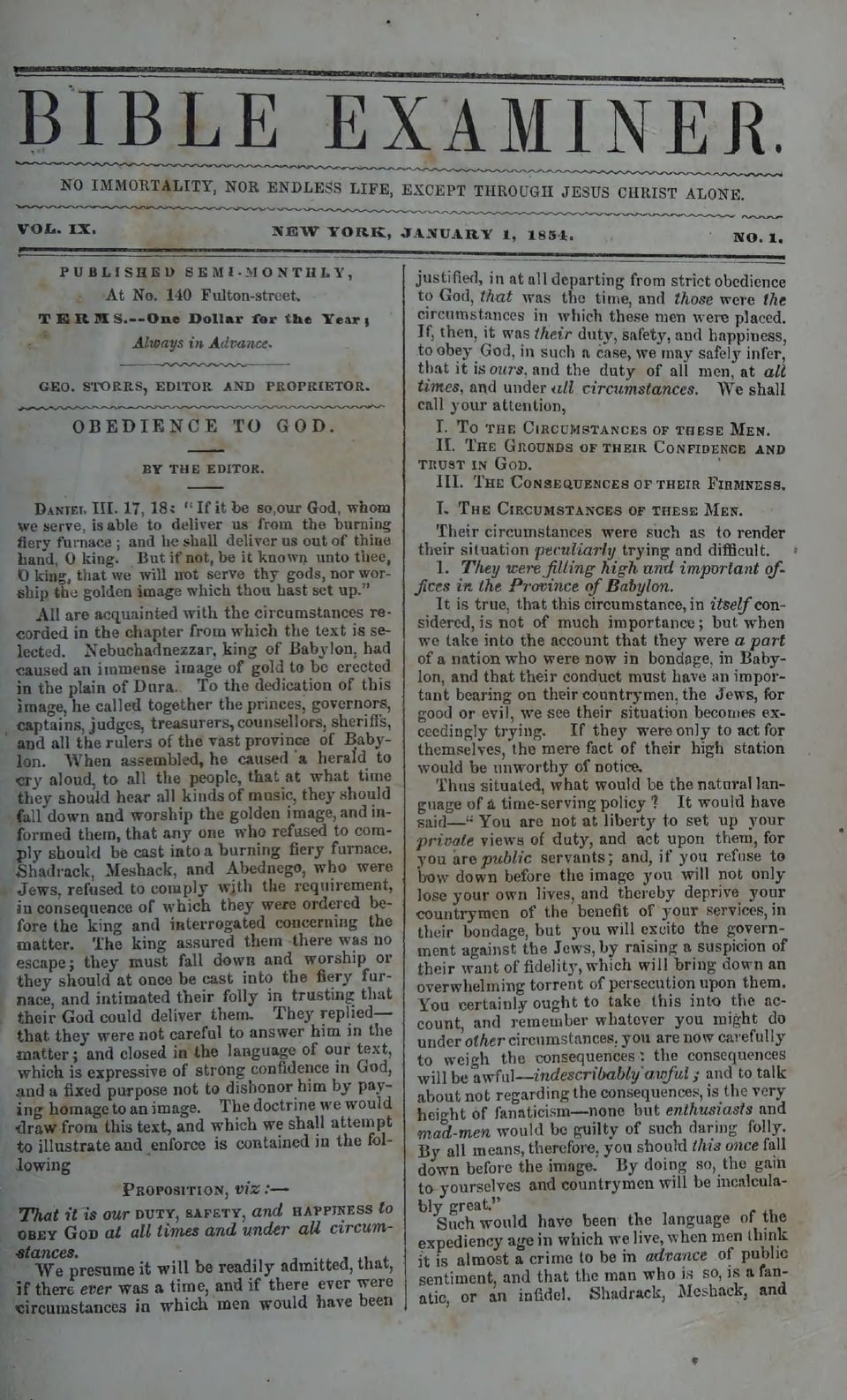
BIBLE EXAMINER.
NO IMMORTALITY, NOR ENDLESS LIFE, EXCEPT THROUGH JESUS CHRIST ALONE.
VOL. IX.
NEW YORK, JANUARY 1, 1854.
NO.1.
PUBLISHED SEMI-MONTHLY, At No. 140 Fulton-street.
T E R M S.--One Dollar for the Year; Always in Advance.
GEO. STORRS, EDITOR AND PROPRIETOR.
OBEDIENCE TO GOD.
BY THE EDITOR.
DANIEL III. 17, 18: "If it be so, our God, whom we serve, is able to deliver us from the burning flery furnace; and he shall deliver us out of thine hand, O king. But if not, be it known unto thee, O king, that we will not serve thy gods, nor worship the golden image which thou hast set up."
All are acquainted with the circumstances recorded in the chapter from which the text is selected. Nebuchadnezzar, king of Babylon, had caused an immense image of gold to be erected in the plain of Dura. To the dedication of this image, he called together the princes, governors, captains, judges, treasurers, counsellors, sheriffs, and all the rulers of the vast province of Babylon. When assembled, he caused a herald to cry aloud, to all the people, that at what time they should hear all kinds of music, they should fall down and worship the golden image, and informed them, that any one who refused to comply should be cast into a burning fiery furnace. Shadrack, Meshack, and Abednego, who were Jews, refused to comply with the requirement, in consequence of which they were ordered before the king and interrogated concerning the matter. The king assured them there was no escape; they must fall down and worship or they should at once be cast into the fiery furnace, and intimated their folly in trusting that their God could deliver them. They replied—that they were not careful to answer him in the matter; and closed in the language of our text, which is expressive of strong confidence in God, and a fixed purpose not to dishonor him by paying homage to an image. The doctrine we would draw from this text, and which we shall attempt to illustrate and enforce is contained in the following
PROPOSITION, viz :—
That it is our DUTY, SAFETY, and HAPPINESS to OBEY GOD at all times and under all circumstances.
We presume it will be readily admitted, that, if there ever was a time, and if there ever were circumstances in which men would have been
justified, in at all departing from strict obedience to God, that was the time, and those were the circumstances in which these men were placed. If, then, it was their duty, safety, and happiness, to obey God, in such a case, we may safely infer, that it is ours, and the duty of all men, at all times, and under all circumstances. We shall call your attention,
I. TO THE CIRCUMSTANCES OF THESE MEN.
II. THE GROUNDS OF THEIR CONFIDENCE AND TRUST IN GOD.
III. THE CONSEQUENCES OF THEIR FIRMNESS.
I. THE CIRCUMSTANCES OF THESE MEN.
Their circumstances were such as to render their situation peculiarly trying and difficult.
They were filling high and important offices in the Province of Babylon.
It is true, that this circumstance, in itself considered, is not of much importance; but when we take into the account that they were a part of a nation who were now in bondage, in Babylon, and that their conduct must have an important bearing on their countrymen, the Jews, for good or evil, we see their situation becomes exceedingly trying. If they were only to act for themselves, the mere fact of their high station would be unworthy of notice.
Thus situated, what would be the natural language of a time-serving policy? It would have said—"You are not at liberty to set up your private views of duty, and act upon them, for you are public servants; and, if you refuse to bow down before the image you will not only lose your own lives, and thereby deprive your countrymen of the benefit of your services, in their bondage, but you will excite the government against the Jews, by raising a suspicion of their want of fidelity, which will bring down an overwhelming torrent of persecution upon them. You certainly ought to take this into the account, and remember whatever you might do under other circumstances, you are now carefully to weigh the consequences: the consequences will be awful—indescribably awful; and to talk about not regarding the consequences, is the very height of fanaticism—none but enthusiasts and mad-men would be guilty of such daring folly. By all means, therefore, you should this once fall down before the image. By doing so, the gain to yourselves and countrymen will be incalculably great."
Such would have been the language of the expediency age in which we live, when men think it is almost a crime to be in advance of public sentiment, and that the man who is so, is a fanatic, or an infidel. Shadrack, Meshack, and Abednego, it might have been urged, would be guilty of all, and might justly be reproached as the authors of all the calamities that might result to the Jews by refusing to fall down on this occasion; so entirely destitute are most men of the claims of right principles, which are but the voice of God, to a correspondent right action.
Men seem to think that right principles are of no more binding force, under certain circumstances, than the principles, if we may give them that name, of aspiring politicians who seek their own aggrandizement, and care not who suffers, who is in prison, or who are crushed by oppression, if they can only effect their own selfish purposes.
These three Hebrews had planted their feet upon the rock of right principles; but they, as wise and understanding men, were not insensible to the probable consequences of their refusal to worship the image, when looked at only as men of this world. They could foresee, as clearly as their opposers, that if God did not appear in some way for the defense of the cause of truth, beyond what mere human wisdom could discover, the most disastrous results must follow: and we have no evidence that these men had any assurance, beyond what was contained in the written word, that there should be any interposition to prevent the natural result of their refusal to comply, on that occasion. We ask then, was this not a most trying circumstance? And had they been actuated by human policy, or a time-serving spirit, must they not have complied? How many, under the morality taught at the present day, would have stood erect? It is to be feared the number is few. The terror of losing some petty office, in church or state, is quite sufficient for multitudes of the present age, without any addition of other terrible consequences: they will bow and lick the dust to obtain or retain such office. Unhappy men! May the good Lord pity them, and teach them, before it is too late, that "he that findeth his life," by the sacrifice of right principles, "shall lose it;" while "he that loseth his life," in defence of those principles, "shall save it."
2d. The situation of these men was trying, from the consideration—
That a LAW, or edict, was promulgated, requiring all to fall down and worship the image.
Nothing is more common than to hear it said that men cannot do a thing, because the law or church prohibits it: or, that we must do so, or so, because the law or creed requires it. Well, here is a case in point. A law requires these Hebrews, with others, to fall down and worship the image. Shall they presume to set themselves up in opposition to the law of the land! Might not their opposers ask them,—"Does not your religion teach you the duty of obeying magistrates? If you refuse to obey, on this occasion, will you not give the lie to the principles of your own religion? and thereby bring it into contempt?" And, adds the time-serving policy, "You will injure the cause you wish to advance." "It must be right," the same policy continues,
"to obey the laws of the land! We are not responsible for the laws, our rulers must answer for them; and nothing can be more preposterous than for a few persons to think of going in the face of the law! It is the wildest fanaticism! So give up your folly and comply with the laws."
All this is plausible, and well calculated to mislead men who are governed by appearances rather than the truth or right principles. The men of whom we are discoursing, undoubtedly felt that the fact, that the law required them to fall down and worship the image, was a trying circumstance. Shall they not obey? To that inquiry we shall call your attention in another part of this discourse.
3d. The circumstances of these men were peculiarly trying from the consideration-That all around them comply with the mandate of the king.
At the signal given, all the princes, governors, captains, judges, &c., fall down and worship the image—there was one united and universal prostration: it was a full and strong expression of "public sentiment." Three men only are seen standing. These men have the "presumption" to act in opposition to the many! Strange conduct this! At least, so would a time-serving spirit decide. It is not so easy a matter for men to be singular. There is a strong propensity to go with the multitude: and it requires more than an ordinary degree of firmness to withstand the example of the many.
All are prostrate on this occasion. There stand the three Hebrews alone. Imagine the ridicule that would be employed to shame them out of their "singularity." We fancy we hear a Governor yonder, saying to his comrades around him, "See those Hebrews standing up—I wonder if they are not ashamed to be so singular."
"I wonder," says another, "if they think they know more than everybody else?" "Ay," exclaims a third, "they think they are wiser than all our great men—they have set themselves above our statesmen; yea, above our Doctors of Divinity,—those comparatively young men vainly think that they are going to set themselves up for reformers." "I suspect," cries a fourth, they will learn a lesson by and by when they feel the fire of yonder furnace kindle on them. I guess they will find it not so desirable as they imagine to smell fire, or be martyrs." "For my part," says a fifth, "I believe idolatry, in the abstract, is wrong; but under present circumstances it is right; at any rate, I have no notion of going in advance of public opinion, and I think a man is perfectly fanatical that does it." "I am not so clear," responds a sixth, "that falling down to an idol is wrong, for the Bible says, 'an idol is nothing in the world,' and surely there can be no great harm, for the sake of keeping peace, and to prevent disturbance by setting ourselves up against public sentiment, for us just to fall down now, 'this once,' to that, which is, after all, nothing." "Those men are foreigners," cries a seventh, "and they have no business to meddle with our domestic institutions; we have worshipped images for hundreds of years; it is a long established institution, and though it might have been wrong when first introduced, yet it is entailed upon us, and it would bring confusion, disorder and ruin to attempt to abolish it now."
Such we may suppose would be some of the language employed by those whose interest it was to sustain idolatry, or who had not moral courage enough to oppose public sentiment which was corrupt enough to sustain image worship, or creed worship.
Men naturally feel much concern for their reputation; especially if they are now in possession of a respectable character. They seem to dread nothing more than the loss of that honor they now enjoy. Hence, opposition to the most important reforms usually originates with men who love popular favor; nor will they move in any reform until it first becomes popular; and then, not so much for any right principles or love to truth they possess as from a desire to retain that public favor which they now see must be lost if they longer stand aloof. To see men espouse a cause when the public sentiment of Church or State is against it, and that from a conviction that the cause is a righteous one, and truth demands their support, shows great moral courage; but it subjects its advocates to great reproach, and to be denounced as fanatics, fools, mad men, or infidels. Such reproach is trying to human nature; and it is not to be supposed that any sensible man would subject himself to it unless upon conviction that truth and faithfulness to God required it of him.
The reproach then these three Hebrews must endure for their extreme singularity cannot so easily be conceived of;—to have a tolerable idea of it, a man must be placed in a somewhat similar situation, and that is not likely to take place, with most of us, 'till the standard of morality and love for truth is raised much higher than what most teachers of religion, in the present age, have placed it.
From the consideration of the reproach these men must endure by their refusal to fall down before the image, and their extreme singularity, must not their circumstances have been extremely trying?
Not only were they subjected to scorn and ridicule, for their want of conformity to the general sentiments of those around them, but—
4th. They were terribly threatened with a most horrid infliction of public vengeance if they dared to dissent from the practice of the mighty men assembled on the occasion.
"Whoso falleth not down and worshippeth shalt the same hour be cast into the midst of a burning fiery furnace." To be at once cast down from honorable stations, and put to a most disgraceful, painful, and public death, was a trial of integrity, and honest adherence to truth and right principles, which few, perhaps, could have endured the thought of without having been overcome. Under the time-serving policy of our age, probably, most men would think they had a sufficient excuse, in such circumstances, for seeming, at least, to fall down and worship the image. Human policy would have said, "It is your duty to yourself, to your family, to your country, and to the church, to save your life. True, it is wrong in the abstract to worship an image, but under present circumstances it is not only right, but 'Christianity enjoins' it: yea, the 'golden rule' requires it."
Such is the language of the expediency, that has taken the place of the Bible, in these last times.
5th. Another circumstance that served to make their situation peculiarly trying was the fact, that flattery was resorted to, to induce them to comply.
Many persons who have successfully resisted all other attempts to draw them aside from the path of duty, and firm adherence to right principles, have fallen before flattery. In fact, it requires much more moral courage and firmness to resist flattery than any other, or all other agencies: because flattery comes in the garment of a friend concerned for our reputation and welfare; and it seems ungrateful in us not to regard the kind feelings and tender concern of those who take pains to let us know how much they esteem us. Hence, it is much more difficult to resist the persuasions of apparent friends than the assaults of open enemies.
Now look at the case before us. The king proposed that all the music should be repeated just to accommodate these three men. As much as to say, "You are men of standing and worth; if you were mean men you should have no such favor granted you; but men of your respectability and importance in community, I am exceedingly desirous should maintain the high standing to which your merits entitle you; now, therefore, I will give command and the music shall be repeated for you three; and certainly you cannot have so little regard for your reputation as to refuse to comply with the desire of your Sovereign, who has always shown you the greatest respect, and advanced you to the important offices in the empire that you now fill."
Who would not have given way under such circumstances, and found some excuse, for at least "this once," in doing homage to the image? "The very peculiar state of the case," most would have concluded, "justifies us now in doing that, which, under other circumstances, would certainly be wrong: and then we mean by it no respect for the image at all, but design to secure a greater amount of good than we think can be secured in any other way, as matters now stand. And besides we certainly are under great obligations to the king, for he has done us much important service, and we should show ourselves exceedingly wanting in gratitude not to do as he desires us now, especially as he has shown so much respect for us, and so much desire for our welfare."
Thus would the time-serving spirit of the present age, have reasoned, and come to the conclusion, that, to persist in the refusal to pay, at least, an external homage to the golden image, situated as they were, would be folly and madness: nay, fanaticism of the worst character.
But thus did not the Hebrews reason. No, trying as their circumstances were they remain firm and unmoved.
[To be Continued.]
THE HARTFORD CONVENTION.
The discussion at that Convention, in June, has at last made its appearance, minus the last speech of Joseph Barker, which was never returned after the Report of it was sent to him. Why it was not we are not told. We have not had time yet to make our contrast between Joseph Barker the christian and Joseph Barker the deist, as the Report has but just come into our hands. It makes a book of about 370 pages 12 mo., bound, with an Appendix of some dozen pages; for which we paid 75 cents. The Appendix and Advertisements show what we have before stated as our opinion, viz:—That that Convention was got up with the design to put down the Bible and put up "Spirit Rapping." The latter object was not reached in the Convention because the former was not accomplished; and so the Publishers make up the deficiency by giving a list of "ALL the works devoted to SPIRITUALISM"; alias, "Spirit Rapping."
At the opening of that Convention, HENRY C. WRIGHT, formerly a Congregational minister, after that a Non-Resistant and Peace man, brought forward the following resolution:—
"Resolved, That the Bible, in some parts of the Old and New Testaments, sanctions injustice, concubinage, prostitution, oppression, war, plunder, and wholesale murder; and, therefore, the doctrines of the Bible, as a whole, are false, and injurious to the social and spiritual growth and perfection of man."
To the presentation of this resolution we spoke as follows, as reported:
Mr. GEORGE STORRS then arose and said: Mr. Chairman, when a court is in session, or opens its session, and a person is brought before that court charged with crime, it is important to understand at the outset by what law that person is to be convicted of crime. The Bible is arraigned, charged with crimes, but we have not yet been told by what law the Bible is to be tried. This is a point I want our friends to define. It certainly seems reasonable, that if any individual is to be tried on a charge, he should not only have the charges specified, but it should be specified against what law he has transgressed. What is the use of standing up and testifying against a man ten thousand things, until you have told us by what law the charges are to be tried? Where is the law that proves that theft, and slavery, and lying, and murder are crimes?
Just let us have it. If that can be established by our friends, to the understanding of the audience, we are prepared to come and see whether the Bible is guilty of the crimes charged, or not; and until that has been done, I maintain that every word that has been uttered here against the Bible, is without any force or weight; because it has not been shown that the Bible has transgressed any law. I do not stand here to advocate and defend everything we find in our translation. I shall not stand here to defend the Bible against interpolations. You have charged the Bible with crimes. Point us to a clear law by which the Bible is to be tried, and we are ready to defend it. (Applause).
After these remarks, Mr. Wright said he would give us "the law;" but to our mind it amounted to inward consciousness—nothing more; and we wished him to say that it was natural religion, or the god of nature, if he was disposed to do so. Br. Turner followed Mr. Wright with a good speech, and then we again took the stand, and are reported to have spoken as follows:
Mr. George Storrs—The resolution brought forward at the opening of this Convention arraigned the Bible before some court, and charged it with certain crimes. I would again ask, if a person be brought before a court, charged with crimes, if it is not right that the law should be defined by which he is to be tried—a law by which it can be judged whether he is a criminal or not? In reply to this question, my friend Mr. Wright, very prettily indeed, appeals to our feelings. "The law is planted in here (touching his breast)---in the constitution of our nature." Is that the law by which the Bible is to be tried, and its morality or irreligion to be tested? Is that the law by which this book is to be proved a wicked thing, or to be justified? Is the Bible to be tried by this law in our nature, which says that murder, theft, slavery, etc., are wrong? I understand that the position which my friend (Mr. Wright) has taken is, after all, that the Bible is to be tried by natural religion.
MR. WRIGHT---Yes, by natural religion.
Mr. STORRS--I ask you then to prove that God is possessed of a solitary moral perfection by natural religion. Tell me how, by natural religion, you are going to demonstrate but that there are more than a million gods in the universe? I am glad that he has said that it was natural religion. We come now to the point--we have something tangible. It is natural religion by which we are to try the Bible. All that you can prove by natural religion, with reference to supreme powers is, that there may be one God or many, and that the God or gods possess intelligence and power; and, for aught that you can know by natural religion, this God or these gods, may have just the character which it has been contended by our opponents the God of the Bible possesses. Does natural religion teach you that God is good, when he suffers so much misery, and woe, and war and slavery, and blood, and sickness, and death, filling graveyards with human beings?
Now, where is your good God? Do not touch the Bible---stand off from that---let revelation alone. Just take your natural religion, and you cannot prove that God is good; and for ought you know, therefore, he is just such a character as sanctions war, slavery, polygamy, etc. I see no possibility of avoiding this conclusion. By natural religion how can you know but that it is right that God should destroy one class of men by another? How do you know that it is wrong for one nation to rise up against another nation, and to commit depredations and destroy one another by war? How do you know that it is wrong to practice polygamy? How do you know it is wrong for God himself to interfere with my rights as a man, having created me? What does natural religion teach you about the animal creation?
See your neighbor take the calf and cut its throat before the eyes of its dam. She moans—she feels bad, don't she? Ah, it is a sin to take the calf and cut its throat—is it not? But natural religion says it is right—you want it to eat; but perhaps my friend Wright will say it is wrong. [Laughter.] Again a man finds a swarm of bees in a tree, and cutting down the tree, he takes the bees and puts them in his bee-house, and tells them to work for him. They work all summer long; but finally the man comes along who says that he is the "slaveholder," and that he wants the honey. He lights his match of brimstone under them, destroys their life, and takes the honey. He is a robber! Does natural religion say so? Oh, no; but they are inferior to me. Indeed, sir, how inferior you are to God! How do you know but that the God that made you has a right to command you to be slaughtered! Does natural religion tell you that he has not? No. The fact is, that natural religion can prove nothing but that there is a God—whether one or many cannot be determined—and that God possesses power and intelligence; but cannot lead us one step farther in determining his character. Hence, I say, that the rule by which it is claimed that this Bible should be tried, is a defective one, and that the Bible cannot be tested by it. But perhaps I shall hear some one saying, You are not going to compare us to the lower and inferior animals? But, sir, what are you but an animal? I was glad to hear my friend Wright say, that if he did not have any brains, he would have no life; but take away his brains and he would be dead, just as dead as any other animal. Now, I ask, if natural religion allows us to enslave the lower animals—and a great portion of the community take their life out of mere sport—and if the law of natural religion were the same and unchangeable, if it would not condemn every man that takes the life of the meanest insect that crawls upon the earth? Our friends have been building upon a foundation that has been laid for them by some theologians, that man has an immortal-soul—that he is a part of God. Whatever else may be charged upon the Bible, this can
not. Man is only an animal till there is a development of moral powers by the application of a moral law. What, a part of God! Why, sir, if man is a part of God, there is no such thing as sin; for sin being a departure from God—a violation of some law, there can be no such thing as sin, unless a man should deny himself. Man, a part of God! No, sir, that is an assumption of the human heart in its pride. They would be as gods. I maintain that man by his creation is only an animal of the highest order, and capable of higher development than any other animal; but as to his having an immortal soul, there is no such thing taught in the Bible; therefore the Bible is clear of that charge. Whatever else they shall claim is taught by the Bible, it never taught that man is possessed of an immortal soul. [Cries of Hear, hear.]
A great many complain because Adam should have been placed in a state of trial; but if he had not been, he never could have risen above the state of an animal, for holiness is not a creation but a development; therefore the conditions for such a development were absolutely necessary for the development of Adam---for enabling him to rise in the scale of being and to become a partaker of the Divine nature, if faithful to his God. His very trial was, therefore, on the part of his Creator, an act of mercy and of kindness. That trial was to develop the moral character of Adam, which if in harmony with God, was to entitle him to an endless existence; but he was informed that if it was not in harmony that he should surely die. When we inquire the meaning of death---what is it to die, we must answer, that it is to return back to that state from which man came. What, to be annihilated? Yes, sir, to be annihilated. "But," says one, "there is nothing that can be annihilated." But I ask if he who created cannot annihilate, if he will? The only question is in regard to his will. It is said that nothing can be annihilated; but I ask the objector if he means to say that God Himself can annihilate nothing? Do you not preach from day to day that God made all things out of nothing; and yet do you deny that that Being who created all things out of nothing can return them to that state of nothing---that is, to annihilate them?
Why, sir. I can annihilate some things. Bring me a glass globe. Can I not grind it to powder and annihilate it as a globe? You say the particles of matter remain. But does the globe as a globe remain? Manifestly it does not; it is annihilated. So man when annihilated will not exist as man, whatever becomes of the elements of which he was composed.
Adam was told by the Creator that in case he did not obey the law given to him he should return to the dust from which he came. Now, sir, do you tell me that natural religion teaches a contrary doctrine—the doctrine of the immortality of the soul? Can natural religion point into the future world? If so, what means all the speculation among heathen philosophers about the immortality of the human soul? I ask what does it mean, if natural religion can carry you to another world? No, sir, natural religion can do no such thing.
It remains for revelation to bring forward and develop a future world; and if it remains for revelation to do it, it remains for that revelation to state the terms upon which the Creator will give us a part in the future world.
The Bible has been complained of on account of its teachings concerning women. They read to you, on the one side, passages telling the duties of the wife, but they read nothing prescribing the duties of the husband. Paul commanded that husbands should love their wives as they love themselves. It is a dreadful thing for a woman to be loved by her husband as he loves himself! [Laughter]. I venture to say that there is not a woman of good sense in this house that will not risk the consequences, if she can get a husband that loves her as he loves himself.
The old theological notion of there being infants in hell not a span long has been adverted to. Suppose we threw the Bible away and do not let a ray of its light shine upon us. and I ask you where infants go when they die? They go down into the grave, don't they? Then all the infants that die go into hell---your natural religion hell [applause and laughter]; and you can not demonstrate by your natural religion but that every infant goes into hell. The infant comes into the world a suffering being, travels on in pain and suffering, and drops into the grave. Now, where is your natural religion to comfort you? "Oh I guess it has a soul that goes off in progression." "I guess!" I guess it is all guess work. It is the Bible that brings to our view another state, and that by a resurrection through Jesus from the dead.
The question in regard to the Bible is not, in fact, whether that Bible is a revelation, but it is whether it is a faithful history of revelations and certain transactions connected with those revelations; and therefore the whole question turns on the credibility of the Bible witnesses, and whatever charges you may bring against hireling priests. these witnesses are to be judged in their testimony, according to the motives under which they may be reasonably supposed to have acted; and if it appears that their whole course was one of self-sacrifice and pain--that they jeoparded their very lives in giving their testimony, and nothing can be shown to the contrary---then you must accept them as credible witnesses. Further, when it is shown that this suffering and trial was foretold them by their beloved Master, there is no reason that can be given for supposing that they were designing men--men that would palm off on the world a falsehood. So if we go back to the Jewish priesthood--who may be considered as Bible witnesses--do we find them men of selfishness? Did they frame, those laws? [turning to Mr. Wright.]
Mr. WRIGHT—Yes.
Mr. Storrs---Let us see whether they were knaves or not. Is it any where evinced in these laws? Did they [the laws] reserve any portion of the land for the priests?
They reserve to the priest one-tenth of all the other property.
Mr. Wright, interrupting Mr. Storrs, said---
Mr. Storrs---Does it look like knavery, I say, to cut themselves off from all possessions in Israel? Yet the people were to give them only one-tenth of their crops, etc., and where was the law compelling the people to give it if they did not do it voluntarily?
Now, I say that the priests did not make the laws, and I call upon my friend Wright to prove that they did; and if they did, they made just such laws as knavish priests would not have made---they made a law to prevent their holding possessions in Israel. They made a law by which it was made a voluntary affair with the people to pay them one-tenth of their crops, etc., or not; and there was no law compelling them to pay this tithe.
A Voice interrupting---The people were not to have any wine the next year in case they did not pay this tithe.
Mr. STORRS---I ask if the priests themselves caused that there should be no wine the next year, after the failure of the people to pay tithe, or did He who caused the herb of the field to grow, cause that there should be no wine? Were you to give knavish priests now the power to make laws to regulate their own salaries, do you think they would exclude themselves from having inheritances among the people, and not make any provision for compelling the people to pay tithes?
A Voice---No, they would pay more attention to their bread and butter. [Laughter.]
Mr. Storrs—No, indeed; but such was the fact in regard to the Jewish priesthood: they were excluded from having inheritance among the people, and there were no provisions made for enforcing the payment of tithes—there were no pains or penalties to be inflicted on the people in case of their failure to pay. Now, I ask, if such a code of laws gives any evidence of having been gotten up by a corrupt priesthood? No; there is every evidence of the purity and goodness of their motives. So with reference to the witnesses of the New Testament. You say of a corrupt priesthood now-a-days, that they keep a good look-out for their bread and butter; but they sacrificed all—being stoned, whipped, and imprisoned, and were assured by their Master that they should come to a violent death. They went out in the face of public opinion—against a corrupt priesthood—against a corrupt world, civil and ecclesiastical, with their lives in their hands, and proclaimed the great truths and facts of the New Testament. And what are these great facts? Why, the great fact—the solar beam of the New Testament, is a resurrection from the dead through our Lord Jesus Christ—that God has given us eternal life, and that this life is in his Son, and not in ourselves. Amid all their trials these witnesses maintained their integrity to the end. But you say that Peter denied his Lord, and cursed and swore. Well, I suppose he was a little afraid of the face of clay, as we are sometimes; and who can wonder at it, when we think that we are possessed of human nature which shrinks at suffering?
Why do you not tell us, that when Jesus turned and looked upon Peter, that he went out and wept bitterly? Would it not answer your purpose? It would not, would it? [Applause.] Does the Bible any where say, that any man on earth is ever so good that he may not sin in the hour of temptation? No; if it did, this might be brought up as an excellent thing against the truth and inspiration of the Bible; but it goes on the very ground that we are liable to sin, and that God has promised that if we repent, and use those means or institutions which he has appointed, we may be forgiven our sins and restored to his favor. And so Peter did, and on the day of Pentecost the fear of man was taken away from him. He will not deny his Lord now.
"No, to be sure, but he will dissemble."
The flesh you see, which must be kept "under," is the source of sin; and in the hour of temptation the best man may be led, in view of pain and suffering, to commit a sin, which, on reflection, he would stand up strong against, if he has the principle of holiness in his heart; and this was the case of Peter.
These witnesses went forward testifying to the truth, namely, that Jesus is the Son of God that Jesus died—that God raised him from the dead—that he ascended into heaven—that he is coming again to judge the world, and to give to his people eternal life. They preached Jesus and a resurrection from the dead, and they went forward in their testimony, faithful to the end; and, mark you, they did not, as hypocrites and dissemblers do, conceal their sins. Dissemblers and hypocrites do not tell their sins. No, no, sir, they cover up their sins. The New Testament witnesses did not cover up theirs, as is evinced by the very fact that we have a knowledge of them; and that is another argument in favor of the credibility of the witnesses. All these witnesses testified to facts and truths which they promulgated to the world at the hazard of their lives. As we go forward in this Convention, I have much to say, if I am permitted to say it. [Cries of hear, hear, and applause.]
We shall hereafter make extracts from the speeches of Br. Turner and ourself as we may find space in our columns.
THE SHELL IN DEATH'S JAWS: OR, A BRIEF ACCOUNT OF A SERMON BY LUTHER LEE.
BR. STORRS—Last Sunday evening I heard your old friend, Luther Lee, preach. His theme was, the Cross of Christ. The two first heads of his discourse I was much pleased with; but when he came to the last---which was the value of the Cross to the dying pilgrim---he seemed to be in the fog. He said the Bible was full of arguments in favor of immortality, but he had not time to present them, and merely gave us a summary of his belief, stating that he had no sympathy with the opposite sentiments, nor with those who believed the present age was near its close, or that the world was growing worse. He was very inconsistent, for he denounced the christianity of the day as an intemperate and slaveholding christianity. And yet it was to be the instrument in converting the world; and he did not know but that it would succeed within the next 150 years; although he acknowledged it had done but little in the past 1800 years. He presented a fine picture of the departure of the pilgrim. I may not remember his entire words, but very nearly so. He said—"Let us view the pilgrim on the banks of the Jordan of death, calm and serene he looks down into the dark waters and there beholds death with its jaws widely extended, just ready to receive him; he starts back at the prospect, but lo! the cross intervenes between those jaws and keeps them asunder, and the pilgrim steps calmly down between them, and there leaves this poor, frail, perishable tenement and in a moment is singing on the golden hills beyond Jordan." We had not a word from him of the resurrection, and why should he say any thing about it, for there seems no need of a resurrection, as the pilgrim only left his shell in the monster's jaws, and the next moment was exulting in an immortal state! It pained me to hear a man of his intelligence, running so widely opposite the Bible. He conveyed to my mind the idea that the cross intervening between the jaws of death, prevented death from gaining the victory, and consequently the pilgrim did not die. I have no desire to misrepresent him, and think I have not; but I suppose he would totally object to my inference, but so his language struck me, and I cannot help it. I am sorry that some one who was capable and willing to report the sermon to you, did not hear it, so that you might have had it.
Br. Lee need not "start back" from such a fine opportunity of losing his shell in death's jaws! No wonder he "said nothing of the resurrection." Of what use will it ever be to the "immortal soul," "singing on the golden hills"?
The "Review of Luther Lee, by Anthropos," should be more widely circulated; it is a most thorough refutation of his position on immortality. It is a pamphlet of 122 pages, 18 mo. Price 15 cents, or ten copies for $1.
NOTICES.—To Subscribers in CANADA the Bible Examiner, now Semi-monthly, will be $1,25 for the year.
BR. MONCRIEFF.—The Expositor for Dec. has not been received, but Br. Chittenden has loaned us his.
BR. HAM.—Christian Examiner for Dec. is received.
TRACTS. We are at present entirely out of all the Tracts in our catalogue, and cannot say when we shall have more, as they are a bill of expense to us rather than of income. Larger works are mostly wanted, and are more important.
BIBLE EXAMINER.
NEW YORK, JANUARY 1, 1854.
THE BIBLE EXAMINER for 1854 is commenced Semi Monthly. Shall it be so continued? We trust it will; but the sum necessary to pay the actual expenses has not been more than half paid yet. Nevertheless, we have ventured to launch out twice per month, believing that the cause demands it, and that the friends will not leave us to labor alone. Through the blessing of God we trust those who love the truth, "Life and Immortality only through Jesus Christ," will find themselves abundantly able to sustain the Examiner, and all kindred publications.
When the Examiner was first started, eleven years ago, it had not a single subscriber, and was published solely at our expense. From '44 to '47 the occasional issue continued, and a small amount was furnished by individuals for that object. In '47 it was issued monthly in quarto form; in '48 it was changed to its present form and issued at 50 cents per year; but after two years it was found impossible to meet its expenses at that price; and in '50 it was advanced to $1 per year by the general approval of its patrons. Still the list of subscribers did little more than pay the printer's bill for '50 and '51. Since that time there has been a steady increase of interest in the Examiner, but never enough paid in to meet the printer's claim for a semi-monthly issue; nor is there near enough yet received to meet that claim for the year upon which we now enter; even making no allowance for compensation for the Editor, who will now, necessarily, be more entirely confined to his labor with the Examiner, and thus be cut off from the help he has received from friends when he visited abroad. Notwithstanding the prospect, pecuniarily, is against himself, he has determined to go on semi-monthly, relying upon friends abroad for a strong effort to increase the circulation of the paper; and he sincerely hopes that the effort will be made at once; so his mind shall be unincumbered with care in relation to the expenses of paper and printing.
No subscription of less than one dollar will be received; nor will that amount pay for anything beyond the present year. If, therefore, the subscriber does not choose to receive the numbers from the commencement of the volume, they are, nevertheless, his to dispose of as he may
please. We print an even number at each issue, and confusion with loss, would be the result were we to break the volume by a subscriber's not beginning with it. If he chooses to pay his dollar for a part only of the volume he can do so. From this rule we cannot depart: nor can we, at present, offer a premium, for five dollars. If our list of subscribers comes up to a thousand, then we will give the premium of the sixth subscriber to those who send $5.
This number of the Examiner may be sent to a few who have not paid for this year. If so, it is to solicit your subscription. You need not return it, as it will not be followed by another if we do not hear from you; but we hope you may feel inclined to help us on in our work.
The Examiner has one main object, which is expressed in our motto, viz:—No Immortality, nor Endless Life, except through Jesus Christ alone." This object will be first and foremost, always. Other topics will find a reasonable space, the Editor being judge what other topics shall enter, and the amount of room it is best they should occupy. There are various and conflicting views, in which brethren and friends are interested, which we should not deem proper to admit into the Examiner because of the space they would necessarily occupy, and because they have no direct connection with the grand theme of our motto. We shall, however, have more on general subjects than heretofore, provided the increasing interest on the Life Theme does not demand all the space added by the semi-monthly issue. Circumstances will guide us in that matter.
If an apostle could say—"Brethren, pray for us," surely the Editor of the Examiner may do so: sensible as he is, that without the blessing and aid of the God and Father of our Lord Jesus Christ, he must fail to profit his readers, or secure life eternal for himself. He earnestly desires that he may ever, and on all occasions, breathe the spirit that was in our Divine Master and Lord, when he was upon earth; and that no provocation, whether from friends or foes, may ever be suffered to move him from that love to God and men which always shone in the life of Jesus Christ, our great example, high priest, life-giver and Lord. Therefore, "pray for us:" and may those prayers be reflected back upon yourselves in rich blessings unto Life Eternal: so shall we rejoice together in the day when the Lord Jesus shall return from heaven.
NEW YORK.—The Life-Theme is now dwelt upon in this city every Lord's day—morning and evening—at Mechanics' Hall, 472 Broadway. Br. H. L. Hastings and ourself have preached there alternately for two months past and truth is manifestly advancing. Many strangers are seen in the meetings, and some interesting cases have already occurred, in which men, before skeptical, have been led to see truth in a light they never dreamed of; while some saints have been made glad by their emancipation from the horrible traditions of men. May the Lord continue to bless and prosper this effort.
PATERSON, N. J.—Our brethren in that city are strong in the truth of life only through Jesus and the resurrection: and none the less so for the effort recently put forth by Mr. Landis, a Presbyterian minister there, to overthrow their faith. We are right glad to get the ministry, called "orthodox," roused up to oppose; for their opposition only reveals their weakness, and may ultimately be the means of their conversion to the truth. A public discussion will probably be had there, the present month, between Mr. Landis and Br. Hastings.
PHILADELPHIA.—We visited that city the past month and spent one Sabbath with them. For near six months, every week, our brethren there have held a discussion with any and all who chose to oppose our views of immortality only through Christ. The interest so far from abating has been constantly on the increase, so that their place of public meetings is often crowded to overflowing,and light is spreading in that city. Brs. Jacob Grim, Wm. Ashman, and Wm. Stuart, have been the principal speakers on our side of the question: all of them mechanics; or what are called "laymen." Pity the "Priests" there would not come out and put to rout these hard-working brethren. It would give them the utmost pleasure to have a friendly conflict with that class of men who, professionally, are Theologians. The truth and God has made these brethren strong, so that they are able to defend the truth against all the opponents that can stand up.
We had a short but profitable time in that city. May our friends there keep the spirit of Jesus, and suffer no "root of bitterness to spring up, and thereby many be defiled." May every other consideration be lost sight of save that of the honor of God and life to men through Jesus Christ.
PROVISIONARY COMMITTEE.
We have received the following letters from those engaged under the Prov. Com., in proclaiming Life and Immortality only through Jesus Christ alone.
FROM THOMAS GARBUTT. Orangeport, N.Y., 1853.
BR. STORRS:—I labored during November in Somerset, Hartland, and Royalton, Niagara Co. My prospects for doing good never looked so bright as at present. I feel that God is in the arrangement I have made with the Provisionary Committee, and my hourly prayer is, that myself and fellow-laborers under its patronage, may be indeed and in truth soldiers of the cross. Eld. Levi Hathaway, a venerable Christian minister, has been of great service to me; a man learned in the Scriptures, of sound judgment, and truly devoted to God. I bless God there are a few such lights in the world. I have every reason to expect many of the Christians in this county will help sustain the truth.
I have preached at Hartland Corners in reply to two lectures in favor of Universalism. Several became deeply interested; saints and sinners wept. I do not know how it will end yet. The sheep are, I am sure, gathering around the great Shepherd. Thus I have hopes. O that God's people would be more faithful. I hope next month to see more turning to God and thus escaping death.
Yours, in hope of Immortality,
T. GARBUTT.
Since the foregoing was received the following has come to hand.
Things look still brighter. I have received three more invitations to preach to Christian churches. I have three preachers now on my side, and only one against, and he is not disposed to say much, as many of his church have said they believe man is mortal.
The Six Sermons are to work. Backsliders are coming up to the work of the Lord; the Lord is with us of a truth. I see it more every day. I think and pray that we shall have a good old-fashioned revival, so far as the work of the Spirit is concerned. Sinners look solemn as death. May the Lord help. Bro. Storrs, hold fast.
Yours in love,
T. GARBUTT.
FROM J. BLAIN.
Auburn, Nov. 29, 1853.
BR. STORRS:-Since I left New York, three weeks ago, I have disposed of 225 of my work- Death not Life,'—30 Bible vs. Tradition—40 Pauline Theology, and a number of other works.
I am more and more encouraged as to obtaining means to support those who are willing to preach the life and death doctrine, under the appointment of the Provisionary Committee.
Where I have traveled, as yet, our plan for spreading truth, meets with about universal approbation, and brethren show it by subscribing. All see more and more plainly that we are using the best means to break the fetters of tradition from the churches.
Since I left New York, the 1st of Nov., I have visited Albany, Troy, Lansingburg, Waterford, Halfinpon, Oppenheim, Herkimer, Utica, Syracuse, Oswego, Port Byron, and Auburn. My traveling expenses for the entire route have been but $7.75. Time forbids giving further particulars at present. J.BLAIN.
FROM C. F. SWEET.
Dec. 2,1853.
BR. STORRS: Since I saw you in Dansville, in Oct., I have traveled over 400 miles with my horse and buggy, or on foot, making my traveling expenses small. (1,96). I have had some good meetings, and some opposition; but none of these things move me. I have but one work to do, and that is, to preach the word of life to a lost world. I am encouraged to go on trusting in the Lord. I am happy to be associated with devoted men whose object and aim is to proclaim Jesus Christ as the life of the world. Disunited with him we remain in a state of sin and death.
I have sold all my books and wish you to send me a new supply.
As ever, yours.
C. F. SWEET.
We are sorry to announce that Br. C. M. Richmond, from his pecuniary circumstances, prior to his labors under the Prov. Com., has felt it necessary to engage in business that occupies him during the week, and cannot travel much abroad. His connection with the Committee has therefore ceased for the present. His residence is Peru, Ind. We hope the friends of the cause will call him out into the field all in their power.
Br. J. S. White, also, has felt that he could not give all his time to labor under the Prov. Com., and has concluded to work entirely on his own responsibility. Br. White is ready to preach the word of life to those who may need his services as he may have opportunity, and we hope he may be abundantly sustained; and we are satisfied he must be useful wherever he goes.
A friend at Martin's Hill, N. Y., " " 4,00
" Lawrenceville, Pa., " " 1,00
" Manayunk, Pa., by Geo. Storrs, 5,00
" Buckland, Mass., by letter. 3,00
Friends in various places. by Br. Blain, 12.00 Albany 4; Halfmoon 3; Oswego 6; Syracuse 2; Herkimer and Utica $3. These are among the places where Br. Blain collected funds, and included in the above, or previous receipts from him. Friends in Williamsburg, N. Y., by
Total disbursements, previously rep'ted $276,85
Paid since last Report, as follows:
To Br. T. Garbutt, - -$ 12.50
" C. T. Sweet, - - 52.65
" J. Blain, - - 6,00
Total the past month, $71,15
Total Disbursements,$ 348,00
Treasury Overdrawn, $30,65
Eld. E. R. Pinney's article on the inquiry, "What is the Soul?" we have commenced in this number, and shall finish in the next. We have suggested to him objections, his answers to which will appear soon. The novelty of his views should not lead us to slight his argument, which is certainly strongly fortified by Scripture. We have often asked our opponents the question, "What is the Soul?" and as often met with an evasive answer. They talk about its being "immaterial;" and they might as well say it is nothing. Luther Lee once said, "it is thought;" but he gave no evidence except his own "say so;" and all immortal-soulists are just as vague and indefinite, which shows they are entirely ignorant as to its nature. "Thought" implies a thinker. What is it thinks? "The soul," we are told! Well, what is the soul? "It is thought!" So, "thought" thinks! How very "immaterial" that must be! That's logic, such as Paul speaks of when he says—"Beware lest any spoil you with vain philosophy after the tradition of men," &c.
Whether Br. Pinney has given a more rational and scriptual answer to the question our readers can judge, when he is through.
Br. Pinney is suffering amazingly under a fearful cancer of long standing, and will probably soon "fall asleep." May the Lord sustain him in his last conflict, and bring him, through Jesus and the resurrection, to Life Eternal.
THE TRUE WESLEYAN.—Is that paper "annihilated?" It made its exit from this city one year ago. Since that time we have not once seen its face. We have several times sent the Examiner after it, with a "Please Exchange," but no tidings have ever returned from the Wesleyan. Now we would be glad to know if it is sick, dead, or ANNIHILATED, or gone into the "spirit land?" Perhaps nothing worse than the latter. If so, of course, it is too busy with phantasms to mind we material creatures. Well, we suppose it can't be helped, so farewell to it.
By the way: we have invited the Christian Advocate and Journal—the Inquirer—and the Independent, of this city, to exchange; but they never show their faces to us. We have also sent each of them the Bible vs. Tradition, but they are mute as death about it, so far as we can learn. What's the matter, friends?—We assure you the Examiner and Bible vs. Tradition are no ghosts. Perhaps they are too material for you: Very well—then they are the easier to be handled; for you will not have to "beat the air." After a number of invitations, Zion's Herald commenced an exchange with us a short time since; but since our "Dialogue" with "Rev. N. D. George," last month, that paper has disappeared. What is the matter, friend Herald?
"HE DIES LIKE A BEAST."—We clip the following from Zion's Herald, the Methodist Episcopal paper, Boston, Mass. If it had thought no man could "die like a beast," it seems strange it should admit such a sentiment into an organ of the M. E. Church. This item we found in one of the papers in which Rev. N. D. George labored to prove that "Materialism is Unscriptural." But, here is a man that "dies like a beast!" He must be rather "material" then, we should think. What do you think about it, Br. Herald?
"He dies like a beast who hath done no good while he lived." True indeed! Go to his funeral. Not a tear is shed. Not a pain, or a grief, or a want has he relieved, and there is none to call him blessed. Think of it, ye time-servers ye who seek for pleasure, ye who make self the centre of every thought and action. What an epitaph! 'He died like a beast, for he did no good while he lived.'"
Now, Br. Herald, we are right glad you see things so clearly. May light continue to shine on your path.
Dr. Watts says, in one of his Hymns—"Like brutes they live, like brutes they die;" and it seems the Herald is inclined to the same view, notwithstanding the nine articles of Br. N. D. George to prove the contrary. Dr. Watts adds :—
"Like grass they flourish till thy breath Blast them in everlasting death."
THE HERESY HUNTING.—The case of Prof. MAURICE, dismissed from King's College, England, for the fancied idea that he was heretical on endless torment, is exciting some attention. The following item is from the London Daily Times.
"In compliance with a special demand made by Mr. Maurice, Dr. Jelf has published the whole of the correspondence which passed between himself and the Professor relative to the charge of unsoundness of doctrine which led to his recent dismissal. It appears that the correspondence commenced as far back as July 8, on which day Dr. Jelf addressed a letter to the Professor, in which he stated that his attention had been called by high authority to the conclusion of the last of Mr. Maurice's theological lectures, lately published, and proceeds as follows: 'It is alleged that you therein deny the eternity of future punishment. I have read the essay with attention, and confess that it appears to me to bear that interpretation; at least, the impression it gives seems to throw an atmosphere of doubt on the simple meaning of the word eternal; and to convey a general notion of ultimate salvation for all. I am, of course, most anxious to ascertain your real meaning.' To this letter Mr. Maurice replied on the next day, stating that he believed in the doctrine of eternal punishment, or death, in that sense which seemed to him most consistent with the other uses of the word 'eternal' in the New Testament; but he does not believe in the doctrine in that sense which is given to it, in many popular discourses and theological treatises, and that he repudiates that sense as inconsistent with the Gospel. He adds: 'To state my convictions on this subject was a duty which I felt that I owed to thousands of young Englishmen, whose faith in the redemption of Christ, even in the being of God, is at stake. I could not but tell them, because I believe it is true, that the statements which have led them to identify the God and Father of our Lord with the evil spirit, are not derived from the orthodox faith; that they are a strange product of Calvinism and Locke philosophy, and of the morbid consciousness of individuals.' On the 14th of July, Dr. Jelf wrote to state that the Professor's views filled him with the most intense alarm, and intimated that as the Rev. gentleman's were, he presumed, official ones, he should lay them before the clerical members of the Council, and if need be, before the Council itself.
At length Dr. Jelf decided that the ultimate decision must pass into other hands than his own, and Mr. Maurice was removed from his Professorship, under circumstances with which our readers are already familiar."
PROF. MAURICE has brought out one fact, that is, that the common teaching of eternal sufferings for men "identifies," in the thinking mind, "God with the evil spirit." Nothing could be spoken more truthfully. How long shall the blasphemy continue?
CATHOLICISM.
This ism, like all other isms, once in a while shows the "cloven foot." The Shepherd of the Valley, published under the eye and professing to speak with the approbation of the Catholic Bishop of St. Louis, delights in such intimations as these:
"The Church, we admit, is of necessity intolerant; that is, she does everything in her power to check, as effectually as circumstances will admit, the progress of crime and error. Her intolerance follows necessarily from her claim to infallibility; she alone has the right to be intolerant. Heresy she inserts in her catalogue of mortal sins; she endures it when and where she must; but she hates it, and directs all her energy to effect its destruction. If the Catholics ever gain, which they surely will do, though at a distant day, an immense numerical majority, religious freedom in this country is at an end. So say our enemies. So we believe."
"We gain nothing by declaring so earnestly against the doctrine of civil punishment of spiritual crimes. Our enemies will not believe that we are better than our church, and—for her—her history is before them; they know what she sanctioned during the middle ages, what she did then, and does now where she can; they know, too, what they would do, were they in power; they judge us by themselves. They can reason besides, and when we say two and two, they will add, make four, whatever we can do to stop them. Heresy is a mortal sin, kills the soul, and sends the entire man, body and soul, to hell; it is, besides, a contagious disease, and affects the interests of unborn millions. Christian kings, believing this, will crush it in the shell. Christian States, knowing this, will drive it from their bodies when they can."
…