The Bible Examiner — Vol. 7, No. 3 (March, 1852)
Download: PDF — The Bible Examiner — Vol. 7, No. 3 (March, 1852)
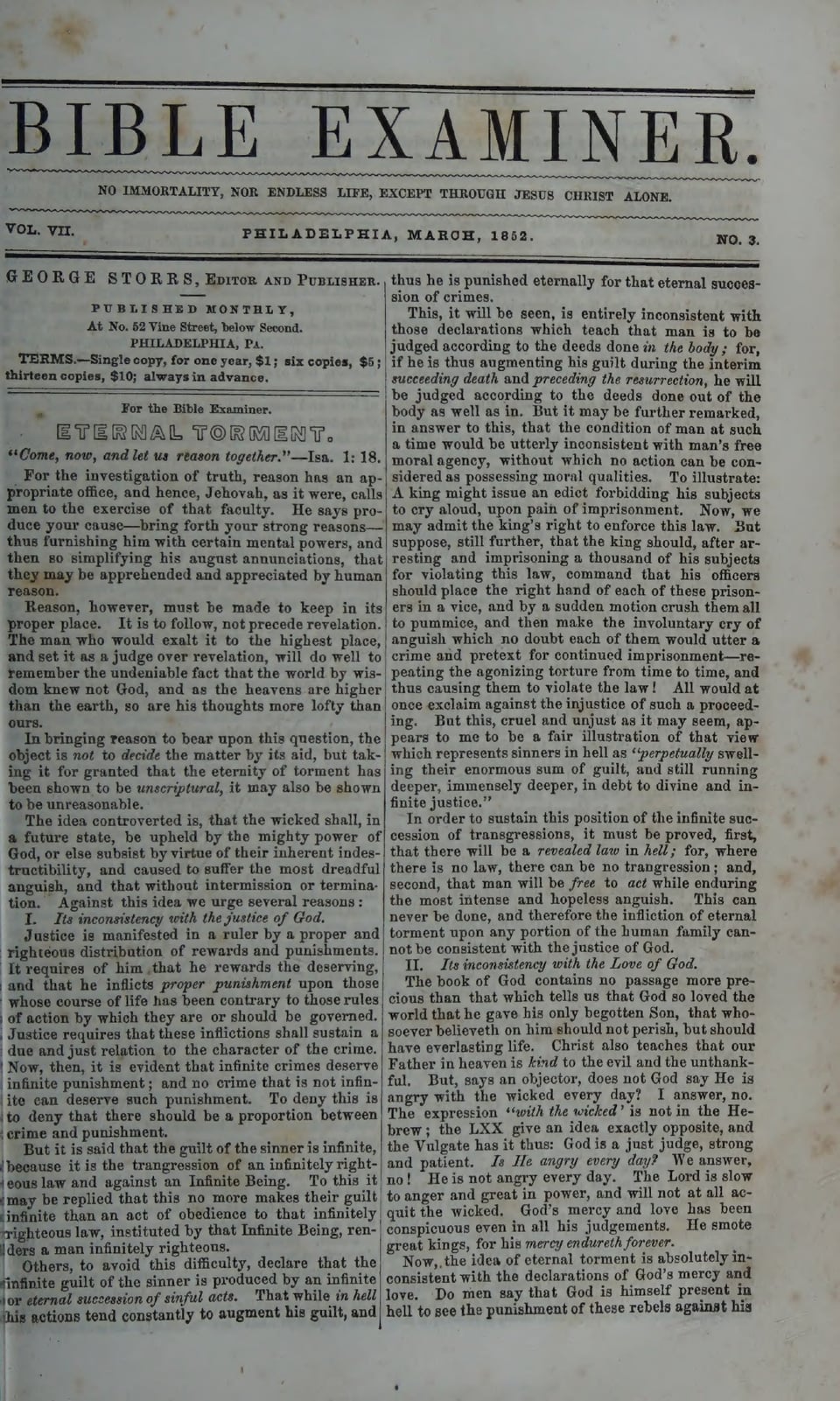
BIBLE EXAMINER.
NO IMMORTALITY, NOR ENDLESS LIFE, EXCEPT THROUGH JESUS CHRIST ALONE.
VOL. VII.
PHILADELPHIA, MARCH, 1852.
NO.3.
GEORGE STORRS, EDITOR AND PUBLISHER.
PUBLISHED MONTHLY, At No. 52 Vine Street, below Second. PHILADELPHIA, PA.
TERMS.—Single copy, for one year, 1; six copies, 5; thirteen copies, $10; always in advance.
For the Bible Examiner.
ETERNAL TORMENT.
"Come, now, and let us reason together."—Isa. 1:18.
For the investigation of truth, reason has an appropriate office, and hence, Jehovah, as it were, calls men to the exercise of that faculty. He says produce your cause—bring forth your strong reasons thus furnishing him with certain mental powers, and then so simplifying his august annunciations, that they may be apprehended and appreciated by human reason.
Reason, however, must be made to keep in its proper place. It is to follow, not precede revelation. The man who would exalt it to the highest place, and set it as a judge over revelation, will do well to remember the undeniable fact that the world by wisdom knew not God, and as the heavens are higher than the earth, so are his thoughts more lofty than ours.
In bringing reason to bear upon this question, the object is not to decide the matter by its aid, but taking it for granted that the eternity of torment has been shown to be unscriptural, it may also be shown to be unreasonable.
The idea controverted is, that the wicked shall, in a future state, be upheld by the mighty power of God, or else subsist by virtue of their inherent indestructibility, and caused to suffer the most dreadful anguish, and that without intermission or termination. Against this idea we urge several reasons:
I. Its inconsistency with the justice of God.
Justice is manifested in a ruler by a proper and righteous distribution of rewards and punishments. It requires of him that he rewards the deserving, and that he inflicts proper punishment upon those whose course of life has been contrary to those rules of action by which they are or should be governed. Justice requires that these inflictions shall sustain a due and just relation to the character of the crime. Now, then, it is evident that infinite crimes deserve infinite punishment; and no crime that is not infinite can deserve such punishment. To deny this is to deny that there should be a proportion between crime and punishment.
But it is said that the guilt of the sinner is infinite, because it is the trangression of an infinitely righteous law and against an Infinite Being. To this it may be replied that this no more makes their guilt infinite than an act of obedience to that infinitely righteous law, instituted by that Infinite Being, renders a man infinitely righteous.
Others, to avoid this difficulty, declare that the infinite guilt of the sinner is produced by an infinite or eternal succession of sinful acts. That while in hell his actions tend constantly to augment his guilt, and
thus he is punished eternally for that eternal succession of crimes.
This, it will be seen, is entirely inconsistent with those declarations which teach that man is to be judged according to the deeds done in the body; for, if he is thus augmenting his guilt during the interim succeeding death and preceding the resurrection, he will be judged according to the deeds done out of the body as well as in. But it may be further remarked, in answer to this, that the condition of man at such a time would be utterly inconsistent with man's free moral agency, without which no action can be considered as possessing moral qualities. To illustrate: A king might issue an edict forbidding his subjects to cry aloud, upon pain of imprisonment. Now, we may admit the king's right to enforce this law. But suppose, still further, that the king should, after arresting and imprisoning a thousand of his subjects for violating this law, command that his officers should place the right hand of each of these prisoners in a vice, and by a sudden motion crush them all to pummice, and then make the involuntary cry of anguish which no doubt each of them would utter a crime and pretext for continued imprisonment—repeating the agonizing torture from time to time, and thus causing them to violate the law! All would at once exclaim against the injustice of such a proceeding. But this, cruel and unjust as it may seem, appears to me to be a fair illustration of that view which represents sinners in hell as "perpetually swelling their enormous sum of guilt, and still running deeper, immensely deeper, in debt to divine and infinite justice."
In order to sustain this position of the infinite succession of transgressions, it must be proved, first, that there will be a revealed law in hell; for, where there is no law, there can be no trangression; and, second, that man will be free to act while enduring the most intense and hopeless anguish. This can never be done, and therefore the infliction of eternal torment upon any portion of the human family cannot be consistent with the justice of God.
II. Its inconsistency with the Love of God.
The book of God contains no passage more precious than that which tells us that God so loved the world that he gave his only begotten Son, that who-soever believeth on him should not perish, but should have everlasting life. Christ also teaches that our Father in heaven is kind to the evil and the unthankful. But, says an objector, does not God say He is angry with the wicked every day? I answer, no. The expression "with the wicked' is not in the Hebrew; the LXX give an idea exactly opposite, and the Vulgate has it thus: God is a just judge, strong and patient. Is He angry every day? We answer, no! He is not angry every day. The Lord is slow to anger and great in power, and will not at all acquit the wicked. God's mercy and love has been conspicuous even in all his judgements. He smote great kings, for his mercy endureth forever.
Now, the idea of eternal torment is absolutely inconsistent with the declarations of God's mercy and love. Do men say that God is himself present in hell to see the punishment of these rebels against his government, that it may be adequate to the infinity of their guilt, his fiery indignation kindles, and his incensed fury feeds the flame of their torment, and this eternally?
We answer, HE RETAINETH NOT HIS ANGER FOREVER, because he delighteth in mercy.
III. Its inconsistency with the holiness of God.
God is displeased with sin. This needs no proof. The bloody sacrifice of ancient times—the constant commands to repentance, and the amazing sacrifice of the Lamb of God that taketh away the sin of the world, all testify that God abhors iniquity. He prefers that man should not sin. He says to his rebellious people, "O that thou hadst hearkened to my
ther, a wife, or a sweet child, that you saw but a week ago beaming with health and beauty. Where would be your bliss as this blood-curdling sight rose in the distance before your eyes? What joy could pleasing sights or sweet sounds or lovely friends produce under these circumstances? Would you desire to dwell longer in that fair palace? Nay, a prison would be preferred to Paradise if it would shut from your view such horrors as these!
But this fails to convey the remotest idea of the horrors of eternal torment. I know it is said that then all human feelings are to be changed, but I deny that this will be the case. Jesus, while here
commandment! And again, "O that my people had hearkened unto me, and Israel had walked in my ways!"
The life which God here bestows upon man may be abused or not. Man has liberty of action, which is good; when he sins he abuses the good gift of God, and God is not chargeable with that abuse. His existence is and may be a blessing—he turns it into a curse many times. Not so an eternal existence amid the flames of hell. Existence there must of necessity be a curse. Man will not then have the freedom of thought or action which he here enjoys. He will have no space for repentance nor hope for mercy. Now, is it reasonable to suppose or believe that God, who hates iniquity, who abhors sin, will preserve to all eternity countless myriads of human beings for the sole purpose of allowing them to sin and causing them to suffer? Can we suppose that the Almighty God of holiness and truth would address a sinner in this way, "I am of purer eyes than to behold iniquity, and because you have sinned against me for a few brief years, surrounded as you were by
on earth, wept not only by the sepulchre of his friends, but over the city of his enemies. We are to follow his example, but are we to cultivate emotions of love and mercy all our lives long and then have them torn from our bosom by the hand of God, and our hearts left as hard as an adamant? Nay, verily. I do not say that this change cannot be effected, but I do say that as the act which takes from the tongue the ability to taste bitterness, takes from it also the ability to discern sweetness; as the act which prevents the eye seeing evil, prevents it seeing good; as the agency that incapacitates the ear to hear discord, also incapacitates it to hear melody; so that act which so changes my nature that I am no longer susceptible of sorrow and anguish, renders me no longer susceptible of joy or pleasure. God may make man so that he cannot feel pity for the anguish of others, but if he does so, he can no longer be partaker of others' joys. Now, it is utterly unreasonable to suppose that God will perfect his meek and merciful and penitent and pitiful children by indurating their hearts until they vie in hardness with the
many incentives to trangression, I will place you where you shall sin against me eternally." Can we believe that God would say to a blasphemer, "because you have cursed your God, because you have dishonored his name, and because I am holy and hate blasphemy, I will place you where your only occupation shall be to blaspheme my name as long as I exist!" Our minds revolt from such an idea as this, so unlike the character of the God of the bible. Far more in accordance with the character of that God is the declaration of his own blessed word, that "All the proud and all that do wickedly shall be stubble, and the day that cometh shall burn them up, that it shall leave them neither root nor branch."
But it is said that the wicked will be thus tormented, to show to the people of God and to the whole universe the consequences of disobedience and sin. I reply, then, this cannot be the case, on account of
IV. Its inconsistency with the happiness of the redeemed. Suppose, for an illustration, that you were in a royal palace surrounded by luxury and beauty
nether millstone! The happiness of the blessed is the result not of such a process as this, but it consists in the absence of every evil thing, and the presence of every good thing, and the most perfect capacity for enjoyment imaginable.
Reader if you ever escape the corruptions that are in the world through lust—if you ever sing with the redeemed on Zion's radiant heights—if you ever possess the conqueror's palm, the unfading crown—if you ever enter the pearly portals of the city of the Lord—if the sound of your tread is ever heard within the golden streets—if the music of your harp is ever heard by the still waters of Life—in a word, if you are saved, think you that you can go and stand and view the wild surgings of the fiery waves, and list to the dread wail of the innumerable damned, and hear the terrific blasphemies that make "the cheek of darkness pale," and the groans that end not, and see those tears that ever fall, but not in mercy's sight, and then recognize among those tortured wretches a friend, a brother, or a child, with
in a royal palace, surrounded by luxury and beauty and glory. Flowers are filling the air with fragrance—forests are waving in the splendid landscape—fountains are pouring forth their bright waters to sparkle in the glad sunlight—sounds of enrapturing melody are wafted on the busy zephyr. Suppose that as you repose here in joy and peace and happiness, you cast your eye without and see in the distance an Indian camp-fire—around it stand the red warriors of the forest, and amid its burning brands and its fiery embers, you see some captives treading round and round their burning pathway. You gaze a moment—you listen to their low, wailing moan, or piercing shriek, and as you look with straining eyes, you recognize among those helpless captives who must tread the fearful circuit of those burning coals, until they fall dead, a father, a mowhom you lived and walked on earth, and whose soul, it may be, you neglected to save. Think amid scenes like this, you could return to the courts of glory, and with these woful accents falling on your ears, sing among the blessed and possess fullness of joy and pleasures forever more? I tell you. nay. The memory of that sight would haunt you—those sounds would ring in your ears, and the thought that such anguish and torture was still endured and was to be endured forever, would mar the joys of heaven with a sorrow that the earth knoweth not.
These, then, are some of the reasons that strengthen me in the belief that "all the wicked will God destroy." God is just, therefore men will not be eternally tormented. God is Love, therefore men will not be eternally tormented. God is holy, therefore men will not be eternally tormented. The saints will be perfectly happy, therefore men will not be eternally tormented.
H. L. H.
PROPHETIC PERIODS.
BY THE EDITOR.
In our last number on the Prophetic Periods, we asked, "How are we to extricate ourselves from the difficulties in which we are involved by conflicting opinions and dates?" We answered as follows:
We are of opinion there is a way of escape out of all this confusion, which the learned and unlearned have thrown around us. We conceive it has arisen from three causes:
First—Making Darius, the Median, and Darius, son of Ahasuerus, to be the same person.
Second—From confounding Cyrus the Great (or Khosrau) with the Scripture Cyrus, (or Coresch.)
Third-From making the 70 weeks and the 7 weeks and 62 weeks to have a common beginning, as though the 7 and 62 were only a subdivision of the 70. All three of these positions, we think, are erroneous, and we trust to be able to make this appear before we have done with the Prophetic Periods.
We then noticed another point from which confusion arose, viz: The "not observing that there are two periods in Babylon and Media, one the 70 years captivity; the other the 70 years desolations of Jerusalem." On these points we refer the readers of the Examiner to what we there said. With regard to making Darius the Median, and Darius, son of Ahasuerus, to be the same person, we judge the absurdity and impossibility of that being the case has been sufficiently made manifest.
The point to which attention is first called, now, is that Cyrus the Great (or Koshrau) and the Cyrus of the Scriptures (or Coresch) are not the same individual, but two distinct and very different persons.
In the first place, Cyrus the Great did take Babylon at some period of its history, by turning the waters of the river Euphrates; all are agreed in this fact. In the next place, we have no account that Babylon was ever taken but once in that manner. Now, there is not the least particle of evidence in the Scriptures that any Cyrus had anything to do in taking Babylon in the time of Darius, the Median, or the reign of Belshazzar. The Scripture account, to say the least, renders it extremely improbable and absurd to suppose that any Cyrus, and especially one who should be a near relative to Darius, the Median, and his first General, as well as the man who actually took Babylon for that Darius, should not be mentioned in the government of Babylon, which immediately followed under Darius, (see Dan. 6: 1,) but that Daniel, a Jew and a foreigner, should, by this same Darius, be made Prime Minister, instead of this imaginary Cyrus the Great. Besides, it would follow, that if Cyrus had any office in the government, it was a place inferior to Daniel; for Darius was personally administering the government, as Daniel 6th clearly shows. If Cyrus, then, was an inferior to Daniel in the government, he was thrown into the lion's den with all the other presidents and governors who ruled over the land, or he was spared; if either of these events happened to him, it would be strange indeed if the Scriptures should pass over in silence the transaction at the time of its occurrence. We might multiply the improbabilities of supposing that Cyrus the Great, or any other Cyrus, had anything to do in the conquest of Babylon, in the time of Belshazzar, but these are, to our mind, unanswerable; and it is evident that those profane
historians, most relied upon in settling the chronology of Cyrus the Great, have made up their account more from conjecture than from facts.
That Cyrus the Great did take Babylon by turning the water of the river from its channel is a truth; but when did he do it? Not in the days of "Darius the Median." The city, it will not be pretended, was ever taken in this manner but once. It must not be forgotten that kings and princes had, in those days, many names, often; and it would not be possible, always, to determine, by the mere name, what person performed certain actions. That person may be called by one name at one time and another name at another. So Cyrus the Great might have had other names besides that of Cyrus; not unfrequently they changed their own names, or the name of their wise men or princes, to correspond with the names or character of some of their gods; see the case of Daniel and his companions, whose names were changed, or new ones added by their king. Daniel's name was "Belteshazzar, according to the name of my god," says Nebuchadnezzar, Dan. 4:8. Nebuchadnezzar is a name evidently attached to that king, not as his real name, but as a name he has assumed from some of his gods.
We see, then, if a transaction, and that not occurring but once, is attributed to two or more different names, those names must belong to the same individual, and identifies him as the actor in the case. Now, if the turning of the water of the river and taking Babylon by that means, is, by some historians, who are respectable authority, attributed to Nebuchadnezzar, for example, then, if they are not mistaken in that fact, the conclusion would be, Cyrus the Great and Nebuchadnezzar must be one, and identical; because, these things were never done but once, and yet Cyrus the Great and Nebuchadnezzar acted in this identical affair. Let us now examine this matter a little, for we have room only for a few words here.
Berossus says that Nebuchadnezzar "so far completed Babylon, that none who might besiege it afterwards should have it in their power to divert the river so as to facilitate an entrance into it." Thus it appears Babylon was taken in the manner attributed to Cyrus, before Nebuchadnezzar reigned, or Berossus was guilty of a great error. If he was correct in his statements, the city had been thus taken prior to Nebuchadnezzar; and if so, the fact is, that Cyrus the great took Babylon prior to the reign of Nebuchadnezzar, and not in the days of Belshazzar. Nebuchadnezzar, then, reigned after Cyrus the Great, or their persons are identical; it is most likely to be the latter; and then Cyrus the Great, who is the same as Nebuchadnezzar, carried away captive the Jews, and was not their liberator, according to the common notion and chronology, which has made a world of confusion in the interpretation of prophecy.
Diodorus Siculus (Berossus in Cory. p. 39,) informs us that he who built the hanging gardens at Babylon, was Cyrus. L. Vives, in his notes on Augustine's City of God, says: "Bede saith that Cambyses, son of the elder Cyrus, was called by the Jews Nebuchodonosor."
Sir Wm. Jones says: "The Great Cyrus, whom I call, without fear of contradiction, Cai-Khosrau; for that I shall only doubt Khosrau of Ferdouri was the Cyrus of the first Greek historians, and the hero of the oldest political and moral romance, when I doubt that Louis Quatorze and Louis Fourteenth were one and the same French King." He then goes on to give his reasons, which are conclusive. Again he says, in his works, vol. 3, p.
106: "Whatever our chronologers say, it is not easy to conceive that the Jews were delivered by this Cyrus. The name Coresh, used by Isaiah, has no affinity with the Persian word Khosrau, and we cannot suppose any corruption of the sacred text; whereas all the Persian writers agree that a prince named Coresh, who was sent by Bahaman, son of Asfundier, to govern Babylon in the room of Baltazar, actually protected the captive Jews, and permitted them to rebuild their temple." Sir Wm. Jones adds: "Our historians, deceived perhaps by the name Cyrus, which the Greeks gave both to Khosrau and to Coresh, have fixed the return of the Jews much earlier than the truth."
The proclamation of Coresh, or Cyrus, in Ezra 1: 1-2, may be considered an objection to the idea that Coresh could be any other than a supreme and independent king. But several things may be noted on that point. First. The language of Coresh, in regard to the extent of his dominions, is his own, and not inspiration. Second. It was not an uncommon thing for an eastern prince, who was appointed by another, to be more powerful than his sovereign. Third. The phrase "all the kingdoms of the world," in eastern language, may signify no more than "all the" land, or territory concerned in the Jews' return, that being the subject matter of discourse; and that "land" was the land where they were in captivity and the land of Canaan; which "the God of heaven" had placed in the hands of Coresh. Allowance is also to be made for the style of the ancients. See an example in 1 Kings 18: 10, "As the Lord thy God liveth, there is no nation nor kingdom, whither my Lord hath not sent to seek thee: and when they said, He is not there, he took an oath of the kingdom and nation, that they found thee not."
We are not to infer from this language of Obadiah that Ahab had actually and literally sent into all nations and kingdoms; but the expression denotes that the inquiry had been of a most extensive character. Bishop Patrick says, "It would be a foolish conceit, from this expression, to attribute anything like universal dominion to Ahab, hence all commentators limit the expression either to the neighboring nations in league with him, or to the ten tribes, or to the nations where he could in reason think that Elijah had hid himself." "Nothing," says Poole, "is more frequent than to understand general expressions with such limitations."
Cyrus the Great never could use the same language that Coresh did without some limitation; for, he certainly never did, literally, possess "all the kingdoms of the world."
The conclusion we arrive at is this: Cyrus the Great and the Cyrus of the Scriptures, are two distinct persons—one living at the commencement of the captivity, the other at its termination. By not understanding this fact, chronologists and commentators have fallen into great confusion, and opened the door to bring discredit on revelation itself, by adopting some of the most absurd propositions, in regard to periods and time, that can well be imagined.
COMMON CHRONOLOGY.—We wish to group together a few points that show, to our mind, irresistably, that the common chronology of the times of Daniel and Ezra must be erroneous.
The Decree of Cyrus, by that chronology, is placed B. C. 536.
The second year of Darius, under whose decree the temple was finished, is placed B. C. 520.
See Haggai 1: 1-15, and compare it with Ezra v. and vi. 8-12, 15. The temple, then, was finished in the sixth year of Darius, or B.C. 516.
The common chronology makes the first decree of Artaxerxes, under which Ezra went up to Jerusalem B. C. 457.
That is 59 years after the temple was finished! Strange, truly, that the commandment to restore (thy people) and to build Jerusalem, should be so long after the temple was finished!
The common chronology places Dan. ix. chap. B. C. 538.
The 70 years "desolations of Jerusalem" were then ending; compare verse 2 of that chapter with Zech. 1:7, 12, 16. That is, according to the common chronology, eighty-one years before the commandment of Artaxerxes: and Daniel must have been dead at least seventy-five years before Ezra went up. Thus, that commandment would have been no guide to Daniel; and Gabriel trifled with him in telling him to "know and understand" a point not yet passed, and to which he gave him no clue by which he could be guided.
THE PRESENT DISPENSATION.
BY GEORGE DUKE OF MANCHESTER.
My first inquiry is, as to the character of this present dispensation.
For the Scriptures to be generally applicable to the condition of believers, it is evident that the Church must be under circumstances similar to those in which the faithful were placed, when addressed by the apostles. They must have the same relation to the world, be called to sustain a similar conflict, and to exercise identical christian graces.
Now the epistles were addressed to churches when composed of individuals, few in number, suffering from persecution, temptation, inward conflict, and outward distress; and all the exhortations, warnings, encouragements, and consolations, are based upon the idea of the Church being in such an aspect.
The expectants of the glorious appearing of our Lord believe that the same relation between the Church and the world will remain, without any material alteration, until the introduction of the new dispensation, and that therefore all the exhortations, warnings, and consolations based upon that idea will continue in their undiluted force, until the sudden and entire change takes place; but those who look for what they call a spiritual millennium, do not expect a distinctly defined transition to the new and perfect age, but a gradual amelioration, through the diffusion of the Gospel, during this present dispensation; hence, according, to their view, all the relations between the Church and the world will be gradually altered, the way to eternal life will become broad, and there will be many to go in thereat
But how different is the language of scripture! St. John addresses an exhortation to all classes of christians; not only to the babes in Christ, but to those who are strong, and have overcome the wicked one, as well as to the fathers who have known Him who is from the beginning; a charge so solemnly introduced, is, we may be sure, of vital importance. The injunction is, "Love not the world, neither the things that are in the world. It is not, apparently, the material of the world, or the furniture of the world, but the people of the world, that we are warned not to love; that is the most common meaning of world in the scripture, and appears to be the sense intended in this passage, because it is so used in the following context: "Therefore the world knoweth us not;" again, it is that world which is subject to "the lust of the flesh, the lust of the eyes, and the pride of life," predicates which are not suitable to the material of the world, nor to the furniture of the world, but which do characterize the people of the world; and, lastly, the world is here put in opposition to those who do the will of God."
"The world," then, in this passage, denotes the people of the world.
St. John continues. "If any man love the world, the love of the Father is not in him; for all that is in the world, the lust of the flesh, the lust of the eyes, and the pride of life, is not of the Father, but is of the world." We cannot love opposites; if we love God, we love what proceeds from God, and "every good and every perfect gift comes from the Father of
val, "The world passeth away, and the lust thereof; but he that doeth the will of God abideth forever." At the close of this age, all that offends shall be gathered out of the kingdom; and "then shall the righteous shine forth in the kingdom of their Father." "For the upright shall dwell in the land, and the perfect shall remain in it; but the wicked shall be cut off from the earth, and the transgressors shall be rooted out of it." Hence the whole of this dispensation is characterised as an "evil age," and the end of Christ's death was to take us out of it; "He gave himself for our sins, that he might deliver us (or take us out) from this present evil world" or "age." Nothing can more strenuously
lights, with whom is no variableness, neither shadow of turning;" we cannot then love the world, nor what proceeds from the world, for it is essentially opposed to God; the world is wholly influenced by "the lusts of the flesh, the lusts of the eyes, and the pride of life;" for St. John testifies that "all that is in the world * is not of the Father." Different phases and characters of wickedness may be formed by the predominance of one or other of these evil principles; but by them, in their different modifications, the whole world is actuated.
When St. John speaks of these being the characteristic features of the world, he must imply that they belong to the great majority of mankind, and that the christian is the exception. "We are of God, and the whole world lieth in wickedness, or "the wicked one." The same language is invariably used by the other apostles. "The wisdom of this world is foolishness with God," and on the other hand, the preaching of the cross is folly to those who seek after the wisdom of the world. Conversion is described as
age. Nothing can more strongly mark the character of the whole dispensation.
But if, at any time during this age, the knowledge of the Lord is to be universal, it would then cease to be an evil age; and it would be our duty to be conformed to it. St. Paul, however, urges on the Romans "not to be conformed to this age, but to be transformed by the renewing of their minds;" and the necessity of this metamorphosis is evident, because those who walk according to the course of this age "are dead in trespasses and sins, walking according to the prince of the power of the air, the spirit that now worketh in the children of disobedience." Hence this age of dominant iniquity will continue whilst Satan is "prince of the power of the air," and is energizing in the children of disobedience.
Thus, then, we have learned the extent and the duration of iniquity; until the God of peace shall bruise Satan under our feet, the whole world will be under the power of the wicked one, and this will be during the whole of this age. We must therefore conclude that the gradual amelioration of the world
"escaping the corruption which is in the world through lust:" and one grand feature of pure religion consists in "keeping oneself unspotted from the world." A great part of the conflict to which believers are exposed, is with the world, and they overcome, only because greater is He who is in them, than he who is in the world; the only ground of trust, therefore, is in the cross of Christ, by which the saint is crucified to the world, and the world to him.
On the other hand, the love of the world causes apostacy, which is evident, because "the friendship of the world is enmity with God; whosoever, therefore, will be the friend of the world, is the enemy of God;" for, as we have already observed, "the whole world lieth in the wicked [one,]" who is therefore called the "prince of this world," and "the god of this world."
Now, all parties agree that these characteristics of the world will cease when the knowledge of the Lord shall cover the earth, as the waters cover the sea.
during this dispensation is not a hope warranted by the Scriptures.
The spiritual account of the relation which the Church bears to the world during this present dispensation, is in exact accordance with what we might expect from the character of the Church during the same period. It is an election out of the world. St. Paul states this in relation to the Jews, and St. James as regards the Gentiles. As to the Jews there is but a remnant, and a very small remnant, according to the election of grace. It is true that a time will come when all Israel shall be saved, but when all. or even most of the Jews are called, the elect can no longer be designated a remnant; the saving of all Israel, moreover, will not be gradual, but sudden. "There shall come out of Zion the Deliverer, and turn away ungodliness from Jacob."
So with respect to the Gentiles, God visits them to take out of them a people for his name; the Gospel is to be preached to all nations, but only for a witness, before the end came.
But when all the world are turned to the Lord, it is evident that these descriptions of the world, and the directions to the saints consequent thereon, will become obsolete; instead of its being our duty to "come out from amongst them, and to be separate," we shall be called upon to love them as brethren.
It is therefore very important to decide, whether these precepts will continue in full force during the whole of this age, and be entirely superseded by the introduction of another dispensation; or whether they will gradually fall into disuse by the progressive amelioration of the world. The expectants of Jesus Christ maintain the former, the spiritual millennarians must admit the latter. The passage in St. John's epistle, with which we commenced, will decide the point; we are not called upon to anticipate the improvement of the world, but their remo-
This peculiar standing of the Church in the world, is the occasion of much of the enmity of the world. "Because ye are not of the world, but I have chosen you out of the world, therefore the world hateth you." Their being the objects of God's special favor is one of malevolence; being also in their lives preachers of righteousness, they condemn the world, and are therefore hated. "If they have persecuted me," says the Lord, "they will also persecute you," which assertion cannot be confined in its application to the apostles, for St. Paul repeats the same truth with the most universal application. "All that will live godly in Christ Jesus shall suffer persecution." But if all, or even the majority in the world, were brought to live godly in Christ Jesus, who would be the persecutors?
It may, however, be said, that now the Church is not persecuted.
This is only partially true; in some places the persecution is sufficiently bitter to give the stamp of genuine Christianity to the sufferers. And we are not told that all godly people are at all times to be suffering persecution; nevertheless if the believer be not in that state, it should be a subject of inquiry with him whether he is living godly. We are taught to expect in the last days, more of the form of godliness than of its power, in opposition to which it is that St. Paul says, "All who will live godly in Christ Jesus shall suffer persecution." I am deeply persuaded that the true character and standing of the Church of God in the world is already greatly lost sight of. What St. Paul says to the Corinthians, with marked disapprobation, might be urged against many of us in this day. "Now ye are full, now ye are rich, ye have reigned as kings without us; and I would to God that ye did reign, that we also might reign with you. For I think that God hath set forth us the apostle's last, as it were appointed unto death; for we are made a spectacle unto the world and to angels and to men. We are fools for Christ's sake, but ye are wise in Christ; we are weak, but ye are strong; ye are honorable, but we are despised. Even to this present hour we both hunger and thirst, and are naked, and are buffetted, and have no certain dwelling-place; and labor, working with our hands; being reviled, we bless; being persecuted, we suffer it; being defamed, we entreat; we are made as the filth of the world and the off-scouring of all things unto this day. I write not these things to shame you, but, as my beloved sons, I warn you. For though ye have ten thousand instructors in Christ, yet have ye not many fathers; for in Christ Jesus I have begotten you through the Gospel; wherefore, I beseech you, be ye followers of me."
The whole upshot of this discourse seems to be, that this dispensation is not the time of reigning, and that a state of prosperity is a condition of danger, requiring warning; and that such a walk is to be followed as will meet with reviling and defamation from the world. Again, in confirmation of the truth of his doctrine, St. Paul puts a question which would hardly now be considered so unanswerably conclusive. "Then is the offence of the cross ceased?" We have so mistaken the character of this dispensation, that we have lost sight of the privilege of suffering for Christ. Many of us, I fear, so little contemplate these things, that we should think a fiery trial strange, rather than rejoice in being partakers of Christ's sufferings. Many appropriate to themselves, "Who shall lay anything to the charge of God's elect?" And "Who shall separate us from the love of Christ?" without applying the accompanying test, "As it is written, For thy sake we are killed all the day long; we are accounted as sheep for the slaughter." But surely if we are not always delivered unto death for Jesus' sake, ought we not to inquire whether we are lively, or even living Christians? For the word of God gives no hope of an end being put to persecutions before the coming of Christ. "It is a righteous thing for God to recompense * to you who are troubled, rest with us, when the Lord Jesus shall be revealed from heaven with his mighty angels."
I have hitherto confined myself to those parts of Scripture which are considered more eminently preceptive, because many shelter their indifference to the doctrine of Messiah's kingdom, under the notion that whether true or otherwise, it is not of any great practical importance. I will not enlarge upon other portions of Scripture, but in order to show that they intimate the same truth, I will give one example
from each of the three modes of setting forth the future, namely, the types, parables, and express predictions.
The temptations and defections of the children of Israel in the wilderness, were types of what the visible Church is appointed to encounter, as well as of the results of her trials during this dispensation: "Now all these things happened unto them for examples, (types, margin,) and they were written for admonition, upon whom the ends of the world are come, wherefore let him that thinketh he standeth take heed lest he fall." The statement that the end of the world or age is come upon us, seems to have connexion with the context in this manner; as the events of the wilderness were types, there must be corresponding antitypes; but as the ends of the world or ages are come upon us, we cannot defer the antitypes to any future age. This present is the concluding dispensation, before the Church enters into her rest, during which, therefore, there must be the temptations corresponding with the typical trials in the wilderness, before entering the land of Canaan.
Now, putting by any consideration of the Moabites, and those who did not profess to worship Jehovah, how large a proportion of the professed followers of the Lord fell in the wilderness; how small a number endured unto the end! Out of the multitude that left Egypt, only two entered Canaan. The termination of the forty years was marked by a solicitation to evil which resulted in the excision of all that remained of those who had been delivered from the house of bondage; and was indeed the discriminating trial by which the rebels were purged out of God's congregation. It was the mingling of the Israelites with the Moabites which brought their last snare, as it was the mingling of the sons of God with the daughters of men which occasioned the flood. How earnestly, then, ought we to watch that we be not amongst those who previously to Christ's second advent, after having escaped the pollutions of the world, through the acknowledgment of the Lord and Saviour Jesus Christ, will again be entangled therein and overcome.
Having given an example from the types, I will proceed to give one from the parables.
The tares are to grow together with the wheat until the harvest; which our Lord explains as denoting the mixture of godly and wicked in the kingdom of heaven—here, I apprehend, denoting the visible Church—until the end. "The field is the world;" the field belongs to the man who sows the good seed; it is the world as belonging to the Son of man, the world in which his kingdom is to be established. "At the end of the age," (not at the destruction of the material of the universe,) "the Son of man shall send forth his angels, and they shall gather out of his kingdom—that kingdom where the good seed was sown, which kingdom is in the world—"all things that offend and them which do iniquity, and shall cast them into a flame of fire, there shall be wailing and gnashing of teeth; then shall the righteous shine forth in the kingdom of their Father;" for "the righteous shall never be removed, but the wicked shall not inherit the earth." I will conclude with one example from the express predictions of the New Testament.
In the second chapter of the second epistle to the Thessalonians, we are informed respecting the stream of corruption which will flow from the days of the apostles even until the revelation of that power which will be destroyed by Christ at his second advent.
The Thessalonians, it appears, were unsettled in mind, conceiving that the day of Christ was impending, or, I should say, actually commenced. Some commentators suppose that the expression, "the day of Christ," does not refer to the day of the advent of our blessed Redeemer, but to the destruction of Jerusalem. Yet it appears strange how any one could suppose this perturbation of mind should have been produced in the church of God in Thessalonica, by the report of a providential dispensation of God being at hand in Judea; or how the destruction of Jerusalem by the heathen could be called the presence of the Lord to the Thessalonians; or how the congregating of the Roman armies round Jerusalem could be called the gathering of the saints of Thessalonica to Christ.*
The apostle, in urging upon the Thessalonians that their perturbation was groundless, takes occasion to show the different developments of evil, from his days even to the time of the second advent.
There was the mystery of iniquity already working when the apostle wrote: There was also a withholding cause then in operation, which would continue until the revelation of the man of sin. There must have come the apostacy. There must have been revealed the man of sin, who is defined by (1) another designation, "The son of perdition." (2.) Several characteristics. (Ver. 4.)
The revelation of the wicked or lawless one would be upon the removal of that which then hindered: "The wicked one" is to be (1) consumed by the breath of Christ's mouth. (2.) "Destroyed" or put down by "the brightness of Christ's coming."
Hence, as one end of the chain is rivetted to the times of the apostles, and the other to the period of the second advent, it is evident that one or other of these forms or developments of evil is to prevail in the visible Church from the days of the apostles, even until the second advent of our Lord. To which link, then, does the spiritual millennium belong? Is it to be under the apostacy, or under the man of sin?
Our first conclusion, therefore, is, that the expectation of a universal spread of the gospel, during this present dispensation, is incompatible with the essential characteristics of the dispensation itself.
My next head of inquiry shall be, What is the Church's expectation?
SPIRIT MANIFESTATIONS.
The following letter, written by Dr. Fondey to a relative, residing in Philadelphia, we suppose is worthy of a careful perusal. He writes:—
Albany, N. Y., Nov. 7, 1851.
Dear H.—As your mother intends returning home soon, and you are anxious to know our opinion in reference to the exercises which you have had while in the interior state, as you term it, I now answer your request. So far (as the spirit of your father, or what represented itself as being such, says,) from my eventually believing in such a mass of delusion as you all seem to have yielded to, I must say that I believe I never shall do so. I pray God that I may never so lose the light which he has given me in His word as to embrace so dangerous and, perhaps in the end, soul-destroying a delusion. I notice that Swedenborgians and Universalists seem to be the most common subjects of it. The reason of this is, I suppose, that they have dipped the deepest into clairvoyance, and have believed Swedenborg's insane ravings, especially those wherein he declares that he had held communion with departed spirits. In these cases the mind seems to have been prepared for the former delusion by previously yielding itself to the belief of the latter. In your professed communications with departed spirits, I notice one thing that they require of you and others—they say you must not doubt the fact we hold communion with you—you must give yourself up to our influence, thus preparing the mind by this very subtle way to give up the exercise of its reason, and give up the word of God also and every thing that might stand in the way of these spiritual influences, and prevent the delusion from taking hold of you. Mark what I say—I consider this a grand device of the devil—a cunning trap laid to get full possession of the mind and render it fit to receive and swallow almost any kind of nonsense. He seems to have led you to believe yourself like the Virgin Mary, highly favored among women—excited your vanity a little, although you try to bear the honor with becoming humility. I deeply deplore your state, no matter how much your health may be benefitted by it. Satan is able to cure disease by Satanic magnetism—he brought disease upon Job, and he is able to cure it, and I consider clairvoyance to have been a grand device of the devil to prepare the way for this interior-state delusion, and thus the better ruin souls. He does this by begetting in those who are the subjects and those who believe in it such an implicit confidence in these communications that they give greater credence to them than to the word of God, and in any matter where the spiritual communications and the word of God come in direct conflict, those who believe in these influences, believe the spirits in preference to the word of God. These influences are common. Le Roy Sunderland is one, formerly a Methodist minister. He now believes the lying spirits in preference to the word of God, and receives a lot of trash coming professedly from the spirits of his little boys as law and gospel. And you will be brought to that point sooner or later; the devil may be very cautious with you, and not reveal the cloven foot very soon—but, sooner or later, rely upon it, you will lose confidence in the word of God, and believe the lying spirits in preference—and the child of a father who, if now alive, would almost weep tears of blood at the thought of your danger and your folly in believing such delusions—whose bible was his guide, and who followed its teachings as his rule—that child may yet lose her soul through these damnable devices, these doctrines of devils. A young lady, once a pious girl, but who had become a medium, and had gone through the clairvoyant and interior-state processes, while in the cars and relating her history to a lady, I believe wept in agony as she told of the wretched state in which she then was—she said she had here arrived at such a point that she did not believe in the bible or anything else. And such will be your condition. A brain like yours, that has for years been so diseased that you have been almost insane and ready to destroy yourself, is the very one Satan would select for his operations. And how cunning in him to improve your health, and thus try to assure you that the process through which you are passing must be good and all right, since by it your bodily health is promoted. Ah! Satan can transform himself into an angel of light—he can put you into a fine spiritual state—make you see your father and every one else but himself—he takes good care not to show himself before the curtain.
He can deliver fine essays on morality and religion, and give you good advice—of course he would just now give you good advice, because, if he came out openly and taught bad doctrine, he would expose himself, and the charm be broken.
I would not, for worlds, be in your situation. I consider you as having given yourself up into the hands of the devil, and you need the grace of God to break loose from his power and recover from the snare. God grant that I and mine may never fall into such a horrid delusion. I do not believe I shall do so—and for worlds I would not have C. either; and so far as I can have any influence over her looking to God for help and strength, the devil shall not have power over her. How Mr. C. can believe such stuff I cannot conceive. However, he has been preparing for it by embracing Swedenborg's ravings, and neglecting the study of the bible—and you yourself have neglected the real study of that book, which is a lamp unto the feet and a light unto the path. If you had studied that bible thoroughly, you would have found that our departed friends and relatives could hold no communication with us until the resurrection—that, instead of floating through the spheres and coming down to earth to tell us a mass of nonsense, they are described as being asleep, and if asleep, they cannot be very communicative.
Look at passages which show that the whole man sinks in death: Gen. 37: 35; Job 3: 12-19; 14: 10-12; 17: 13-16; Ps. 6: 5; 88: 10-12; 115: 17; Is. 38: 18- 19; 1 Cor. 15: 32. Also, from 12-24; especially the 18th verse shows conclusively that if there is no resurrection of the body, there is no existence hereafter, and consequently the dead cannot be conscious, and of course there can be no such thing as the spirits of departed friends holding communion with living beings.
Passages showing that the soul goes to the grave and dies: Job 33:18; Ps. 22:20; 78:50; 89:48; 94:17; Is. 38:17; Ezek. 18:20. Jesus' soul was for a short time subject to death for our sins, and laid in the grave. Ps. 16:10, compared with Acts 2:31, &c.; Matt. 26:38; 1 Cor. 15:3; and Is. 53:10; Eccl. 9:10; and Ps. 146:4, show that there is no knowledge nor anything else in the grave, and that man's thoughts perish, or in other words, he stops thinking when he dies. In Job 14:19-22, I find that when man dies he knows nothing of what happens on earth; "his sons comes to honor and he knoweth it not, and they are brought low, but he perceiveth it not of them." If this be so, how can your father or any other dead person know what happens on earth until the resurrection? In the face of these plain declarations of God's word, how can you believe the lie which the devil, the father of lies, would make you swallow, that the souls of the dead, which are described in the bible as being in the grave, are not there, but floating in the spheres and coming down occasionally to the earth to enlighten humanity and give them that light which it seems in these last days the bible, God's book, is not able to impart. Let God be true, but man and the devil be liars. And after all, what has the pretended spirits of E. and your father, and others, communicated to you? I see nothing wonderful in the substance or language of the revelations. E.'s poetry I consider decidedly poor—much worse than what she could write when she was alive—spirits must retrograde instead of advancing, if her's is a specimen of celestial and improvement. God makes use in these days of no such extraordinary ways of imparting information to man.
He has given him a book which clearly marks out the way of salvation—we are commanded to search it, and if you had studied that more, and prayed over it, and had nothing to do with A. J. Davis' imaginations, or Swedenborg's insane vagaries, you would have had a power of spiritual discernment that would have put you completely on your guard against these devices of the devil. As I have said, you may yet lose your soul through the delusion—if it is the work of the devil—and permit your mind to weigh well the question whether it may not be Satanic after all, you are in his power—your will, your thoughts, and all, are subject to him, and nothing but a determined effort, together with the mighty power of God, can save you. May God interpose in your behalf. May the former prayers of a pious father, whose spirit, instead of roaming among the spheres, is asleep, and will be until the resurrection, be answered in your behalf now, (by the way, you have it that your father was praying in one of your visions—that is real Popery—we have no proof that any one prays in heaven but Christ,) and you be rescued from a snare that I would not for worlds have myself or mine entangled in. The Lord save you, for no one else can do it. This is my ardent prayer.
Yours, affectionately and truly,
JOHN FONDEY.
NOTE BY THE EDITOR.—We fully agree with Dr. Fondey in his view of the Satanic character of the developments, called "Spirit Manifestations." That they are a part and parcel of the "strong delusions" into which many will enter, in the last days, we have no doubt. None can have these manifestations, to any extent, who do not resign themselves, "soul, body and spirit," to the will of the spirits. When this is done, the deluded mortal has performed an act of homage to Satan such as he asked of our Lord Jesus. We warn all, once more, to beware of these "seducing spirits and doctrines of devils," which an apostle has forewarned us would be in the last days; and to which some would "give heed," and so "depart from the faith." The effect that Dr. Fondey speaks of, that the persons who fall into this snare will ultimately reject the Bible, is inevitable. The revelations of these spirits cannot be harmonized with that book; and however respectful the followers and devotees of these manifestations may at times speak of the Bible, in heart they despise and hate that volume as the greatest obstacle to this Satanic development. It was our lot, a short time since, unknowingly, to be in company with one of the lecturers on the subject. He professed much respect for the bible and Jesus at first, but it was soon apparent that he regarded both as far behind the times in which we live, and as bearing no comparison with the developments and wisdom now being manifested by the spirit-rappers and their adherents. Such a mass of blasphemy, pride and folly may and will, with many, pass for great wisdom; especially with those who have become weary of travelling to the kingdom of God by the way of the cross. Some sincere souls for a time will be entangled therein; but we boldly affirm, none can be long ensnared therein who daily draw nigh to God through the one Mediator, Jesus Christ.
Christ and Belial cannot both be mediums to and with God. A little time decides the question. If we hold to Christ, as the "one mediator," we shall none of us long be connected with these spiritual developments that are now deceiving so many unwary souls. Adherence to these rapping spirits will soon terminate in rejecting Christ, and end in perdition. Few will ever return from this fatal delusion. We regard all such cases as hard bordering on the hopeless: they are fascinated, charmed, bewildered, taken captive by the devil at his will; and nothing short of a miraculous interposition of God can save those who have fully and deliberately given themselves to the influence of these spirits; such an interposition none have a right to presume upon, because not promised; for it is written, "thou shalt not tempt the Lord thy God;" and, again it is written, "thou shalt worship the Lord thy God, and him only shalt thou serve." Those who will not heed these commands will be filled with the fruits of their own way, and perish in their own devices.
BIBLE EXAMINER.
PHILADELPHIA, MARCH, 1852.
TOUR TO WINSTEAD AND NEW YORK.—Since the last Examiner was issued, we have travelled four hundred miles; and preached during our absence eleven times. We went first to West Winstead, Conn., where we were greeted by an excellent band of brethren and sisters who are waiting for our Lord "from heaven," [1 Thess. 1: 10,] not expecting to "go to heaven when they die." For this latter expectation there is no gospel promise; for Christ's return from heaven there are many promises; and "to them that look for him shall he appear the second time without sin unto salvation." Heb. 9: 28. Such are the hopes of the brethren we visited at Winstead. The immediate occasion of our visit to that place was, the "spirit rappers" have been there; and the public mind was roused on the subject of the state of the dead, etc. Br. John Howell had given the Rappers some awful raps before we arrived; we followed with eight discourses, on immortality and the state of the dead, to large and deeply attentive audiences. The impression, we trust, will prove favorable, and result in the deliverance of some souls from the ghostly delusions. Some, there, we know, who had been Universalists, were led to give up that system, and determined to seek and serve God without delay.
We were kindly received and entertained by Br. Miles Grant, who keeps a pilgrim's tavern, receiving the Lord's servants joyfully. We abode at his house wholly during our week's stay in Winstead. There we met Br. Howell and Br. Samuel G. Mathewson, both of whom, as well as Br. Grant, are proclaiming
"No eternal life out of Christ"—and "no future life except by a resurrection at the last day;" and in order to this glorious result, the "return of our Lord from heaven:" an event believed now to be near. Day after day, while with these brethren, we spent in searching the scriptures, and trust much good will result to us all from that work.
The large band of believers in Winstead seem truly united and happy. They have, so far as we could judge, no divisions or strife among them, and it was truly refreshing to be with them. We left with regret, yet rejoicing in the consolation our interview with them had insplred. May the Lord abide with them all, and keep them unto his kingdom and glory.
From Winstead we returned to New York city, a distance of 120 miles. We preached three times on Lord's day, Feb. 8th, in that city, at the corner of Grand and Elizabeth streets, and had the pleasure of seeing many old friends and brethren, to whom we ministered in former years. The day was spent agreeably, and we trust with profit. May the blessing of God rest upon the precious souls with whom we labored there. The next day we returned home, much refreshed in body and mind, rejoicing in the consolation that we had not labored in vain, and that we had gained more strength than we had expended; so that we were stronger to labor on our return than when we left home; for which we praise and bless the God and Father of our Lord Jesus Christ, "our hope."
We hope to receive, before long, the substance of Br. Howell's discourse, exposing the Spirit Rappers, and trust it will be both interesting and profitable.
WORDS OF COMFORT.—A brother in Christ writes: "I cease not to make mention of you in my prayers." These words carried consolation to our heart; and the reflection passed in our mind, "I shall never know in this life how much I am indebted to the praying brethren and sisters;" in faith we could see many of them asking God to keep and sustain us in our work; and our thoughts rose higher to our Great Intercessor, Jesus Christ; we saw him interceding in our behalf; and tears of joy and gratitude gushed from our eyes; and our heart melted before God. O! for more praying one for another; and thus manifest our sympathy with Jesus our Lord and head, who ever maketh intercession for us.
…