The Bible Examiner — Vol. 8, No. 3 (March, 1853)
Download: PDF — The Bible Examiner — Vol. 8, No. 3 (March, 1853)
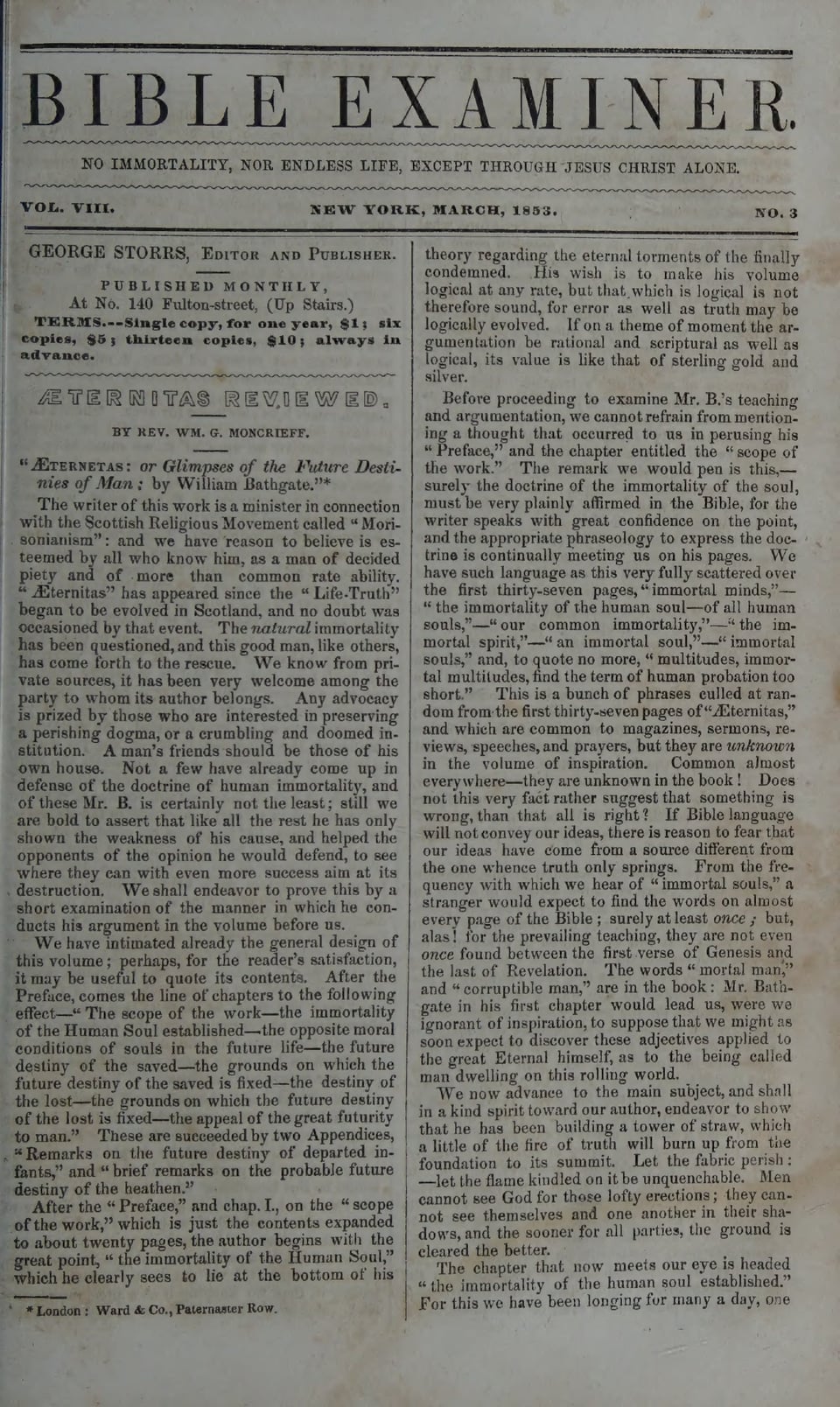
BIBLE EXAMINER.
NO IMMORTALITY, NOR ENDLESS LIFE, EXCEPT THROUGH JESUS CHRIST ALONE.
VOL. VIII.
NEW YORK, MARCH, 1853.
GEORGE STORRS, EDITOR AND PUBLISHER.
NO.3
PUBLISHED MONTHLY,
At No. 140 Fulton-street, (Up Stairs.)
TERMS.--Single copy, for one year, 1; six copies, 5; thirteen copies, $10; always in advance.
ETERNITAS REVIEWED.
BY REV. WM. G. MONCRIEFF.
"ETERNETAS : or Glimpses of the Future Destinies of Man : by William Bathgate."*
The writer of this work is a minister in connection with the Scottish Religious Movement called "Morisonianism": and we have reason to believe is esteemed by all who know him, as a man of decided piety and of more than common rate ability. "Eternitas" has appeared since the "Life-Truth" began to be evolved in Scotland, and no doubt was occasioned by that event. The natural immortality has been questioned, and this good man, like others, has come forth to the rescue. We know from private sources, it has been very welcome among the party to whom its author belongs. Any advocacy is prized by those who are interested in preserving a perishing dogma, or a crumbling and doomed institution. A man's friends should be those of his own house. Not a few have already come up in defense of the doctrine of human immortality, and of these Mr. B. is certainly not the least; still we are bold to assert that like all the rest he has only shown the weakness of his cause, and helped the opponents of the opinion he would defend, to see where they can with even more success aim at its destruction. We shall endeavor to prove this by a short examination of the manner in which he conducts his argument in the volume before us.
We have intimated already the general design of this volume; perhaps, for the reader's satisfaction, it may be useful to quote its contents. After the Preface, comes the line of chapters to the following effect—"The scope of the work—the immortality of the Human Soul established—the opposite moral conditions of souls in the future life—the future destiny of the saved—the grounds on which the future destiny of the saved is fixed—the destiny of the lost—the grounds on which the future destiny of the lost is fixed—the appeal of the great futurity to man." These are succeeded by two Appendices, "Remarks on the future destiny of departed infants," and "brief remarks on the probable future destiny of the heathen."
After the "Preface," and chap. I., on the "scope of the work," which is just the contents expanded to about twenty pages, the author begins with the great point, "the immortality of the Human Soul," which he clearly sees to lie at the bottom of his
theory regarding the eternal torments of the finally condemned. His wish is to make his volume logical at any rate, but that which is logical is not therefore sound, for error as well as truth may be logically evolved. If on a theme of moment the argumentation be rational and scriptural as well as logical, its value is like that of sterling gold and silver.
Before proceeding to examine Mr. B.'s teaching and argumentation, we cannot refrain from mentioning a thought that occurred to us in perusing his "Preface," and the chapter entitled the "scope of the work." The remark we would pen is this,—surely the doctrine of the immortality of the soul, must be very plainly affirmed in the Bible, for the writer speaks with great confidence on the point, and the appropriate phraseology to express the doctrine is continually meeting us on his pages. We have such language as this very fully scattered over the first thirty-seven pages, "immortal minds,"—"the immortality of the human soul—of all human souls,"—"our common immortality,"—"the immortal spirit,"—"an immortal soul,"—"immortal souls," and, to quote no more, "multitudes, immortal multitudes, find the term of human probation too short." This is a bunch of phrases culled at random from the first thirty-seven pages of "Eternitas," and which are common to magazines, sermons, reviews, speeches, and prayers, but they are unknown in the volume of inspiration. Common almost everywhere—they are unknown in the book! Does not this very fact rather suggest that something is wrong, than that all is right? If Bible language will not convey our ideas, there is reason to fear that our ideas have come from a source different from the one whence truth only springs. From the frequency with which we hear of "immortal souls," a stranger would expect to find the words on almost every page of the Bible; surely at least once; but, alas! for the prevailing teaching, they are not even once found between the first verse of Genesis and the last of Revelation. The words "mortal man," and "corruptible man," are in the book: Mr. Bathgate in his first chapter would lead us, were we ignorant of inspiration, to suppose that we might as soon expect to discover these adjectives applied to the great Eternal himself, as to the being called man dwelling on this rolling world.
We now advance to the main subject, and shall in a kind spirit toward our author, endeavor to show that he has been building a tower of straw, which a little of the fire of truth will burn up from the foundation to its summit. Let the fabric perish : let the flame kindled on it be unquenchable. Men cannot see God for those lofty erections; they cannot see themselves and one another in their shadows, and the sooner for all parties, the ground is cleared the better.
The chapter that now meets our eye is headed "the immortality of the human soul established." For this we have been longing for many a day, one writer after another has tried our arguments, but Mr. B.
is the first in Scotland who has manfully appeared, since the life-controversy began in that country, to establish the hoary dogma of immortal soulism. Honor to one who can face what others flee from or avoid! Our wish is gratified; we have here an attempt to do and that from Scripture, what we have often, in various ways, asserted could not be done. We can easily suppose with what a measure of relief one anxious about preserving his old faith, concerning souls, and a little tremulous at the thought that the old opinions were questioned, yea upon the whole validly questionable,—we say we can suppose how delivered such a brother must feel at reading the unhesitating, and manly title of this section of our author's treatise. Had it ran, "Is man immortal"? or "Who will live for ever"? or "What says inspiration about human souls, and human immortality"? the trembling brother could only have had his anxieties deepened; these titles would have suggested doubt, they would have indicated a conflict, a struggle, where there was a hope that doubt would have been excluded, and a conflict declared to be inadmissible. Our author's first sound is re-assuring: the very title must have a tranquillizing effect. "The immortality of the human soul established!" If every reader will append that at the close of the chapter, it would be more valuable. We do not blame the excellent writer for emblazoning the chapter we are about to examine. An author may head his chapters as he pleases; if the support does not prove itself able to bear the capital, the more striking will be the overthrow. We see not the writer's presumption, or arrogance in so heading a section of his treatise; we discern, however, the strength of his conviction that human immortality is demonstrable, and that he has afforded the demonstration.
"The question to be considered," says the author, "is at once simple and vast. Is the soul of man adapted and destined by its Maker to live for ever?" p. 38. "Oh! how flutteringly should the soul ask, Am I immortal"? p. 39.
As a stage toward the solution of this question, he remarks, "There are three aspects in which the immortality of the soul may be viewed—the possibility, the probability, and the certainty of human immortality. It will be granted by every man endowed with reason, that it is quite a possible thing that the soul which does live, may continue to live, and may continue to live during eternity." p. 40, 41. So much for the possibility of human immortality, which seems just as applicable to a midge or a butterfly. They live—they continue to live for a while, and he would be a rash man who would assert that it is beyond the power of Almighty God to preserve them in being for ever. It would be no greater effort for the Creator to produce an archangel than a midge; and if he can, and if he alone can, preserve the lofty being in existence eternally, the same energy could surely preserve the less. In reference to both, the grand question is—what is the intention of their Creator? What is the term of being assigned them in his infinitely wise and irreversible counsels? All creature immortality must necessarily be God-dependent, just as all creature life and being is suspended on the will and pleasure of Omnipotence; and to determine what he can preserve for ever, or will preserve for
ever, or what is fitted for being preserved for ever, by examining forms of existence, and modes, and properties, is to speculate in the veriest cloudland that imagination ever formed. The question of duration of being, pushes itself up to his will. What has God chosen and ordained? is the first and last inquiry. He can announce to us his will concerning the immortality of any being, in two ways, either by that being's perpetual preservation, or by a distinct intimation that it is immortal. Indeed the second is the only way, strictly speaking, in which we could learn any creature's deathlessness, inasmuch as however long we might see a creature preserved, and however difficult or impossible it might be for us to detect any causes of decay, it might, to our amazement, gradually or suddenly expire. The possession of life, is no pledge that it will be prolonged, much less continued for ever. Should God promise immortality, the case would be entirely different, but to be sure of it, we must have his word. Indeed, what we might judge to be seals, signs, or tokens of endlessness of being, may, apart from his plain promises, be things which we have misconstrued, and thereby only manifested our own hastiness and presumption. Concerning the creatures we have already mentioned, midges and butterflies, and all such beings, the world, with the exception, perhaps, of some among the Hindoos, admit that in their case death is not a seeming event, but a reality. In their case it is held to be an extinction of being: they are, posterior to that crisis, as if they had never existed. It is only when we deal with man that the real is generally changed into the apparent; that an event having signs in his case identical with the signs in theirs, is yet pronounced to be entirely different. As in transubstantiation, the thing seen is bread, and yet we are to believe it is, according to the Romanists, the body of the Lord Jesus; so here the event contemplated is death; it has all the signs and results of it as we understand it in all other cases within the sphere of our observation, but it appears we must understand that really there is no death—there is continuance of life in absence of all its tokens—a dark cloud fallen for a moment on a being through which he has passed,—a ripple on the stream of his unending duration. One would require great faith to receive the Popish dogma, and the other appears to need a no less extraordinary endowment. All appearances are against the opinion that life continues, and if it does continue, the demand we make is that we shall have the voice of God, so that we can place the evidence of the ear against the evidence of the eye, and the touch, and the nostrils. God can so enlighten us, but to no voice short of his will we yield our reason and our faith.
It would be a sad mistake indeed were we to assert that death was to men what it is to an inferior creature, when it no more ended their being than their birth did. The mistake would be mournful, and could not but work ill to all who made it. He would be our benefactor who would help us to see our error, and, if he could give us the testimony of heaven against our belief, we humbly conceive there is as much grace and honesty in us as to lead us to renounce the view which we hold to be the truth, and must retain till we get better reasons for rejecting it, than for keeping it as a precious possession. But surely it would be a no less deplorable fact in our history, that we believe that to be life which every sense and every faculty assured us was death; it could only be matched by him who can believe, if belief is not too dignified a word to apply to his mental operation, that a little bread can be changed into the body and blood, and even divinity of our Lord, and yet retain all its ordinary and sensible qualities.
How important then to have Divine instruction on the great question—when we see a man die, does a man really expire? When life seems to end has it only commenced in a sublimer sense, and to endure without pause or termination?
Edinburg, Scotland.
W. G. M.
"The Christian Examiner and Bible Advocate," is the name of a Magazine commenced by our brethren in England; of which, we suppose, Bro. Ham is Editor, though for some cause his name does not appear as such. It was commenced in November, but we did not receive a copy till just as our last was going to press, when the November, December, and January numbers all came at once. Better late than never. We hail it with joy, and are glad a light has been raised on the other side the Atlantic; knowing there is ability there to keep that light henceforth illuminating the moral hemisphere in that far-off land. May the Lord give strength and wisdom to our fellow-laborers, and abundantly encourage their hearts.
We shall draw largely from their magazine to enrich our own columns, and thus our friends will find, we trust, a rich feast, by means of this aid. We commence our extracts by giving in this number, the "Advertisement" of this new comer, and an article entitled, "A History of the Present Popular Opinions Concerning the Doctrine of Human Immortality," which will be read with much interest. They are as follows:—
ADVERTISEMENT.
"The distinguishing characteristic, the primary seal of Christianity, is TESTIMONY—is CONFESSION; and the greatest crime towards God, is SILENCE." PROFESSOR VINET.
PROFESSOR VINET.
This journal, as its name imports, is strictly religious in its character, and will have for its chief object the exposition and enforcement of certain doctrines, which, although not bearing the broad seal of popular orthodoxy, claim to be primary verities of the Bible. Ignoring altogether the authority of Creeds, and the standards of the sects, it will appeal solely to the sacred Scriptures as the only depository of the written revelation of God, and the exclusive arbiter of Christian truth. Its name, "The Christian Examiner and Bible Advocate," expresses its independence of all Creeds and Confessions, and implies its purpose to acknowledge the authority of the Word of the Lord only.
While not presumptuously arrogating to itself the comprehension of all revealed truth, the Christian Examiner yet professes to be the vehicle of a large and important mass of such truth as is but
very partially known and recognized by the churches. Its mission is to deliver a message, and therefore it will come before the public, not only with the lamp of the truth-seeker in its hand, but with a fully-written roll,-the copious transcription of truth already sought,-which it will essay to gradually unfold and commend to candid and intelligent truth-seekers, as the true teaching of the Word of God, with which it asks a careful, devout, and unprejudiced comparison.
The appearance of this journal has been partly prompted by the desire to concentrate the strength and influence of a growing number of independent Bible students, both in England and Scotland, who have fearlessly avowed their religious convictions on one or more of the chief topics which it proposes to advocate; and partly by the hope that in appealing to the intelligence, the conscience and avowed deference to the Bible of the popular churches, to succeed in convincing them that no small proportion of their time-honored belief has no other foundation than the fluctuating traditions of post-apostolic Christianity. The narrow sectarianism of religious periodicals generally forbids, not only the occasional utterance of our thoughts, but any utterance at all in their pages, which are devoted exclusively to that particular system of theology which the popular voice unites to honor. On this account, moreover, we are necessitated, if we would deliver our message, to establish a periodical of our own, for the exhibition of those scriptural doctrines which we conscientiously espouse and feel constrained to proclaim.
Our mission may give us that aspect of theological one-sidedness and dogmatism of which we complain in other religious contemporaries. We are the victims of a vicious system of sectarian exclusiveness, which the common consent of Christendom has agreed to establish. Our religious journals are ex-parte advocates, not arenas for earnest courteous controvertists to compare their convictions with the Christian Scriptures for the sake of coming to a common consent. We do, therefore, but submit to the conventional conditions of controversy, and become advocates of our own beliefs. Possessed with convictions, like our contemporaries, we necessarily take a doctrinal side; but we most earnestly disclaim anything like a desire to dictate to others what they should believe or reject. We stand aloof in spirit and purpose,—and we will strive in practice, too,—from that competition of infallibilities which demonstrates the Romanism of the Reformed Churches, and places their Protestantism in a posture so palpably puerile. We essay to commend the truth, as we perceive it, to every man's intelligence and conscience, and if our language be very decided, we trust it will not earn for us the demerit of being dictatorial, but be accepted as indicating very deep and sacred conviction.
Judging the churches, not by the theology of the Reformation, nor by any antecedent theologies whatever of the historic church, but by the theology of the Bible, we find them more or less wrong, even on primary doctrines of Scriptural Christianity. There is nothing presumptuous or peculiar in this judgment of ours. The goldly John Robinson, in his farewell exhortation to the Pilgrim Fathers of New England, said nearly two centuries and a half ago,—“For my part, I cannot sufficiently bewail the condition of the Reformed Churches, who are come to a period in religion, and will go at present no further than the instruments of their reformation.
The Lutherans cannot be drawn to go beyond what Luther saw, whatever part of his will our God has revealed to Calvin they will rather die than embrace it; and the Calvinists, you see, stick fast where they were left by that great man of God, who yet saw not all things. This is a misery much to be lamented, for though they were burning and shining lights in their times, yet they penetrated not into the whole counsel of God.” The popular faith in the fixity and perfection of the theology of the Reformation, has become an irrational and dangerous superstition. The same enlightened man just quoted closed his parting address with these words.—“It is not possible the Christian world should come so lately out of such thick anti-christian darkness, and that perfection of knowledge should break forth at once.” They who are ever and anon appealing to the Reformation and making it their Bible instead of the Word of God, need to ponder these weighty words. Many of the wisest and best men of God have had their doubts in reference to the scriptural orthodoxy of the churches. The language of Dr. Vinet, the Chalmers of Switzerland as he has been called, is very significant:—“Even now, after eighteen centuries of Christianity, we are very probably involved in some enormous error, of which Christianity will at some future time make us ashamed.” It is our humble belief that we, in common with not a few Christian brethren both on this and the other side of the Atlantic, have been led to see more than one “enormous error” in the faith of popular Christendom. The Constitution of Man; the State of the Dead intermediate between death and resurrection; the Future Punishment; the Doctrine of Redemption; the Theology of the Cross; the Second Advent, and the Kingdom of the Messiah, abound in radical errors in their popular presentation. That scriptural views are possessed by others than ourselves on all these grand topics of revealed truth, we rejoice to be assured. We believe that a comparison of creeds, even among the larger ecclesiastical communions, now widely sundered from each other by doctrinal antipathies, would be a means of eliciting more truth, and of complementing, to some extent, each others’ doctrinal deficiencies. An Eclectic Church would be a more truthful society than any of the existing communions out of which it was formed; but even an eclectic Christianity would stand in need of a careful comparison with the Christianity of the Bible to purify it of many traditional errors, and raise it to the standard of scriptural integrity. By these remarks we wish not to be understood as commending such a process of doctrinal purification, or as suggesting the course which we design to pursue in gathering together the scattered doctrines of Christian truth,—our appeal, first and last, will be to the Bible as the shortest, safest and most respectful course.
Having candidly avowed the fact, that we deviate considerably from the acknowledged standards of popular orthodoxy, we shall not be chargeable with concealing our real character, and seeking by jesuitical processes to undermine the faith of the unwary. We believe that we have the truth on great vital points of Christian revelation, and that we have
only to place our convictions before an intelligent truth-seeking public to secure their approval. Concealment, therefore, is what we most deprecate; we have nothing to hope from a doctrinal disguise. To succeed in our mission we must preach from the house-top, and on the market-place, in the plainest and most unambiguous phrase. We essay to proselyte by the power of Scripture evidence,—to make converts, not only from the ranks of the irreligious, but also from the popular churches, which are weary and wearing away under the weight of their theological traditions. Our success is conditional on Christian candour and plainness of speech. What we have to say, and think worth saying, we shall fearlessly say; no one will find fault with our reserve. We are ambitious to be able to say, with the Apostle to the Gentiles, we "have kept back nothing that was profitable" for our readers. Let us have, therefore, full credit for candor, and we hope not to forfeit the commendation for all due courtesy.
In the age in which we live, our only safeguard is the acknowledgment and enforcement of truth. The tremulous fear of truth among professing Christians, in these inquisitive times, is fraught with danger, the symptoms of which have long been apparent in the declining confidence and fervor of religious people, and the gradual secession from the churches of some of the best and purest minds. Enemies from without are active in their assaults upon the questionable faith of the popular churches; but there is a more active and dangerous foe within the very bosom of the churches themselves. This foe we may denominate Theological Toryism,—an infatuated conservatism of whatever has the imprimatur of the past, no small portion of which consists of the theorizings of a twilight time, and against which, as falsely denominated Christianity, infidelity is ever and anon directing its most furious and successful assaults. Preachers and people have acquired an axiomatic arrogance, which rudely repels all reason and reflection on certain speculative inferences which they have raised to the rank of "fundamental truths." With a strange infatuation the churches have gone on multiplying their "fundamental truths" until, like unwise "masterbuilders," they are fated to see their faith of many foundations tottering on its multifarious bottom, and threatening to tumble down altogether. Although it has been plain as the sun in the firmament that "other foundation can no man lay than that is laid, which is Jesus Christ," they have failed to to see this obvious truth. There can be but one fundamental truth: no building has more than one foundation: unity in the superstructure demands unity in the foundation. The popular churches have many superstructures corresponding to their many foundations, and on these heterogeneous structures there is no possibility of putting the topstone of unity. Wise people see this clearly enough, but the Churches and the Evangelical Alliance having eyes see not. The chief danger to the churches of popular Christendom lies in their conservatism of these so-called "fundamental truths."
Popery is powerful against popular Protestantism chiefly in consequence of Protestant concessions. The conservatism of Protestant infallibility has obliged it to concede too much. The Bible shows a "short and easy method" with Roman Popery, which sweeps away at one breath a host of its hydra-headed heresies.
But Protestants of the orthodox school are at-one with Popery on some "fundamental" points. The Immortality and Separate State of the Soul has been conceded to Popery, and this concession has been turned to profitable account. The Worship of the Virgin, the Invocation of Saints, Purgatory, Indulgences, Masses for the Dead, all stand upon this "fundamental" doctrine, common to both Popery and Protestantism. No wonder that with this among its "fundamental" doctrines Protestantism has built up a superstructure of Puseyism. The most successful antagonist of Popery, both Roman and Reformed, will be the man who has delved his divinity from the Bible, which counsels a crusade against the conceited conservatism of the churches. The policy of the churches has long been suicidal, if not of themselves as religious organizations, certainly of their success as propagandists of the faith. Reform is needed,—yea, radical reform,—and reform there must be. New light has broken upon the world, let us see it and rejoice therein. Away with the thick darkness of your antiquated beliefs, which have too long already extinguished the eternal sunlight of God's blessed Word! Let the light come! for we have well nigh lost all spiritual sight beneath the sombre shield of your opaque orthodoxy. The Bible breathes anew! let its vitalizing breath be felt. Bread!—"living bread," bread from heaven,—does the Bible bring us; let our famishing souls be fed in this wide-spread famine of the faith!
It is moreover our conviction that not only the doctrines, but also the ecclesiastical polity of the Protestant Churches—Congregational as well as Episcopal,—needs a searching examination by the light of revealed truth, and that to submit the Churches to such a process would develop a radical unsoundness in their constitution. According to the New Testament representation, the Churches of Christ are religious Fellowships—Fraternities of the Faithful; but the "Churches" of modern Christendom are ecclesiastical organizations for the support of a professional priesthood and the systematic subjection of the people to a servile state of congregational pupilage. Against such a polity we protest as essentially worldly and corrupt, and to whose baneful influence we trace much of that spiritual declension of the "Churches" which is now so universally lamented. The reformation which we seek to promote is therefore ecclesiastical as well as doctrinal,—not only the matter, but also the mode of modern Christianity will be comprised in the sphere of our labors.
While much of our duty will lie in the department of Biblical exposition, we shall yet give some attention to whatever properly comes within the range of our general religious review. To preserve the distinctive character of this journal, we shall decline to intermeddle with many things of interest and importance in the progressive movements of our age, which now have numerous channels of communication with the public mind, and can, therefore, well afford to dispense with our assistance.
For the general contents, as well as for his own contributions in particular, the Editor holds himself responsible. He must not, however, be considered
as pledged to every sentiment which a writer may think proper to advance in its pages. Each writer, also, is responsible for his own contribution, and no more; and as a guarantee against misrepresentation, and for means of redress, no contribution involving matters of fact will be inserted, unless authenticated by the name and address of the writer in perfect confidence to the Editor.
"The Christian Examiner and Bible Advocate" is now commended to the blessing of the Great Head of the Church, and the practical sympathy of all its members who desire to know what Biblical Christianity is, and to see the Bible emancipated from that hollow profession of respect which popular orthodoxy affects, while it arrogantly assumes to itself the sovereign dictatorship of truth.
HISTORICAL INQUIRY.
BY EDITOR OF CHRISTIAN EXAMINER.
We propose in this first number of our journal to commence a historical inquiry into the present popular opinions of the doctrine of Human Immortality. The notions now current on this subject we believe to be altogether unscriptural, and a most mischievous corruption of Biblical Christianity. The unscriptural character of these current opinions we intend to discuss and disclose. At present we are but doctrinal chroniclers,—historians of opinions. Our inquiry will demonstrate that there is such a thing as an hereditary faith, not necessarily a Scriptural faith. We think it will demonstrate more,—that such a faith is the popular faith in the theory of the soul's intrinsic immortality.
THE APOSTOLIC FATHERS. THE FIRST AND SECOND CENTURIES.
The Apostolic Fathers, or Clement of Rome, Polycarp, Ignatius, Barnabas and the Pastor of Hermas, are so called as having been contemporaries with the Apostles of our Lord. Their opportunities of being informed concerning the doctrines of Christianity were therefore peculiar, and their testimony is of a corresponding value. Let us not, however, unduly exaggerate the doctrinal value of their writings; for although their opportunities were what we have stated, it is quite conceivable that other circumstances should tend to depreciate the value of their personal testimony. Their testimony is nevertheless valuable, if not authoritative; and by the clearer light of Scripture they may be read with considerable profit. In their writings, as in the sacred writings, we never meet with those conventional phrases of modern orthodoxy about the soul,—its separate state and immortality. "Immortal soul,"—"never-dying soul,"—"deathless soul,"—"separate soul,"—"disembodied soul,"—these and such like expressions are never to be met with in the canonical and primitive Scriptures. They belong to a more recent religious nomenclature. The prevailing opinions of the Apostolical Fathers are clearly set forth in their epistolary writings, where they uniformly speak as if they had no philosophy about the elementary constituents of the human constitution, but regarded man as one indivisible being, depending upon his organization for his personal existence. In the estimation of these early writers death was the absolute decease of the conscious being man, and he could only live after dissolution by being re-organized, or raised up from the dead.
They never allude to a state of consciousness between death and resurrection, but speak much of their hope in being raised out of their graves by their Lord,—"the Resurrection and the Life." It should strike the reader as very remarkable that the Apostolical Fathers never allude to a state of glorification for the righteous in a disembodied condition of existence, when this is the grand theme of modern Christian teaching and hope; and, on the other hand, that they so frequently and emphatically refer to a being raised up out of the grave, when the resurrection occupies so subordinate a place in the present popular creed and ordinary pulpit ministrations. The coming of Christ, too,—how they dwell upon and hail that event!—like the beloved Apostle, "Come, Lord Jesus!"—"Even so, come, Lord Jesus!" The second coming of Christ was a necessary and cardinal doctrine in the creed of those primitive saints, who, like their apostolical contemporary, "suffered the loss of all things" to "attain unto the resurrection of the dead."
But let them speak for themselves:—"Blessed are those priests," writes Clement, "who having finished their course before these times, have obtained a fruitful and perfect dissolution." . . .
"All the ages of the world, from Adam even unto this day, are passed away; but they who have been made perfect in love, by the grace of God, obtained a place [by inheritance, not yet by realization] among the righteous, and shall be made manifest in the judgment of the kingdom of Christ. For it is written, 'Enter into thy chambers for a little space, till my anger and indignation shall pass away: and I will remember THE GOOD DAY [the resurrection day], and will RAISE YOU UP OUT OF YOUR GRAVES.' (1 Ep. to Corinth.)
Says Polycarp, "If we please [the Lord] in this present world, we shall also be made partakers of that which is to come, according as he has promised to us that he will raise us from the dead, and that if we shall walk worthy of him, we shall also reign together with him." (Ep. to Philip.)
Ignatius, in the following quotation, expresses plainly his belief that immortality is not inherent in the human constitution, but a communication through Christ, as says the Apostle,—"The gift of God is eternal life [or immortality] through our Lord Jesus Christ." In his Epistle to the Ephesians, Ignatius writes,—"For this cause did the Lord suffer the ointment to be poured on his head [or was anointed for his burial]* that he might breathe the breath of immortality into his Church. Be not ye therefore anointed with the evil savor of the doctrine of the prince of this world, let him not take you captive from the life that is set before you." Again: "Men's ignorance was taken away, and the old kingdom abolished, God himself being made manifest in the form of a man, for the renewal of eternal life. From thence began what God had prepared; from thenceforth things were disturbed,
forasmuch as he designed to abolish death.” And yet again: “That ye [he says], breaking one and the same bread, which is the medicine of immortality, our antidote that we should not die, but live for ever in Christ Jesus.” In his Epistle to the Magnesians, Ignatius writes,—“Seeing then all things have an end, there are these two together set before us, death and life; and every one shall depart unto his proper place.” To the Trallians he writes: Jesus Christ “was truly raised from the dead by his Father, after the manner as He will raise up us who believe in Him, by Christ Jesus, without whom we have no true life.” To the Romans he writes: “For it is good for me to set from the world unto God, that I may rise again unto Him. But if I shall suffer, I shall then become the freeman of Jesus Christ, and shall rise free.” There is a very singular passage in the Epistle to the Smyrnæans which at first sight may appear to favor the notion that man can live in a state of disembodiment. “He [Christ] suffered truly, as he also truly raised up himself; and not as some unbelievers say, that he only seemed to suffer, they themselves only seeming to be. And as they believe so it shall happen unto them, when being divested of the body, they shall become mere spirits,” or incorporeal. That the reader may understand this passage, it is necessary to remark that Ignatius is here alluding to a very mischievous heresy which sprung up in the apostolic age, under the name of Docetism, or the doctrine of the Docetæ. This sect were so called because they professed the opinion that Christ did not really suffer and die on the cross, but only in appearance. They denied the reality of Christ’s corporeal nature, and maintained that his flesh and blood were phantasmal only. Their name, Docetæ, is derived from a Greek word signifying to seem or appear. Now, it is against the professors of this strange notion, that Christ was a mere phantom, that Ignatius directs his remarks. His language is obviously ironical. He certainly had no Scripture warrant for saying that these primitive heretics should live after death as disembodied souls, nor does he indeed say so. What he says virtually is, that when they are dead they shall pass away into mere phantoms,—or have no real existence. So far from according with the present popular notions of a state of disembodiment for the soul or spirit, this language makes directly against that notion; for it is the utterance of a malediction,—the ironical denunciation of a punishment suitable to the abettors of so silly a heresy. “I know,” he adds, “that even after his resurrection he was in the flesh: and I believe that he is still so. And when he came to those who were with Peter, he said unto them, ‘Take, handle me, and see that I am not an incorporeal demon.’” Not as some in our own day strangely imagine our Lord to mean, that he was not a disembodied human soul; because he said, ‘Handle me and see; for a spirit [not my spirit] hath not flesh and bones, as ye see me have.” “Behold my hands and my feet,” said our Lord, “that it is I myself,” not some other spiritual being,—or, as Ignatius expresses it, an “incorporeal demon.” Neither our Lord nor Ignatius make any allusion to such a notional entity as a disembodied soul, or spirit. This Apostolic Father treats at some length of this heresy, which it is easy to understand, was of a very pernicious character.
The following words express more emphatically his Docetic antagonism, and at the same time set forth his views of the future life, only through a resurrection from the dead. "If all these things were done only in show by our Lord, then do I also seem only to be bound." . . . "But much better would it be for them to receive it [that is, the doctrine of Christ's real humanity and passion on the cross, of which the eucharist was the symbol], that they might one day rise through it." The Apostolical Fathers opposed the error of the Docetæ, chiefly on the ground that it destroyed the reality of Christ's resurrection; for if he only seemed to suffer and die, he could only have seemed to rise again, and hence their Christian hope of
tivity, and consciousness, like the expired flame, had become extinguished. These primitive saints, in common with prophets and apostles, looked forward to the "good day,"—the day of the Lord's second coming, to open the graves of his slumbering ones, and redeem them from the dominion of death. Their hope was in a resurrection from the dead, hence they preached the resurrection of Christ as the evidence and pledge of his people's resurrection unto life, and jealously guarded this first principle of Christian doctrine against the contemporary heresies, among which that of the Docetæ was the chief. How unlike the degenerate theology of modern Christianity, in which the grand cardinal doctrine of Resurrection from the Dead is almost
future life, and its grand evidence and pledge, were both denied and destroyed. The doctrine of the Apostolical Fathers was that of the Apostles themselves, that "if Christ be not raised" from the dead, "faith is vain," and "they which are fallen asleep in Christ are perished;" because without a resurrection they cannot live again; and if Christ is not raised from the dead, but is still under the power of death and will ever remain so, then none will be raised,—there can be no future life,—all are "perished."
The object of Christ's mission is thus set forth by Barnabas in his Catholic Epistle,—"Now, how he suffered for us, seeing it was by men he underwent it, I will show you. The prophets having received from him the gift of prophecy, spake before concerning him; but he, that he might abolish death, and make known the resurrection from the dead, was content, as it was necessary, to appear in the flesh, that he might make good the promise belost sight of! The pagan philosophy of Plato, patronized by the popular churches, has substituted the doctrine of an independent human immortality, hence immortality as the gift of God by Christ is not known; it has taught the world to believe in a state of life during death, hence the modern Christianity has an imported phraseology about "departed souls," "immortal souls," "souls in glory," "souls in torments," of which the Scriptures and Apostolical Christians know nothing. A state of glorification immediately after death for the "disembodied soul," obviously supersedes the doctrine of a resurrection. Let the Churches of our degenerate modern Christendom mark the contrast between the scriptural and primitive doctrine of immortality and that doctrine as professed by themselves. Let them note the strange phenomena, that the Apostles and their contemporaries speak much of life as the gift of God by Christ, and life obtainable by resurrection, and never once allude to "im-
fore given to our fathers; and preparing himself a new people, might demonstrate to them, whilst he was upon earth, that after the resurrection he would judge the world." Now, as judgment precedes rewards and punishments, this language obviously implies that until the resurrection takes place there can be neither a state of reward nor punishment. "It is appointed unto men," says the Scripture, "once to die, but after this the judgment." Not, as the popular Christianity teaches, "after death" rewards and punishments,—then resurrection from the dead,—then judgment,—and then again rewards and punishments! Such bungling and confusion belong not to the revelation of Scripture nor the creed of the apostolical believers.
The passages bearing on this subject in the writings of the Pastor of Hermas are too numerous for quotation here. Suffice it to say, that he uniformly describes the condition of the unconverted as a state of death, and union with Christ as securing the hope
mortal souls," and " souls in glory," or " torment," at death; whereas both the Protestant and Popish Churches (the latter, indeed, to no small advantage) reverse this mode of preaching,-they preach in strange contradiction to inspired and primitive testimony, that man is immortal by natural constitution, and that he can live while he is dead. Thanks be to God, amidst this doctrinal degeneracy, Litera Scripta manet!
(To be Continued.)
ILLUSTRATION OF SCRIPTURE.—"The day thou eatest thereof thou shalt surely die." Gen. 2: 17. Hebrew, ki bium akalek memena muth temuth. Literally, in the day, or after the day, from the eating of it, dying, thou shalt die: bium, after, from the participle b, which is both a preposition and a prefix, and ium, a day depending on the context whether definite or not. Bayt or b, is render-
of a future and eternal life. Nothing can be plainer than that the Apostolical Fathers were consentaneous in the belief of the essential mortality of the human race; that they had no philosophy concerning the human nature corresponding to the Platonized Christian philosophy of modern times; and that their only expectation of the future life was by means of a resurrection from the dead. It is undeniable that they believed nothing about disembodied human souls, and a condition of rewards and punishments intermediate between death and resurrection. In this mortal interval, the dead, according to them, slumbered in "the land of forgetfulness." [Psa. 88:10-12.] Thought ceased its ac
ed in, against, to, after, &c. Numbers 28:26, sebothikam is rendered after your weeks. Hence, in the day, or from the day, or after the day. Ki bium akalek memenu muth (dying) temuth, (thou shalt die, muth. part, ben kal. dying, temuth, pers. masc. sing. fut kal. Thou shalt die. Thou shalt surely die. Marg. is not a full translation of muth temuth. This illustration is literal, and regarding Adam as mortal, makes his death certain after his disobedience, and yet gives him nine hundred and thirty years to die in. It defends God's word, independent of vain explanations, and proves the devil a liar. N. SUMMERBELL.
Christian Palladium.] BIBLE EXAMINER.
NEW YORK, MARCH, 1853.
AN APPEAL.—1. For Laborers. The cry comes up to us from every quarter for help on the great Life theme. Many of these calls I cannot comply with, and it gives me great pain to say, No. What shall be done? There are many whom God has given ability to speak, and speak well on the subject. Some of them are statedly ministering to one congregation, it may be in comfortable circumstances; but, beloved brethren, if your convictions are as mine were, before I removed from Philadelphia, there is a pressure on your spirit to go out into a wider field, where multitudes sit in darkness, on this great subject, and are thirsting for light. May their cry enter your heart and stir you up to go forth. The time is short, and there is little hope of reaching minds on the theme of the resurrection and the coming again of Christ from heaven except through the Life theme. Will you not then make an effort to pass out through the open door and into the field that God is now specially
opening for us? Those to whom you have ministered statedly, ought to thrust you out with deep concern for those who have not the light; but whether they do this or not, ought you not to take up your cross and go to the work? O, hear the cry of those who sit in darkness, and are fed on husks! Have we no heart to pity and help them? We must do it, brethren. May God help us to feel the woe that Paul felt if we preach not this gospel of "Life ONLY in Christ." Let all chains and shackles, of whatever nature or character, that hinder us in this work, be broken asunder, and let us come up like men of God to the work. But how are these laborers to be sustained? We appeal—
FOR FUNDS.—That there is no lack of funds in the hands of those who profess to believe the glorious doctrine of immortality through Christ alone, I know, and fear these funds will "eat their flesh, as it were fire," in the day of the Lord. The laborers themselves may be blame-worthy that more has not been contributed to help on the work, by not urging all to give as the Lord hath prospered them; and showing, that by withholding, they wrong God, themselves, and their fellow-men. Now, friends, we beseech you by the love of God—by the hope of life—by the anguish of God's suffering children, who are tortured with the "hellish" doctrine of endless misery, and fear the coming of Christ, if for no other reason, because of friends who they suppose must then go into endless torture—we beseech you by the Lord Jesus,
our Life-Giver, who though he was rich for our sakes became poor, that you will come up to the work of supplying these laborers with the pecuniary aid necessary to enable them to pursue their work without the burden on their minds, of a family suffering for help, or themselves for lack of necessary traveling expenses and raiment. Shall they be "helped after a Godly sort"? Do you ask, how that is? It is to "give liberally and upbraid not." GEO. STORRS.
PROVISIONARY COMMITTEE.—A few of us have assumed this name, with the determination to search out laborers, and proffer them help in the field of their labors, to scatter light on the Life theme. The spread of light on this subject is our only object. This we state frankly; not that we desire to restrict the laborers so that they will not feel themselves free on other topics; but this theme is the one upon which we shall aim to give light; and we now call upon all who love it to lend us a helping hand, by contributing to the funds, and by your counsel and prayers. We believe the time has come that God expects us all to show more fully our faith by our works. The living voice must be heard proclaiming Life in the name of Jesus alone; and those who make the proclamation must be sustained. Let all who have a willing mind send funds to the Provisionary Committee, in New York, or raise such a Committee in their own town or county, and act at once in this matter. HENRY A. CHITTENDEN.)
HENRY A. CHITTENDEN,
HENRY F. JOHNSON,
GEO. STORRS.
Prov.
Com.
New-York, March 1st, 1853.
"MAN IN DEATH," AND "LIFE AND DEATH." These works by J. Panton Ham, published in the double Examiner last year, have been circulated to considerable extent, and we have given several hundreds of them as a premium to our subscribers for early remittances to the Examiner. The price we have greatly reduced, as we were enabled to do after the first edition was taken up. The third edition has now been published, and we have concluded to make a further reduction in the price, in hope that the friends of truth will scatter them still more widely.
We will, for the present, put those double Examiners at ten cents per copy, retail; or, six dollars per hundred. At this price we shall expect the cash with the order. The postage on them, if pre-paid, is one cent per copy; so that if ordered by mail, they will cost you but 7 per hundred. For 1 we will send ten copies and pre-pay the postage; or, for $2 we will send 24 copies and prepay the postage. Let us have your orders at once.
FROM ENGLAND.
We rejoice to be able to treat our readers with the following letter from Br. White. We have long desired to hear from him again.—Ed.
CAMDEN TOWN, LONDON. Jan. 24,1853.
To the Editor of the Bible Examiner.
DEAR BROTHER:—As you kindly write to me regularly once a month, by sending your Examiner, I consider myself much in your debt as a correspondent. Accept my best thanks for each and all of your favors. Our friends Dobney, Moncrieff, and Ham keep you, I perceive, pretty well informed of the progress of opinion in England, on the subject of Human Immortality. Every new truth has to struggle very hard for a living on this side of the water, as Englishmen are highly conservative in all matters pertaining to theology. Nevertheless it is unquestionable that the truth is making way in Great Britain. Our converts are, to a remarkable extent, among the most spiritual persons in the religious communities, and each one therefore becomes an earnest missionary in the promulgation of the doctrine. The confidence of denunciation with which we were assailed at first, is sensibly diminished—and I have not noticed any public attack upon the doctrine of Life in Christ, for several years past, in the magazines. Several persons of much consideration in the literary world, have openly expressed their sympathy with us, among whom may be mentioned Sir James Stephen, Professor of History at the University at Cambridge, one of the principal writers in the Edinburgh Review, and author of Lectures on the History of France. He is a man of great authority in this country, and since Englishmen always ask first, not for the evidence, but for the authority, it is very useful to be able to affirm that at least some of "the Scribes and Pharisees have believed."
The letter of John Foster, on Future Punishment, addressed to myself ten years ago, and lately reprinted in your Examiner, still does good service amongst us, as a general introduction to the controversy. It has been recently reprinted in a cheaper edition of his Life and Correspondence, and will doubtless open the question in multitudes of minds in years to come. The whole state of religious philosophy in England, however, I regret to say, is unfavorable to our enterprise. Theology is not the study of the day, particularly scriptural theology. Low ideas of the authority of the Bible militate against a reverent study of its doctrines; and an overweening conceit of the unassisted powers of the human mind in the discovery of truth leads to a corresponding distaste for submission to the
form of sound words prescribed by Apostles and Prophets. Add to this, that our doctrine is considered unsafe for the multitude, and you cannot wonder that we have to swim against a powerful stream. But our conviction is unchanged, that all the danger is not on the side of misrepresenting the justice of God: there are at least equal dangers in misrepresenting his goodness. It must be as unsafe to render the love of God unintelligible to man, as ever it can be to prevent their view of his righteousness. The common opinions, however, have the double disadvantage of obscuring both at once.
Since last writing to you, I have removed to London, and have been for the last nine months occupied in preaching the Word of Life, in St. Paul's chapel, Hawley Road, Camden Town, to a new congregation. You will not doubt that there has been a very clear manifestation of the doctrine of Life in Christ,—the first, I believe, made in this mighty metropolis. The neighborhood is as might be expected, much shocked at the novelty, but there are around us some admirable men, who having counted the cost, stand by me, and second every effort by their sympathy and prayers. The chief of these is Mr. Haddon, for fifty years a printer in London, a man universally known among the English Baptists, and lately first deacon of John Howard Hinton:—one who has rendered perhaps more service to the cause here, by the weight of his character, than any other "layman." I trust it may please our Lord to enable me to inform you before long, that we have great success. At present I can only say that numbers are beginning to read and inquire, the fruits of which we shall see in after days.
In the west of England, Mr. Ham, of Bristol, (converted to our views by accidentally reading a copy of the Lectures on Life in Christ,) has distinguished himself as a most earnest promulgator of the main truth. I see that you have reprinted his Lectures. He goes farther than either Mr. Dobney or myself on the question of the intermediate state, and is in agreement on that matter with your friends and Br. Moncrieff. There have been reports recently circulated respecting his views of the Atonement—to the effect that he has become radically unsound on the doctrine of Propitiation, and these reports have served to assist the adversaries to an unlimited extent by enabling them to allege that we are a set of socinians altogether. But in the first place, I have no reason to believe in these reports;—and, secondly, if I had, it is very certain that Mr. Ham would encounter, from all the principal advocates of the truth in England, the most unflinching opposition, so that he would stand much alone in his sociinianism.
But, as I said, these reports are far more probably weak inventions of the enemy, to which no credit is to be attached. Very likely he has, as who has not, favorite methods of stating the doctrine of propitiation, which by no means make void the sacrificial language of the New Testament. He is a man of ardent zeal, and has endured a great fight of afflictions in Bristol, from his brethren in the ministry. I saw much of him at a time when he forsook all things for the truth as it is in Jesus; and had the pleasure of being present at the opening of his chapel. In point of zeal he outstrips us all in Great Britian; and is much beloved by those who know him best.
Now, my dear sir, forgive this rambling letter. Go on and prosper! Let us not waver in the conviction that the popular doctrine of the immortality of the soul is the very chief device of the devil for hiding the glory of Christ, and for producing infidelity by the terrific consequences that flow from it. It it my deepening conviction that it is almost impossible to compress more of the quintessence of infernal falsehood into a few words than is contained in the proposition that the soul of man is immortal. This is indeed strong language, but the strongest language feebly represents the importance of Divine Truth. Truth is the life of God—the word by which he gives life eternal to us. It is unspeakably sacred; and therefore the adversaries of truth are not to be smoothed down in their wilful opposition to it. If the doctrine of natural immortality be so important, why is it not in the Bible: why is the Bible so full of declarations of the glory of the Life-Giver, so devoid of all references to the immortality of man? We want more boldness. The adversaries ever quail before a regular marshalling of the evidence. The righteous may well be bold as lions. How can the people be taught affectionately to love God, so long as they are led to believe that it is His intention to torment throughout boundless eternity all those pagan nations from pole to pole, whom He has himself declared that, "He suffered to walk in their own ways," without sending them one single warning to escape from that impending doom? Blow then your monthly trumpet more and more loudly, till all men understand that it is not a mere unintelligible theological proposition that GOD IS LOVE, but the great fact of both time and eternity. The Lord preserveth all them that love him: but all the wicked will he destroy.
I am, dear Brother Storrs,
Yours, faithfully,
EDWARD WHITE.
"THE FRENCH EMPIRE." Norwalk, Ohio, Jan. 18, 1853.
Bro. Storrs: I am happy to perceive your attention has been turned, by the recent events in France, to a re-examination of the 17th chapter of Revelations. As I feel an anxious desire that the truth might be brought out and made manifest to the minds of the brethren, I take the liberty of suggesting some objections, that have arisen in my mind, to your arguments and conclusions. If, however, after a careful examination, you discover that my exceptions are not well taken, you will greatly oblige me, and perhaps others, by pointing out their defects. By thus doing, you may remove strong objections to your application of this chapter.
My two first exceptions will be considered unitedly, and are—1st, to your declaration, that in prophecy the term beast denotes only a Dynasty or body of civil rulers, not including the ruled or subjects; and 2nd, That the scarlet beast of this chapter is a symbol of the French empire under the Napoleons the 1st and 3rd. My reasons are as follows:—In the 2nd chap. of Daniel, the great metallic image symbolizes forth four successive universal kingdoms, covering all time from the days of Nebuchadnezzar till the second advent of Christ. Each kingdom, during their day, under their modified or diversified forms of government, comprehends the earth, including Rulers, the Ruled, and territory. The same thing is clearly taught by the four great wild beasts of the 7th chapter. After the fourth takes the dominion, it has it till the end.
In the natural world, when the term Beast is used, the idea is conveyed to the mind of an animal having a body, head, &c. As the organ of volition is located in the head, of course, the office of governing or controlling (at least its own body,) devolves upon the head. So also in prophecy, both in Daniel and Revelation, the term beast comprehends the prophetic part of the world: whilst heads denote dynasties of rules, or forms of government that control its body. Hence, the form, whether regal, republican, imperial, or papal, cannot affect or destroy the proper sense of the term BEAST, when used to designate the acts of any of its said forms.
The seven different forms, you virtually admit, are consecutive. The sixth, you admit, was imperial Rome; and of course universal; for a decree went forth under Cæsar Augustus that all the world should be taxed. The eighth head, of course, belongs to the scarlet colored beast of chapter 17. That beast is made up of and constitutes the many peoples, and multitudes, and nations, and tongues of earth, upon which the great Harlot sitteth, viz., "that great city which hath a kingdom over the kings of the earth." This language justifies the conclusion, that this beast will be as comprehensive as the feet and toes of the metallic image, when the stone strikes it upon the feet; or the fourth beast of the 7th of Daniel, when his body is destroyed, &c. Hence, I conceive you in error in both points of your application; otherwise the French monarchy must become another universal kingdom like those of antiquity, embracing the earth; which conclusion is forbade by the unerring word of prophecy. Should you however change your phraseology so as to make that empire only the eighth headship, or form of government, still that view would not be free from objections; because in order to fulfill the prophecy, its authority must become universal over the entire body of the beast, which is the prophetic world.
…