The Bible Examiner — Vol. 8, No. 5 (May, 1853)
Download: PDF — The Bible Examiner — Vol. 8, No. 5 (May, 1853)
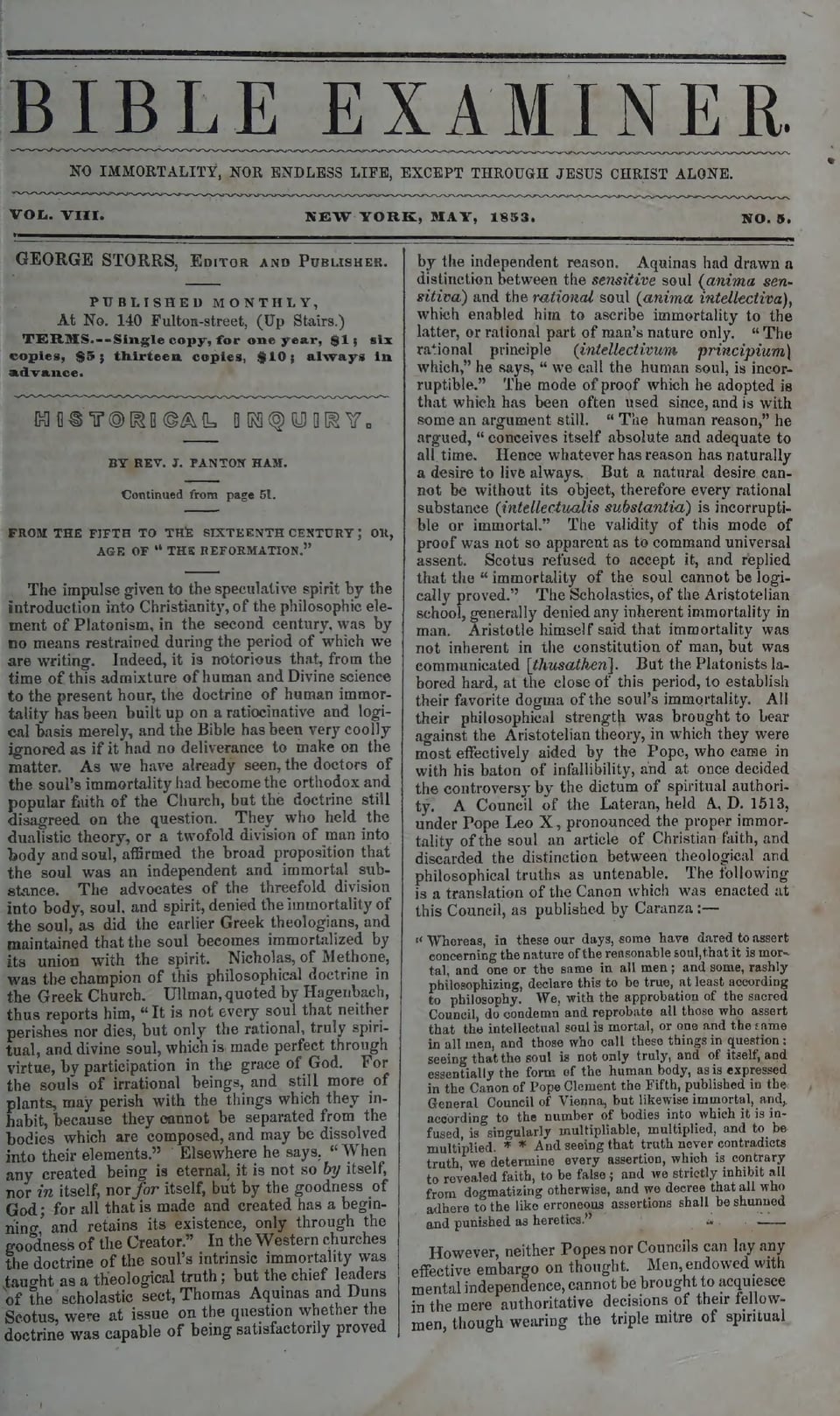
BIBLE EXAMINER.
NO IMMORTALITY, NOR ENDLESS LIFE, EXCEPT THROUGH JESUS CHRIST ALONE.
VOL. VIII.
NEW YORK, MAY, 1853.
GEORGE STORRS, EDITOR AND PUBLISHER.
NO. 5.
PUBLISHED MONTHLY, At No.140 Fulton-street, (Up Stairs.)
TERMS.--Single copy, for one year, 1; six copies, 5; thirteen copies, $10; always in advance.
HISTORICAL INQUIRY.
BY REV. J. PANTON HAM.
Continued from page 51.
FROM THE FIFTH TO THE SIXTEENTH CENTURY; OR, AGE OF "THE REFORMATION."
The impulse given to the speculative spirit by the introduction into Christianity, of the philosophic element of Platonism, in the second century, was by no means restrained during the period of which we are writing. Indeed, it is notorious that, from the time of this admixture of human and Divine science to the present hour, the doctrine of human immortality has been built up on a ratiocinative and logical basis merely, and the Bible has been very coolly ignored as if it had no deliverance to make on the matter. As we have already seen, the doctors of the soul's immortality had become the orthodox and popular faith of the Church, but the doctrine still disagreed on the question. They who held the dualistic theory, or a twofold division of man into body and soul, affirmed the broad proposition that the soul was an independent and immortal substance. The advocates of the threefold division into body, soul, and spirit, denied the immortality of the soul, as did the earlier Greek theologians, and maintained that the soul becomes immortalized by its union with the spirit. Nicholas, of Methone, was the champion of this philosophical doctrine in the Greek Church. Ullman, quoted by Hagenbach, thus reports him, "It is not every soul that neither perishes nor dies, but only the rational, truly spiritual, and divine soul, which is made perfect through virtue, by participation in the grace of God. For the souls of irrational beings, and still more of plants, may perish with the things which they inhabit, because they cannot be separated from the bodies which are composed, and may be dissolved into their elements." Elsewhere he says, "When any created being is eternal, it is not so by itself, nor in itself, nor for itself, but by the goodness of God; for all that is made and created has a beginning, and retains its existence, only through the goodness of the Creator." In the Western churches the doctrine of the soul's intrinsic immortality was taught as a theological truth; but the chief leaders of the scholastic sect, Thomas Aquinas and Duns Scotus, were at issue on the question whether the doctrine was capable of being satisfactorily proved
by the independent reason. Aquinas had drawn a distinction between the sensitive soul (anima sensitiva) and the rational soul (anima intellectiva), which enabled him to ascribe immortality to the latter, or rational part of man's nature only. "The rational principle (intellectivum principium) which," he says, "we call the human soul, is incorruptible." The mode of proof which he adopted is that which has been often used since, and is with some an argument still. "The human reason," he argued, "conceives itself absolute and adequate to all time. Hence whatever has reason has naturally a desire to live always. But a natural desire cannot be without its object, therefore every rational substance (intellectualis substantia) is incorruptible or immortal." The validity of this mode of proof was not so apparent as to command universal assent. Scotus refused to accept it, and replied that the "immortality of the soul cannot be logically proved." The Scholastics, of the Aristotelian school, generally denied any inherent immortality in man. Aristotle himself said that immortality was not inherent in the constitution of man, but was communicated [thusathen]. But the Platonists labored hard, at the close of this period, to establish their favorite dogma of the soul's immortality. All their philosophical strength was brought to bear against the Aristotelian theory, in which they were most effectively aided by the Pope, who came in with his baton of infallibility, and at once decided the controversy by the dictum of spiritual authority. A Council of the Lateran, held A.D. 1513, under Pope Leo X, pronounced the proper immortality of the soul an article of Christian faith, and discarded the distinction between theological and philosophical truths as untenable. The following is a translation of the Canon which was enacted at this Council, as published by Caranza:—
However, neither Popes nor Councils can lay any effective embargo on thought. Men, endowed with mental independence, cannot be brought to acquiesce in the mere authoritative decisions of their fellowmen, though wearing the triple mitre of spiritual absolutism.
And this Council, Luther says, was of so little authority as to be laughed at and despised by the Romanists themselves. The most notable philosopher of Italy, in Leo's time, was Pietro Pomponazzo. This distinguished man took upon himself to maintain that the soul is absolutely mortal. Extracts from Papal letters by Contelori, show that Pietro was immediately and peremptorily assailed on the opinion which he had avowed. "Pietro, of Mantua," it is there said, "has asserted that, according to the principles of philosophy, and the opinion of Aristotle, the rational soul is, or appears to be mortal, contrary to the determination of the Lateran Council. The Pope commands that the said Pietro retract, or otherwise that he be proceeded against." The Pontificate of Leo was an epoch in the history of the doctrine of the soul's immortality. It was then that the successful effort was made to establish and give permanence to this doctrine; but it was made by a usurper of the right of private judgment, and accomplished by an act of sacerdotal despotism. The advocates of the doctrine of the soul's immortality need to be reminded of this suspicious passage in its historic progress. The seal of authority was annexed to it by a Roman Pontiff, in the dawn of the sixteenth century,—a man, the worthy counterpart of England's Charles II.,—fond of fashion and field sports, and mixing up in all the dissipated excesses of the sacred metropolis. Such was his extravagance, that "the charge has been laid at his door," says Ranke, "that he ran through the wealth of three Pontificates,—that of his predecessor, from whom he inherited a considerable treasure; his own, and that of his successor, to whom he bequeathed a mass of debt." "It certainly cannot be denied," says the same historian, "that his life did not correspond to that befitting the supreme head of the Church." It was during the Pontificate of Leo the Tenth that Luther visited Rome, and where the licentiousness of the Papal court and clergy so astonished and disgusted him, that from that time his reverence for the Pope was completely and for ever destroyed. What must have been the corrupt influence of this Papal oracle of orthodoxy, when in Rome it was a characteristic of good society to dispute the fundamental elements of Christianity! "One passes no longer," says P. Ant. Bandino, "for an accomplished man, unless he entertain some heterodox notions of Christianity." "At Court," proceeds Ranke, "they spoke of the institutions of the Catholic Church, of passages in the Holy Scriptures, only in a tone of jesting; the mysteries of faith were held in derision." Such was Pope Leo the Tenth and such the circle of sanctified society of which he was the animating centre!—Behold, ye asserters of your own inherent immor-
—the hero of a hey-day heterodoxy!—the jolly jester with the solemn sanctities of Scripture!—the mocker of the sacred mysteries! Worthy patron of a Pagan progeny! Let it be registered as the genuine genealogy of a fundamental doctrine of modern British Christendom, that the Pagan Plato was its father, and the profligate Pope Leo its foster-father. Born and bred by the Pagan Philosophy and the protege of Popery, this notion of the soul's immortality has become a pet dogma of Popular Protestantism, which, with a strange forgetfulness of its low lineage, openly declares it to be the honorable offspring of a true orthodoxy!
FROM THE REFORMATION TO THE PRESENT TIME.
Papal influence had been declining for some time previous to the Reformation; but by the dawn of the sixteenth century, it reached the nadir of its popularity. The character of Leo X., and the condition of his Court, as we have already seen, were anything but adapted to inspire respect for the triple crown. As the symbol of a spiritual dominion, it was very generally despised, and only a suitable opportunity was wanted to give unmistakable expression to the reactionary feeling which extensively pervaded this age. Luther afforded this opportunity; and by his manly though perilous course, delivered his own and subsequent generations from the powerful spell of Papal absolutism. The great German Reformer assumed an unwonted position in the giant presence of Papal infallibility. The old orthodox obsequiousness was spurned by the strong individuality and godly sincerity of his spirit. He spoke disdainfully of the decrees of Popes, after he discovered the deference due to the Word of God. The decrees of Pope Leo, for the reasons before assigned, he had a special contempt for. He thus ironically responded to the decree of the Council of the Lateran held during the pontificate of this Pope:
"I permit the Pope to make articles of faith for himself and his faithful,—such as the soul is the substantial form of the human body.—the soul is immortal,—with all those monstrous opinions to be found in the Roman dunghill of secretals; that such as his faith is, such may be his gospel, such his disciples, and such his church, that the mouth may have meat suitable for it, and the dish a cover worthy of it." The belief of Luther is plainly expressed in these words, on the doctrine of the soul's immortality; it is evident that he refused to acknowledge this doctrine. The philosophy of Luther led him to conceive of the human soul as a distinct, but not an immortal, subsistence. The soul, he imagined, was separated from the body in death; but he did not believe in its continued consciousness between death and resurrection. He embraced and taught the doctrine of the sleep of the soul, and continued in that belief to the close of his life.
The prominence given by Luther to the doctrines of the non-immortality of the soul, and its unconsciousness in death, induced Sir Thomas More to publish a work in reply, objecting to the views advocated by the Reformer. This reply of More's called another distinguished witness into the arena of controversy,—William Tyndale, the translator: "In putting departed souls in heaven, hell, and purgatory," says Tyndale, "you destroy the arguments wherewith Christ and Paul prove the resurrection. What God doth with them, that shall we know when we come to them. The true faith putteth the resurrection, which we be warned to look for every hour. The heathen philosophers denying that, did put that souls did ever live. And the Pope joineth the spiritual doctrine of Christ and the fleshly doctrine of philosophers together,—things so contrary that they cannot agree...And because the fleshly-minded Pope consenteth unto heathen doctrine, therefore he corrupteth the Scriptures to establish it...If the souls be in heaven, tell me why they be not in as good case as the angels be? And then what cause is there of the resurrection?" Sir Thomas More asked,—"What shall he care, how long he live in sin that believeth Luther, that he shall after this life feel neither good nor evil in body nor soul, until the day of doom?"
To which Tyndale replied,—" Christ and his Apostles taught no other, but warned to look for Christ's coming again every hour; which coming again, because ye believe will never be, therefore have ye feigned that other merchandize."
The above quotations prove that the present popular doctrines of the immortality of the soul, and a state of conscious life between death and resurrection, were not doctrines held by Luther and the first Reformers. Luther calls them "monstrous opinions,"—and Tyndale declares that they were "heathen" and "fleshly doctrines," and subversive of the Scripture doctrines of Christ's second coming and the resurrection from the dead.
Calvin now entered the arena, by the publication of a tractate entitled "Psychopannychia," a word of Greek derivation, intended to express the idea that the soul is awake in a state of consciousness thro' the whole night of death. "As to the book itself," writes an anonymous reviewer in the year 1772, "it is hot, furious, and abusive. The Hypnologists [sleep-preachers] as he [Calvin] calls them, are babblers, madmen, dreamers, drunkards, &c. Happily for them, his arguments are as feeble and sophistical as they themselves could wish." From Calvin's time, the doctrine of the soul's immortality, and its dependent dogmas, have gradually found their way into the several Protestant confessions; and to this hour, these heathen heresies are accepted by the Romish, and all the Reformed Churches, as Christian verities.
In the year 1706, Henry Dodwell, a clergyman of celebrity, espoused the doctrine of the mortality of the soul, and so revived the controversy. He associated, however, with his subject some singular notions, the nature of which will be best perceived by the following copy of the title page of his book. "An Epistolary Discourse, proving from the Scriptures, and the First Fathers, that the Soul is a Principle Naturally Mortal; but Immortalized actually by the pleasure of God to Punishment, or to Reward, by its Union with the Divine Baptismal Spirit. Wherein is Proved that none have the power of giving this Divine Immortalizing Spirit, since the Apostles, but only the Bishops." [!!] This book called out several antagonists; and the "learned Dodwell," as he was respectfully called, had the satisfaction of seeing this question of the soul's immortality again very widely agitated, and warmly debated.
The controversy throughout has, as we have seen, been too much mixed up with philosophical and ecclesiastical tradition. The Reformers spoke of the sleep of the soul, implying the old Platonic idea, that the soul is a distinct subsistence,—and, indeed, that it is the essential human being in a state of torpor, which they called its "sleep" or "rest." Dodwell reasons like a clerical believer in baptismal regeneration, differing from the modern Tractarian school in this respect,—that his regeneration was physical, whereas theirs is spiritual only. It has remained to our own times, to see the doctrine put in its proper light, although it is still but very imperfectly apprehended by some advocates, as well as opponents. The true statement of the doctrine, we apprehend, does not concern the soul, or spirit,—but MAN. We should not ask
whether the soul is mortal or immortal; but whether man is one or the other. The Scripture teaches nothing about the soul as a subsistence distinct from the body. Man is sometimes called flesh, and sometimes soul,—"All flesh," "Man became a living soul," &c.
Bishop Law, the author of the "Call to the Unconverted," in an "Appendix" to his "Considerations on the Theory of Religion," published in 1755, shook to its foundations the popular doctrine of a conscious intermediate state. Dr. Warburton also laid himself open to the suspicion of heterodoxy on this subject, in his third edition of the "Divine Legation of Moses," published in 1752. In his fourth edition of that work, he altered his phraseology, which had given occasion to the suspicion, not however without incurring the charge of trimming to popular prejudice. Many eminent Biblical scholars, since Law's time, have turned their attention to this controversy. In the city of Norwich it was mooted by the labors of Mr. Bourne, and also by Mr. John Marsom, who, in addition to the publication of two small volumes, which have passed through two editions, advocated his opinions in the Monthly Repository. The controversy has passed through what we may call its philosophical period, and is now, by most thinking and well-read persons, acknowledged to be a Bible question. In this all but universal admission we rejoice, as tending to popularize a subject so necessary to be understood by all, whether learned or unlearned. We are thankful that the advanced intelligence of our own times has been through the fallacy of the "Argument from Reason;" and that such elaborate sophisms as Mr. Samuel Drew's "Essay" are universally voted to the shelf, as now altogether beside the question, which, at one time, they were thought so triumphantly to elucidate, and even to settle.
The theological writings of the learned Dr. Whately, Archbishop of Dublin, have exercised considerable influence in reviving the controversy in our own times. The scholastic popularity, as well as ecclesiastical eminence of this dignitary of the English Church, have secured for his writings an amount of attention and respect beyond those of his contemporaries. His work, entitled "A View of the Scripture Revelations concerning a Future State," has been extensively read by professional theologians; and since the publication of this book, many others have issued from the press, from the pens of both clergymen and Nonconformist ministers. The Rev. Reginald Courtenay, Rector of Thornton Watlass, issued, in the year 1843, a goodly octavo volume under the title of "The Future States," advocating the unpopular side of the question, and which he dedicated to Archbishop Whately. This was followed, in the ensuing year, by a little work called "Notes of Lectures," afterwards considerably amplified in a clever and closely reasoned book, published in 1846, by H. H. Dobney, a Baptist Minister, at Maidstone, entitled "The Scripture Doctrine of Future Punishment." Almost simultaneously with this work of Mr. Dobney's, appeared a volume from the pen of Mr. Edward White, a Congregational Minister, in Hereford. Mr. White's book, "Life in Christ," contains much valuable matter in defence of the non-immortality of man, and the final destruction of the wicked.
Since these works, others have issued from the press. Three Nonconformist ministers, one in Edinburgh, another in Bristol, and the third in Plymouth, have, in addition to their public testimony as preachers, put on record their convictions in pamphlets and larger works. Mr. W. Glen Moncrieff, a Congregational Minister in Edinburgh, has published his "Dialogues on Future Punishment," a work on "Soul," and is about to issue a companion to the foregoing, to be entitled "Spirit." Besides these, Mr. Moncrieff has edited a pamphlet by Mr. Grew, of Philadelphia, U. S., called the "Intermediate State." In the spring of 1849, Mr. J. Panton Ham, Congregational Minister, of Bristol, issued a volume of lectures on "Life and Death; or the Theology of the Bible in relation to Human Immortality." The first edition of this book sold in the first year of its publication; and a second, somewhat enlarged, was sent forth in the spring of 1851. As a supplement to this work, he issued another, entitled "The Generations Gathered and Gathering; or the Scripture Doctrine concerning Man in Death." Both these books have since been republished in New-York, U. S.
A distinguished writer against the popular doctrine of inherent natural immortality, has appeared in the person of the Regius Professor of Modern History, at Cambridge,—the Right Hon. Sir James Stephen. The views of this writer are very candidly expressed in "The Epilogue" to his recently published "Essays in Ecclesiastical Biography," a series of papers originally contributed to the Edinburgh Review. An attempt was made, in the University of which Sir James Stephen is a member and Professor, to affix the stigma of heresy on him for the publication of these opinions; the attempt, however, failed. The following report appeared in the Times newspaper, of Thursday, Oct. 30, 1851.—"Cambridge. Congregation.—The Professor of Modern History.—It was proposed by the Rev. Lucius Arthur, M. A., of Trinity College, to offer the following grace to the Senate, in connection with the works of Sir James Stephen: 'Cum falsa doctrina in religione omnino cavenda sit: Placeat vobis ut fiat inquisitio in opiniones a Professore Historiae recentiores vulgatas.' Essays in Eccles. Biography; the Epilogue. The grace was, however, rejected in the caput." All honor to the Senate for resisting this piece of clerical impertinence and tyranny!
It is due the untiring activity of Mr. Geo. Storrs, of New York, that we should make honorable mention of him, in connection with these controversies. Mr. Storrs is the editor of a monthly periodical, called the "Bible Examiner," and has written and preached very extensively on his side of the Atlantic. He has been testifying to these truths for the past twelve years, and been the means of raising up many advocates of these Gospel principles, in different parts of the States.
Once more the controversy is revived both in Great Britain and America, and has been publicly acknowledged by several writers, who have labored to fortify the popular faith. The Congregational Lecture of the late Dr. Winter Hamilton, entitled, "The Revealed Doctrine of Rewards and Punishments," and "Athanasia; or four books on Immortality," by the Rev. J. Howard Hinton, A.M., are the principal responses on the orthodox" side, in
Great Britain. Some writers and preachers, misapprehending the position of those who advocate the natural mortality of man, and that immortality is a gift of God communicated to believers only through Christ, have helped, by their unreflecting and angry impatience, to foment much bitter feeling, and to stir up a blind and uncharitable opposition. False and opprobrious epithets have been freely applied to the advocates of the so-called "new doctrine," a mode of warfare which is happily much less harmful than it used to be. It is now generally regarded as the evidence of a weak cause, or personal inability to defend a cause, when recourse is had to opprobrious name-calling, and offensive personalities. Bullying is not a legitimate weapon in the battle of truth, and can never be acceptable except to the bantling and the bigot. It is to be earnestly hoped, that these great fundamental inquiries will be prosecuted in the present age, in that spirit of seriousness and sanctity becoming their nature and importance. We may "contend earnestly for the faith," without discourtesy and uncharitableness towards those who differ from us; and a contest courteously carried on is most likely to result in a mutual agreement, and that in the truth.
A word, in conclusion, on the importance of the doctrinal inquiries which have been the subjects of this historical sketch. Some, convinced of the unscriptural character of the popular or "orthodox" doctrine of human immortality, and of the duty of laboring to disabuse the public mind of this false doctrine, yet disagree with those who inculcate the implied truth of an intermediate state of unconsciousness, as the condition of man between death and resurrection. With some, its offensiveness to our human sympathies is the reason why they would have it held in abeyance. With others, as Mr. Dobney, the Scriptures are considered not to have made a very clear and satisfactory deliverance on the subject; and again, with others, as Mr. Edward White, the state of intermediate unconsciousness is only the condition of the deceased wicked, the righteous being actually quickened or made alive at the time of their regeneration or conversion, and so passing, at the time of death, into a new state of disembodied existence. None of these objections appear to us to have any real validity. The sentimentality of the first may be passed by without notice. The opinions of Messrs. Dobney and White have received due respect elsewhere,* where, we think, it has been conclusively shown that the Scriptures abound in the most unambiguous and harmonious evidence in favor of the unconscious intermediate state. The relation of this doctrine to the Christian doctrines of resurrection, and the pre-millennial advent of Christ, is obvious. It adds a new emphasis to the cry, "Come, Lord Jesus!" and gives a prominence, unknown to the popular theology, to the official dignity of Christ, as the "Resurrection and the Life." Besides the aspect of this doctrine of unconsciousness in death to other related truths revealed in the Scriptures, its aspect towards certain errors is no less obvious and important. Deprive Popery of these two false dogmas,—the immortality of the soul, and its separate and conscious state in death,—and you deprive that monster system of spiritual wickedness of its prestige, and terrible influence.
Protestantism is weak in the presence of this ancient foe, because to a considerable extent, it stands on a common doctrinal platform. It grants to Popery the very foundations of its anti-scriptural and mischievous dogmas. Let Protestants echo the voice of the Bible through the length and breadth of the land, on the doctrine of immortality,—let them exhibit its decisive testimony against the pagan heresies of the soul's immortality, separate state, and consciousness in death, and this hoary heresiarch would meet with such an antagonist as it has never encountered before. Its deified Virgin, and its Pantheon of Saint-gods, could not stand before it,—to invoke them would appear, what it really is, a vain calling upon the silent dead. The great Popish bugbear, Purgatory, if there were no disembodied souls to be tortured therein, would pass away like a dark foul vapor from the abused imaginations of men; and Indulgences, that Popish scheme of raising money under false pretences, would be so thoroughly exposed, as to need an indulgent people to prevent a terrible popular reaction against the religious rascality of the whole Papal priesthood. The honor of God, the consistency of Christian doctrine, and the emancipation of mankind from the worst spiritual thraldom, unite to urge on this great doctrinal reformation. Every believer of these important truths should add the weight of his personal testimony, and cast in all his personal influence, to give prominence and success to such a controversy. There are laborers now in the high places of the field, bearing, almost single-handed and alone, the burden and heat of the day,—whose voice unites with the voice of God, of Christ, and of the truth, urging their fellow-believers to come openly to their help, and the help of the Lord, against the mighty. Let not this united appeal be in vain. The proof of faith is faithfulness. He that has convictions, if he have also a conscience, will confess. The claims are complete, which this divine cause makes on Christian candor and self-denial. We trust they will be reverently heeded, that this work of reform may be carried on to its final and triumphant consummation.
SCRIPTURE DOCTRINE OF FUTURE PUNISHMENT.
BY THE RIGHT HON. SIR JAMES STEPHEN, K.C.B.
Prof. of Modern History in the University of Cambridge.
The real, though often unavowed, ground of the doubts which are overclouding the spirits of so many of the nominal disciples of Christ, is the hopeless dejection with which they contemplate that part of the Christian scheme which is supposed to consign the vast majority of our race to a future state, in which woe inconceivable in amount, is also eternal in duration. From this doctrine the hearts of most men turn aside, not only with an instinctive horror, but with an invincible incredulity; and of those who believe that it really proceeded from the lips of Christ himself, many are sorely tempted by it either to doubt the divine authority of any of his words, or to destroy their meaning by conjectural evasions of their force.
There are, indeed, others to whom it appears irreverent and even impious to hold parley with such doubts at all. They forbid us to inquire whether the generally received sense of our Redeemer's language on this melancholy and overwhelming theme, be really the sense in which he spoke. They resent, as mere conceit and arrogance, the opposition of the human understanding to what they consider as the unequivocal declarations of the Son of God himself; and demand that every voice which would presume to controvert those declarations should be subdued into a submissive silence. And most just is the rebuke, and most reasonable the demand, if it be indeed the fact that our Divine Teacher has really revealed to us the eternity of the punishment inflicted in a future state for the sins of men in this life. For, as the truth of God is the corner-stone of all religion, so the truth of Christ is the cornerstone of Christianity.
Disclaiming, therefore, the very slightest sympathy with that arrogance which would reject any part of divine revelation on the ground of its inconsistency with the dogmas of human wisdom, we would yet (in the exercise of that freedom which all Protestants, in terms at least, assert for themselves and allow to others), venture to inquire, or rather to suggest the inquiry, whether any sufficient authority really exists for asserting that either Christ himself, or his Apostles, taught the doctrine of a penal retribution, which is to be "eternal" in the sense in which we believe the Deity Himself to be "eternal."
The Bible teaches us that Christ came into the world to bruise the serpent's head, to destroy the works of the devil, and to establish the kingdom of God; and Christ himself declared that "He saw Satan like lightning fall from Heaven." Is it reasonable to accept any construction of the other words of Christ, which would ascribe to the Spirit of Evil an eternal triumph over the Spirit of Good, in the persons of the vast majority of the race whom He lived and died to redeem?
Throughout the holy Scriptures a constant appeal is made to those moral sentiments which God has himself implanted in our nature. Our heavenly Father has graciously condescended everywhere to point out to us the sacred harmony between his law as revealed by prophets and evangelists, and his law as written by himself on our hearts; and from that harmony we are taught to draw the best and highest proof of the inspiration of those sacred writings. Deeply conscious with what profound reverence it behoves us to apply that test of truth to any opinion deduced by the Church at large from holy Scripture, we may yet venture to inquire whether it could be successfully applied to the case under consideration? If the words ascribed to our Saviour are not inexorably bound down to the construction they usually receive, by the absolutely inflexible force of the text and of the context, is it not most reasonable to adopt some other construction, to which our own natural sense of justice and equity can respond as clearly as it responds to all the rest of the inspired canon?
So inveterate is the corruption of the human heart, that, in the judgment of some, the infliction and announcement of no penalty less than that of eternal misery would be sufficient to turn it aside from present sinfulness. But does the dread of that terrific penalty really stem the headlong current of iniquity?
Is it really productive of any corresponding alarm? Does it produce an alarm equal to that which would have been excited by the announcement of a penalty of infinitely less amount, but definite and intelligible? Does the world—does the Church—do her ministers—do her saints—really believe this part of the language of our Redeemer in that sense in which they familiarly interpret it? Is any human mind so constituted as to bear the incumbent weight of so fearful a probability of an evil so utterly beyond the reach of exaggeration? Is the texture of any human body vigorous enough to sustain the throes of so agonizing an anticipation? What means the whole course and system of life which is passing hourly before our eyes, and through which we are ourselves passing? Why have our preachers time to engage in study, to harmonize the periods of their sermons, to give heed to our wretched ecclesiastical disputes, to devote one superfluous instant to food, to repose, or to occupy themselves with any other thing than the proclamation of the horrors of the approaching calamity, and the explanation of the only way of escape from it? Let any honest man fairly propose to himself, and fairly answer the question, whether the unutterable disparity between his actual interest in all the frivolities of life, and his professed belief in an eternity of woe, impending probably over himself, but certainly over the vast majority of the human race, does not convict him of professing to believe more than he actually believes? And, if so, is there not some reason to doubt whether he has not erred in attributing to his Saviour a meaning, for which, after all, he cannot find any real place in his own mind, or any vital influence in his own heart?
Nothing can be more remote from the design with which these pages are written than to suggest a doubt whether penal retribution in the future state does really await "the many who are called," but who throng "the broad way which leadeth to destruction." Neither does the writer of these pages presume to intimate that either the nature or the continuance of that penalty are such as to be fitly contemplated by any soul of man without the most profound awe and the most lively alarm. To propagate or to entertain such opinions, would be to question the truth of Him who is emphatically himself "the Truth." The questions proposed for inquiry are—whether He, or any of his inspired Apostles, has really affirmed, in express words, that the retribution shall be endured eternally by those on whom it shall fall?—whether all the words employed by Him, or by them, on the subject are not satisfied by understanding that the punishment is eternal only inasmuch as it involves the ULTIMATE DESTRUCTION, OR ANNIHILATION, of those on whom it is to be inflicted?—whether the sense usually ascribed to this part of holy Scripture is congruous with the spirit of the rest of the revealed will of God?—whether it is not really derived from ecclesiastical traditions, rather than from any sound and unbiassed criticism?—and whether our own translators have not been induced, by those traditions, to enhance the real force of our Saviour's words by a forced and exaggerated version of them?
This digression (if such it be) from the more immediate subject of these pages, has been suggested, and may, it is hoped, be vindicated, by the consideration, that the generally received opinion regarding the endless duration of the state of punishment, is among the most effective of all the causes which are at present inducing amongst us that virtual abandonment of Christianity, which assigns a mythic sense to almost every part of the sacred oracles. Learnedly and wisely as that fallacy has been combated by many, their yet more serious attention might, perhaps, be advantageously given to the inquiry whether that opinion, which is to so large a number an insuperable rock of offence, might not be either retracted or qualified without any sacrifice of truth; and whether, if so, they would not contribute, by such an acknowledgment, to reclaim the deserters to the camp much more effectually than by any assault on the positions in which they have openly entrenched themselves.—Chris. Examiner, Eng.
THOUGHTS ON ROMANS vii. 13.
BY REV. EDWARD WHITE, LONDON.
"For if ye live after the flesh ye shall die; but if ye, through the Spirit, do mortify the deeds of the body, ye shall live."
In these words the apostle presents to our view the two forms of human life, the fleshly and the spiritual, and their respective consequences, Death and Life Eternal. Consider therefore,
1st. What is the exact signification of the phrase "living after the flesh." We may be certain that there are two things which the Apostle does not mean. He does not intend by this phrase, the occasional sins, infirmities, and slips, of good men. No man in the estimation of God is thoroughly sinless; yet in those who shall be saved, there is implanted a victorious principle of moral and spiritual excellence, which, under favorable circumstances, would speedily develop itself as a divine nature triumphant over the last vestiges of evil in the human constitution. Neither does the Apostle intend by this expression "living after the flesh," the habit of attending to duties on earth which spring out of fleshly relationships. There are some persons who spend the first half of their lives as if there were no God; and the second half as if there were no world. But the spirit of true religion displays itself, not in the affectations of asceticism, nor in the ambition to become an angel before the time. It is a family spirit. It is intended to make good husbands, good wives, good parents, good children, good masters, good servants, good neighbors, good citizens; and if it does not accomplish this, it accomplishes nothing. Men are to be judged according to the deeds done in the body.
"The flesh" is the scriptural term employed to designate the unreformed nature of man, in its totality. To walk after the flesh is to follow the course of a sinful world. It is to lead a life without God, without prayer, without truth, without selfrestraint, without love,—a life of business without a religious aim, or a life of pleasure without any reference to principle,—a life which is a mere struggle for existence and amusement, without grace to ennoble it now, or glory to crown it hereafter. It is such a life as that which is led by the overwhelming majority of our fellow-creatures; whether we regard the victims of grossness and debauchery, or the more refined millions of triflers who people the civilized world.
The human nature was formed to be a temple of the Deity,—to enshrine the thought of God as the ruling power, as the Jewish temple contained the Shekinah at Jerusalem; and whensoever a human life is spent thus, "without God in the world," the residuum is "flesh," and its "end is to be burned."
2d. The Apostle declares what shall be the proper penalty of such a career,—“If ye live after the flesh ye shall die.” In the Greek the expression is peculiarly marked and emphatic,—“ye are about to die,” or “ye are on the point of death.” It is a phrase composed of two verbs; which are thus translated in John 4:47—“and besought Jesus to heal his son, for he was at the point of death.” Here the phrase is the same with that which in our text is translated, “ye shall die.” All life around us is transitory, vegetable and animal. It passes away with the organisms which it animated; like the frost-work on our windows in winter when the sun appears. An animal life on the part of mankind—a life after the flesh, will result also in death, “ye shall die!” “The letter or law of God killeth,” 2 Cor. 3. “Bring hither mime enemies and slay them before me!” “The world passeth away and the lust thereof, but he that doeth the will of God abideth forever.” Ye shall die! When the messengers of “Him that was dead and is alive again,” declare that sinful persons shall die, it is not a far-fetched conclusion, but a reverential and honest inference from such a word, that they will literally perish, be slain, be killed with death, be destroyed body and soul; and it is in vain that men, in the face of such a threatening, flatter themselves with the possession of a natural immortality, or natural deathlessness. No; the word of God will be fulfilled. The wicked are at the point of death. Christ comes quickly; and when he shall appear, he will execute the judgments of God against an impenitent world,—“in flaming fire taking vengeance against them that know not God and obey not the gospel of his Son.” If fire be not an instrument of destruction, it must be a fire of a different nature from that well-known element so often spoken of in the Scriptures—“He will burn up the chaff with unquenchable fire.”
Thus has God, the eternal being, duly warned mankind to improve wisely their span of life below. He offers us on one side, an existence in sin, which is, "but for a moment;" on the other, an existence in holy obedience, which is of everlasting duration. "Behold I set before you death and life, therefore choose life."
3d. "If ye through the spirit do mortify the deeds of the body." Man is helpless without the divine Life-giving spirit; but the human agency works out salvation along with the Divine. The stately ship floats on the heaving ocean with her sails set. The winds of heaven supply the motive force; but there is a voluntary navigation below and aloft which spreads the sails and guides the helm. Even thus the Spirit bloweth where it listeth, and furnishes the motive force in the heavenly voyage of the soul; but a voluntary intelligence spreads out the moral faculties to be filled with the Spirit, and yields itself to be impelled by the celestial gale.
The mortification of the animal nature, with its
licentious and angry passions, is the great work of the Christian life. The power to accomplish this result must be derived from a positive, not a negative force. The monastic system of cheerless legality attempted this in the middle ages, and failed from want of a positive antagonist power. This is supplied to us by that truth which the Spirit teaches concerning Jesus our Lord. Here is the expulsive power of a new affection. Love to God in Christ must cast out sin; and we love him, in consequence of having something to love him for because he hath first loved us--because he has visited us in our low estate of misery and degradation, with assurances of acceptance in the Beloved.
4th. "Ye shall live." United to God by faith and love, the believer becomes as indestructible as God. The Spirit of Truth, of beauty, of holiness, of power, of life, dwelling in him, he cannot perish. His life is carried forward into eternity along with that of the necessary being. Amidst the changes of creation and the conflagrations of the universe, the good man in Christ abides secure. His life is beyond the action of the elements, and is destined to the development of an endless history. If all the beams darting from all suns through immensity, represented lines of figures denoting years or centuries or millenniums of glory, these amazing suns combined or multiplied would form not even a sufficient unit of the arithmetic by which to measure the believer's life. It is something divine—and since divine, incomprehensible to man. The Christian embodies in his own person all those mysteries of love and life which dwelt in God; and it will require eternity for him to understand himself.
Reader! art thou living after the flesh-a momentary, damnable life of sin—a suicidal life to be speedily swallowed up by the devouring fire of Law; or art thou through the Spirit mortifying the deeds of the body, that thou mayest live for ever?— [Moncrieff's] Expositor.
THE SCIENCE OF SCRIPTURE WORDS.—BODY.
Paul speaks of "the adoption, to wit, the redemption of our body," Rom. 3:23, but it is questionable if here, and in similar instances, "body" is not used for self, and, if such be the case, he means the redemption of ourselves, or simply our redemption from the grave to live immortally with Jesus. Examples can easily be found in which the term "body" expresses the whole of man, whatever view may be taken of him, whether a compound of soul and spirit, or wholly soul. For instance:—"a body [entire humanity] hast thou prepared me;" Heb. 10:5. "My substance," or, according to the margin, "my body [or J] was not hid from thee, when I was made in secret;" Psa. 139:5. "That thy whole body [person--being] should be cast into hell," (Gehenna), Matt. 5:29. "The light of the body [of the man] is the eye;" 6:22. "The whole body [thou, or the whole man] shall be full of darkness;" 6:23. "Through the offering of the body of Jesus," that is by the offering of Jesus, Heb. 10:10. "The tongue defileth the whole body," (the whole man), James 3:6. "Present your bodies [yourselves] a living sacrifice," Rom. 12:1, &c. It is, then, clearly a scriptural mode of speech to import entire man by the word body, and we suggest that it is highly probable that such an expression as "the redemption of the body" just signifies our final and complete redemption by the glorious resurrection, about which the Apostles and the early Christians delighted to speak so much.
W. G. Moncrieff, Notes to Grew's Intermediate State.
BIBLE EXAMINER.
NEW YORK, MAY, 1853.
Since the April Examiner was issued, we have traveled a thousand miles, and preached some twenty times, besides attending to getting out the Examiner for May, and bringing forward the "Bible vs. Tradition." We have reason to thank the Lord for his preserving and sustaining mercy: but yet we feel that we have been over-taxed in body and mind. Nevertheless, work must be done. May the Lord raise up more laborers. Time is short—the work is great—and the reward glorious to the faithful. There is no cause to faint. If God be for us, who can be against us? Men of God, let us come up to the work, relying on Almighty aid.—Let praying men call upon God to strengthen his servants in their work and help them to speak boldly as we ought to speak; and let substantial aid accompany your prayers, that none who proclaim the truth need be compelled to leave the work to "serve tables."
WHAT WE ABHOR.—A paper smutted, and the impression defective, so that the reader has to guess out letters and words; and is made to feel a tax on his patience. Such was the fate of a portion of our last Examiner; and tho' we had a 2nd edition printed to remedy the defect, we fear lest some found themselves supplied with a defective number; if so, and they will let us know it, we will send them a perfect copy.
"BIBLE VS. TRADITION."—We have at length got this work so far advanced that it will be ready for delivery in a few days. It has been no small labor to bring it out, even after Brs. Ellis and Read had spent so much time upon it. They have labored without compensation, and so have we thus far; and besides have involved ourselves in a heavy pecuniary responsibility, of which we can only be relieved, by immediate sales or donations for that purpose. We hope those who have made pledges will remit immediately; and if all was now paid in that has been pledged it scarcely meets half the expense of publishing the work, without any allowance to either of us who have done the work. We have given some specimens of the book, and hope our
friends will take interest enough in it to scatter it quickly and widely. The battle is waxing warmer every month; and the more intelligent of our opponents are making concessions to us which must ultimately bring them entirely off the old ground of endless sin and suffering. We have added to the work of Brs. Ellis and Read, "The Historical Inquiry," by J. Panton Ham, which we have published in the Examiner; making thereby some twenty-four pages additional matter, of very deep interest and importance to those engaged in this controversy; and making the book now contain 312 pages, 12 mo. Price 75 cents. Ten copies will be sent for $5. The freight or postage must be at the expense of the purchaser. The weight, we expect, will be about 16 ounces. None of the work will be put up in paper covers.
VISIT WEST.—When we consented to visit Northern Indiana, some time the coming season, it was a matter of certainty that we would be importuned to visit many places on our route. This consideration made us reluctant to venture out that way at all, as it would be impossible for us to spend the time necessary to gratify our friends in the matter. If we had means to employ some competent person to do the work that must be attended to in New York, in our absence, then we would gladly spend two or three months in the West; but as it is, we see no way to enjoy the pleasure it would give us and our friends to visit the many places from which we have earnest appeals for a portion of our time. We consented some weeks ago to visit Middlebury, South Bend, and such other places in that part of Indiana as Br. Miller and the friends there should deem best; but informed them if three weeks would not answer for our stay among them, we could not come, as that would be the longest period we could be away from New York.
The time first fixed upon for our visit was the last of May; it has since been postponed to the last of August, on account of a pressure of circumstances in our affairs at home. At that time we will do the best we can about calling on the friends who have written us, but dare not make any positive promises at present.
"PROVISIONARY COMMITTEE."—It has been before stated what the object of this Committee is, viz : To search out and offer encouragement to men of God in the glorious work of proclaiming "Life and Immortality only through Jesus Christ." We announced, in the April Examiner, that Eld. J. S. White, of Worcester, Mass., had engaged to devote a part of his time to traveling in this cause, under the patronage of our Prov.
Com. Since then Eld. Jacob Blain, of Buffalo, N. Y., and Eld. C.M. Richmond, of Gowanda, N.Y., have been engaged to go out in the same work. Br. Richmond travels West through Ohio, laboring chiefly in central Indiana. We suppose he is now on his way.
To all who have ability to help, we appeal for aid, not by prayers only, but with "material" aid. Immortal-soulists may live on "immateriality" if they can; but substantial beings need and must have substantial aid. Now man—whosoever thou art—having this world's good, if you wish to lay it out profitably, so that thieves cannot steal it, nor speculators devour it, invest a portion in helping us in the work we are engaged in. It is time that "Tophet" was "defiled" as done by good King Josiah: see 2 Kings 23:10. Self-styled orthodoxy has driven our "sons and daughters through the fire to Moloch" long enough. Let us wipe out this stain from the Christian name, and no longer "talk wickedly for God;" ascribing to him an abomination immeasurably worse than that of the children of Israel when they made their children pass through the fire to Moloch; for, in their case, Moloch's fire in Tophet—or Gehenna—devoured the suffering victim; but the god of this orthodoxy perpetuates, by his power, the existence, without end, of his victims; and tortures them without mercy and without the possibility of escape. It is time such blasphemy as this was put an end to; and we believe it is the will of the God and Father of our Lord Jesus Christ that his friends should spare no pains, labor, or expense, in bringing to an end a system of doctrines which has forced men to hate God, or to offer to him only a hypocritical service to appease his wrath, that they might escape savage cruelty.
We rejoice that light is springing up—that the character of God is being better understood; and that his love to a perishing world is being made to appear through the dark clouds of false doctrine and superstition that have so long cursed our race.
Who will come up to the help of the Lord in the work before us? Now, do not turn away from this call, nor lay this paper down till you have resolved to do something more than you have yet done.—The Provisionary Committee are resolved, through the help of God, and your aid, that they will do more than they have done. If you have no funds to give, ask those to help us who have. Surely you can talk. Talk then to the hearts and pockets of those who can help with funds. The work must be done; and we must do it who love the truth, or our love for the truth will become extinct; and we shall slide back into death ourselves. We must work to live; and we cannot live if we do not
work. Up, then, every man, woman, and child whose heart is for God, and to the work in earnest. We have no time to sleep. Moloch must be overthrown—" Tophet" must be " defiled," that God may no more be blasphemed by attributing to him a worse than Moloch work.
QUITE A STORM IN "EAST NEW JERSEY."—In the "New York Recorder;"—a Baptist paper—is a communiation from "Y." dated "East New Jersey, March 21, 1853." "Y." first blows a blast about there being "always something new under the sun"—"some new discovery in theology"—"some cackling novelty hatched by uneasy brains, to catch the popular mind"—and "running a tilt against wind-mills," with a string more of such like outbursts of a mind manifestly disturbed with fear that the earth may be proved a globe and not a mere plain; and terribly afraid that he shall not keep up the place of eternal torture to gratify his dislike of change; all of which we should regard as unworthy of notice if it had not appeared in a religious paper. After exhausting a little of his extra steam, which it seems was generated by reading our Six Sermons—as the sequel will show—he proceeds to say:—
"The old paths' are too worn and stale. Hence the eagerness with which 'new lights,' preachers with new tricks, pulpit performers with improved legerdemain, spiritual jugglers who can make God's Word utter strange things, and thrust 'sugar-coated' error down people's throats, are run after. Any man, now-a-days, who has a flippant tongue, a front of brass, and a new doctrine, can obtain a congregation and a vogue. He is all the greater prophet, all the more eagerly and easily swallowed, if he only professes to take his doctrine from the Word of God.
These remarks have been provoked by the perusal of a publication of one George Storrs, one of the chief priests of the doctrine of Annihilationism, the doctrine of the final destruction of the wicked. It professes to be, 'An Inquiry: Are the wicked immortal? In six sermons.' The author, of course, comes to the conclusion that the wicked are not immortal—in other words, that they will be annihilated. He gives us logic, and criticism, and exposition with a vengeance. I found the task of getting through these 'sermons' (shade of Paul!) too great for even an extra stock of patience and perseverance, laid in for the purpose. Such a mass of ill-begotten reasoning, such a rabble of verbiage, such a mess of tinkum tankum, I did not know there was a mortal who had the courage to perpetrate in print. The doctrine, however, has abler defenders than this Storrs. But, despite the man's flippancy and incoherence, people go to hear him; and, as I learn, people of mind and intelligence. It is said that, in the city of Paterson, where he has been for some time lecturing, on the Sabbath, three or four of the first men among the Methodists have embraced his views.
The doctrine of annihilation has plausible ground, and certainly, is not of so pernicious a character as that of Universalism. Many good men have believed it. Still, it is fraught with evil. It weakens the sanctions of truth. It furnishes a refuge for all those, not a small number, who wish to enjoy the pleasures of sin and escape the threatened penalty. It is folly to assert that the fear of annihilation will have more influence to deter men from sin than that of eternal torment. Our instincts teach the contrary."
What a tempest! Wonder if "East New Jersey" is all laid waste! What's the matter, friend "Y"? You are so near the bottom of the alphabet, who would have thought you could have been so stirred up. It is probable, however, you have been so far down in the scale of letters that you concluded it impossible to be reached; yet it seems the "Sermons," some how, have lifted you almost up to A. Well, we hope when the dust is cleared away from your vision, that you have stirred up in rising, you will be able to see that you are no longer in the stagnant pool among the putrid waters where any move is hated and dreaded.
But, you were "provoked by the perusal" of the Six Sermons! We are sorry you could not keep your temper while reading them. But, the author "gives us logic, and criticism, and exposition with a vengeance." Indeed, friend Y.; and why did you not give just a little "logic, criticism, and exposition"? Probably because you had neither. You are excusable then, in that respect; but what excuse for exhausting such an "extra stock of patience" as you "laid in for the purpose of getting through these sermons"? Men are not apt to get out of a previously provided stock of patience if they have argument. As you have not given even the "shade" of an argument, we conclude you had none; and that explains the sudden deficiency of your large stock of patience. To help you in your trouble, however, you have made one appeal—heathen like—to the "shade" of a dead one. You would have shown more wisdom to have tried an appeal to his living testimony; though you would have appealed equally in vain. But, the Sermons are "such a mass of ill-begotten reasoning, such a rabble of verbiage, such a mess of tinkum tankum"! Hold, friend "Y"; don't quite exhaust the prolific fountain of your brain: the Baptist "Recorder" will need some new ideas next time you write.
We come now to an oasis. "The doctrine has abler defenders than Mr. Storrs." Praise the Lord for that. "But ** people go to hear him; and, as I learn, people of mind and intelligence." How astonishing that "such a mess of tinkum tankum" should attract "people of mind and intelligence"! Really, we do not wonder "Y's""extra stock of
patience" has run out. What next, friend Y.?— Why, "in the city of Paterson, where" this "tinkum tankum" man—"Storrs—has been lecturing *** three or four of the first men among the Methodists have embraced his views." Terrible! Invoke the "shade of Paul" again, "Y." Anything more to say? "The doctrine of annihilation has plausible ground." Indeed! We thought it was all "a rabble of verbiage," etc! What more? "Many good men have believed it." That's refreshing.— "Good men have believed it." Yea, "many" of them. Thank you, friend "Y." After all, we may prove to be one of those "many good men." Don't get "out of patience" with us then, lest you offend one of these little ones that believe in Jesus, who is our life.
But, says "Y." "It is folly to assert that the fear of annihilation will have more influence to deter men from sin than that of eternal torment. Our instincts teach the contrary."
Does the Bible "teach the contrary"? No. "God is love"and the manifestation of that love in the gift of his Son, to give life to men, has more power over an unbrutalized mind than all the floods of hell torments ever preached.
TRUTH ADVANCING.—We have had occasion to remark before that the most reflecting and best informed among our opponents are yielding many points which have heretofore been strenuously maintained. A writer in the Methodist Quarterly Review, for April, 1852, admitted, that the "immortality of the soul cannot" be "proved" apart from the Bible,—that "neither the metaphysical nor the moral arguments in favor of its immortality amount to demonstration:" and he added—"Yet, in the Bible, we think, there is no passage which can be strictly said to declare that all human souls are immortal." He then admits that the whole ground of dispute between them and us is—"Shall the wicked exist for ever in misery?" This is narrowing down the controversy and lessening our work amazingly.
In the last Examiner, we gave admissions from Prof. Johnson, taken from the Methodist Quarterly Review, for January last. The April number of the same periodical contains a Review of the
"Analytical Investigations concerning the Credibility of the Scriptures, and of the Religious System inculcated in them: together with a Historical Exhibition of Human Conduct during the several dispensations under which mankind have been placed by their Creator. By J. H. M'Culloh, M.D., 2 vols., 8 vo. Baltimore, 1852."
The review is by Dr. T. E. Bond, Jr., Baltimore. He opens as follows:— "Since the days of our Lord's personal ministry, his disciples have altered the shibboleth of Christianity.
…