The Bible Examiner — Vol. 9, No. 10 (May 15, 1854)
Download: PDF — The Bible Examiner — Vol. 9, No. 10 (May 15, 1854)
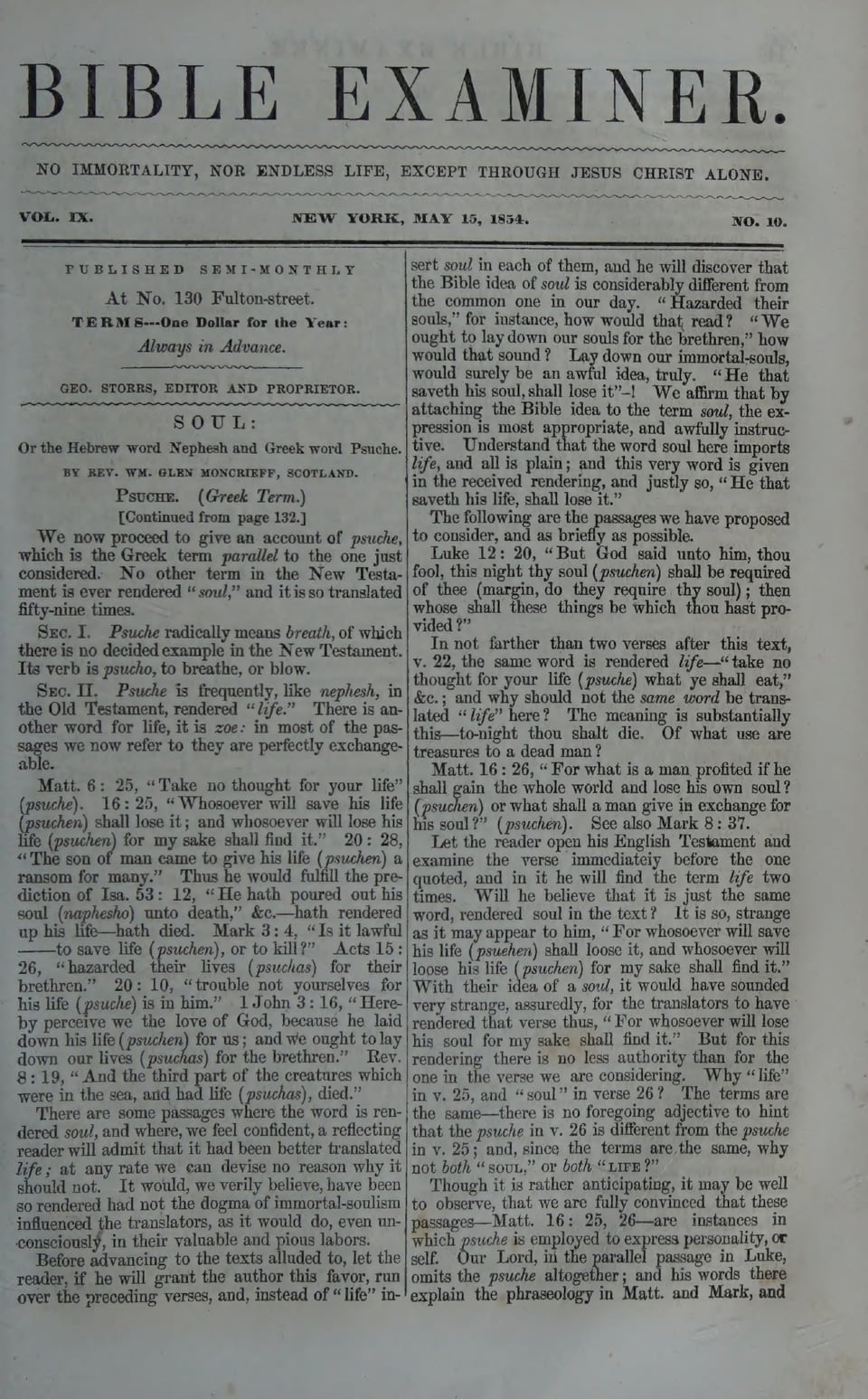
BIBLE EXAMINER.
NO IMMORTALITY, NOR ENDLESS LIFE, EXCEPT THROUGH JESUS CHRIST ALONE.
VOL. IX.
NEW YORK, MAY 15, 1854.
NO.10.
PUBLISHED SEMI-MONTHLY
At No. 130 Fulton-street. TERMS---One Dollar for the Year: Always in Advance.
GEO. STORRS, EDITOR AND PROPRIETOR.
SOUL:
Or the Hebrew word Nephesh and Greek word Psuche. BY REV. WM. GLEN MONCRIEFF, SCOTLAND.
We now proceed to give an account of psuche, which is the Greek term parallel to the one just considered. No other term in the New Testament is ever rendered "soul," and it is so translated fifty-nine times.
SEC. I. Psuche radically means breath, of which there is no decided example in the New Testament. Its verb is psucho, to breathe, or blow.
SEC. II. Psuche is frequently, like nephesh, in the Old Testament, rendered "life." There is another word for life, it is zoe: in most of the passages we now refer to they are perfectly exchangeable.
Matt. 6: 25, "Take no thought for your life" (psuche). 16:25, "Whosoever will save his life (psuchen) shall lose it; and whosoever will lose his life (psuchen) for my sake shall find it." 20:28, "The son of man came to give his life (psuchen) a ransom for many." Thus he would fulfill the prediction of Isa. 53:12, "He hath poured out his soul (naphesho) unto death," &c.—hath rendered up his life—hath died. Mark 3:4, "Is it lawful to save life (psuchen), or to kill?" Acts 15: 26, "hazarded their lives (psuchas) for their brethren." 20:10, "trouble not yourselves for his life (psuche) is in him." 1 John 3:16, "Hereby perceive we the love of God, because he laid down his life (psuchen) for us; and we ought to lay down our lives (psuchas) for the brethren." Rev. 8:19, "And the third part of the creatures which were in the sea, and had life (psuchas), died."
There are some passages where the word is rendered soul, and where, we feel confident, a reflecting reader will admit that it had been better translated life; at any rate we can devise no reason why it should not. It would, we verily believe, have been so rendered had not the dogma of immortal-soulism influenced the translators, as it would do, even unconsciously, in their valuable and pious labors.
Before advancing to the texts alluded to, let the reader, if he will grant the author this favor, run over the preceding verses, and, instead of "life" insert soul in each of them, and he will discover that the Bible idea of soul is considerably different from the common one in our day. "Hazarded their souls," for instance, how would that read? "We ought to lay down our souls for the brethren," how would that sound? Lay down our immortal-souls, would surely be an awful idea, truly. "He that saveth his soul, shall lose it"-! We affirm that by attaching the Bible idea to the term soul, the expression is most appropriate, and awfully instructive. Understand that the word soul here imports life, and all is plain; and this very word is given in the received rendering, and justly so, "He that saveth his life, shall lose it."
The following are the passages we have proposed to consider, and as briefly as possible.
Luke 12:20, "But God said unto him, thou fool, this night thy soul (psuchen) shall be required of thee (margin, do they require thy soul); then whose shall these things be which thou hast provided?"
In not farther than two verses after this text, v. 22, the same word is rendered life—"take no thought for your life (psuche) what ye shall eat," &c.; and why should not the same word be translated "life" here? The meaning is substantially this—to-night thou shalt die. Of what use are treasures to a dead man?
Matt. 16:26, "For what is a man profited if he shall gain the whole world and lose his own soul? (psuchen) or what shall a man give in exchange for his soul?" (psuchen). See also Mark 8:37.
Let the reader open his English Testament and examine the verse immediateiy before the one quoted, and in it he will find the term life two times. Will he believe that it is just the same word, rendered soul in the text? It is so, strange as it may appear to him, "For whosoever will save his life (psuehen) shall loose it, and whosoever will loose his life (psuchen) for my sake shall find it." With their idea of a soul, it would have sounded very strange, assuredly, for the translators to have rendered that verse thus, "For whosoever will lose his soul for my sake shall find it." But for this rendering there is no less authority than for the one in the verse we are considering. Why "life" in v. 25, and "soul" in verse 26? The terms are the same—there is no foregoing adjective to hint that the psuche in v. 26 is different from the psuche in v. 25; and, since the terms are the same, why not both "soul," or both "LIFE?"
Though it is rather anticipating, it may be well to observe, that we are fully convinced that these passages—Matt. 16:25,26—are instances in which psuche is employed to express personality, or self. Our Lord, in the parallel passage in Luke, omits the psuche altogether; and his words there explain the phraseology in Matt. and Mark, and bear out the observation we have just made.
His words in Luke 9:25 are, "For what is a man advantaged if he gain the whole world, and lose HIMSELF, or be a cast-away."
Matt. 10:28, "And fear not them that kill the body, but are not able to kill the soul (psuchen); but rather fear him which is able to destroy both soul (psuchen) and body in hell"—Gehenna.
a. In many other passages, as already shown, we learn that the "soul" can be killed by man; and, also, that it is the duty of Christians to render up their souls (psuchas) or lives for the brethren.
b. There is no term in this verse that would draw any distinction between a soul that men cannot kill and one that they can; between a soul that men cannot quench, but that God, and God only, can destroy. It is the same word without the shadow of an adjectival qualification or distinction.
c. Observe, had the text even read there is a soul in man which no persecutor can kill, it distinctly affirms that that soul can be destroyed by the Divine power, and intimates very plainly that it shall be destroyed in the case of every apostate. So that an indestructible soul, however common language in this day, is as unscriptural as the destructable Creator would be.
d. The only legitimate manner of interpreting the text is, in our humble opinion, to understand it as affirming that God only can destroy a soul, a life, a human being's existence forever; and that this will be the doom of all apostates and of all the ungodly. Persecutors may destroy a Christian's life now, and for a little, but, at "the last day" he will be raised to "glory, honor, and immortality." When God destroys a man, a soul, a life, or a living being in Gehenna, he is quenched forever; the second death is to be followed by no resurrection. He that findeth his life, he who keeps his life at the expense of his love to Jesus, shall at last lose it in Gehenna's fire; and he that loseth his life (psuchen), or lays it down for Jesus, shall find it at the resurrection of the just, and retain it through unending ages. Matt. 10:29.
It is worthy of observation that, in the parallel words of our Lord as given by Luke, the word "soul" does not occur. "And I say unto you, my friends, Be not afraid of them that kill the body, and after that have no more that they can do. But I will forewarn you whom ye shall fear; fear him, which after he hath killed hath power to cast into hell; yea, I say unto you, fear him." (12:4,5.) "After he hath killed," that is, killed men, as he has often done, by his judgments in this state, hath power, after their resurrection and the final assize, to destroy them in the fire of Gehenna, with a destruction which is to be everlasting, or which is to be followed by no return to conscious being. It is the second death. Persecutors, then, can only, by their murderous acts, at most, suspend conscious being, or destroy life for a short period; God can obliterate the man forever, and will do so in the case of all his impenitent and apostate subjects, therefore fear Him!
Sec. III. Psuche is also frequently used to express the idea of personality or self. For example.
Matt. 11:29, "ye shall find rest unto your souls" (psuchais), i.e., to yourselves. 26:38,
"My soul (psuche) is exceeding sorrowful even unto death;" i. e., I am exceeding, &c. Luke 1: 46, "My soul (psuche) doth magnify the Lord," i. e., I do magnify, &c. Acts 2: 41, "Three thousand souls" (psuchas) i. e., men. 14: 22, "Confirming the souls (psuchas) of the disciples;" i.e., confirming the disciples. 15: 24, "subverting your souls" (psuchas) i. e., subverting you. Rom. 13: 1, "Let every soul (psuche) be subject;" i. e., Let every one, or every man, &c. Heb. 13: 17, "they watch for your souls" (psuchas), or, for you. 2 Pet. 2: 8, "vexed his righteous soul" (psuchen). i. e., self; or, vexed himself a righteous person. Jas. 1: 21, "able to save your souls" (psuchas); i. e., to save you. 5: 20, "save a soul (psuche) from death;" i. e., save a man from death. Instead of translating the word (psuchon), our version has simply you, in 2 Cor. 12: 15, "I will very gladly spend and be spent for you" (margin, your souls.)
Sec. IV. Since psuche designates a living man, it is natural to suppose, that like nephesh, it will also be applied to men dead. Of this usage, there are, in our opinion, examples in the Revelation.
Rev. 20:4, "And I saw thrones, and they sat upon them, and judgment was given unto them, and (or even) I saw the souls (psuchas) of them that were beheaded for the witness of Jesus—and they lived and reigned with Christ a thousand years."
The " souls of them" are the men themselves. John saw the dead martyrs in his vision. He also beheld the souls live, " they lived," that is, the slain men were made alive and reigned with Christ.
Rev. 6:9,10, "and when he had opened the fifth seal, I saw under the altar the souls (psuchas) of them (the men themselves) that were slain and they (the dead souls, or dead men) cried with a loud voice, How long, O Lord, holy and true, dost thou not judge and avenge our blood on them that dwell on the earth."
By turning to Isa.14, the reader will see dead kings and mighty ones, represented rising up, as if they were really alive, and addressing the fallen monarch of Babylon when entering among them, now as weak as themselves. In perusing the chapter let the reader bear in mind that they are in hell, or sheol, of which our explanation has been briefly given.
Sec. V. Psvche sometimes denotes a particular power, or mental state of a man, though it is not always easy to settle what the reference exactly is.
Mark 12:30, "Thou shalt love the Lord thy God with all thy heart, and with all thy soul" (psuche), &c. On which Barnes has this note, "They are required to love God above all other beings or things, and with all the faculties of their minds." Acts 4:32, "the multitude——were of one heart and of one soul" (psuche); which is, according to Bloomfield, "a proverbial description of close amity." They were unanimous. 19:2, "made their minds (psuchais) evil affected;" i.e., made them evil affected. Eph. 6:6, "Doing the will of God from the heart" (psuches). "God requires industry, fidelity, conscientiousness, submission, and obedience in that rank of life."—Barnes. Phil. 1:27, "with one mind (psuche) striving together for the faith," &c.; i.e., striving unanimously and with zeal.
1 Thes. 5:23, "I pray God your whole spirit, soul (psuche) and body, be preserved blameless," &c. Robinson, in his Greek Lexicon, under pneuma, 2 b, justly says, "spirit, soul, and body is a periphrasis for the whole man." The same may be said of the preceding passage, Mark 12:30. Heb. 4:12, "piercing even to the dividing asunder of soul (psuche) and spirit, and of the joints and marrow," &c.
Without inquiring minutely what is meant here by soul, and spirit, and the dividing of them asunder, it seems wisest to regard the whole verse as giving a strong representation of the possible effects of God's word on the whole man. It penetrates the depths of his being; reaches and searches him in every point; lays bare his inmost thoughts and most hidden depravities.
Heb. 12:3, "lest ye be wearied and faint in your minds" (psuchais). Is it not enough to say —lest ye be wearied and faint?
Sec. VI. Psuche, in one passage, obviously imports a fish.
"Rev. 16:3, "and every living soul (psuche) died in the sea." With this compare Gen. 1:21, 24, &c. Part I. Sec. 3.
REMARKS.—1st. From the preceding pages is it not fully evident that the scriptural idea of a soul, and the theological one, are as different as could be imagined? As for "immortal souls," and "deathless souls," and "unquenchable souls," &c., the Book knows nothing of them: such language is common in prayers, sermons, treatises, and even newspapers, but the very opposite is the inspired representation of our nature. Dust we are, and unto dust we shall return. Men are mortal; we need to "seek for" immortality, Rom. 2:7. The Bible description of man is "corruptible man," Rom. 1:23. "The wages of sin is death; but the gift of God is eternal life through Jesus Christ our Lord," Rom. 6:23.
2d. If to be a soul, is to be immortal, then all breathing animals in the world, great as the elephant, small as the insect, are immortal also, for they are as much souls as man. Part I., Sec. III. Do none of these creatures die? Is it not true that the beasts perish?
3d. Since the soul of man is the fragile life of a man, or simply the mortal man himself, it is evident that, when a man dies, a soul dies; when a man is destroyed, a soul is destroyed; and when a man is saved from death, a soul is saved from dissolution and corruption. Thus, when a man dies he becomes necessarily as if he had never been. This fact is explicitly affirmed in Job 10:18,19. So far from continuing to think, his thoughts perish, Ps. 146:3,4,—he now knows nothing, Ecc. 9:5,6,—he, however pious before death, cannot now praise the Lord, Ps. 115:17,—he is asleep till the resurrection trumpet shall sound, Dan. 12: 2; 1 Thes. 4:14.
4th. The only prospect of the dead recovering consciousness, is, therefore, by a resurrection. Hence the importance of that scriptural doctrine a doctrine now nearly forgotten, at least rendered, through the dogma of immortal-soulism, singularly valueless. We are helped thus to see the force of Paul's language, and it is only in the light thrown by Scripture on man, that it can be at all accurately understood,—"if Christ be not raised—they (the believing MEN) also which are fallen asleep are PERISHED;" i. e., they have ceased to be forever. "If after the manner of men I have fought with beasts at Ephesus, what advantageth it me, if the dead rise not? let us eat and drink for to-morrow WE DIE." 1 Cor. 15:32. How can it be forgotten that the only consolation the Divine Redeemer had for the weeping Martha was, "Thy brother"—has gone to glory? no—"thy brother shall rise again." And what else had Paul for the bereaved Thessalonians? 1 Thes. 4:14, 18, "The dead in Christ shall rise first."
5th. Glory be to the Son of God who hath brought "life and immortality"—incorruptible life—"to light through the gospel," 2 Tim. 1:10. "Now is Christ risen from the dead, and become the first-fruits of them that slept," 1 Cor.15:20,23.
How awfully the Life-Giver, the blessed Redeemer—who is the only Immortalizer—has been dishonored, by telling men that they are all immortal beings! To the wicked it is said, their "end is destruction," and how can good men continue to affirm their end is preservation; life, instead of death? "The wicked shall perish, and the enemies of the Lord shall be as the fat of lambs; they shall consume, into smoke shall they consume away." Ps. 37:20.
6th. At present believers have a constitution of being similar to Adam, of whom it is written, "the first man Adam was made (into, Greek eis) a living soul," 1 Cor. 15:45, Gen. 2:7. This is the animal state, or the state in which human beings live by breathing, out of which every one may ascend to a higher constitution or sublimer mode of existence, as all the true saints ultimately shall. This second stage, or state, is called the spiritual one, in Cor. 15:46, "That was not first which is spiritual, but that which is natural (psuchikon—literally, soulish or soulical), and afterwards that which is spiritual;" for, the Apostle says, "there is a natural (psuchikon—soulical) body," or being, "and there is a spiritual body," or being, v. 44. Speaking of the dead saints and their resurrection, he declares, "It is sown (laid in the grave) a natural (soulical) body," or they lie down soulical; "it is raised a spiritual body," or they are resurrected spiritual, v. 44. Into this, the higher and purer state of humanity, the living saints will be instantaneously changed at our Lord's appearing; and all must undergo this transformation, that is, be spiritualized, whatever may be the full import of the glorious language used when describing their destiny, since "flesh and blood (soulical humanity?) cannot inherit the kingdom of God, neither doth corruption inherit incorruption," v. 50. But, blessed be God, every saint may exclaim, "as we have borne the image of the earthly (Adam), we shall also bear the image of the heavenly" (the Lord from heaven), v. 47.
It seems, then, scriptural to tell men that through the Redeemer they may yet be spiritualized, or become spirits. At present men have a spirit— "the spirit of life from God"—Rev. 11:11, that evanishes when the man (it is not the man) dies, like his thoughts which perish on that very day.
Ps. 146:3,4; but in the kingdom of God men may live as spirits yet, equal to the angels of light. That is the second, the perfect, the spiritual, the divine condition of humanity; and in this state Jesus himself now exists, the model and the fountain of the change that is, ere long, to be wrought upon his martyrs and friends.
So far, then, from souls being immortal, the Scripture teaches us, when it is rightly understood, that it ought to be our holy ambition, and our earnest prayer, that we may yet cease to be souls and become spirits. Souls are not immortal; men must merge into spirits if they are to live for ever in the incorruptible kingdom. The soulical form of humanity must perish, being corruptible, for "flesh and blood cannot inherit the kingdom of God;" spirit alone abides, since it alone is adapted for ceaseless duration. Thrice blessed are they who shall cease to be souls, or creatures living by breathing; and become like the spiritual Lord from heaven, when he descends the second time without sin unto salvation. Amen. Alleluia.
THE DOCTRINE OF THE CROSS.
THE CROSSTHE MORAL POWER OF CHRISTIANITY.
BY J. PANTON HAM.
[Continued from page 135.]
The significance of the cross would be only partially apprehended were it viewed in no other aspect than as the symbol of a model obedience. Christ came into the world to exemplify a perfect righteousness, hence "he became obedient unto death, even the death of the cross," and has thus set us an example that we should follow his steps." But this was not the whole of his mission as the mediator between God and man. Not only does the human race need a model righteousness, they need a motive beyond that supplied in the moral beauty of an exemplary personal perfection, to stimulate them to that dutiful course of personal obedience which God demands. The loveliest moral image, as has been proved in the history of Christ, would, by itself, fail to evoke the spiritual sympathies of our degenerate race, and effect our reformation. Righteousness provokes as well as purifies, and stirs up hate as well as admiration. "They have both seen and hated both me and my Father." Holiness of character, under the present conditions of humanity, is only to be secured by taking the heart captive: if no successful appeal has been made to the affections, the intellectual and moral judgments will be appealed to in vain. Love to God, without which there is no obedience to God, is begotten within us by the perception of his love to us—"We love him, because he first loved us." Mankind need to be wooed in order to be won for God; and God has graciously condescended, through the medial agency of his Son, to so address himself to them. "Son, give me thine heart," is his kindly claim. "Yea, I have loved thee," we hear him say, "with an everlasting love; therefore with loving-kindness have I drawn thee." And no less true is it of all the "household of faith," as well as of Ephraim of old, that God
drew them with the cords of a man, with bands of love." Now the cross of Christ supplies this motive—this drawing power; and because it supplies it in the strongest degree, it is commonly represented in the New Testament as the primary agency in our personal conversion. Thus Christ is said to have "made peace through the blood of the cross," to have reconciled "both in one body by the cross," to have "redeemed us to God by his blood." Thus sinners, who are "far off" in moral alienation from God, are said to be "made nigh by the blood of Christ," and to be "bought with a price," even "with the precious blood of Christ." These and similar expressions imply that the cross of Christ, on which he shed his life's blood, has become an active moral agency in the Christian scheme of human redemption. Here, by the prominence given to it in the New Testament, is obviously concentrated the strength of the Christian salvation. Here lies the secret of Christ's success as the moral "power of God." The cross is the gauge of Christ's love. It is the eloquent utterance of a love stronger than reproach, ignominy, and death. It tells, in most trustful tones, the tenderness of his loving heart. Thus far would Christ go, if thus much should be involved in his mediatorial agency in behalf of the sons of men. If it should cost not only personal inconvenience, self-denial, and suffering both of body and mind, but also an ignominious death, to effectually ransom the human race from the power of sin and its punishment, then would Christ pay even this high price for an object so dear to him. "For the joy that was set before him" he willingly "endured the cross, despising the shame." But it was a woful necessity that was laid upon him, to bear his cross to Calvary, and be brutally murdered thereon. Many a sigh was heaved from his burdened heart as the time drew near for this mighty sacrifice of love. And when at last the "cup" of bitter anguish was put into his trembling hands, as the cruel recompence of his perfect righteousness, with what "strong crying and tears" did he appeal "to him that was able to save him from death!" How agonizingly he holds up in the presence of his Heavenly Father that "cup" of human cruelty and guilt, and thrice deprecates the dreadful ordeal before him, "Father, if it be possible, let this cup pass from me!" His body, blood-bedewed with the force of inward wrestlings, utters most eloquently the otherwise unutterable anguish of the "hour" that was then "come." He might have avoided that "hour," for he knew before-hand the anguish of its terrible moments—he knew that as "the Holy One of God," the race he came to ransom would hate and hang him on a tree. But he knew also that if he avoided that "hour" of suffering and self-sacrifice, man had been unransomed, and his salvation had been impossible. For there is no salvation from sin without suffering; and if the Christ of God had declined to become the "way," who else could have effectually walked therein and discovered the path of life? It behoved the Lord Jesus Christ, if he would redeem mankind from sin and death, to set before them in the experience of his own life, the method of this mighty redemption. It behoved him to set before our fallen race the example of a perfect righteousness, and show us how such a character fares in our guilty world, and how it is rewarded by the righteous God.
By the example of Christ we are taught the great lesson that before honor comes humility, and before salvation, suffering and sacrifice. Christ was "made perfect through suffering," to illustrate the inevitable law that there is no personal perfection to be wrought out in this world without suffering. In "striving against sin," he "resisted unto blood," because "the contradiction of sinners against himself" went to the sanguinary length of demanding his blood. He would not shun this sad sequel of his life, because he would not shun any condition of duty, nor refuse any consequence, however painful, of a complete personal obedience. He would show mankind how to live and how to die, that they might see, by his resurrection from the dead, how highly his heavenly Father honors such fidelity, and will reward it in the case of all who endure to the end. Had it not "pleased the Father to bruise him," or "that he should be bruised and put to grief," he could not have been the pattern of our righteousness; his experience, instead of being the exemplification of the law of suffering for righteousness' sake, would have been the singular and solitary exception to that law. Hence the experience of Christ and his saints is one. If he has suffered for righteousness sake, so must they, otherwise they cannot know "the fellowship of his sufferings;"—if he has had a cross, and been "crucified to the world," so must they have a cross, and be willing to take it up "daily," and follow their Lord;—if he has been "obedient unto death," they too must be "made conformable to his death," in readiness of spirit, if not in reality of experience, otherwise their faith is vain, and they are yet in their sins. "The disciple is not above his master, nor the servant above his Lord. It is enough for the disciple that he be as his master, and the servant as his lord."
Such a redemption as the human race needs—a redemption from the active power of sin and its punitive desert, death, obliged the Redeemer to submit to all the conditions and circumstances of the race he came to redeem; and hence his life and death became a sacrifice—a sacrifice of love. Our sins, that is, our habitual selfishness, needed to be rooted out of our moral being, our characters formed on a new model, and our hearts impelled by new motives. These Christ came to accomplish. "He was manifested to take away our sins, and in him is no sin." Hence he needed to be "made in the likeness of sinful flesh," to suffer the assaults of sin in all its manifold forms and intensity, and to demonstrate the possibility of a successful resistance of sin even to the end. The sacrifice was as great as a conflict with the most dangerous and distressing forms of evil could make it. It was a sacrifice for sin—for its repudiation and overthrow. He "bore our sins," as he "took our infirmities and bear our sicknesses," that is, he bore or took them away—the latter by a miraculous, the former by a moral power. [Matt. 8:17.] But not with equal facility, for to bare, or take away, our sicknesses, cost him only the utterance
of a command; but to bear, or take away our sins, cost him the exhibition of a character. Our sicknesses fled instantaneously before the power of his voice, but our spiritual sicknesses yield to slower processes, and only before the constant presence, and by the power of his personal virtue. To make such a sacrifice was an act of condescension on Christ's part: it is spoken of as "the grace of our Lord Jesus Christ." "Ye know the grace of our Lord Jesus Christ, that though he was rich, yet for our sakes he became poor, that ye through his poverty might be rich." And because it is an act of grace, it appeals to the gratitude of every human heart, and evokes its reverence and love. The spontaneousness of Christ's sacrifice makes the appeal the stronger, and gives it that resistless power which begets repentance in every believing sinner, and achieves his personal reformation. The life of Christ abounds with such appeals—its disinterested devotedness, its self-denials, its painful and unremitting labors in behalf of our race, are so intelligible and influential, that where it obtains an audience, it rarely fails to secure a victory. Its last evidence of love, when "he was led as a lamb to the slaughter," and submitted to the death of the cross, because it was a consequence of the life he had lived in this evil world, and the doctrine and spirit he had taught and manifested, whilst it was the perfection of his obedience, was at the same time the consummation of his power. "Greater love hath no man than this, that a man lay down his life for his friends." The cross tells the most touching tale of love, and is the symbol of Christ's greatest personal sacrifice; hence it gathers into itself every other utterance of his affection, and engrosses every other act of his self-denial in the cause of our personal redemption. And when, moreover, we view the crucified One as the representative of God—the visible manifestation of the Great Invisible; when we bear in mind that every utterance, every expression of feeling, every action, every endurance of the Christ of God, was not so much to manifest Christ himself, as "God in Christ;" when all the love which Jesus expressed both in action and suffering is viewed, as it should be viewed, as the representation, on a human scale, of the feelings and sympathy for man of which God is the subject; then the cross becomes the expression of what is too vast even for itself to adequately declare: it stands before us as the finite guage of an infinite—it is the highest possible utterance of the Love of God! Connect the two mighty facts together, that the cross is the expression of a duplicate love—the love of the Christ, and the love of "God in Christ," and the mystery of the cross is understood—its moral power is obvious and complete. This explains why the cross, or one or other of its synonyms, "the blood of Christ," "the sufferings of Christ," "the death of Christ," is so commonly alluded to in the sacred writings, and presented either as the chief motive to our gratitude, or the chief stimulus to our fidelity. Christianity itself as a religious system, is, for the same reason, com, prehensively expressed by the phrase, "the Cross of Christ," for the cross expresses at once the cause and effect of human redemption: it sets forth love as the cause, and a perfect obedience as the effect.
It is thus, at the same time, an appeal and an admonition. It asks, in the tenderest eloquence, for our hearts; and announces our personal reformation as the object of its request. The cross suggests a moral significance which was not to be found in the symbolism of the former dispensation; and because it was wanting there, that ancient ritual was inefficient as a means of religious reformation and discipline. There was blood, it is true, in the Mosaic as well as in the Christian economy; but "the blood of slaughtered animals" could not utter what the blood of Christ did, the voice of an intelligent and irresistible love; hence "it was not possible that the blood of bulls and of goats should take away sins." "Those sacrifices which they offered year by year continually," if they could have made "the comers thereunto perfect" in personal holiness, would "not only have ceased to be offered" by the same persons, but would also have superseded the necessity of any further sacrifice for sins, because the worshippers once personally purged from their sinfulness, would "have no more conscience of sins." The ancient symbolic service of sacrifice would have continued to this day as the Divinely appointed means for educating and reforming our race, had it been efficient as a means of purification. "For if that first covenant had been faultless, then should no place have been sought for the second." But the flesh was weak; our nature needed a more emphatic portraiture of piety, and a mightier motive than the Levitical sacrifices afforded. Our moral wreck was too complete to bear to be reconstructed after such a model, and by such means as the older dispensation supplied. Hence, "what the law could not do, in that it was weak through the flesh, God sending his own Son, in the likeness of sinful flesh and for sin, condemned sin in the flesh," that by the perfection of His living example, and the touching eloquence of His love, we might be incited to a life of personal obedience; and so "the righteousness of the law might be fulfilled in us who walk not after the [principles of the] flesh, but after [those of] the Spirit." The many sacrifices of the ancient worship were thus superseded by the "one sacrifice" of the new—whose greater moral efficacy is exhibited in effectually putting the Divine laws in our minds, and writing them upon our hearts, so that "by one offering he [Christ] hath perfected for ever them that are sanctified."
MAN'S WORD vs. GOD'S WORD.
MAN'S WORD.—"The Soul of Man is Immaterial and Immortal, and can subsist independently of the Body."—Dr. Adam Clarke.
"Man is endowed with an Immortal spirit, which shall exist as long as God endures: either blooming in the paradise of God, or eternally withering, not dying, in the regions of despair!"—Prof. Harkey, of the Ill. State University.
God's Word.—"Till Thou return unto the ground, for out of it wast Thou taken; for Dust Thou Art, and unto Dust shalt Thou return." Gen. 3:19.
"Shall MORTAL MAN be more just than God." Job 4:17.
"How much less in them that dwell in Houses of clay, whose FOUNDATION is in the Dust, which are crushed before the moth."—Job 4:19.
"For he remembered that they were But Flesh, a wind that passeth away and cometh not again." Ps. 78:39.
"He knoweth our frame : he remembereth that we are Dust."—Ps. 103:14.
"How much less man that is a Worm, and the son of man which is a Worm."—Job 25:6.
"The blessed and only Potentate, the King of kings, and Lord of lords, WHO ONLY HATH IMMORTALITY."--1 Tim. 6 : 16.
MAN'S WORD.—"A never dying soul to save, And fit it for the sky." [Charles Wesley.
God's Word.—"The Soul that sinneth it shall DIE."—Ezek. 18:4.
"He spared not their Souls from DEATH, but gave their lives over to the pestilence."—Ps. 78 : 50. "The wages of sin is DEATH."—Rom. 6 : 23.
MAN'S WORD.—"Death disengages the Soul from the trammels of the Body, and gives expansion to its powers.—All those passions and propensities which belong to the Body will, of course, accompany it to the silence of the grave; but all that belongs to the Soul, as ANGER, MALICE, REVENGE, will not only be retained in the disembodied state, but acquire greater capacity and power for action."Amer. Tract. Soc., Tract No. 371.
God's Word.—"For the living know that they shall die, BUT THE DEAD KNOW NOT ANY THING, neither have they any more a reward; for the memory of them is forgotten. Also their Love, and their HATRED, and their ENVY, is now PERISHED," &c.—Eccles. 9 : 5-6.
"His breath goeth forth, he returneth to his earth; in that very day his Thoughts Perish." Ps. 146:4
"The dead praise not the Lord, neither any that go down into silence."—Ps. 115:17.
"For in death there is no remembrance of thee : in the grave [Heb. Sheol, or state of the dead,] who shall give thee thanks?"—Ps. 6: 5.
"Whatsoever thy hand findeth to do, do it with thy might; for there is no work, nor device, nor KNOWLEDGE, nor WISDOM, in the grave [Heb. Sheol] whither thou goest."—Ecc. 9 : 10.
"For the grave [Heb. Sheol] cannot praise thee; death cannot celebrate thee; they that go down to the pit cannot hope for thy truth. The living, the living shall praise thee as I do this day." Isa. 38:18-19. See also Job 14:21; Ps. 88:10,11,12; Isa. 63:16; Job 3:11-19,and 10:21-22; Luke 10:24; 1 Thess. 4:13-15.
MAN'S WORD.—"The souls of believers at death do immediately pass into glory."Methodist and Presbyterian Catechisms.
God's Word.—"Henceforth there is laid up for me a crown of righteousness, which the Lord the righteous Judge shall give me AT THAT DAY; and not to me only, but unto all them also that love His APPEARING."—2 Tim. 4:18.
"And WHEN THE CHIEF SHEPHERD SHALL APPEAR, ye shall receive a crown of glory that fadeth not away."—1 Pet. 5 : 4. See also John 6 : 40- 44; 1 Pet. 1 : 5-13; 2 Tim. 1 : 12; Col. 3 : 4; Rom. 8 : 23.
MAN'S WORD.—
"He'll in a moment call thee hence.
To Heaven or down to HELL." [Hart.
God's Word.—"The Lord knoweth how to reserve the unjust unto THE DAY OF JUDGMENT TO BE PUNISHED.—2 Pet. 2 : 9.
"Who shall be punished with everlasting destruction——WHEN HE SHALL COME to be glorified in his saints."—2 Thess. 1 : 8-10. See also Rev. 11 : 18 ; Matt. 13 : 30 ; Mal. 4 : 1-3.
MAN'S WORD.—" Eternal redemption is to be regarded as involving an equally eternal enslavement. Heaven is only Heaven while there exists a Hell."—Dr. Hamilton.
"Oh miserable state of the damned! In it they utter as many blasphemies against God as the happy souls in heaven shout hallelujahs to his praise." Amer. Tract Soc., Tract No. 277.
"God is therefore himself present in hell to see the punishment of these rebels against his government that it may be adequate to the infinity of their guilt; his fiery indignation kindles, and his incensed fury feeds the flame of their torment, while his powerful presence and operation maintain their being, and render all their powers most acutely sensible, thus setting the keenest edge upon their pain, and making it cut most intolerably deep. He will exert ALL HIS DIVINE ATTRIBUTES to make them as wretched through eternity as the capacity of their nature will admit."—Benson, the eminent Methodist Commentator.
God's Word.—"For behold the day cometh that shall burn as an oven; and all the proud, yea, and all that do wickedly, shall be stubble; and the day that cometh SHALL BURN THEM UP, saith the Lord of hosts, that it shall LEAVE THEM NEITHER ROOT NOR BRANCH——And ye shall tread down the wicked, for THEY SHALL BE ASHES under the soles of your feet in the day that I shall do this, saith the Lord of hosts."—Mal. 4:1-3.
"But the wicked shall PERISH, and the enemies of the Lord shall be as the fat of lambs; THEY SHALL CONSUME; INTO SMOKE shall they CONSUME AWAY."—Ps. 37:20.
"When the wicked spring as the grass, and when all the workers of iniquity do flourish, it is that they shall be DESTROYED FOREVER."-Ps. 92:7.
"But the transgressors shall be DESTROYED together : the END of the Wicked shall be CUT OFF." Ps. 37: 38.
"What fruit had ye in those things whereof ye are now ashamed? for the END of those things is DEATH."—Rom. 6:21.
"Who [the wicked] shall be punished with EVERLASTING DESTRUCTION from the presence of the Lord and from the glory of his power."—2 Thsss. 1:9.
"Behold all they that were incensed against thee shall be ashamed and confounded: they shall be as NOTHING: and they that strive with thee shall PERISH: they that war against thee shall be as
NOTHING : and as a thing of NAUGHT."—Isa. 41: 11-12. "They [the wicked] shall be as though they had not been."—Obadiah 16.
See also Ezek. 33:11; Ps. 145:20; 101:8; 37:9; Prov. 13:13; 21:15; Isa. 10:16,17; 1:28; 5:24; 33:11,12; 57:16; Job 31:3; Zeph. 1:2; Matt. 7:13; 13:30; Rom. 6:23; 8:2,6,13:2:12-16; 2 Cor. 2:15-16; Gal. 6:8; Phil. 3:19; Heb. 10:27; 6:8; 1 Tim. 6:9; 2 Pet. 2:12.
You have here set before you Man's Word and God's Word. Which will you believe?
"Let God be true, but every man a liar." "God is not a man that he should lie." "Add thou not unto his words, lest he reprove thee, and thou be found a liar."—Prov. 30:6. "If any man shall add unto these things, God shall add unto him the plagues that are written in this book." Rev. 22:18. But do you not perceive a striking discrepancy between the words of men and the words of God? The contents of this tract plainly show that there have been considerable additions made to God's Word, and without his authority.
Reader, art thou a believer in Christ? O prize the precious volume. It contains words of life. Do not allow men who are "wise above what is written," to destroy its simplicity and its preciousness by obtruding their "vain traditions" in its place.
Art thou still out of Christ? O, be persuaded to come to him, that thou mayest have life. The precious Word of Life gives thee every encouragement to come. Delay no longer, lest the dark night of an eternal death engulf thee in its awful gloom.
From M. Batchelor, Pownal, Vt.
BRO. STORRS-I hear you have been made to feel the uncertainty of all earthly good. I send inclosed $2, to help print the Six Sermons. I cannot consent to have them die, for they have opened the eyes of thousands to see that man is mortal, and an unholy mortal; and that immortality can only be found in Christ; and that the sinner, rejecting Christ, must die, become extinct, as the fruit of his own folly in believing the devil rather than God. I rejoice in the truth taught in the Six Sermons; and the time is soon coming when sin and sorrow will cease in all God's universe. My whole being says, Amen.
The Lord is still blessing us here. The truth is triumphing over the unbelief of the human heart. Many have submitted, and learned that God is a God of love; but it makes the enemy war. I have labored here going on eleven years, and we have had three precious revivals in the time; but many of those brought in have moved away, which keeps our number small. We have had to labor against wind and tide. With two or three exceptions the ministry all around have thrown their influence against the truth I have preached; but, to the praise of God's grace we can say, truth has lived and spread abroad. I have felt of late that I had a claim on God for help. I have endeavored to show that God is love, and that His love will shine in the execution of the last judgment on the wicked, not by giving them everlasting life in misery, but as He had offered them life in Christ, and they having refused it, benevolence lets them die.
God is love. Amen. I feel God's promise is verified in my experience, as thy day is thy strength shall be. I am yours in hope of life in Christ.
BIBLE EXAMINER.
NEW YORK, MAY 15, 1854.
From Professor Mattison.
New York, April 23, 1854.
Geo. Storrs: Dear Sir:—In looking over your strictures upon my Sermons on Immortality, it has occured to me that a better method of discussing the subject involved might be adopted. While I accord to your reporter and to yourself a desire to state my position fairly, if not fully, I think you will admit that few reporters can do justice to an extemporaneous speaker, and especially to a Methodist preacher. With their best efforts they will give but a poor idea of his discourse, especially if it be argumentative or metaphysical. So in the present case: your reporter has done the best he could, doubtless, but I am not fairly before you in the notes you are reviewing, and in some instances a man of straw is there instead of "Prof. M."
Allow me, therefore, to suggest that instead of wasting your strength upon the necessarily imperfect notes of your reporter, my positions and arguments be placed before your readers over my own signature in your columns, and that then you proceed to disprove them if you can. I shall then be tangibly in your hands, and there can be no misapprehension or dodging.
I am ready to take the affirmative of the question—
DO THE HOLY SCRIPTURES TEACH THAT THE SOUL OF MAN HAS A CONSCIOUS EXISTENCE, SEPARATE FROM THE BODY, BETWEEN DEATH AND THE RESURRECTION?
I affirm that they do; you say they do not. I think I can prove it; you think I cannot. Let us discuss it, then.
This question involves the prior question, namely, whether man has a soul essentially different from his physical organization—the point at which you would wish to begin—but the main question upon which all side issues must concentrate is the one I propose to discuss.
Should you agree with me that this is a preferable mode of conducting the discussion, and accept my proposal, my first argument shall be furnished for your next number.
Very respectfully, H. MATTISON.
REMARKS BY THE EDITOR.—We have had several friendly interviews with Prof. Mattison, and wish to be as accommodating as possible; but we stated to him distinctly if we went into a discussion we should insist upon the previous question being settled at the outset, viz.:—
Does the Bible teach that the creature man—which the Lord God formed of the dust of the ground—has a superadded entity called the soul?
Till this question is settled, it seems to us it would be arguing upon assumed premises, and hence the discussion would be attended with no certain results. It cannot satisfy an inquiring mind to have Prof. M. and ourself spend our strength till we know what it is about. On the question, as we have stated it, we take the negative The Prof. says his "question involves" this "prior" one. If he is willing to affirm this prior one, our columns are open for him to proceed, and we shall be happy to have him do so.
When that question is settled—if the Prof. succeeds in establishing the affirmative—the next will be—
Does the Bible teach that the soul is immortal— not liable to die, or, to lose all life and consciousness.
If these two questions can be settled affirmatively, then the Prof.'s question follows naturally and will be easy of solution, and shorten the discussion materially.
Now if Br. Mattison wishes to take up the subject from the root, and settle it forever, here is an opportunity to make the trial, and do good to men.
We defer further remarks on the Reported Sermons of Prof. M. till we see if he assents to our conditions of discussion, for if he does it is unnecessary to finish our Review of his reported discourses, as the same ground may have to be traveled over in the discussion.
NOT SO SHORT LIVED.—Prof. Mattison, as we have before noticed, said that the immortality of the soul had not been called in question since the days of our Saviour till within the last ten years. We have shown that to be a mistake. Since our remarks on that point Dr. Barlow, of this city, has put into our hands a work entitled "LEVIATHAN, or the Matter, Form, and Power of a Commonwealth Ecclesiastical and Civil. By Thomas Hobbes, of Malmesbury! Printed in London 1651."
This author says, p. 244—" Nor can the name of second death, be applied to those that can never die but once : and though in metaphorical speech, a calamitous life everlasting, may be called an everlasting death, yet it cannot well be understood of a Second Death."
Again, in speaking of the "everlasting fire," and "unquenchable fire," he saith, p. 245—"But it cannot thence be inferred, that he who shall be cast into that fire, or be tormented with those torments, shall endure and resist them so as to be eternally burnt, and tortured, and yet never be destroyed, nor die." On same page, in speaking of the places in Scripture where men are said to be cast into everlasting fire, &c., he says, "I find none that affirm there shall be an Eternal Life therein of any individual person; but, on the contrary, an everlasting death, which is the second death. * It is evident there is to be a Second Death of every one that shall be condemned at the day of Judgment, after which he shall die no more." Again this author speaks as follows, page 339:
Another general error is from the misinterpretation of the words Eternal Life, Everlasting Death, and the Second Death. For though we read plainly, in Holy Scripture, that God created Adam in an estate of living forever—which was conditional, that is to say, if he disobeyed not his commandment—which was not essential to human nature, but consequent to the virtue of the Tree of Life; whereof he had liberty to eat, as long as he had not sinned; and that he was thrust out of Paradise after he had sinned, lest he should eat thereof, and live for ever; and that Christ's passion is a discharge of sin to all that believe on him; and by consequence a restitution of eternal life to all the faithful and to them only: yet the doctrine is now, and hath been a long time, far otherwise; namely, that every man hath Eternity of Life by Nature, inasmuch as his soul is Immortal:—so that the flaming sword at the entrance of Paradise, though it hinder a man from coming to the Tree of Life, hinders him not from the immortality which God took from him for his sin; nor makes him to need the sacrificing of Christ, for the recovering of the same; and consequently, not only the faithful and righteous, but also the wicked and the heathen, shall enjoy eternal life, without any death at all; much less a second and everlasting death. To salve this, it is said, that by second and everlasting death, is meant a second, and everlasting life, but in torments—a figure never used, but in this very case—all which doctrine is founded only on some of the obscurer places of the New Testament; which, nevertheless, the whole scope of the Scripture considered, are clear enough in a different sense, and unnecessary to the Christian faith:—for supposing that when a man dies there remaineth nothing of him but his carcass, cannot God, that raised inanimated dust and clay into a living creature by his word, as easily raise a dead carcass to life again, and continue him alive for ever, or make him die again, by another word? The soul, in Scripture, signifieth always, either the life or the living creature; and the body and soul jointly, the body alive. In the first day of creation God said, Let the waters produce reptila anima viventis, the
creeping thing that hath in it a living soul—the English translate it, that hath life: and again, God created great whales, and omnem animam viventem—which in the English is, every living creature: and likewise of man, God made him of the dust of the earth, and breathed in his face the breath of life, and factus est Homo in animam viventem, that is, and Man was made a living creature: and after Noah came out of the ark, God saith. He will no more smite omnem animam viventem, that is, every living creautre: and Deut. 12:23, Eat not the blood, for the blood is the soul, that is, the life. From which places, if by soul were meant a substance incorporeal, with an existence separated from the body, it might as well be inferred of any other living creature as of man. But that the souls of the faithful are, not of their own nature, but by God's special grace, to remain in their bodies, from the resurrection to all eternity, I have already [I think] sufficiently proved out of the Scriptures, in the 38th chapter; and for the places of the New Testament where it is said that any man shall be cast body and soul into hell-fire, it is no more than body and life, that is to say, they shall be cast alive into the perpetual fire of Gehenna.
This window it is that gives entrance to the dark doctrine first, of Eternal Torments, and afterwards of Purgatory; and consequently of the walking abroad, especially in places consecrated, solitary or dark, of the ghosts of men deceased; and thereby to the pretences of exorcisme and conjuration of phantasmes; as also of invocation of men dead, and to the doctrine of indulgences—that is to say, of exemption, for a time or for ever, from the fire of purgatory, wherein these incorporeal substances are pretended by burning to be cleansed and made fit for heaven. For men being generally possessed before the time of our Savior, by contagion of the Dæmonology of the Greeks, of an opinion that the souls of men were substances distinct from their bodies, and therefore that when the body was dead, the soul of every man, whether godly or wicked, must subsist somewhere by virtue of its own nature, without acknowledging therein any supernatural gift of gods. The doctors of the church doubted a long time what was the place which they were to abide in till they should be re-united to their bodies in the resurrection; supposing, for awhile, they lay under the altars: but afterward the Church of Rome found it more profitable to build for them this place of purgatory, which by some other churches in this later age has been demolished.
Pages 343-4, on the Immortality of Man's Soul not proved by Scripture to be of nature, but of grace, he speaks thus :—
To prove that the soul separated from the body liveth eternally, not only the souls of the elect, by especial grace and restoration of the eternal life which Adam lost by sin, and our Saviour restored by the sacrifice of himself; to the faithful, but also the souls of reprobates, as a property naturally consequent to the essence of mankind, without other grace of God but that which is universally given to all mankind; there are divers places which, at the first sight, seem sufficiently to serve the turn : but such, as when I compare them with that which I have before [Chapter 38] alledged out of the 14th of Job, seem to me much more subject to a divers interpretation, than the words of Job.
And first there are the words of Solomon [Ecc. 12:7], "Then shall the dust return to dust, as it was, and the spirit shall return to God that gave it." Which may bear well enough [if there be no other text directly against it] this interpretation, that God only knows [but man not] what becomes of a man's spirit when he expireth. And the same Solomon, in the same book [Chap. 3:20, 21], delivereth the same sentence in the same sense I have given it: his words are, "All go [man and beast] to the same place; all are of the dust, and all return to dust again; who knoweth that the spirit of man goeth upward, and that the spirit of the beast goeth downward to the earth?" That is, none knows but God. Nor is it an unusual phrase to say of things we understand not, God knows what, and God knows where. That of Gen. 5:24, "Enoch walked with God, and he was not, for God took him:" which is expounded Heb. 11:5, "He was translated that he should not die; and was not found, because God had translated him: for before his translation he had this testimony, that he pleased God;" making as much for the immortality of the body as of the soul, proveth that this his translation was peculiar to them that please God, not common to them with the wicked, and depending on grace, not on nature. But on the contrary, what interpretation shall we give besides the literal sense of the words of Solomon, Ecc. 3:19, "That which befalleth the sons of men befalleth beasts; even one thing befalleth them: as the one dieth, so dieth the other; yea, they have all one breath [one spirit]: so that a man hath no pre-eminence above a beast: for all is vanity." By the literal sense here is no natural immortality of the soul: nor yet any repugnancy with the life eternal which the elect shall enjoy by grace. And again, [chap. 4:3], "Better is he that hath not yet been, than both they;" that is, than they that live, or have lived; which, if the soul of all them that have lived were imm mortal, were a hard saying; for then to have an immortal soul were worse than to have no soul at all. And again, [chap. 9:5], "The living know they shall die, but the dead know not any thing;" that is, naturally, and before the resurrection of the bodv.
Another place which seems to make for a natural immortality of the soul, is that where our Savior saith that Abraham, Isaac and Jacob are living : but this is spoken of the promise of God, and of their certitude to rise again, not of a life then actual ; and in the same sense that God said to Adam, that on the day he should eat of the forbidden fruit, he should certainly die ; from that time forward he was a dead man by sentence, but not by execution, till almost a thousand years after. So Abraham, Isaac, and Jacob were alive by promise, then, when Christ spake ; but are not actually till the resurrection. And the history of Dives and Lazarus make nothing against this, if we take it [as it is] for a parable.
Thus the doctrine of immortality being of grace,
and conferred only on the righteous at the resurrection, is more than "ten years" old; yea, more than two hundred. We may give further extracts from the LEVIATHAN hereafter.
THE Pope's Bulls.—A correspondent of the Due West Telescope, in an article on the waning of Popery, says, "Of late the Pope's Bulls are of the moily (no-horn) breed, and are consequently unable to gore as formerly, and in fact so lean, like Pharaoh's, that they can scarcely butt!"
Our friend Hurly, editor of the Irish Evangelist, of this city, when he receives one of these papistical missiles calls it "A Calf." His bold exposure of Romanism has called forth a number of these calves.
We have received "a calf" lately, from some of those lovers of darkness. The following extract may serve to show how sincerely they wish us dead if we will not leave off to send death into their purgatorial system, built on the unscriptural doctrine of man's natural immortality; and because we venture to challenge an examination of the Bible against Traditions. This "calf" cost us seven cents, in postage. Certainly that is a cheap calf! Our readers perhaps will think it is more than it is worth. May be so, but we cannot tell what may come of it yet. It seems to be an intimation that if we do not die at his blairing we may expect to go in some other popish way. We have only to say, "If the Lord will." He is our keeper; and if these calf-makers can gain his consent to accomplish their purpose, to put down those who defend the Bible against the traditions of men, then let them work till their "perdition" comes. With his mouth wide open the calf speaks thus:—
"God forbid the devil to publish the Bible, and corrupt the texts by turning into dark speech, and pleasing speeches, and good words, to seduce the hearts of innocents. This is the way you defend the Bible against tradition. You publish the Bible contrary to the spirit of God. You would not publish that which are a restraint on your passions and yourself—the terrible words in the Bible. You would not suffer the word of God to chastise and judge your sins, hypocrisy and bigotry, and all your vices. You put all these aside, that it may not hurt your passions. This is the Bible which proceedings against Tradition. Blind guides! how can you flee from the wrath of God, which may fall upon you! Why will you not judge yourselves in this world, and confess your sins to the ministers of God in this world, before you die? Beware of flattery and presumption, or you will be lost for eternity. You will die in a moment after you read this letter! Terrible moment! Delay not one minute. Go quick! or your conscience accuses you before God for neglect of your salvation, and trust in your strength and flattery.
If you deny the confession and the church of God! God will appear to you horribly and speedily, for a most severe judgment against heresy and schism. Go to the Roman Catholic Church and confess all your sins sincerely before you die this day! and let the priest give you instructions before you be baptized and be communicated. Beware of the devil's delusion, or the death overtake you! THEOCRAT.
From Br. Grew, Philadelphia.
Br. Storrs—I have sympathised with you, beloved, in your recent trial of holy faith. "Whomsoever the Lord loveth he chasteneth." I inclose a donation to aid a little in your good work. "My God shall supply all your need, according to his riches in glory by Christ Jesus." "The earth is the Lord's and the cattle on a thousand hills."
I notice with pleasure that you "do not endorse every expression in the articles of Br. Ham, and perhaps may not agree with him in all his conclusions." I pray God to unite us in his own holy and immutable truth, relative to the one great offering by which the Redeemer "hath perfected forever them that are sanctified." Heb. 10:14.
You object to that truly absurd and unscriptural notion of the atonement which represents it as "paying our debts," and excluding our Father's forgiving love, and, in immediate connection, remark, "We are glad that Br. Grew is evidently modifying his views on the subject; for he now says, that Christ's death 'was vicarious in some sense.'" When, dear bro., did I ever say or write any thing different from this? The reader might suppose from your remark that I had heretofore given some sanction to the preposterous sentiment above stated. If you can quote any thing from my writings which implies it, I will most cordially unite with you in its repudiation.
…