The Bible Examiner — Vol. 9, No. 5 (March 1, 1854)
Download: PDF — The Bible Examiner — Vol. 9, No. 5 (March 1, 1854)
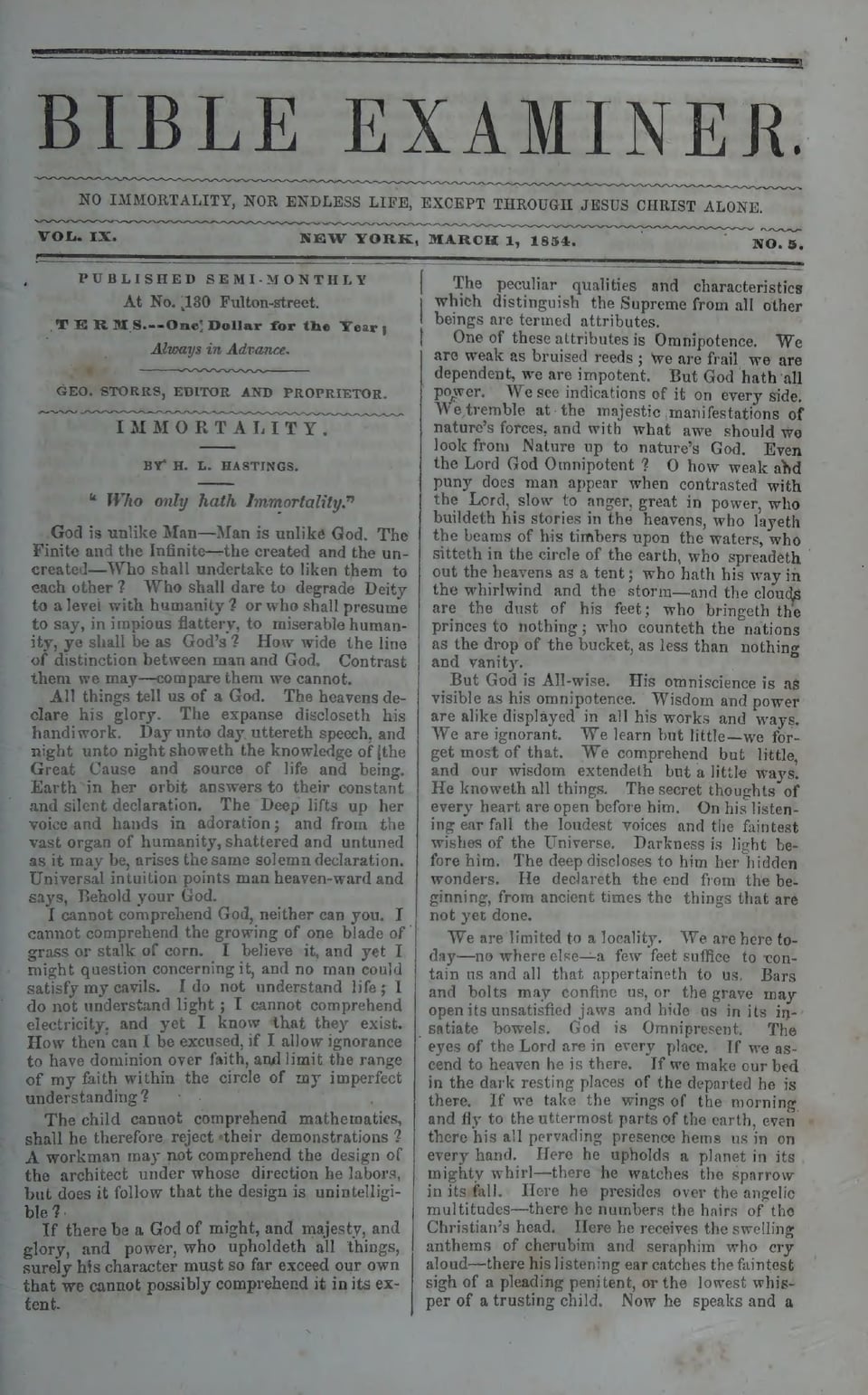
BIBLE EXAMINER.
NO IMMORTALITY, NOR ENDLESS LIFE, EXCEPT THROUGH JESUS CHRIST ALONE.
VOL. IX.
NEW YORK, MARCH 1, 1854.
NO.5.
PUBLISHED SEMI-MONTHLY At No. 130 Fulton-street.
T E R M S.--One Dollar for the Year; Always in Advance.
GEO. STORRS, EDITOR AND PROPRIETOR.
IMMORTALITY.
BY H. L. HASTINGS.
" Who only hath Immortality. "
God is unlike Man—Man is unlike God. The Finite and the Infinite—the created and the uncreated—Who shall undertake to liken them to each other? Who shall dare to degrade Deity to a level with humanity? or who shall presume to say, in impious flattery, to miserable humanity, ye shall be as God's? How wide the line of distinction between man and God. Contrast them we may—compare them we cannot.
All things tell us of a God. The heavens declare his glory. The expanse discloseth his handiwork. Day unto day uttereth speech, and night unto night showeth the knowledge of the Great Cause and source of life and being. Earth in her orbit answers to their constant and silent declaration. The Deep lifts up her voice and hands in adoration; and from the vast organ of humanity, shattered and untuned as it may be, arises the same solemn declaration. Universal intuition points man heaven-ward and says, Behold your God.
I cannot comprehend God, neither can you. I cannot comprehend the growing of one blade of grass or stalk of corn. I believe it, and yet I might question concerning it, and no man could satisfy my cavils. I do not understand life; I do not understand light; I cannot comprehend electricity, and yet I know that they exist. How then can I be excused, if I allow ignorance to have dominion over faith, and limit the range of my faith within the circle of my imperfect understanding?
The child cannot comprehend mathematics, shall he therefore reject their demonstrations? A workman may not comprehend the design of the architect under whose direction he labors, but does it follow that the design is unintelligible?
If there be a God of might, and majesty, and glory, and power, who upholdeth all things, surely his character must so far exceed our own that we cannot possibly comprehend it in its extent.
The peculiar qualities and characteristics which distinguish the Supreme from all other beings are termed attributes.
One of these attributes is Omnipotence. We are weak as bruised reeds; we are frail we are dependent, we are impotent. But God hath all power. We see indications of it on every side. We tremble at the majestic manifestations of nature's forces, and with what awe should we look from Nature up to nature's God. Even the Lord God Omnipotent? O how weak and puny does man appear when contrasted with the Lord, slow to anger, great in power, who buildeth his stories in the heavens, who layeth the beams of his timbers upon the waters, who sitteth in the circle of the earth, who spreadeth out the heavens as a tent; who hath his way in the whirlwind and the storm—and the clouds are the dust of his feet; who bringeth the princes to nothing; who counteth the nations as the drop of the bucket, as less than nothing and vanity.
But God is All-wise. His omniscience is as visible as his omnipotence. Wisdom and power are alike displayed in all his works and ways. We are ignorant. We learn but little—we forget most of that. We comprehend but little, and our wisdom extendeth but a little ways. He knoweth all things. The secret thoughts of every heart are open before him. On his listening ear fall the loudest voices and the faintest wishes of the Universe. Darkness is light before him. The deep discloses to him her hidden wonders. He declareth the end from the beginning, from ancient times the things that are not yet done.
We are limited to a locality. We are here today—no where else—a few feet suffice to contain us and all that appertaineth to us. Bars and bolts may confine us, or the grave may open its unsatisfied jaws and hide us in its insatiate bowels. God is Omnipresent. The eyes of the Lord are in every place. If we ascend to heaven he is there. If we make our bed in the dark resting places of the departed he is there. If we take the wings of the morning and fly to the uttermost parts of the earth, even there his all pervading presence hems us in on every hand. Here he upholds a planet in its mighty whirl—there he watches the sparrow in its fall. Here he presides over the angelic multitudes—there he numbers the hairs of the Christian's head. Here he receives the swelling anthems of cherubim and seraphim who cry aloud—there his listening ear catches the faintest sigh of a pleading penitent, or the lowest whisper of a trusting child. Now he speaks and a world is created—there he kindles it in flames.
Now he commands and it stands fast—then at his bidding it reels to and fro. Now he rolls the waves of a shoreless ocean above a deluged world, and pours from above his torrents and his water-floods—then he lifts again the buried earth from beneath the burying waters, and hangs the golden bow of promise upon the rear of the retreating storm. GREAT God, how wondrous are thy ways! How majestic thy power! how matchless thy wisdom!
What is man? Can he lay claim to these attributes? Never!
There is another attribute which we have space to notice—Self-existence, or Immortality. We are frail, mortal, and perishable. Our life is a vapor that appeareth for a little time and then vanisheth away. But Jehovah is the Everliving, Everlasting God. He only hath immortality. By Immortality we understand a deathless, indestructible, unceasing principle. Lacking this we are subject to decay and death, possessing it the Almighty abideth forever, exempt from all the perishability and mortality to which the human family are subjected.
In agreement with the text, the Apostle, 1 Timothy 1: 17, speaks of "the King Eternal, IMMORTAL, invisible,—the only wise God." There are many kings on earth, but no "invisible" kings,—there are many kings on earth, but no "Eternal" kings,—there are many kings on earth, but, by a parity of reasoning, there are and can be no IMMORTAL kings. The expression "THE KING IMMORTAL" clearly confines and limits the attribute of immortality to "the only wise God."
Thus Jesus speaks of "THE LIVING FATHER," John 6: 57. Now we know that every father is a living father at some time, and all the fathers whom Jesus then addressed, were living fathers, but the significance of the expression is due to the fact that all other fathers were dying fathers, and would be dead fathers by and by. So he could refer to the fathers that did eat manna in the desert and were dead, and then by an easy contrast inform them that he derived his authority and commission from the LIVING, the EVERLIVING FATHER, "who only hath immortality."
But our progenitors once lent a willing ear to the seductive and deceptive falsehoods of one who "was a Liar from the beginning." Deification and exemption from death, or immortality, were the magnificent cheats displayed as prizes which they might win by the violation of the divine prohibition, "Ye shall not surely DIE. Ye shall be as GODS." These words fell sweetly on the ear of vanity and ambition. The experiment was tried and proved a lamentable failure, but still that same old phantom dances, in its mocking brilliance, before the vision of a world that "by wisdom knows not God."
In opposition to the teachings of the apostle, the heathen philosophers had previously taught somewhat extensively the doctrine that human souls were immortal. A portion of the Jews,
namely, the Pharisees (with some other minor sects) who crucified our Lord, had imbibed the same opinion. While this-opinion, so flattering to human vanity, was prevailing, the apostle cautions his brethren to beware of "philosophy," and also forbids them to give heed to "Jewish fables;" and in opposition to the heathen, Pharasaic, and philosophic notion of the immortality of the soul, he opposes the word of truth, declaring that God "only hath immortality."
Men love darkness rather than light. Hence notwithstanding the admonitions of the apostle, and notwithstanding his positive and reiterated declarations with regard to this topic, the doctrine of human immortality found its way into the Christian Church. There fostered by philosophic preachers, eagerly cherished by converted and half Christianized heathens, upheld by interested papal priests, environed with popish anathemas, hedged in by the thorns and briars of papal bulls, and decrees of general councils, transmitted unexamined and almost unquestioned from father to son through the years of many generations, it is no wonder that it has budded, and blossomed, and filled the face of the world with fruit. Fruit too that resembles the apples of Sodom, far more than it does that blessed fruit that overhangs the stream of Life in the midst of the Paradise of God.
But still the word of God remaineth steadfast. We may believe not, "yet he abideth faithful, he cannot deny himself;" and though mortals may exalt themselves, and deify each other, yet the truth remains unshaken—He "only hath immortality."
It shall be our purpose in the present tract to oppose to the traditions of men, the word of Almighty God. Men suppose, and teach, that every individual is possessed of an undying or immortal soul, or spirit, which is destined to exist forever whether obedient or disobedient, whether a friend or an enemy of God, whether complying with his requisitions or disclaiming allegiance to him, whether sitting meekly at his feet as an obedient and teachable listener looking to him for life and every blessing, or assuming his prerogatives and laying claim to his attributes.
To this view I shall oppose certain reasons drawn solely from the word of the Lord. This shall be the man of my counsel—the teacher to whose declarations I shall yield my unquestioning and cordial assent.
Believing from evidence which I have investigated and found conclusive, that the Scriptures contain the record of God's will, the transcript of the divine mind, I shall accept their word as my only source of information with regard to this important topic.
First then, the popular doctrine of human immortality is proved to be false by reference to the Scriptural account of man's origin or creation.
We reject the vague traditions and mythological fooleries of heathendom, with regard to this subject.
We are confident there is no gleam of radiance here which shall assist us in our investigation. We pass by those learned philosophers who rather than believe the word of God are laboring to deduce their origin from tadpoles, apes, monkeys, baboons, and ourang-outangs. To avoid discussion, we admit for the moment that they may have sprung from such a source. We would not rob them of the glory which they may inherit, or the joy they may experience while contemplating the ancestrial dignity, which they so richly deserve, as the lineal descendants of such exalted progenitors! But for ourselves we prefer to seek wisdom of God—so shall we be guided into all truth.
Did Moses in compliance with the divine purpose give us an account of the origin of the human race? He did. He gives us the only record concerning it that does not insult our reason and mock our faith.
Here then we look for an intimation of man's nature. If when God created a perishable human form that must crumble beneath the fingers of time, within the lapse of a few fleeting years, and if he at the same time introduced into that man an immortal element destined to exist so long as God exists—then certainly in the account of the creative process we shall have a brief announcement of the facts relating to man's external formation, and a more full and perfect record of the origin and character of that more important part, the immortal soul. Our expectation is but reasonable. Certainly we have a right to anticipate such intimations in the outset as shall enable us to obtain a proper conception of the frailty of our mortal bodies, and the superior dignity of the celestial tenants that occupy them. Let us then examine this record and observe whether our anticipations prove to be in conformity to the facts in the case.
Gen. 1:26,27; 2:7,—"And God said let us make man in our image after our likeness: . . . So God created man in his own image, in the image of God created he him; male and female created he them. And the Lord God formed man of the dust of the ground, and breathed into his nostrils the breath of life; and man became a living soul."
Here is the record. This is the inspired and authentic record of the origin of our race. Is the word immortality found here? Not at all. Is the idea of human immortality here? Not at all. No person taking the words of Moses in the age in which he wrote them, and receiving them in the obvious sense in which they were used, would ever have had the faintest conjecture that there was in this man, thus created, a divine and immortal element. There is not the slightest intimation of such a fact in the whole history.
But where facts fail, the aid of fancy is often invoked ; and where the testimony of Scripture is wanting, human conjecture and inference is made to supply the deficiency.
In accordance with this principle there are three expressions in the passages quoted which
are made to give countenance to the modern notion of human immortality. First, It is alleged that as man was created in the image of God, he is therefore immortal. But is there one vestige of evidence that the image of God is immortality? Where do the Scriptures give countenance to such an idea? No where! And we have just as good a right to say, that man was Omnipotent, Omniscient, and Omnipresent, because in the image of God, as to say that he is immortal. If the image of God comprehends one of his attributes it comprehends all. Why not?
Concerning the image of God we may not feel competent to present a definite view. It may however be remarked, in passing, that it was something which he retained after his transgression (Gen. 9: 6). A careful examination of the context may afford us some light. God had created the world. It had no ruler. Whoever ruled it must be possessed of an authority delegated from the Almighty. Hence he would occupy the place of a God, or Supreme ruler, over this portion of the Universe. (Compare Exodus 4: 16).
The Rev. Dr. M. J. RAPHHALL, a Jew, and head master of the Hebrew National School at Birmingham, renders Gen. 1: 26. "God said, we will make man in our image, after our likeness, THAT THEY (BEAR) RULE over the fish of the sea, and over the birds of the air, and over the cattle, and over all the earth, and every reptile that moveth on the earth." Here it is clearly implied that the likeness alluded to regarded the authority or dominion possessed. God was supreme ruler of the Universe—man was made in his image to be ruler, or vicegerent over this earth. This view will derive confirmation from an examination of 1 Cor. 11: 3, 12. Here the matter in consideration and the point of resemblance is authority, and authority alone. "The head of Christ is God." "The head of every man is Christ" The head of the woman is the man. "All things" are "of God," verse 12. "The woman is of the man," verse 8. "He is the image and glory of God," while "The woman is the glory of the man."
But we leave the subject with the remark that whatever the image of God may signify, there is not the least EVIDENCE that it implies the IMMORTALITY of man.
Second, it is assumed that as God breathed into man the BREATH OF LIFE, he thus communicated to him an immortal element. If the record had declared that he breathed into him the "breath of immortality" the point would have been established. But he says no such thing. Not one word can be found giving countenance to such an idea. This breath was breathed into his nostrils. Isaiah 2:22, speaks of "man whose breath is in his nostrils" as a creature of no account. The beasts who entered the Ark "two and two of all flesh" possessed this same "breath of life," as did those who remained without and died. Gen. 7:15, 22. Job 34:14, 15, declares concerning the Almighty, that "if he set his heart upon man, if he gather unto himself His Spirit and His breath; all flesh shall perish together, and man shall turn again unto dust."
Clearly implying that man possessed in this respect an element of life common to every animate creature, and which could be recalled at pleasure by the being from whom it emanated. And Solomon, Ecc. 3: 19, obviates the necessity for further argument upon this point by the express declaration concerning man and beasts that "they have ALL ONE BREATH."
Hence, it is evident that this expression, "breath of life"—no more proves the immortality of man than it does the immortality of beasts and creeping things.
Third—The doctrine of human immortality is inferred from the declaration that "man became a living soul." If the record had declared that man became an immortal soul, as it should and doubtless would had that been true, there would then have been no dispute about it. But it declares no such thing. Man may be a living soul for nine hundred and sixty-nine years, as was Methusalah—but what then? Why, if he dies at the expiration of the term, he is a living soul no longer. But what is the import of this phrase "living soul," about which so much has been said? I will give my opinion in the language of eminent scholars. Dr. Raphall renders the passage, "and man became AN ANIMATE CREATURE." Dr. A. Clarke declares that the original expression, "nephesh hhaya," is "a general term to express all creatures induced with animal life, in any of its infinitely varied gradations, from the half-reasoning elephant down to the stupid potto, or lower still, to the polype which seems equally to share the animal and vegetable life." Says the late learned Dr. J. Pye Smith, in Kitto's Cyclopædia of Bib. Lit., Article Adam—"Some of our readers may be surprised at our having translated nephesh hhaya by living animal. There are good interpreters and preachers who, confiding in the common translation, living soul, have maintained that here is intimated the distinctive pre-eminence of man above the inferior animals, as possessed of an immaterial and immortal spirit. But, however true that doctrine is, we should be acting unfaithfully if we were to affirm its being contained or implied in this passage. The two words are frequently conjoined in the Hebrew, and the meaning of the compound phrase will be apparent to the English reader, when he knows that our version renders it, in Gen. 1: 20, 'creature that hath life;' in verse 24 'living creature,' and so in Chap. 11: 19; 9: 12, 15, 16; and in Chap. 1: 30, 'wherein there is life.' This expression therefore sets before us the organic life of the animal frame."
Having thus removed, in a measure, the collected rubbish of tradition and inference, we return to the account of man's creation. "The Lord God formed MAN," not merely man's body, but "MAN of the dust of the ground." The elements that entered into his composition
were dust, not dust and divinity, not dust and immortality,—but "DUST OF THE GROUND." Man was thus organized and remained destitute of vitality until his Creator "breathed into his nostrils"—not into his brain, or some secret seat of the soul, but "into his nostrils" "the BREATH OF LIFE"—not the breath of immortality, or an immortal spirit—but "the BREATH OF LIFE," such as was possessed by every portion of the brute creation. The result was, MAN became a living soul, being, creature or animal. God did not put a soul in him. God did not breathe a soul into him. But when God imparted to him the principle of life, then he became a living soul, not an immortal soul, not a never-dying soul; but simply "a living soul." While this principle of life remains, the soul is alive; but when it returns to God who gave it, the living soul dies and becomes a dead soul; and is thus denominated in the Scriptures, as the Hebrew scholar may see by referring to Num. 19:11; Hag. 2:13. The English reader may be surprised to learn that the words meth nephesh, here rendered in our version dead body, are, literally dead soul. Such is the fact.
From all this, we conclude that man is not immortal: "The first man is OF THE EARTH, EARTHY;" 1 Cor. 15: 47. If he were immortal we should have met with an intimation of it in the account of his creation. We meet with no such intimation, therefore it is not true. Man is sometimes compared to a watch. His body is a case. His soul the watch itself. What would be thought of a man who, having invented and constructed a beautiful watch, and placed it in an earthen case, should employ a man of great abilities to give an account of its origin and history. The man commences his work under the immediate supervision of the originator of the watch, gives an account of the earthen case and then dismisses the subject! We would think he had most lamentably failed in his attempted account. And yet this is just what has been done in the Mosaic account of the creation of man, if man has within him an immortal soul. Bishop Waburton, in his Divine Legation, admits that the doctrine of human immortality is not revealed in the writings of Moses. Now let this fact be remembered. That man's soul is not immortal, or else if it is, the Almighty did not esteem the matter of sufficient importance to inspire his servant to record the fact.
THE DRAGON.
Some inquiry has recently been made of us in regard to the power symbolized by the dragon, called "the Devil and Satan," Rev. 20. In some articles which we wrote and published in the Examiner, 1849, we gave our opinion of the dragon power. That opinion has since been strengthened by observation and reflection. For the sake of some inquirers we will reprint as much of one of the articles of '49 as relates to this subject.
We were speaking of "The battle of that great day of God Almighty," and of the parties engaged in it, viz.: "The beast, the false prophet, and the dragon." We had traced out the two first, and shown their fate to be entire destruction at the end of the present dispensation. We then proceeded as follows:—
Having thus briefly noticed the fate of some of the powers engaged in the battle of that day, we must not pass by an other power concerned in the same conflict. This is liable to be done by separating the 19th and 20th chapters, which should be regarded as inseparable. The dragon power is most assuredly engaged in that war, though not mentioned in chap. 19; yet the 16th chap. clearly shows the dragon as a principal actor in the scenes of that day. It was out of his mouth one of the unclean spirits came that was to gather to the battle. We may depend, therefore, that that power will not be overlooked. The account of the battle in Rev. 19th should be read to the close of the 3d verse of the 20th chap. without interruption; thus we shall get the fate of all the powers engaged in the conflict.
We are now, then, to inquire what power is symbolized by the Dragon; after which we will notice its fate. In introducing this power, chap. 20, it is called "The Dragon, that old serpent, which is the Devil and Satan." The whole description here we consider symbolical; and not designed at all to represent a personal being usually denominated "the devil." This remark, however, is not to be construed into a denial of the existence of such a personal being: we only say, that in this text he is not the power spoken of. Dr. Eadie, in his Biblical Cyclopædia, a new English work on the word "Dragon," says: "In the Apocalypse it seems to be a symbol of the dark, malignant spirit of Evil, either in himself or in those human influences which he inspires or employs." On the "serpent," the same author remarks: "In Egypt and other nations the serpent was a common symbol of power. Idolaters regarded it as a personification of all evil." Kitto, in his "Cyclopædia of Biblical Literature," another English work of great merit and reputation, says: "They anciently represented all great destructive agents under the form of a Dragon, or monster serpent." He further remarks that there were temples built to Dragons, some of which were several miles in length, and built in a serpentine form.
As a sign of power, Moses seems to have used it when sent to Pharaoh: see Exodus 7:9, where the Lord told Moses his rod should become a serpent—a dragon—before Pharoah. The word here translated serpent is the same that is rendered dragon Isa. 27:1. It was the sign of Moses' power, received from God to deliver Israel. The words devil and satan are the Greek and Hebrew words expressing the same
thing; and literally signify "adversary," leaving the connection to determine what particular adversary is spoken of. The expression, "the dragon, that old serpent, which is the devil and satan," therefore, signifies a dark, malignant power, which is to act a prominent part in the transactions of "that great day of God Almighty;" and is not to be utterly destroyed at that time, but reserved for another period, hereafter to be spoken of. The question now returns—What power is it? We have said that the symbols by which it is represented only signify a malignant and destructive power. We now add, that we are not to suppose, because we find these symbols employed in regard to one destructive power, that that is the power always intended. If this were the case, we should have to confine its application wholly to the Imperial power of Egypt; for, in Ezekiel 29, the Lord expressly calls "Pharoah king of Egypt, the great dragon." This passage goes to confirm the position that it is a symbol to denote an extraordinary malignant or destructive power, and a power too that has specially been an oppressor of Jacob's posterity. Such was the Imperial power of Egypt; such was the Imperial power of Rome, and hence symbolized by a dragon, Rev. 12th; but in Rev. 16th and 20th we have come to a period where the symbol cannot apply to Rome Imperial, nor to Rome Papal; the latter is described by other symbols, and the former had passed away. The Dragon, then, in chapters 16 and 20 is another power. To find this power, we shall again have to revert to the prophecies of the Old Testament; we shall there find more in detail, a description of a part of this same battle of the great day of God. We turn then to Ezekiel 38 and 39. Let us examine some of the powers here introduced.
The 38th chapter commences thus—"Son of man, set thy face against Gog, the land of Magog, the chief prince of (Rosh) Mesheck and Tubal." We have inserted "Rosh" on the authority of the Septuagint. The 6th verse speaks of "Gomar, and all his bands; the house of Togarmah of the north quarters," &c. These powers are among those that are found, in the conflict described in that prophecy. These are all descendants of Japheth, as may be learned from Genesis 10:1—5. They peopled Asia Minor and nearly all Europe; called "The isle of the Gentiles," in the time of Moses: see Gen. 10:5. "Gog." then, is to be found some where in Europe, and the Septuagint gives us the clue to the power intended, viz. "Rosh," or Russia. Gog was in ancient times the name of the king of the northern country, as Pharoah was the common name of the kings of Egypt. Hence Gog is the name of a Dynasty of kings or emperors; and, if the Septuagint can be relied upon, it seems it is the Russian Dynasty. Russia has been a great oppressor of the Jews, and is still their greatest scourge; and, in this respect, is entitled to the appellation of "the great Dragon." Whether that power is literally to invade the land of Israel, as indicated Ezk.
38 and 39, or whether the scenery is laid there only because the legal inheritors of that land are the subjects of Gog's malignant operations, we need not now decide—time will soon determine that point—but that Gog, the chief prince of Rosh, or Russia, is one of the most active and malignant powers engaged in the terrible conflict immediately to precede the establishment of the reign of Christ on the throne of his father David, is clearly evident. It is not our design now to give an exposition of this prophecy in Ezekiel, but only to introduce it so far as to identify the power with that denominated the Dragon, Rev. 16 and 20. In further confirmation of this view, we have in Rev. 20, the fact that when this power is loosed at the end of the 1000 years, the same powers are introduced into the scene as in Ezekiel, viz. "Gog and Magog." We are led, then, to the conclusion that the Dynasty of Russian Emperors is symbolized by "the Dragon, that old serpent, which is the devil and satan." The Russian Imperial power began to assume its present importance and form under Peter the Great, in the commencement of the last century. It has steadily marched on to its present greatness, and its dark, malignant character; and most unquestionably has a part to act in the battle of the great day of God Almighty, which is not to be passed over under the general name of "the kings of the earth"—tees gees—of the land, or Roman Catholic earth, or territory where that Romish power had held sway. Russia is not, and never was, of that land; but is, and always has been, a separate and distinct power, and also is of the Greek religion, which is hostile to the Papal authority and religion. The difference between the two religious systems may be seen by consulting the "Encyclopaedia of Religious Knowledge," but we have not space to note it now.
If we are correct, then, in fixing upon the Russian imperial power as the Dragon power, we are now prepared to contemplate its fate. The other powers, let it be remembered, are utterly destroyed in the battle; and the symbols employed denote a destruction from which there is no revival—their destruction as organized powers is final. Not so with the Dragon power; and this forms a sufficient reason for introducing its fate in a distinct scene as found at the commencement of chap. 20. An angel is represented as coming down from heaven. By this expression, however, we are to understand nothing more than that the angel is a symbol of the agency that God shall choose to employ in accomplishing the work to be done. It is quite useless to speculate as to what agency precisely it is, that is symbolized by the angel, or that God will employ—time alone can certainly determine that. This power is represented as being commissioned to bind and imprison the dragon—that is, to cut off and curtail his power so that it can perform no organized work of evil for a specified period; but the dragon is not to be destroyed now as the other powers are;
and it will have a revival, after which comes its final doom.
The work now to be accomplished is represented by symbols easy to be understood. The dragon is bound—i. e. deprived of all his power; then he is shut up; i. e. kept securely: in the "bottomless pit"—abusson. This Greek word occurs only twice out of Revelation, and seven times in that book. It may be proper here to inquire as to the meaning of it. One thing is certain, it never means hell, in the popular sense of that term. The first place where it occurs is in Luke 8: 31; and is there translated "the deep." Dr. Eadie, on this word, in his Cyclopædia, says—"Rendered in our version sometimes Deep, and uniformly Bottomless Pit, either by itself or in connection with another term, in the book of Revelation. A deep without a bottom—a very deep pit, referring often to that vast body of water which in Jewish opinion was laid up in some cavernous receptacle within the earth. It refers sometimes to the dark sepulchres of the east, which, hewn out in the rock, and descending far beneath the surface, formed a kind of under world. In the Apocalypse, it symbolizes the abode and the doom of those powers which are hostile to Christ and his Church."
This definition may help us in further examining this point. In Rom. 10: 7, Paul uses the word thus, in speaking of our Lord—"Who shall descend into the deep"—abusson? "That is," says the apostle, "to bring up Christ again from the dead." Here the word is used for the sepulchre—the tomb—the state of the dead. The other places where it occurs are in Rev. 9: 1, 2, 11; and 11: 17; and 17: 8; and 20: 1, 2. In the last place, which we are at this time considering, it is used to indicate that as in a state of death a man is deprived of all power to accomplish anything, so the Dragon should be placed in such circumstances that he can accomplish nothing against those who had previously suffered from his malignity; and the world, under the reign of Christ and his associates in government, will remain unmolested till the end of the period specified; after which the Dragon power will revive for a short period, and then share the same fate that the beast and false prophet had done at the battle of the great day; which is symbolized by being cast into the lake of fire, and being tormented day and night for ever and ever; which language implies no more than the awful nature of the destruction of that power, and the perpetuity of its overthrow. Whether there be a personal devil, yea or nay, this text and context has nothing to do with his final destiny. It is an anti-Christian organism, national in its character, whose fate is here brought to view.—From the general view expressed in the foregoing article, we see no cause, as yet, to alter our mind, but much to confirm it. We are, however, now of opinion that the Dragon power will be bound before the other powers, spoken of in the prophecy, are cast into the lake of fire.
Our reasons for this are, first—Revelation 19th makes no mention of the Dragon power being in the battle with Him "on the white horse;" and Rev. 17th says, expressly, it is the scarlet colored beast, with his horns, that "shall make war with the Lamb."
"The battle of that great day of God," we are now inclined to think, will have two or more divisions. The first part of which will result in binding the Dragon and casting him into the bottomless pit, or abyss; after which may next follow that division of the battle which is with the Lamb, Rev. 17th and 19th chapters. Or, it may be that previous to the war with the Lamb, and after the binding of the Dragon, there will be a conflict between the agencies that bound the Dragon, resulting in some one of those agencies taking Jerusalem, or Palestine, and exalting itself there; the head of which to become the Atheistical "Anti-christ." We are of opinion that such an Anti-christ is to appear in Jerusalem, "exalting itself above all that is called God, or that is worshipped." That power, we think, will be at the head of the war against Him that sitteth on the white horse, Rev. 19th. But on that point we shall not dwell now: possibly we may say more hereafter. Our object now is to give our opinion, from present light, as to the probable period of the binding of the Dragon: not of the year, but of the order of time in the battle of the great day of God.
Our opinion is, that the first great event in the drama of that day will be, the overthrow, or breaking of the Russian Dynasty. Thus, in our first step, we differ from nearly all, if not of every one, of the writers on the subject. The general opinion of writers on prophecy is, that Russia is to be victorious in its present struggle with Turkey. We are, however, of a different opinion; and the view we take of prophecy compels us to the conclusion that though Russia may be in some respects victorious, for a time, yet, the result will be the entire breaking of the Russian power. Nothing is clearer than that this is not the period of that power's invasion of the land of Israel, spoken of in Ezekiel 38th. Whetner it be Israel literal or Israel spiritual that is to be there, when this northern power invades that land, it matters not as to the argument; for neither the one nor the other is there now: hence Russia's time for going there has not yet come; to our mind that point is settled.
Besides, the prophecy, Ezekiel 38th and 39th, clearly shows that in Gog's, or Russia's first attempt to go there God is "against" her, and declares He "will put hooks into thy jaws; and I will turn thee back, saith the Lord God." And again—"Behold I am against thee, O Gog and I will turn thee back, and leave but a
sixth part of thee;" or, as the margin reads— "I will strike thee with six plagues; or draw thee back with a hook of six teeth:" showing when Russia shall stir up all her strength to come into Palestine, through Turkey, a combination of several powers-called a "hook of six teeth, or six plagues"—will fall upon her, and she will be driven back with a terrible overthrow; and this overthrow corresponds with the binding of the Dragon, Rev. 20. She goes into the Abyss; and a period of some length elapses before she recovers so as to have strength to come up against Palestine; and when she finally comes there the "people gathered out of the nations, which have gotten cattle and goods" will be "dwelling in the midst of the land:" and that people is "My people of Israel" "saith the Lord God;" and let him say otherwise who dares, we dare not.
Whatever may be said of the fall of Turkey, or the Ottoman empire, we are satisfied that power is not the Euphrates of Rev. 16th, which the sixth vial is to dry up. Our reasons for abandoning that interpretation we gave in part in the Examiner for August last. In addition to those reasons we now add another still more conclusive, that is—"The battle of the great day" does not commence till after the symbolical great river Euphrates is "dried up." That is first done, and this prepares "the way of the kings of the east."
The great question, now to be settled, is, every where, called, "The Eastern Question." The kings of the east, or "kings of the earth" (Rev. 16:14), move not to the battle of that great day till the way is "prepared." The great river Euphrates, or "the water thereof," is dried up just as certain as the battle of the great day of God is at hand. The water is not dried up in that battle; but before it commences.
The waters on which Mystical Babylon, Rev. 17th, sat are expressly said to be "peoples," &c. Literal Babylon sat on literal Euphrates. Mystical Babylon sat on mystical Euphrates. Babylon literal did not fall till the literal Euphrates was dried up, or turned away from being its defence. Babylon mystical does not fall till the water of mystical Euphrates is dried up. Those waters are the people of Italy, especially; who had sustained her. Those waters have been dried up since '48. The people have left her to her fate; and she is now on "the scarlet colored beast," till "the hour of her judgment" is fully come; then "her flesh" will be "eat," and she "burned with fire."
Whatever may be the ultimate fate of Turkey, we are quite sure the interpretation that makes it the mystical Euphrates is an error. Whether the views we have suggested are true or not time will soon determine; and it alters not our mind because some may cry out. " inconsistency." Some people are quite consistent in never confessing themselves wrong, tho' they may have changed as many times as their neighbors.
BIBLE EXAMINER.
NEW-YORK, MARCH 1, 1854.
IMMORTAL-SOULISM.—"Saunder's Fifth Reader" is among the books used in our common schools. In the 114th Lesson, "Life and Death Contrasted," are the following sentiments:
"Life is much flattered, death traduced: Compare the rivals, and the kinder crown. Life makes the soul dependent on the dust,
Is not the mighty mind, that sun of heaven!
By tyrant life dethroned, imprisoned, chained?
By death enlarged, ennobled, deified?
Death is the crown of life!
Were death denied poor man would live in vain,—
Were death denied even fools would wish to die.
Death wounds to cure;—we fall,—we rise,—we reign!
Spring from our fetters, fasten in the skies, Where blooming Eden withers in our sight. Death gives us more than was in Eden lost; This king of terrors is the prince of peace."
Such blasphemy as this is worthy of the source from whence it emanates. The notion of an immortal soul in man begat and nourishes this robbery of God and his Christ. If "death is the crown of life," who puts it on our head? Answer—"The Devil;" for he "had the power of death." Heb. 2: 14. And as Christ is to "destroy death and him who had the power of it," (Heb 2: 14.) it follows that Christ is to destroy "the crown of life!" But Jesus saith, "I will give thee a crown of life." But this immortal-soul theory saith, "Were death denied, poor man would live in vain!" Did Énoch and Elijah "live in vain" who were "translated that they should not see death?" Did they miss "the crown of life!" Will all such as "are alive, and remain unto the coming of the Lord," who are then to be "changed in a moment" to "immortality," and so not die, miss "the crown of life?" Have they lived "in vain?" Strange havoc does this theory make of the truth of God. But death is made the great Physician—"Death wounds to cure!" Death then is the healer, and the devil brings the medicine! Here is robbery of Christ and blasphemy against him! Next, "life" is blasphemed. How so? "Life makes the soul dependent on the dust—death gives her wings to mount above the spheres." Thus life is condemned and death glorified!
Moses saith, "I set before you life and death choose life, that thou mayst live." But Moses, didst thou not know life makes the soul dependent on the dust, while death gives it wings? Surely, Moses, death is by far the most desirable!
The next point in this blasphemy is, that "Death gives us more than was in Eden lost." Now, God gave Eden, with life and all its joys and pleasures; but informed man that he should lose it all, as a punishment, if he sinned. But Satan (alias immortal-soulism,) true to his original text—"thou shalt not surely die"—still affirms the soul gains by sin; and that the death threatened brings more to man than he lost in Eden! Thus death was a blessing, and exclusion from the tree of life a reward to be coveted, as death is to give more than was in Eden lost!
But the blasphemy stops not here. It puts death in the place of Christ, and openly steals the peculiar title of the Son of God. Death, saith immortal-soulism, "is the Prince of Peace!" Truly, this blasphemous railer could go no higher. Christ came to "destroy death"—i.e., to destroy "the Prince of Peace." The last enemy to be destroyed is death, (1 Corth. 15:26,) but then, according to this blasphemy, the Prince of Peace is destroyed!
If such doctrine is not putting darkness for light, and calling light darkness—if it is not calling evil good and good evil, then we may defy language to tell us what is. But it is the natural and legitimate fruit of the doctrine of an immortal soul in man. The resurrection is of no use—is a fable—and would be a positive evil according to the sentiments here commented on. Yes, according to this theory, the work of Christ, to raise the dead and give life again, is all an evil work; and the whole scheme of redemption, or deliverance from death and corruption, is a work utterly useless and pernicious. Alas, for a theory which contemns God—deifies death, and exalts the devil, who had the power of it. Truly, immortal-soulism stands out in its genuine character as a robber of God and his Christ—as the betrayer and murderer of the Son of God, and showing its paternity—i. e., that it is of its father the devil. The only testimony in favor of the natural immortality of man, in the Bible, is in Gen. 3:4, "Ye shall not surely die." If that testimony is good and true, then is that theory true, and this school book tells the truth, and all the blasphemous assumptions therein contained must stand as truth against all the claims of Jesus Christ, and redemption by him.
Our heart sickens within us whenever we contemplate the fatal and destroying delusion of immortal-soulism, and trace out its legitimate consequences. We believe many sincere souls are entangled in its meshes, and fear to allow themselves to think of the possibility that they may be in error. Time-honored error has more charms to them than care-worn, slighted and contemned truth. They fear to look truth in the face, lest they may be deceived by her. We can sympathize with them in some degree; but hope they will yet see, that to receive honor of men is the way to shut out truth and faith from their hearts. "How can ye believe that receive honor one of another?" said the beloved Saviour; and it is just as solemn a truth now as in the day he uttered it.
Shall such blasphemy, as that we have commented on, be taught to our children in our common schools? Are they, thus early in life, to be taught to despise life—the gift of God—and to praise death, the curse for sin? Is all distinction between sin and holiness to be abolished in their youthful minds, and they be taught that death is "kinder" than life? the best of the two? So that in fact, "the wages of sin" which "is death," are more to be desired, and more valuable than life? We ask, shall such slander of our Creator be tolerated in our public schools?
A THEOLOGICAL SOUL:
AN EXAMINATION BY THE EDITOR.
It is said—" The soul is a simple essence, immaterial, uncompounded, indivisible, indestructible, and hence immortal."
Here is surely an array of words that might deter a timid man from investigation; but, following the apostolical injunction, we proceed to prove, or examine, these assumptions.
How do those who take this position know the soul is a simple essence? Again, What is a simple essence? can they tell us? Or, is it merely a phrase to blind the mind and hinder investigation? Surely the phrase communicates no idea to the mind of man—it is too vague to give any instruction—it is too subtile to admit of being the subject of thought, and therefore it must pass for an unfounded assumption.
What is immateriality? Strictly speaking it is, not material—not matter. In other words—it is not substance. What is that which has no substance? What kind of creation is it? If the Creator formed "all things out of nothing," it would seem that man's soul has taken the form of its original, and is nothing still; for it is not matter, we are told. If it is said—"It is a spiritual substance"—we ask, What kind of substance is that, if it is not matter? We cannot conceive, and we do not see how it is possible to conceive, of substance without matter, in some form: it may be exceedingly refined. We regard the phrase, immaterial, as one which properly belongs to the things which are not: a sound without sense or meaning: a mere cloak to hide the nakedness of the theory of an immortal soul in man; a phrase of which its authors are as profoundly ignorant as the most unlearned of their pupils.
It is said—"The soul is uncompounded." If that is true, then it follows that it is uncreated. We can form no idea of a creation without compounding. If not compounded it is only what it was: no new idea is produced. Then if the soul exists at all, as an entity, it must be a part of the uncreated: that is, it must be a part of God. If a part of God, how can it sin? Can God be divided against himself? But how is that God who is "without body or parts" to be separated into the millions of souls that have inhabited, and do inhabit this earth? And then these parts of God often meet in the battle field, slaying each other! Horrid work, truly, for parts of God to be engaged in! But we cannot stop here. Millions of these parts of God sin against other parts of God, and are sent to hell to be tormented eternally, and eternally to curse and blaspheme the other parts of God! Such is the inevitable result of the theory we oppose, disguise it as its advocates may.
"The soul is indivisible," it is affirmed. Then, if a part of God, it is an undivided part of God; and there is not, and cannot be, in the nature of the case, but one soul to the whole human family. If the soul is indivisible, how could Abraham give or communicate a soul to Isaac? It could not be an offshoot from his own, for that would make his soul divisible, and our opposers say it is "indivisible." We cannot see, if Abraham communicated Isaac's soul to him, but what it must still have been Abraham's soul in Isaac, if the soul is not divisible; and then we do not see how there can be more than one soul for the whole human family; and as that is "indivisible," it is a family soul; hence it follows that the action of any one man must be the action of the family soul; so if one man sins, it is a family sin, or if one man acts virtuously it is a family virtue.
Again, as the soul is "indivisible," all men must have the same common destiny: say, for example, if Abraham should be lost, Isaac must be lost, for the soul can't be divided! and so whatever is the fate of the first man, Adam, must be the fate of all the men of his race, or else the soul must be divisible; and then, what would become of the theory of its indivisibility? Happy for man, however, we have the assurance that Abraham, Isaac and Jacob are saved, and that proves Adam and Eve were, and that all their posterity must inevitably be so too—for "the soul is indivisible." Thus our opposers take a short and certain rout to universal salvation. Can they get out of that dilemma without abandoning their theory?
There is no avoiding these conclusions only by affirming that a soul is created for each newborn child. But if created, is it holy or unholy? If holy, does God place holy souls in unholy bodies to pollute and defile them? If souls are a new creation at birth, how is Adam's moral depravity transmitted to his posterity? as theologians affirm it is. But if they are created unholy, is any soul of man blameworthy for their moral depravity? These are questions for the theologians to solve who maintain the indivisibility of the soul; questions which are no longer to pass by any man's mere affirmation. Give us proof—"thus saith the Lord," for these assumptions about the soul.
Shall it be affirmed the soul is "indestructible?" If so, it is because God has determined it shall not be destroyed, or because he lacks power to destroy it. If it is the first, give us Scripture testimony of such determination. We hesitate not to say, there is no "thus saith the Lord" for any such assumption. If it is said, God cannot destroy it—We ask did he create it? If so, does it take a greater exertion of power to destroy than to create? or, did God so exhaust his omnipotence in the act of creation that it is not now equal to the work of reducing back to its original state that which he has made? If we were to affirm God's inability to destroy anything he has created we might justly be charged with being "infidel." As it
is, our opposers might more justly be charged with atheism; for they, in fact, deny Jehovah's omnipotence, which is equivalent to a denial of his being.
If to make their assumptions stronger they use the term annihilate, and say, "nothing can be annihilated—therefore man cannot be;" we answer, this position is wholly untenable, and is a deceptive play upon words. If a man dash in pieces a bottle, or burn a house to ashes, or consume a lamb in the fire, are not the bottle, the house, the lamb, annihilated? Say not, the elements of which they consisted still exist: they—the bottle, the house, the lamb—do not exist, as such: that form is annihilated. So when man ceases to exist, as man, he is annihilated. Not the elements of which he was formed: but as man he is no more. On the subject of annihilation, however, we may speak more at large in another place: we will only add now—If "God created all things out of nothing," as the theology of the age affirms, then he can, if he will, reduce all things back to nothing, or omnipotence has ceased to be omnipotent.
The attempt to prove the immortality of the soul, from its supposed indestructibility, is without force or truth; and with it falls the whole catalogue of assumptions, with which it is connected. He who created can destroy—"Fear him who is able to destroy both soul and body in hell"—in gehenna.
The Philosophical argument for the immortality of man's soul, when stript of all its useless attire, stands thus:—
There are only two primary substances, viz : matter and spirit.
Matter has no power of self-motion, or self-determination, however it may be organized.
Therefore, wherever we see matter endowed with this power, there must have been added to it an immortal spirit or soul, that is immaterial, &c.
This is the soul of all the philosophical arguments that have ever been put forth to prove man has an immortal soul. If the position is true it endows every animal, insect, or crawling worm upon earth with an immortal and imma- torial soul just as really as man; and strips Jesus Christ of all the glory of bestowing immortality upon man by his work and mediation.
PROFESSOR MAURICE ONCE MORE.—We expressed the hope, in our last, that we should be able to get a more definite view of this gentleman's position; and, possibly, the following editorial remarks, by Br. Ham, in his Christian Examiner, may throw some light on the subject. Br. Ham speaks as follows:
The indictment against Mr. Maurice rests on his denial of the popular dogma of future punishment, as an eternity of irretrievable misery, but he is obnoxious to his sectarian superiors for other doctrinal reasons, as for example, his symbolizing with the Unitarian apprehension of the Christian Atonement, to which we referred in our last, and further, for espousing those views of the natural constitution of man as a being not inherently or by constitution immortal, which we have been laboring to advocate, and we rejoice to see has gained the earnest and conscientious advocacy of so popular and influential a writer and preacher as Professor Maurice. His doctrinal departure from popular orthodoxy is thus very considerable—indeed, Mr. Maurice, with a slight variation on the subject of Future Punishment, occupies the same theological stand-point as ourselves. He claims to represent a true orthodoxy, of which, he maintains the recognized creeds of the Church of England are the plain exponents. That the three English creeds will very largely justify Mr. Maurice's exposition of them, a contributor to our pages has very satisfactorily shown. Still Mr. Maurice must know, that if he can cite authorities from the doctrinal formularies of his Church, others can bring counter authorities from the same formularies, and his opponents occupy as strong ground as himself. He cannot be ignorant that the doctrinal dicta of the Church of England are various and conflicting, and that those who differ most widely from him, can find shelter under its broad wing as well as he. We respectfully submit to him whether it would not be more honorable, and safer, to candidly acknowledge the compost of heterogeneous doctrines advocated by the Church of England, and setting its formularies aside as authorities in the high matter of Christian doctrine, appeal, as we believe he may, most powerfully to "the law and the testimony" in support of the chief doctrines he advocates. If his wish be to maintain his status as a clergyman in the Church of England, the course he is pursuing is most undoubtedly the proper one; but if it be to use his wide-spread influence in vindication of unpopular doctrines of Scripture, then should he, we think, pay that supreme deference to Scripture which he professes to acknowledge, and discarding merely human and conflicting formularies of faith, which will give their sanction equally to error and truth, defer to it as the sole arbiter in all that concerns Christian faith and practice. It is a sad inconsistency in those who regard the Bible as the doctrinal text-book, to transfer its authority to the Praver Book. "Churchmen"
Bible as the doctrinal text-book, to transfer its authority to the Prayer Book. "Churchmen"
may look with complacency on such a derogation from the dignity of the Bible; but Christians, and all earnest truth-seeking men, must deprecate and deplore it. As to what the Prayer Book teaches is of very partial importance, but what the Bible discloses to our understanding and faith, is of universal moment. We do entreat the Professor, therefore, to make these grand discussions Bible questions, and if he must take up his cross in doing so, he will bear it in a goodly cause, and may. peradventure, be the instrument of a broad and blessed reformation.
We complained, in our former notice of Professor Maurice's theological opinions, of a want of conspicuousness, and, we write it with much regret, of an absence of candor. These drawbacks are less conspicuous in the Essay* now under review, than in some others; still, even the present essay is not altogether free from these serious faults. The inquiry presented in this Essay concerns the meaning of the following words in the Apostle's Creed: "He was dead and buried. He descended into Hell, the third day He rose again from the dead."
"I wish to inquire," writes Mr. Maurice, "whether the spiritual men, or these words of the creed, meet the demands of the human heart best, whether these words, or those who cast them aside, are most favorers of superstition." p. 151.
The "spiritual men" referred to by Mr. Maurice, are they, we presume, who are fond of the spiritual or non-natural acceptance of plain words, and through whom these words of the creed have got a singularly vague sense attached to them. We rejoice to see our author join issue with these theological libertines, by whose licentious handling of the word of God it is so often made "of none effect." Their dreamy and illogical interpretations have done an incalculable amount of mischief to the profession of an intelligent Christianity. Let not our readers mistake Mr. Maurice. He means not by "spiritual men" those only who, after the Swedenborgian type, convert our plain Saxon into the most perplexing signs of an equally perplexing religious super-sensualism,—he includes also, those mischievous meddlers with their mother-tongue, who force plain and palpable words to a service in Scripture which they have not in ordinary parlance. The language of theology needs a eareful and candid revisal, and must have it before we can hope to see religious discussions either intelligibly or satisfactorily prosecuted.
We must pass over the introductory portions of the Essay, although, had our space afforded, we should have been glad to call our readers' attention to Mr. Maurice's admirable remarks on Strauss's antithesis to Paul's memorable saying—"the last enemy which shall be destroyed is Death;" in which he justifies the apparently "audacious paradox" of the German theologian, and shows how much the orthodox theology has had to do in making the large mass of men "practically yield assent to the proposition that,-the last enemy which shall be destroyed is the belief of man in his own immortality."
This much we must transcribe :—
"Surely the modern teacher has a large body of unconfessing, unconscious disciples; he must have known that he was the spokesman for thousands, whom some fear withheld from expressing their own feelings. And have I not been obliged to confess in former essays, that there is a justification for these feelings? Cannot numbers tell of sad effects which the dread of the world to come has produced upon their conduct to other men, upon their judgment of the beautiful world in which God has placed them, upon their thoughts of God Himself? Have they not been cold, harsh, selfish, whenever their minds have been occupied with the one problem, how they may avert the doom which they fear is awaiting them hereafter? Have they not almost cursed the trees and flowers, the new birth of spring, the songs of birds, the faces of children, as if they were mockeries—witnesses of some present life with which they cannot safely sympathise? Has not the vision of God been one of darkness and horror? When they have said, 'Our Father,' have they not intended one who might destroy them, and from whom they have wished to be delivered? Such experiences in themselves, interpret what they read in history. They see what frightful crimes have been committed by men for the sake of pleasing or appeasing those who may dispose of their future destiny; how these crimes have become a part of their moral system, sanctioned and promoted by those who had apparently more insight into the mind of their God or gods than they have; what poverty and filth, what neglect of relations, what slavery and cowardice have been engendered by the notion that the business of existence here, is to provide for the possibilities of another.
…