The Bible Examiner — Vol. 9, No. 6 (March 15, 1854)
Download: PDF — The Bible Examiner — Vol. 9, No. 6 (March 15, 1854)
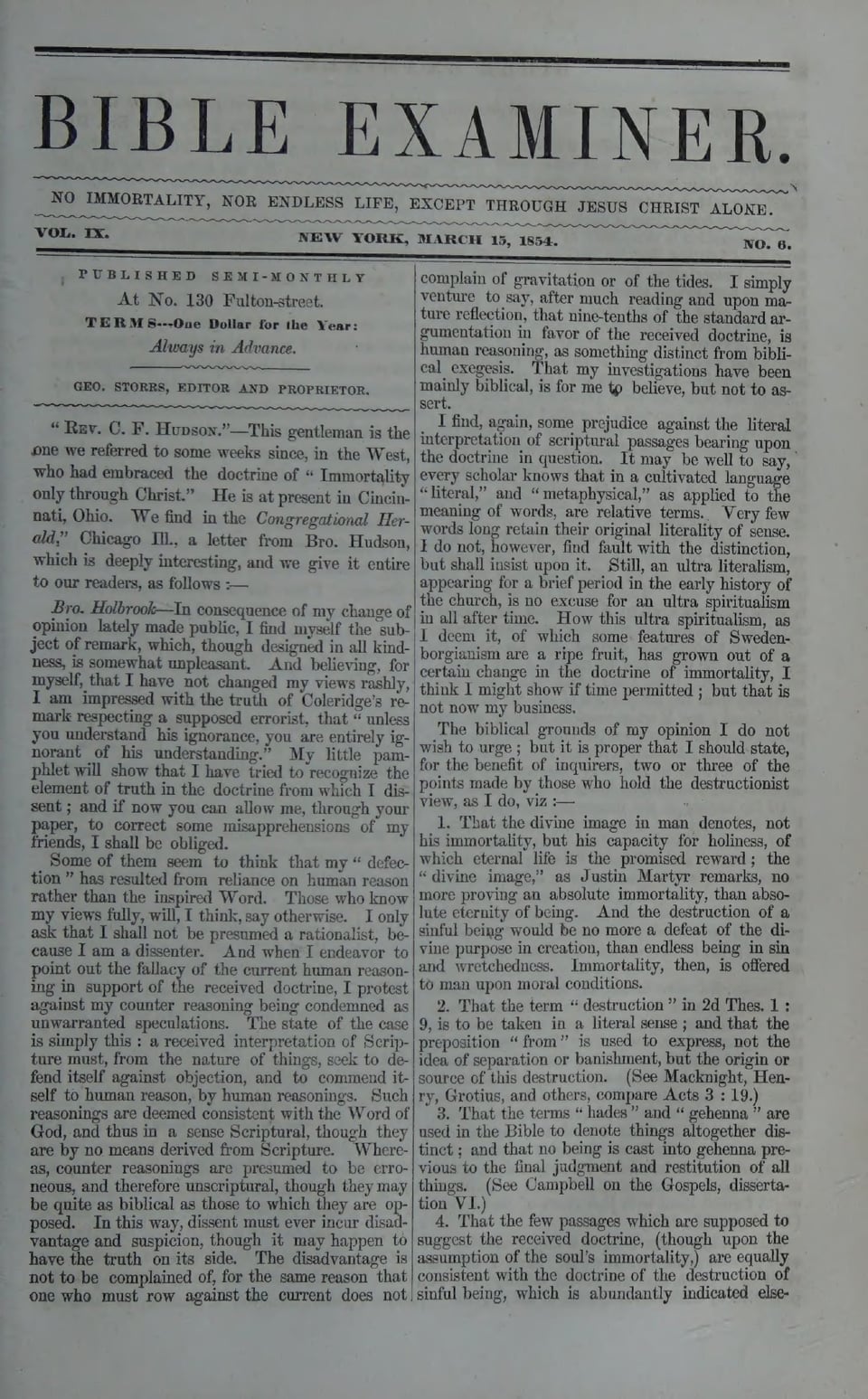
BIBLE EXAMINER.
NO IMMORTALITY, NOR ENDLESS LIFE, EXCEPT THROUGH JESUS CHRIST ALONE.
VOL. IX.
NEW YORK, MARCH 15, 1854.
NO. 6.
TERMS---One Dollar for the Year: Always in Advance.
GEO. STORRS, EDITOR AND PROPRIETOR.
"REV. C. F. HUDSON."—This gentleman is the one we referred to some weeks since, in the West, who had embraced the doctrine of "Immortality only through Christ." He is at present in Cincinnati, Ohio. We find in the Congregational Herald." Chicago Ill., a letter from Bro. Hudson, which is deeply interesting, and we give it entire to our readers, as follows :—
Bro. Holbrook—In consequence of my change of opinion lately made public, I find myself the subject of remark, which, though designed in all kindness, is somewhat unpleasant. And believing, for myself, that I have not changed my views rashly, I am impressed with the truth of Coleridge's remark respecting a supposed errorist, that "unless you understand his ignorance, you are entirely ignorant of his understanding." My little pamphlet will show that I have tried to recognize the element of truth in the doctrine from which I dissent; and if now you can allow me, through your paper, to correct some misapprehensions of my friends, I shall be obliged.
Some of them seem to think that my "defection" has resulted from reliance on human reason rather than the inspired Word. Those who know my views fully, will, I think, say otherwise. I only ask that I shall not be presumed a rationalist, because I am a dissenter. And when I endeavor to point out the fallacy of the current human reasoning in support of the received doctrine, I protest against my counter reasoning being condemned as unwarranted speculations. The state of the case is simply this: a received interpretation of Scripture must, from the nature of things, seek to defend itself against objection, and to commend itself to human reason, by human reasonings. Such reasonings are deemed consistent with the Word of God, and thus in a sense Scriptural, though they are by no means derived from Scripture. Whereas, counter reasonings are presumed to be erroneous, and therefore unscriptural, though they may be quite as biblical as those to which they are opposed. In this way, dissent must ever incur disadvantage and suspicion, though it may happen to have the truth on its side. The disadvantage is not to be complained of, for the same reason that one who must row against the current does not
complain of gravitation or of the tides. I simply venture to say, after much reading and upon mature reflection, that nine-tenths of the standard argumentation in favor of the received doctrine, is human reasoning, as something distinct from biblical exegesis. That my investigations have been mainly biblical, is for me to believe, but not to assert.
I find, again, some prejudice against the literal interpretation of scriptural passages bearing upon the doctrine in question. It may be well to say, every scholar knows that in a cultivated language "literal," and "metaphysical," as applied to the meaning of words, are relative terms. Very few words long retain their original literality of sense. I do not, however, find fault with the distinction, but shall insist upon it. Still, an ultra literalism, appearing for a brief period in the early history of the church, is no excuse for an ultra spiritualism in all after time. How this ultra spiritualism, as I deem it, of which some features of Swedenborgianism are a ripe fruit, has grown out of a certain change in the doctrine of immortality, I think I might show if time permitted; but that is not now my business.
The biblical grounds of my opinion I do not wish to urge ; but it is proper that I should state, for the benefit of inquirers, two or three of the points made by those who hold the destructionist view, as I do, viz :—
That the divine image in man denotes, not his immortality, but his capacity for holiness, of which eternal life is the promised reward; the "divine image," as Justin Martyr remarks, no more proving an absolute immortality, than absolute eternity of being. And the destruction of a sinful being would be no more a defeat of the divine purpose in creation, than endless being in sin and wretchedness. Immortality, then, is offered to man upon moral conditions.
That the term "destruction" in 2d Thes.1 : 9, is to be taken in a literal sense; and that the preposition "from" is used to express, not the idea of separation or banishment, but the origin or source of this destruction. (See Macknight, Henry, Grotius, and others, compare Acts 3:19.)
That the terms "hades" and "gehenna" are used in the Bible to denote things altogether distinct; and that no being is cast into gehenna previous to the final judgment and restitution of all things. (See Campbell on the Gospels, dissertation VI.)
That the few passages which are supposed to suggest the received doctrine, (though upon the assumption of the soul's immortality,) are equally consistent with the doctrine of the destruction of sinful being, which is abundantly indicated elsewhere, if scripture terms are to be taken generally in their obvious sense.
These propositions I offer without argument. Others may discuss them, and none shall charge them with being "wise above what is written." I will only add a historical suggestion, and a remark on the connexions of doctrine.
My suggestion is this—that in the second century, the Christian doctrine, as I deem it, of conditional immortality, instead of supplanting the Platonic doctrine of absolute immortality, began to be engrafted upon it; that in the effort to relieve the undue pressure thus created, the restorationism of Origen was the natural fruit of this alliance, and was the first of a series of restorationisms, of which the purgatory of the Romish Church has been the most prominent; that from this alliance has resulted a "conflict of ages" for which Paul is in no way responsible; and that the final destruction of the wicked, after imprisonment (during the intermediate state) and public trial, so far from being a doctrine of "purgatory," is the scripture refutation of this and all other schemes of universal salvation.
And again: is it not an unwarranted and hazardous thing to argue the divinity of Christ from the supposed need of an infinite sacrifice for the infinite evil of sin? This style of reasoning seems to have been unknown to Athanasius, the Father of Orthodoxy; his ever recurring argument for the divinity of Christ being derived from his power to give life to the dead, and to restore a lost immortality to man. (See John, chap. vi.) Now the argument from the infinite evil of sin is, at least, not biblical; and if we succeed in making an apparent connection between the two doctrines, they are so far likely to share a similar fate. Have our orthodox divines, in this way, unwittingly given occasion and a stumbling block to Socinianism?
Of the history of the dangerous doctrine which I hold, I need not say much. Justin Martyr lived, it seems, before the happy age of doctrinal development; and Richard Whately is perhaps, "eccentric" (as every innovator is de facto eccentric.) Be this as it may, I have reached my conclusions without the help of either of them. The prestige of great and good names, of course, proves nothing; but neither is it to be dismissed with a sneer.
Finally, if I were to ask my friends to forgive my difficulty with the received doctrine [of future endless punishment,] I should just remind them of the language of Dr. Dwight : "There are, I know, persons who speak concerning future punishment with an air of cool self-complacency, as being in their view easy of investigation and free from embarrassment. I am inclined, perhaps uncharitably, to give them little credit for candor, clearness of intellect, or soundness of character; and greatly doubt whether it has been investigated by them, either to such an extent, or with such a spirit, as might furnish them with just views of its nature." (Theology, IV., 457.)
I do not know but I have a larger charity for such persons than Dr. Dwight. And I have a right to suggest that reciprocal charity will be promoted by a free investigation of the subject.
Since the foregoing was prepared for the compositor we have received a letter from Bro. Hudson, from which we give the following extract; though possibly he did not design it for the public eye.—Ed. Ex.
CINCINNATI, March 9, 1854.
GEORGE STORRS :—Dear Bro.—Mr. F. Y. V., of Walnut Hills, tells me he called upon you some time since, and that, telling you something of my views as concurring with yours, you desired to hear from me. I now take pleasure in complying with your wish, and shall rejoice to make your acquaintance, as a fellow-laborer in the effort to recover from long oblivion and contempt an important article of the faith once delivered to the saints. I can now cordially greet you as a brother, and trust we may receive mutual assistance by comparing notes and by our several labors.
I have come to this city to elaborate my views, and to confirm certain points of history and philology, with advantages, such as I could not find in Chicago. I have taken a small school to help myself in the mean while, until I should be able to execute such plans of preaching or publishing as shall seem best. In that direction I have matured nothing yet.
I have prepared one or two of a SERIES OF ARTICLES to present an outline of the history and a suggestion of the importance, of the doctrine of specific immortality; though I am not sure I shall get them inserted in any of the papers. Three or four of my friends in the city will be glad to see me get a congregation, and even to establish a church, because they deem my views safe, and adapted to the prevention of skepticism in many minds.
How far I shall be able to silence gainsaying among those who never will hear me, I do not know. I do know, however, that there are many indications that this doctrine will speedily be brought forth from obscurity, and will be relied upon to solve what is now called the "Conflict of Ages."
I send you copies of opinions given upon an argument I have prepared, constituting about half of the work I contemplated. These opinions are given by young men of more than ordinary promise in the ministry. How soon I shall be able to bring out my book is altogether uncertain. One of these friends has been quite anxious I should publish a pamphlet, or a brief book, immediately, prefacing that the argument and its ramifications would be made more complete in an after-publication. I prefer, however, if possible, to finish my book in six or eight months, and publish it so complete that it shall defend itself.
I obtained White's book by considerable trouble—have sent for Courtnay's—and also for Dodwell's, as being the book of a learned man, though I am not sure I shall get his writings. I have been much interested in Maimonides, and find that he was once prohibited the Synagogues for holding this opinion, i.e. the synagogues of a certain province, where he was not well known as morally orthodox.
The "opinions" which I send you have never been published, and I have no authority to publish them. If any thing is done with them, it would be better anonymously, for the present. The fact that I am heterodox is published widely enough, but my book is not in a state to be proclaimed.
The Lord be with you. Pray that the spirit of wisdom and faith may direct.
Yours truly, C. F. Hudson.
The following are the opinions referred to in Br. Hudson's letter.—Ed. Ex.
Dear Br. H.I have perused with great pleasure your MS.on "The Future Destruction of the Wicked."
Your views of course, according to the standards of Orthodoxy, would be pronounced erroneous, if not heretical. But it is certainly most rare we find an error—if error it be—maintained with such an array of scripture, such force and clearness of logic, in a manner so frank and with a spirit so candid, so honest, so Christ-like. It seems, rather, the earnest convictions of the sincere, than the empty boastings of the self-confident.
As servants of Christ, pledged to maintain the faith once delivered to the saints, we most naturally begin to look after our responsibilities, when any doctrine not mentioned in creeds and confessions claims attention. What shall we say of it? How shall we treat it?
Evidently if it be at variance with those principles on which we hold the government of God to be administered—if it is calculated to vitiate those motives designed of God to move the heart and conscience and lead to purity and holines of life, it must be discarded and opposed as an obstacle to the conquests of the gospel.
In this view of the case what shall we say of the Destructionist's theory? Does it assume any new and antagonist principle? Is it calculated to hinder the free course of the gospel?
1st. I cannot see that it does in anyway abate the demands of justice, or defeat the ends of mercy. 2d. I can see how it would produce the most salutary effect upon the minds of many. (a,) In giving liberty to those who hold the common doctrine in dubis, and of consequence suffer a partial paralysis in the efforts and joys which are peculiar to the Christian. (b.) In reclaiming those who discard the whole system of Christianity because of the common doctrine which they conceive an essential part of it.
At all events the doctrine is worthy a thorough investigation. While I must hesitate before acknowledging it, I could not feel justified in condemning, without a much more ample examination of its claims. It may be erroneous, but I doubt whether it can be shown worthy of the epithet heresy, which the apostle regards as a sufficient ground of excommunication.
"Prove all things," is emphatically a Protestant as well as a Christian maxim. And since we hold that the divines of Westminster and the Reformation did not exhume all the jewels of truth from the accumulated rubbish of ages, we should be the more anxious to give free scope to inquiry within the bounds of known fundamental privileges.
Knowing you as I do, and believing you have no other desire than to arrive at a full knowledge of the truth as it is in Jesus, I feel confident your investigations will be productvie of good.
But in conclusion, let me remind you of our Master's promise, "When he, the Spirit of Truth, is come, he will guide you into all truth;" and let us ever most devoutly and thankfully seek his wisdom in all our investigations of divine things.
$
Yours in Christ,
$
Dear Br. H.-After a single and hasty hearing of your argument on the final doom of the wicked which I have been favored, I feel qualified to give only a crude and half formed opinion; yet so far as it is shaped in my mind I will communicate it.
I have been accustomed to regard the doctrine of the annihilation of the wicked—so far as it has ever entered my thoughts, which is but slightly—with feelings of mingled abhorrence and contempt, as being in my view akin to the pernicious error of Universalism, and also materialistic, and philosophically base. I am not sure indeed, but that my philosophy revolted at it even more than my religion.
But I confess that these feelings are now wholly done away—at least so far as a view like yours is concerned. Your doctrine is no more materialistic than the common view; for it does not deny that the soul is spiritual in its nature, and fitted for immortal existence; while, on the other hand, those who hold the common theory cannot deny, with all their ideas of its spirituality and immortality, (if I may so speak,) that He who made it is able even now to destroy it in hell. Neither has your doctrine any kinship with these errors, which, denying the punishment of sin, abolish that essential and infinite difference which separates right from wrong, holiness from sin. Your doctrine teaches that an awful and remediless punishment awaits the sinner, and I can see nothing in the nature of things or in the necessities of moral government, which makes the common doctrine more probable than yours. Nay, I am compelled to own, that this probability appears to me on the other side.
But it is of course the scriptural argument only that is at all decisive. And here I confess my astonishment at the force of your reasoning—contrary to my previous convictions—and own that I am at present unable to answer it. Your argument stands in my mind thus—the generic immortality of the soul is not taught in the scripture as a specific doctrine.
It is thought, however, to be implied in certain passages teaching the punishment of the wicked. Yet it does not appear to be necessarily, or with absolute certainty, taught in these; while there are many passages, which, unless we hold such a doctrine respecting the future existence of the soul as forces us to give them a metaphysical interpretation, teach plainly that it will be destroyed.
The question then to be decided is, whether the probabilities of the former class of passages are such and so great as to overbalance the probabilities of the latter.
Your candid and able argument has left an impression on my mind in favor of your view—an impression which future investigations, if I am allowed to make them, must either remove or deepen. So far as my knowledge extends, the doctrine of eternal suffering will need a new defence upon the publication of your argument.
I will add, your view gets rid of all the difficulty about the question of positive punishment; it saves also the doctrine of atonement from that depreciation, which belongs to the theory of eternal sinning as the ground of eternal punishment. The relief it gives also to many pious minds is manifest. And if these things do not prove it true, they add to the reasons which should secure it toleration and respect.
With the highest esteem,
Your Br. in the Gospel,
THE CROSS.—A REVIEW.
BY HENRY GREW.
Our respected brother Ham, referring to the testimony of our blessed Lord concerning his death, remarks as follows :—
"His crucifixion, he tells us, was an act of highest impiety and cruel wrong; a manifestation of godless hostility to the holy laws and purposes of the Most High, and merited the severest marks of the divine displeasure. He says no more."
Being, with the pious writer, by divine favor, "set-free to sit at the feet of the great Teacher," let us unite in humbly "asking the Lord Jesus Christ the meaning of his last sufferings and death."
That the meek sufferer considered, as did his inspired apostle, that the crucifixion was the work of "wicked hands," is not to be questioned. Is it true that "he says no more?" Is it not a matter of fact, that he said more respecting the divine design of his death, than he said in direct condemnation of the act of his murderers? Let us hear him.
"I lay down my life for the sheep." "I lay it down of myself." "Therefore doth my Father love me because I lay down my life," &c.—John 10 : 15-18. "The Son of man came—to give his life a ransom for many."—Mark 10 : 45. "As Moses lifted up the serpent in the wilderness, even so must the Son of man be lifted up: that whosoever believeth in him should not perish, but have eternal life."—John 3 : 14, 15. "And I, if I be
lifted up from the earth, will draw all men unto me. (This he said signifying what death he should die.)” "The bread that I will give is my flesh, which I will give for the life of the world."—John 12:32,33;6:51. "This is my blood of the new testament, which is shed for many for the remission of sins."—Matt. 26:28.
Surely, we must not affirm, that our gracious Redeemer "says no more" than that "his crucifixion—was an act of highest impiety," &c. In the above passages, we clearly perceive the same connection between his voluntary death, and the salvation of a lost world, which is exhibited by the inspired prophets and apostles, in passages I have quoted in my former article; particularly in Isa. 53, and Rom. 3 : 25, 26.
The zealous apostle, previous to his enlightenment on this divine purpose, when our dear Lord gave notice of it, said, "Be it far from thee, Lord : this shall not be unto thee. But he turned and said unto Peter, get thee behind me, Satan; thou art an offence unto me: for (in objecting to my sufferings and death) thou savorest not the things that be of God," &c., plainly teaching "the meaning of his last sufferings and death," as being "the things that be of God."—Matt. 16:21-23.
On the last confiding prayer of "the Son of the Blessed," "Father, into thy hands I commit my spirit," brother H. remarks, "How natural is this language in the lips of the dying Christ, on the supposition that he was conscious, at this time, of no other than an endeared filial relationship towards his divine Father; and how unnatural, on the supposition that he was conscious of being in the attitude of an imputed criminal, expiating a world's offences by suffering the penalty due to those offences." "The Lord Jesus, at this time, was only conscious of a Eather's presence and a Father's sympathy." What then meaneth that affecting exclamation, "My God, my God, why hast thou forsaken me?" How natural is this language in the lips of the dying Christ on the supposition" that "the Jehovah hath laid on him the iniquities of us all;" how unnatural, if the Father did not "make his life an offering for sin;" "a propitiation—for the sins of the whole world?" How unnatural is this language according to the views of our intelligent brother. "Awake, O Sword, against my Shepherd, and against the man that is my fellow, saith the Jehovah of Hosts, smite the Shepherd," &c.—Zech. 13 : 7. He supposes that if the death of the Son of God was of a vicarious character, "we should have expected—language betokening a sense of the most distressing rejection by God," &c. How significant of such "a sense," is the language actually used by the sinner's dying friend; "My God, my God, why hast thou forsaken me?"
The divine testimony indeed reveals no such absurdity as the Son of God "suffering the penalty due to (our) offences," which is "everlasting destruction." Still more absurd is such an opinion on the part of those who believe the penalty to be eternal torment! The truth, however, must not be rejected, that "God hath set (him) forth to be a propitiation, through faith in his blood, to declare his righteousness for the remission of sins that are past, through the forbearance of God— that he might be just and the justifier of him which believeth in Jesus."—Rom. 3 : 25, 26.
I advocate no "scholastic theology" or theory of fallible man. Let us beware, however, lest in plucking up the tares, we pull up the wheat also.
I have only to remark, that the corresponding testimony of the prophets and apostles teaching us that the "last sufferings and death" of the Mediator, were in accordance with the divine purpose, and "a propitiation—for the sins of the world," is of equal authority with that of the Saviour. They "spake as they were moved by the Holy Ghost" "the doctrine" and "the commandments of the Lord."—2 Peter 1:21; Acts 13:12; 1 Cor. 14:37.
THE DOCTRINE OF THE CROSS.
THE CROSS AN EXAMPLE.—BY J. PANTON HAM.
(Continued from page 57.)
The question which it was obviously necessary to ask and reply to, in such an inquiry as the present, has now been answered, and we think scripturally answered. The cross, the gibbit of the ancient Gentiles, became identified with the personal history of Christ, because the Jews resisted and rejected his Divine mission. Although foreseen by God, it was not demanded and planned by Him. The honor of His moral government of His creatures could not be upheld by an act of rebellion against that government. The crucifixion of Christ, according to the Scriptures, was a crime,—the highest and most aggravated of all crimes,—and can crime be cleansed by crime? Can it be a law of the Christian revelation that the fouler the crime the more perfect it becomes as an agent of moral purification? What! sin sanctify sin! sin give a satisfaction for sin! sin save men from sin! If this be the philosophy of the Churches, the "orthodox" Churches, well might an Apostle exclaim, "beware lest any man spoil you through philosophy after the tradition of men, after the rudiments of the world, and not after Christ." It is such philosophy as this which props up and gives plausibility to infidelity. The understanding and moral sentiments of men are violently shocked and set at most dangerous defiance by such palpably absurd and offensive dogmas as these. No wonder that a dreary infidelity is diffused over the laud. The Churches see and sorrow over the melancholy fact, but they see not that themselves are the creators of the evil they deplore. And they are now seeking for specifics, and think to cure the evil by the more diligent application of its cause! The principles of homoeopathy, whatever may be their worth in Materia Medica, have no application to intellectual and moral diseases. The medicine of the mind is not that which deranged it. Truth, not error, is the cure for error. The "orthodox" Churches are not the spiritual physicians of the age, they are empirics who have well nigh extinguished its spiritual life as well as its health. A voice from the Bible, if they could but hear it, commands them to stand aside out of the sunshine of God's pure truth. Neither light nor heat can
radiate their genial influences upon the world while they stand in the way. The experiment has been tried on the old, opaque orthodoxy, and the result of centuries of trial have proved it a most effectual spiritual screen. The world has gathered darkness, and grown cold under the sombre shelter of the Churches. And now the world, as well as the Bible, is crying out to one and to all of them, Stand aside! let the light have its course, or our vision will wholly fail us; let the heat of heavenly truth come unhindered to our human hearts, that we may feel its blessed influence and that faith may germinate and grow!
The evidence against the popular theory of the death of Christ includes the important fact that Christ himself, who so frequently referred to his sufferings and death, never so interpreted them. Not the remotest allusion is ever made by him to those notions of the nature and purposes of his last sufferings which are so generally received by professing Christians. We have seen in what manner he spoke of the tragic event,—that he uniformly refers it to the malignancy and impiety of Satan and wicked men. The silence of the Lord himself on these popular and so called evangelical notions is a phenomenon which is altogether inexplicable except on the supposition that these notions are false,—the mere conceits and traditions of men. Add to this important fact that our Lord sometimes used language which no theological ingenuity can make to comport with the popular doctrines, and we have not merely a pressumptive evidence against these time-honored notions, but proof demonstrative of their doctrinal falsity. Such language, to select a principal illustration, is furnished in the discourse of the Lord Jesus with the two sons of Zebedee—his disciples, James and John. The reader will recollect that on one occasion these two disciples asked Christ to be allowed to sit, the one on his right-hand, and the other on his left in his kingdom. Upon which the Lord asked them, "Can ye drink of the cup that I drink of? and be baptized with the baptism that I am baptized with?" Now if these disciples had understood that the sufferings and death of their Master would be expiatory in their nature, they surely would have replied, "We cannot." But, they answered, "We can!" The reader is requested to give this incident his careful and candid attention. Here is an allusion to that "cup" concerning which Christ, in the bitterness of his grief in Gethsemane, cried, "If it be possible, let this cup pass from me." It is commonly said that Christ could only drink of that cup because it was the cup of his Father's wrath against sin, and that it figuratively expresses the inconceivable anguish which he had to endure in bearing the judicial recompense of sins.
James and John must certainly have been ignoant of this view of their Lord's sufferings, or they never would have presumed to reply as they did. Should any one attempt to excuse them on the score of ignorance, they do not escape from the difficulty because Christ did no trebuke these disciples, as we would have expected, if the common opinions of most Christian people are correct, but on the contrary assured them that they should should drink of the same cup as he was about to drink of.
Jesus said unto them, "Ye shall indeed drink of the cup that I drink of, and with the baptism that I am baptized withal shall ye be baptized"!!—Mark 10:31. The popular mode of exhibiting the cup and baptism of Christ's sufferings as expiatory, necessarily excludes all participation therein by any other than Christ himself. He only could drink of that "cup," He only could pass through the dreadful ordeal of that "baptism." But such is not Christ's mode of representing his sufferings. According to him the principle of his final sufferings was not unique but only the circumstances. He acknowledges the possibility of a participation therein, and distinctly declares that James and John should have a common experience with himself. "Ye shall indeed drink of the cup that I drink of, and with the baptism that I am baptized withal shall ye be baptized." In the view of this emphatic language we are permitted to speak with great confidence and say, that the sufferings and death of Christ were not of the nature of an expiation,—that they were not a satisfaction to Divine justice for sin,—and that they were not endured vicariously by way of undergoing the just punishment due to the guilt of mankind. For to avow these as the real purposes of Christ's sufferings obliges the further avowal that James and John's last sufferings were of the same nature. None can deny that the Lord Jesus, himself, institutes a comparison between his own last sufferings and those of his disciples. He declares in most unequivocal language, that their experience would be identical with his own. The "cup" and "baptism" were in kind the same. Then it follows, in addition to what we have already inferred, that as both James and John endured violent deaths as witnesses to the truth,—the moral character of Christ's death was the same,—that he suffered and died as a witness of the truth. It was in each case a martyrdom. Christ is called in the book of revelation "the faithful and true witness, (in the Greek, martyr.) James and John were faithful unto death. And of Christ it is written, that, "being found in fashion as a man, he humbled himself and became obedient unto death, even the death of the cross."
A passage in the Epistle to the Hebrews, (Ch. 12,) expresses in a compendious form the several ideas which we have endeavored to place before the reader in these serial papers on the "Doctrine of the Cross." The cross is characterized as a great ignomy, or "Shame;" and is called the "Contradiction," (or opposition) of Sinners against Christ. It is there simply regarded as the expression of sinful resistance to Christ's character and mission. No other aspect of the cross is here recognized by the sacred writer; and this particular aspect is so presented as to necessitate the conclusion that the cross of the Lord Jesus was, in its character and value, not expiatory, but exemplary. On Christ's patient endurance of "such contradiction of sinners against himself," he founds his eloquent expostulation, "Ye have not yet resisted unto blood striving against sin," in which, it is observable, that the idea is repeated,—that Christ's death on the cross, was a resistance "unto blood,"
not for the sake of bearing sin—punitively, nor satisfying for sin judicially, but in "striving against sin." His war with sin in all its forms, degrees, and manifestations, was so complete, that, sooner than yield to sin, he would sacrifice his life, or resist unto blood striving against it. By placing an emphasis on the pronoun "Ye," we see the significance of this Apostolical memorial. "Ye have not resisted unto blood," &c., clearly implies that the persons addressed ought to be prepared for such a perfect obedience, and that it was possible to attain to it. They are reminded by the example of Christ's suffering and death on the cross, that they should not be weary in the great warfar, but persevere in their godly resistance against sin, even should it cost them their blood;—and are assured that if they do so strive against sin, they will imitate their great Example whose last sufferings and death were of this eminent moral nature.
THE IRISH EVANGELIST;
OR, REV. JOHN HURLY ON IMMORTALITY.
In the last Irish Evangelist—a paper edited by Mr. Hurly, Pastor of the Irish Evangelical Church, who worship at 187 Bowery, I find the following language made use of by him, in answer to a Roman Catholic :—
"God at various times selected and inspired men of holy lives, who spake, as they were moved by the Holy Spirit, to the common understanding of the people to whom they delivered their divine message. Yet from no paragraph, nor sentence, that they revealed can we deduce the doctrine of man's natural immortality. The Bible in many places teaches that God made man for immortality, but nowhere, to our knowledge, does it teach that God made man IMMORTAL.
"We call upon you, or any one sympathizing with your views, to show us one passage from the holy scriptures which teaches the natural immortality of man; or that any being, as yet, is immortal but God. We believe in immortality; and that in humble hope, and patient endurance we seek for glory, honor, and immortality.—Rom. 2:7. But, friend, let us tell you that, this immortality, which our soul sighs for, is in Jesus Christ, and not in us.
"The writer, and all the human family, are by nature possessed not of immortality, but of innate depravity, and consequent mortality. And this depravity, alas, has seized them, soul, spirit, and body. But blessed be his holy name, who has not left us without a hope; for, through faith in Jesus, and patient continuance in well doing, this corruptible will put on incorruption; and this mortal will put on immortality; and then, and not till then, shall be brought to pass that saying which is written—Death is swallowed up in victory. O death, where is thy sting; O grave, where is thy victory.—I Cor. 15 : 53-58."
It is a cause of thankfulness to God, that notwithstanding the powerful influence Popery holds over the Protestant mind, yet there is now and then a Protestant Minister who dare come out, regardless of the consequences, and enter their Protest against all the corruptions of Popery.
I would recommend the above article of Br. Hurly's to the serious consideration of those who are writing and preaching against Popery, and say—How can you consistently argue against Popery, while you hold in your own creed, the grand Root-Errors of the Church of Rome? I mean natural immortality. How can you consistently sing, "Babylon is fallen, is fallen," when, at the same time, you hold up, cherish, and advocate, the corruptions on which the whole superstructure of Babylon is erected?
When the Christian world will come out and publicly Protest against natural immortality, as Br. Hurly has done, and look to Christ as the only fountain of immortality, then, and not till then, will Babylon fall to rise no more. How can you consistently preach about the inconsistency of Purgatory, when, at the same time you hold to the immortality of the soul, which gave birth to Purgatory? For it is evident, if their is no conscious living soul when the man is dead, then there is no chance for a Purgatory.
The Reformation from Popery is a great work. Luther, Calvin, and others, did great things; but let it be distinctly understood, that they only Protested against about half the Errors of Popery, and the Protestant world has now endorsed the other half—inherent immortality! That is the fundamental article of the Protestant faith. It is the Alpha and Omega of the so called orthodox world: and I here assert, without the fear of contradiction, it is not in the Bible. Where then does it come from? It comes from Heathenism, adopted by Popery, and not Rejected by the Reformers; but it is now Protested against by the Rev. John Hurly, as a doctrine not found in the Bible. PATRICK CANNON.
New York, Feb. 21, 1854.
HOPE OF ETERNAL LIFE.
A single portion of Scripture, to one placing confidence in the teachings of the Bible, ought to put the whole matter at rest, and fix the mind directly upon the only way to heaven. I refer to the epistle of Paul to Titus. The apostle, in the course of this brief letter, elucidates every essential principle of Christian experience, practice and hope, confining himself to the experience of himself and Titus directly, or applying general principles of the divine administration to themselves. (1.) The fallen and sinful condition of man—" foolish, disobedient, deceived, serving divers lusts and pleasures, living in malice and envy, hateful and hating one another.—Titus 3 : 3. (2.) The originating cause of man's recovery—" the kindness and love of God toward man,"—not by works of righteousness which we have done, but according to his mercy."—3 : 4, 5. (3.) The mediatorial cause—" through Jesus Christ our Saviour."—3 : 6. "Who gave himself for us."—2 : 14. (4.) The instrumental causes—faith and truth—" Paul, a servant of God according to the faith of God's elect and the acknowledging of the truth which is after godliness."—1 : 1. Christians also designated by the phrase, "they which have believed in God."—3 : 8. (5.) The recovery itself—" he
saved us by the washing of regeneration, and the renewing of the Holy Ghost,"—3 : 5 ; "justified by his grace,"—ver. 7. (6.) The extent of this salvation—"which he shed on us abundantly,"—ver. 6 ; "redeem us from all iniquity,"—2 : 14. (7.) The mode of life required of the saved—"Holding fast the faithful word,"—1 : 9 ; denying ungodliness, and worldly lusts, we should live soberly, righteously and godly, in this present world,"—2 : 12 ; zealous of good works,"—ver. 14 ; "careful to maintain good works."—3 : 8. Finally, the result of this experience—"that we might be made heirs according to the hope of eternal life."—3 : 7. "Looking for that blessed hope, and the glorious appearing of the great God, "and our Saviour Jesus Christ."—2 : 13.
The following conclusions are legitimate :—
There is a state or condition properly denominated "eternal life," which state is to be enjoyed in another world; "for what a man hath, why doth he yet hope for?"
There is an exercise of the mind or heart, properly termed, "the hope of eternal life." This "hope" is a sincere desire of eternal life, associated with a well founded expectation of enjoying it.
Eternal life is an inheritance, and as such belongs only to the legal "heirs."
Man, in his natural state, is not an "heir according to the hope of eternal life." Paul and Titus were made heirs by grace. Not naturally so—neither "by works of righteousness which we have done."
Man is an alien from the house of God, in such sense as deprives him of the rights and privileges of heirship; else, how could he be "adopted," how be "made" an heir!
No election before the world began, constituted any man an heir. Paul was one of "God's elect;" but his election did not make him an heir, because he was justified by grace that he might be made an heir according to the hope of eternal life. His heirship was a result of his justification; his justification was not the result of his election to heirship.
Genuine Christian experience, faithfully maintained, will constitute any man an "heir according to the hope of eternal life."
Dear reader, "examine yourself whether you are in the faith." "Prove your own self." "If any man be in Christ, he is a new creature." "He that believeth hath the witness in himself." Whoever receives the same work of grace with Paul, will receive "the spirit of adoption," which will bear witness with his spirit that he is a child of God; and if a child, then an heir of God, and a joint heir with Jesus Christ.—Rom. 8 : 1-16. If, on examination, you have not been made an heir "by the washing of regeneration and renewing of the Holy Ghost," rest not, till by repentance of all sin, renunciation of every false hope, and implicit faith in Christ as your present and everlasting Saviour, you fly for refuge from the consequences of alienation from God, and "lay hold upon "THE hope set before you in the Gospel." Having this hope, you may have "strong consolation," and "abound more and more in the work of the Lord, knowing that your labor is not in vain in the Lord."
You may then be prepared to give a reason of the hope that is in you, claiming with the great apostle to the Gentiles, that you have been made an heir according to the hope of eternal life.—Zion's Herald.
BIBLE EXAMINER.
NEW YORK, MARCH 15, 1854.
NEW SUBSCRIBERS will be furnished with the EXAMINER from January 1st, unless they order otherwise. But we cannot make any abatement in the price if they do not take the back numbers. Our terms are one dollar for the year. That sum pays only to December 15th, begin when the subscriber will, so long as we can supply all the numbers for the volume. Any one, on reflection, will see the propriety of this course, as we publish an even number at each issue, and the numbers not taken are broken sets, and lost to us.
CONTINUED ARTICLES.—We have found ourselves in difficulty in publishing articles, which are "to be continued," before we knew to what extent they would reach. They have sometimes run through a volume and extended into the following: thus depriving those who did not continue their subscription of the benefit of the entire argument; and new subscribers are not interested in a mere conclusion. We have determined, therefore, not to commence a series of articles, hereafter, till we have them all before us, and then we shall exercise our best judgment in their insertion.
We wish it distinctly understood that we do not endorse all the sentiments contained in any article, whether original or selected; but we do not think it either necessary or courteous to express dissent to every idea that does not harmonize with our own. We think our readers have intelligence enough to judge, with their Bibles in their hands, of the correctness of anything which appears in our columns, without our standing as censor over every expression.
MORE IMMORTAL-SOULISM.—We clip the following from one of the daily papers of this city :—
A portion of the Chinese believe in a variety of hells for those who lead irreligious lives in the present world. One of these hells they say is stuck full of knives; another is a great iron boiler, filled with scalding water; in another, liars' tongues are pulled out, &c., &c. It is no uncommon thing to hear them pray, "May I not fall into the hell of swords," or into this or that place of torment.
Such is the natural result of the belief of an immortal soul in man. We hear prayers among professing Christians that differ not, essentially, from that in the foregoing item. Indeed, it seems to be the burden of nearly all christendom to know how they "shall escape such a hell" as their theologians describe. It seems to concern them but little that sin is a dishonor done to God; and that His glorious character and attributes demand our love and homage. If they can only escape the hell of eternal torment they seem to be quite at ease, and leave others to serve God from principle, and because His perfections, and especially His love, claim our love and obedience.
What better can we expect than just such ideas as the Chinese have, so long as men believe themselves possessed of an immortal entity, and that their God will inflict undescribable torments on the creatures he has made?
THE THEOLOGICAL HELL:
For the want of time to write a more extended article on the above topic, we give the following extract from our last speech at the "Hartford Bible Convention," as reported.—Ed. Ex.
I need not again state the position I occupy. It is possible that some of my friends on the opposite side may think that I grant them all they contend for. I have not contended that every word in the Bible is inspired: I have only contended that it contains a history of revelations in certain ages, made by certain instruments, which God has employed; and a history of certain facts and transactions which were connected with those ages in which the revelations were made. I shall go perhaps a step further,—that no man is called upon to receive as a revelation that which plainly and palpably contradicts right reason. If, therefore, I was convinced that there were doctrines in this Bible, claiming to be inspired of God, that contradicted my sense of what was right, when weighed in the balance of right reason, I would not feel myself bound to receive them as a revelation from God; because the God of the same Bible says, "Come, now, let us reason together." He appeals to our reason, and that very appeal imports that he has nothing to say that will shock right reason. I feel for the position, condition, and situation of many intelligent friends on the other side, who, loving and appreciating virtue, reject the Bible, as they suppose, though, in fact, they reject the traditions of men and the corruptions of theologians. They suppose, indeed, that the Bible teaches certain doctrines which shock their reason; and they reject the Bible supposing that these doctrines are contained in it; and if they really think so, I cannot blame them for rejecting it.
I do not know how they could feel otherwise than they do while they suppose that book contains some of the doctrines attributed to it by theologians.
The most horrible and shocking of all doctrines the last speaker on this stand referred to, and therefore I feel called upon to refer to it myself in my remarks this evening. That speaker came for with the declaration, that the Bible taught the doctrine of eternal misery. With that assumption I take issue. I deny it. The Bible teaches no such doctrine—either in the Old or New Testament. I admit that theologians, professing to understand what the Bible teaches, have taught such doctrines; and she may have supposed that theologians ought to know whether the Bible taught it or not. But theologians may, in these last days, be as mistaken in regard to these things as other men. I take the position that there is not a solitary expression in the Bible that countenances the theological notions of hell. What is the theological hell? I will sum it up from the catechism. It is, that there is a dark, bottomless pit, full of fire and brimstone, where the wicked drink in eternal, unmitigated torture—torture continually increasing, and without end. That is the theological notion of hell; and if the last speaker really supposes that the Bible teaches such a doctrine, I cannot blame her for rejecting the Bible. She says that the Bible does teach it; and what text does she quote to prove it? She could not tell us exactly; but I will tell you that the first text referred to by her is found in Mark 9:43, and it relates to the expression of our Lord, "If thy hand offend thee, cut it off; it is better for thee to enter into life maimed, than, having two hands, to go into hell, into the fire that shall never be quenched," etc.
This was the text mainly relied on in proof that the Bible teaches a hell of endless torments. I maintain that no such doctrine is taught by this declaration, as has been assumed. To settle this point, we want to get a clear and scriptural explanation of the term "hell;" and I wish the congregation to mark distinctly that the text says, "It is better to enter into life halt, or maimed, than to be cast into hell." The very expression tells you that life is what is to be lost if the person does not pursue a certain course, and not endless torment to be endured. Now there are in the New Testament three words that are translated in our language "hell:" Gehenna, Hades, and Tartarus ; the latter occurring but once, and that in 2 Peter 2 : 4. The term " Gehenna" occurs twelve times in the New Testament. The term " Hades" occurs eleven times, and ten times out of the eleven is translated " hell," and once, in 1 Cor. 15 : 55, is translated " grave." The term " Gehenna," and the term " Hades," in the original, have entirely different significations, as every one knows who knows anything about the original. But we are not, on this account, to throw any blame on the Bible; the blame lies on the translators? The translation is not inspiration. It is the work of fallible, erring men, and in no place erring more than in translating Hades, " hell."
In the Old Testament (Hebrew), the only term that is translated "hell," is Sheol, which occurs sixty times, and thirty-one times out of sixty it is translated "hell." It has precisely the meaning of Hades, in the New Testament; and yet thirty-one times in the Old Testament it has been translated "hell," and at other times "grave," etc., according to the judgment of the translators.
My time is so limited, of course, that I have to take but a mere glance at this subject. The term Hades does not occur in the text quoted this afternoon, but the term Gehenna. The translators might better have left it untranslated. We will give you an explanation of it, as given in "The Polymicrian Greek Lexicon," by Greenfield. "Gehenna, properly the valley of Hinnom, south of Jerusalem; once celebrated for the horrid worship of Moloch, and afterward polluted with every species of filth, as well as the carcases of animals, and dead bodies of malefactors; to consume which, in order to avert the pestilence which such a mass of corruption would occasion, constant fires were kept burning."
The term Gehenna is composed of the words, Ge, a valley, and Hinnom, a man's name. Dr. George Campbell, an eminent divine—and orthodox, by the way—tells you that the term Gehenna never occurs in the Greek translation of the Old Testament, nor in any classic author in the world. Then we are shut up to the use of the term among the Jews. What did it mean among the Jews? Place yourself one moment in Jerusalem, where Jesus stood; look outside of that city, and see the Valley of Hinnom, Gehenna. That valley, in the days of the ministration of Jesus, was the receptacle of the filth of the city, carcases of dead animals, and the bodies of malefactors. What purpose did it serve? Was it designed to preserve and keep in existence everything cast into it? Every one knows that whatever was cast into that Gehenna, was cast in there to be made an end of.
When the Saviour says, "It is better to enter into life maimed, than to be cast into hell," (Gehenna), he only uses an expression equivalent to saying, "It is better for you to possess life, to continue in being, by losing one hand or one eye in the present time, than to be totally destroyed at last for your sins." The term, then, in the text, imports a total or entire destruction, and not preservation, under any circumstances. It has no such signification as theologians put upon it.
The idea that the term unquenchable fire imports a fire "never to go out," or that shall "burn eternally," it is easy to show, by its use among the Jewish prophets, has no such meaning, but simply imports utter destruction that cannot be resisted. And such is its common-sense meaning always. A gentleman's house is on fire, and the firemen hasten to his assistance; he says, "Effort is useless, it is unquenchable." Does he mean the fire will burn eternally, or simply that the house will be totally destroyed? If the fire could be quenched, some part of the house might be preserved; but it is unquenchable, and therefore total destruction is certain. Any school-boy knows that is the commonsense meaning of the term, however theologians may pervert it. The text, then, gives no support to the notion of the "theological hell," or endless torments.
If the term Hades, so often translated "hell," had been uniformly translated, we never would have reason and common sense shocked by the doctrine of endless torture. No, never. Why do the translators sometimes translate, in the Old Testament, the term Sheol, "hell," and sometimes "grave?" I will compare two texts—one found in the Old Testament, where the term Sheol occurs, and one in the New Testament, where the term Hades is used as the proper correspondent of the term Sheol. In Psalm 16:10, it is said of the Messiah, "For thou wilt not leave my soul in hell," (the original is sheol), "neither wilt thou suffer thy Holy One to see corruption." In Acts 2:31, Peter speaking of David, says, "He seeing this before, spoke of the resurrection of Christ, that his soul was not left in hell"—Hades, not Gehenna, an entirely different word, and having an entirely different meaning; and yet our translators have translated it the same as though it were Gehenna. We have shown that the terms Sheol and Hades are precisely of the same import. Now, when the word Sheol is so often translated "the grave," why should they not translate the term Hades in the same manner? They did not do so,
because they believed in the natural immortality of the soul; and if they had translated, "thou wilt not leave my soul in the grave," they would say that Christ's soul died, as it did. "What, Christ's soul die!" Yes, sir, Christ's soul died. "You mean Christ's body?" No, sir; whatever constituted Christ went into the grave and died; and had the translators been faithful in translating here, we should never have heard of Christ's going to the theological hell. Rather than give up the doctrine of the immortality of the soul, they would send Christ to hell! Yes, to a hell of endless torments. But, unfortunately for their theory, he got out of it, and so others may. The fact is, Sheol and Hades never mean a place of suffering. The terms signify "covered," "out of sight," and are used in the Scriptures almost uniformly to signify the state of the dead—a state which is hidden from our view—and this the testimony of the Bible clearly confirms. It says, Eccl. 9 : 10, that "in Sheol there is no knowledge," and, consequently, no suffering.
I must charge our translators with being warped by the doctrine of the natural immortality of the soul. In the passage 1 Cor. 15:55, wherein it says, "O grave, where is thy victory?" the original term is hades. Why did they not translate it "hell" here as they did in every other instance where the term occurs? Because if they had done so they would have proved that there is to be a victory over hell. In Hosea 13:14, it says, "I will ransom them from the power of the grave; I will redeem them from death; O death, I will be thy plague; O grave, I will be thy destruction." Why did they not translate the word sheol in this passage "hell" instead of "grave?" Because they would not allow the shadow of the idea that a soul could be delivered from hell to be taught in the translation. The term used here is sheol. "I will redeem them from death; O grave—O sheol—I will be thy destruction." Had it been translated hell instead of grave, it would have proved that hell is to be destroyed, and consequently all the wicked in it delivered or destroyed with it. The fact is, sheol nor hades have never any such sense as theologians attach to the term hell. The doctrine of eternal torments, or the theological hell, then, is not a doctrine of the Bible.
AN EXTRACT. What I say or write to day, I do not engage to stand by, or to defend to mowrow; it is but my foot-print, left for others to see that I have been in this dispensation. By the time you read this, the spirit may have led me into a higher and purer state. Then say you, "What do I learn?" verily that the road to perfection is strewed with imperfections and crudities.
"THE ETERNAL MISERY OF HELL."
Such is the title of Tract No. 277, of the American Tract Society, New York. That Society published it several years ago; it had disappeared, we thought, entirely; but it has reappeared in a new dress. It is an extract from Saurin's Sermon on the subject. Let it have a wide circulation: it will work its own cure. The days of superstition are passing away; and thinking men will not take assumptions for truth: they will demand scripture evidence in harmony with sober reason. We noticed this Tract in 1847; but as it has appeared anew we think best to renew our notice. The first point it takes up is, "The quality and the duration of the punishment of hell." It says: "A privation of celestial happiness is the first idea of hell." Upon this point the author makes some sensible remarks, but says: "We seldom think we have immortal souls." Why should "mortal man" [Job] "think" that he has that which is only the gift of God, through Jesus Christ, at the resurrection, "to them who by patient continuance in well doing seek for immortality"? See Rom. 2:7.
The author next considers the "painful sensations." Here he has the common theory briefly, but fully, brought out to view, with such a strange mixture of truth and error as one would almost think could not fail to convince his own mind that his theory was both false and blasphemous. He gives a true definition of the term "Hell Fire," and its origin; and then proceeds from it to show that his God is as much more horrible than Moloch as omnipotence is more powerful than the "monstrous machine" or iron image, which "consumed" the miserable infant victims of [the idolaters'] cruel superstition." Moloch "consumed" his "victims" almost instantly; but the God of Mr. Saurin and the American Tract Society, while his "horrible" burnings are equal to those of Moloch, yet does not intend to consume his victims, but to keep them in this perpetual torture: and this is said, too, in the face of the plain and positive declaration of the Holy Spirit that "the enemies of the Lord shall be consumed—into smoke shall they consume away." See Psalm 37:20. Let us here give you the very language of the tract. It says:—
"The very name given in Scripture to the fire of hell hath something very significant in it: it is called the fire of Gehenna.—Matt. 5:22. This word is compounded of words which signify the valley of Hinnom: this valley was rendered famous by the abominable sacrifices which the idolatrous Jews offered to Moloch. They set up a hollow brazen figure, inclosed their children in it, kindled fires underneath, and in this horrible manner consumed the miserable infant victims of their cruel
superstition. This is an image of hell—terrible image! We have no need of abstract and metaphysical ideas. Who among us could patiently bear his hand one hour in fire! who would not tremble to be condemned to pass one day in this monstrous machine? and who—who could bear to be eternally confined in it—"and yet forbid to die?" When we see a criminal in chains, given up to an executioner of human justice, and just going to be burnt to death, nature shudders at the sight—the flesh of spectators shivers—and the cries of the suffer rend their heart, and excite, in painful compassion, all the emotions of the soul! What then must it be to be delivered up to an executioner of divine justice! What to be cast into the fire of hell! Delicate flesh! feeble organs of the human body! what will you do when you are cast into the quick and devouring flames of hell?"
How are the "flames of hell devouring," when, according to the theory here maintained, nothing is ever devoured? Was ever a greater piece of folly, contradiction, and blasphemy put together in so few words as in this one quoted paragraph? It seems hardly possible to exceed it.
The tract, after mentioning several other things that go to make up future punishment, no one of which is "death," but such as the following, viz : "Remorse of Conscience," "Horrible society of Hell," &c., proceeds to say:—
…