The Bible Examiner — Vol. 9, No. 9 (May 1, 1854)
Download: PDF — The Bible Examiner — Vol. 9, No. 9 (May 1, 1854)
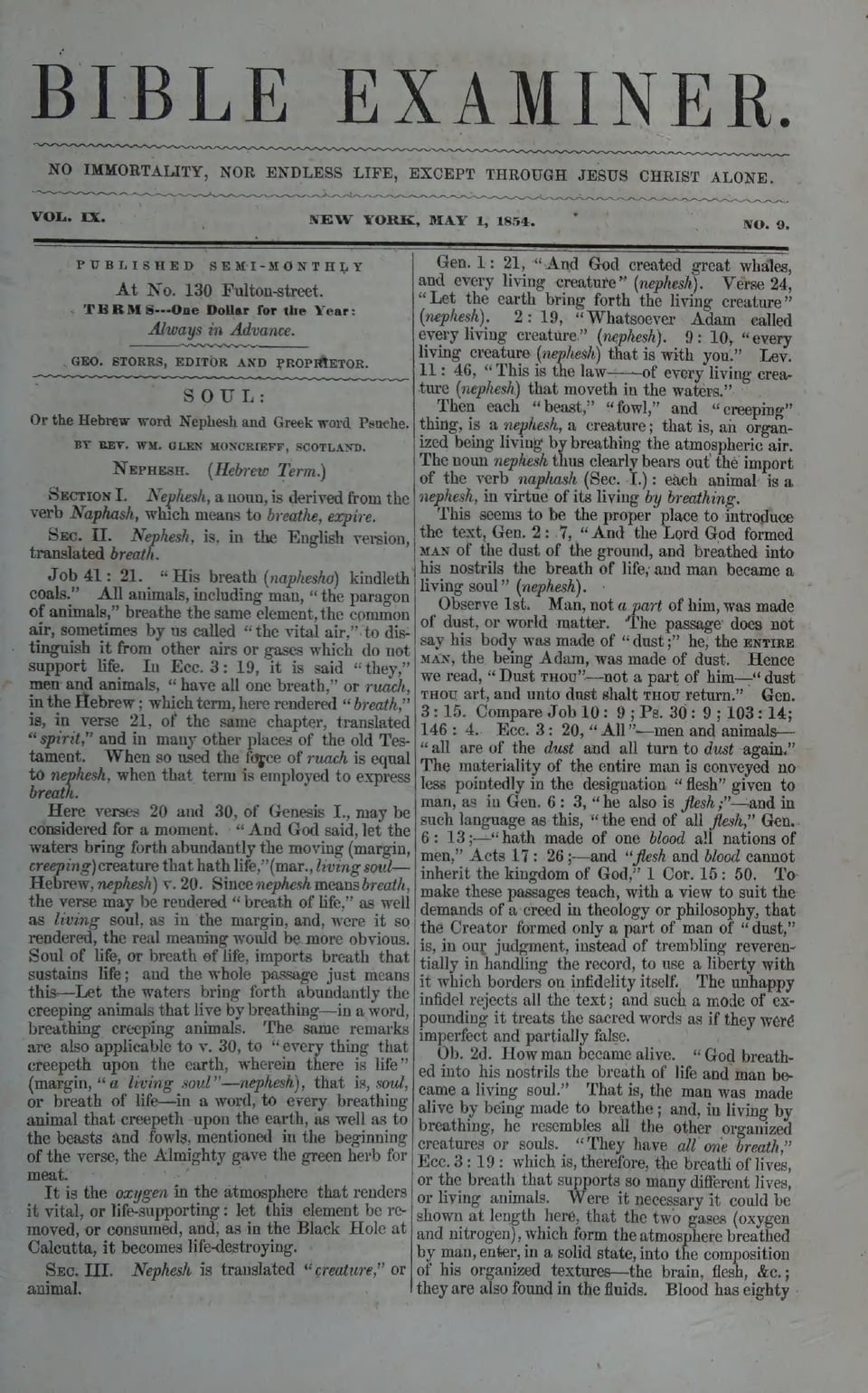
BIBLE EXAMINER.
NO IMMORTALITY, NOR ENDLESS LIFE, EXCEPT THROUGH JESUS CHRIST ALONE.
VOL. IX.
NEW YORK, MAY 1, 1854.
NO. 9.
PUBLISHED SEMI-MONTHLY At No. 130 Fulton-street. TERMS---One Dollar for the Year: Always in Advance.
GEO. STORRS, EDITOR AND PROPRIETOR.
SOUL:
Or the Hebrew word Nephesh and Greek word Psueche.
BY REV. WM. GLEN MONCRIEFF, SCOTLAND.
NEPHESH. (Hebrew Term.)
SECTION I. Nephesh, a noun, is derived from the verb Naphash, which means to breathe, expire.
Sec. II. Nephesh, is, in the English version, translated breath.
Job 41:21. "His breath (naphesho) kindleth coals." All animals, including man, "the paragon of animals," breathe the same element, the common air, sometimes by us called "the vital air," to distinguish it from other airs or gases which do not support life. In Ecc. 3:19, it is said "they," men and animals, "have all one breath," or ruach, in the Hebrew; which term, here rendered "breath," is, in verse 21, of the same chapter, translated "spirit," and in many other places of the old Testament. When so used the force of ruach is equal to nephesh, when that term is employed to express breath.
Here verses 20 and 30, of Genesis I., may be considered for a moment. "And God said, let the waters bring forth abundantly the moving (margin, creeping) creature that hath life,"(mar., living soul—Hebrew, nephesh) v. 20. Since nephesh means breath, the verse may be rendered "breath of life," as well as living soul, as in the margin, and, were it so rendered, the real meaning would be more obvious. Soul of life, or breath of life, imports breath that sustains life; and the whole passage just means this—Let the waters bring forth abundantly the creeping animals that live by breathing—in a word, breathing creeping animals. The same remarks are also applicable to v. 30, to "every thing that creepeth upon the earth, wherein there is life" (margin, "a living soul"—nephesh), that is, soul, or breath of life—in a word, to every breathing animal that creepeth upon the earth, as well as to the beasts and fowls, mentioned in the beginning of the verse, the Almighty gave the green herb for meat.
It is the oxygen in the atmosphere that renders it vital, or life-supporting: let this element be removed, or consumed, and, as in the Black Hole at Calcutta, it becomes life-destroying.
SEC. III. Nephesh is translated "creature," or animal.
Gen. 1:21, "And God created great whales and every living creature" (nephesh). Verse 24, "Let the earth bring forth the living creature" (nephesh). 2:19, "Whatsoever Adam called every living creature" (nephesh). 9:10, "every living creature (nephesh) that is with you." Lev. 11:46, "This is the law of every living creature (nephesh) that moveth in the waters."
Then each "beast," "fowl," and "creeping" thing, is a nephesh, a creature; that is, an organized being living by breathing the atmospheric air. The noun nephesh thus clearly bears out the import of the verb naphash (Sec. I.) : each animal is a nephesh, in virtue of its living by breathing.
This seems to be the proper place to introduce the text, Gen. 2:7, "And the Lord God formed MAN of the dust of the ground, and breathed into his nostrils the breath of life; and man became a living soul" (nephesh).
Observe 1st. Man, not a part of him, was made of dust, or world matter. The passage does not say his body was made of "dust;" he, the ENTIRE MAN, the being Adam, was made of dust. Hence we read, "Dust thou"—not a part of him—"dust thou art, and unto dust shalt thou return." Gen. 3:15. Compare Job 10:9; Ps. 30:9; 103:14; 146:4. Ecc. 3:20, "All"—men and animals—"all are of the dust and all turn to dust again." The materiality of the entire man is conveyed no less pointedly in the designation "flesh" given to man, as in Gen. 6:3, "he also is flesh;"—and in such language as this, "the end of all flesh," Gen. 6:13;—"hath made of one blood all nations of men," Acts 17:26;—and "flesh and blood cannot inherit the kingdom of God," 1 Cor. 15:50. To make these passages teach, with a view to suit the demands of a creed in theology or philosophy, that the Creator formed only a part of man of "dust," is, in our judgment, instead of trembling reverentially in handling the record, to use a liberty with it which borders on infidelity itself. The unhappy infidel rejects all the text; and such a mode of expounding it treats the sacred words as if they were imperfect and partially false.
Ob. 2d. How man became alive. "God breathed into his nostrils the breath of life and man became a living soul." That is, the man was made alive by being made to breathe; and, in living by breathing, he resembles all the other organized creatures or souls. "They have all one breath," Ecc.3:19: which is, therefore, the breath of lives, or the breath that supports so many different lives, or living animals. Were it necessary it could be shown at length here, that the two gases (oxygen and nitrogen), which form the atmosphere breathed by man, enter, in a solid state, into the composition of his organized textures—the brain, flesh, &c.; they are also found in the fluids. Blood has eighty per cent.
of water, and water is a compound of oxygen and hydrogen; blood contains nitrogen and oxygen, as well as other elements. The brain and nerves contain a large quantity of albumen, which is one of the constituents of blood; one of the "fatty acids," discovered in the brain, contains nitrogen. No vegetables afford nutriment to animals unless they are rich in nitrogen. (See Liebeg's Animal Chemistry, by Gregory, 3d Edition, Part I., pp.12, 50, 52, &c.) From this it could be proven that "breath" is essentially, to a given extent, of the same nature as the animal organization; indeed, man breathes what he is made of, as disclosed by the chemical analysis of his being. Man inhales the air, his breath is nephesh, and he himself, to a great extent, is breath or air, in an organized solid, or liquid state; radically, then, he is one with the vital atmosphere—this breath, or its elements, differently received by him, (the oxygen, e.g., in one form, from the air absorbed by the blood, in its passage through the lungs,) being largely found in his physical structure.
Ob. 3rd. What man became,—literally grew into,—in the act of becoming alive. The man made of dust "became a living soul" (nephesh); or more accurately, even, he became living soul. See also 1 Cor. 15:45. The words here (Gen. 2:7) rendered "living soul" are, in the first chapter of that book, twice translated "living creature," and in the other passages quoted at the commencement of this section, where the inferior tribes are spoken of. In all these verses, for "living creature" we may read "LIVING SOUL;" and in the one before us, Gen. 2:7, we may, with equal propriety, render the Hebrew, man became a living (not an ever-living) creature, or a living being. God breathed into man the breath of life, and the man became alive,—became living man, is the perfect force of the language. We may, therefore, make all the original phrases in our English version "living creature," or all "living soul;" so that to be a "living soul" is nothing peculiar to man, each of the inferior breathing tribes being a "living soul" as well as himself. They are all souls, inasmuch as they live by breathing; he became living soul—living creature; an animal alive and to live by breathing. The identity in their mode of being, as in their material constitution, is thus shown to be perfect.
SEC. IV, Nephesh is rendered "life," as
Gen. 9 : 4, "But flesh with the life (naphesh) thereof, which is the blood thereof, shall ye not eat." Verse 5, "At the hand of every man's brother will I require the life (nephesh) of man." Ex. 21 : 23, "Shalt give life (nephesh) for life" (nephesh). Job 2 : 4, "All that a man hath will he give for his life" (napheshu). Job 12 : 10. "In whose hand is the soul (nephesh—margin," life ") of every living thing." Job 31 : 39, "have caused the owners thereof to lose their life" — (nephesh). Prov. 12 : 10, "A righteous man regarded the life (nephesh) of his beast." Jonah 1 : 14, "Let us not perish for this man's life" (nephesh). See also Lev. 17 : 11 and 14; also 24 : 17 [margin.]
The reason why life is expressed by " nephesh " is obviously this :—life results from breathing, and
as breath is " nephesh," life, its product, is also so denominated.
Here we may advantageously note a few passages where, in place of the indefinite rendering "soul," it had been better if "life" had been employed, as in the above verses and others that might have been transcribed. These are, Gen. 35 : 18, "And it came to pass as her [Rachel's] soul [naphesh] was in departing (for she died) that she called his name Ben-oni," &c. Her soul—her nephesh—undoubtedly was her life, and the parenthetic words, "for she died," show clearly that such was the sense in which the inspired historian used the term. It was not her that was departing, but her soul—her life—was departing from her, or expiring. She was ceasing to breathe, and life, like an exhausted lamp, was going out. Hence we read "she died," and she was buried. Dust she was, and unto dust she—not a part of her merely returned; in a word, the woman Rachel died and was committed to the tomb.
Again : 1 Kings 17 : 21, 22, 23, " And he [Elijah] stretched himself upon the child three times, and cried unto the Lord, and said, O Lord my God. I pray thee, let this child's soul [nephesh] come into him [margin, his inward parts] again. And the Lord heard the voice of Elijah, and the soul [nephesh] of the child came into him again, and he revived. And Elijah took the child, and brought him down out of the chamber into the house, and delivered him unto his mother, and Elijah said, see, thy SON LIVETH."
Had our translators rendered nephesh, in v. 21, "life," instead of soul, as they have done in many other places, of which we have already given proof, there would have been no difficulty in understanding this text. That it should have been so rendered, or that we ought here to understand by the word soul "life," is obvious from the whole circumstances of the narrative,
a. We learn from v. 17 that the child's sickness was so sore "that there was no breath left in him;" and by ceasing to breathe he would cease to live.
b. The mother understood him to be dying "art thou come unto me——to slay my son?" v. 18.
c. The language of Elijah after the child's recovery is most explicit, "THY SON LIVETH," v. 23; he was miraculously restored to life and activity.
d. Let it also be marked that the Prophet prayed that the soul (there is nothing about immortal soul in the passage) of the child might come "into him again." He did not ask that he—the child—might return, say to his body again; but that the soul might return to the child; in a word, that the boy might be made to live anew. The personality was in the child, not in his soul, which soul merely gave life to, or was the life of the enfeebled child. Life had departed, breathing had ceased, or he had ceased to live; the prophet desired that life might return, or that he might re-live, in the mercy of Heaven. We use the same form of speech ourselves; for example, we say a man's strength has gone, that it has returned; we speak of health returning and of health departing, and we mean that the man has become weak or strong; he has become diseased, or grown healthy again. So here, the child's "soul" or life went away,-he ceased to live; it returned, or he began afresh to live by breathing, as he had done before the fatal calamity assailed him.
Another passage is Job 11 : 20, "But the eyes of the wicked shall fail, and their hope shall be as [margin, a puff of breath] the giving up of the ghost" [naphesh.]
Giving up the ghost is expiring, and thus the version is rather a commentary on the original than strictly a rendering of it. To give up the "naphesh," here rendered ghost, is giving up the life; and to expire is to cease to live, the continuance of life being dependent on the prolongation of the breathing. Hence, for a hope to be like the giving up the naphesh, is to be transient and vain.
Sec. V. The idea of personality, or self, is often expressed by "nephesh," rendered soul. Of this the instances are all but innumerable, a few examples will enable the reader to detect others in a moment.
Gen. 12 : 13, "My soul [I] shall live because of thee;" 34 : 3, "His soul clave [he clave] unto Dinah;" 42 : 21, "We saw the anguish of his soul," i.e., his anguish. Exod. 30 : 12, "Give every man a ransom for his soul [for him] unto the Lord." Ps. 3 : 2, "Which say of my soul," [of me]; 25 : 13, "His soul [he] shall dwell at ease;" 49 : 8, "The redemption of their soul" [their redemption]; 56 : 13, "Thou hast delivered my soul [me] from death;" 89 : 48, "Shall he deliver his soul [him] from the hand of the grave." Prov. 2 : 10, "Knowledge is pleasant unto thy soul." [to thee.]
Not unfrequently have our translators omitted the nephesh (rendered soul in the preceding verses) and simply expressed the force of the original, as will be seen in a few examples.
Gen. 14 : 21, "Give me the persons [margin, souls,"] and take the goods to thyself;" 36 : 6, "And Esau took——all the persons [mar., souls,] of his house." Exod. 12 : 16, "save that which every man [mar., soul,] must eat." Lev. 4 : 27, "And if any one [margin, souls,] of the common people." Judges 16 : 30, "And Samson said, let me [mar., my soul,] die." Job 31 : 39, "caused the owners [mar., soul of the owners] thereof to lose their life,"—nephesh—[mar., expire]; 36 : 14, "They die," [mar., their soul dieth.] Ps. 105 : 18, "He [mar., his soul,] was laid in iron." Isa. 46 : 2, "but themselves [mar., their souls] are gone into captivity."
The explanation of such passages as the following, where nephesh occurs, and where it is rendered soul, is no less obvious and satisfactory.
Joshua 10 : 30, 32, 39, "He [Joshua] smote all the souls [i. e., all the men] that were therein," &c.; 11:11, "Smote all the souls," [i.e., men.] Ps. 22:29, "None can keep alive his own soul," [or himself]; 30:3, "Brought up my soul [me] from the grave;" 56:13, "Deliver my soul [me] from death." Isa. 38:17, "Thou hast in love to my soul [me] delivered it [me] from the pit of corruption." Jer. 2:34, "Blood of the souls," [of the men.] Ezek. 13:18, 19, "To slay the souls [the men, or those] that should not die; and to save the souls alive [the men, or those] that should not live," &c.: 18:4, "All souls [men] are mine, as the soul of the father, so also the soul
of the son is mine; the soul that sinneth it shall die,"or simply thus,-all are mine, as the father is mine, so also the son is mine, he that sinneth shall die ; 22 : 25, "They have devoured souls," [men] ; verse 27, "to destroy souls," [men.]
It may be useful to call attention to one other passage, which, after the verses just quoted, cannot be found to present any insuperable difficulty to a candid mind. It is Ps. 16 : 10, "Thou wilt not leave my soul in hell; neither wilt thou suffer thine Holy One to see corruption." Quoted in Acts 2 : 27, 31.
a. What is here rendered hell; is sheol in the Hebrew, which, according to Professor Lee, means a grave; the state of the dead, or a state of death; the grave; any great depth. It is rendered grave in Ecc. 9 : 10, "There is no work——in the grave [sheol] whither thou goest," So also in Ps. 30 : 3 ; 31 : 17 ; 88 : 3 ; 89 : 48 ; Prov. 1 : 12 ; Hos. 13 : 14.
b. "My soul" is a Hebrewism for me, as we have discovered in many other passages, and the words my soul are here obviously paralleled, and indeed explained by the phrase "thine Holy One" in the end of the passage.
c. The soul of Messiah, was Messiah himself; and the soul of Messiah, Jehovah's Holy One, could see corruption in the grave; but this is a prediction that he would not be permitted to see corruption. In other words, the text is announcement that Messiah should have a very early resurrection; and that this was the fact the gospel history explicitly attests.
Having presented these passages, we may remark, in concluding this section, that the process by which nephesh came to designate a man, appears to have been the following :—It first means breath, then life, resulting from the inhalation of vital air by the lungs; and then, naturally, the being who breathes and so lives. By being described as a nephesh, man is portrayed to us as an organized being who is to live by breathing, like the other breathing creatures, or souls, who are subjected to the same life-laws with ourselves.
Sec. VI. Nephesh is applied to dead men; or it designates a corpse. Man became a living soul by being made to breathe, and, when he expires at the final hour, he becomes a soul without life, or a dead soul,—a dead being. The following are instances of this usage:
Num. 6: 6, "He shall come at no dead body," (nephesh] or dead man : 9: 6, "certain men who were defiled by the dead body [nephesh] of a man." Lev. 19:28, "Ye shall not make any cuttings in your flesh for the dead," [nephesh] : 22:4, "unclean by the dead," [nephesh] ; Hag. 2:13," unclean by a dead body," [nephesh.]
SEC. VII. Nephesh describes some of the powers, desires, appetites, or mental states of a man; or of a living human soul.
Gen. 23 : 8, "If it be your mind,"—napheshechem, your opinion, your judgment. Exod. 15 : 9, "My lust [naphesh] shall be satisfied upon them,"—I will be revenged upon them. Deut. 6 : 5, "Thou shalt love the Lord thy God with all thine heart, and with all thy soul [naphesh] and with all thy might."
What special power of man is expressed by soul, in this passage, is not easily discovered. If heart is taken to express affection, soul may then be understood to describe intellect, or mind; perhaps it may be life that is referred to, and it is as easy to suppose a call to love God with all the life as with all the "might." Obviously the text summons men to love supremely the Eternal God of love and mercy, with every power they possess, and as long as they have them for exercise, let the capacities receive from us whatever names we please to confer on them.
Deut. 23:24, "at thine own pleasure,"—naphesheka; 28:65, "The Lord shall give thee sorrow of mind,"—naphesh; simply, the Lord shall give thee sorrow. Judges 18:25, "angry fellows,"—nephesh; margin, bitter in soul; i.e., men in a rage. 1 Sam. 22:2, "Every one that was discontented,"—Hebrew, man, nephesh; margin, bitter of soul. Prov. 23:2, "a man given to appetite,"—naphesh.
Sec. VIII. Nephesh, in conjunction with another word, is rendered tablets in Isa. 3 : 20, "the head-bands and the tablets," (batei, nephesh), mar. "houses of the soul." In professor Lee's Lexicon, this Hebrew phrase is interpreted, perfume boxes. Gesenius explains it to mean, "smelling bottles." Prof. Alexander, of America, in his commentary on this verse, says, "the houses (i.e., places, or receptacles) of breath, meaning, probably; the perfume boxes, or smelling bottles worn by the Oriental women at their girdles." If perfume bottles or boxes are referred to in the text, the perfume may naturally be called their nephesh, inasmuch as it breathes out, like odors from flowers. In this way the original idea conveyed by nephesh, breath, (see preceding Sec. II,) is beautifully preserved. The soul of the perfume boxes was the perfume that exhaled from them.
THE CROSS,—A REVIEW BY HENRY GREW.
The intelligent writer, whose "serial papers on the doctrine of the Cross" I am humbly endeavoring to test by the Word which abideth forever, referring to "a passage in the Epistle to the Hebrews (chap. 12), observes: "The Cross is characterised as a great ignomy or 'Shame;' and is called the 'contradiction' (or opposition) of sinners against Christ. It is there simply regarded as the expression of sinful resistance to Christ's character and mission. No other aspect of the Cross is here recognised by the sacred writer; and this particular aspect is so presented as to necessitate the conclusion that the cross of the Lord Jesus was, in its character and value, not expiatory but exemplary." He also remarks, "that as both James and John endured violent deaths as witnesses to the truth,—the moral character of Christ's death was the same,—that he suffered and died as a witness of the truth. It was in each case a martyrdom."
Our author's views, on this important subject are here exhibited without the shade of ambiguity. The death of the Son of God, in respect to its "moral character" and expiatory nature, is reduced to a level with the deaths of James and John!
God no more made the "soul" or life of his "only begotten Son" "an offering for sin" (Isa. 53) than he made the lives of James and John such an offering. The Lamb of God, by dying for us, no more "taketh away the sins of the world," than James and John! "The Jehovah hath (no more) laid on (Jesus) the iniquity of us all" than he has laid it on James and John, or Cranmer and Ridley, or any other martyr. One was no more "wounded for our transgressions," or "bruised for our iniquities" than the other: (Isa. 53). "We were (no more) reconciled to God by the death of his Son," are no more justified by his blood," than we are reconciled and justified by the death and blood of any other martyr:—Rom. 5:10. God has no more "set forth" his matchless Son "to be a propitiation (mercy seat) through faith in his blood, to declare his righteousness for the remission of sins," than he has set forth James and John, or John Rogers, for that grand and gracious purpose of infinite wisdom and love! Rom. 3:25. The former was no more "delivered for our offences" than the other:—Rom. 4:25. What then meaneth the testimony of the inspired Apostle: "These are they which came out of great tribulation and have washed their robes and made them white IN THE BLOOD OF THE LAMB?"—Rev. 7:14. What are the arguments offered to sustain a theory manifestly opposed to the obvious import of these divine testimonies? Is it possible that so talented a writer can imagine that his proving that our blessed Lord died as a martyr, or witness to truth, is proving that he died only as a martyr? Is proving that his death is to be viewed in this aspect, proving that it is to be viewed in no other? Our author has referred to Heb. 12th chap., where the apostle, exhorting to the exercise of Christian patience, enforces the duty by the example of Jesus, who "endured the cross," and the "contradiction of sinners against himself." It is true, indeed, as the writer affirms, that the inspired apostle regarded the crucifixion "as the expression of sinful resistance to Christ's character and mission." Is this proving that he regarded it in "no other aspect?" Why, then, I ask, did he in the very same Epistle write as follows;
"For such a High Priest became us, who is holy—who needeth not daily, as those high priests [under the Law] to offer up sacrifices, first for his own sins, and then for the people's, for this he did once, when he offered up himself:"—7 : 26, 27.
"For if the blood of bulls and of goats—sanctifieth to the purifying of the flesh: how much more shall the blood of Christ, who, through the Eternal Spirit, offered himself without spot to God, purge your conscience from dead works to serve the living God? And for this cause he is the mediator of the new testament, that by means of death, for the redemption of the transgressions that were under the first testament, they which are called might receive the promise of eternal inheritance:"—9 : 13, 15. "Christ was once offered to bear the sins of many." "Now once in the end of the world hath he appeared to put away sin by the sacrifice of himself." Without the shedding of blood is no remission:"—9 : 26, 28, 22. "We are sanctified through the offering of the body of Jesus Christ once:"— 10 : 10.
"This man after he had offered one sacrifice for sin," &c., 12th verse.
What are the aspects here represented by the inspired apostle, in which he contemplated the death of the Son of God? It is as an offering or "sacrifice for sin." "He offered up himself" as "MEANS—for the redemption of transgression" and of our receiving "the promise of eternal inheritance." It was to "BEAR the sins of many."
It is argued that, because Jesus told his disciples, "Ye shall indeed drink of the cup that I drink of, and with the baptism that I am baptized withal shall ye be baptized," his "suffering and death—were not of the nature of an expiation," &c. It is affirmed that "the cup and baptism (of the Savior and his disciples) were in kind the same;" "their experience would be identical with his own." The question is, were they the same in all respects? Was the divine purpose the same in respect to design? "The Lord hath laid on Him [His Son] the iniquities of us all:"—Isa. 53:6. Did he thus lay our iniquities on "James and John?" Was "the chastisement of our peace upon" them?v. 5.
Our intelligent author must, I think, on a review of the subject, perceive that his construction of the Savior's words is untenable. There is no logical necessity for any other construction than that his disciples should endure sufferings and death for the sake of the same holy truth for which he suffered. The Savior's words contain no implication that "the principle of his final sufferings was not unique" in any particular. In suffering for Christ's truth, they had "fellowship with his sufferings," although it can never be said of their sufferings and death that they were "a propitiation—for the sins of the whole world:"—1 John 2:2. "By one offering he hath perfected forever them that are sanctified:"—Heb. 10:14. Will our respected author affirm this of all or any of his disciples? He must affirm it, or acknowledge that "the principle of his final sufferings was unique." No other martyr must presume to claim any participation of this honor with the matchless Son of the Blessed. None other in heaven or on earth, or under the earth, can ever announce that he "has washed us from our sins in His own blood:"—Rev. 1:4.
"O the sweet wonders of the Cross Where Christ the Savior loved and died!"
Our author remarks of the Cross, "Although foreseen by God, it was not demanded and planned by Him." See Acts 2:23; 4:27, 28.
We thank the writer for reminding us of the solemn caution of the inspired apostle, "Beware lest any man spoil you through philosophy—after the tradition of men, after the rudiments of the world, and not after Christ." The question is, what, in respect to the subject at issue, is the "philosophy" which is "after the tradition of men, after the rudiments of the world," and what is the divine philosophy which is "after Christ?" Our appeal now is to Christ himself, "the faithful Witness" of the Truth, to determine this important question. Let us obey the voice of Jehovah, "Hear ye him."
"I lay down my life for my sheep." "I lay it down of myself." "The Son of man came to give his life a ransom for many." "The bread that I
will give is my flesh which I will give for the life of the world." "This is my blood which is shed for many FOR THE REMISSION OF SINS." Compare Isa. 53 : 5,6,10.
What is the philosophy which is "after the tradition of men," &c.? It is that this "doctrine of the Cross," this emanation of the wisdom and love of God, is "to the Jews a stumbling block and to the Greeks foolishness." "The [animal] man receiveth not the things of the Spirit of God, for they are foolishness unto him, neither can he know them because they are spiritually discerned:"—1 Cor. 2 : 14. The apostle, inspired by the Eternal Spirit, and our author are agreed on this point. The holy truth, to the natural or animal man, is indeed "absurd and offensive." I pray our Father that there may be also an agreement in opposing "the wisdom" which "is foolishness with God." Did he cause "the offense of the Cross" to cease, by compromising the matter with carnal men, whose "understanding and moral sentiments" were "violently shocked" with this "stumbling block?" Did he attempt to remodel the "sure corner stone" because the builders rejected it? Did he give place by subjection to the self-righteous Jew or conceited Greek, through fear of giving "plausibility to infidelity?" "No, not for an hour."
It is asked, "can crime be cleansed by crime?" To this and all questions of the same category, it is sufficient to reply in the language of inspiration, "Surely the wrath of man shall praise thee." As Joseph said to his penitent brethren, so can Jesus say to his penitent crucifiers, "Ye thought evil against me; but God meant it unto good, to bring to pass, as it is this day, to save much people alive:"—Gen. 50 : 20.
To divest the offering of the Son of God of its vicarious character, is to divest the entire divine institution of typical sacrifices of all significance, and to subvert the foundation of the hope of eternal life, by nullifying the means which infinite wisdom has devised, that God may "be just and the justifier of him which believeth in Jesus."
"Unto him that loved us, and washed us from our sins in his own blood, and hath made us kings and priests unto God and his Father; to him be glory and dominion for ever and ever. Amen."
THE DOCTRINE OF THE CROSS. THE CROSS AN EXAMPLE.—BY J. PANTON HAM. [Continued from page 117.]
No attentive reader of the Pauline Epistles can fail to observe that the cross was associated in the Apostle's mind with ideas very foreign to the notion of expiation. Already we have seen how he aspired after a common experience with Christ in his crucial sufferings and death, and it is in harmony with that aspiration, and the language in which he expresses it, that he speaks of being "crucified with Christ." There is no difficulty in apprehending the Apostle's meaning in this and similar modes of speech, if we suppose him to have conceived of the cross as neither more nor less than the malignant and wicked recompense of that high devotion to truth and righteousness which Christ came to reveal and fulfil. But if we are to associate with the cross a scheme of judicial satisfaction by substitutionary punishment, then a singularly alien idea is introduced, and one which refuses to concur not only, as we have seen, with its several historic incidents, but with those forms of expression, and associations of thought, which so frequently present themselves in the apostolical writings.
If the cross of Christ was an expiatory fact, as it is commonly understood by the popular mind, then we are at a loss to account for that style of speech, so familiar to the Apostles, which obviously establishes a oneness of experience with their Lord in this special incident of his history. Again we repeat, the cross of Christ, if expiatory, would have stood forth in its own solitary singularity unapproached and unapproachable, as much as, nay, more so than Sinai, when it was made a tabernacle for the terrible manifestation of the Divine Majesty. The experience of Christ then could never have been made a grand lesson of human virtue, and be held forth for the imitation of mankind, as it evidently is in the epistolary writings. Nor could the Apostles have had such a conception of the cross as that which they reveal when they speak of fellowship in Christ's sufferings, and conformity to his death, and being crucified with Christ. They draw too near, and claim too great intimacy when they so speak of the world's expiation.—Their more suitable attitude would be to stand far off, and smite upon their breasts, and gaze with unmingled awe. But they obviously approach with bold step and speech, and, instead of looking upon the cross as a solitary and terrible insulation,—as the awful concentration of judicial ideas hedged about by the most singularly distinct circumstances—they stand with shod feet on this great central spot,—surround themselves with the identical circumstances, and regard it as the very soul of their religious life. Thus speaks one of the Apostolical College: "God forbid that I should glory save in the cross of our Lord Jesus Christ, by which* the world is crucified unto me, and I unto the world." Strange language on the expiation theory! The cross, and that too of the Lord Jesus Christ, is here in a figure made to bear another victim, and that "the world,"—the spirit, principles, and pursuits of the world,—"by which the world is crucified unto me." And to establish the completeness of the divorce between himself and the world, he represents the cross of Christ as bearing yet another victim, and that himself—"and I (am crucified) unto the world." We think we have very strong presumption against the expiatory notion of the cross in such apostolical phraseology. If the Apostle wished to convey the idea that the world was dead to him, and he dead to the world, he could have said so, without introducing the idea of the cross and crucifixion, which, on the popular supposition, is the symbol of ideas so entirely unique as to be unfit for illustrating such, or indeed any subject, and which we should imagine, on this supposition, would never have been associated in the mind of an Apostle with any other idea than
than that one insulated idea, which it is alleged especially to imply. But the fact is manifestly otherwise. The cross has entered largely into the vocabulary of apostolical theology, and furnished one of the commonest illustrations of the New Testament. Its exclusive appropriation to Christ, which the popular theory requires, is at once confronted by such a passage as that we have just quoted, where we find that the cross, not a cross, but the cross of Christ is made the common property of Apostles, and even of the world by personification. Paul speaks of being "crucified with Christ,"—of being crucified to the world by the cross of Christ, and of the world being crucified to him, by the cross of Christ. Even "the flesh, with the affections and lusts," are said to be "crucified." And in another place Paul says, "our old man is crucified with him," not, be it observed, he was crucified for our "old man," or former corrupt self, but our corrupt self, or old man, is crucified on his cross, and with him. Such a rhetorical appropriation of the cross of Christ we do not understand on the theory of expiation, but find no difficulty in understanding it apart from that theory. The phraseology, technical though it be, affirms the intelligible truth that all true christians have undergone such a moral transformation as is implied in the change of the old or former man, into the new man; and that this great transformation has been accomplished on the same principle of personal resistance of sin, which ultimately ended, in the case of Christ, in his crucifixion. It is manifestly in reference to believers' personal reformation that the Apostle says, "Our old man is crucified with him," for he adds, "that the body of sin might be destroyed, that henceforth we should not serve sin." But why should Paul describe this personal reformation of a believer's character, by the idea of crucifying the old man, or old corrupt nature, unless he understood the cross to express the great moral idea of holiness resisting and overcoming the assaults of sin? This was beyond doubt the idea in Paul's mind, an idea totally distinct from, and inconsistent with the expiatory and vicarious nature of the cross of Christ.
The same Apostle has a remark in his Epistle to the Galatians too obviously bearing on this part of our subject to be passed by without notice. The work of Paul in Galatia had been greatly interrupted by the blind fanaticism of certain Judaizing teachers, who insisted on the obligation of circumcision, and the maintenance of the Mosaic institutes, by the Christian disciples. The pain and annoyance which this circumstance had given the Apostle, are apparent throughout his Epistle to that Church; and it is in reference thereto that, in the close of his letter, he says, "From henceforth let no man trouble me; for I bear in my body the marks of the Lord Jesus." Here is plainly an allusion to the crucial stigmata, or scars on the person of Jesus, which he had received in his unswerving fidelity to truth and righteousness. These marks were flesh witnesses to the perfection of that obedience from which even a violent death could not divert him. They stood, therefore, in the natural rhetoric of the Apostle as the symbols of an unflinching devotion under persecution; and because he himself had flesh scars, endured in the same great cause, he says, with peculiar propriety, "I bear in my body the marks of the Lord Jesus."
The thrice scourging, and the stoning at Lystra, had left their indelible tokens on his person, which he gloried in as the tokens of a truer circumcision than that supplied by the mere ceremonial circumcision which certain of the Galatian Church were anxious to superadd to their Christian faith. Now this comparison of the scars or marks in his own flesh with those which had been left in the flesh of Christ by the crucifixion, establishes a common principle in their endurance; it explains Paul's idea that Christ was crucified on the very same principle as he was scourged and stoned, that is, in bearing a living testimony to the truth of God. Had the Apostle regarded the cross-scars of Christ as the tokens of a vicarious satisfaction or expiation, he surely could not have expressed himself as he does in the language above. That he should have placed his own scars and those of the Lord Jesus Christ in juxtaposition, and even call Christ's mark his own, is another and very considerable weight in the scale of evidence against the popular theory of expiation. This language takes its place side by side with that which has already come under our notice, where Paul aspires after "the fellowship of Christ's suffering," and to be made conformable to his death;" it expresses the Apostle's idea, as Mr. Albert Barnes has well put it, that it was his duty as it was his privilege, to become in all things "just like Christ."
Peter, (first Epist. 2:19-21), like his brother Apostle, alludes to the sufferings of Christ in a manner which is totally inexplicable on the popular theory. He tells servants that they should be subject not only to such masters as are "good and gentle, but also to the froward: for this is thankworthy," he adds, "if a man for conscience toward God endure grief, suffering wrongfully. For what glory is it, if when ye be buffeted for your faults ye shall take it patiently? But if when ye do well, and suffer for it, ye take it patiently, this is acceptable with God. For even hereunto, (namely, to suffer for well doing, and so to suffer wrongfully,) were ye called, because Christ also suffered for us (that is, suffered wrongfully, contrary to all justice, because he was a well-doer), leaving us an example, that ye should follow his steps." What can be plainer than that Peter says Christ suffered for us, by way of an example, not for the expiation of our sins? He bids us follow his steps in the matter of his sufferings, because hereunto are we called. Then clearly the sufferings of Christ are exemplary, and as such cannot be of the nature of an expiation.
In the chapter following the above quotation the same Apostle says, "For it is better if the will of God be so, that ye suffer for well-doing than for evil-doing. For Christ also hath once suffered for sins,"—not as a punishment for sins, or for the sake of expiating sins, because why should the Apostle introduce such an idea in this place, where he is enjoining his disciples to suffer, if need be, for well-doing, rather than for evil-doing, and also introduces it with the word for, which signifies the
introduction of an example or a motive? He could only mean that " Christ also hath once suffered for sins," in the sense of suffering unjustly as a welldoer, hence he adds, "the just for the unjust," and hence the appropriateness of this reference to Christ's sufferings, and their value as an example to suffer for well doing.
The exemplary character of Christ's sufferings are yet further set forth in the opening verse of the succeeding chapter (chap. 4:1), "Forasmuch then as Christ hath suffered for us in the flesh, arm yourselves likewise with the same mind." Here believers are enjoined to be prepared to imitate Christ's sufferings, if the occasion shall demand it, and in the view of such an occasion he writes, "Beloved, think it not strange concerning the fiery trial which is to try you, as though some strange happened unto you, but rejoice, inasmuch as ye are partakers of Christ's sufferings."
No one, we presume, will venture to deny that the Scriptures set forth the sufferings and death of the Lord Jesus Christ in the light of an EXAMPLE to the Church. We have never heard this disputed. As a doctrine it is acknowledged, but it is not prominently set forth and enforced. And the reason is obvious. It is not easy to reconcile the exemplary and expiatory character of the cross of Christ. If it be expiatory, how can it be imitated? and yet, if it be exemplary, it must be capable of imitation. Can the cross of Christ have this two-fold character? That it is exemplary the Scriptures distinctly declare—but they do not distinctly declare that it is expiatory. We must, if we acknowledge the authority of Scripture, accept the first, but we are not bound to accept the latter, for the reason that it is nowhere mentioned in the Scriptures. There is express Scripture authority in support of the doctrine that the cross of Christ is the Church's example, but there is not express Scripture authority that it is the Church's expiation. This latter is only a theological speculation, and ought a theological speculation to be elevated to the rank of a Scripture doctrine, especially where it is found to be at irreconcilable variance with another clearly ascertained and undisputed truth? We lay great stress on this part of the argument against the popular doctrine of expiation, and do not hesitate to declare our conviction that, confronted with the fact that the cross of Christ is erected before the Church as its great EXAMPLE—the notion of expiation is untenable, and ought to be repudiated. Add to this the whole force of evidence derived from the Scripture history of the Crucifixion, and our Lord's public and private discourses concerning that event, and the conclusion is logically inevitable, that the idea of an expiation is most foreign to the nature and purpose of Christ's death, and cannot be made to consist with the facts and phenomena of the case.
A
AFFLICTIONSThose afflictions which have their proper effect on us and humble us into true resignation, are like storms which drive rightly-directed vessels towards their desired ports.
The longer the saw of contention is drawn the hotter it grows.
BIBLE EXAMINER.
NEW YORK, MAY 1, 1854.
THE CONFLICT.
REVIEW OF PROF. MATTISON.—BY THE EDITOR.
In our last, we brought our review of Prof. Mattsison's first discourse to a close. We now proceed with his second. His text was Luke 23:43, "Today shalt thou be with me in Paradise." He remarked:
"We shall prove, this evening, from the Word of God, that immediately at death, the soul of the righteous goes to glory. Nature throughout recognizes the distinction between mind and matter. Death is the separation of the two."
If "nature recognizes the distinction between mind and matter," will the Professor be kind enough to show us where in nature a created mind is recognized as existing, or making any manifestations, separate from matter? If death is the separation of mind and matter, will he show us where in nature there is evidence of the existence and activity of that mind when thus separated? Can he do it without going to the "Spirit Rappers?" But the Prosessor is strong against them; yet they manifestly are too strong for him: for he gives them their premises: i.e., he admits that mind lives and acts when the man is dead! But as the Professor does not claim this spirit rapping development, in his facts in "nature," we are curious to know if he has any others. Let him prove, if he can, that a created mind can live and act separate from all material organisation, or separate from matter. But he saith:
"If this [text] was the only declaration in the Bible, on this point, it ought forever to set the question at rest. Those who teach the death of the spirit with the body, when they come to this text are like Samson, shorn of their strength. They know not at what point to raise a fog to obscure its meaning, The Savior told the thief, in substance, this day thy soul shall be with my soul in paradise, that is, in heaven."
Here is a little "fog," but we think we can see through it. In the first place, it is obvious the Prof. makes "mind—soul—and spirit," synonymous terms; hence, the spirit and soul are the mind, and the mind is the spirit or soul. The spirit, soul, and mind, are only so many different words for thought. Then if the Savior's promise to the thief was, "in substance, this day thy soul shall be in heaven," it stands thus: "This day thy thought shall be with my thought in heaven;" or "Thy mind shall be with my mind in heaven." But waiving this: by what authority does the Professor give us the "substance" of the Savior's words? The words themselves are, "This day shalt thou"
—the person addressed, "be with me"—the person who speaks—"in paradise." Three days after, and subsequent to his resurrection, Jesus said to Mary, John 20:17, "Touch me not; for I am not yet ascended to my father." Hence three days are passed and Jesus had not been to heaven "yet;" therefore the Professor's inference from the Savior's words cannot be true, and that part of his "fog" is dissipated. Jesus' own testimony that he had not "yet ascended" to heaven, cannot be set aside to accommodate our friend; and any attempt to set it aside—as some do—by saying, "He had not ascended in his body, but his soul had been there," is null and void, from the fact that Jesus declares that he, personally, had "not yet ascended,"—I—the personality—the Jesus who spoke to the thief and said, "with me." The personality is the same in each case—the one before and the other after his resurrection.
There is no difficulty in the text under consideration only what arises from neither of the other evangelists having said anything of the penitence of one of the thieves, and two of them having expressly said that the thieves—plural—reviled Christ upon the cross. Supposing the account of Luke to be a genuine account of the penitence of one malefactor, it is only necessary to understand the thief's prayer to remove all the "fog." What did the thief pray for? "Lord remember me when thou comest into thy kingdom." Archbishop Whately says, "Into is a mis-translation; it should be, in thy kindom. The meaning is—at thy second coming in triumphant glory. Thus we read in Heb. 9:28, 'Christ was once offered, &c. . . : and unto them that look for him shall he appear the second time . . . . unto salvation.'"—Scrip. Rev. on a Future State, p. 324.
Thus, then, the thief prayed that when Jesus—who was now being "offered" on the cross—should come in his glory, to take his kingdom, that he would remember him. The answer is plain—"This day"—of which the thief had spoken, viz., when Christ should come in his kingdom, at his return "from heaven" in his glory—"thou"—not thy soul merely—but "thou shalt be with me in paradise." Here all is plain and easy to be understood, and the "fog" is all on the Professor's side; for if he insists on the literal day in which the words were spoken he has not only the insurmountable testimony of Christ to overcome, that he had not yet ascended to heaven three days after, but he has also to prove that the thief died that day at all. He was not dead when "the even" of that day came; for it was after that his legs were broken to hasten his death; and hence unless his soul left his body before he was dead, it did not arrive at paradise till the day after the promise; and if it arrived there then, the promise was unfulfilled in two particulars: 1st.
It was not the "to-day" of the Professor; and, 2nd, Jesus was not there for more than forty days afterwards. Let the impartial now judge on which side the fog is. It is all light on our side, in our judgment. Whether our Professor is in the fog, he perhaps can judge better than we. Wishing him a happy deliverance from all fog, we pass this part of the subject. The Professor goes on to say:
"Paul says, 'death cannot separate us from God,' therefore the soul lives on, or death does separate us from Him."
If the Professor had told us where Paul says this we would have felt obliged to him. It is however nowhere in the Bible, and must be a new revelation, if the Professor is correct in the statement. We have no doubt he thought Paul said so, yet he should translate the English right, if we cannot do so with Hebrew and Greek, as he affirmed not one of us could. The mistake of our Professor here is in making a very important omission. Paul saith, Rom. 8: 35-39, that nothing "shall be able to separate us from the love of God, which is in Christ Jesus our Lord." Let it be observed it is the love of God, as manifested in Christ Jesus, that neither death nor anything else can separate us from. When the saint falls asleep in death he is no more separated from the love of God than the infant asleep in its mother's arms, or in the cradle before her, is separated from the love of its mother. Her love, if possible, is even stronger than before, while she watches for it to awake; especially if it was suffering much before it fell asleep, and she knew it was to awake free from all pain and sorrow. God's children are great sufferers here, especially those of whom the Apostle is speaking in this chapter—they were killed all the day long, &c. v. 36; but though killed God loves them still, and watches over them to awake them at the last trump, by the voice of His Son, in whose hands he has placed their lives; and because of their union with His Son he loves them though men may hate and kill them. That love secures their resurrection at the last day; from it they cannot be separated, not even in death. But what has this to do with the Professor's assumption from his imperfect quotation? Next he says:
"God is not the God of the dead but of the living, therefore Abraham, Isaac, and Jacob must be living, or God is not their God."
Here is another specimen of a want of attention to the text and its connection. What is the subject in dispute, of which these words are an imperfect extract? It is the subject of the Resurrection. It was not about the present state of the dead, though it involved the agreement of both parties that the dead were not now alive. We say it involved this agreement, because no question of their present state was raised, it was a question about the resurrection. The Sadducees denied the resurrection of the dead, and believed that death was an eternal cessation of conscious existence: that was what they called being dead. Hence their question is direct on this subject—"Whose wife of them (the seven husbands) is she in the resurrection?" Not, Whose wife is she now? Mark's record reads the question thus, "In the resurrection therefore, when they rise, whose wife shall she be of them?" And Jesus' recorded answer, in Mark is, "When they shall rise from the dead; . . . . and as touching the dead that they rise"—not that they are now living—but, "that they rise, have ye not read in the book of Moses, how in the bush God spake unto him, saying, I am the God of Abraham, and the God of Isaac, and the God of Jacob?" Luke adds, "For he is not the God of the dead, but of the living, for all live unto him." Thus by a combination of the Evangelists, we arrive at this truth,—The Sadducees did not question our Lord on the present state of the dead, because they manifestly had no dispute with him as to the fact that if there is a future life, at all, it depends on a resurrection. They understood him to teach a future life to dead men by a resurrection, and in that way only; while they maintained, when men die they remain eternally dead. It is in view of their belief, or disbelief, our Lord uses the term dead. If men were to be eternally dead, as the Sadducees maintained, then God could not be called their God, for he is not the God of men who are dead in that sense. The Sadducees acknowledged the authority of Moses, and Jesus appeals to that authority to prove them in error. To do this, he shows them, if there be no resurrection, then Abraham, Isaac, and Jacob would be dead in their sense; but that such is not the case, he tells them that God had declared himself to be their God; hence they must have a resurrection, and that such was the purpose of God concerning those Patriarchs; in his purpose they all—Abraham, Isaac, and Jacob—live unto him "who quickeneth the dead and calleth those things which be not as though they were," because of the certainty of their actually being. Compare Mark 12:23-27, and Luke 20:27-38, with Rom. 4:17; then turn to Heb. 11:13, where, speaking of Abraham and others, Paul saith, "These all died in faith, not having received the promises," &c., and at verses 39 and 40, having spoken of many ancient worthies, he saith, "These all, having obtained a good report through faith, received not the promises : God having provided some better thing for us, that they without us should not be made perfect."
The whole family of saints are to be brought into the inheritance at once, at the last trump, by the resurrection, and not by a survival in life when dead.
If Prof. Mattison's construction of the words under consideration is the true one, he will find it difficult to show why the Sadducees were silenced. For if Jesus designed to show that the souls of those ancient Patriarchs were now living, by his appeal to Moses, his opponents might easily have replied, "How does that prove the resurrection, Master?" So far, in fact, would such an argument be from proving the resurrection—the very point in question—it would prove it wholly unnecessary, and hence highly improbable. The only way to avoid this would be to take the ground of Rev. John Howard Hinton, England, who attempts to make it appear that it is not the resurrection proper that is the disputed point, but a future life in general; but to his view Mark's account—which we have quoted—is fatal, viz.: "When they shall rise—when they shall rise from the dead"—not, when they die, or when they enter the future life merely; no, the great question of a future life all turns on the fact whether men shall rise from the dead: without such rising there is no future life to any man. The text we have considered, so far from sustaining our opponents, is an engine that demolishes their own theory completely, and is a strong bulwark to defend the position we advocate, viz., "Life—future, eternal life—only through Christ, and that by the resurrection at the last day." Our Professor next saith:
"Fear not them which can kill the body but cannot kill the soul.' Man cannot kill the soul. But if it is one with the body, any man can kill it. There is no such thing in the universe as a dead soul."
Ignorant as the Professor says we are of Hebrew and Greek, we think we know enough to comprehend the fact that he does not possess the attribute of omniscience, and therefore there may be such a thing somewhere in the universe as a dead soul. If he will turn to Rev. 16 : 3, he will find testimony that "every living soul in the sea died." Then there must have been such a thing as a dead soul. Should the Professor say, "That means the fishes and whales died," we reply that they were souls, and they died. If he understands Hebrew and Greek, he knows that the principal
word in Hebrew for soul is Nephesh, and that the only word in Greek for soul is Psuche. In the Hebrew we find the expression dead nephesh—dead soul,—of not unfrequent occurrence, though our translation does not always suffer that fact to appear, but a Professor should not attempt to conceal it. The Greek term psuche is primarily and properly expressive of life, though our translators have sometimes rendered it life, and at other times soul. Of this Dr. Clarke complains, particularly in Math. 16:25,26. If our Professor maintains a nephesh or psuche cannot be killed by man, yet he must admit that God is able to destroy both soul (psuche) and body; for so the remainder of the text declares, from which he quoted partially. Besides, if souls cannot be killed by men, in some sense, will our friend tell us how we are to understand the record, Joshua 10th chap., where, in the overthrow of certain cities, it is said six times, with slight variations, "All the souls that were therein he utterly destroyed?" That looks as if men might kill some souls! Will the Professor say, That means he destroyed their persons. Agreed. So soul sometimes means person, or personality. Now whose person, or personality, cannot men kill, or destroy? Or, of whose persons or personality did Jesus speak in the text under consideration? Was it the soul or person of all men, or of a certain specific class of men? Luke introduces the words thus, "I say unto you, my friends;" and Matthew shows that it was in a discourse with the disciples, and to fortify them against apostacy under their coming suffering that Jesus spake the words under consideration. They express a fact, viz.: That man cannot extinguish their personality, or deprive his followers of life, so as to destroy or deprive them of that future and eternal life which he promised; but that God was able to do both—therefore fear not them who kill the body [deprive you of life now] but are not able to kill the soul (or extinguish your personality); for who-soever shall lose his life—psuche—for my sake shall find it." Compare Matth. 10:28, and Luke 12:4, 5, with Matth. 16:25.
The text, then, gives no countenance to the Professor's assumption of an entity in man, called the soul, that survives in a state of consciousness when the man is dead; but it does give the glorious hope to the followers of Christ, that however they may be tortured by men, even unto death, their personality shall be maintained by God, and they shall be raised up to an endless life at the last day. But it is also a warning that if they deny Christ, and apostatise under their sufferings, God will do that which man cannot do—destroy both soul and body—extinguish their being, their personality forever : therefore fear Him, and not men who have no such power.
DEFENCE OF THE BIBLE.
We here give our readers the last of our speeches in the Hartford Bible Convention followed however by the one we published March 15th, on the "Theological Hell," which was the last in order. ED. Ex.
It may be proper for me to state at the outset, that I do not stand here, and have not stood here at any part of this discussion, to plead that every word in the Bible was given by inspiration. No such ground have I taken. I take the Bible to be a record, by faithful and trustworthy witnesses, of revelations that have been made by God to men, and of transactions connected with these revelations, and that the record of these transactions is not a matter of inspiration. The persons who recorded it, recorded it in their own language, according to their understanding of it. Now, sir, in regard to the general charge, I, at the outset of this discussion, called for the law by which the Bible was to be judged, and so far at least as it related to my friend Wright and myself, it was settled that natural religion, the religion of Nature, or the God of Nature, was the law by which the Bible was to be tried. Though we might have pressed that point further, we chose to stop at that point, and to meet our friend on that ground—his own ground—and to test the God of the Bible by the God of Nature. Even supposing the God of the Bible sanctioned those dreadful things which he (friend Wright) spoke of—which may be a question of itself—we have, in comparing the God of Nature with the God of the Bible, shown, at any rate, that the God of the Bible is no worse than the God of Nature, and therefore the God of the Bible can not be brought in guilty under the law by which he was to be tried. If it is pleaded that the God of the Bible sometimes acted one way and sometimes another, we say that the God of Nature has acted in the same way. The God of Nature sometimes gives rain, waters the earth, refreshes it with cheering showers, and causes it to vegetate and bring forth; and at other times the God of Nature withholds the rain, and the earth parches up, and man and beast suffer and languish for the lack of the necessaries of life. Then the God of Nature is equally as deficient in this respect as the God of the
…