The Bible Examiner — Vol. 7, No. 5-6 (May–June 1852)
Download: PDF — The Bible Examiner — Vol. 7, No. 5-6 (May–June 1852)
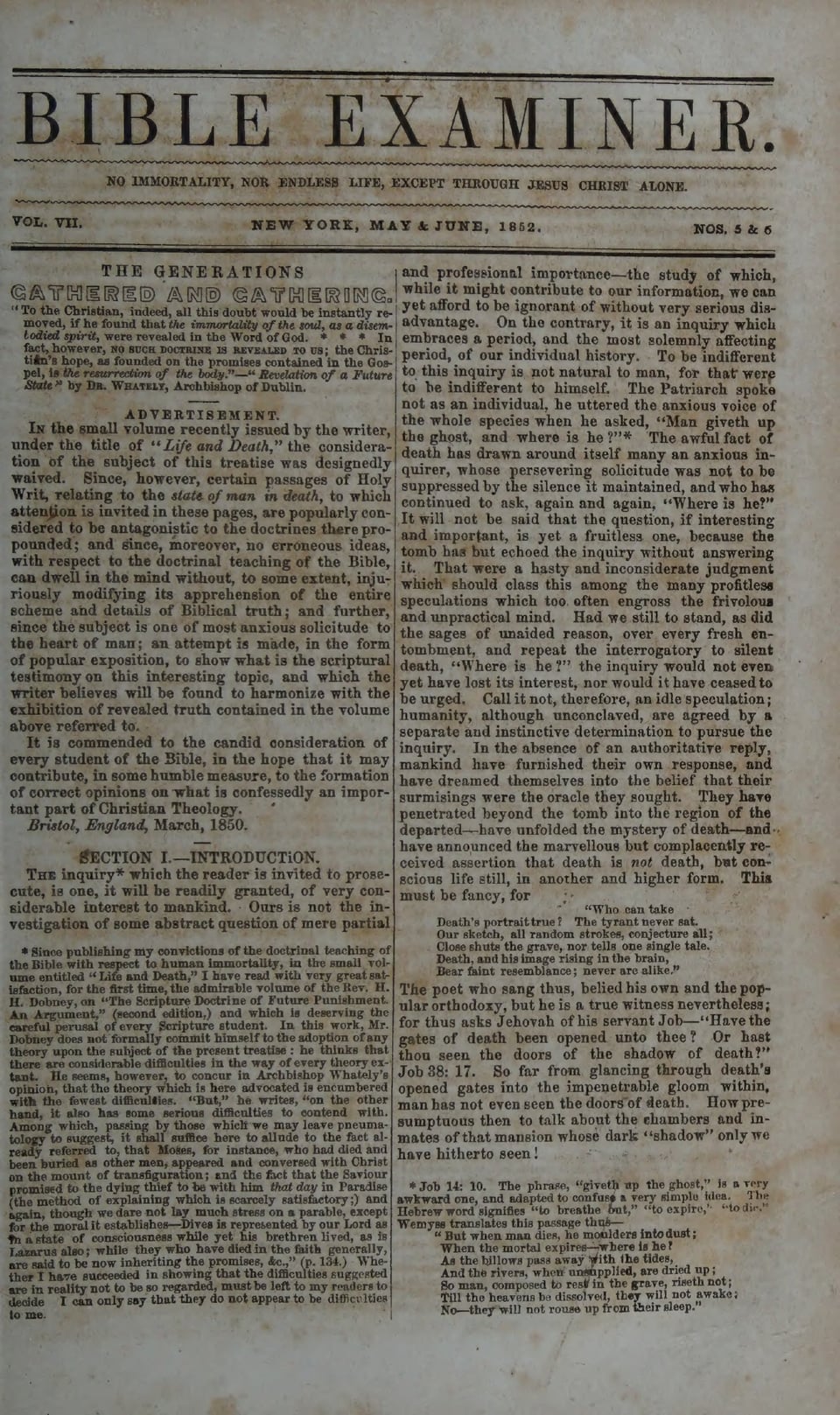
BIBLE EXAMINER.
NO IMMORTALITY, NOR ENDLESS LIFE, EXCEPT THROUGH JESUS CHRIST ALONE.
VOL. VII.
NEW YORK, MAY & JUNE, 1852.
NOS, 5 & 6
THE GENERATIONS
CATHERED AND CATHERING.
"To the Christian, indeed, all this doubt would be instantly removed, if he found that the immortality of the soul, as a disembodied spirit, were revealed in the Word of God. * In fact, however, NO SUCH DOCTRINE IS REVEALED TO US; the Christian's hope, as founded on the promises contained in the Gospel, is the resurrection of the body."—"Revelation of a Future State" by Dr. WHATELY, Archbishop of Dublin.
ADVERTISEMENT.
In the small volume recently issued by the writer, under the title of "Life and Death," the consideration of the subject of this treatise was designedly waived. Since, however, certain passages of Holy Writ, relating to the state of man in death, to which attention is invited in these pages, are popularly considered to be antagonistic to the doctrines there propounded; and since, moreover, no erroneous ideas, with respect to the doctrinal teaching of the Bible, can dwell in the mind without, to some extent, injuriously modifying its apprehension of the entire scheme and details of Biblical truth; and further, since the subject is one of most anxious solicitude to the heart of man; an attempt is made, in the form of popular exposition, to show what is the scriptural testimony on this interesting topic, and which the writer believes will be found to harmonize with the exhibition of revealed truth contained in the volume above referred to.
It is commended to the candid consideration of every student of the Bible, in the hope that it may contribute, in some humble measure, to the formation of correct opinions on what is confessedly an important part of Christian Theology.
Bristol, England, March, 1850.
SECTION I.—INTRODUCTION.
THE inquiry* which the reader is invited to prosecute, is one, it will be readily granted, of very considerable interest to mankind. Ours is not the investigation of some abstract question of mere partial
and professional importance—the study of which, while it might contribute to our information, we can yet afford to be ignorant of without very serious disadvantage. On the contrary, it is an inquiry which embraces a period, and the most solemnly affecting period, of our individual history. To be indifferent to this inquiry is not natural to man, for that were to be indifferent to himself. The Patriarch spoke not as an individual, he uttered the anxious voice of the whole species when he asked, "Man giveth up the ghost, and where is he?"* The awful fact of death has drawn around itself many an anxious inquirer, whose persevering solicitude was not to be suppressed by the silence it maintained, and who has continued to ask, again and again, "Where is he?" It will not be said that the question, if interesting and important, is yet a fruitless one, because the tomb has but echoed the inquiry without answering it. That were a hasty and inconsiderate judgment which should class this among the many profitless speculations which too often engross the frivolous and unpractical mind. Had we still to stand, as did the sages of unaided reason, over every fresh entombment, and repeat the interrogatory to silent death, "Where is he?" the inquiry would not even yet have lost its interest, nor would it have ceased to be urged. Call it not, therefore, an idle speculation; humanity, although unconclaved, are agreed by a separate and instinctive determination to pursue the inquiry. In the absence of an authoritative reply, mankind have furnished their own response, and have dreamed themselves into the belief that their surmisings were the oracle they sought. They have penetrated beyond the tomb into the region of the departed—have unfolded the mystery of death—and have announced the marvellous but complacently received assertion that death is not death, but conscious life still, in another and higher form. This must be fancy, for
"Who can take
Death's portrait true? The tyrant never sat. Our sketch, all random strokes, conjecture all; Close shuts the grave, nor tells one single tale. Death, and his image rising in the brain, Bear faint resemblance; never are alike."
The poet who sang thus, belied his own and the popular orthodoxy, but he is a true witness nevertheless; for thus asks Jehovah of his servant Job—"Have the gates of death been opened unto thee? Or hast thou seen the doors of the shadow of death?" Job 38:17. So far from glancing through death's opened gates into the impenetrable gloom within, man has not even seen the doors of death. How presumptuous then to talk about the chambers and inmates of that mansion whose dark "shadow" only we have hitherto seen!
Job 14: 10. The phrase, "giveth up the ghost," is a very awkward one, and adapted to confuse a very simple idea. The Hebrew word signifies "to breathe out," "to expire," "to die." Wemyss translates this passage thus— But the Bible has spoken of death, and volunteers its aid to man, not as a guide, to astonish his vision with its chambers of imagery, but as a teacher, to solve more truthfully than he has done the perplexing problem, "Where is he?"
"Man giveth up the ghost, and where is he?" Its answer, and which the language of the patriarch fitly expresses, is emphatic and contradictory of the decisions of the adventurous reason, which, unhappily, have been adopted as the teachings of Scripture by the great bulk of the professing Church: "As the waters fail from the sea, and the flood decayeth and drieth up; so man lieth down and riseth not: till the heavens be no more they shall not awake nor be raised out of their sleep." Job 14: 10-12.
That we may arrive at a common and truthful conclusion, we must understand distinctly the subject of our inquiry. There is reason to believe that many who enter upon this controversy, have not a mutual understanding with respect to the point in debate; and that there would be more unanimity of opinion if care were taken to describe accurately the precise nature of the controversy. On this subject we are in special danger of mixing up human traditions with the verities of revelation; and it is, therefore, of the first importance that we distinguish warily the unequivocal utterances of inspired truth from the speculative deductions of purely human science. Here the caveat of Paul may be urged with special propriety—"Beware lest any man spoil you through philosophy and vain deceit, after the traditions of men, after the rudiments of the world, and not after Christ." Col. 2: 8. Here philosophy has, for many ages, usurped the chair of the Great Teacher; and her voice has prevailed above the voice of Him that speaketh from heaven. Here the authority of Plato transcends the authority of Christ—and the dogmas of the Academy, the doctrines of the Bible. We must reverse the Protestant boast in describing the real authority with the Church on this portion of its faith and doctrine, and say, "not Scripture, but tradition."* I am aware that these are grave charges, and I would not be understood to insinuate that the defenders of the doctrines which I have ventured to impugn, knowingly and designedly displace the highest and only authority. I believe that they revere the supremacy of Christ in his Church quite as much as myself, and would be as ready as I am to abandon whatever shall be proved to be contrary to his doctrine. But while I am anxious not to question the sincerity of those who differ from me, I am equally anxious not to be found abetting, by a culpable withholdment of personal conviction, a system of instruction which my conscience dictates to be radically erroneous. The separate existence of the human soul—its immateriality, immortality, and conscious personality, are, I believe, the labored cogitations of human reason, unblest with, and, alas! despite of, the teachings of revelation. They are, in my humble opinion, neither more nor less than the perpetuations of Platonic theories in the Christian Church, which found their way hither in the polemic
age of ancient Christianity, and which have been borne down the turbid stream of controversial and scholastic theology to our own day. In proof of this I have only to appeal to the candor of every student of Church history, especially of that important part of Church history which embraces the history and development of the doctrines. That the doctrines concerning the human soul as popularly held, are not the doctrines of the Scriptures, will be best seen by a careful examination of those passages upon which depends this branch of religious teaching, and to which we propose to advert. Allow me, however, to impress my preliminary caution on the great importance of distinguishing between the teaching of human philosophy, and that of Divine revelation. The question, let it be particularly noted, is not "What is the human soul—is it capable of a separate existence—and what is its separate state after death?" This is a purely philosophical, not a religious inquiry, nor has it anything whatever to do with religion, unless the decisions of philosophy shall be accepted as the affirmations of revealed religion, and be acknowledged as part and parcel of it. To this question Philosophy has given a categorical reply; the Bible nowhere supposes, nor suggests such a question as this, and hence it has given no answer. Let it be especially observed. Every dogmatic assertion touching the human soul as a separate existence—every predication of its nature, capabilities, and mode of being, is necessarily of no higher value than a human opinion. I say necessarily, because the Bible neither directly nor indirectly, neither by affirmation nor implication, contains the remotest allusion to any of these ideas. I repeat then, the question is not, "What is the separate state of the soul after death?" but, "What is the state of man after death?" The former question, if it be a proper question at all, properly belongs to the circle of human science, and must be regarded as partaking of the dubious and unsatisfactory character which pertains to psychological investigation. The soul or spirit of man in the popular sense of a disembodied personality, is an idea nowhere recognised, and is evidently unknown to inspired theology.* The Bible nowhere regards the soul of man any more than his body as attaching to itself the human personality. When it speaks of man's destiny, and predicates anything concerning it, it has respect to the composite being—the unique creature, man. Neither the body nor the soul is separately contemplated; but the one intellectual, sensational and corporeal being called man. I have endeavored in another place† to show that whatever may be the qualities and characteristics of the constituents of man's composite nature, his personality is not involved in either of these constituents separately considered, but in their union; and that in the disunion of the constituents of his being is involved the dissolution of the personality, or the man. Man is an organized being, and like all other organic natures, must owe his existence, we should presume, to his organization. We are not acquainted with any species of organized being, whose individuality survives disorganization; why, therefore, should we suppose, in the absence of any authoritative information, that the case is otherwise with man—that man retains his individuality after his disorganization? Have we not reason to repudiate an opinion which is contrary to analogy, and without the least shadow of support from Scripture? The Patriarch puts the question in the true theological form, and furnishes a categorical reply at direct variance with the popular creed?
"Man giveth up the ghost, and where is he?" Not where is his soul, or spirit, but where is he—man? To which it is replied, "As the waters fail from the sea, and the flood decayeth and drieth up: so man lieth down and riseth not; till the heavens be no more they shall not awake, nor be raised out of their sleep." Can imagery and literal assertion more emphatically declare the complete decease of the being man? and give a more unequivocal reply to the interesting question—"Where is he?"—man, between death and resurrection? The cessation of man's conscious being is yet further implied in the succeeding question, "If a man die, shall he live again?" To which the Patriarch replies, "All the days of my appointed time will I wait till my change come. Thou shalt call and I will answer thee: thou wilt have a desire to the work of thine hands."*
SECTION II.—TERMS DENOTING THE LOCALITY OF THE DEAD.
"Have the gates of death been opened unto thee? or hast thou seen the doors of the shadow of death?" Such is Jehovah's challenge to the patriarch Job, and which occurs among that wonderful series of questions by which the Almighty impressed His tried servant with the extreme narrowness and insignificance of human knowledge. The interrogation is equivalent to, "What knowest thou of death, or the dead?" And well had it been for mankind, and for the integrity and practical efficiency of Christianity, had they been content with the knowledge of their ignorance in this solemnly profound direction. We cannot explore the place of the dead—we know not even if there be a place, except in the imaginations of men, who because they know that all mankind share a common experience in this matter, speak of them as having gone to one place. It is the necessity of human thought which is compelled to localize the departed, that has originated a place, and a name for the place, of the dead. The Hebrews called it Sheol, the Greeks Hades, and the Saxons Hell, words most aptly chosen, since while they subserve the necessity of human thought, they express at the same time the modesty of the human mind which in its election of terms, would, in this instance, appear to approve of the wisdom of not being wise above what is written. The Greek word Hades, is of very common occurrence in the Greek classics, but its classical signification is no criterion of its meaning in the sacred writings. We are referred back to the Hebrew Sheol for the strict sense in which it is employed by the inspired writers. "The Greek term did not come to the Hebrews from any classical source, or with any classical meaning, but through the Septuagint as a translation of their own word; and whether correctly translating it or not is a matter of critical opinion. The word Hades is, therefore, in nowise binding upon us in any classical meaning which may be assigned to it. The real question, therefore is, what is the meaning which Sheol bears in the Old Testament, and Hades in the New? A careful examination of the passages in which these words occur will probably lead to the conclusion, that they afford no real
sanction to the notion of an intermediate place of the kind indicated, but are used by the inspired writers to denote the grave—the resting place of the bodies, both of the righteous and the wicked."* Let it be borne in mind that nothing relative to the state of of the dead can be ascertained by these words simply and separately considered. In all the three languages they have a common signification—their etymological meaning being the unseen, hidden, or unknown place or state. These terms, then, so far from conveying to us any information concerning the place or state of the dead, only express our own ignorance of these matters, and ought on this account to operate as a perpetual check upon the indiscretion of the rash speculator. Whatever sense the word Sheol has in the Old Testament, Hades, as its Greek equivalent, will have in the New. The Hebrew prophets, in their allusions to the place and state of the dead, conveyed their ideas in the imagery which was suggested by their mode of sepulture. It is not to the Hebrew writings, but to the Greek philosophy, that we trace the birth of those opinions concerning the state and place of the dead, which at the present time prevail as the orthodox creed of modern Christianity. Such opinions must necessarily be defective, and destitute of any claim on our religious belief, since they partake of the imperfection and uncertainty which characterize all human investigation. They are philosophical traditions, not scriptural informations, and as such ought to be jealously excluded from the sacred domain of inspired authority. It is evident that the Hebrew prophets were strangers to these philosophical opinions—their poetical descriptions of death and the dead show whence their imagery was derived, and suggest that they could form no other conceptions of the condition of the departed, than what the analogies of their mode of interment presented to their view. Bp. Lowth, in his "Lectures on Hebrew Poetry," says, "That which struck their senses they delineated in their descriptions: we there find no exact account, no explicit mention of immortal spirits"—a very significant testimony! This testimony is the more important since the Bishop considered that the immortality of the soul as a disembodied existence, was a doctrine known to and acknowledged by the prophets; and he accounts for their uniform silence on this subject, "because they had no clear idea or perception by which they might explain where or in what manner it existed; and they were not possessed of that subtlety of language which enables men to speak with plausibility on subjects abstruse and remote from the apprehension of the senses, and to cover their ignorance with learned disputation. The condition, the form, the habitation of departed spirits were, therefore, concealed from the Hebrews equally with the rest of mankind. Nor did revelation afford the smallest assistance on this subject."† I would beg the reader's special attention to this paragraph from the pen of the learned Bishop.
He acknowledges that the writings of the prophets contain "no explicit mention of immortal spirits"—that they never alluded to disembodied spiritual existence, and that "revelation" did not "afford them the smallest assistance on this subject." Is his inference then a reasonable one, that the prophets who make no "mention of immortal spirits," therefore believed in immortal spirits? and that, although they make no allusion to disembodied spiritual existence, this is to be explained by their inability to express suitably their ideas? And that, notwithstanding "revelation" afforded not "the smallest assistance on this subject," the soul's disembodied existence, as the human personality, and the intermediate state as popularly understood and held, were yet doctrines of revelation? By what unknown process could the Bishop arrive at such conclusions? The sacred writers have said nothing about these doctrines, therefore, says Bp. Lowth, they believed them! I humbly suggest that this negative premiss would be more logically connected with a negative inference; that since the sacred writers have said nothing about these doctrines, the probability is that they knew nothing about them. Their word Sheol drew a veil over the departed state, and involved it in concealment and darkness. If ever they have occasion to refer to the departed, their thoughts are not directed upwards, as if they believed that the personality as a disembodied soul had ascended to God—they think of the body and the tomb, and associate the departed with that which is buried. Thus, "they shall go down to the bars of the pit, when our rest together is in the dust." Job 17: 16. "Let not the pit shut her mouth upon me." Ps. 69: 15. "My life draweth nigh unto the grave. I am counted with them that go down into the pit. Free among the dead, like the slain that lie in the grave, whom thou rememberest no more; and they are cut off from thy hand. Thou hast laid me in the lowest pit, in darkness, in the deeps." Ps. 88: 3-6. "Therefore, Sheol hath enlarged herself, and opened her mouth without measure, and their glory, and their multitude, and their pomp, and he that rejoiceth shall descend into it." Is. 5: 14. "When I shall bring thee down with them that descend into the pit, with the people of old time, and shall set thee in the low parts of the earth, in places desolate of old, with them that go down to the pit, that thou be not inhabited." Ezek. 26: 20. It seems sufficiently plain that the prophets associate the personality of the departed with the buried body; and since the words which they utter are not always their own, but they are frequently the message bearers of Jehovah, as in the citation last given, it seems also plain that God himself points to the grave as the temporary abode of the human personality: "Dust thou art, and unto dust shalt thou return." Gen. 3: 19.
Only which comes direct from God, His Spirit, Is deathless. Nature gravitates without Effort; and so all mortal natures fall Deathwards.
The soul's inheritance,
Its birth-place, and its death-place, is of earth,
Until God maketh earth and soul anew;
The-one;like Heaven, the other like Himself"—
BAILEY'S "FESTUS." p. 37
The only means we have of estimating the real opinions of the sacred writers on this subject, is the language in which they convey their thoughts. Their opinions must necessarily be of a very indefinite and general character, since the subject is involved in so
much obscurity. So much, however, is beyond dispute, that their language instead of indicating their belief in the soul's disembodied and conscious existence, suggests their utter ignorance of such ideas. They spoke as if they believed that the outward image of death and its circumstances were not the fictitious, but the real semblance of the state of the departed. Their descriptions of Sheol or Hades are utterly irreconcilable with the supposition that they believed the state of death to be a condition of consciousness and activity.* All, irrespective of character, are dismissed to Sheol; "All go unto one place; all are of the dust, and all turn to dust again." Eccl. 3:20. "All things come alike to all; there is one event to the righteous and to the wicked." Eccl. 9:2. Sheol is a place of inaction and silence. "Let them be silent in Sheol." Ps. 31:17. "There is no work, nor device, nor knowledge, nor wisdom in Sheol whither thou goest." Eccl. 9:10.
Sheol is never described except in the imagery of terror, and is always regarded as a great evil. It is never spoken of as the portal of heaven—the gate of immediate bliss to the righteous. On the contrary, it is described as an awful, unfathomable abyss, extending deep into the heart of the earth, to indicate the completeness of its dominion. "Deeper than Sheol what canst thou know?" Job 11: 8. It stands in contrast with heaven; and, therefore, the inhabitants of the one must be distinct and separate from the other. "If I ascend up into heaven, thou art there; if I make my bed in Sheol, behold thou art there." Ps. 139: 8. "Though they dig into Sheol, thence shall my hand take them; though they climb up to heaven, thence will I bring them down." Amos 9: 2.
Now, whatever may be the opinions of uninspired Jewish writers, whether ancient or modern, they can be of no authority in determining the opinions of the Hebrew prophets, whose thoughts, inspired by the Holy Ghost, are conveyed in language sufficiently explicit to indicate their faith and doctrinal instruction on this subject. It is to introduce a novel and dangerous canon of biblical interpretation, to affirm, in reference to the present question, that the silence of the sacred writers speaks consent.
I presume it will be apparent that the terms denoting the locality of the dead, suggests nothing in favor, but rather involve the denial of the doctrines of the disembodied soul, and an intermediate state of consciousness for man, between the night of his death, and the morning of resurrection; and, therefore, the logical conclusion is, so far as these terms are concerned, that the origin of such opinions is purely traditional.
SECTION III.—SCRIPTURE DESCRIPTIONS OF THE STATE OF THE DEAD.
There are terms and phrases employed by the sacred writers in their allusions to the state of the departed, which, but for the pre-occupation of our minds by ideas purely philosophical and traditional, would have conveyed the impression that the Scripture doctrine of death is the cessation of the consciousness and activity of the human being. Death is frequently spoken of under the figures of "rest," as "sleep." Thus we read, "They rest from their labor"—"He fell asleep"—"The sleep of death." But it has been said that the analogy between death and taking rest or sleep, supports the belief that there is consciousness in death, since man, in the repose of sleep, is not deprived of all consciousness, although he may be so far deprived of it with respect to the external world.* If, however, the analogy is to be pushed thus far, and viewed so specially in this aspect, we may extend it still further and view it in any other aspect of which it is capable—which I conceive to be the abuse rather than the use of a metaphor. Now, death is alleged to be a separation of the soul and body, and that it is the separate soul which is conscious and active. Where then is the analogy between the respective states of death and sleep? For surely no one but phrensied poets will affirm that any separation of soul and body takes place in sleep! Most certainly the consciousness of the man in sleep is located in the animal frame. The figure of sleep, it appears to me, is employed in the Scriptures to point out a very different, but very appropriate analogy. It is adopted, I apprehend, because it suggests that the death which mankind
die in this world is not final—that it will be succeeded by a resurrection, even as sleep is by a waking time. Thus there was a very evident propriety in our Lord's address to the friends of Jairus, whose daughter they were lamenting as dead, "The maid is not dead but sleepeth;" and again to his disciples, "Our friend Lazarus sleepeth, but I go that I may awake him out of sleep." They were both dead; for of the mourners in the first case, who did not apprehend his meaning, it is said, "They laughed him to scorn, knowing that she was dead." And our Lord himself said, when his disciples misunderstood the meaning of his remark, and thought that "he spake of taking of rest in sleep"—"Lazarus is dead." He spake of them both as sleeping, because it was so near their waking time through his miraculous agency. The misapprehension of our Lord's meaning when he used the term sleep to denote death, both on the part of the disciples and the mourners, indicates the popular belief of the Jews of that time on the subject of death. The term sleep, in their judgment, was most inappropriate to describe the state of the dead, their associations with this subject, inculcated and fostered by their sacred writings, being of a more gloomy and hopeless nature, than the term sleep gave birth to. It is probable, that the beautiful analogy between the awaking from sleep, and the resurrection from the dead, led to the adoption of this term, more especially to describe the death of believers in Christ. They were taught to regard death as a sleep, because their waking time by resurrection was not far off—their Lord would "come quickly."
There are, however, other phrases and figures which will baffle the most zealous ingenuity to make them tally with the popular notion of death. We hear sometimes of the emancipated spirit breaking away from the confinement of its gross prison-house, and winging its way in happy freedom to heaven and to God. Of course this kind of speech is used only of the deceased righteous. But how does this notion accord with the scripture phrase, 'the pains of death?' Death is here described as a bondage, not a liberation; for the word "pains" signifies a cord or band. And it is affirmed that our Lord himself was held in this bondage for a brief period, although it was impossible that he should be the captive of death. The whole passage shows that death is a binding, not a loosing power—"Whom God hath raised up, having loosed the pains of death, because it was not possible that he should be holden to it." Acts 2: 24. He became Death's conqueror, not his captive; and hence he holds by right, and as the symbol of his victory, "the keys of hades and of death;" that, as the Resurrection and the Life, he may, at the appointed time, open the prison doors to them that are bound.
And no less difficult will be the task to prove that there are animation and consciousness in death, if we resort to other figurative expressions of Holy Writ. In one of David's psalms we have this mournful complaint—"Thou hast brought me into the dust of death." Ps. 22:15. The dust of death! What is there in this phrase to suggest the idea of animation and consciousness? There is, indeed, much to suggest the original curse, "Dust thou art, and unto dust shalt thou return." Gen. 3:19.
"The shadow of death" is another image by which the state of death is portrayed. "There is no darkness nor shadow of death where the workers of iniquity may hide themselves." Job 34:22. Death is here imaged as a place of dark seclusion and concealment. Such a place is surely not a fit intermediate abode for the immortal spirits of the just! It may be a suitable habitation for them who "love darkness rather than light, because their deeds are evil."
The "gates of death," (Ps. 9:13; 107:18,) like the scripture phrase, the "pains of death," is an image which suggests the idea of a powerfully fortified city or mansion, whose massive gates close in hopeless captivity upon all who pass within them. These analogies are certainly most unhappily chosen by the sacred writers, if they are intended to denote that death procures life and liberty, and a more complete enjoyment for man in the intermediate state.
Let me request the reader's attentive consideration of the following selection of passages, which present, in very definite language, the scripture testimony on the state of the dead:—
"Man lieth down and riseth not: till the heavens be no more they shall not awake, nor be raised out of their sleep." Job 14: 12. "In death there is no remembrance of thee, in the grave who shall give thee thanks?" Ps. 6: 5. "Wilt thou show wonders to the dead? Shall the dead arise, and praise thee? Shall thy loving kindness be declared in the grave? Or thy faithfulness in destruction? Shall thy wonders be known in the dark? And thy righteousness in the land of forgetfulness?" Ps. 88: 10-12. "What man is he that liveth and shall not see death? Shall he deliver his soul from the hand of the grave?" Ps. 89: 48. "Thou turnest man to destruction, and sayest, Return, ye children of men." Ps. 90: 3.
The Psalmist, in that beautiful composition from which the preceding text is selected, contrasts the Creator with the creature man. The eternity of God is confronted with the limited duration of man's existence. Thus, "from everlasting to everlasting thou art God," is opposed to "thou turnest man to destruction, and sayest, return ye children of men." Many expositors understand the word translated "destruction" as the poetical term for the word "dust," since its literal signification is "what is beaten to pieces." There is evidently a reference in this passage to the original curse—the returning to the dust. If, therefore, death be but the liberation of the living spirit, and the spirit is the personality, or man, where is the destruction spoken of? "Thou turnest man to destruction." And if the spirit be immortal, where is the contrast between the duration of God, and that of man?
"The dead praise not the Lord, neither any that go down into silence." Ps. 115: 17. "His breath goeth forth, he returneth to his earth; in that very day his thoughts perish." Ps. 146: 4. "The man that wandereth out of the way of understanding shall remain in the congregation of the dead." Prov. 21: 16. "The living know that they shall die; but the dead know not anything." "Whatsoever thy hand findeth to do, do it with thy might; for there is no work, nor device, nor knowledge, nor wisdom in the grave whither thou goest." Eccl. 9: 5-10. "For the grave cannot praise thee, death cannot celebrate thee; they that go down into the pit cannot hope for thy truth. The living, the living, he shall praise thee, as I do this day." Is. 38: 18-19. "Many of them that sleep in the dust of the earth shall awake." Dan. 12: 2. "Thus saith the Lord God, Behold, O my people, I will open your graves, and cause you to come up out of your graves, and bring you into the land of Israel. And ye shall know that I am the Lord, when I have opened your graves, O my people, and brought you up out of your graves, and shall put my spirit in you, and ye shall live." Matt. 27: 52, 53. "And the graves were opened, and many bodies of the saints which slept arose, and came out of the graves." Ezek. 37: 12-14. "The hour is coming,
in the which all that are in the graves shall hear his voice, and shall come forth." John 5:28.
Now, to endeavor to evade the accumulated force of this scripture array by saying, as is commonly said, that in all these citations the body, not the soul, is referred to, is to fall back upon the vain philosophy of the unproved separate state of the soul; and, also, to make the inspired writers assert most ridiculous truisms. We need not inspired writers to tell us that an inanimate corpse cannot remember, and give thanks, and praise, and hope, and know. No one could suppose that the Psalmist was alluding to a dead carcase when he said, "In that very day his thoughts perish." Will our antagonists explain how it can harmonize with their theory of a state of consciousness after death, that in the day of death a man's "thoughts perish?"
The method of getting out of the difficulty in which several texts of scripture place the advocate of the immortal and separate soul, by saying, in utter defiance of all consistent exegesis, that this text refers to the body, and that text refers to the soul, is deservedly characterized as sophistical, unsatisfactory, and suspicious. We will bring this species of lawless exposition to the test in a given case.
In the 2d chapter of Acts, 29th verse, we hear Peter thus reasoning on the day of Pentecost—“Men and brethren, let me freely speak unto you of the Patriarch David, that he is both dead and buried, and his sepulchre is with us unto this day.” Peter's affirmation is, that David is dead and buried—“he,” the personality David, “is both dead and buried.” Now, what are we to understand that the Apostle affirms? It is replied, Peter here refers to the body of David: his affirmation is equivalent to—the body of David is both dead and buried. Well, be it so. David means the body of David. Now carry this exposition on to the 34th verse of this same chapter, where Peter says—“David is not ascended into the heavens.” How are we to interpret this? You reply—if for convenience I may personify my antagonistic type of a numerous class—that Peter tells us, the body of “David is not ascended into the heavens.” Can you seriously think that Peter “tells us” this? Surely, we need not to be told that David's inanimate body has not ascended into the heavens! “Flesh and blood cannot inherit the kingdom of God.” Surely flesh without blood—a corrup tible corpse—could never be supposed to find a mansion there! Besides, Peter has just previously told us that David's body, according to your interpretation, is “both dead and buried.” Unless, therefore, David had two bodies, he could not be supposed to be both in his “sepulchre” and “in the heavens.” This is to turn the gravely effective argument of the Apostle into a most meaningless jargon, and to put into his mouth a ridiculous absurdity. However, let this exposition stand upon its own merit, and for what it is worth. You certainly cannot agree with the Apostle's assertion that “David is not ascended into the heavens.” You believe that David is in glory—David's soul, his personality—himself, has long been enjoying his heavenly bliss. But pause! You have said, in explanation of verses 29 and 34, that the body of David is David, and now you say that the soul of David is David. Were there two Davids then, or had the Psalmist a double personality? I anticipate your reply to this—David's body is only called David in a secondary and popular sense; properly speaking, the separate soul or spirit of David is the personality of David, and that has “ascended into the heavens.” Then why, I ask, does Peter affirm that “David is not ascended into the heavens," if the separate soul is properly David, and that separate soul is in the heavens?
Did Peter not speak properly? How are we to know whether he spoke properly or popularly on this occasion?
Now, there is no difficulty in understanding the sense in which the proper name David is here employed, if men will but keep their "science, falsely so called," out of the question. The Apostle was showing his astonished audience, that the Patriarch David had prophesied of the resurrection and ascension of Christ, and he quotes the last four verses of the 16th Psalm in confirmation of his statement. Anticipating the possible objection of some that David in that Psalm spake of himself, and not of the Messiah, the Apostle reminds them that the statement, "Thou wilt not leave my soul (life) in hades (grave,) neither wilt thou suffer thine Holy One to see corruption," could not refer to David, because his life was under the power of the grave, and his body had seen corruption. "The Patriarch David is both dead and buried, and the sepulchre is with us unto this day." Therefore, some other must have been referred to, to whom these circumstances can apply; and Peter assures them that they were fulfilled in Christ of whom David prophesied: "He seeing this before, spake of the resurrection of Christ, that his soul was not left in hades—(his life was not left under the power of death)—neither his flesh did see corruption." And when David added, "Thou hast made known to me the ways of life; thou shalt make me full of joy with thy countenance," he prophesied of the rising from the dead, and the ascension into the heavens of Jesus Christ, that he might make plain "the ways" or path "of life," and behold "the countenance" of his Father in his peoples' behalf. For the proof that this language could not apply to David, he appealed to their common sense, and, may I not add, to the theological opinions of the time on this subject? and said, "For David is not ascended into the heavens; but he saith himself, the Lord said unto my Lord, sit thou on my right hand, until I make thy foes thy footstool."
It is, I think, apparent that Peter's argument requires us to understand, that David himself, the "Patriarch David," not simply his body, was "dead and buried," and that David in no sense had "ascended into the heavens."
Therefore, if the Patriarch David has no conscious life in the intermediate state, but is awaiting the manifestation of the life which is at present hidden in Christ, (Col. 3: 3-4,) the Life and the Light of men, and which shall take place at the resurrection, when Christ shall come to be glorified in his saints; if this, we say, be the case of the sweet Psalmist of Israel, we may fairly presume that the case is the same with all others. Then the Scriptures teach that although in the midst of life we are in death—in the midst of death we are not in life.
SECTION IV.—CHRIST'S MIRACLES ON THE DEAD.
The three recorded miracles of our Lord which he wrought on the deceased daughter of Jairus, the Son of the widow of Nain, and Lazarus, contain nothing in their mode of execution, and other attendant circumstances, that give the least shadow of support to the popular theory relative to the condition of the dead. The manner in which they are recorded by our Lord's historians, if it suggests anything at all, suggests rather that the modern theological anthropology was unrecognized by the Church in apostolic times, that dissolution was not then believed to be a dissolving of the composite nature of man into the
constituent elements of his being, leaving the conscious life of man entire, resident in one of these constituent elements—but that it was the dissolution, in the sense of the actual decease, of the man himself. When man dies, "in that very day," says the Psalmist, "his thoughts perish"—the thinking being ceases to be. There is no calling upon the departed spirit, as a conscious ethereal embodiment, to return again to the fleshly tabernacle; the lifeless form is the object of attention and address, and the terms denoting personality are applied to it. Thus in the case of the deceased daughter of Jairus, it is said that our Lord "took the damsel by the hand, and said unto her, Talitha cumi, which is, being interpreted, Damsel, I say unto thee, arise, and straightway the damsel arose."*
Standing by the bier of the widow's son, our Lord thus addressed the deceased—"Young man, I say unto thee, arise. And he that was dead sat up." Luke 7: 14-15. And similar is the style of address to the dead Lazarus—"Lazarus, come forth, and he that was dead came forth." John 11: 43-44. And in the raising of Dorcas and Eutychus, there is nothing said or done that could suggest such an idea of the state of the dead, as that which now so extensively and injuriously prevails. I am aware it may be said that this style of address to the dead in the instances just cited, is to be regarded as popular, and that a mere philosophical mode of expression would have been unnecessary and inconvenient. This reply, however, contains the implication that the popular and the philosophical in the present case are at variance, which must be proved. Granted that it was the popular style of address, it is very obvious that what was popular with our Lord and his contemporaries, is not popular with us. We detach, by almost universal consent, the idea of personality from the corporeal part of man, and speak of the soul as retaining the personality. Let the reader recal to mind the usual inscriptions upon our gravestones in exemplification of the discrepancy between the language of modern and ancient Christianity. "Here lieth the body of," &c.; "here lieth the mortal remains," &c.† Peter did not say on the day of
The very interesting and valuable work of Dr. Maltland furnishes many examples of the Christian mode of inscribing places of sepulture, so early as the first century. The extensive catacombs of Rome were used by the Roman Christians as a place of refuge during the long season of their severe persecutions under the emperors. They also afforded a convenient burial place, and were commonly used for this purpose. "The number of graves contained in the catacombs is very great. In order to form a general estimate of them, we must remember from the year 98 A. D., to some time after the year 400, (of both which periods consular dates have been found in the cemeteries.) the whole Christian population of Rome was interred there. As this time includes nearly a century after the establishment of Christianity under Constantine, the numbers latterly must have been very considerable. A city peopled by more than a million of inhabitants, so far christianized as to give rise to a general complaint that the altars and temples of the Gods were deserted, must have required cemeteries of no ordinary dimensions." In the latter part of the 16th century, these catacombs were eagerly plundered of the tablets and blocks containing the ancient sepulchral inscriptions, and distributed in the museums of the learned. The chief collection of these exhumed relics, is in the long corridor of the Vatican Museum. The following are among these ancient inscriptions, which the reader will perceive to exhibit obvious points of contrast with modern Christian memorials of the deceased.
"THE PLACE OF PHILEMON."
"VIRGINIUS REMAINED BUT A SHORT TIME WITH US." "VIDALIO, IN THE PEACE OF CHRIST." "VICTORINA, IN PEACE, AND IN CHRIST." "DORMITIO ELPIDIS"—the sleeping place of Elpis. "VICTORINA SLEEPS." BOTIOUS LAY HERE TO SLEEP."
Pentecost, "the body of David," but "David is both dead and buried." Let him reflect also upon the modern conventional phraseology with respect to the dead, and he will see that our language, and, as language is but the vehicle of thought, that our thoughts also are widely discrepant with those of the early believers. Thus we say, "My departed friend," "My departed parent," "He departed this life," by which we mean that the soul, which we consider to be the friend or parent, has departed from the body, as from its temporary and earthly home. Now, such a phraseology as this, and with such a signification, is nowhere to be found in the Bible. We read, indeed, of the mournful death of Rachel, that "As her soul (life) was in departing, (for she died,) that she called," &c. Gen. 35:18. But Moses does not seem to have attached such an idea to his language, "as her soul was in departing," as that which it has in modern usage—he does not seem to have imagined that her soul was herself, set free from the body to enjoy a purer life; so far was he from conceiving that the personality of Rachel was resident in her departing soul, that he puts in a parenthesis his idea of what had become of her personality, "for," he says, "she died"—she, the personality Rachel—died.
But it may be objected, that whatever may be said of the discrepancy between the popular modes of thought and speech of primitive and modern believers on this subject, it is sheer absurdity to suppose that our Lord and his Apostles actually addressed unconscious matter and mere nonentities. But this alleged absurdity is an unreasonable charge; it may have the appearance of absurdity to us who are ignorant of the mysterious processes by which the effect is accomplished. We are informed that the original creation was effected by the agency of Jehovah's "word." "He spake and it was done." Thus God said, "Let there be light, and there was light." So far from there being any absurdity in speaking of, or to non-existences, Paul has the following passage, "God who quickeneth the dead, and calleth those things which be not, as though they were." Rom. 4: 7. This passage is in point, and rebuts the allegation of absurdity. The last clause of this text is not distinct from the former, but is in apposition to it; and hence is explanatory of the state of the dead. Let it be observed that in the first clause the Apostle says, "God who quickeneth the dead." Now, to quicken, or make alive the dead, is to us a profoundly incomprehensible act; it is to call "things which be not, as though they were;" it is to command that which is not into that which is. Hence the Apostle to his remark, "God who quickeneth the dead," adds, and which was suggested by that remark, He "calleth those things which be not as though they were." And since this last clause is explanatory of the preceding, it informs us what death
"CEMELLA SLEEPS IN PEACE." "HERE IS GORDIANUS, DEPUTY OF GAUL."
One Placus thus memorializes his wife Albana—
"YOU, WELL DESERVING ONE, HAVING LEFT YOUR [RELATIONS,] LIE IN PEACE—IN SLEEP—YOU WILL ARISE—A TEMPORARY REST IS GRANTED YOU."
"LAUNUS, THE MARTYR TO CHRIST, RESTS HERE."
One is buried with the prayer that she may "live in the Lord Jesus;" of another it is said he "sleeps in Christ."
"The Church in the Catacombs; a Description of the Primitive Church of Rome, Illustrated by its Sepulchral Remains, by Charles Maitland, M. D.," London: Longman & Co., 1846.
All these epitaphs speak not of a part—the body only being under the temporary power of death—but of the individual himself or herself. The grave is the temporary resting place of the human personality. Yes! only temporary, for Christ has said, "The gates of Hades shall not PREVAIL against my Church."
is. That which is dead is, philosophically and on the authority of an inspired writer, that which is NOT.
It is deserving attention that in each case of the miraculously revived dead, there is all the appearance of the having come from a state of unconsciousness, a waking as from a profound sleep; thus verifying, as far as appearances enable us to judge, the truth of Solomon's statement—"The dead know not anything," (Eccl. 9: 5;) and also the Psalmist's characterization of the place of the dead, when he terms it "The land of forgetfulness." Ps. 88: 12.
SECTION V.—CHRIST'S DISCOURSES CONCERNING THE DEAD.
The discourses of our Lord concerning death and the dead exhibit the same uniform phraseology, and suggest precisely the same ideas as in the last section, on his miracles on the dead. For example, "The hour is coming in the which all that are in the grave—(not, all the disembodied spirits in heaven)—shall hear his voice and shall come forth." John 5:28-29. "I will raise him—(not his body)—up at the last day." John 6:40, 44, 54. Christ said to the Jews, "Your father Abraham rejoiced to see my day, and he saw it and was glad." John 8:56. Not understanding in what way Abraham had seen the day of Christ, and supposing that our Lord referred to some occasion when he professed to have been with Abraham, they replied, "Thou are not yet fifty years old, and hast thou seen Abraham?" John 8:57. The form in which the Jews put their question to our Lord is not a little remarkable. Had they believed that their father Abraham, as a disembodied spirit, was in heaven, it would not have been so much a cause of surprise to them that Christ might have seen Abraham, though he was "not yet fifty years old," since he had but just declared to them, in the course of the same conversation, that he was "from above," and that he "proceeded forth and came from God." But they do not appear to have had the faintest shadow of an idea of such a doctrine as a condition of life for the human being between death and the resurrection; and hence they express their astonishment that a person not fifty years old should profess to have seen Abraham, who had been dead several hundred years. Whatever may have been their philosophical notions about the separate state of the human soul, they do not appear to have entertained the belief that the separate soul is the conscious personality of the human being. I cannot otherwise understand why they should measure the age of Christ with the long interval since the Patriarch's death, and in effect affirm that to have seen Abraham he need to be upwards of eighteen hundred years, instead of "not yet fifty years old." "Thou art not yet fifty years old, and hast thou seen Abraham?" Let it be observed that our Lord had said to the Jews during this conversation, "I am from above." "I am not of this world." John 8:25. "I speak that which I have seen with my Father. John 8:38. "I proceeded forth, and came from God." John 8:42.
In answer, therefore, to the question, "Hast thou seen Abraham?" our Lord could have replied, and which would have been consistent with these professions that he had seen Abraham in the mansions above, did Abraham, as a disembodied spirit, dwell there. But instead of this our Lord made answer, "Verily, verily I say unto you you, before Abraham was, I am." John 8:58. He frames his memorable reply in allusion to the distant period before Abraham existed, and explains thus how he had seen their illustrious Patriarch, "Before Abraham was"—obviously before Abraham lived a man on this earth—"I am"—I, the self-existent being lived; and, therefore, although as a man I am "not yet fifty years old," I have seen your father Abraham in the days of his pilgrimage.
Not a word is breathed that Christ had seen him in any other way than this. Our Lord speaks of Abraham not as a person then in existence, but as having been, and at that time no more. "Before Abraham was, I am." If Abraham, according to the opinions of many, is in heaven as a disembodied soul, it is marvellous that our Lord should go back to the distant antiquity of the Patriarch's earthly existence, to prove that he had seen him, when on this supposition he must have seen him in heaven, for he said, "I came down from heaven," and he spake of himself as "the Son of man who is in heaven." John 3:13; 1:18.
I would ask very special attention to that part of the Evangelical history which records the interview of our Lord with the Sadducees. Luke 20. This sect was evidently one of very great consideration among the Jews, since, notwithstanding the very serious errors which they professed, they were sufficiently numerous and influential to share the dignities of office with their rival countrymen the Pharisees. With both these sects Christ was at issue; and, therefore, his opposition to the one is not to be regarded as identifying him with the other. The Sadducees were very prominently opposed by the teaching of Christ, the grand theme of whose ministry was resurrection from the dead, a doctrine which this sect especially repudiated. The success of our Lord's mission as a teacher was, therefore, so much loss of influence to them: and in this respect, so much clear gain to that of the Pharisees. Under these circumstances they adventured to publicly confront him, and imagined that they should successfully perplex him, by instancing, what they supposed, an insuperable difficulty in the way of the doctrine in question.
It is not undeserving our notice that no allusion is made by the Sadducees to a state intermediate between death and the resurrection, to which their objection would also have been applicable; but they proceed from the time of the death of the woman of seven husbands to that of the resurrection. It would seem that, if our Lord had taught the doctrine of the conscious disembodied soul existing in a state intermediate between death and the resurrection, these philosophico-religious controvertists would scarcely have travelled over this long interval to a future event; it would have been more to their purpose to have inquired, "What relation does this woman sustain to her seven husbands now?" There would have been no greater absurdity in this question than that which they proposed, since, if it be affirmed that the soul is the human personality, capable of a separate existence, then relationships of some kind might be presumed to obtain in the intermediate state as likely as in the resurrection. It would have answered their end equally well to have asked the general question, "What relation does she now sustain to these husbands?" as the more specific one, "Whose wife will she be in the resurrection?" This form of the question, indeed, would have been the more useful, because it would have embraced the two obnoxious articles of the Pharisaic creed, and like a two-edged sword have cut both ways at once. The Sadducees not only denied the resurrection, but the Pharisaic philosophy of the existence of separate souls. Their silence with respect to this subject of disembodied existence in an intermediate state, makes it highly probable that whatever the Pharisees
may have taught, Christ's ministry comprehended no such doctrine. Their inquiry is only in reference to the resurrection—they ask, "Therefore in the resurrection whose wife of them is she?"
And Christ's reply, although it does not formally contradict the popular doctrine of the conscious intermediate state, yet certainly seems to imply that there is no such state. "The children of this world," he says, "marry and are given in marriage; but they which shall be accounted worthy to obtain that world, and the resurrection from the dead, neither marry nor are given in marriage: neither can they die any more; for they are equal unto the angels; and are the children of God, being the children of the resurrection." Luke 20:34. Here are but two states spoken of—"the children of this world," and "they which shall be accounted worthy to obtain that world." Not the remotest allusion is made to any other state in which man exists. On the contrary, it is affirmed of them "which shall be accounted worthy to obtain that world, neither can they die any more." It might be plausibly replied that our Lord used this word "die" in allusion to the event of death, the mere experience of dying; but it seems more natural and more in harmony with the context to suppose that he meant by it the state of death, the whole period between dying to "this world," and arising in "that world" of which he had previously been speaking. And the very phrases by which the redeemed are designated, seem to exclude any intermediate state of conscious existence between death and the resurrection. They are called in reference to their two states, "the children of this world," and "the children of the resurrection."*
But further, having exhibited to them the futility of their supposed unanswerable argument against the doctrine in question, and placed its possibility before them by the announcement that the new condition of the future life will dispense with many of the relations and circumstances of the present, he proceeds to appeal to their sacred books, and their acknowledged authority, Moses, in vindication of the doctrine of resurrection from the dead. "Now that the dead are raised, even Moses shewed at the bush, when he called the Lord the God of Abraham, and the God of Isaac, and the God of Jacob. For he is not a God of the dead, but of the living, for all live unto him." Luke 20:37-38. This allusion to the writings of Moses, let it be carefully observed, is for this especial purpose—to prove to the Sadducees the certainty of the resurrection. Its purpose is thus formally announced by Christ—"Now that the dead are (will be) raised." Obviously the future, according to a common idiom of language, is here put in the present tense. We inquire, how does this appeal to the words of Moses prove the disputed doctrine? Moses called the Lord the God of Abraham, and the God of Isaac, and the God of Jacob. But Abraham, and Isaac, and Jacob, are dead! Is God the God of the dead? Said Christ, "He is not a God of the dead, but of the living; for all live unto him." Does this last statement, "all live unto him," mean that Abraham, Isaac and Jacob were actually alive as disembodied spirits? If so, how does it prove the point in debate? Christ is arguing with the object of proving the certainty of the resurrection—"Now that the dead are raised," is the position which he undertakes to prove.
Such an interpretation of his words makes our Lord's argument pointless; it then contains no proof "that the dead are raised." But the argument is logical, and the proof triumphant. As if our Lord had said, True, Abraham, Isaac and Jacob are dead, but their death is only temporary, they will live again; this brief cessation of their existence is nothing to Him "who calls those things which be not as though they were." All live unto God, whom He designs shall live, though they live not now. Abraham, Isaac, and Jacob, although dead, yet live in God's affections and purposes; and at the appointed time, when "all that are in the graves shall hear his voice and come forth"—they shall live in His actual presence. God would not be called "the God of Abraham, and of Isaac, and of Jacob," were they dead for ever, as you Sadducees believe; "for he is not a God of the dead, but of the living." Jesus Christ, as "the Resurrection and the Life" promised, and the Patriarchs are interested in that promise—"Whosoever liveth and believeth in me shall not die for ever;"* he shall die for a time, but not for ever; he shall rise again. Because, therefore, the Patriarchs Abraham, Isaac and Jacob, will live again at the resurrection of the just, God, the "God of the living," is appropriately called by Moses their God. The proof of resurrection from the dead is complete and irresistible. The point to be proved, "Now that the dead are raised," is triumphantly reached. "Then certain of the Scribes answering said; Master, thou hast well said." Luke 20:39.
…