The Bible Examiner — Vol. 8, No. 11 (November, 1853)
Download: PDF — The Bible Examiner — Vol. 8, No. 11 (November, 1853)
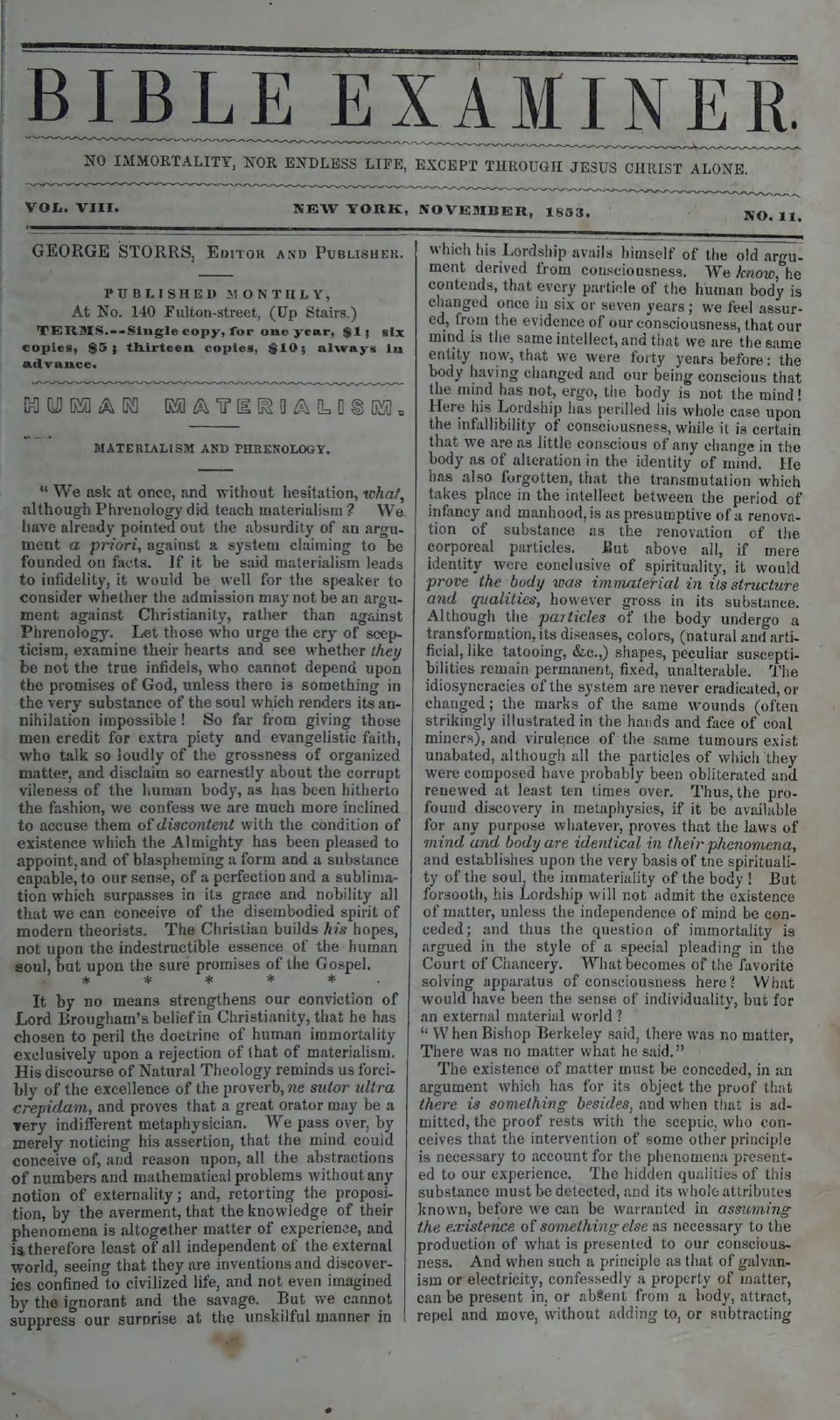
BIBLE EXAMINER.
NO IMMORTALITY, NOR ENDLESS LIFE, EXCEPT THROUGH JESUS CHRIST ALONE.
VOL. VIII.
NEW YORK, NOVEMBER, 1853.
GEORGE STORRS, EDITOR AND PUBLISHER.
NO.11.
PUBLISHED MONTHLY, At No. 140 Fulton-street, (Up Stairs.)
TERMS.--Single copy, for one year, 1; six copies, 5; thirteen copies, $10; always in advance.
HUMAN MATERIALISM.
MATERIALISM AND PHRENOLOGY.
"We ask at once, and without hesitation, what, although Phrenology did teach materialism? We have already pointed out the absurdity of an argument a priori, against a system claiming to be founded on facts. If it be said materialism leads to infidelity, it would be well for the speaker to consider whether the admission may not be an argument against Christianity, rather than against Phrenology. Let those who urge the cry of scepticism, examine their hearts and see whether they be not the true infidels, who cannot depend upon the promises of God, unless there is something in the very substance of the soul which renders its annihilation impossible! So far from giving those men credit for extra piety and evangelistic faith, who talk so loudly of the grossness of organized matter, and disclaim so earnestly about the corrupt vileness of the human body, as has been hitherto the fashion, we confess we are much more inclined to accuse them of discontent with the condition of existence which the Almighty has been pleased to appoint, and of blaspheming a form and a substance capable, to our sense, of a perfection and a sublimation which surpasses in its grace and nobility all that we can conceive of the disembodied spirit of modern theorists. The Christian builds his hopes, not upon the indestructible essence of the human soul, but upon the sure promises of the Gospel.
It by no means strengthens our conviction of Lord Brougham's belief in Christianity, that he has chosen to peril the doctrine of human immortality exclusively upon a rejection of that of materialism. His discourse of Natural Theology reminds us forcibly of the excellence of the proverb, ne sutor ultra crepidam, and proves that a great orator may be a very indifferent metaphysician. We pass over, by merely noticing his assertion, that the mind could conceive of, and reason upon, all the abstractions of numbers and mathematical problems without any notion of externality; and, retorting the proposition, by the averment, that the knowledge of their phenomena is altogether matter of experience, and is therefore least of all independent of the external world, seeing that they are inventions and discoveries confined to civilized life, and not even imagined by the ignorant and the savage. But we cannot suppress our surprise at the unskilful manner in
which his Lordship avails himself of the old argument derived from consciousness. We know, he contends, that every particle of the human body is changed once in six or seven years; we feel assured, from the evidence of our consciousness, that our mind is the same intellect, and that we are the same entity now, that we were forty years before: the body having changed and our being conscious that the mind has not, ergo, the body is not the mind! Here his Lordship has perilled his whole case upon the infallibility of consciousness, while it is certain that we are as little conscious of any change in the body as of alteration in the identity of mind. He has also forgotten, that the transmutation which takes place in the intellect between the period of infancy and manhood, is as presumptive of a renovation of substance as the renovation of the corporeal particles. But above all, if mere identity were conclusive of spirituality, it would prove the body was immaterial in its structure and qualities, however gross in its substance. Although the particles of the body undergo a transformation, its diseases, colors, (natural and artificial, like tatooing, &c.,) shapes, peculiar susceptibilities remain permanent, fixed, unalterable. The idiosyncracies of the system are never eradicated, or changed; the marks of the same wounds (often strikingly illustrated in the hands and face of coal miners), and virulence of the same tumours exist unabated, although all the particles of which they were composed have probably been obliterated and renewed at least ten times over. Thus, the profound discovery in metaphysics, if it be available for any purpose whatever, proves that the laws of mind and body are identical in their phenomena, and establishes upon the very basis of the spirituality of the soul, the immateriality of the body! But forsooth, his Lordship will not admit the existence of matter, unless the independence of mind be conceded; and thus the question of immortality is argued in the style of a special pleading in the Court of Chancery. What becomes of the favorite solving apparatus of consciousness here? What would have been the sense of individuality, but for an external material world?
"When Bishop Berkeley said, there was no matter."
"When Bishop Berkeley said, there was no matter. There was no matter what he said."
The existence of matter must be conceded, in an argument which has for its object the proof that there is something besides, and when that is admitted, the proof rests with the sceptic, who conceives that the intervention of some other principle is necessary to account for the phenomena presented to our experience. The hidden qualities of this substance must be detected, and its whole attributes known, before we can be warranted in assuming the existence of something else as necessary to the production of what is presented to our consciousness. And when such a principle as that of galvanism or electricity, confessedly a property of matter, can be present in, or absent from a body, attract, repel and move, without adding to, or subtracting from the weight, heat, size, color, or any other quality of a corpuscle,—it will require some better species of logic than any hitherto presented, to establish the impossibility of mind being a certain form, quality, or accessory of matter, inherent in and never separated from it.
We do not argue thus because we are confident that there exists nothing but matter, for, in truth, our feeling is, that the question is involved in too much mystery, to entitle us to speak with the boldness of settled conviction on either side. But we assume this position, because we think the onus probandi (burden of proof) falls on the spiritualists, and that they have not established the necessity of inferring the existence of another entity besides matter, to account for all the phenomena of mind, by having failed to exhaust all the possible qualities or probable capabilities of that substance which they labor so assiduously to degrade and despise. But while they have altogether failed to establish this necessity, whereon depends their entire proposition, they have recourse to the usual expedients of unsuccessful logicians, by exciting the ignorant prejudices of bigotry, and intolerance, against all that is dignified with the name of dispassionate philosophy.
The truth is, it is time that all this fudge and cant about the doctrine of materialism, which affects the theory of immortality in no shape whatever, as the God who appointed the end, could as easily ordain that the means might be either through the medium of matter or spirit, should be fairly put down by men of common sense and metaphysical discrimination."—Sidney Smith's "Principles of Phrenology," 1838.
MATERIALISM AND IMMATERIALISM, AND THEIR MORAL AND RELIGIOUS BEARINGS.
The extract we are about to present is long; but an intelligent reader, we apprehend, will find it worthy of deliberate consideration. To some statements in this extract, we, of course, object, because they jar with the Bible doctrine of the human soul and spirit; nevertheless, apart from these, it contains information that is valuable, and reasoning that is sound.—Ed. of Expositor.
"The supposed tendency of modern physiology to materialism has peculiarly alarmed Protestant divines. We are not concerned with the truth or falsehood of the opposite theories which have been advanced on this subject; but with their religious aspect. The author of this volume (Vestiges,) is a decided Materialist; but he holds that this does not in the slightest degree affect the truths of Theism, since the development of faculties whereby we suppose we surpass the brutes, is precisely that which puts us into contact with Deity. The whole subject of materialism has been so involved in verbal controversy, that we desire to try to clear off much that is extraneous.
"First, let it be observed, that if, (according to a current opinion) materialism consists in supposing that the soul possesses weight, extension, visibility, and other properties of matter, all the ancients were materialists. Beyond a doubt, Job, Ezekiel, and John, equally with Plato, Cicero, and the Christian fathers, conceived of spirit as nothing but thin matter, vapor or gas; and the philosophic idea of spirit,
now current in the regions of learning, is not older than the days of the European schoolmen. It is at once evident that the recent philosophy cannot be of essential moment to religion. But such a view of materialism is for many reasons unsatisfactory. Electricity, light, and heat, are regarded even by those moderns who hold the corpuscular theory concerning the two last, to be void of gravitation, and (we believe) of inertia. Yet it is evidently materialism to teach that the substance of the soul is made of these ingredients. Next; to those who will have it that nothing is spirit which has a proper attachment to space and time, we think it may be fairly replied that our souls do not fulfil this condition. If we know anything about them at all, it is that they stand in most intimate relation to our bodies, and are susceptible of change, growth, and decay, with the progress of time.
"We further assert, that the doctrine of materialism, if it be ever so true, ought not to affect any doctrine of morality or of religion, rightly so called. To put this in a strong light, let us be allowed to make an extravagant supposition, which will give every advantage to the opposite argument. Suppose that a future Mr. Crosse should succeed in constructing a living dog out of inorganic matter, by a series of galvanic operations, and that this dog should display all the sagacity and affection of other dogs; this would be the most decisive imaginable proof of the identity of that substance by which brutes think, feel, and live, with electricity and other forces which act on unorganic matter, yet such an experiment would not have the most remote tendency to undo our experience and our internal perceptions that truth, justice, disinterestedness, humility, compassion, and purity, are better than their opposites; it could not justly lower our reverence and admiration for the great Power who presides over the universe which we behold, or alter in any point the posture of our hearts and spirits towards Him. The sphere of religion is the inner and moral world; and as no external discoveries of philosophy, change the moral and spiritual nature of man, fear of any permanent harm to religion from this quarter is vain. Unwillingly, however, we must confess that such fears do temporarily verify themselves. For if the professors of religion proclaim that certain doctrines of philosophy are subversive of religion, too many are found to take them at their word.
"No doubt it is a prevailing idea, that the doctrine of immaterialism is essential as a foundation for that of future retribution. Rightly to discuss this question might need half a volume. Here it might suffice broadly to protest against basing such a doctrine on physical subtleties. The experience of the old Platonists and other schools which committed this error, might sufficiently warn us against it. A man who believed his soul to be immortal, because it was an unchangeable atom in which his self consisted, was irresistibly carried to believe his past as well as his future immortality, and therefore lost all idea of 'person' in connection with his soul. As Archbishop Whately states it:— 'They believed, not their souls but the substance of their souls to be immortal'; and personality being dropped, Pantheism crept in, which was nothing but veiled materialism in its most objectional form. Equally clear is it, that the immortality of the lowest brutes,—a limpet or a fly—perhaps even that of the souls of vegetables, follows from the same reasoning; as may be seen indeed in Butler's Analogy; and all moral import in a future state becomes more than problematical.
But the very basis of the theory is in direct collision with notorious fact. It is pretended the soul is unchangeable, when we have all the proof possible that it changes from day to day, and nothing but hardy denial on the other side. And if it be ever so immaterial, it still remains, that what had its beginning at birth may have its end at death.
"One other ground of fear from materialism derives too much countenance from a prevailing doctrine of Phrenologists. It is supposed that a materialist must of course be a Necessarian, and must deny that men cannot be justly praised or blamed, rewarded or punished. We know that a necessarian may with logical consistency hold that it is right to punish a man, as we would whip a dog, merely because experience shows the efficacy of the motive; but altho' this satisfies the lower demands of economies, it by no means meets what we believe spiritual religion and sound morality to require. We cannot ourselves see any proper connection between materialism and the doctrine of necessity. The latter controversy is notoriously an entangled one. Spiritual Fatalists are not at all rare among contemplative and even devout persons; and as far as we can see, the difficulties in the way of believing in human free-agency are equally great, and need to be met by the very same considerations, in the immaterialist as in the materialist theory. No materialist has any right to argue, that as a planet moves without power of self-control, so also must the human brain, if its forces are merely material ones. For the pretended analogy would quite as well prove that it cannot hope and desire, meditate and reflect, as that it cannot act freely upon itself. Into such false analogies those are perhaps peculiarly apt to fall, who have studied inanimate, more than animate or rational nature; and it is hardly fair to charge on materialism, as such, the errors which arise out of an undue encroachment of physiology on the domain of morals."—Prospective Review, March, 1845.
THE DOCTRINE OF THE CROSS.
THE FACTS AND PHENOMENA OF THE DEATH OF CHRIST.
(Continued from page 148.)
An important part of the scriptural evidence against the popular doctrine of the Cross is furnished in the facts and phenomena of the death of Christ. The intelligent and candid reader will acknowledge that if the current opinions on the subject are correct, they will appear to be borne out by all the circumstances connected with our Lord's last sufferings and death. Here, however, we discover the most conflicting phenomena,—conflicting, that is, with the opinions usually held as to the doctrinal significance of this solemn fact in our Lord's history. Every attempt to interpret the events which cluster around the Cross of the crucified Jesus, on the recognized principles of the popular theology, involves us in strange and painful confusion. The
attitude of the suffering and dying Christ as set forth in the Gospels exhibits nothing in common with his alleged attitude as the substitute for sinners, bearing vicariously their punishment, and drinking the bitter dregs of Divine wrath. We see, indeed, marvellous anguish there, but it does not seem as if it were the result of Divine wrath. That those sufferings were of the nature of a judicial satisfaction, demanded by the justice of God, and only completed when "Jesus cried with a loud voice and expired," appears to us a notion so clearly at variance with the historic phenomena of the case, that we only wonder that ourselves and others should have been so long blind to its obvious disharmony with the Gospel record. As to the process of proof usually adopted by the learned defenders of the popular doctrine, we do not think that we speak only our own experience when we say, that it always struck us as rather perplexingly profound than plain and palpable. Candor obliges us to confess that we received these theological theorizations not so much because we were convinced, but because we were constrained by the popular conscience and the prestige of orthodoxy to accept them as true. And possibly had we never been called upon to publicly defend the popular faith, we might have remained to this day as thoroughly "orthodox" as any of our brethren. We are thankful that even at some painful cost, we have learnt 'a more excellent way'—that our faith in popular infallibilities has been entirely shaken and destroyed, and that we have at last learnt that true godly allegiance to truth which obliges us to appeal first and last to the law and to the testimony for the rule of our faith and the guide of our life. As we have so often said, this is the oracle of our orthodoxy. To its teachings we make our supreme and final appeal, and by its decisions only we stand or fall.
Opening our oracle, then, we turn to that solemn page which informs us that Jesus knowing his "hour" was come, said to his disciples who had been partaking with him of the last supper, "Arise, let us go hence." Towards Gethsemane they direct their way,—a spot consecrated as the loved resort of Jesus and his disciples for its retirement, and where, removed from the cares and numerous interruptions of the city, they often had passed together many a holy and happy hour. Here once more and for the last time they come, and Jesus bids his disciples remain behind, with the exception of Peter, James, and John, and prepare for the approaching trial by seeking counsel and strength from God. To these chosen three Jesus discloses the depth of his sorrows—a sorrow "even unto death." "Tarry ye here," he says, "and watch with me." To them is entrusted the painful duty of guarding their Lord's retirement, and giving him notice of any hostile intrusion. He himself "went a little further," and there overwhelmed with sorrow, "he fell on his face," and prays that if possible he may be saved from that hour. "O my Father, if it be possible, let this cup pass from me! nevertheless, not as I will, but as thou wilt." "Being in an agony, he prayed more earnestly;" thrice did he cry to be delivered, "and his sweat was as it were great drops of blood falling down to the ground."* Now here is a phenomenon which it becomes us to look upon with trembling awe, and to write of with the most cautious reverence.
Many have speculated on this solemn significance, and have attempted to unravel the mysterious emotions of that terrible hour. It is not our purpose to undertake any such task, but rather to confront that theory of this season of sorrow which has obtained the ascendancy, and arrogated to itself the claim of being exclusively orthodox, with other accompanying phenomena which the sacred history develops. That theory we have often indicated. Suffice it here to remark, that it ascribes the Savior's intense anguish in Gethsemane to the alleged fact that, by a fiction of law, he stood in the place of a world of sinners lying under the wrathful displeasure of God, and exposed to an eternity of miserable torment in hell. He was enduring then the first bitter pangs of the punishment of sin, and writhing under the first mighty pressure of infinite wrath. The "cup" which he so earnestly prayed might if possible pass from him, was the cup of Divine indignation, we are told, put into his hand by the Omnipotent Avenger of sin, and which he was made to drink even to the dregs. It was then that the inexorable law was taking its terrible course—justice exacting its sanguinary satisfaction,—"the concentration of the sufferings of the atonement"* as a popular commentator writes, "pouring together upon him, and filling him with unspeakable anguish." From this representation our moral judgment revolts—and our understanding, in the view simply of the historic phenomena of our Lord's sufferings and death, withholds its assent.
How, we ask, in the view of that fact "there appeared an angel from heaven, strengthening him," can we accept this popular explanation of the agony in the garden? Whence came this angel? "From heaven." For what purpose? To give consolation and strength to the exhausted sufferer. Now either he came on his own account, moved by sympathetic impulses, or he came at the bidding of God. One or other was the cause of this Angelic mission. But if the suffering Jesus was then in the eye of God but as the concentration of a world's pollution and guilt—if at that moment he was the impersonation of all sinners, and in that assumed character was an object of Divine loathing and indignation, deserving and receiving the dreadful penalty due to their sins, what sympathy could a holy and obedient angel of heaven be conscious of towards him, much
less practically express? Nor, under these alleged circumstances, is it conceivable that God could have sent one of his "ministering spirits" to Christ, whose peculiar sonship was for the time being set aside for judicial purposes, and who stood before him in none other than a representative and criminal character. In the view of God, Jesus was then not his immaculate Son, in whom he was well pleased, but the impersonation of a guilty and doomed humanity, against whom his anger was kindled, and whom he was about representatively to punish. Inasmuch as God could not give consolation and strength to sinners themselves, when left to the endurance of their condign punishment; he could not so minister to one who is supposed to have been their substitute. And yet, says the record. "there appeared an angel from heaven strengthening him." Here is a clearly revealed historic fact which we invite our readers to confront with these so-called "Evangelical" doctrines. The fact will not be disputed; then the theology of the popular churches must be disputed, for there is most obvious contrast and discordance here. If it be a fact that an angel from heaven ministered strength and consolation to Jesus during his agony in Gethsemane, then that system of doctrine which we have described, and which the popular churches endorse, must be a notorious and most mischievous fiction.
The explanation of our Lord's agony on this occasion seems to be furnished by an apostle. Writing of this sorrow "even unto death" Paul says, "Who (viz. Christ) in the days of his flesh, when he had offered up prayers and supplications with strong crying and tears unto him that was able to save him from death." We shall speak more particularly on this subject as we proceed. No doubt our Lord's dread of death was one chief cause of his anguish, for it should be remembered that death to him was not what it is, or can be to ordinary human beings. But it is probable that there were other elements of grief besides a natural sympathy with his own prospective sufferings. The guilt of the Jewish people in their deliberate rejection of him, and in being about to imbrue their hands in the blood of one who came in the name, and as the representative of God, no doubt pressed heavily on his loving heart. It was not exclusively a sympathy with himself, we may well imagine, that prostrated his soul in anguish. When from the summit of Olivet he looked on the devoted city, and wept over it—when on his way to Calvary, bearing the burden of his own cross, he looked around on the weepers, and bade them weep rather for themselves than for him, we see such a wonderful forgetfulness of self that it is reasonable to suppose that similar feelings were agitating his bosom at this time. But whether we can, or cannot explain the nature and causes of this mental agony, is not of much importance to our present inquiry; it is sufficient that the circumstances of the case forbid us to accept as the true explanation that offensive theory which is now so generally received.
The language of Christ to the weeping multitude who followed bewailing him is deserving our attention while examining the incidents of this memorable tragedy. The language is not without significance in its aspect towards our present inquiry. "Daughters of Jerusalem, weep not for me, but weep for yourselves, and for your children." We have said that this was the language of loving sympathy.
There is nothing of unfeeling harshness here, as if our Lord was then taunting them with the woes which the national guilt of crucifying him was about to bring upon them. These were genuine sympathizers with his sufferings who attracted his notice on this occasion, and it was not the wont of Jesus harshly to repulse any, much less such as these. But why should Jesus bid these weeping ones dry their tears under circumstances so truly extraordinary as the popular faith represents? If Christ were then on his way to expiate a world's guilt by bearing the desert of a world's punishment, was there not the most abundant reason why tears should flow—scalding tears—tears of blood, if that were possible? "Daughters of Jerusalem," we should rather have expected to hear Christ say, "well may ye weep, for behold the hour of expiation is at hand, and I your substitute and that of the whole world am now going to bear the mighty burden of an infinite punishment which your, and the world's sins have brought upon me. Weep on, daughters of Jerusalem, for great indeed is your guilt which needs so great and fearful an expiation." But not so. "Weep not for me" is the singularly strange bidding!
Yet, further, Christ declares to these weeping women that they had more cause to weep for themselves than for him, and for the reason that they were about to undergo all the horrors of a sanguinary invasion, in which their city should be taken and destroyed. "Behold the days are coming in which they shall say, Blessed are the barren and the wombs that never bare, and the paps which never gave suck. Then shall they begin to say to the mountains, fall on us; and to the hills, cover us. For if they do these things in a green tree, what shall be done in a dry?" Viewed aright, this language exhibits a beautiful illustration of the benevolence and unselfishness of Christ's heart—but how can we understand it, on the supposition that Christ was then on his way to the endurance of a substitutionary and infinite punishment? Our Lord compares his own sufferings with those which they would shortly endure, and he tells them to reserve their tears for themselves, for his sufferings were light in comparison with what awaited them. But what are the horrors of even the worst conceivable siege—its famishings, its desolations of fire, and sword, and pestilence, and the constant apprehension of a terrible death; compared with those inexpressible agonies which we are assured that Christ, as the substitute for sinners, had to endure? Language fails to furnish expression for the horror of this expiatory crucifixion. Thought is overpowered by the very effort to conceive the dreadful nature of Christ's vicarious sufferings. Does it not, then, seem strange,—unaccountably strange, that Christ should compare his unique and indescribable woe, with that which awaited the Jewish people in their national overthrow, and declare that the sufferings of that national catastrophe would be even beyond his own? His,—
"A weight of woe, more than whole worlds could bear,"
lighter and less to be lamented than the woes which the people of Judah would endure in the siege and capture of their city!! Here again we meet with singular inconsistency in examining the phenomena of the Sacred History by the light of popular opinion. That the Lord Jesus should have bidden the
daughters of Jerusalem not to weep for him, but rather weep for themselves, as exposed to more terrible calamities than he was about to suffer, is a standing protest against the monstrous construction which is put on the last sufferings of Christ by the dominant theology. Were those sufferings of the nature they are declared to have been, there can be no doubt but that all the circumstances of that awful occasion would have contributed to give them that appearance. Their expiatory character, had such been their character, would by the manner and circumstances of their endurance have stood out in prominent relief, and nothing would have occurred, and especially nothing would be said or done by our Lord which would be adapted even to conceal so important a significance, much less to contradict it. But here, in the phenomena of the last sufferings of Christ, is nothing to be discovered which could make it possible for the actual spectators of them, or ourselves, who read the history from the pens of eye-witnesses, to know that they had any such significance as the popular theology declares they had; but on the other hand very much is to be met with, as we shall have further occasion to show, which obliges us to reject that system of doctrine as having no foundation in, and no harmony with the Sacred History.
(To be Continued.)
"BOOKED FOR HELL."
Bro. Storrs:—I am still looking for, and loving the appearing of Christ who is our Life. I can assure you that I am not a careless spectator of the conflict that is being waged concerning the glorious topic of Immortality as revealed in the gospel. It is but little that I can do in the cause, yet I would not leave that little undone.
One thing is certain, that the Life question is assuming a greater importance with the passing of every day. Opposers of the doctrine have learned what a few years since many of them were ignorant of, namely, that there is such a doctrine preached and believed Their abortive attempts to meet, or rather to evade the true issue, can only be accounted for by recollecting the influences of early prejudice, and the pressure of earthly motives.
Some of them seem to make use of railings, instead of reasons—sneers instead of sense—anathemas instead of arguments. They are welcome to the honor of such a course. Some men are not thus deterred from making use of their eyes, ears, and brains. Candidly, we want something else. When men rail, the reason is presumed to be, because they have no better arguments. When men can only stand and cry "infidelity," "heresy," "unscriptural doctrine," &c., when they know that we believe the Bible as firmly and as fully, to say the least, as they do; when they know that we can read the doctrine out of the Bible, and the only way they can prevent its being done, is by refusing to hear us read God's Word, (as they have repeatedly done at church trials;) to have them take such a course as this, and then stand back upon their dignity and infallibility and deliberately doom us to perdition, seems the extremest stretch of impudence, to say nothing of its sin.
Do they do this? There is a man connected.
with the New England Methodist Episcopal Conference, as a preacher, named J. D. B. He is esteemed as one of the leading preachers in that Conference. (Lord have mercy on those that are led.) Well, about the last of August, the Methodists had a camp-meeting at Southampton, Mass. Thursday afternoon, if I recollect rightly, this man undertook to preach from Phil. 1:28—"And in nothing terrified by your adversaries," &c. He went on to show who the adversaries of the M. E. Church were, and went over with a list of atheists, infidels, Universalists, spirit rappers, &c., and at the conclusion of each head would say—"I book them for hell!" At length he pounced upon the believers in "life and death," as revealed in the gospel, and after calling them "soul-sleepers," "annihilationists," and other interesting names, he said, "Book them for hell!" And I am informed that he intimated something about sending them there by the first conveyance. Thus he went on waxing exceeding zealous, and thinking, no doubt, that his pious "wrath" was working "the righteousness of God." So it did, for the ultimate effect was exceedingly salutary.
Said one Methodist brother, who is interested in the Life question, "I agreed with the preacher in one thing. When he commenced to preach, he said, he presumed that his sermon would be called by some the ugliest sermon they ever heard. I agreed with him perfectly there; it was so."
A few reflections are suggested by such kind of talk as this of the Rev. J. D. B.
I think this man had forgotten what belonged to common courtesy: and especially to the character of the Christian ministry. "The servant of God must not strive," He must "be patient towards all men," and "in meekness instruct" (not insult,) "them that oppose themselves, that peradventure God may" (not "book them for hell!" but) "give them repentance to the acknowledging of the truth." We read of a no less personage than Michael, who once contended with the very devil himself, and yet durst not bring a railing accusation against him. One would think that some of the modern guardians of pagan tradition and heathen fables had become possessed with the idea, either that they are a great deal better than Michael, or else that we are much worse than the devil, and so they seem to imagine that they may rail to their hearts' content.
I think that this man has not studied his text very closely in English or Greek, for if he had he might have seen that the word apoleia, perdition, means DESTRUCTION, RUIN, STATE OF BEING Destroyed, and contains within itself (aside from twenty-five other passages in Paul's epistles that teach the same doctrine,) enough to overthrow his pagan notion of eternal torment. By the way, last Sunday evening I preached about two hours on a series of passages which were sent me by an unknown person, whose 'nest,' perhaps, had been a little 'stirred' by the "Scripture searchers." Well, in giving, as I supposed, all the passages he could find to sustain eternal torment, he could only find one in all Paul's fourteen epistles which he dared to quote, and that was, "Who shall be punished with everlasting DESTRUCTION." "Blindness in part, has happened unto" Methodists. But to return.
I thought J. D. B. a little unmerciful, to "book" us "for hell"—there to be tormented, tortured, agonize, writhe, wail, blaspheme God, and suffer millions of years of inconceivable anguish for each and every heretical thought and word and deed, and yet when this was past have all our sufferings but just begun, and never to end, and all this because we believe God means just what he says, and are willing to forsake, for his truth, snug parsonages, fat salaries, or, as Rev. J. D. B. might express it, "desirable appointments." Now is it not a little too bad? And then to be in such a hurry—the 'first' 'boat,' or 'stage,' or 'train:' must you have us tormented before the time?
Then I thought, "Perhaps after all his talk, he don't think hell is such a terrible affair! Perhaps it is only the same to him as being out of the M. E. Church! for certainly if he was orthodox on this point, he wouldn't "book" men off so unceremoniously. And further—do you suppose that a whole stand full of preachers would have set behind him laughing, and a host of people would have sat before him doing the same, if they hadn't thought he was only in fun? May be he was trying to mimic the old Pope Leo X., who decreed that the soul was immortal—and "condemned all such as taught that the soul was mortal;" and perhaps the people were laughing to see how nicely he carried it out!!
I thought perhaps the poor man was provoked to it by some who had pestered and bothered him with passages of God's Word till he was out of all patience, and hoped to get rid of them, as the Pope did of heretics, or as a backwoodsman would of musquetoes by kindling a FIRE.
Ah, well, Bro. B., this is but "the beginning of sorrows"—and if the "whips" gall you so, I don't know how you will bear the scorpions."
The truth is destined to spread, and be it known unto you, that that sermon did more to spread it in the immediate vicinity of that camp-meeting than any other that has been preached for a long while.
Perhaps you do not know that a number of your brethren in "good and regular standing in the M. E. Church," got together the following Sunday night in the school-house at Westfield Farms, and in the midst of the best meeting they have had, some of them, for fifteen years, concluded that after all they guessed they wasn't "booked for hell," and they preferred going somewhere else—especially as some of them had serious doubts whether there really was any just such hell as you talked of.
I thought I wouldn't feel at all cross or hard toward Bro. B., for it may be he will be in a better mood at another time, and who knows but he may yet preach, that "God only hath immortality?" and if he does not, I shall not judge him, but shall hope to meet him in the better land where we shall know a great deal more, and do a great deal better than here.
I thought it wouldn't make much difference whether he booked us for heaven or hell. I doubt whether he is an authorized book-keeper for the former place, indeed I don't know as he professed to book any one for heaven at all. Perhaps his business lay chiefly in another direction.
I thought that "the Word of God is not bound; and" further, it never will be; and men had better be careful how they oppose its march.
'Potsherds' may do to fight with 'potsherds,' but when they claim immortality, and assume the attributes of the Creator, they show their own weakness and contemptibility. This last thought was forcibly impressed upon my mind when I was in Springfield Depot, and saw a little yellow dog running and barking after a huge locomotive, which was trundling away its ponderous load just as if there wasn't a single yellow dog under the whole heavens.
If you judge these thoughts worthy of examination, put them in your valuable Examiner.
Plymouth, Mass., 1853. H. L. H.
fore, the soul that shall not die. We are not,however, to infer from this, that the wicked shall be annihilated: but only, that they shall experience a death from which the righteous are exempt."
I am astonished that such a paragraph should be admitted into a Methodist work, for if it proves any thing, it proves that Immortality is to be received only through Christ. But, then, I am reminded that O. Scott abandoned the endless misery theory before he died. I regret that he did not do so before he wrote the sermon in question.
Have you seen Hiram Mattison's work on "Spirit Rappings?" I have examined but one chapter—that devoted to the "Intermediate State."
EXCERPTS.
Bro. Storrs:I am pleased with the manner in which, in the June Examiner, you dispose of the Northern Advocate, as well as the use you have made of the paragraph relating to Dr. Dick. My continued investigations on the Life and Death question satisfy me not only that our views are in harmony with the whole tenor of the Bible, but that they will also stand the test of the most enlightened criticism.
Prof. Geo. Bush, in his "Notes on Genesis," after expressing his belief that "living soul" means the same in Gen. 2:7, that it does in other places when applied to beasts, says: "As to the intellectual faculties which raise man so far above the tribes of the brute creation, we find no term that expressly designates them in any part of the sacred narrative.
and I find he denies that Moses appeared at the transfiguration as a disembodied spirit, contending that he was raised from the dead. This is a good position against the rappers,and it deprives our double-entity friends of one of their strongholds. The same view, I observe, is advanced in a sermon (by Rev. G. G. Hapgood,) on the Resurrection, in a work, published a few years since, called "The Methodist Episcopal Pulpit."
Canajoharie, N. Y.
RUFUS WENDELL.
"WHERE THEIR WORM DIETH NOT," &c.
Mark 9;48.
RICHARD WATSON, in his exposition of the above passage, says—"As the worm itself dies not, but destroys that it feeds upon, and as a fire unquenched consumes that upon which it kindles, so when temporal judgments are expressed by this phrase, the utter destruction of persons, cities, and nations,
Indeed, it may be remarked that the Scriptures generally afford much less explicit proof of the existence of a sentient immaterial principle in man capable of living and acting separate from the body than is usually supposed."
Such testimony on this point should, it seems to me, excite the suspicion in " orthodox" minds that the future life of man may, after all, depend upon a resurrection from the dead.
Prof. Bush, speaking of some of the "blemishes" of "the received version" of the Bible, says—"Of these, by far the most prominent is a want of uniformity in the mode of rendering, both in regard to single words and to phrases." In what way this "blemish" has served to hide the truth in relation to the nature of man. the state of the dead, and the doom of the wicked, is clearly and fully brought out in "Bible vs. Tradition," where the meaning of nephesh, ruah, psuche, pneuma, sheol, hades, gehenna, and other terms and phrases are
appears to be intended; but when it refers to a future state, and the subject of the punishment is, in itself, or by Divine appointment, immortal, the idea is heightened to its utmost terror; their worm of remorse and reflection ever gnaws; and the fire, which represents the severity of accumulated judgments, is never quenched."
We may learn, from this exposition, in what way those passages which clearly teach the "utter destruction" of the ungodly are pressed into the service of the endless misery theory. This is done by assuming the unconditional immortality of all men. The undying worm and unquenchable fire are not, it will be observed, deemed inappropriate symbols of "utter destruction," when "temporal" judgments are intended; but when they are applied to future punishment, we are required to receive
set forth.
A recent work, entitled, "The Methodist Preacher," has a sermon, by your old friend ORANGE SCOTT, on the "Immortality of the Soul." I have copied one paragraph and here give it:—
"There are certain persons, of whom it is said, that they shall never see death. 'He that believeth in me, though he were dead, yet shall he live; and he that liveth and believeth in me, shall never die.' 'If any man eat of this bread, he shall live forever.' 'Verily, verily, I say unto you, if a man keep my word, he shall never see death.' From hence it appears that by performing certain conditions, men may 'live for ever.' But none are exempt from the death of the body. It is, therethem in a sense that bears not the slightest analogy to their original import! The necessity for this violent interpretation vanishes when we come to regard man, agreeably with the uniform testimony of God's Word, as a probationer for an endless existence. Then it becomes apparent that "utter destruction" must be the doom of the finally impenitent. "They shall," says an apostle, "utterly perish in their own corruption." In what will this differ from the "utter destruction" of which Mr. Watson speaks? R. WENDELL.
Canajoharie, N. Y., Aug. 25, 1853.
BIBLE EXAMINER.
NEW YORK, NOVEMBER, 1853.
BIBLE EXAMINER.—One more number completes this volume. We shall act as heretofore, viz. Discontinue sending the Examiner to all persons who have not paid in advance for the next volume. Those, therefore, who do not receive the paper for January, 1854, will know the reason is, that we have not received payment according to our terms. If any think themselves entitled to it, let them inform us, stating the circumstances, and we will make it right.
Soon as we have issued the Dec. number, we shall have the volumes for 1852 and 1853 bound in one volume. Those who wish for it in that form will please let us know soon, as we can supply only a limited number of copies. The price will be $1.50.
We can supply a few copies of the Examiner, in sheets, for '49,'50,'51,and '52. Price, 50 cents for each of those years.
The proposition for next year is as follows:
If we receive one thousand dollars by Dec. 25th, from subscribers or otherwise, we will publish the Examiner twice each month at $1 per year.
Or, if fifteen hundred paying subscribers are secured by January first, at $2 per year, then we will publish it weekly.
If neither of the previous propositions are met, then we shall go on monthly as heretofore; but any person who pays $1, prior to Dec. 25th, shall be entitled to a copy of Br. Blain's new work—"Death not Life,"—without charge; they paying the postage. This offer applies only in case of the Examiner being published monthly.
A RESPONSE FROM DR. McCULLOH
Baltimore, Md., Sep. 1853.
MR. GEORGE STORRS,—Dear Sir:—I have just received the October number of the Bible Examiner, and am gratified to find the prospect so good of extending the simple truths of the Gospel, by making it the interpreter of itself, and not in conceding any thing to the authority of men.
To help you towards publishing your periodical twice a month, I forward you ten dollars.
With all good wishes to you,
I am, &c.,
J. H. McCullor.
Dr. McCulloh will accept our thanks; and, also,
Jacob Grim, of Philadelphia, from whom we have received eleven dollars for the same object.
ED. OF Ex.
BIBLE VS. TRADITION.—This work still continues to be called for, and we have just issued the "Third Edition." Let it be sent into every corner of the land: it is a thorough cure for the natural immortality theory; and shows beyond a reasonable doubt that Life and Immortality are the gift of God through Jesus Christ alone, and by the resurrection at the last day.
Price, 75 cents. For 5, ten copies. Sent in all cases at the expense of the purchaser, except where 1 is sent for one copy, and the two double Examiners containing Ham's Works, then we pay the postage.
"DEATH NOT LIFE."—This work, also, has had a rapid sale; thirteen hundred copies having been disposed of in two months. Another edition is now issued. Let it be placed in every neighborhood; it will open eyes to see the deception that has been practiced to conceal the fact that the doctrine of endless misery is not taught in the Bible, but is a pure fiction, invented by men. Price, 25 cents; or six copies for one dollar. Postage to be paid by the purchaser.
Both of the forenamed works should be scattered by tens of thousands; let it be done.
"PAULINE THEOLOGY; or, The Christian Doctrine of Future Punishment as Taught in the Epistles of Paul. By H. L. Hastings, Plymouth, Mass." A neat pamphlet of 48 pages, 12 mo. A valuable work. For sale at the Bible Examiner Office, 140 Fulton-street, N. Y. Price, 10 cents. Also for sale at 26 State-st., Hartford, Conn., Second Advent Watchman office, and by the Author. It should be put into every house in the land.
VISIT TO DANSVILLE.—We were absent from New York city nine days—traveled seven hundred miles, and preached twelve times. Our meeting was well attended by an intelligent class of people. The weather was fine and mild; and we had a most delightful interview with the brethren. Truly it was good to be there. The truth is clearly advancing in that region.
Br. Wm. Brown's house was our resting place whilst at Dansville; and we felt much at home in his kind family.
We met our fellow-laborer, C. F. Sweet, there and was much interested and pleased with our interview. He now goes out under the patronage of the Prov. Com. May the Lord abundantly bless him in his labors.
Others in that region, we trust will soon launch forth into the work.
The friends at Dansville will accept our thanks for their liberality in helping us on our way. They also subscribed some thirty dollars for the Prov. Com., through Br. Blain, who was present with us part of the time.
PROVISIONARY COMMITTEE.
We have thought best to republish, from the March Examiner, the first notice of this Committee and its object. It is as follows:—
"PROVISIONARY COMMITTEE.—A few of us have assumed this name, with the determination to search out laborers, and proffer them help in the field of their labors, to scatter light on the Life theme. The spread of light on this subject is our only object. This we state frankly; not that we desire to restrict the laborers so that they will not feel themselves free on other topics; but this theme is the one upon which we shall aim to give light; and we now call upon all who love it to lend us a helping hand, by contributing to the funds, and by your counsel and prayers. We believe the time has come that God expects us all to show more fully our faith by our works. The living voice must be heard proclaiming Life in the name of Jesus alone; and those who make the proclamation must be sustained. Let all who have a willing mind send funds to the Provisionary Committee, in New York, or raise such a Committee in their own town or county, and act at once in this matter.
HENRY A. CHITTENDEN, Prov.
HENRY F. JOHNSON,
GEORGE STORRS.
New York, March, 1st, 1853."
The object thus expressed last March is still the object.
The Preachers laboring in the Life Theme, on the ground proposed by the Prov. Com., and under its patronage, are the following, viz:
C. M. RICHMOND, of Peru, Ind., in Central Indiana.
W. S. CAMPBELL, of Chester Factories, Mass., in Western Mass. and Eastern N.Y.
JACOB BLAIN, of Buffalo, N. Y., in Western New York.
J. S. White, of Worcester, Mass., in Massachusetts.
T. GARBUTT, of Orangeport, N. Y., in the counties in that vicinity.
C. F. SWEET, of Ulster, Pa., in Northern Pa., and Southern N. Y.
Others will be added to the list as fast as approved men can be found who are willing to go to the
work. We have hesitated, hitherto, in soliciting preaching brethren to engage under the patronage of the Prov. Com., fearing that we might disappoint them in relation to the pecuniary assistance which we know they need, and ought to have. Each man, who has a family, certainly ought to receive about $300 per year, if he is devoting his whole time to the work. The Committee think that a small sum; and there should be added to it necessary traveling expenses. We wish to do every thing in this matter openly: we have no private designs or object. No one of our Committee charge or receive any thing for our services in this matter. All the money contributed to the Com. is applied to sustain the Preachers who go out under its patronage; and the application of it will be stated from time to time in the Examiner, so that all can judge for themselves whether their offerings have been properly applied.
Shall these men be sustained, who go forth bearing the precious seed of Life Eternal? Has God given any of us this world's goods to hoard up, while men of God are laboring to spread the truth, asking only that they may have sufficient to keep them and their families from actual want? Brethren and friends, let us ask ourselves whether we do not owe a debt of gratitude to God for the light He has granted us; and whether we are not bound to repay that debt by contributing to scatter the same light to those persons who are still bound in the miserable chains of superstition, which so long afflicted and tormented ourselves?
The Prov. Com. are not anxious that you should make them the distributors of your bounty. We would prefer that in every county the friends should have a Prov. Com. to receive and pay over to some preacher or preachers, in whom they have confidence, all that they may be able to collect. But if they prefer that we should receive and distribute their bounty, we are willing to do so according to our best judgment: yet, if any choose to designate to what preacher, in particular, they will have their money applied, it will be so applied; or if they wish it should be applied to publish works on the Life Theme, for gratuitous distribution, it shall be so done. We wish every one's bounty applied so as to meet the approval of the donor.
Now is the time to come up, with renewed zeal, to the help of the Lord in publishing Life only through Christ; and the Prov. Com. have ventured to encourage several more Preachers to launch forth in the work, believing that the hearts of the lovers of the glorious truth we promulgate will be opened to help these men of God. Shall we be disappointed? We trust not. Say at once, friends, what you will do in the matter. Send your bounty direct to "Geo.
Storrs, New York," or pay it to either of the Preachers whose names we have given you above. In acknowledging money paid, the name of the individual donor will not appear in the Examiner—unless it is necessary for satisfaction as to the fact that it is received--but the amount only. We wish nothing done for show, or through emulation. Let us work for God and his Christ, and wait till the resurrection of the just for our reward.
GEO. STORRS, for the Prov. Com. New York, Nov. 1, 1853.
RECEIPTS BY PROV. COM.
<tr><th colspan="4">Acknowledged previous to October, $142.65
During the month of Oct., as follows:
By Br. Blain, from friends in Lockport, N.Y.
“
“
Buffalo,
5.00
“
“
Honeoye,
5.00
“
“
Fredonia,
16.00
“
“
Dansville,
8.00
“
A friend, E. Springwater,
6.00
By Br. C. M. Richmond, from friends in La Fayette, Ind.
Total receipts, to Nov. 1st,
$193.65
DISBURSEMENTS BY PROV. COM., TO NOV. 1ST.
To Br. C. M. Richmond,
$115.40
To Br. J. Blain,
42.00
To Br. C. F. Sweet,
20.00
To Br. Thomas Garbutt,
20.00
For Tracts distributed by C. M. Richmond,
4.37
Total disbursements,
$201.77
Treasury overdrawn,
$8.12
GEO. STORRS, Treasurer for Pro. Com.
P. S. Bro. Blain has obtained some $100 in pledges, besides the above amount paid in. All this he has done in about six weeks.
Br. C. M. Richmond.—In September, this brother visited Ohio, to attend a "Family Convention" at his father's house: a convention at which all the children and grand-children are expected to be present. His father is a Preacher, (Baptist, we suppose,) and has three sons, who are preachers. At these conventions—which are Triennial, we believe—the father preaches a sermon, and each of his sons also. Br. Richmond must have had a trial to stand his ground on this occasion; but it seems God enabled him to testify for the truth. He thus speaks of it:—
The Family Convention is closed. I had the privilege, on the Sabbath, of presenting the truth on the penalty of God's law, to a large and attentive congregation. Of course it gave offence to some; for the time is come when men will not endure sound doctrine. After preaching many called upon me for publications. Some declared that they were convinced that the wicked would cease to exist.
My dear brother, I am bound up in the work of preaching the glorious Truth. I cannot refrain. The light shines so clear upon my own mind, and the orthodox system seems so unscriptural and absurd, that I must preach the whole truth with all the ability God has given me. It is really painful to be obliged to leave awakened inquirers and pass on to other fields of labor, and know that all the bigotry and ingenuity of orthodoxy will exert themselves to extinguish, or befog the ways of truth. But God is on the side of truth, and it will and must prevail. Your brother in Christ,
The foregoing was received too late for our last, and we now give the following along with it.
Bro. Storrs:—On my return to this place I spent a Sabbath at Fort Wayne. The truth on life and death, was presented in the afternoon and evening. At night the Court House was full. Many were disposed to receive the truth. Unfortunately I had scarcely any publications with me, for they were, in many cases, earnestly desired. I was solicited to visit them again, which I shall endeavor to do soon. In that city, as in other places, the strongest opposition, and the most bitter and bigoted spirit was manifested by leading professors of religion. I will give an instance. After I had presented the Bible doctrine, of the constitution and destiny of man, and dismissed the congregation, a prominent Methodist stepped forward, and insultingly asked, "How long, sir, have you been a missionary of the Devil?" and indulged in other abusive and uncourteous language. But the "spirit he was of" was manifest to all, and fully appreciated. Soon after this occurrence, two gentlemen, (and not professors of religion.) called upon me and apologized for the rudeness of their fellow-citizen, to a stranger who was peaceably presenting Bible Truth, as he understood it, to the people.
I am now laboring in different localities in this county. I was recently visited by an old Baptist minister, who earnestly exhorted me not to discuss nor preach on the state of the dead, and penalty of the law! "But none of these things move me." I am happy to say that the discussion in the "Sentinel," is doing, without doubt, a good work. The Truth is still onward in this part of the State. C.M.RICHMOND.
Peru, Ind., Oct. 13, 1853.
THE WHOLE TRUTH.
The whole truth given to man in the Bible for his benefit and salvation, is comprehended under four heads:
1st. Man as he was in his origin and condition before the fall.
2nd. Man as he is in his present state since the fall.
3rd. Man as he will be in his future state and final condition.
4th. The means or conditions by which his future state will be settled or determined.
My purpose is, wherever I go, to speak on some part of this whole truth, as I understand it—looking for Eternal Life only through Jesus Christ our Lord.
J. S. WHITE.
SPIRIT RAPPINGS.—The New York Daily Times, of Oct. 20th, in speaking of Judge Edmonds, who has recently published a work in defence of Spirit Rapping, says:—
"Judge Edmonds is guilty of the folly of saying that the doctrine of the Soul's Immortality is now, for the first time, put beyond a doubt. We have read his book with all reasonable care; and we defy Judge Edmonds to point out, in these pretended revelations of Bacon, Swedenborg, and the rest, a single thought or doctrine now for the first time revealed, or adding any substantial or useful knowledge."
The Times adds:-
"Throughout this farrago of revelation there is one thread which unites them into a systematic whole—and that is their steady hostility to the essential elements of Christianity, * every distinctive article of the Christian faith is negatived by these pretended revelations."
The italicising in this extract is ours. If our neighbor of the Times is correct in this last statement—and we think he is—then "the doctrine of the Soul's Immortality" is not an "article of the Christian faith;" for, "this farrago of revelations" does not "negative" that doctrine, but affirms it, and makes it the foundation of all its blasphemies. The so-called "Christian sects" have laid a foundation—not from the Bible, but out of their own fancies—and Judge Edmonds and others with him build thereon. Thus speaks the "Hon. N. P. Tallmadge," in his letter on "Spiritual Manifestations":—
"Let me scan this subject for one moment, and present one simple view, which, it seems to me, comprises the whole in a nut-shell. It is the belief of all Christian denominations, at the present day, that departed spirits revisit the earth, that they attend us, that they impress us to go or not to go, to do or not to do, for our good. Every one's experience will satisfy him of the truth of this remark. What then follows? If spirits visit us, attend us, and impress us for our good, what is the objection to believing that a mode is now discovered by which they can communicate with us?—There can be no possible objection, provided the facts justify that belief. If the one is for our good, the other is still more for our good. If the facts justify it, the conclusion is both reasonable and philosophical. Do the facts justify it? I undertake to say they do. I undertake to say, too, that no intelligent mind that investigates with a sincere desire to ascertain the truth, and has the opportunity to do so, can come to any other conclusion. What, then, is the result of this mighty outcry, as if heaven and earth were coming together? Why, simply, that it has been ascertained that spirits can communicate with us, in addition to impressing us! It hath this extent, no more."
…