The Bible Examiner — Vol. 9, No. 19 (November 1, 1854)
Download: PDF — The Bible Examiner — Vol. 9, No. 19 (November 1, 1854)
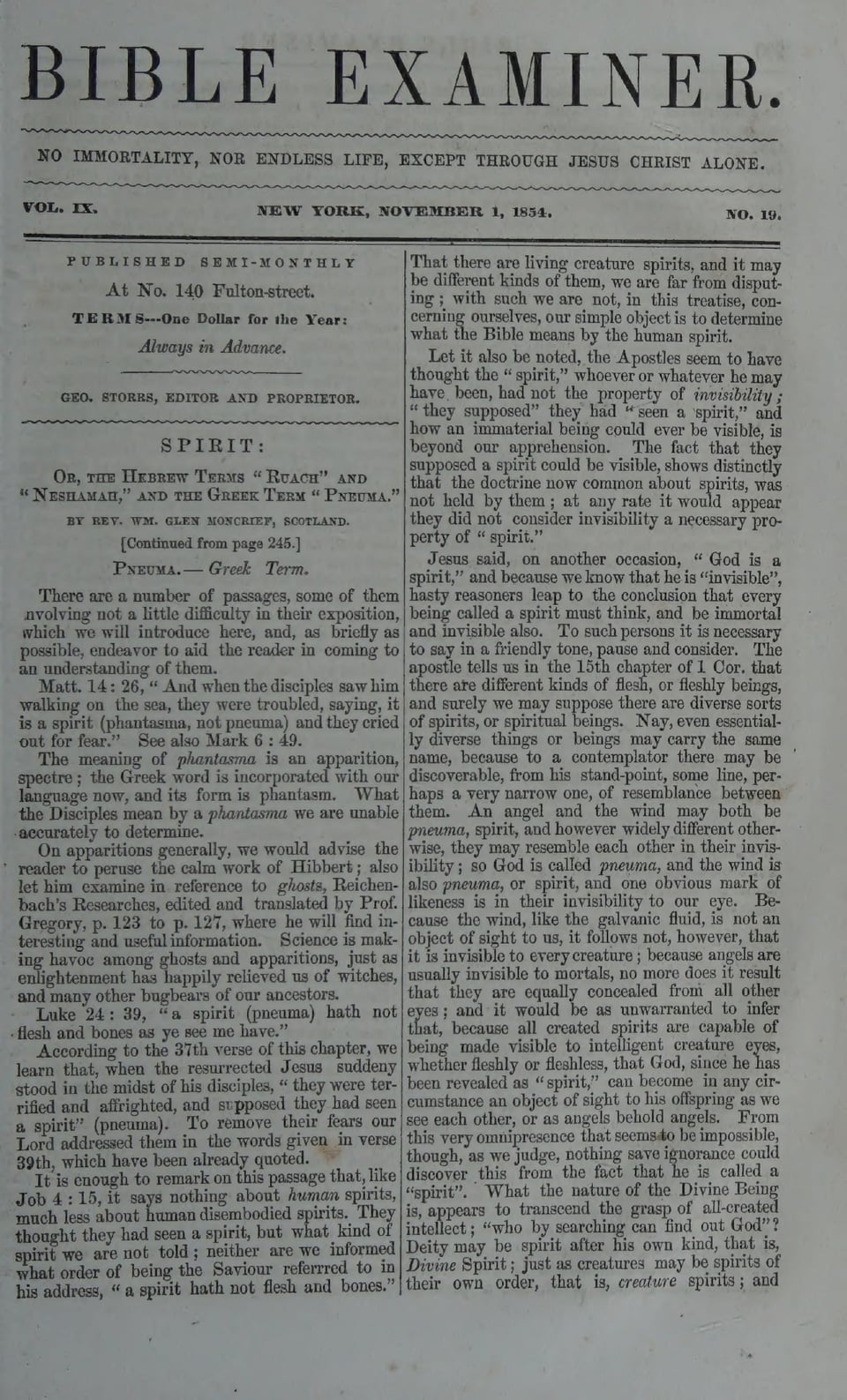
BIBLE EXAMINER.
NO IMMORTALITY, NOR ENDLESS LIFE, EXCEPT THROUGH JESUS CHRIST ALONE.
VOL. IX.
NEW YORK, NOVEMBER 1, 1854.
PUBLISHED SEMI-MONTHLY
NO.19.
At No.140 Fulton-street.
Always in Advance.
GEO. STORRS, EDITOR AND PROPRIETOR.
SPIRIT:
OR, THE HEBREW TERMS "RUACH" AND "NESHAMAH," AND THE GREEK TERM "PNEUMA."
BY REV. WM. GLEN MONCRIEF, SCOTLAND.
[Continued from page 245.]
PNEUMA. — Greek Term.
There are a number of passages, some of them involving not a little difficulty in their exposition, which we will introduce here, and, as briefly as possible, endeavor to aid the reader in coming to an understanding of them.
Matt. 14:26, "And when the disciples saw him walking on the sea, they were troubled, saying, it is a spirit (phantasma, not pneuma) and they cried out for fear." See also Mark 6:49.
The meaning of phantasma is an apparition, spectre; the Greek word is incorporated with our language now, and its form is phantasm. What the Disciples mean by a phantasma we are unable accurately to determine.
On apparitions generally, we would advise the reader to peruse the calm work of Hibbert; also let him examine in reference to ghosts, Reichenbach's Researches, edited and translated by Prof. Gregory, p.123 to p.127, where he will find interesting and useful information. Science is making havoc among ghosts and apparitions, just as enlightenment has happily relieved us of witches, and many other bugbears of our ancestors.
Luke 24:39, "a spirit (pneuma) hath not flesh and bones as ye see me have."
According to the 37th verse of this chapter, we learn that, when the resurrected Jesus suddenly stood in the midst of his disciples, "they were terrified and affrighted, and supposed they had seen a spirit" (pneuma). To remove their fears our Lord addressed them in the words given in verse 39th, which have been already quoted.
It is enough to remark on this passage that, like Job 4:15, it says nothing about human spirits, much less about human disembodied spirits. They thought they had seen a spirit, but what kind of spirit we are not told; neither are we informed what order of being the Saviour referred to in his address, "a spirit hath not flesh and bones."
That there are living creature spirits, and it may be different kinds of them, we are far from disputing; with such we are not, in this treatise, concerning ourselves, our simple object is to determine what the Bible means by the human spirit.
Let it also be noted, the Apostles seem to have thought the "spirit," whoever or whatever he may have been, had not the property of invisibility; "they supposed" they had "seen a spirit," and how an immaterial being could ever be visible, is beyond our apprehension. The fact that they supposed a spirit could be visible, shows distinctly that the doctrine now common about spirits, was not held by them; at any rate it would appear they did not consider invisibility a necessary property of "spirit."
Jesus said, on another occasion, "God is a spirit," and because we know that he is "invisible", hasty reasoners leap to the conclusion that every being called a spirit must think, and be immortal and invisible also. To such persons it is necessary to say in a friendly tone, pause and consider. The apostle tells us in the 15th chapter of 1 Cor. that there are different kinds of flesh, or fleshly beings, and surely we may suppose there are diverse sorts of spirits, or spiritual beings. Nay, even essentially diverse things or beings may carry the same name, because to a contemplator there may be discoverable, from his stand-point, some line, perhaps a very narrow one, of resemblance between them. An angel and the wind may both be pneuma, spirit, and however widely different otherwise, they may resemble each other in their invisibility; so God is called pneuma, and the wind is also pneuma, or spirit, and one obvious mark of likeness is in their invisibility to our eye. Because the wind, like the galvanic fluid, is not an object of sight to us, it follows not, however, that it is invisible to every creature; because angels are usually invisible to mortals, no more does it result that they are equally concealed from all other eyes; and it would be as unwarranted to infer that, because all created spirits are capable of being made visible to intelligent creature eyes, whether fleshly or fleshless, that God, since he has been revealed as "spirit," can become in any circumstance an object of sight to his offspring as we see each other, or as angels behold angels. From this very omnipresence that seems to be impossible, though, as we judge, nothing save ignorance could discover this from the fact that he is called a "spirit". What the nature of the Divine Being is, appears to transcend the grasp of all-created intellect; "who by searching can find out God"? Deity may be spirit after his own kind, that is, Divine Spirit; just as creatures may be spirits of their own order, that is, creature spirits; and surely we may safely affirm that there must be, in essential nature, or in the kind of spiritual substance, an infinite difference between them all and God, and that there may be a vast disparity between creature spirits among themselves.
In connection with the passage from Luke, we may specify another remarkable instance of hasty reasoning, it is this: because Jesus pronounces such a spirit as he was referring to, not to have "flesh and bones," must we leap to immateriality? Is there no matter in the great universe but "flesh and bones"? What is carbonic acid gas? what is oxygen? what is electricity? what is nervous influence? what is light? what is the perfume of a rose? How varied, how subtile, how imponderable even, the forms matter assumes? Is there no possibility of a creature being material and yet not "flesh and bones"? Who shall say so without folly? So far from being necessarily immaterial, the writer of the 15th chapter of 1 Cor. makes mention of a "spiritual body;" and, indeed, an immaterial being, appears to our judgment, simply an absurdity. Every being must be a something occupying space,—he must have an essence, and that essence located, in all space or a portion of it. There may be inconceivable differences between the essences, substances, or material of beings; we may, without danger of presumption, affirm there must be such a difference absolutely between the Divine Agent and all his creatures. To say that God is immaterial, or that spirits are immaterial, is very like an assertion that there is no God—no spirit in the universe. The uncreated Being can be spirit and yet matter,—eternal, unchangeable, and all-pervading, of an order peculiar to himself; for to be spiritual is not to be absolutely immaterial; and intelligences formed by his hand can be spirit and essentially material, though they may not be "flesh and bones," but organizations or structures of a more ethereal cast.
John 6:63,—"the words that I speak unto you they are spirit (pneuma) and they are life."
"They (the words that I spake unto you) are not to be understood literally, as if you were really to eat my flesh; but they are to be understood as denoting the need of that provision for the soul which God has made by my coming into the world."—Barnes in lo.
Acts 23:9, "but if a spirit (pneuma) or an angel hath spoken to him, let us not fight against God."
So spake the "scribes that were of the Pharisees' part," about Paul, but as the words contain nothing about human spirit, the passage is excluded from consideration at this time. See remarks on Luke 24:39.
Rom. 8 : 10, "And if Christ be in you the body is dead because of sin ; but the spirit (pneuma) is life because of righteousness."
In the first work we published on this momentous controversy regarding man and futurity, we expressed our opinion that this verse intimated a conditional hereafter to the spirits of pious men, understanding as we then did, that the spirit of man imported what it is generally supposed to do. A more careful examination of the Scripture teaching about man's spirit, and a prolonged
consideration of the verse, has convinced us that we formerly misunderstood it; if this confession be deemed humiliating, we are perfectly willing to bear the shame, since we are conscious of a desire to advance in a better knowledge of the Word, and are, at the same time, alive to our own ignorance and fallibility. God is the only being who requires neither to learn nor unlearn; these are the unavoidable conditions of finite intelligence.
The verse before us has been employed lately by Prof. John Brown, of Edinburgh, in his work, "The dead in Christ," to support the opinion that the dead (dead?) are conscious, having his argument, as usual, based on the word "spirit," and, after quoting his remarks, we shall presume to offer a few critical observations upon them. He says, "The following declaration of the apostle Paul, in the epistle to the Romans, fairly interpreted, seems clearly to assert that the state between death and the resurrection is one of conscious activity and happiness:—'If Christ be in you,' if you be true Christians, united to Christ as dying and rising, 'the body is dead,' and must die, because of sin,' the first sin of the first man, and the sin, too, that dwells in us; 'but the spirit,' the soul, as contrasted with the body, 'is life,' shall live, 'because of righteousness,' or of justification,—shall live while the body is dead: 'and if the spirit of him that raised up Christ from the dead dwell in you, he that raised up Christ from the dead shall' not only preserve the spirit alive, but shall 'also quicken your mortal,' your dead, 'bodies by,' (or rather as it is in the margin) because of, 'his spirit that dwelleth in you.'"
In our work, already alluded to, we employed this passage from Romans to carry out the idea of conditional immortality, having then a strong subcurrent in our mind, of the abounding notions concerning human spirits, but, when properly interpreted, the text neither supports our previous statements nor those of the learned and venerable Professor. Nothing but assumptions stand out from the extract we have quoted above.
One assumption is that the human spirit and soul are one;—he says "the spirit," "the soul," as if the two terms were mutually explanatory. It may be fashionable in creeds and sermons to employ phraseology like this, "the soul, that is, the spirit of man," "the spirit or the soul," but the usage is unsanctioned by the authority of inspiration. Indeed, the soul of a man is just the organized being man himself, and if at any time a contrast is drawn between his soul and body, life is assuredly the import of "soul" in all such instances, as we have tried to manifest in our work "Soul." The common idea attached to soul is that of human self, or personality, but it must be kept in mind that "soul" in the Bible it essentially different from "soul" in the creeds and pulpits, and, instead of contrasting the human soul or life, and the body, we should have expected a repeated contrast between the soul and the man—the being himself, and his physical dwelling-place, yet that is never once discoverable in the sacred volume. Without doubt it speaks of soul and body, but not so as to teach us that the soul was the man apart from, and residing in, his material abode.
So far from the soul and spirit being synonymous, it becomes us to speak of them as very distinct. Instead of writing soul or spirit, thereby expressing unity, we should say a soul and his spirit; "soul" designating the man whom the Lord God formed of the dust of the ground, and spirit being the breath of life inhaled by his lungs. We have said so much on these points already, that we may be excused any enlargement at this stage.
If it be the spirit of man that is here mentioned, another assumption is that it was ever conscious before death, that it was ever the thinking agent man, properly speaking, at all. Man has a spirit, and if it is an axiom that spirit must be alive, and must think, and must think on forever, all that Dr. B. asserts, and all that was ever affirmed on the same subject by myriads before him, may be admitted without a moment's hesitation. But are these things self-evident? It is here said "the spirit is life," may a spirit not be so described, because it is essential to life, without being itself alive? Food is life to man, and so is breath, or the spirit of life that comes from God. Enough has been shown in the preceding pages to manifest what the spirit of man is, that has been so long mistaken for man himself. What an humbling thought that, along with others, we mistook the breath for the breather!
It is another assumption that the spirit spoken of by the Apostle, is the spirit of man. We feel a growing assurance that it is God's Spirit and not man's. The writer does not say, if Christ be in you, your body is dead because of sin, but your spirit is life, because of righteousness, he merely asserts, the body is dead, but THE SPIRIT is life. Who, or what is this "Spirit?" Much is said about a spirit in the context, and, as far as we can determine it is exclusively of God's Spirit that mention is made. In verse 9th, we read, "Ye are not in the flesh, but in the Spirit, if so be the Spirit of God dwell in you. Now if any man have not the Spirit of Christ, he is none of his," and then, after introducing the verse under discussion, the Apostle goes on at verse 11, thus, "But if the Spirit of him that raised up Jesus from the dead dwell in you, he that raised up Christ from the dead shall also quicken your mortal bodies by his Spirit that dwelleth in you." At the close of verse 10th, the writer declares "the spirit is life because of righteousness," and he continues to speak about the same Spirit in the 11th verse as just quoted, "but if the Spirit of him that raised up Jesus from the dead dwell in you," &c. A case could hardly be clearer, as we humbly think, against Dr. B.'s interpretation of Spirit here, as being the spirit of man instead of that of Christ; and, if the thoughtful reader will study the point with his Bible open before him, we feel persuaded he will agree with us. Let it be also noted, that the interpretation we give of "spirit" here is obviously the one approved by our Translators, as is evinced by their printing Spirit with a capital S, and not a small one, as we think would have been the case, had they supposed the reference to be the spirit of man.
The meaning of verses 10 and 11 seems to be the following, which we give in the paraphrastic form: and if Christ be in you, if ye are true Christians, the body, or ye yourselves, are condemned to die, and must die in consequence of sin, (compare Rom. 5:12, &c.); but the Spirit of Christ who dwells in you at present, is giving you life, opening up to you, as justified and pious men, the hope of a glorious future life through a resurrection from the dead; and if the Spirit of him that raised up Jesus from the dead—as the first fruits of them that slept—dwell in you, as you are well aware he does, by the peace and light, the love and hope which are your great possession, he that raised up Christ from the dead shall ere long quicken your mortal bodies, or give you an immortal and incorruptible resurrection by, or rather because of the Spirit that now resides in you. Still the old doctrine comes up in new and vigorous forms, that the human spirit is not the man; and that saints have no hope of everlasting life except through a resurrection from the dust. No passing from death unto life; only from the grave to immortality.
We are only required now to meet an objection that may probably arise in some minds, it is this:—why make "body" in the phrase "the body is dead," equivalent to the ENTIRE MAN? We answer, because we find this done in a variety of ways all over the Book; personality is there connected with the organization, not with anything like that undefined and incomprehensible conception, a human soul, or spirit, as it looms forth a cloud-enveloped popular creation. In proof of the propriety of our interpretation, we refer to such examples as these—Gen. 2:7, "God formed man of the dust of the ground;" 3:19, "Dust thou art;" 6:3, "he (man) also is flesh;" Ps. 103:14, "He remembereth that we are dust;" Ps. 139:15, "my substance," (margin, 'my body') or I, "was not hid from thee when I was made in secret;" Matt. 6:22, "the light of the body (of the human being) is the eye;" Rom. 12:1, "Present your bodies (yourselves) a living sacrifice," &c.; Heb. 10:10, "through the offering of the body of Jesus," i.e., the offering up of Jesus; James 3:6, "it (the tongue) defileth the whole body," i.e., the entire being.
1 Cor. 5:3, "For I verily, as absent in body, but present in spirit (pneumati), have judged already as though I were present," &c. Regarding the phrase "present in spirit," Barnes on the text has these remarks :—"my heart is with you; my feelings are with you; I have a deep and tender interest in the case, and I judge as if I were personally present. . . Paul meant, probably, that though he was absent, yet his mind and attention had been given to this subject."
1 Cor. 5 : 4, "when ye are called together,and my spirit (pneumatos,) with the power of our Lord Jesus Christ."
"The passage,' says Bloomfield, "may be rendered thus :—I do hereby direct that ye (being assembled together, and I being spiritually and virtually present with you, by the signification of this my opinion) do, in the name and in behalf of our Lord Jesus Christ, and acting by the power of our Lord Jesus Christ, deliver the person so described."
1 Cor. 5 : 5, " deliver such an one unto Satan for the destruction of the flesh, that the spirit (pneuma) may be saved in the day of the Lord Jesus."
The "spirit" is either life here, or it is used as a periphrasis for the man himself. The end of the disciplinary excommunication was for the destruction of the offender's flesh, that the spirit, or that he himself, might be saved in the day of the Lord Jesus:
Using the word "soul" as synonymous with "spirit," Bloomfield paraphrases the clause thus : that his soul, corrected, humbled, and reformed by these sufferings may be saved," &c. "His soul" being a periphrasis for himself, and this being employed, though without the warrant of Scripture, for "the spirit" in the text, shows the commentator, whose words we have quoted, understood the verse in the sense we have assigned it. Better, is the force of the passage, to have the flesh, or the animalism destroyed now under a severe judicial visitation,—better to lose even the present life itself than to remain unwarned and untroubled in the midst of sin, which has such a deadly influence on every moral being; as a result of a true humiliation and thorough purgation in the fiery furnace, one may ultimately phoenix-like, spring from the dust incorruptible and deathless.
1 Cor. 6:20, "glorify God in your body and in your spirit, (pneumati) which are God's."
Here, as we have remarked on other occasions, there is nothing about a rational, thinking, immaterial, deathless spirit. The command to glorify God "in your spirit," it may be affirmed, intimates that the spirit thinks and wills and loves. Then, would we answer, O friend of the popular systems, observe that your own reasoning lands you in the conclusion that the material frame must think also, and that is a horrible idea to one instructed as you have been. Are we not commanded to glorify God in our body as well as spirit? And if the command proves the spirit thinks, it must show that the body performs intellectual operations also; and if a spirit must survive death because thought is ascribed to it, the same fact would seem to compel us to infer that the physical and organic associate of the more ethereal division of human nature should escape dissolution likewise, which being a great absurdity, as is established by observation, however logical and congruous it may appear in the region of abstraction and speculation, warns us from concluding that, because any part of man happens in the Book to have thought connected with it,—be it called "heart, reins, bowels, or spirit,"—the author of inspiration does thereby teach us, that the said part actually performs the given function, and will elude the grasp of death. It is the BEING MAN who thinks. Sometimes the thought process, or mentalization, is conjoined with one part, sometimes with another, and sometimes it is even associated with its breath, or life-spirit, inasmuch as it is by the vital spirit every human function is generated and sustained. And what is man. "The Lord God formed MAN of the DUST of the ground." Gen. 2:7.
In a verse like the one we are considering, it is
sometimes affirmed that there is a statement given of the two parts that compose each human being, the body and the spirit, meaning, of course, his rational and indestructible spirit. These two parts compose a man—then how happens it that after death the man remains as perfect as ever? He thinks as well, joys or suffers as completely; in a word, is equally perfect as prior to the disunion of these two parts. When the compound agent thinks, does it not seem to be a dictate of common sense that, if the parts are taken asunder, all the results of their union, such as thought, love, pain, pleasure, and voluntary action must terminate? Take away the silver plate from the galvanic battery, or the acid from its trough, will the flash be seen? will the message run along the wires? Is a part, in a word, equal to a whole?
On the supposition that this passage teaches the existence of two parts in man, will not the text in which "spirit—soul—body" occur, reveal three parts; and the words of our Master "thou shalt love the Lord thy God with all thy heart, and with all thy soul, and with all thy mind, and with all thy strength," announce the existence of many; and what must be astounding to every one wedded to common notions, the Great Teacher in these terms makes no mention of a spirit whatever. A most vital part, nay, the part, compared to which all besides is unworthy of being taken into calculation,—this very vital part ignored!
Without controversy, the text under discussion is simply a mode of expressing ENTIRE MAN, like the words of Jesus we have transcribed a few lines above. Body and spirit, being and breath, being and life, being and all its powers, visible and invisible, mental or physical,—let them all be consecrated to him who is their Creator and Redeemer. In the words of Barnes, "Let your entire person be subservient to the glory of God." Who has difficulty in understanding the force of these texts, "The Lord direct your hearts into the love of God," "Sanctify the Lord God in your hearts?" When glorifying God in our hearts is so readily understood, on what ground shall we make a mystery of glorifying him in our spirits? Give him all outward and inward reverence is the substance of the exhortation. Would that it were universally done.
[To be Continued.]
IDOLATRY.
BY DR. S. B. BARLOW, NEW YORK.
Mr. Editor. Will the great problem of "Man's Nature and Destiny," ever get itself settled? Who could believe that that, the greatest of all moral problems, was yet a debateable question? Especially, who could believe that the Church, the orthodox Church, claiming almost to be infallible, whose Grand Muftis and learned Bishops, High Priests, and titled Dignitaries, blessed with the Gospel, a light which is capable of out-shining all darkness, should still be groping in heathenish and worse than Egyptian darkness on that great question which above all others is of the most paramount importance to every living son and daughter of Adam? And yet such seems to be the fact.
We see it everywhere in the Church from the highest to the lowest of its members, and in churches of all manner of names; they have adopted the heathen philosophy and theory of man's nature and destiny in point-blank and Heaven-defying contradiction to God's word in relation to it; and that too where that word is so plain that a way-faring man though a fool need not err therein. It is the idolatry of the Church! It is their idol, and it is questionable whether they will ever give it up and settle down upon the plain truth of God's word until the great day whose light shall blaze and burn the truth into every man's mind and conscience.
And can they benefit by the truth then communicated? I fear not. We are commanded to know the truth, to believe it, to live in it. To all men is given understanding that they may know it, and if men will cleave to error when the truth is so plainly revealed to them in the word of Jehovah, how will they answer for it in a day of accounts? Alas! I dare not answer how. Bishop Newton said of Lord Bolingbroke: "the Lord gave him splendid talents, but the Devil gave him the application of them." Are not many of our talented men and Professors fearfully linked in the same category with his Lordship? I was led to these reflections by an article in the Christian Advocate and Journal of July 13, 1854, signed G. P. D., in which he gives long extracts from Cicero on the immortality of the soul, extolling him and Plato and Aristotle to the skies as the great expounders of the truth on that great subject, without once hinting, or seeming to know that the philosophy of God's Book was opposed totally to those heathen theories, (devices of Satan) and contradicted them in limine et extenso as much and as plainly as any known truth contradicts its opposing error. Did G. P. D. know the fact that God's word entirely, directly, and pointedly opposed those very heathen notions? If not let me beg him to go once through the Bible, carefully sifting and collating every passage in it which has any even the slightest bearing upon that point—the soul's immortality, and the great question of man's nature and destiny; and see if he cannot come to a truthful understanding of the matter. What is to be the final result of the Church's error on these more than vital questions? Can men live in, and deal in, error of the most deadly and destructive nature all their days, when the truth lies open, world-wide before them, and come out of it at last unscathed? If so, what is truth for and what is it worth? "Ephraim is joined to idols." "The soul that sinneth it shall die."
Yours affectionately.
PROVIDENCE, R.I., Sept. 9, 1854.
Henry Ward Beecher.
Dear Br. Storrs.-This being Commencement week of Brown University, we have been favored with some superior emanations of gifted minds. On Tuesday evening our respected christian brother, Henry W. Beecher, gave, to a very crowded audience, an interesting discourse on the subject of Gospel missions, in his own original
style. Our Boanerges commended himself, to every pious heart, by an impressive delineation of the absolute importance of vital godliness, as the grand effective element in this holy enterprise. Alas! the sacred pleasure of the occasion was diminished by the perception, that the expansive and independent mind of our brother has not emerged from the ignoble bondage of a traditional theology. Under the influence of human tradition, in the presentation of supposed barriers to the prosperity of the missionary enterprise, the eloquent speaker was pleased to class with the national sin of Slavery, (which elicited a faithful and scorching rebuke,) the prevalence of the belief, that Death, as an extinction of VITAL BEING, will ultimately be the doom of impenitent men! In direct opposition to the pious intention of the speaker, here was the impious anomaly, of placing the very truth of "the faithful Witness," in the category of obstacles to the advancement of his own cause! If the words of Jesus Christ, Matt. 10:28; teaching men to fear a destruction of "soul and body," in Gehenna, subsequent to the first death, do not plainly declare the truth we preach, and for which we are charged with hindering the Gospel our inmost powers love to promote; if the numerous declarations of the Bible, that God will destroy the wicked do not teach the sentiment Mr. B. repudiates, we ask him to inform us what words can teach it? If our brother believes that he can advance the cause of the Redeemer, whom we mutually serve, by teaching the heathen philosophy of natural immortality, and consequent eternal life of those who die in their sins; let him, at least, cease accusing us for teaching the testimony of the Eternal Spirit that "the wages of sin is DEATH." "The second death," as well as the first. Let him solemnly consider whom he is opposing, when he opposes the sentiment that in the "very day" of death, the "thoughts" of man "perish;" "also his love," &c. Do we persuade men to believe these things, or God?
What, we ask, is the objection of the talented preacher to these plain testimonies of the only reliable revelation? Did he adduce from the living oracles any counter testimony? Not a word. The sentiment does not chime with our brother's views and fancies of the dignity of human nature, or with his respect for it! This reminds us of the means adopted by another personage, to persuade the sinner to disbelieve the truth we preach, by flattering him with attaining to the high dignity of being "as Gods." Gen. 3:5. Suppose a man charges our brother with lowering the dignity of human nature, because he denies that the human soul is really a part of the eternal and immutable essence of God: or because he denies that man was made higher than the angels. His answer to such a change, will be an answer to himself.
Finally, if Mr. B's. regard for humanity, or for the justice and mercy of God, is such as induces him to prefer the contemplation of innumerable intelligent beings existing to endless duration in sin and misery, to the contemplation of their annihilation, we must dissent from the horrible philosophy.
Yours, for the truth, HENRY GREW.
Dr. Clarke Again.
Br. Storrs:—That Dr. Adam Clarke should find himself "in a dilemma" when he attempts to explain a passage which is hostile to the going-to-heaven-at-death theory, is natural enough; and that he should at any time completely nullify this theory by his own express teaching, may well excite surprise. Has he done so? Let us see. The Doctor proposes to read 1 Cor. 15:32 thus: "If after the manner of men, I have fought with beasts at Ephesus, what doth it advantage me? If the dead rise not, let us eat and drink; for to-morrow we die." His comment on the place is as follows:
"What the apostle says here, is a regular and legitimate conclusion from the doctrine, that there is no resurrection; for, if there be no resurrection, then there can be no judgment; no future state of rewards and punishments; why, therefore, should we bear crosses, and keep ourselves under continual discipline! Let us eat and drink, take all the pleasure we can, for to-morrow we die: and there is an end of us forever."
That the Doctor in this exposition faithfully echoes Paul's meaning, does not, it appears to me, admit of a reasonable doubt; but in doing so, who does not see that he subverts the immortal soul hypothesis, and thus becomes a co-worker with those who hold and advocate what he elsewhere calls "the vile doctrine of Materialism!" Possibly he had not recovered from the shock which the popular notion receives at the 18th verse, which declares that "if the dead rise not," "Then they also which are fallen asleep in Christ are PERISHED." Indeed, he appears to have been deeply imbued with the drift of the inspired Apostle's reasoning, and by making future life depend on the "resurrection," he establishes the fact that "the dead know not anything." In the light of this truth it is easy to explain another remark of the Doctor, in his concluding notes on this chapter. He says, speaking of the resurrection, "The Apostles were continually insisting on it, and exciting the followers of God to diligence, obedience, and cheerfulness through it." He also says, "There is not a doctrine in the Gospel on which more stress is laid." All this is very plain, if the no-resurrection hypothesis involves the fearful consequence affirmed in the comment I have quoted, namely, that at death "there is an END OF US FOREVER." Had the Doctor seen this truth when he penned his note on Acts 9:40, he would have escaped the "dilemma" which you remark upon in the Examiner for August.
Canajoharie, N. Y.
Very truly yours, RUFUS WENDELL.
DARK DAYS.—In the year 358, before the earthquake of Nicomedia, the darkness was very dense from two to three hours. Two years afterwards, in all the provinces of the Roman Empire, there was obscurity from early dawn to noon. The stars were visible; and its duration precludes the idea of a solar eclipse. At the return of light, the sun appeared first in a crescent form, then half its face was seen, and was gradually restored to its
whole visible disk. In 409, the stars were seen by day at Rome. About 536, the sun was obscured for fourteen months, so that very little of his light was seen. In 567, such darkness prevailed from 3 P. M. till night that nothing could be seen. In 626, half the sun's disk was obscured for eight months. In 733 he was again darkened, and people were generally terrified.
In 934, Portugal was in darkness for two months, the sun having lost its brightness. The heavens were then opened in fissures by strong flashes of lightning, when there was suddenly bright sunlight. September 21, 1091, the sun was darkened for three hours. February 28, 1206, for six hours complete darkness turned the day into night. In 1241, on Michaelmas day, the stars were visible at 3 P. M. In 1647, April 23-25, three days, the sun was so obscured that many stars were visible at once. Thus says Humboldt in Cosmos.
If we come almost to our own time, to May 19, 1780, history and tradition assert the occurrence of a remarkable day prevailing over New England at least, and considerably in some other places. It came on between 10 and 11 A. M., and continued until midnight, growing gradually darker and darker, even till 11 at night. Candles and lamps were lighted for the people to see to dine, and to perform work about the house. These became requisite before 12 o'clock M. In the evening, so dense was it, that farmers could scarcely, even with the aid of a lantern, grope their way to the barn to take care of the cattle. The birds retired to their roosts at 11, A. M., and the day was converted into night.—N. O. True Delta.
FAMILY PRAYER.—Nothing, I think, is more useful in a family than prayer. For a man to call his family around him, and, on his bended knees, with sincere devotion, implore Almighty aid for himself and his household, is productive of the most beneficial results. And O, my God, how few families in my neighborhood even erect a family altar in their houses! Arouse us, sweet Saviour, and help us to feel and appreciate this glorious privilege! It not only instructs the younger members, by the godly example set before them, but it leads on and confirms the older ones in the way of piety and holiness. It teaches them a sense of their duty, to be thankful to the great Jehovah for his aid and support, which they daily receive, instead of returning to rest without thinking from whence they obtain their protection. When they pour out their thanks to God, who will never forsake those who pray in a right manner, then their prayers come from the heart, and not from the lips only. Then, too, they obtain that inward consolation and spiritual comfort which God is pleased to bestow on his followers when they breathe forth their desires in humble supplication. The man who never prays in his family, who retires to rest like the beasts of the field, without thinking that he is dependent on God for everything that he receives, is bringing up his children and family strangers to God; he is making them blind in their own evil ways, and hence double guilt will fall upon him. I would entreat all heads of families to pray by all means; to never forget the duty they owe to their families and their God, and to keep in mind that holy precept, "Train up a child in the way he should go, and when he is old he will not depart from it."—Ch. Ad.
and Jour.
Prof. Mattilson vs. Prof. Mattilson!
Br. Storrs.—In the EXAMINER for Oct. 1st, Prof. Mattison called "your special attention" to the "case" of Moses at the transfiguration, which he urged "as an incontrovertible instance, in which a human spirit has manifested itself as having a conscious existence while the body it once occupied lay in the grave."
It may interest your readers to learn that the Prof. himself quite recently advanced an altogether different opinion on this matter! He published a work last year entitled "SPIRIT RAPPING UNVEILED," in which (on p. 36,) after stating what was "supposed" to have occasioned "the 'dispute' between Michael the archangel and Satan 'about the body of Moses,'" recorded by Jude, he says:—"If this explanation is correct (and to say the least, it is highly probable), it affords much ground for the belief that God had settled the 'dispute' by raising the body of Moses from the dead, and that he appeared on the Mount of transfiguration precisely as Elias appeared. As the saints are to appear with Christ hereafter 'in glory,' and the bodies of the just are to be 'raised in glory,' so of Moses and Elias it is said 'they appeared in glory,' which, WE THINK, implies the full redemption of both soul and body."
Thus, reader, it is evident the Prof. "is in a strait betwixt two." In "unveiling" the "rappings" he saw no necessity for allowing the presence of a ghost at the transfiguration—indeed, he argues well against that notion; but when his "superadded entity" theory is in danger of being "unveiled," he does not hesitate to affirm that "the spirit of Moses met Elijah and Christ on the top of Tabor near fifteen centuries after his body died, and while it yet slumbered in the valley of Moab!" Oct. 16, 1854. R. WENDELL.
From J. W. Dye, Jordan, New York. Oct. 9. 185.
Oct. 9, 1854.
Br. Storrs.—It is now several years since I first read your Six Sermons, by which J became interested and fully convinced of the truth of the Bible doctrine, "No immortality or endless life except through Jesus Christ alone."
For two or three years past I have been a reader of the BIBLE EXAMINER, and am well pleased with it, and the manner in which it is conducted.
My interest in the immortality question suffers no abatement. It is my ground of hope. Jesus the great Life Giver came that those who would believe on Him—take the Cross and obey His commands—might have life, and that they might have it more abundantly.
I hope yet to see the truth of this most interesting subject prevail, and the Examiner shed its light into every town and locality, until men shall throw off those yokes of bondage—those creeds and confessions of faith which conflict with each other and with the Bible—and take the Holy Scriptures
for the only authoritative rule of faith and practice, and there learn, that if ever mortal man shall obtain immortality, they must seek for it, by patient continuance in well doing—endure hardness as good soldiers for Christ—overcome the world as he overcame; then, when he shall come from Heaven, the second time without sin unto salvation, we shall, if sleeping, be raised; if living, be changed in a moment, in the twinkling of an eye; then this mortal shall put on Immortality, and we be caught up to meet the Lord, and so be forever with the Lord.
I am glad that Prof. Mattison came forward to discuss the question now under examination by yourself and the Prof. in the Examiner. I think it must do great good; it has, and it will show the sandy foundation, the no foundation at all, upon which immortal soulism rests.
I have been sorry to learn that the Examiner has not been better supported—that you should be shut up to the cares of the office without compensation. But I am now glad to see that some friends have taken a good step, and you are likely to be relieved from those cares with which you have been burdened. As for myself I can do but little (having to labor with my hands from day to day, pay rent and support a family) but that little is done cheerfully. I hope all others will do what they can afford to do in this matter; then the truth will advance; we be benefitted and blessed in doing our duty, and you go on in the good work without embarrassment.
Enclosed you will please find $2, which I forward to help you for this year.
I hope you will be able to publish the Examiner at least semi-monthly next year; and I had rather pay 3, and have it weekly, than pay1, and have it once in two weeks.
Spicy Words.
"MATERIALISM ANTI-SCRIPTURAL: or the Doctrines of George Storrs refuted, by Rev. N. D. George, N. E. Conference.
This work is published in Tract form, 48 pages price 3 cts. Being so cheap it should be extensively circulated wherever this miserable delusion prevails. Thousands have already been disposed of, and we hope to send out many more."
We clipt the foregoing notice from Zion's Herald. When our friends have read it we hope they will not fail to order "thousands" of the Reply of Eld. Z. Campbell, which is now ready for delivery. The Reply is properly headed—"MATERIALISM SCRIPTURAL; or, the Doctrine of Rev. N. D. George Exploded." Br. Campbell was the principal object of Mr. George's attack, though professing to refute the "Doctrines of Geo. Storrs." Br. C. has left "Rev. N. D. G." in a "miserable" condition; not having even the "skin of his teeth" remaining. Send us your orders and scatter them by tens of thousands: it will always keep ahead of Mr. G.'s. Price $3 per hundred.
BIBLE EXAMINER.
NEW YORK, NOVEMBER 1, 1854.
BIBLE EXAMINER.—One more number will complete our issue for this year. Shall it be published semi-monthly in 1855? To insure this we must have nine hundred dollars paid, on subscription or otherwise, before the January issue. This sum can be easily raised if our present subscribers will send us one dollar each, which may be done at our risk. It is just as easy to pay 1 within the next two months as at any future period. "Payment always in advance," are our terms; and we are sure it is best for all parties. The subscriber reads his paper with more satisfaction, and we publish with less embarrassment. Shall we hear from you all immediately? We promise to issue only monthly; but if the 900 is received by Dec. 25th we shall go forward with the semi-monthly. Some have already paid 2 for next year; others, we know, intend to do so; yet we do not ask it; and should much prefer that we might be able to say the Examiner is sustained from the payment of 1 from each subscriber. Some will not renew their subscriptions, but if our real friends will exert themselves, we doubt not, the $900 will be paid by the time specified.
Any person in the states collecting and sending us $5, current money, shall have six copies sent to his order for 1855. Any one in Canada doing it shall have five. Direct, in all cases, "Geo Storrs, Bible Examiner Office, New York."
We give the following from a Preacher: but he wishes us to withhold his name. He is one whose face we have never seen, that we recollect; but he seems in good earnest.—A PROPOSITION.
The BIBLE EXAMINER must, and will live. But it should do more than this; it should be some help to its EDITOR ; and in order to have it do so, its friends must make an effort.
I observe by the Sept. issue, that some have proposed to pledge themselves for 2; this is an excellent idea, and I readily agree to do the same; that is, to continue my present subscription, and get two new subscribers, or pay over the 2 myself; and I hope every subscriber will do the same, and then Br. Storrs will have sufficient funds to employ some help, and thereby be able to bestow more labor upon the paper and in the field, and be saved from that very unpleasant position which he must now occupy, that of being cramped in financial affairs.
O! ye men who have this world's goods, stop for
a moment and think of a man who has spent his substance and given his time to feed you and other starving souls with the bread of life, then lend a helping hand.
But I have another proposition to make, Namely, that we learn the expense of publishing 1000 extra copies of the last number of this year's Examiner, and divide it in shares of 25 cents each, and those individuals who wish to take one, two, or more shares, do so, and take his worth of the papers, and scatter them in places where it is not now circulated; or perhaps where we cannot go to obtain subscribers; for by this means undoubtedly many will be led to subscribe for it who would under no other circumstances. Come, Brethren, what say you to this? let us hear from you.
Once more.—Br. Storrs must have 1000 subscribers to commence Vol. 10 with. He has now 900; out of these 900 subscribers there ought to be enough to get 100 more. I will pledge myself to put forth every effort to obtain 25 of them, and who will take the rest?
A SUBSCRIBER.
NOTE BY THE EDITOR. We will furnish the "extra thousand" copies of the last number of the Examiner for this year, for $1, 50 per hundred, provided, the cash for them is received before that number goes to press. That price only covers the cost of paper and press work, without charging anything for composition.
To Subscribers.—If any of you have failed to receive either number for this year we will send it to you on the receipt of the notice. No charge will be made for the odd numbers.
Any subscriber who thinks we have wronged him by not issuing 24 numbers this year, if he will give us notice, we will allow him 17 cents in any books or pamphlets we issue, that he shall name.
BOUND EXAMINER.—Immediately after the issue of the December EXAMINER we shall have the numbers for this year bound in one volume. This volume, if we may judge, contains a greater amount of important matter connected with the Life Theme than any two previous volumes. The articles by Br. Moncrieff, on Soul and Spirit are worth the price of the volume. They embrace an amount of information on the question which ought to be in the hands of all who wish to understand the question; and they could not be printed and sold, alone, at much less price than we charge for the Examiner, which has an addition of a vast amount of other matter. The Examiner for this year bound will be sold at the low price of $1, if sent us free of expense in current money. The postage on the volume will be about 27 cents, if pre-paid, which amount might be remitted in Post Office stamps.
If any wish the numbers for this year in sheets, we will put them at 75 cts.
"God Died." So said Henry Ward Beecher of Brooklyn, N. Y. Will he please inform us who sustained the Universe when the ever-living God was dead? and who restored His vitality and infinite powers?
HENRY GREW.
This expression seems to be a favorite one with Mr. Beecher, as we have heard of his using it more than once. We hope he will meditate on Br. Grew's questions, and if he cannot give both a rational and scriptural answer, cease to employ it. The EXAMINER is open for his reply. Ed. Ex.
PICK'S BIBLE STUDENT'S CONCORDANCE is not to be had in this city or country, that we can learn. We sent to England for some last spring, but could not procure them at a price that would answer for us. If we can find any, we will give notice, and the first applicants will first be supplied. Five dollars will be the price, if we procure any.
SMOKERS BEWARE!—A leading medical practitioner in Brighton, England, has lately given a list of sixteen cases of paralysis, produced by smoking, which came under his own knowledge within the last six months. Phrenological Almanac for 1855.
Is the Soul a Distinct Entity? AFFIRMATIVE BY C. F. HUDSON.
Bro. Storrs:—I must still complain a little that Bro. Grew does not recognize the sense in which I have spoken of the soul as immortal. I do not ask him to adopt my expression, or even to allow it. Though I am sure our common argument would gain an advantage by allowing this use of terms, provided it be understood. For the phrase has been so used. To say nothing of its occurrence in the epistle to Diognetus, and in the Apostolic Constitutions, apparently in this sense, it is a fact which may mean something that Athanasius, the so-called father of Orthodoxy, in one instance speaks of the soul as immortal, while in the same treatise, (his 'Oratio contra Gentes,') he seems to speak as though, if men wish to be actually immortal, they must try for it. And his language on this subject generally accords with our view of conditional immortality. Neither the received doctrine of endless evil, nor of universal salvation, can be made out from his genuine works. Dr. Hamilton quotes him in one instance, but the book, (Quæstiones ad Antiochum,) is spurious. See Fabricus Bibliotheca.
In several of the Jewish writings, also, the soul seems to be called immortal in the same sense.
The later Rabbis I cannot cite here, but an instance occurs in point in the Book of Wisdom, 2:23. "God made man incorruptible," (Greek, ep aphtharsia,) i.e., on the basis of incorruption, or such that his immortality was to be expected in the natural course of things.
Now Bro. Grew may censure this use of language if he pleases; still the fact of its use is historically important, and that he should recognize my use of terms, is simple justice. The question whether the soul is naturally mortal or immortal, I have all along held as unimportant. Whately says the same, and I find that others, learned men, holding to Life in Christ, have taken the same view. Whether the death of the soul shall be effected by forces from within or from without, by natural decay or by special judgment and infliction, we cannot tell.
Our respective comments on Mat. 10:28, I am willing to submit to the reader.
Upon Gen. 3 : 19, I might reply further, showing how the predicate is often anticipated in the subject, especially when a certain class of verbs is used. When we say, "A house is built," do we mean that the house exists before it is built? Grammatically, we do say it,—and by Bro. G.'s philology, we should mean it. I submit this point to those who have studied the laws of our imperfect human speech.
Bro. G. speaks of "the principle of life;" "the vital breath" returning to God who gave it; and "that mysterious principle." If he does not explain and solve this mystery, how shall I know but that it may be an "entity?" How could he dare even to call it a "principle?"
I now return to the list of texts proposed July 1, p.197.
Job 10:19,22,it will be seen at once,just as much proves the utter and eternal annihilation of Job himself,as it proves anything.
Ps. 6 : 5. Either David held the firm hope of a resurrection when he uttered this prayer, or he did not. If he did not, the Psalm simply proves that life and immortality were not yet brought to light. If he did hope in a resurrection, he did wrong to deprecate the gloom of the intermediate state. In fact, David is praying that his enemies may not have occasion for triumph in his untimely death. The Psalm proves nothing respecting the nature of the soul.
Ps. 30:3. Here "sheol" is translated "grave," but without warrant. The body was never buried in sheol. Nor was the pit named in the latter clause of the verse, a place of burial. Sheol was the place or state of the dead, wherever and whatever that be, but in which they were always contemplated as having a proper existence, except when the wicked are spoken of, and that without mention of the second death, as in Ps. 9:17. The 9th verse of this Psalm might be taken as a proof text of the distinct entity of the self or soul, from the body, if we were to insist upon niceties. "What profit is there in my blood, when I go down to the pit? Shall the dust praise thee?" As much as to say, What is the body good for, when the soul returns to God who gave it? The true sense of the word shahath, translated pit, might however be disputed, and I waive it for the present.
Ps, 88: 11, 12, proves the same as Ps. 6: 5. Ps. 146: 4. "In that very day his thoughts perish." This at the most would only prove the unconsciousness of the dead. The text does not kill the soul. But the word here translated "thoughts," is unusual, and seems to denote, not thoughts in the general sense, but counsels, plans, devices, schemes, or fine speculations. The verb from which it is taken is hashath, "to shine," "to be bright." The splendid hopes of the rich man, as told in Luke 12: 16, 19, are a case in point. And the context would refer the thoughts here named to the devices which men found for their mutual aid, when they forget that their help is in God. The passage proves nothing in the matter of psychology.
Eccl. 9: 5, 6. "The dead know not any thing." Your readers are all familiar with this text. The answer to the argument based on it, and also on the 10th verse, is very simple. We need only appeal from Solomon foolish to Solomon wise. No one, who regards not only what he reads, but where he reads in the Bible, will look for a "Thus saith the Lord" in the first part of this chapter. And if these famous verses are allowed to prove any thing whatever, then we are shut up to the Epicurean faith, that "All things come alike to all; there is one event to the righteous and to the wicked; to the good, and to the clean and to the unclean; to him that sacrificeth, and to him that sacrificeth not; as is the good, so is the sinner; and he that sweareth, as he that feareth an oath." v. 2.
Isa. 26:19. If this passage proves that the soul is an attribute of body, or a result of bodily organism, it must also prove that the present and future organization is identical, or else our identical dust inherits the kingdom. The readiest way to lead men to deny the resurrection, is to burden the doctrine with such difficulties.
Isa. 38:18. Are the doubt and gloom of Hezekiah in his sickness to be taken as a Thus saith the Lord, and a revelation of things to come?
Isa. 53:12. "He hath poured out his soul unto death." We may discuss this passage without deciding the question whether Christ had a human soul. I do not interpret the incarnation as proving that Christ had such a soul, nor shall I quarrel with those who do. I refer to Dr. Bushnell those who wish to know what is to be said on this subject, and commend his "Christ in Theology" to all who love to think.
"His soul unto death." And what was it that died? It could hardly be his breath, for we do not say that a man's breath dies. Nor his blood, for the same reason. The death was evidently that of the body, and the question remains, was the soul some "mysterious principle," neither an attribute nor an entity, or was it so much of Christ as was not body, withdrawing from the "body prepared," (Heb. 10:5.) until on the third day it should be quickened by him who had power to lay down his life, and to take it again? Respecting the divine nature of Christ I do not know but Bro. G. and myself will differ. Be that as it
may, he will hardly say that the divine soul, as named in Psa. 11:5, is a mere "mysterious principle," and no entity. The proper meaning of the term soul, as indicated by this and similar passages, will come up again.
1 Cor. 15:18. This text has been discussed in your paper for Aug. 1., p. 234.
vs. 44 and 47. We know the adjective "natural" is from the word psuche, and might be technically translated soul-ual. And "spiritual" is that which is suited or corresponds to the pneuma. This pneuma is called the "quickening spirit" in verse 45, and "the Lord from Heaven" in verse 47, and "Christ in us, the hope of glory," in Col. 1:27. Is this a "distinct entity," or only an attribute of the spiritual body? Now if the incorruptible body is quickened by pneuma as a distinct entity, is not the corruptible body also, by the terms of the comparison, enlivened by the psuche, as a distinct entity? The earthly body and its soul are each alike perishable. The heavenly body and its spirit, are alike imperishable. The relation of the soul to the spirit, and the redemption and preservation of the soul from death by the spirit, are matters I may treat of hereafter.
Thus, I have considered a series of proof-texts on each side of our question. Out of so many, my exegesis of some may have been faulty and erroneous; still I think that in the main I have been correct. It is clear, however, that we are not much nearer an agreement than we were at the outset. Our definitions of the "mysterious principle" would probably differ still. And it is also clear that we must come to definitions, and even to some theory, before we can understand each other, or even ourselves. This is what I call philosophizing, that painful necessity we are under in this world, of using our reason as well as we can for lack of angelic intuition. Our philosophy, of course, is concerned with the non-essentials of Christian faith. But non-essentials are very apt to grow in our estimation until they become an actual burden to our own faith, and a stumbling block to the faith of other men. It is because I fear this has happened in the present case, that I have written. And in your next number, after giving my definition of 'soul,' such as I think will meet the use of the term in the Bible, I shall try to show what I regard as the bearings and dangers of what seems to be Bro. G.'s view of the case. Meanwhile, with the highest esteem, I am Yours in Christ,
Cincinnati, Oct. 9, 1854.
C. F. HUDSON.
Response by Henry Grew.
Dear Br. Storrs. When our respected brother H. uses the term "conditional immortality" I understand him to "recognize" it as the scriptural doctrine. But I cannot allow him to represent "the soul as immortal," previous to the fulfillment of the condition. If Athanasius teaches, that "if men wish to be actually immortal, they must try for it," and also "speaks of the soul as immortal" antecedent to such trial, I ask Bro. H. to inform us how he proves the necessity of a man trying to get what he already possesses.
This is as intelligible as the proposition that three distinct intelligent persons constitute but one intelligent being." To be the reputed "father of (such) orthodoxy as this, is an honor no one need to envy.
I dissent from the opinion that "the question whether the soul is naturally mortal or immortal," is "unimportant." If immortality, or eternal life, is the gift of God by nature, then it is not the gift of God "through Jesus Christ," as the Scriptures of truth declare. Rom. 6:23. If man is immortal by nature, he is not dependent on a resurrection from death for eternal life, and the importance and magnitude of that doctrine is destroyed. The soul, which is supposed to be immortal, and never dies, being considered the essential and main part of man. If immortality comes by nature, it comes by the first Adam, not by the second, by whom alone man has life everlasting. 1 John 5:11, 12. Is it "unimportant" to rob the Saviour of this honor? He it is who "hath brought life and immortality to light through the gospel;" 2 Tim. 1:10. This glorious attribute pertains, not to nature, but to our Father's rich grace in the gospel. It is the crown of that marvellous system of redeeming love.
Gen. 3:19. I submit that our friend's remarks on this passage are entirely inadequate to set aside its obvious import. The declaration of "the Lord God," "dust thou art, and unto dust shalt thou return," is to the entire man, and not to an inferior part of man. It is a complete refutation of the opinion that man possesses "a distinct entity" not subject to death. The phrase "a house is built," is unmistakeable. The declaration that an immortal soul, or being, is dust and will return to dust, is a gross violation of truth.
I have spoken of life as a "mysterious principle." Br. H. asks, "If he does not explain and solve this mystery, how shall I know but that it may be an entity?" I reply, because the divine testimony most clearly teaches, that the organic man, formed "of the dust of the ground, became a living soul," or person, by the simple addition of the breath of life in his nostrils. Gen. 2:7. Is the breath of the nostrils such a distinct entity; such an immortal soul as reputed orthodoxy supposes man to possess? Such an opinion may well teach us to "cease from man whose breath is in his nostrils." In view of this latter passage, the theory of an immortal soul in man by creation falls like Dragon before the Ark of God.
…