The Bible Examiner — Vol. 8, No. 10 (October, 1853)
Download: PDF — The Bible Examiner — Vol. 8, No. 10 (October, 1853)
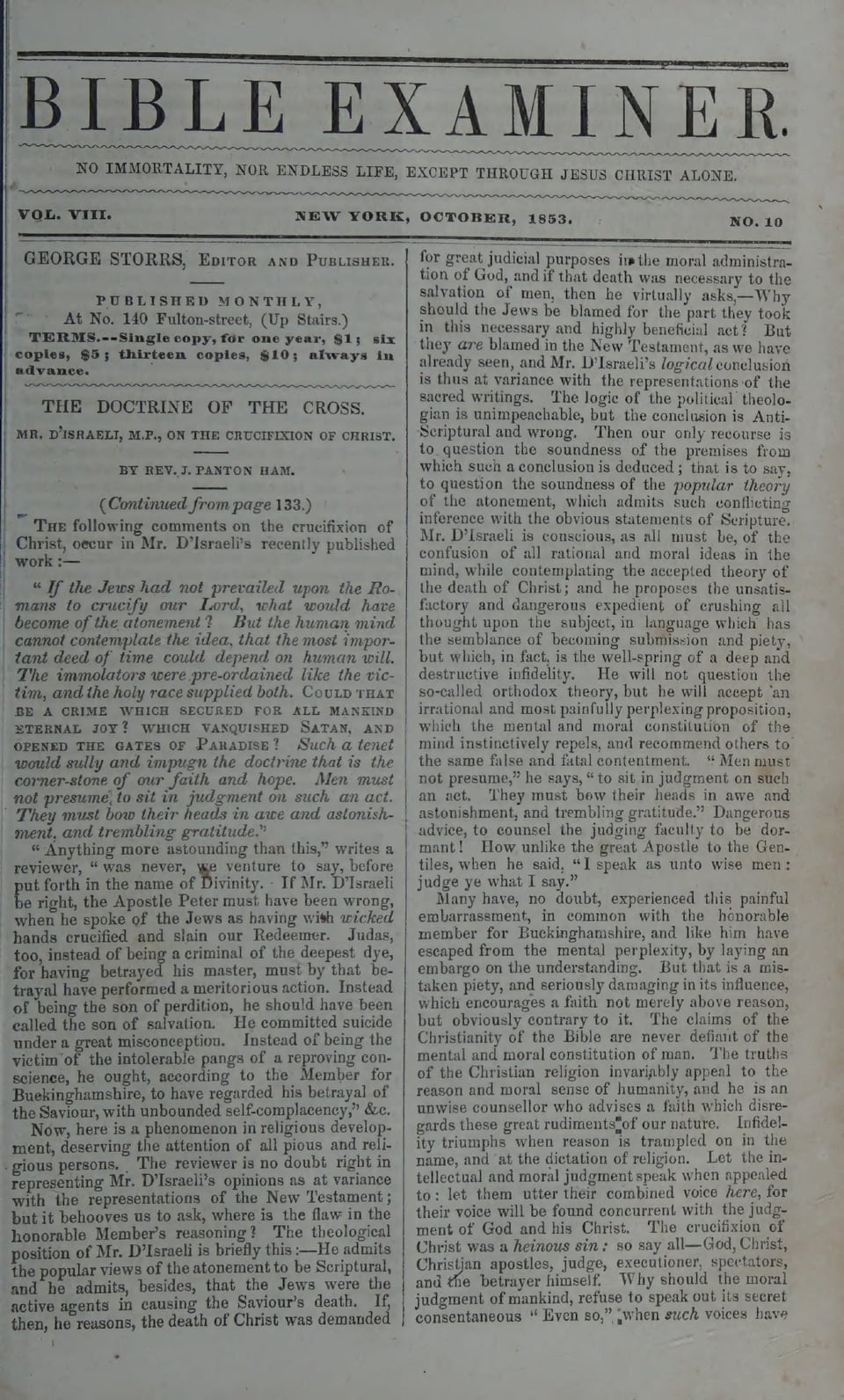
BIBLE EXAMINER.
NO IMMORTALITY, NOR ENDLESS LIFE, EXCEPT THROUGH JESUS CHRIST ALONE.
VOL. VIII.
NEW YORK, OCTOBER, 1853.
GEORGE STORRS, EDITOR AND PUBLISHER.
NO.10
TERMS.--Single copy, for one year, 1; six copies, 5; thirteen copies, $10; always in advance.
THE DOCTRINE OF THE CROSS.
MR. D'ISRAELI, M.P., ON THE CRUCIFIXION OF CHRIST.
BY REV. J. PANTON HAM.
(Continued from page 133.)
The following comments on the crucifixion of Christ, occur in Mr. D'Israeli's recently published work :—
"If the Jews had not prevailed upon the Romans to crucify our Lord, what would have become of the atonement? But the human mind cannot contemplate the idea, that the most important deed of time could depend on human will. The immolators were pre-ordained like the victim, and the holy race supplied both. COULD THAT BE A CRIME WHICH SECURED FOR ALL MANKIND ETERNAL JOY? WHICH VANQUISHED SATAN, AND OPENED THE GATES OF PARADISE? Such a tenet would sully and impugn the doctrine that is the corner-stone of our faith and hope. Men must not presume to sit in judgment on such an act. They must bow their heads in awe and astonishment, and trembling gratitude."
"Anything more astounding than this," writes a reviewer, "was never, we venture to say, before put forth in the name of Divinity. If Mr. D'Israeli be right, the Apostle Peter must have been wrong, when he spoke of the Jews as having with wicked hands crucified and slain our Redeemer. Judas, too, instead of being a criminal of the deepest dye, for having betrayed his master, must by that betrayal have performed a meritorious action. Instead of being the son of perdition, he should have been called the son of salvation. He committed suicide under a great misconception. Instead of being the victim of the intolerable pangs of a reproving conscience, he ought, according to the Member for Buekinghamshire, to have regarded his betrayal of the Saviour, with unbounded self-complacency," &c.
Now, here is a phenomenon in religious development, deserving the attention of all pious and religious persons. The reviewer is no doubt right in representing Mr. D'Israeli's opinions as at variance with the representations of the New Testament; but it behooves us to ask, where is the flaw in the honorable Member's reasoning? The theological position of Mr. D'Israeli is briefly this:—He admits the popular views of the atonement to be Scriptural, and he admits, besides, that the Jews were the active agents in causing the Saviour's death. If, then, he reasons, the death of Christ was demanded
for great judicial purposes in the moral administration of God, and if that death was necessary to the salvation of men, then he virtually asks,—Why should the Jews be blamed for the part they took in this necessary and highly beneficial act? But they are blamed in the New Testament, as we have already seen, and Mr. D'Israeli's logical conclusion is thus at variance with the representations of the sacred writings. The logic of the political theologian is unimpeachable, but the conclusion is Anti-Scriptural and wrong. Then our only recourse is to question the soundness of the premises from which such a conclusion is deduced; that is to say, to question the soundness of the popular theory of the atonement, which admits such conflicting inference with the obvious statements of Scripture. Mr. D'Israeli is conscious, as all must be, of the confusion of all rational and moral ideas in the mind, while contemplating the accepted theory of the death of Christ; and he proposes the unsatisfactory and dangerous expedient of crushing all thought upon the subject, in language which has the semblance of becoming submission and piety, but which, in fact, is the well-spring of a deep and destructive infidelity. He will not question the so-called orthodox theory, but he will accept an irrational and most painfully perplexing proposition, which the mental and moral constitution of the mind instinctively repels, and recommend others to the same false and fatal contentment. "Men must not presume," he says, "to sit in judgment on such an act. They must bow their heads in awe and astonishment, and trembling gratitude." Dangerous advice, to counsel the judging faculty to be dormant! How unlike the great Apostle to the Gentiles, when he said, "I speak as unto wise men: judge ye what I say."
Many have, no doubt, experienced this painful embarrassment, in common with the honorable member for Buckinghamshire, and like him have escaped from the mental perplexity, by laying an embargo on the understanding. But that is a mistaken piety, and seriously damaging in its influence, which encourages a faith not merely above reason, but obviously contrary to it. The claims of the Christianity of the Bible are never defiant of the mental and moral constitution of man. The truths of the Christian religion invariably appeal to the reason and moral sense of humanity, and he is an unwise counsellor who advises a faith which disregards these great rudiments of our nature. Infidelity triumphs when reason is trampled on in the name, and at the dictation of religion. Let the intellectual and moral judgment speak when appealed to: let them utter their combined voice here, for their voice will be found concurrent with the judgment of God and his Christ. The crucifixion of Christ was a heinous sin: so say all—God, Christ, Christian apostles, judge, executioner, spectators, and the betrayer himself. Why should the moral judgment of mankind, refuse to speak out its secret consentaneous "Even so," when such voices have already spoken?
The Bible never represents the crucifixion of Christ, as subserving any great judicial purpose in the moral administration of God over his creatures, but always points to it as the evidence of a culminating depravity, and high hostility to the holy Majesty of heaven. Why should not the human reason—why should not the moral sense of mankind record their united judgment, for they utter the same voice? Say not, ye priests of a popular prejudice, that we must hush this voice within; for that were to stifle the ready response of a religious faith, inasmuch as there is no true faith where there is no reason. An irrational religion must be as hateful to God as it is dishonorable and dangerous to men. Ye are plotting against the faith, trampling out the embers of an already expiring piety, and aiding to spread over the land the black pall of a deadly infidelity, when ye so preach. Christianity respects the human constitution—intellectual and moral—it is framed with a regard to this constitution, and will ye seek to destroy the radical elements of this constitution? In so doing, ye pluck out the eye and cut out the tongue of man's intellectual and moral nature. He is left by you with neither a moral percipient, nor a tasting faculty. He is blind, and cannot henceforth see; he has no palate for the great principles of piety, and he is driven by necessity to a moral life, where all is dark and vapid; he hurries to the dreariness and desolation of infidelity, and ye have preached him thither! Yes, ye priestly revilers of reason, ye have preached him thither; for men will think, must think, and ye forbid them to think. Men will worship with the understanding as well as with the heart, and ye forbid them so to worship. Ye virtually tell them that the God ye serve demands reasonless worshippers, and they stop not, alas! to ask if ye malign the God ye worship, but turn away altogether from God, whom ye have taught them to regard as the enemy of free thought and speech. Much of infidelity is the product of your preaching, ye priests! Ye have scattered the flock by your doctrines, and think ye have all the while been doing God service!
THE LOGIC OF FACTS.
We have appealed to the facts recorded in the evangelical narratives, with the view of furnishing the true Scriptural reply to the question we have raised, How came the Cross, that instrument of ignominy and death, to be identified with the history of the Holy Son of God? But although much light has been cast upon the subject by the ambiguous evidence of these facts, it is capable of yet further elucidation, and to this additional evidence we now turn.
Allusion has already been made to the parable of the wicked husbandmen, for the purpose of showing that, in the judgment of the Almighty Father, and of Jesus himself, the crucifixion was the highest expression of human wickedness; and that so far from its being demanded by God for any purpose connected with his own righteous government of his creatures, it was regarded by him as a new and most heinous resistance of his government, deserving a very severe and summary punishment. So far from the crucifixion making the forgiveness of sins possible, it was the addition of another and the greatest of all sins, to the already mighty catalogue of human guilt, needing itself to be forgiven by the infinite clemency of God. So Christ viewed
it in his parable, and so he evidently considered on the cross, when he lifted up his benignant and forgiving voice to his Father, and prayed him to be merciful towards his murderers :—"Father, forgive them for they know not what they do." To the parable of the wicked husbandmen we again turn, for it contains some further explanation of the circumstances which led to our Lord's rejection and crucifixion by the Jews.
This parable, we are informed, was directed against the Chief Priests and Scribes of Israel, and that these Jewish dignitaries saw this: "they perceived that he had spoken this parable against them." And why against them? Obviously because they had a chief part in putting Christ to death. They were the "husbandmen" whom the Lord describes as saying, at the sight of their lord's son, "This is the heir, come let us kill him, that the inheritance may be ours." Here Christ plainly speaks out the motive which induced the spiritual chiefs of Israel to imbrue their hands in his blood. He was the "heir," the heir of "an inheritance." He was not tolerated by these priestly magnates, because his principles clashed with certain priestly "interests." His preaching spoilt the priestly profession. "If we let him alone," said the orthodox priesthood, "all men will believe on him;" which was tantamount to their saying, "All men will cease to believe on us." The church was in danger. The loaves and fishes were in danger. The uppermost seats in the synagogue, and greetings in the market-places, were in danger. Their professional distinction as Rabbis—the Reverends and Right Reverends of the people—their "livings," as the tithe-appropriators and consumers, were jeopardized by the new Reformer of Galilee. Our "inheritance" will be gone, said they, "if we will let him alone." He, this upstart son of the common people, will be the "heir" of the people's confidence and the honor of the people's hearts; "this is the heir, come let us kill him, that the inheritance may be ours."
Here, then, is the proximate cause of Christ's death on the cross revealed by the Lord Jesus himself. That awfully wicked event was accomplished by the priests and rulers of the people, who were instigated thereto by Satanic selfishness, the lust of priestly domination, place, pecuniary profit, and social preferment. The popular violence against Christ was fomented by the priesthood, under the influence of a sordid rapacity. The "inheritance," that was what they cared for:—"Come let us kill him, that the inheritance may be ours." An answer, if not all the answer, is by this parable clearly given to the question we have asked. How came the Cross to be a part of the history of the Lord Jesus Christ? The mission of Christ clashed directly with the profits of a professional priesthood —damaged and threatened to totally alienate the priestly "inheritance." It had no respect for the "vested interests" of priestcraft. It was working too radical a reformation—unmasking too ruthlessly hypocritical sanctimony—tearing away too roughly the purple and fine linen of a well-beneficed clergy. Christ was too holy, too truthful to be tolerated by the priests of Israel; and they put him to death because they could not, and would not, endure him.
The history of the crucifixion thus far presented, is derived from the plain records of the Evangelists. The facts are potent and undisputed. Whoever may disagree with this historical sketch, must find his justification, not in the statement of the facts, but in the view which we take of these facts.
Here is the point of divergence where we part company with the conventionally styled "orthodox." His theory or explanation of these facts is altogether different from our own. He, as well as ourselves, accept the facts, but not the same inferences from these facts which we are constrained to draw. It should be well observed that our "orthodox" opponent has no Scriptural authority for his deductions. Neither the Old nor the New Testament expresses formally his speculative view of the Cross—there lie the facts, but nowhere, that doctrinal scheme which he accepts as the true theory of these facts. The Bible nowhere says that Christ was punished for our sins—that he endured, as a substitute for mankind, the infinite wrath of God—that he gave to Divine justice a full and complete satisfaction for the sins of the world—that his merits are placed to the believer's account, which he appropriates by believing that they are thus appropriable, and which constitute the moral ground of his personal acceptance with God. Nowhere, we repeat, are such doctrines contained in the sacred Scriptures. They are mere speculations of theologians, old and "orthodox," but not Scriptural. The phraseology of these popular doctrines is quite foreign to the Bible—the terms in which they are expressed, are never met with there.
Now, the faith of the larger proportion of the professing church, is cheated into the acknowledgment of these speculative doctrines, by the assurance that they express the true Scriptural idea of the Christian Atonement. To deny these theories is always declared to be the denial of the atonement. Anything more palpably illogical and unjust is scarcely conceivable. We do not deny—God forbid!—that the Scriptures reveal a doctrine of atonement; what we deny is, that the popular and so-called "orthodox" notions are the true exposition of the Scriptural atonement. To deny a particular theory of atonement, may surely be a very different thing from the denial of the atonement itself. If that theory be the true theory, then to deny it, is virtually to deny the atonement. But it makes strongly against the probability of the truth of the popular theory, that its distinctive propositions, even its terminology, cannot be found in the sacred volume, while at the same time, a large body of facts there are absolutely irreconcilable with it. It cannot fail to strike every reflecting mind as singularly strange, that the terms which the popular churches are constrained to make use of in the expression of their theory of the death of Christ, have no place in the Bible. The churches, even the Protestant churches, are so sensibly alive to this fact, that they dare not trust the Bible any more than the Romanists, without the accompaniment of notes and comments, Catechisms, and Articles of Faith, either expressed or understood.
These express the popular faith "in the words which man's wisdom teacheth,"—the words "which the Holy Ghost teacheth" are not found sufficiently clear and definite for the creed-instilling purpose. Now, we cannot express our theory of the death of Christ in more appropriate and definite language than the language of Scripture; and if we put our ideas into other language, it is merely
to indicate our theory, which would be less likely to be understood if we employed Scripture language, because of the conventional meaning which the prevalence of the popular theology has succeeded in attaching to that language. Our theory does not need the popular expiation-satisfaction-vicarious sacrifice-the sinner's substitute-imputed merits-faith in the merits of Christ-imputed righteousness, and others which might be named; we can do without them—we should rather say, we cannot do with them; and it is very satisfactory, at least to ourselves, that the Bible can, and does, dispense with them also.
We have said that a considerable number of facts connected with the tragedy of the crucifixion cannot be made to consist with the popular theory of the death of Christ. If we must accept both, we are constrained, by the stern logic of common sense, to infer the most astounding and even impious conclusions. This must be apparent. For example:
It is affirmed that the death of the Lord Jesus Christ gave to God a satisfaction for sins.
Then it follows, in the view of the facts which have come under our consideration, that as Satan was the prime instigator of that deed, Satan must hare given the satisfaction.
It is maintained that the justice of God was maintained and magnified by the death of the Lord Jesus Christ.
Then it follows, from the New Testament representations of the causes of Christ's death, that God's justice was maintained and magnified by the highest injustice and wickedness of men!
It is affirmed that the death of Christ cleansed judicially the world's guilt, and is the reason why God forgives sin.
Then it follows, from the Scriptural history of the Cross, that the world's guilt was purified by the foulest guilt which the world ever perpetrated ; and that the greatest sin which was ever committed is the reasonable cause why God should forgive all other sins !
Marvellous conclusions! strangely at variance with every moral sentiment of our bosoms: but yet sternly and logically true, if we must accept the popular and so-called "orthodox" theory, along with the representations which the New Testament gives of the death of Christ—representations which most evidently set forth that solemn event as an unprecedented act of wickedness—the joint accomplishment of the arch-spirit of evil, and the apostate sons of men.
We are aware that in thus following our subject to legitimate issues, we are stepping beyond the limits of that liberty which orthodoxy licenses. Popular Christianity prohibits reasoning, unless it consents to revolve in its own recognized circle. In bar of any hostile conclusions, though never so logical, it steps in and demurely deprecates the "pride of reason," "leaning to one's own understanding," and so forth. Although itself abounding in argumentation of a kind, even sinking under the oppressive weight of its many speculations, it lifts up itself in angry impatience, and denounces, in true sacerdotal style, all logic but its own. We hear the protest from many a popular pulpit and priest-ridden people—already the thunder-tones of an intolerant orthodoxy fall on our ears, telling us that our reason is rebellion—that our logic is the veriest licentiousness—a lever lent us by the powers of darkness to do a work worthy of the arch-demon himself.
But wrath and raillery are not reason. Hard names and withering denunciations do not necessarily come from the "heavenly places." Abuse is not argument; and condemnations may come from other than Christian lips. Such have always been the ill-deserts of those who will dare to confront favorite theories with the facts and principles of the Bible; and we hope for grace and patience to enable us to bear our part of the great penalty which all truth-witnesses in this world must calculate on. "The servant is not greater than his lord." This hackneyed habit of deprecating and denouncing reasoning is only indulged in when reasoning resists the popular conclusions. It is only hostile reasoning that is heretical. Reason may run riot, if she will consent to be reeled at last into the place that orthodoxy has assigned her; but if clear-sighted, calm and Christian, she will obey only her own higher dictate—then even the religious will unite with the rabble to rail at her integrity. You must not reason at all, say some. You may reason, say others, if you will consent to do so by our religious rule. We have abundant illustrations of this last class, in the history of sectarian intolerance, and the odium theologicum of religious controversy; and the political theologian before alluded to, is an example of the former. A curious example, too; for while he tells us that "we must not presume to sit in judgment on such an act" as the crucifixion of our Lord, he himself presumes to do this very thing, and asks, with singular inconsistency, the question, "Could that be a crime which secured for all mankind eternal joy?"—a question, be it observed, arising out of his own logical conclusion from the premises which, in common with the so-called orthodox, he accepts as Scripturally true. The obvious truth is, that men will and must reason—that their Creator has constituted them reflective and rational beings, and bidden them, by the necessity of their constitution, to exercise their reasoning faculties. And we may be sure, that that is not the true, but a false religion, which rebukes the exercise of reason, and treats it as a renegade and enemy to the truth. Truth ever assumes the dignified attitude of the great Apostle to the Gentiles, and says with him, "I speak as unto wise men, judge ye what I say." If the judgments of men differ in reference to any principle, or fact—if the individual reason of two or more men, guided by a profound reverence for the revelations of the Bible, shall constrain contrary conclusions, then it is both wise and Christian to compare notes—not to curse and condemn one another. A candid comparison of premises will often lead to the detection of the causes of difference, and secure ultimately a common consent. The conclusion of Mr. D'Israeli differs from our own. There is no fault in his logic, any more than we believe there is no fault in our own. But our premises differ. He accepts the popular or "orthodox" opinions concerning the death of Christ. He believes that the Almighty Father required that Jesus should suffer as he did, on the cross, for great purposes connected with his moral government of his creatures, as well as for the sake of enabling him to be gracious to them, consistently with certain supposed perfections. Believing this, he naturally reasons that the Jews were doing a necessary, honorable, and highly beneficial work in putting Jesus to death; and therefore he asks—"Could that be a crime which
secured for all mankind eternal joy?" &c. He does not appear to be mindful of the moral light in which the sacred writers have exhibited the conduct of the Jews in crucifying Christ. With them he appears unconsciously to differ. They, as we have seen, denounce it as the climax of all crime. All believers in the Bible will readily allow, with his reviewer, that Mr. D'Israeli must be wrong in his conclusions. Would that they saw the real ground of his serious mistake! His reasoning is right, but his religion is wrong. God did not require the crucifixion of his Son. His government was not supported and strengthened, but set at naught, by that act of the Jews. God did not need that the people of Israel should commit another and greater crime, in order that he might forgive them their previous crimes, and furnish a moral justification for the forgiveness of the crimes of all mankind. These and their kindred dogmas belong to the corrupted Christianity of the churches, not to the genuine Christianity of the New-Testament. Mr. D'Israeli believes them, however, hence he is logically led into a great error. The popular and self-styled orthodox churches, believe with Mr. D'Israeli, but with less candor or courage than he, they rein in their reason; or else, pained and perplexed by their reflections, seek refuge in that ignoble and dangerous recommendation,—"Men must not presume to sit in judgment on such an act. They must bow their heads in awe and astonishment, and trembling gratitude." False and fatal submission! but a seeming sanctity, which in reality is an act of suicide—a laying violent hands on one's own mental and moral constitution. The unnatural tyranny, if portable, must involve serious loss. If, as is often the case, it proves insupportable, and the laws of the intellectual and moral being will assert their resisted but rightful sway, then the recoil is commonly a precipitation of the violated manhood, into the deep dreary gulf of a hopeless infidelity. God and his Christ are dishonored by both results—for an irrational reverence, as well as a blind infidelity, must be alike offensive to him who asks from all his intelligent creatures the undivided homage of the understanding and the heart.
HUMAN MATERIALISM.
WHAT THINKS?
"It has appeared to us, that the very-first axiom of our science (Phrenology) is erroneous. 'The brain is the organ of the mind.' Mr. Combe states 'We do not in this life know mind as one entity and body as another, but we are acquainted only with the compound existence of mind and body, which act constantly together, and are so intimately connected, that every state of the mind involves a corresponding state of corporeal organs, and every state of those organs involves a certain condition of the mind.'
A similar doctrine we shall find inculcated by almost all writers on Cerebral Physiology.
This is mere assumption. We boast that our science is purely inductive, and yet In the enumeration of our axioms, we assume a position all our facts tend to disprove. To evade the charge of materialism, we content ourselves with stating that the immaterial makes use of the material to show forth its powers.
What is the result of this? We have the man of theory and believer in spiritualism, quarreling with the man of fact, and supporter of material doctrines. We have two parties: the one asserting that man possesses a spirit superadded to, but not inherent in brain—added to it, yet having no connection with it—producing material changes, yet immaterial—destitute of any of the known qualities of matter—in fact, an immaterial something, which in one word signifies nothing, producing all the cerebral functions of man, yet not localized, not susceptible of proof; the other party contending that the belief in spiritualism fetters and ties down physiological investigation—that man's intellect is prostrated by the domination of metaphysical speculation—that we have no evidence of the existence of an essence, and that organized matter is all that is requisite to produce the multitudinous manifestations of human and brute cerebration.—pp. 293, 294.
Almost all physiologists commence their investigations with an unfavorable bias. How is this? Because they first adopt a theory, and then commence their investigations; instead of first taking a wide and extended view of human and comparative physiology, apart from preconceived opinions; because in their infancy they were taught that man's position depended on the possession of some essence; and in their manhood, that intellect which should investigate the grounds for such a belief, is cabin'd, cribb'd, confin'd, by the apparent necessity for such a speculation. Is it necessary to prove this? Consult physiological writers, and we find they are perfectly satisfied that the seat of mental operation is the brain, and no other organ; yet they contend that nothing more has been proved than this—that the brain, by its peculiar organism, is the instrument by which the mind acts. They introduce us to a phantom—they call forth a spirit, and without the shadow of a proof, state, it guards, governs, and directs material movements.—pp. 294, 295.
The 'why or how' such a form of matter (brain) is capable of manifesting such peculiar functions, we cannot explain: it is sufficient for our purpose to decide that it does so—we may never go further. Does any one doubt the power of matter to do this? (to evolve feeling, intelligence, &c.) To such an one we would say, who dares assign limits to the inherent powers of matter? Let us first find out all that matter can do, before we dogmatize and assert what it cannot do. p. 295.
We would ask those who are still doubtful, whether by means of intellect they gain a knowledge of the existence of anything independent of matter? We would ask them whether they can picture to the imagination 'the mind' of man apart from the organism composing man? If they cannot do this, we say, why make man an exception to the invariable law of nature? Why, in ascending link by link, the chain of organic life, add an indefinable something to the last link, which it was found unnecessary to call to our aid in the preceding? Witness the unrelenting and savage cruelty of one tribe; the fidelity and tameness of another; the sagacity, gentleness, and intellectual manifestations of a third; contrast all these with the characteristics of man, and explain, if possible, why we have recourse to theory? Why, in jumping from the sagacious monkey to man, are we to have recourse to the stimulus of an essence for explaining the
superior cerebration he manifests? Why not give a portion of this or some similar essence to the monkey, because his cerebration is superior to the sheep's or goat's? Nay, why not allow a minute portion of some more impoverished essence to the fish, which obeys the call of its feeder, and swims to the required spot for its daily nourishment? If this be ridiculous—if no addition be requisite to account for the improved cerebration of inferior beings—why, without the slightest evidence, are we to suppose that a higher order of cerebration in man cannot be manifested without such an addition?
It is this conjectural doctrine--this belief in the individual and indivisible essence of mind--this love of the marvellous--this thirsting after something mysterious--which is retarding the progress of cerebral physiology, and in the same ratio, the happiness of man. It is this clinging to old opinions--this disinclination to shake off old garments, which is the cause of so much doubt concerning a question so self-evident. We oppose this system by the antagonism of Reason and Nature. It is impossible any longer to countenance the opinion. It must be rooted up. It is like a malignant disease: which can only be cured by extermination. Let it be boldly affirmed, because it is true, that as philosophers we have to deal simply and exclusively with matter. Man neither possesses, nor does he need the possession of any other stimulus than which is given to the simplest of organized beings; to the highest and most complicated, there is nothing more than a gradual addition of parts, accompanied by concentration. pp. 297, 298.
The brain of the most profound philosopher—the brains of Bacon and Newton—of Shakspeare and Byron, during their formation, assumed for a short time the peculiar form of the same organ in inferior beings."—Dr. Engledue, in Phrenological Journal, Vol. 5, New Series, pp. 300, 301.
MATERIALISM.
"Some men noted for acuteness and talent, have affirmed, that what is called mind is not an immaterial principle, but that its manifestations are the result of a peculiar combination of material substances endowed with what is called life, which also they have said, results from certain material influence. Such an announcement instantly brings down upon the devoted head, the execrations of religious feeling, and the thunders of the church; the unfortunate philosopher is denounced as a heathen, an infidel, and so forth. Now, I would have you reflect in this manner, believing you to be a Christian; Jesus Christ himself never uttered a reproachful word. He exhorted his followers not to rail at their neighbors, even though they should rail at them. He denounced and reproached hypocrisy, but never the expression of a mere opinion. He strove to reclaim men from the errors of their ways, and knew well that reviling was not the way to effect that important end. If, then, any one should broach to you the opinion (for it is no more) that mind is nothing but a modification of matter, put the question, what is matter, a modification you speak of? The instant this question is pronounced, you perceive the utter impossibility of answering it. All the multitudes of chemical discoveries have not yet opened, even to imagination, a hope that what matter is can ever be known to man.
We may feel an eagerness to dive into the mysteries of creation; but we may rest assured that whatever power is denied to us, is denied to us because it is for our good.
Now, we are altogether ignorant of what mind may be, as well as matter; and the materialist could equally puzzle us by putting the question, what is mind? It is inferred, but erroneously, that if the opinion of the materialist be correct, it would impugn the doctrine of the immortality of the soul. I say erroneously, because it is obvious that nothing is impossible to God. If it has pleased Him to form body and soul of what we call by the imaginary term matter, what is that to us? He made both soul and body, and he can destroy them both. He can kill and make alive again; and this whether the materialist be right or wrong in his conjecture. Although the body is formed to die: although we should even suppose the soul dies with it, though they may be reduced to dust, or dispersed into dust, or dispersed in smoke, who will dare say that the power of God cannot reunite them at his own good pleasure, and not only restore their former union, but improve their nature, so that while the condition of former existence is not forgotten, they shall be fitted for that new sphere of enjoyment reserved for the just when made perfect? Thus we perceive that the opinion of the materialist is of no consequence whatever. But suppose that a man's mind shall be in such a condition, as to give such an opinion the hold of belief. Suppose that this belief should lead to the idea that death is annihilation; we ought not to use harsh expressions or severity against him who may be so unhappy as to be reduced to such a state of mind. It is more fitting that Christians should mildly exert themselves to convince him of error, than violently to abuse him, and treat him as an outcast. Any man or set of men holding certain opinions contrary to our own, can inflict no injury upon us. If we should feel offended, and desire to wreak vengeance on our brother, who differs from us in opinion, we are guilty of abusing our faculties, as I propose afterwards to point out, when submitting to you what may be called their legitimate and illegitimate exercise. If one man has a right to judge and form an opinion, every other man has the same undoubted right."—Sir George Mackenzie's "Observations on the Principles of Education." 1836.
LONGING AFTER IMMORTALITY.
The fact that the most of men have a disinclination to fall back into the non-being whence they came, and an anxiety to live forever, is considered, in many quarters, proof positive that the Creator has determined they shall exist on like himself, through the cyles of eternity. The following is the shape in which this argument lately met our eye: "The longing after immortality which is born with us, would seem to be the prophecy and assurance of our deathlessness, the foreshadowing of the soul's prolonged and indefinite continuance, the revelation of its triumph over the change which wears the semblance of destruction." And thus philosophers and poets have triumphantly asked—If man is not the heir of everlasting existence—
"Whence this pleasing hope, this fond desire.
Whatever value such reasoning may possess, as
regards eloquence and poetry, it is, we apprehend, strikingly deficient as an argument when put to the test of sound logic and common sense. It is founded on the assumption that all men are what they wish to be, or that they will ultimately obtain what they desire to possess—an assumption so obviously false, that a moment's reflection must discover its absurdity. As a general rule, young men desire to arrive at a good old age, yet how many of them are laid prostrate in the dust, ere they reach the meridian of life!
Moreover, the object of this general desire is not immortality simply, or endlessness of being, considered by itself, but an immortality conjoined with happiness. So that the argument, therefore, if sound, would not only prove all men, independent of their character, to be immortal, it would also demonstrate them to be equally the heirs of perpetual bliss—a conclusion, we presume, which few who employ the argument in question, are prepared to accept.
Still the inquiry presents itself—"Why has God implanted in man this strong desire for everlasting being?" "Whence this natural aversion from nonexistence?" At unaided reason we might long ask the question in vain; the Bible alone can return a satisfactory reply. That oracle discloses to us the glorious fact, that the beneficent Creator has placed before men the transcendent prize of immortal being, associated with "glory, honor, and peace," and suspended its final reception on the possession of faith in Christ, and a life of obedience to His will in this stage of existence. It seems wise, then, to declare our Heavenly Father has kindled "this longing after immortality" within us, to excite us to such a course of conduct as shall secure that inestimable blessing, which he so kindly desires to bestow. Here we find the blessed Lord commanding the Jews to "labor, not for the meat that perisheth, but for that which endures unto everlasting life;" hence, also, we read, in Romans 2:7, of those who "by patient continuance in well-doing, sought for glory, and honor, and immortality." Our "longing after immortality," therefore, is to be regarded as no proof that we shall live forever; it is, however, another evidence of the goodness of God,—of his intense desire that we should become the heirs of eternal being.
"If ye live after the flesh, ye shall die; but if, through the Spirit, ye do mortify the deeds of the body, ye shall live."—Expositor of Life and Immortality.
SPIRIT RAPPING.—We are indebted to Dr. Lees of England, for the following item:
Mr. G. E. Lewes has published an amusing account of a seance with the "rapping" lady now in London, in the course of which the "spirits" were entrapped into saying that the ghost of Hamlet's father and Semiramis, had seventeen noses; that Pontius Pilate was a leading tragedian, and that one of the Eumenides died six years ago, aged twenty-five, leaving six children! Indeed, the only correct reply received, was one which declared the "Medium" to be an impostor! Mr. Lewes' hypothesis is, that the Medium guesses according to the indications the experimentalizer gives, and only guesses right when you give right indications.
Dr. Lees, of England, called at our office in our absence West. We felt a deep disappointment in not seeing him, and hope he will favor us with a visit before his return to England. We would drop him a line, if we knew where it would find him.
The following notice from the English "Journal of Sacred Literature Advertizer," he left at our office, and we give it a place in the Examiner as an interesting item of information:
PUBLISHED BY W. E. PAINTER, 342 STRAND; Second Edition, enlarged, 3 vols., cloth 24s.: FABER'S SACRED CALENDAR OF PROPHECY. By the Ren. G. Stanley Faber, B. D., Sherburn Hospital.
The anticipation of the revival of the French Emperorship, originally made from facts combined with chronology in 1818, and repeated in 1828 and 1844, pervades the whole of the Sacred Calendar, and confirms the correctness of Mr. Faber's views.
To the Publisher :
"SIR-I cannot help thinking that the circulation of the cheap edition of Mr. Stanley Faber's Sacred Calendar of Prophecy, published by you in 1844, would be very considerably extended, if, in connection with it, the attention of the public were directed to the recent extraordinary events in France. The portion of the work to which I specially refer is that contained in vol.3,p.102-130.
"All the six first heads of the symbolical Roman Wild Beast having fallen, as history attests, in the year 1806, Mr. Faber stated in his Sacred Calendar more than twenty years ago, when it was originally published, and again in its republication by yourself in the year 1844, that the rise of the seventh head must be looked for, either in the year 1806 or very shortly before it. On this principle of interpreting prophecy through the testimony of history, Mr. Faber pronounced that the Franco-Roman Emperorship, or the Emperorship of the French, must inevitably be the predicted seventh head of the great Roman symbol. Nor was his opinion built upon the necessity of historical chronology alone, it was also built upon circumstantial evidence.
"The characteristics of the seventh head are three:—1. Shortness of continuance. 2. Death by the sword of violence. And 3. Subsequent revival or restoration to political life. The two first of these characteristics had been fulfilled when Mr. Faber wrote—namely, shortness of continuance, to wit, only eleven years, from A.D.1804,to A.D.,1815; and political death by the sword in the latter of these years at Waterloo.
"The third characteristic was not then fulfilled. Mr. Faber could only, if his premises were just, expect its fulfilment. This he certainly did, as he made no scruple of declaring, in the year 1827, or twenty-five years ago, and again in the year 1844, or eight years ago.
But it is pretty evident that this third characteristic is even now in the progress of fulfilment : for, though the style of Emperor of the French and King of Rome, has not yet been formally adopted, the substance of Empire is now possessed, and in all human probability the style will shortly follow.
"It is a matter of great political importance when viewed in the light of prophecy. Under the revived seventh head, the divided Roman Empire, we are
told, will go into perdition, or will be utterly destroyed; and the prophetic time assigned for this destruction is the close of the period of 1260 years. That period commenced, as there is reason to believe, A.D., 604-606. Therefore, on such a supposition, it will expire A.D., 1864-1866.
"Should the present revolution in France go on to the assumption of the French Emperorship of the first Napoleon, Mr. Faber's interpretation will be established by something not far short of mathematical demonstration.—An Observer of the Times."
FROM DR. WM.K.EVERSON.
Springboro, Ohio.
Br. Storrs:—I bless God and feel glad that you attended that Convention at Hartford. The result, as far as you have reported it, encourages my soul, for when I beheld the bold front of Infidelity, and examined its apparent proportions, and the depth of its influence through Spirit Manifestations, and beheld the flimsy character of the material with which the church proposes to build a barrier against it, I must say, I feared the result to the Bible, with many. Not that its truths would be impaired thereby, but that the minds of many would be darkened by the striking coincidence of opinion on many subjects, held by Churchmen and Infidels; and that if the former be true, then the latter have the pith of the argument against the Churchmen, and the Bible suffers as a consequence of false constructions and false admissions; but now that Convention has resulted in good, I know, and feel thankful for the fact.
I am called an infidel, here, by nominal professors who think to hide their own deformity by calling attention to me—like Alcibiades, who cut off his dog's tail and sent him howling through the streets, to divert public attention from himself—when, in fact, it is an almost daily business with me to argue for and defend the Bible, in all public or private places, against professed infidels, (and we have some of a very intelligent kind here,) while Churchmen skulk away, or stand and hear their Bible defamed, its truths scandalized, and their God blasphemed, without one reproof of any kind, like dumb dogs. "Nero fiddled while Rome fell;" and Napoleon ordered the gilding of the domes of Paris, that his inglorious defeat might be lost sight of, while the citizens were gazing upon the false splendor he had created; but history notes facts, and the future reveals judgment.
AN AGED BELIEVER.—The writer of the following note is an old Methodist, and till recently, has lived in the belief of the immortal soul theory: but now his eyes and heart are open to the truth. We suppress his name and residence, as he did not expect his note to be made public, we presume. He says:
"I put a $20 bill in this letter, to help you in publishing the good word of Eternal Life, in and through the merits of Jesus Christ. I wish for eternal life in and through his merits. I am now more than ninety years old. I was born June 7th, 1763, and now live near D C. I take the Bible Examiner with him. I know according to nature, I cannot live here much longer.
I think that when I die, after death I shall not know any more than I did before I existed, until the Resurrection, if it should be a million of years. I think that time would be no longer to me, than it would to any one that will die but one minute before the resurrection. I am yours, respectfully."
May God bless and keep thee, dear old pilgrim, to Life Eternal, through His Son Jesus Christ, our Lord and Life-Giver. Soon will Jesus return from heaven to change our vile body: then may you have a part in the glory.
BIBLE EXAMINER.
NEW YORK, OCTOBER, 1853.
BIBLE EXAMINER.—Two numbers more complete the present volume. By this time, in our history, we presume it is understood that we act on the principle of "payment always in advance:" hence, when the volume ends, for which payment is made, our rule is to discontinue sending to those who have not paid in advance for the next volume. This rule is adhered to except in rare instances; and no one should expect they are among these exceptions unless they have specially communicated with us on the subject. Our course in this respect saves us disappointment, and our patrons the mortification of a dun, which is never pleasant.
Shall the Examiner be published twice each month the coming year? This question must be answered by our friends. If one thousand dollars are paid for that object by the 25th of December, we shall go forward with it twice each month, without increasing the present price of the paper. This sum can be raised if each of our present subscribers will pay their dollar and give us half as many more. To make sure the work, let each subscriber try to send us one new one, with his own subscription, and we think the work will be done. Those who pay one dollar for the next volume, before Dec. 25th, if we do not go on twice a month next year we will send them one copy of the new work by Br. Blain — "Death not Life"—without charge; they paying the postage on it. The general character and object of the Examiner will not be changed; but none need expect we shall surrender our independence, as an editor, to please any one, or to get or keep subscribers. We are neither anxious to continue an editor nor to have "popularity." We are quite certain we have been influenced by no such motives heretofore. If we have any notoriety hitherto, we have not sought it; but we have striven to do what we believed faithfulness to God and his truth required of us. If it please God we go into
obscurity, we shall cheerfully retire; but we intend, through grace, it shall not be for unchristian conduct and uncharitableness on our part. He who cannot as cheerfully be sacrificed for the truth's sake as honored and promoted, is not worthy to be an instrument in the cause of truth. Be it as it may, we will not surrender our independence to any man or body of men. The freedom of thought, and expression of thought, we will maintain for ourselves and concede to others. In love we hope ever to express ourself, and we ask others to do the same to us. Sectarian exclusiveness we abhor; and that is such exclusiveness which makes a matter of opinion a ground of Christian love. The Examiner cannot be prostituted to any such course while we have the same convictions of Christian charity that we now possess. We are not indifferent as to what opinions are held by our fellow-christians; yet we do not feel called upon to fall upon every opinion that may be advanced contrary to what we think is truth, as if we were the only one on earth with whom wisdom dwelt. Such a course, to us, is disgusting in the extreme.
We design to keep on the course, in this matter, that we have hitherto traveled; hoping to improve in Christian forbearance and love. Shall we be sustained in it? Let us hear from all, soon, who intend we shall be.
Our proposition is this—If we receive one thousand dollars by Dec. 25th, from subscribers or otherwise, we will publish the Examiner twice per month at 1 per year. Or, if fifteen hundred paying subscribers are secured by January first, at 2 each per year, then we will publish it weekly. If neither of these propositions are met we shall go on monthly as heretofore. The Examiner has been better sustained the year past than ever before; for which our friends have our thanks; and we hope to give them a semi-monthly next year.
TOUR WEST.—We left New York Wednesday morning, Aug. 24, by the New York & Erie Railroad, for Buffalo; four hundred miles by that route; and expected to reach there in time to take the steamer for Detroit, Michigan, the same evening, as we were promised: but, by some unaccountable delays, when there seemed no cause for them, we did not reach Buffalo till half-past ten at night-two hours behind time—and the steamer had left, so we must remain till the next evening—or near twenty-four hours—thus compelling us to fail of reaching our appointment for the first evening. Thursday we spent at the house of Br. Clark in Buffalo, where we made our home during our second course of Lectures in that city last spring. He stands firm in "the faith once delivered to the saints," but has been compelled to withdraw from the "Free Baptist Church"—of which he was deacon—because he would not hold his peace on the subject of "Life only through Christ."
The minister, after organizing that church, some two or three years since, on the avowedly free principle, found he was bound to see that such views as Br. Clark held should not become the faith of the church; for if he did allow it the "Free" [bound] "Baptist Connection" would cast him and the church out of the synagogue; so Br. Clark was requested to withdraw "to save trouble"—and he did withdraw. Then they gave him a vote of thanks for his "Christian spirit" in leaving them without subjecting them to the feared censure of the aforesaid free-bound connection. So Br. Clark has a "Christian spirit"—they being judges; if so, they who wished him to leave have manifested that they do not possess such a spirit, and that their profession of being a "Free" church is mere hypocrisy—a name to catch free men. But we leave them to the final Judge. Br. Clark, we dare say, will feel freer now than before. Let our brethren everywhere beware of all these sectarian names, and human invented "Covenants." In every place, where there are two or three, meet together to comfort and exhort one another, and pray with and for each other, but beware that no cords save the Bible and Love bind you. Let the utmost freedom be enjoyed for all to express their views, however they differ from one another, only that all such expressions should be in the spirit of charity, i.e., Love. "Forbearing one another in love" is the apostolic injunction; and it must be heeded or there is an end to Christian liberty. As to these "settled ministers" we have no faith that God ever designed such a class of men in his church. The tendency of it is to lordship over the church and the crushing of the gifts of the body of the church. If men think themselves called to preach, let them "go forth bearing the precious seed," and not hive themselves up till they become so narrow as to think there is nowhere else for them to live or preach; for, when this is the case, fences and bars will be necessary to bind the church, somehow, lest the minister be jostled out of his snug bed; and then "Br. Clark," or some one else, must go out of the church to save the "settled minister." Pity such ministers were not all pushed along into some other field, where a little hard work would cure them of their love of ease and popularity. But we will not pursue this topic further now.
Thursday evening at ten o'clock, we left Buffalo, in the "Buckeye State," and launched away upon the broad waters of Lake Erie. The waters were
calm till after midnight, then we had a "stiff breeze," but a clear sky. At daylight we found ourself in the midst of the lake, with no land in sight, and none appeared till near noon. At length we entered the Detroit river, with Queen Victoria's dominions on our right and "Brother Jonathan's" on our left; passing up the river twenty-two miles we arrived at Detroit. Here we were compelled to remain over Friday night. At 8 o'clock Saturday morning we left for Buchanan—196 miles west of Detroit—by railroad, and at four o'clock, P. M., arrived at our destination; found a larger number of friends waiting for us than we expected to see. They had been disappointed by our detention at Buffalo; but the time had been well occupied by Br. D. M. Mansfield and his beloved wife. We commenced immediately, the same evening, to proclaim the glorious truth of "Life only through Christ." On the Sabbath we had a very large assembly; some of whom came 40 or 50 miles to hear; and we gave them three discourses, embracing about four hours in all. Before us sat an intelligent and deeply attentive audience, who, we trust, were blessed in the proclamation made. A deep interest is manifest in that place, and they showed it by furnishing themselves with books to quite a large amount, especially the "Bible vs. Tradition."
We continued at Buchanan till Wednesday; then left for South Bend, Indiana, in company with our much loved Br. A. N. Seymour, who was with us during the meeting, and helped us much. We are sorry that his health and that of his beloved wife is so poor. They have labored hard, and long, but seem to be almost worn out by their labors.
Our visit at Buchanan was one of much interest and satisfaction. They helped us on our way liberally. From there we had a most delightful ride, in a "two-horse wagon," across wide-spread prairies, sixteen miles, to South Bend. Here also we received a hearty welcome, and met with many old friends whose faces we had never seen before; but their names were familiar to us as subscribers to the Examiner. It was truly refreshing to see them and grasp the friendly hand, and have communion of hearts by sight and words. Sweet were the days we spent in their company, and painful to part with them, but from the hope that ere long "we shall meet again" in our Father's kingdom.
We gave nine Lectures at South Bend, and Br. N. M. Catlin three, during the meeting. Br. Catlin formerly resided in Indiana, but for four years past at Smith's Basin, Washington Co., N. Y. He longs to be in the West again, but is at present prevented from going there through the care of his aged father in New York.
Br. Catlin's whole soul is in the work, and we hope his ardent desires to spread the truth may have a wide field.
At South Bend we also met our beloved fellow-laborer, E. Miller, Jr. Long had we been conversant, on paper, with his efficient labors in the West; but now for the first time we met him face to face. The interview, to us, was one of much pleasure and satisfaction; and the cheering account he gave us of the rise and progress of the Life theme in the West made us feel to "thank God and take courage." This glorious theme has been onward against all opposition, till many strong men and women, in the West, have been raised up, of God, who are able to meet any and all who may choose to come to the rescue of the fallen Dagon—immortal-soulism and endless torment. We do praise the Lord for these men and women; who by their thorough study of the Bible and the sound common sense with which they are endowed, are enabled to meet, convince, or confound all the would-be wise ones, whether ministers or laymen, who try to prop up that system which has so long dishonored God and given the lie to his truth. Yes, those who attempt to prop up the old natural immortality theory and endless torture, to use the language of Job, "talk wickedly for God:" Job 13:7. We trust they do so, "Ignorantly in unbelief;" though, for some, facts forbid our charity to make even this apology; nevertheless, we leave them to the judgment of God.
The friends at South Bend, and those gathered to our meeting there, manifested the same liberality, in helping us on our way, as did those at Buchanan. May the Lord abundantly reward them all.
We left South Bend by railroad for Middlebury, Ind., the residence of Br. Miller, some thirty-five miles from our last place of labor. We were met at the cars by Br. L. W. Beach—a familiar name on our list of subscribers—who carried us to his residence, some three miles from railroad. He gave us a most interesting account of the conversion of himself and wife to the faith of Life only through Christ. In their case we felt to praise God that he ever enabled us to issue the "Six Sermons," which found the way to their habitation, several years ago, and led them to "search the Scriptures" to see if these things were so. The result was, their thorough conviction of the truth and their open advocacy of the same. Not long after Br. E. Miller, Jr., traveled through that region confirming their faith, and adding many to the same. We found a strong company in that place; among whom Br. Miller lives, but travels extensively abroad.
At Middlebury we preached seven times to good and deeply attentive audiences; some of whom had come from thirty to sixty miles to be with us at the meeting. It was good to be there, and we trust not in vain. Here also we were helped on our way liberally. The Lord reward them.
Monday, Sept. 12th, we left those beloved ones, and set our face towards the East. We had preached over twenty times—in fifteen days—from one hour to near two each time. We were sustained in speaking above all we expected; and though often weary we did not faint till we had accomplished the mission on which we went out. Thanks be to the God and Father of our Lord and Life-Giver, Jesus the Messiah, for his mercy to us: and thanks be to all those dear brethren and sisters who helped us by their sympathy and prayers. They stand before the eye of our mind now, and we should be glad to mention all their names individually; but the mere mention, unless we could also give some of the thoughts of affection and satisfaction that fills our heart would perhaps not be expedient. They may be assured we remember them, as we doubt not they do us, with sincere desires and prayers that we may all meet in Life Eternal at the return of our Lord from heaven.
After various delays and vexations on the road, we arrived at home Wednesday eve; having traveled, in all, during our absence, about two thousand miles—twice crossing Lake Erie, 250 miles long. Our family we found in health and peace. The Lord be praised for all his kindness and mercy to us and ours in his watchful providence over us.
We are satisfied that the cause we advocate is advancing in the Western States, and nothing, we think, can prevent its onward march. Much more labor is needed there, and on all sides. But where can we find men to labor? and who will sustain them in it? The work must be done: there is no time to sleep.
BAPTISM.
BY THE EDITOR.
However others may misrepresent us—as some have done of late—we never spoke against baptism with water, as an ordinance of Christ. If those who have made the misrepresentations have done it ignorantly, they may have an excuse: if wilfully, sin lieth at their own door.
…