The Bible Examiner — Vol. 7, No. 10-11 (October–November 1852)
Download: PDF — The Bible Examiner — Vol. 7, No. 10-11 (October–November 1852)
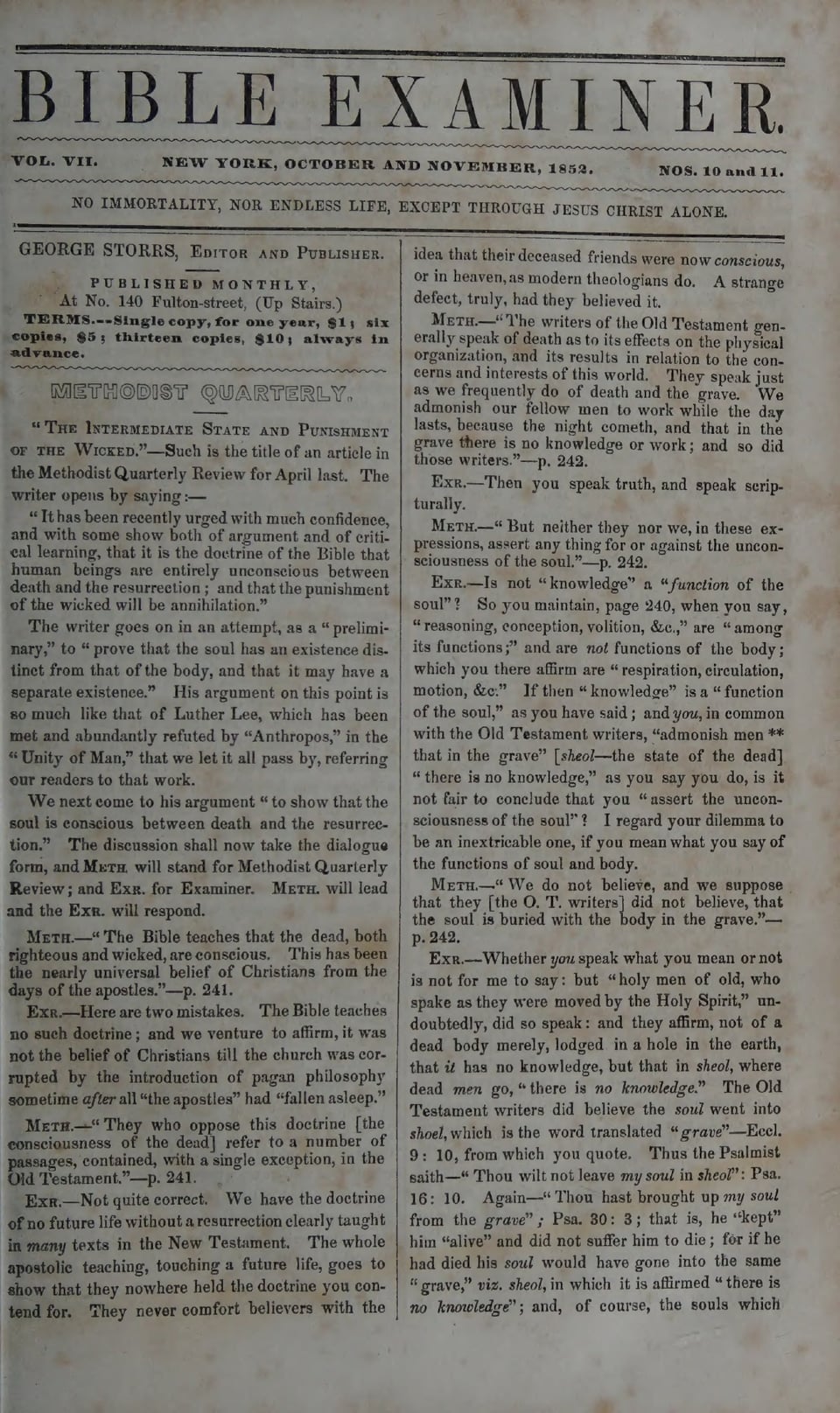
BIBLE EXAMINER.
VOL. VII.
NEW YORK, OCTOBER AND NOVEMBER, 1852.
NOS. 10 and 11.
NO IMMORTALITY, NOR ENDLESS LIFE, EXCEPT THROUGH JESUS CHRIST ALONE.
GEORGE STORRS, EDITOR AND PUBLISHER.
PUBLISHED MONTHLY,
At No. 140 Fulton-street, (Up Stairs.)
TERMS.--Single copy, for one year, 1; six copies, 5; thirteen copies, $10; always in advance.
METHODIST QUARTERLY.
"THE INTERMEDIATE STATE AND PUNISHMENT OF THE WICKED."—Such is the title of an article in the Methodist Quarterly Review for April last. The writer opens by saying:—
"It has been recently urged with much confidence, and with some show both of argument and of critical learning, that it is the doctrine of the Bible that human beings are entirely unconscious between death and the resurrection; and that the punishment of the wicked will be annihilation."
The writer goes on in an attempt, as a "preliminary," to "prove that the soul has an existence distinct from that of the body, and that it may have a separate existence." His argument on this point is so much like that of Luther Lee, which has been met and abundantly refuted by "Anthropos," in the "Unity of Man," that we let it all pass by, referring our readers to that work.
We next come to his argument "to show that the soul is conscious between death and the resurrection." The discussion shall now take the dialogue form, and METH will stand for Methodist Quarterly Review; and Exr. for Examiner. METH. will lead and the Exr. will respond.
METH.—"The Bible teaches that the dead, both righteous and wicked, are conscious. This has been the nearly universal belief of Christians from the days of the apostles."-p.241.
Exr.—Here are two mistakes. The Bible teaches no such doctrine; and we venture to affirm, it was not the belief of Christians till the church was corrupted by the introduction of pagan philosophy sometime after all "the apostles" had "fallen asleep."
METH.—"They who oppose this doctrine [the consciousness of the dead] refer to a number of passages, contained, with a single exception, in the Old Testament."—p. 241.
Exr.—Not quite correct. We have the doctrine of no future life without a resurrection clearly taught in many texts in the New Testament. The whole apostolic teaching, touching a future life, goes to show that they nowhere held the doctrine you contend for. They never comfort believers with the
idea that their deceased friends were now conscious, or in heaven, as modern theologians do. A strange defect, truly, had they believed it.
METH.—"The writers of the Old Testament generally speak of death as to its effects on the physical organization, and its results in relation to the concerns and interests of this world. They speak just as we frequently do of death and the grave. We admonish our fellow men to work while the day lasts, because the night cometh, and that in the grave there is no knowledge or work; and so did those writers."—p. 242.
Exr.—Then you speak truth, and speak scripturally.
METH.—"But neither they nor we, in these expressions, assert any thing for or against the unconsciousness of the soul."—p. 242.
Exr.—Is not "knowledge" a "function of the soul"? So you maintain, page 240, when you say, "reasoning, conception, volition, &c.," are "among its functions;" and are not functions of the body; which you there affirm are "respiration, circulation, motion, &c." If then "knowledge" is a "function of the soul," as you have said; and you, in common with the Old Testament writers, "admonish men ** that in the grave" [sheol—the state of the dead] "there is no knowledge," as you say you do, is it not fair to conclude that you "assert the unconsciousness of the soul"? I regard your dilemma to be an inextricable one, if you mean what you say of the functions of soul and body.
METH.—"We do not believe, and we suppose that they [the O. T. writers] did not believe, that the soul is buried with the body in the grave." p.242.
Exr.—Whether you speak what you mean or not is not for me to say: but "holy men of old, who spake as they were moved by the Holy Spirit," undoubtedly, did so speak: and they affirm, not of a dead body merely, lodged in a hole in the earth, that it has no knowledge, but that in sheol, where dead men go, "there is no knowledge." The Old Testament writers did believe the soul went into shoel, which is the word translated "grave"—Eccl. 9:10, from which you quote. Thus the Psalmist saith—"Thou wilt not leave my soul in sheol": Psa. 16:10. Again—"Thou hast brought up my soul from the grave"; Psa. 30:3; that is, he "kept" him "alive" and did not suffer him to die; for if he had died his soul would have gone into the same "grave," viz. sheol, in which it is affirmed "there is no knowledge"; and, of course, the souls which enter there are "unconscious."
Such was the faith of the O T. writers, whatever you may believe or disbelieve.
METH.—"Eccl. 9:5, 'For the dead know not anything,' is a text, perhaps, quoted more frequently and with more confidence than any other, by those who deny the consciousness of the soul after the death of the body, but they always stop at the end of this clause. The wise man adds, 'neither have they any more a reward.'"—p.242.
Exr.—We do not always stop where you say: we have frequently, both in writing and preaching, dwelt upon the expression, "neither have they any more a reward," as additional evidence of the unconscious state of the dead; because, if conscious they have some sort of reward. The wise man does not affirm they never will have a reward. He uses the present tense; indicating the state they are now in: "neither have they any more a reward;" and immediately assigns the reason—"for, the memory of them is forgotten." We understand this last expression to refer to the memory of the dead ones; and the tenth verse confirms this view, for there he reaffirms the doctrine of the fifth verse of the entire destitution of knowledge among the dead ones; and the Psalmist is equally as explicit when he saith—"In death there is no remembrance of" God: Psa. 6:5. Thus our position is doubly fortified, and your attack upon it has only served to make it more apparent that it is invulnerable.
METH.—"The passage in the New Testament referred to above" [as the only one in the N.T. that those who oppose the conscious state of the dead use] "is Acts 2:34, 'David is not ascended into the heavens.' We do not know that it is necessary to suppose that the souls of the righteous dead, if conscious, have 'ascended into the heavens.' They may exist in a state of consciousness elsewhere, which sufficiently answers the argument from this passage."—p. 243.
Exr.—That is cool, very cool, truly, Bro. Meth. What then becomes of all the Methodist and "orthodox" fancies of flying off to heaven at death! Truly you have given your fanciful brethren a thrust which will make you suspected of beginning to be a little tinctured with our views. Our arguments, which you appear to have read in part, it seems, have brought you down from the fancy heaven, and so clipt your wings that you even use an expression implying doubt as to the consciousness of the dead: you say, "if conscious;" not, though conscious. Well, as you have done soaring to heaven with disembodied souls, through the power of the light that has been poured on your mind in reading our works, I trust you will yet be made to see that, as it is not "necessary to suppose that the souls of the righteous dead ascend into the heavens," so it is not necessary to suppose they are conscious till they are raised from the dead. Christ has
"ascended into heaven;" this the Scriptures plainly affirm: see Luke 24:51; Acts 1:9-11; Heb. 1:3; 8:1; 9:24, &c. Now, as Christ has ascended into heaven, it is very "necessary" that you should not only "suppose" but prove that "the souls of the righteous dead have ascended" there also, in order to be "with Christ." Is it not a part of your argument against us that Paul desired to depart and be with Christ?
METH.—Yes: "That Paul refers to himself, [as gain to die,] and what would be desirable in relation to himself, is evident from the 23d and 24th verses, 'I am in a strait betwixt two, having a desire to depart, and to be with Christ; which is far better.' *** For himself, it was more desirable that he should die, and more desirable, because he should then be in a state of conscious existence with Christ."—p. 245.
Exr.--And yet you have just said that you "do not know that it is necessary to suppose that the souls of the righteous dead have ascended into heaven"! If they have not ascended into heaven, they are not "with Christ"; for I have proved that Christ has ascended. If these two legs of your theory are equal I cannot see it; and you may find yourself shut up to the necessity of proving that dead saints have ascended; in which case you will not find it so easy to dispose of Peter's affirmation, while under immediate and divine inspiration, on the day of Pentecost, that "David is not ascended into the heavens." Try again, Bro. Meth. There is nothing like effort to lay open one's eyes; and I hope a few more plunges, such as you have made, will help you to see the truth, that the dead are asleep, and will sleep till Christ returns from heaven to wake them up to consciousness and life.
METH.—"It is clear, that Moses, though his body had not been raised from the dead, was conscious at the time of the transfiguration."-p. 244.
Exr.—It is equally "clear" if Moses was there in reality, and not in vision, that he was there "in glory." If not raised from the dead he was not there except in vision; for saints will not "appear in glory' till Christ "changes the vile body" and appears himself in glory: see Col. 3:4, and Phil. 3:20, 21. But Moses did "appear in glory;" see Lk. 9:30, 31. It is "clear," then, that Moses had been raised from the dead, or that he appeared in vision of what he should be when Christ shall actually "come in his glory" to raise his saints, and fashion them like to his own glory. As I judge your other arguments and texts quoted, to prove the dead do know more than all the living, have been sufficiently met elsewhere, we will pass on to the subject of the eternal existence of all souls whether righteous or wicked. What admissions have you to make on this question?
METH.—"It is generally conceded that we cannot, apart from the Scriptures, prove conclusively the immortality of the soul—neither the metaphysical nor the moral arguments in favor of its immortality amount to demonstration.
But none who believe in the Bible will admit that the soul is essentially indestructible, in such a sense that it exists by a necessity of its own nature. It exists because God created it; and he who created, can, if he will, annihilate it. After all our metaphysical and moral reasoning upon the subject, if it can be shown that the Bible clearly asserts that God will annihilate the souls of the wicked, the question will be entirely settled in the minds of all who believe that it teaches what will be the destiny, in the future state, of the righteous and the wicked.
"We turn then to the Bible for entire assurance on the great question of the soul's immortality; and here is assurance found. Yet, in the Bible, we think, there is no passage which can be strictly said to declare that all human souls are immortal. Some have supposed that the account of the creation of the soul, given in Gen. 2:7, contains an intimation of its immortality. If there be in this verse such an intimation, it must be found either in the expression, 'the Lord God . . . breathed into his nostrils,' or in the phrases, 'breath of life,' and 'man became a living soul.' If it be in the former phrase, then the idea is that God infused a portion of himself, of his own divinity, into the human body at that time. But few will admit this idea. Most of us think that there is more poetry than truth in the line of one of our hymns: 'Our souls are his immortal breath.' If the proof is sought in the phrases, 'breath of life,' and 'living soul,' these do not prove anything; for both of them are applied, in the first chapters of Genesis, to brutes, and prove the same thing concerning them. Thus the words in Gen. 7:15, and in Gen. 1:20, rendered life, are the same with those rendered in Gen. 2:7, 'a living soul.'"—pp. 247-8.
Exr.—We thank you for these admissions: they show clearly that our arguments, in the works you have read, have not been lost upon you. Such admissions are a blow at the root of the whole theory of immortal-soulism.
METH.—"The only passages in the Bible which clearly teach the endless existence of all human beings, are those which speak of the endless happiness of the righteous and the endless misery of the wicked. If then the Bible does not teach that the punishment of the wicked shall be endless, it does not teach that they shall exist forever, and the question is resolved into this, 'Shall the wicked exist forever in misery?' The Bible answers this question, we believe, affirmatively."---p. 249.
Exr.—"We believe the Bible answers this question" negatively. The Bible does teach the endless existence of some human beings in plain and positive terms; and does not leave it to be inferred from expressions relative to their "endless happiness." They who are accounted worthy to attain that world, and the resurrection from the dead, cannot "die any more." See Luke 20:35,36. That is plain; and there are many texts of like character, which may be noted in another place. Not one such assertion have you, in the Bible, in relation to the wicked.—
We do not question but that "the punishment of the wicked will be endless;" but we do deny that it is endless misery.
METH. "It is said, 'that we have proof from various passages in the Bible that the immortality of the soul is only through faith in Christ.' John 10: 28, 'I give unto them eternal life.' 1 John 5: 12, 'He that hath the Son hath life,' are instances. John 3: 15, 36; 5: 40; 20: 31; Rom. 6: 23, and numerous other passages, are to the same purpose. If it is admitted that the phrases 'life' in some, and 'eternal life' in other of these passages mean only the existence of the soul forever, the question is settled. But this, the very point to be proved, is assumed by Mr. Storrs."---p. 249.
Exr.—“Mr. Storrs” has not “assumed” it. He has demonstrated that those phrases in many important passages mean primarily the existence of the man forever; and they cannot have any other construction put upon them without corrupting the testimony of the faithful and true witness. Take the first text in your list, in John 10:28, “I give unto them eternal life.” Does not this text clearly express eternal existence? What follows shows that it does; for, adds the Saviour, “they shall never perish.” Here it is plain that life, being, in its obvious signification is what is promised, and is explained by our Lord as the opposite of perishing, or death. Just read it as our opposers usually explain it, and it is stript of all its beauty and force. It then reads, “I give unto them eternal happiness, and they shall never be miserable.” Who, unbiassed by a preconceived notion, could believe that our blessed Lord used figurative language when the literal could have been so easily expressed? I regard it as an impeachment of his honesty and sincerity to say that he used, so uniformly, the phrases, life, eternal life, when he intended to be understood to mean happiness, and not life proper. But take another text—“As sin hath reigned unto death, even so might grace reign through righteousness unto eternal life by Jesus Christ our Lord.” Rom. 5:21. What is “eternal life” here? Do those on your side of the question say it is eternal happiness?—Then its opposite, “death,” in the text, means misery. Then it would read, “as sin hath reigned unto misery, even so might grace reign unto eternal happiness.” But will the context allow any such interpretation? What had the apostle said? “By one man sin entered into the world, and death by sin: death reigned from Adam to Moses, even ever them that had not sinned after the similitude of Adam’s transgression:” verses 12 to 14. Here the point is settled as to what Paul means by the phrase death; and he concludes his argument by affirming—“as sin hath reigned unto death, so might grace reign through righteousness unto eternal life by Jesus Christ our Lord.” Man dies by the first Adam: man lives again, if he ever lives at all, by the second Adam; and that life, to the righteous, is an eternal one.
It clearly means here existence in conscious being. That such a life will be a happy one is true; but the phrase itself expresses the idea of life, or conscious existence, and of that "only." These examples are sufficient till our opponents shall do something more than assume that our Lord and his apostles do not mean what their words express.
METH.—"It is said, 'that the penalty of Adam's transgression was "death," and that death is equivalent to "extinction or cessation of being," or annihilation. We remark in reply, that death does not mean extinction, or cessation of existence, but of life. The whole force of this part of the Scripture argument of the advocates of annihilation depends upon the confusion of the two ideas, existence and life."---p. 250.
Exr.—There is no such "confusion" as you speak of in our arguments. It is only a creation of your own. We understand perfectly the difference between "existence and life;" and you, had you carefully examined what we have said on that point, would not have made the statement you have: it is only your inference. We may say of man, however, he ceases to exist as man in death; meaning only that he ceases to be a living man; not that the materials of which he was composed are out of existence.
METH.----"All will admit that the penalty of Adam's sin was 'death:' but the point to be settled is this, Does 'death' mean 'extinction, or cessation of existence?' Mr. Storrs assumes that it does; we deny it. Life and existence are essentially different."----p. 250.
Exr.---"Mr. Storrs assumes" no such thing; but he does affirm that death is the cessation of conscious existence. If this were not so, it would not be death, but merely another mode of life; and could not, if there is any meaning in language, be called death. Life and existence may be essentially different; but life and conscious existence are not, in relation to any creature; though a living creature may not at all times be conscious.
METH.----"What was the penalty inflicted on Adam? The authors under review take the position that it was the loss of 'soul-immortality,' meaning thereby annihilation. There is not a passage in the Bible which sustains this position."---p. 252.
Exr.—We do not take the position that it was the loss of 'soul-immortality;' but that it was the loss of life—the life of the man. If any part of the man was exempt from the penalty of death it is for our opponents to prove it, and not assume it, as they uniformly do; and you have admitted that "there is no passage which can be strictly said to declare that all human souls are immortal:" p. 248. But the testimony is abundant that the life of the man was forfeited and lost by sin; and that the man
is now in a perishing condition. If the soul is a part and parcel of the man, and without which he would not be man, then it must be included in the threatened death.
METH.—"We object, also, that the penalty of the law could not have been annihilation, because that penalty was not, in any sense or degree, inflicted on Adam 'in the day' of his sin. The denunciation, the penalty was, 'In the day thou eatest thereof, thou shalt surely die.' Mr. Storrs thinks that he finds relief from the pressure of this objection in the idiomatic form of expression used in the original.—He says, 'The penalty was not, "In the day thou eatest thereof thou shalt surely die," but as the Hebrew language has it, "dying thou shalt die." That very day the whole man commenced dying.' Those who are but slightly acquainted with the Hebrew idiom, very well know that our version conveys precisely 'the meaning of the original, and Mr. Storrs' attempt to answer this objection entirely fails. The same phrase is used by God to Abimelech, in Gen. 20:7; by Saul to Jonathan,1 Sam.14:44; by Saul to Abimelech,1 Sam.22:16; by Solomon to Shimei,1 Kings 2:37,42,—in each of which cases it is manifest that certain and not lingering death was threatened."—pp.252-3.
Exr.—“The penalty of the law” was death: and that it was literal death the texts you quote demonstrate: for, it was not a spiritual death God threatened to inflict on Abimelech; or Saul on Jonathan and Abimelech; or Solomon on Shimei: in each of these cases, and in every other where the phrase surely die occurs in Moses' or the prophets' writings, it means a literal death of the man; and does not include a moral or spiritual death in a solitary text, unless this in Gen. 2:17 is an exception: and if it is an exception it is for our opponents to prove it such, and not assume it, as they uniformly do, and as you have done. While I do not admit that “Mr. Storrs’ attempt to answer” the objection, that the “penalty was not in any sense or degree inflicted on Adam in the day of his sin,” if that penalty was “annihilation”—as you please to call it, but which I call death—“entirely fails,” I do admit that Mr. Storrs might have found a better explanation of the subject had he known ten years ago, when he first published his exposition, what he now knows about the Hebrew, viz.: that the Heb. preposition translated in has the sense of after and against, as well as in. The Heb. preposition is be, and is prefixed to ium, day. The text is, be-ium: be being the prefix determines as to the use of ium, i.e., what day is meant. The context shows be is used in the sense of after: and the text reads, “after the day thou eatest thereof thou shalt surely die.” It does express certainty, as you say: but the certainty is not as to the particular day on which the penalty would be inflicted, but that it would, without fail, follow eating the forbidden fruit. God’s own explanation of the threatened penalty, chap. 3:19, shows that the whole man was embraced in it, and that it was a return to the state he was in before his creation—"Dust thou art, and unto dust shalt thou return."
Not, "dust thy body is;" but, thou—the man. No exception here of an entity, which our opponents call an immortal soul: a most important exception, if true, our opposers themselves being judges; for they insist upon it, though Adam's Maker is silent on the subject.
METH.—"The penalty inflicted on Adam consisted in physical and spiritual death, the former affecting the body, the latter the soul or spirit; not annihilation in either case, but a cessation of their appropriate functions."—p. 253.
EXR.—Where is your proof of this two-fold death? No where in the Bible, most assuredly. Besides, you have just said, it was "certain and not lingering death that was threatened:" and you have said, also, that the penalty could not have been what Mr. Storrs contends, "because that penalty was not, in any sense or degree, inflicted on Adam in the day of his sin." Now you contend that "the penalty inflicted on Adam was physical death"—the very thing Mr. Storrs contends for; but you add, "and spiritual death;" thus adding to the law and testimony of God. But, as you admit physical death to be a part of the penalty, was it "in any sense or degree inflicted on Adam in the day of his sin"?
METH.—" We may regard physical death as a part of the penalty, though it was not at once fully inflicted."—p. 253.
Exr.—If it was not at once fully inflicted, then it was a lingering death, which you just now said was not threatened. Thus you are compelled to eat your own words, and take precisely the ground as to physical death that you condemned Mr. Storrs for taking! Truly, "happy the man that condemneth not himself" for that which he condemneth others! He is a privileged character. Mr. Storrs said the Hebrew was, "dying thou shalt die"; importing a period elapsing before the penalty would be "fully inflicted"; you affirmed the Hebrew would not allow such a construction of its language, and therefore Mr. Storrs' argument "entirely fails"! Now you come forward and take the very ground you condemned in him, and say that "physical death, as a part of the penalty, was not at once fully inflicted"! What more, or different, had Mr. Storrs said?
METH.—"Adam, doubtless, understood the denunciation of the penalty to refer to physical death, and Paul teaches the same thing in 1 Cor. 15:20, 22, where the statements in the 20th verse, that Christ is 'become the first-fruits of them that slept,' is conclusive proof that the death referred to in the 22d verse, 'as in Adam all die,' is physical death; else Christ was the subject of spiritual death, and a spiritual resurrection, that is, of depravity and the new-birth."--p. 253.
Exr.—Thank you, Br. Meth.; it is refreshing to hear you appeal to the law and the testimony; and that which is conclusive too, and so completely demolishes your whole fable of a two-fold death. "Adam understood the penalty to refer to physical death, and Paul teaches the same thing." Truth, truth, Br. Meth.; may the light shine more and more upon your mind.
METH.—"The other, and, as we believe, the chief part of the penalty, that which affected the soul, was inflicted in the day and at the very moment of Adam's sin. Some call this 'original sin; others, 'native depravity'; we have called it 'spiritual death.' This Adam suffered in the day of his transgression."—p. 253.
Exr.—Do you say "Adam understood the penalty to refer to "spiritual death?" If so, where is the evidence of it? Where? Does "Paul teach" it? You have shown to the contrary conclusively in your appeal to his argument, 1 Corth. 15. Your whole position of the penalty of the Adamic law being a spiritual death is an unfounded assumption. To use your own words, p. 252, "There is not a passage in the Bible which sustains this position."
METH.—"The functions of Adam's spiritual life at once ceased; his soul was at once alienated from God. This condition he transmitted to his posterity; . . young children exhibit, not perversity only, but depravity, long before they can understand the nature or the results of their conduct."-p.254.
Exr.—And young pigs manifest the same. Did Adam transmit his spiritual death to them? But you are, on this point, at war with God. Listen:
"The word of the Lord came unto me again, saying, What mean ye, that ye use this proverb concerning the land of Israel, saying, The fathers have eaten sour grapes, and the children's teeth are set on edge? As I live, saith the Lord God, ye shall not have occasion any more to use this proverb in Israel. Behold, all souls are mine; as the soul of the father, so also the soul of the son is mine: the soul that sinneth, it shall die."—Ezekiel, 18:1-4.
Here God declares he will not allow any such imputation as you have cast upon him. And any text from which you infer the doctrine of transmitted moral death, or depravity, is perverted by such inference. As to the exhibition which you suppose young children make of moral depravity, you might as well conclude that Adam was created morally depraved, because, so far as we know, his first moral act was one of disobedience. Children are born into the world under the law of physical death, and commence their course in pain; no wonder they manifest uneasiness, and what you denominate moral depravity; but which can have no such character till they arrive at years to understand the nature of their acts. But this subject cannot here be fully discussed; we will only add that the Scriptures, everywhere, represent the moral depravity and sins of men as their own, and not as the result of an act of Adam.
But physical corruption and death are, uniformly, ascribed to "the offence of one," viz., Adam the first. This shows plainly enough what was the penalty of Adam's sin, and its only penalty. The adding of "spiritual death" is of human invention; and has its foundation in the traditions of men, by which they have made void the law of God, and filled men's mouths with excuses for their sins. Hence, God has plainly expressed his will, by Ezekiel, that such language should no more be used. Let all beware how they persist in using it, lest they be found fighting against God.
METH.—"Our opponents claim that many passages in the Bible teach the annihilation of the wicked, and we claim that many passages teach their endless punishment. These two ideas are plainly contradictory, and cannot both be taught in the Bible."—p. 254.
Exr.—Why "cannot both be taught in the Bible"? Is not an eternal deprivation of life "eternal" punishment? Most assuredly it is. You, and all on your side of the question, assume that pain and punishment are of necessity identical. This we deny. "Capital punishment"—the greatest of all punishments known under human tribunals—is not the greatest because it is the greatest infliction of pain, but because it is the deprivation of life. The capital punishment under the law of God is the eternal deprivation of life, and is therefore eternal punishment.
What the Methodist Quarterly Review saith further on this topic, we regard as having been so often met and refuted in our publications, that we let it pass, at least for the present. What it has said on the term aionios is contradicted by most commentators, who are nearly unanimous in their admissions that the terms eternal, everlasting, forever, and forever and ever, are uniformly used in the Scriptures to denote the longest period of which the subject or object is capable to which they are applied. Hence they prove nothing as to the duration of the existence of wicked men or devils, unless it is first proved that they are immortal, and cannot die, or cease from conscious existence. That point our opponents assume, and we deny. We demand the proof. But that they have not and cannot produce. We may at another time take up the topic of the sense of aionios in a separate article.
MORE TRACTS.---The articles "The Gospel Benefits," and "The Gospel Faith," in this Examiner, will be issued shortly in Tracts of 10 or 12 pages each. Price 75 cts. per 100.
THE COSPEL FAITH.
BY THE EDITOR.
Earnestly contend for the faith once delivered to the Saints.—JUDE, 3.
The Syriac version reads, "Maintain a conflict for the faith," &c. It will be our object first to determine what is the faith spoken of; and then note the importance of the apostolical exhortation, earnestly contend for it. "The faith," we apprehend, is expressed in the previous part of the verse, under the appellation of the "common salvation." It is "the faith" of salvation by or through our Lord Jesus Christ. But what is the distinctive feature of that salvation?
In answering this question, we wish to avoid the looseness which seems to pervade most men's minds when they speak of salvation, or being saved. The terms save, saved, and salvation, have a great latitude of meaning; and hence the sense of these terms will accord with the fancy; prejudice, or judgment of different individuals, according to their preconceived notions, unless we can show that they have a definite sense, when used in relation to man as the object of God's favor. Such a sense we believe the New Testament writers have in the use of those terms. To assist us in determining that sense, we shall bring to our aid the Syriac New Testament, as translated by Prof. Murdock, late of the Theological Institution of Andover, Mass.
Of the "Peshito Syriac Version of the New Testament," Prof. Murdock says—It "is very generally admitted to be the oldest version that has come down to us, of the New Testament in any language. It is called by the Syrians the Peshito version, on account of its style or character. The Syriac verb signifies to unfold or spread out that which was folded up, so that it can be seen in its true form, dimensions, and character. Hence the participle signifies spread out, not involved or folded up, simplex and not duplex; or as applied to a translation, explicit, free from ambiguities, direct, simple, and easy to be understood. And precisely such is, in fact, the character of this venerable version."—P. 489.
Among the principles which Prof. Murdock adopted in his translation of this version, the "5th" is, "In general, to avoid using technical theological terms, when good substitutes could be found, in order to call away attention from the word to the thing." In his illustration of this principle, he says—"Saviour is rendered Vivifier, as being more literal, for the verb properly signifies to make alive, to vivify; and its derivatives properly signify life, life-giver, or vivifier. These are the usual terms of the Syriac version, denoting that salvation which Christ bestows on fallen men."—Preface, p. 7.
In the foregoing quotation we have from necessity omitted the Syriac words, as we have no type of that character. In accordance with the principle here laid down, the Professor gives us "life, Life-Giver," or "vivify and Vivifier," throughout his translation, where it is save, Saviour, &c., in the common English version. In following his translation, we shall use the term Life, and Life-Giver, where he, in some instances, has inserted vivify and Vivifier, &c.; as these last terms have a Latin cast, and do not as clearly express to the mere English reader the sense of the text.
With the light shed on the Scriptures by this venerable Syriac version, we shall be able to satisfy our own mind, at least, as to what "the faith" is, of which Jude speaks. In the first part of the verse from which our text is taken, Jude says—"My beloved, while I take all pains to write to you of our common life": Syriac. The great theme of Jude and all the apostles was, that of "Life"—"Eternal Life," through Jesus the "Life-Giver." This was the faith, the doctrine, the great matter to be believed, the truth to be preached, the faith for which they were "earnestly to contend."
In further presenting this subject, we shall pass over, for the present, the multitude of texts in the common English version which express the same great and glorious truth, and call attention directly to the Syriac version, where life, Life-Giver, &c., occur in place of save, saved, salvation, and Saviour in our version. We begin the examination with Matthew 19:25; where, after our Lord had spoken of the difficulty of a rich man entering into the "kingdom of God," the "disciples wondered greatly, and said: Who then can attain to life?" Here, attaining to life is the salvation looked for. Our version reads—"Who then can be saved?" What the salvation is, might be a matter for dispute, as that term is more or less indefinite: but life is a definite term, and brings us at once to the nature of the salvation. It is a salvation from death, into life.
Again, Matt. 27:42; when Jesus hung upon the cross, our translation reads—"He saved others: himself he cannot save." The Syriac has it— "He gave life to others; his own life he cannot preserve." This version is truly open, and easy to be understood. He gave life to several during his ministry; and that which determined the Scribes and Pharisees to put him to death, at all hazards, was the fact that he gave life to Lazarus, who had been dead four days: see John 11:48-53. He was a Life-Giver.
In John 3:17, our translation reads, "For God sent not his Son into the world to condemn the world; but that the world through him might be saved." The Syriac—"That the world might live by means of him." Here the nature of the salvation is clearly expressed. and no doubt is left on the mind as to its real character. It is life—that's what the world, the dying world need; and Christ came that they might live.
Acts 2: 21, reads—"Whosoever shall call on the name of the Lord shall be saved." The Syriac—"Shall live." Thus showing that Life is the great proffered blessing to the human race; and that the doctrine of life, through Jesus, is "the faith delivered to the saints," and which they are to maintain, earnestly contending for it.
Acts 4: 12, reads—"There is none other name under heaven given among men whereby we must be saved." The Syriac—"There is not another name under heaven, which is given to men, whereby to live." Here, as in the previous texts, there is a definiteness that forms a firm basis for faith. The salvation is life. Who is it that gives this life?
Acts, 5: 31—" Him [Jesus, who was raised from the dead] hath God exalted to be a Prince
and a Saviour." Syriac—" Him hath God established as a head and Life-Giver." Jesus, Messiah, died—God raised him from the dead and made him "head" of another life, even an endless life, and constituted him the Life-Giver; he is to bestow that life of which he is now the fountain. It is not in ourselves, but in him who was dead, but is alive again, and lives forevermore; who also has "the keys of death and hades."
When the angels directed Cornelius to send for Peter, as related Acts 11:14, he said—"Who shall tell thee words whereby thou and all thy house shall be saved." The Syriac reads—"He will utter to thee discourses, by which thou wilt live," &c. Here again the nature of the salvation is definite: it is life. And our translation so construes the salvation, verse 18, when those who heard Peter's relation of the matter said—"Then hath God also to the Gentiles granted repentance unto life."
Acts 13 : 26, Paul in addressing the "children of the stock of Abraham," &c., saith—"To you is the word of this salvation sent." Syriac—"To you is this word of life sent." Again in the same chapter, v. 47, Paul saith—"That thou shouldest be for salvation to the ends of the earth." Syriac—"That thou shouldest be for life," &c. In the previous verse, he had said to the blaspheming Jews—"Seeing you judge yourselves unworthy of everlasting life, lo, we turn to the Gentiles." The salvation, then, is "everlasting life."
In corrupting the Gospel, Acts 15: 1, some said, "Except ye be circumcised, ye cannot be saved." Syriac—"Ye cannot have life." And when this matter was under discussion in the council of apostles and elders at Jerusalem, at verse 11, Simon said, as the Syriac reads—"We believe that we, as well as they, are to have life by the grace of our Lord Jesus Messiah." The great theme was life. Well did Peter answer Jesus, when he asked the twelve, John 6th, "Will ye also go away?" "Lord, to whom shall we go? thou hast the words of eternal life." That was "the faith"—the doctrine once delivered to the saints."
When the maid possessed of a spirit of divination followed Paul and Silas, Acts 16: 17, she said—"These men are the servants of the Most High God, and they announce to you the way of life." She understood what they preached; it was about Life. Though this spirit, on this occasion, spoke the truth—as "rapping spirits" sometimes do in these days—yet "Paul was indignant" [Syriac] and refused to suffer such liars to testify, and commanded it to depart. For this act, Paul and Silas were whipped and cast into prison. But happy in the hope of life, they praised God in their chains and dungeon. The jailor was convicted, and came trembling before the apostles and said—"What must I do that I may have life?" Syriac. How came his first inquiry to be about life? Clearly, because he understood that was the grand theme of the apostles' preaching. They answer him—"Believe on the name of our Lord Jesus Messiah, and thou wilt have life," &c. Here is clearness, beauty, and force. There is no vague and indefinite something under a general term, but a specific one is used, which brings us at once to the nature of the Gospel salvation. It is, obtaining life.
Rom. 1: 16, Paul says—"I am not ashamed of the gospel, for it is the power of God unto life, to all who believe it."
Syriac. Again, chap. 10: 1, he saith of Israel—"The desire of my heart, and my intercession with God for them is, that they might have life." And in the same chapter, verse 9, he states the conditions of the proffered blessing, thus—"If thou shalt confess with thy mouth our Lord Jesus, and shalt believe in thy heart that God hath raised him from the dead, thou shalt live." And at the thirteenth verse he saith—"Every one that shall call on the name of the Lord, will have life." In speaking of the stumbling of Israel, chap. 11: 11, he saith—"By their stumbling, life hath come to the Gentiles." Syriac. In chapter 13: 11, Paul, exhorting to wakefulness, saith—"For now our life hath come nearer to us, than when we believed." Eternal life is only actually bestowed at the resurrection unto life, at Christ's return from heaven. Every day brings it nearer; and that consideration should arouse us from all stupidity, and excite us to diligence. All these expressions, as found in the Syriac, go to show the great idea of salvation as it lay in the apostle's mind—it was the "one idea" of Life.
We now proceed to his other epistles. 1 Corth. 1: 18—“Our discourse concerning the cross is to them who perish foolishness; but to us who live it is the energy of God.” In chap. 10: 33, speaking of his course as a preacher, he says—“I do not seek what is profitable to me, but what is profitable to many, that they may live.” Chap. 15: 1, 2, he saith—“I make known unto you, my brethren, the gospel which I preached to you, and which you received, and in which ye stand, and by which ye have life.” 2 Corth. 1: 6—“Whether we be afflicted, it is for your consolation, and for your life.” Chap. 2: 15—“Through the Messiah, we are unto God a sweet odor, in them that live, and in them that perish,” &c. Chap. 7: 10—“For sorrowing on account of God, worketh a conversion of the soul which is not to be reversed, and a turning unto life: but the sorrowing of the world, worketh death.” To the Ephesians, chap. 1: 13, Paul saith—“In whom [Messiah] ye also have heard the word of truth, which is the gospel of your life.” The good news, or gospel, is that of life to dying men. To the Philippians, 1: 28, he saith—“In nothing be ye startled by those who rise up against us; [which is] an indication of their destruction, and of life for you”; and in chap. 2: 12, he saith—“My beloved, as ye have at all times obeyed, not only when I was near to you, but now when I am far from you, prosecute the work of your life more abundantly,” &c. The great work we have to do is to work for life. In chap. 3. Paul having spoken of the conduct and end of the wicked, and said “whose thoughts are on things of earth.” adds—“But our concern is with heaven; and from thence we expect our Life-Giver, our Lord, Jesus the Messiah; who will change the body of our abasement, that it may have the likeness of the body of his glory,” &c. This is a life-giving work: a work which “the Father, who hath life in himself,” hath entrusted to his Son to accomplish for all that obey him.
1 Thess. 2:16, Paul says the Jews "forbid us to speak to the Gentiles, that they may have life." Chap. 5:8,9, he thus speaks—"Let us who are the children of the day be wakeful in mind, and put on the breast-plate of faith and love, and take the helmet of the hope of life: for God hath not
appointed us to wrath, but to the acquisition of life. by our Lord Jesus the Messiah." The hope of life is that which sustains the Christian in all his conflicts; and is the great gospel motive to labor and suffer for the Messiah's cause: it is life God has set us to acquire.
2 Thess. 2: 10, Paul saith that the Evil One will by signs and lying wonders deceive them that perish; "because they did not receive the love of the truth, by which they might have life." He adds—"We are bound to give thanks to God... brethren...that God hath...chosen you unto life, through sanctification of the Spirit, and faith in the truth." Life is kept prominent as the great gift of God and object of pursuit, as well as that for which the spirit of God works in us.
Paul opens his first epistle to Timothy with the announcement that God is "our Life-Giver." As he proceeds, verse 15, he says—"Faithful is the declaration, and worthy to be received, that Jesus the Messiah came into the world to give life to sinners." He adds, that Messiah displayed on him "all his long-suffering, for an example to them who were to believe on him unto life eternal." In the next chapter, he exhorts to prayer, &c., for all men, "for this is good and acceptable before God our life-giver, who would have all men to live, and be converted to the knowledge of the truth." In chapter 4: 10, he uses this language—"We toil and suffer reproach, because we trust in the living God, who is the life-giver of all men, especially of the believers." He directs Timothy, verse 16, "Be attentive to thyself, and to thy teaching, and persevere in them: for," saith he, "in doing this thou wilt procure life to thyself and to them who hear thee."
Thus the testimony is uniform in regard to the great end of the gospel; it is to call men to life, and bestow it upon them. The language, by this translation of the Syriac, is divested of all vagueness and speaks out to the comprehension of all minds. We will, however, present a few more places where Saviour save, and salvation, in the common English version, are in the Syriac Life-Giver and life.
2 Tim. I : 10, " The appearing of our Life-Giver, Jesus the Messiah, who hath abolished death, and hath made manifest life and immortality by the gospel." How forcible and plain is this language.
Chap. 2:10—"Therefore I endure everything for the elect's sake, that they may obtain life in Jesus the Messiah, with eternal glory." Life is still the theme; and the glorious object set before us.
Chap. 3 : 15—"From thy childhood thou wast taught the holy books, which can make thee wise unto life, by faith in Jesus the Messiah."
Chap. 4: 18—"My Lord will rescue me from every evil work; and will give me life in his heavenly kingdom." One theme still-one end in view, viz.: life-life in the kingdom of God.
To Titus Paul writes, on opening the epistle, "In hope of eternal life...grace and peace from God our Father, and from our Lord Jesus the Messiah, our Life-Giver." Chap. 2:10,13—"For the life-giving grace of God is revealed to all men; and it teaches us to deny ungodliness and worldly lusts, and to live in this world in sobriety, and in uprightness, and in the fear of God, looking for the blessed hope, ["hope of eternal life;" see chap. 1: 2] and the manifestation of the glory of the great God, and our Life-Giver, Jesus the Messiah."
Chap. 3: 4-6—"When the kindness and compassion of God our Life-Giver was revealed... according to his mercy...by the renovation of the Holy Spirit, which he shed on us abundantly, by Jesus the Messiah, our Life-Giver, that we might...become heirs in the hope of eternal life." Thus the author and giver of life is clearly set before our minds; and in a manner that cannot fail to make an impression of our obligation, and of God's great mercy.
Paul, in writing to the Hebrews, speaking of angels, asks, chap. 1: 14—"Are they not all spirits of ministration, who are sent to minister on account of them who are to inherit life?" He asks, chap. 2: 3—"How shall we escape if we despise the things which are our life." &c. Again, verse 10—"It became him...[who] bringeth many sons unto glory, to perfect the prince of their life by suffering." How forcible are right words? All the commentaries in the world cannot make plainer the work of Messiah, and the blessing he came to give the perishing.
Chap. 5: 7-9—" When he [Jesus] was clothed in flesh, he presented supplication and entreaty, with intense invocation and with tears, to him who was able to resuscitate him from death; and he was heard. And tho' he was a son, yet, from the fear and sufferings he endured he learned obedience; and thus he was perfected, and became the cause of eternal life to all them who obey him."
Chap. 7 : 25—" He is able to vivify [give life] forever, them that come to God by him, for he always liveth, and sendeth up prayers for them." And chap. 9 : 28, Paul saith Messiah will "a second time...appear for the life of them who expect him." What is Messiah coming a second time for? The answer is clear—for the life of his followers: to give them the "crown of life."
James, chap. 4:12, says—"There is one Law- Giver and Judge, who can make alive and [can] destroy."
Peter, in his 1st epistle, chap. 1:9, 10, says— "That ye may receive the recompense of your faith, the life of your souls; that life about which the prophets inquired," &c.
We now come back to Jude, the point from which we started. He calls this life, which we have been tracing out, "the common life" of the "beloved." This is that which so deeply interested them all—which the saints were exhorted to lay hold of; for which they labored and suffered; for which they hoped, believed, and fought; and in the firm persuasion of possessing it, when called to lay down their lives, met death without terror, knowing that God, who cannot lie, had promised it to all who by patient continuance in well-doing seek for it.
If such, then, is "the faith" of the gospel, the importance of "contending earnestly" for it can hardly be magnified. The necessity of such a course is as apparent as that nearly all Christendom have departed from "the faith," and perverted the very words in which the Bible presents the subject, to mean "happiness" instead of life; thus corrupting the testimony of God, and affirming that it is not life that man needs, but something else: yea, insisting that all men have endless life themselves; so that he who would maintain the
Bible truth on this subject must contend earnestly for it, and is in danger of being denounced as an "infidel" for believing that God, his Messiah, and the apostles, mean what they say, and speak what they mean. Surely, there never was a subject or topic that Christian men needed apostolical authority more to sustain them in their work than the one we have been contemplating. "Fight the good fight of faith," said Paul to Timothy, "lay hold on eternal life, whereunto thou art also called." And he adds—"I give thee charge, in the sight of God...that thou keep this commandment without spot, unrebukable, until the appearing of our Lord Jesus Christ." 1 Tim. 6: 12-14. Can a subject of such importance be magnified above its just claims? We think not. Let us, then, "earnestly contend for" it, as "the faith once delivered to the saints." Let those be admonished who assume that man has immortality or endless life in himself, that they are not by such a course, contending for the faith once delivered to the saints, but for a fable imposed upon them by tradition and the corruption of the words of God. May they quickly have their eyes open to see the truth, and be able to defend it.
GOSPEL BENEFITS.
BY THE EDITOR.
"God will render to every man according to his deeds: To them who by patient continuance in well-doing, seek for glory and honor, and immortality, eternal life."—Rom. ii. 6, 7.
Our object in the remarks we make upon this text will be, just to examine the nature or character of this cluster of benefits presented for our attainment, and then point out the means by which we may make them our own.
I. THE NATURE OR CHARACTER OF THE BENEFITS PRESENTED IN OUR TEXT.
"Glory."—Greek, Doxan. The term glory, is one often used, and generally includes in the mind the ideas of excellence and happiness: or something splendid, connected with much enjoyment. As the glory spoken of in our text is something to be attained in the future, and after effort on our part in the present time, it is worth while to endeavor to get as clear a conception of it as may be.
We regard it as that "change," of which the Scriptures speak, to be experienced by the saints at the second advent of Christ. Or, in other words, that change to be wrought at the resurrection from among the dead, viz.: the resurrection of the just. Paul informs us, 1 Cor. xv. 43: "They are sown in dishonor, they arise in glory."—Syriac.
The present state of man is one of dishonor, because one of corruption. Great pains are now taken to adorn our persons—to make ourselves look beautiful; i.e., glorious. But after all the labor and toil, corruption prevails—the most beautiful form and countenance is changed, its appearance becomes offensive, and we willingly lay it away from our sight. "They are sown in dish honor." But the followers of Christ will be raised in glory.
How shall we obtain an idea of the glory to be attained?
Paul informs us, Phil. iii. 21, that "Our Life-giver, the Lord Jesus Christ," will come "from heaven;" and that then he shall change our vile body, (or, body of our abasement—Syriac) that it may be fashioned like unto his glorious body," (or the body of his glory.—Syriac.) But how can we get an idea of that glory which Jesus possesses? Paul has, in this text, given us the pattern of the glory, and Peter shall give us the clue to its full discovery: 2 Peter. i. 16-18. Peter says,—"We have not followed cunningly devised fables, when we made known to you the power and coming of our Lord Jesus Christ, but were eye-witnesses of his majesty; for he received from God the Father, honor and glory, when there came such a voice to him from the excellent glory, This is my beloved Son in whom I am well-pleased; and this voice which came from heaven we heard, when we were with him in the holy mount." Another eye-witness of the same manifestation, viz., John, says,—"We beheld his glory, the glory as of the only begotten of the Father." John i. 14.
We will now turn to the manifestation of that glory, as recorded by Matthew, chap. xvii. 1: "Jesus taketh Peter, James, and John his brother, and bringeth them up into a high mountain apart, and was transfigured before them, (Syriac—was changed before them,) and his face did shine as the sun, and his raiment was white as the light." Here, in this vision, was the manifestation of "his glorious body," like unto which, Paul tells us, "our vile bodies shall" be "changed" when Christ "comes from heaven." Surely here is glory enough to satisfy our largest desires. The sight of it in vision, made Peter say, "Lord, it is good for us to be here." O, how satisfying the sight, and how much more so the realization when "vision" will be swallowed up in the reality. Such is the glory presented as one of the benefits of the Gospel of Jesus Christ.
"Honor"—Greek, Timeen. "A state of honor, dignity: a distinguished mark of favor." Such is the state to which the followers of Christ are to be exalted, "A Royal Priesthood;" to be "kings and priests unto God and the Lamb," to "reign on the earth," and "over the nations." This is what Christ has promised those who obey him; and the Scriptures everywhere confirm the same thing. "To him that overcometh will I grant to sit with me on my throne, even as I also overcame, and am set down with my Father on his throne." Rev. iii. 21. Christ's own throne is "the throne of his father David," which Jehovah has sworn to give him, and which will be bestowed upon him when the judgment is executed, or in a process of execution upon the "fourth" dynasty of rulers on earth, symbolized by a "dreadful and terrible beast." That beast is to be slain—the body of rulers overthrown and destroyed; then one is seen coming in the "clouds of heaven," who is "like the Son of Man;" and he "came to the Ancient of days, * and there was given him dominion. and glory, and a kingdom, that all people, nations, and tongues, should serve him: his dominion is an everlasting dominion, which shall not pass away, and his kingdom that which shall not be destroyed." Dan. vii. 13, 14. This dominion and kingdom is that in which Christ has promised his followers a share: and "judgment" is to be "given to the saints of the Most High," when the "time" has come "that
the saints possess the kingdom;" verse 22: then "the kingdom and dominion, and the greatness of the kingdom, (or the greatness of the kings—Septuagint,) under the whole heaven, shall be given to the people of the saints of the Most High, whose kingdom is an everlasting kingdom, and all dominions shall serve and obey him;" verse 27.
Such is the Royal Honor presented to our faith, as one of the grand motives to a right course of action in our present state of trial. Men are amazingly influenced by what they call "a sense of honor;" and to occupy some important post of trust where their honor can be conspicuous, is the ambition of many minds. No sacrifice, no suffering, no effort is spared, if they have evidence of the possibility of attaining the desired eminence. What an honor, in their estimation, to be President of the United States, though the term of office is a few short years, and though they may die before even that short period terminates; while the honor proffered the followers of Christ, is an honor never to pass away, nor to be changed into other hands, or to cease by death, as we shall shortly see. Let us suppose that all the honor ever possessed by Kings, Emperors, Governors, and Presidents, could be concentrated on one man, and that his life could be prolonged to a period equal to the combined years that have been occupied by the entire race of Adam; even then in splendor and duration it would fall infinitely short of that of one saint who shall become a king in the Empire of Jesus Christ! Let then the men of earth, or worldly men, seek their dying honors, which so soon fade away; the Christian has a "far more exceeding," even "an eternal weight of honor," reserved in store, soon to be conferred upon him, if found possessing the required characteristics. Here then is motive sufficient to stimulate the most desponding child of God. Take courage, brother: you are shortly to wear a kingly crown, and wear it for ever and ever. Lift up thy head, then, and faint not at any trials or sufferings you may be called to endure now.
"Immortality."—Greek, Aphtharsian. "Incorruptibility:" a state opposed to our present state, which is corruptible, mortal, dying. This incorruptible state, proffered in our text, is essential to confirm us in the glory and honor previously noticed. Without this, that glory might fade away—that honor have an end. With this, they are both made eternal.
The apostle here clearly shows that men are not possessed of immortality by creation, or birth; and he shows also that it is a favor to be conferred on those only who pursue a defined course. He had stated in the previous chapter, that men "professing themselves wise, became fools, and changed the glory of the uncorruptible God into an image made like to corruptible man," &c. Little did he then know of the folly which was to be developed in after times, by an attempt to make it appear that man is incorruptible, like God. Such "changing the truth of God into a lie," by which "the creature" is "worshipped and served more than the Creator," remained to be developed as the Man of Sin should begin to be manifested. Now, men affirm that they are "immortal"—incorruptible like God! True, they admit their bodies will die; but the essential man, they affirm, is "immortal, and can never die; thus making "void the word of God through their tradition."
in whole or in part. Not one solitary text in the Bible affirms any such thing, but the reverse. Let that fact satisfy the believer in the Scriptures. Immortality is a gift, dependent on the will of the giver—God, and on the action of him who shall partake of it. Paul informs us when it will be conferred, and how; viz., "At the last trump," and by "the resurrection," for, saith he, "the trumpet shall sound, and the dead shall be raised incorruptible" —aphtharsian; the same word employed in our text. "So when this corruptible shall have put on incorruption, and this mortal shall have put on immortality, then shall be brought to pass the saying that is written, Death is swallowed up in victory." 1 Cor. xv. 52-54. And this victory, which "God giveth," is "through our Lord Jesus Christ." Here is the true source of immortality, and the time when it will be attained. Let all remember this and lay aside that pride which possesses men's hearts from a fancied notion of inherent immortality.
…