The Bible Examiner — Vol. 9, No. 17 (September 1, 1854)
Download: PDF — The Bible Examiner — Vol. 9, No. 17 (September 1, 1854)
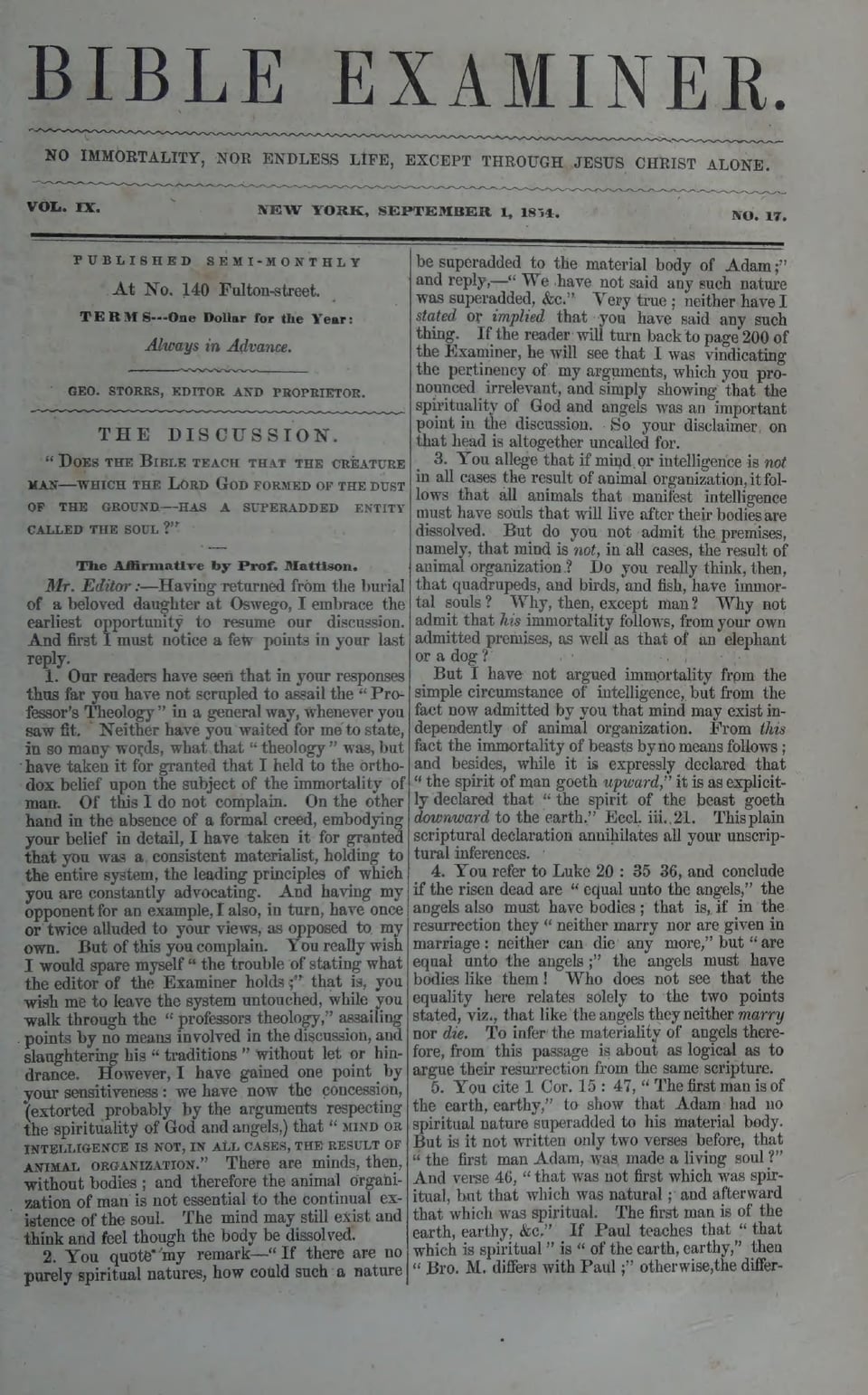
BIBLE EXAMINER.
NO IMMORTALITY, NOR ENDLESS LIFE, EXCEPT THROUGH JESUS CHRIST ALONE.
VOL. IX.
NEW YORK, SEPTEMBER 1, 1854.
NO.17.
PUBLISHED SEMI-MONTHLY
At No.140 Fulton-street.
TERMS----One Dollar for the Year:
GEO. STORRS, EDITOR AND PROPRIETOR.
THE DISCUSSION.
"DOES THE BIBLE TEACH THAT THE CREATURE MAN—WHICH THE LORD GOD FORMED OF THE DUST OF THE GROUND—HAS A SUPERADDED ENTITY CALLED THE SOUL?"
The Affirmative by Prof. Mattison.
Mr. Editor:—Having returned from the burial of a beloved daughter at Oswego, I embrace the earliest opportunity to resume our discussion. And first I must notice a few points in your last reply.
Our readers have seen that in your responses thus far you have not scrupled to assail the "Professor's Theology" in a general way, whenever you saw fit. Neither have you waited for me to state, in so many words, what that "theology" was, but have taken it for granted that I held to the orthodox belief upon the subject of the immortality of man. Of this I do not complain. On the other hand in the absence of a formal creed, embodying your belief in detail, I have taken it for granted that you was a consistent materialist, holding to the entire system, the leading principles of which you are constantly advocating. And having my opponent for an example, I also, in turn, have once or twice alluded to your views, as opposed to my own. But of this you complain. You really wish I would spare myself "the trouble of stating what the editor of the Examiner holds;" that is, you wish me to leave the system untouched, while you walk through the "professors theology," assailing points by no means involved in the discussion, and slaughtering his "traditions" without let or hindrance. However, I have gained one point by your sensitiveness: we have now the concession, (extorted probably by the arguments respecting the spirituality of God and angels,) that "MIND OR INTELLIGENCE IS NOT, IN ALL CASES, THE RESULT OF ANIMAL ORGANIZATION." There are minds, then, without bodies; and therefore the animal organization of man is not essential to the continual existence of the soul. The mind may still exist and think and feel though the body be dissolved.
You quote my remark—"If there are no purely spiritual natures, how could such a nature
be superadded to the material body of Adam;" and reply,—" We have not said any such nature was superadded, &c." Very true; neither have I stated or implied that you have said any such thing. If the reader will turn back to page 200 of the Examiner, he will see that I was vindicating the pertinency of my arguments, which you pronounced irrelevant, and simply showing that the spirituality of God and angels was an important point in the discussion. So your disclaimer on that head is altogether uncalled for.
You allege that if mind or intelligence is not in all cases the result of animal organization, it follows that all animals that manifest intelligence must have souls that will live after their bodies are dissolved. But do you not admit the premises, namely, that mind is not, in all cases, the result of animal organization? Do you really think, then, that quadrupeds, and birds, and fish, have immortal souls? Why, then, except man? Why not admit that his immortality follows, from your own admitted premises, as well as that of an elephant or a dog?
But I have not argued immortality from the simple circumstance of intelligence, but from the fact now admitted by you that mind may exist independently of animal organization. From this fact the immortality of beasts by no means follows; and besides, while it is expressly declared that "the spirit of man goeth upward," it is as explicitly declared that "the spirit of the beast goeth downward to the earth." Eccl. iii. 21. This plain scriptural declaration annihilates all your unscriptural inferences.
You refer to Luke 20 : 35 36, and conclude if the risen dead are "equal unto the angels," the angels also must have bodies; that is, if in the resurrection they "neither marry nor are given in marriage: neither can die any more," but "are equal unto the angels;" the angels must have bodies like them! Who does not see that the equality here relates solely to the two points stated, viz., that like the angels they neither marry nor die. To infer the materiality of angels therefore, from this passage is about as logical as to argue their resurrection from the same scripture.
You cite 1 Cor. 15 : 47, "The first man is of the earth, earthy," to show that Adam had no spiritual nature superadded to his material body. But is it not written only two verses before, that "the first man Adam, was made a living soul?" And verse 46, "that was not first which was spiritual, but that which was natural; and afterward that which was spiritual. The first man is of the earth, earthy, &c." If Paul teaches that "that which is spiritual" is "of the earth, earthy," then Bro. M. differs with Paul ; otherwise,the difference is between Paul and my friend of the Examiner.
In your next paragraph, we have a distinct denial of the spiritual nature of man. He has no "other nature than an animal one," and "there is no indication of any other or different life being imparted to man, than what was imparted to all other animals." Your logic is that all other animals breathed as well as Adam, and therefore they must have possessed all the life which he possessed. But is it even true that all animals breathe? Or is it written that God breathed into the nostrils of quadrupeds, and birds, and fish, and oysters, the breath of lives, and they became living souls? Why was he created so differently from them? Were these all made "in the image of God," as well as Adam? And why, if he was a mere animal, like the horse or the elephant did God say to him, "have dominion over the fish of the sea, and over the fowl of the air, and over every living thing that moveth upon the earth." Gen. 1:28. And does not all this amount to even an "indication" that man has another and a higher life than the brute?
But we are referred to Eccl. 3 : 19, "they have all one breath," &c.;—in proof that man is a mere animal. But a more unfortunate reference could scarcely be made. "For that which befalleth the sons of men befalleth beasts; even one thing befalleth them; as the one dieth, so dieth the other; yea they have all one breath; so that man hath no pre-eminence above a beast, for all is vanity. All go unto one place; all are of the dust, and all turn to dust again," Eccl. 3 : 19, 20. "One thing befalleth them"—they all die. In this respect man has "no pre-eminence;" but, like the beast, must turn to dust. But least any should fall into the error of the Examiner, and conclude that the spirit of man dies and goes to dust, it is immediately added, "Who knoweth the spirit of man that GOETH UPWARD, and the spirit of the beast that GOETH DOWNWARD to the earth?" Verse 21.
Upon this verse, Dr. Clark, who knew something of Hebrew, observes, that "the word ruach, which is used in this and the nineteenth verse, has two significations, breath and spirit, and cites numerous passages in proof. And his literal translation of the passage is, "Who considereth the [ruach] immortal spirit of the sons of Adam, which ascendeth? it is from above; and the spirit or breath of the cattle which descendeth? it is downward unto the earth." How, then, with such a declaration before him, can any believer in the Bible assert that man has no spirit different from the brute? and that his whole being goes to dust like the beast that perisheth?
As an offset against the flaming capitals from Dr. Pye Smith, respecting the import of Gen. 2:7, I will give you the opinion of two Hebrew scholars, either of whom will more than balance the Doctor, even though printed in plain Roman.
JOSEPH BENSON says, "It is sufficiently implied here that the soul of man is of quite a different nature, and higher origin than the souls of beasts;" and DR. ADAM CLARKE says, "God breathed into his nostrils—nishmath chaiyim—the breath of LIVES, i. e., animal and intellectual. While this
breath of God expanded the lungs and set them in play, his inspiration gave both spirit and understanding." See commentaries. And if you wish to settle the matter by citing authorities, I can furnish you several columns as flatly against you as the specimens here adduced.
You do well to "pass the Prof.'s pair of bellows," for if the breathing of the "breath of lives" into Adam's nostrils was merely inflating his lungs with air, as is often done in cases of drowning, or where animation is suspended, then any thing that would force air into the nostril, and lungs would answer the purpose. And as a bellows is often used for this purpose, and is well adapted, you have nothing to say against them; and do well to be silent. I repeat it, therefore, that upon your principles a bellows, and a man to use them, was all that was requisite to make the lifeless body of Adam "a living soul!" Pray answer this reasoning if you can.
You say Paul's inward man" was his "mind;" for he "saith nothing about his 'soul,' &c." Indeed; and does he say anything about his "mind?" What was his mind in your opinion? Was it any thing more than his animal life? And could that be renewed day by day" while he was "failing and growing feeble?" Pray tell us how, upon your principles the "mind" could be distinguished from the "outward man?" That is the point that needs explanation.
I regret that you did not find it convenient to notice all my proof-texts, one by one, instead of selecting here and there; but you may intend to notice the balance in your next. Allow me then to remind you that Isa. 31 : 3, Num. 16 : 22, 27, 1 Cor. 6 : 21, and 2 Cor. 7 : 1, by some means escaped your notice. They were formally cited as proof-texts, and I really hope they will not be dispatched by the simple assertion that they "just avail him nothing." Would it not be better to show, if you can, that they do not prove the point in reference to which they are quoted?
Having thus devoted all the space I can spare, to your response and criticisms, I shall now proceed with the direct argument.
I have already shown by numerous unequivocal proof-texts, that the Scriptures every where recognize the philosophical distinction between the body and the spirit, and the two-fold nature of man. I shall now proceed to show that in accordance with this principle they uniformly represent death as a SEPARATION of the body and spirit of man.
The original decree of death, Gen. 3 : 19, implies only the death of the body. "In the sweat of thy face shalt thou eat thy bread, till thou return unto the ground; for out of wast thou taken: for dust thou art, and unto dust thou shalt return." Here it is plain that only so much of man as was "dust" and "taken out of the ground" is doomed to return to dust again. But the "breath of lives" breathed into Adam by his Creator, was not "dust" nor 'taken out of the ground'; therefore it has no affinity for the material clod, and is not to return to the dust with the body at death. That this is the true meaning of the decree is obvious from every description we have had of its fulfillment throughout the Scriptures.
Take, for example, Eccl. 3 : 20, already cited. "All are of the dust, and all turn to dust again." But how does man turn to dust? Does his spirit die or go downward to the earth? Nay, indeed. "The spirit of man GOETH UPWARD." verse 21. It is not "of the earth, earthy," and is not doomed to perish with the mortal body.
In Eccl. 12 : 7, we have a clear allusion to the original decree of death, and a striking description of the nature of its fulfillment. "Then shall the dust return to the earth as it was: and the spirit shall return to God who gave it." "Then" at death—"the dust"—or body,"shall return to the earth as it was." It could not "return" had it not been originally from the earth. So of the spirit; it "shall return unto God who gave it," because it was given by and eminated from God, when breathed into the body of Adam at the first. Then animal life began; and now when it becomes extinct, the spirit goes back to God who gave it.
Job. 34 : 15, "If he set his heart upon man if he gather unto himself his spirit and his breath; all flesh shall perish together, and man shall turn again unto dust." Here observe that the "spirit" and "breath" of man are two distinct things; and "when God gathers these unto himself" men "turn again unto dust." But the "spirit" does not return "again" unto dust, for it was never in the dust; and besides it is "gathered" by God "unto" himself,"—it "goeth upward" and "returns to God."
To the same effect is the very common description of death, as the giving up of the ghost,—a departure of the soul from the body. Of Rachel it is said, "And it came to pass as her soul was in departing, (for she died)"—Gen. 35 : 18. "Abraham gave up the ghost," Gen. 25 : 8; "Isaac gave up the ghost," Gen. 35 : 29; Jacob "yielded up the ghost," Gen. 49 : 33; "And when Jesus had cried with a loud voice, he said, Father, into thy hands I commend my spirit: and having said this he gave up the ghost," Luke 23 : 46. "But man dieth and wasteth away, yea, man giveth up the ghost," Job 14 : 10; Sapphira "fell down and yielded up the ghost,"—Acts 5 : 10. I shall spend no time with the peurile criticism that "ghost" in these passages means simply the breath. It is enough to know that both ruach and pneuma signify spirit as well as breath or wind. It is worse than trifling, therefore, to assent that because they sometimes mean wind or breath, that therefore they mean nothing more when applied to the intellectual nature of man. The "ghost" is undeniably the spirit or soul, which returns to God who gave it when the body dies.
That death is a separation of the soul from the body is obvious from the fact that when Elijah prayed for the son of the widow of Zarephath, I Kings 17:21, that he might be restored to life, he did not pray for the child to be roused from sleep; or that his lungs might be inflated with air merely, but he said, "O Lord my God, I pray thee, let this child's soul come into him again. And the Lord heard the voice of Elijah; and the soul of the child came into him again, and he revived." Here the "soul" had left the body, and was miraculously "superadded" to it again as the means of restoring it to life.
James 2 : 26, " For as the body without the spirit is dead, so faith without works is dead also." Here the apostle refers, for illustration, to a fact almost universally acknowledged in his day, viz., that a body was "dead" when it was "without the spirit;" or, in other words, that death is a separation of the soul and body of man.
"For I am in a strait betwixt two, having a desire to depart, and to be with Christ; which is far better: nevertheless to abide in the flesh is more needful for you." What does the apostle mean by "departing," and what by "abiding in the flesh?" Is he not obviously speaking of death? And is not living to "abide in the flesh," and dying to "depart?" Besides, how could he be with Christ after death, if his whole being went down to silence and corruption? Pray reconcile such scriptures, if you can, with the principles of materialism.
2 Cor. 5: 6, "Therefore we are always confident, knowing that whilst we are at home in the body, we are absent from the Lord. We are confident I say, and willing rather to be absent from the body, and to be present with the Lord." What does Paul here mean by "at home in the body," and "absent from the body," if the soul and body are not essentially distinct; and if death is not a separation of these two natures? What materialist would ever employ such language, in reference to himself, on the event of death? And how is it that Paul was "absent from the Lord" while "at home in the body," and must be "absent from the body" before he could be "present with the Lord?" Is not the obvious meaning simply this; that before death he could not be with Christ, who had "passed into the heavens;" but at death, his soul would leave the body and ascend to heaven, there to be present with Christ, forever.
Precisely such was the hope of the first martyr. "And they stoned Stephen, calling upon God, and saying, Lord Jesus, receive my spirit." He was now looking "steadfastly into heaven," where he saw Jesus" standing on the right hand of God." What, then, is the meaning of his prayer? Is it "Lord Jesus receive my breath? Or does he mean "receive my spirit down in the dust?" I hope the "Examiner" will examine these curious portions of the "Bible," and give them an interpretation consistent with his theory of no-soul-ism; or the death of the spirit of man.
With these sixteen stubborn passages, and the four that remain over from my last article unnoticed, I shall rest the argument for the present.
New York, August 8th. H. MATTISON.
Response by the Editor.
We sympathise with Br. Mattison in the death of his." beloved daughter," and trust she "sleeps in Jesus;" if so, most assuredly, God will bring her from the dead—as He "raised up Christ" "when the Lord himself shall descend from heaven with a shout, with the voice of the archangel, and with the trump of God: and the dead in Christ shall rise first : then we which are alive and remain, shall be caught up together with them in the clouds, to meet the Lord in the air : and so shall we ever be with the Lord.
Wherefore comfort one another with these words :" 1 Thess. 4 : 16-18.
To save space and to avoid repetition, in our response, we again adopt the method of referring to the point to which we respond by the quotation of the number of his paragraphs.
“1.” The Prof. “does not complain” that we “assail” his “theology in a general way,” because we “have taken it for granted that” he holds “to the orthodox belief,” &c. We thank him for this concession that we have not mistaken his position. On the other hand we are in nowise responsible for what he calls “a consistent materialist”: we are a Bible materialist; and believe that “the Lord God formed man of the dust of the ground,” and gave life to that man in the way the scriptures affirm; and not by superadding another entity called the soul, which the Scriptures nowhere affirm. The Prof. is mistaken in supposing that any argument he has used has “extorted” from us “the concession” he supposes. We said expressly, “we never uttered such a sentiment” as that “Mind or intelligence is, in all cases, the result of animal organization.” It was no new position with us—no concession to anything the Prof. had said. But upon this supposed concession he triumphantly exclaims—“There are minds, then, without bodies!” Here he has jumped at a conclusion that by no means follows. Are there no other bodies except “ANIMAL” ones? Are there no organizations except ANIMAL ones? Sure our friend is too much in haste in his conclusion. Does not Paul speak of “a SPIRITUAL body?” and, does he not do it in contrast with the ANIMAL organization, or body? And does not the apostle as distinctly state that this “spiritual body” is to be at the resurrection, when “this MORTAL shall have put on immortality?” See 1 Cor. 15: 44–54. “Flesh and blood”—or an ANIMAL organization—“cannot inherit the kingdom of God,” saith Paul. What then? Just this: we must have SPIRITUAL bodies: not “minds without bodies,”—to use the Prof.’s language. Had Paul believed so, he had no need to spend so much labor to prove the resurrection, and the change from natural, or animal bodies to spiritual ones. Because there may be, and will be spiritual bodies, or bodies not of animal organization, it does not follow that mind can or does exist without any body. “The ANIMAL organization of man is not essential to” his “continued existence”; but can the Prof. show that
man has another entity called the soul? and that it can think and feel without any bodily organization, whatever? In this paragraph he has ASSUMED, as usual, that such an entity does exist.
"2." Whether our "disclaimer" was "uncalled for" is purely a matter of judgment, and we let the Prof's remarks on it pass.
"3." The confusion the Prof. has introduced here, by a misstatement of facts, needs unravelling. We have made no such ALLEGATION as he assumes. The Prof. said, in his previous article—"I affirm that mind or intelligence is not the result of animal organization, and that therefore the soul does not become extinct at the death of the body." To this we replied—"Thus he ASSUMES that man has an entity called 'the soul,' instead of proving it, and if his affirmation" [that mind is not the result of animal organization] "is true, all animals, which manifest mind or intelligence, as CERTAINLY as man, have souls that do not become extinct at the death of their bodies." When the Prof. made the foregoing affirmation we understood him to say, that in NO CASE is mind or intelligence the result of animal organization. If he did not mean that, then he admits that mind or intelligence may exist without a superadded entity called the soul; and hence, mind or intelligence in MAN is no evidence of the presence of such an entity: but if he did mean—as we supposed and still think—that mind is in NO CASE the result of animal organization, then our conclusion from his premises inevitably follows, unless he can demonstrate that animals have NO mind or intelligence. Our Prof. seems anxious to change the issue from the question in hand to that of the immortality of the soul. That question may come up if our friend ever succeeds in proving the affirmative of the one in debate. The fact is, we said not one word about "the immortality of beasts;" but the Prof. argued the existence of a distinct entity in man, called the soul, from the fact that man has MIND or intelligence. Our reply is, if that fact proves man has such a soul, as is in dispute, it equally proves that all other animals as certainly have such souls. How does the Prof. meet this unanswered and unanswerable argument? He does it by saying—"I have not argued immortality from the simple circumstance of intelligence," &c. Did he not argue the existence of a distinct entity in man, called the soul, from the circumstance that man had mind or intelligence? We think our readers all so understood him: and we do not wonder he should shift to the question of IMMORTALITY; but when that question comes up—if we ever reach it we shall see whether he is more successful in his labor.
Let the Prof. remember we said nothing of the immortality of beasts, because we intend to keep to the question at issue in this discussion. What he has said on Eccl. 3:21, does not touch the question at issue at all. If his construction of Solomon's language is admitted, it does not prove that man has a distinct entity, called the soul, any more than the beasts, or that there is any conscious survival in death. Solomon speaks of the spirit of the beast as well as that of man, and uses one term for both. If this text proves man has such a soul as the Prof. affirms, it equally proves the beast has: the only difference is in the destiny of those souls. But, we desire to know by what Scripture rule he uses the terms spirit and soul as synonymous? Where is his authority for it? On Eccl. 3:21, we shall speak at large when we come to the point where the Prof. urges it more fully.
"4." On the text Luke 20:35,36, we only gave a "hint," without affirming that angels "have bodies like" the resurrected ones; yet it will be very difficult for the Prof. to prove that the reason why the resurrected ones neither marry, &c. is not because they are bodily conformed to the angels, so that such a relation as marriage, is impossible in the very nature of their state; and we know the resurrected ones will have some kind of bodies; hence the organization may be included in their being "as the angels"—Matt. and Mark—or "equal," or like, as Luke has it, notwithstanding the Prof.'s demurring at the idea.
"5." Our citation of 1 Cor. 15: 46, 47, to show that Adam had not a SPIRITUAL nature, at his creation, seems to have put Br. M. in difficulty. He wishes to know if it is not "written only two verses before, that the first man Adam was made a living soul?" Truly, Prof., it is even so; and that is the reason Paul assigns for the statement he made in the previous verse, viz. "There is a NATURAL body, and there is a SPIRITUAL body," or as the Syriac has it—"There is a body of ANIMAL life, and there is a body of the spirit."—Prof. Murdock's Translation, Syriac N. T. To prove that man was possessed of an animal nature only, at his creation, Paul selects a phrase from Gen. 2: 7, which is alike used as expressive of the LIVING condition of man and all animal creation—"The first man Adam was made a LIVING CREATURE." The whole account of creation shows this to be the sense introduced by Moses and appealed to by Paul. The Prof. or ourself, is in sad confusion on the 46th verse in Paul's argument. "That was not first which is spiritual, but that which is
natural; and afterward that which is spiritual. The first man is of the earth, earthy," &c. Now, saith the Prof. "If Paul teaches that 'that which is spiritual' is 'of the earth, earthy,' then 'Br. M. differs with Paul,' otherwise the difference is between Paul and my friend of the Examiner."
Truly this is the most remarkable theological development we have seen lately. If there is any force in this exegesis, [shall we so call it?] it is intended to make the impression that "that which is spiritual" is the soul, which the Prof. affirms was superadded to the man Adam. Now did the apostle speak in that direction? Paul saith—"The FIRST MAN is of the earth, earthy: the SECOND MAN IS THE LORD FROM HEAVEN." He saith, also—"The FIRST MAN, Adam was made a living soul," or creature; "the LAST Adam was made a quickning spirit." This last Adam, Paul declares, is the Lord from Heaven and the SPIRITUAL person to whose "image" men must be made conformable, and should be made so by the resurrection, if they "sleep in Jesus." But our Prof. if we understand him, makes the SECOND man—the last Adam, the Lord from heaven"—to be the distinct entity, called the soul which the Lord God created "afterward" and put into the man formed of the dust of the ground, thus constituting the spiritual part of man; and he adds—"If Paul teaches that that which is spiritual is of the earth, earthy, then" he "differs with Paul."
Surely, it is no evidence that a man's theological views are "heresy" because they differ from most other men; therefore, should the Prof. be right in this novel exposition, it turns out that Paul was all along talking not of Christ, and his spiritual nature, which he would impart to those who believe on him—so that they shall be "partakers of the divine nature,"—but he was informing the Corinthians how they became possessed of that distinct entity called the soul! But we submit the query—Did Paul speak of anything pertaining to Adam the first when he spoke of that Adam which is spiritual? Did he teach the second or "last Adam" was united to the first, at his creation, constituting the one man created? If this "last Adam" was united to the first, at creation, then it follows that "the soul, superadded" to the creature man, was the "LORD FROM HEAVEN!" for such Paul affirms the "last Adam" to be. Thus, at last, we have the mystery solved—THE SOUL IS "THE LORD FROM HEAVEN!" Then it follows, there is no such thing as sin, or the Lord from heaven sinned! and there is no such thing as moral corruption, or the Lord from heaven is morally corrupt!
There is no such thing as man's soul being unreconciled to God, or the Lord from heaven is thus unreconciled to God! And in the work of redemption the Lord Jesus Christ only redeems the Lord from heaven! But we forbear to press this point to its full and legitimate result. We shall be glad if the Prof. disclaims the intention of making the "last Adam" the spiritual nature superadded to the first Adam, at creation. We are unable to put any other construction on his words than that we have commented upon.
Man's spiritual nature, Paul teaches us, is not by Adam the first; but is the result of being "in Christ," the last Adam, and is derived from him, as our animal nature is derived from the first Adam. The spiritual nature is of grace, through faith in the last Adam—the head of the new creation, so that, "if a man be in Christ, he is a new creature"—literally, A NEW CREATION: 2 Cor. 5:17. But this new creation is not perfected, or exhibited in its fullness, till the resurrection from the dead, of which Paul is speaking, 1 Cor. 15. Paul does not teach that "that which is spiritual is of the earth, earthy;" but he does teach that in order to be possessed of the spiritual we must "bear the image of the heavenly;" or, of the last Adam, the Lord from heaven, and be raised from the dead to incorruptibility and immortality.
"6." Does the Prof. deny that animals live by breathing? Not exactly; but he insinuates that some do not breathe! It is an undeniable matter of fact, that the animal creation, so far as we know, did live by breath in their "nostrils;" and do still live in the same way. If the Prof. can prove that "oysters," &c., do not live in that manner, it does not affect our argument; for it is still a fact that animals were created before man, and that the general law of life was that of living by breathing; thus at the flood, "All flesh died that moved upon the earth, both of fowl, and of cattle, and of beast, and every creeping thing that creepeth upon the earth, and every man: ALL in whose nostrils was the BREATH OF LIFE"—margin, "the breath of the spirit of life." Thus it is clear that men and animals had life by one common principle, viz., by breath in their nostrils; and that God breathed that life into the nostrils of them all, in one and the same way is a "self-evident truth," unless the Prof. can show that he used a "pair of bellows" in the case of the beasts. Some things are certain—the beasts lived by breathing—so did man. Man's breath was in his nostrils—so was that of the beast.
That men and beasts are not capable of the same intellectual development is wholly owing to their peculiar organization, so far as we have evidence to guide us on the subject. The fact that man was made to have dominion over fish, fowl, cattle, &c., so far from proving that he "has another and higher life than the brutes" indicates just the contrary. Man was of the ANIMAL FAMILY; but with an organization which enabled him to develop intellect far superior to any other animal; hence was placed at the head of this family to govern it, or exercise dominion over it. With his superior capacity for intellectual development he was made capable of being placed under a law given verbally, by which a moral character might also be developed; of which other animals were incapable. All this neither imports nor implies, much less proves, that man had "another and a higher life than the brutes;" but it does import, that he was by his superior organization, qualified to govern, or have dominion.
Our reference to Eccl. 3: 19, is not so "unfortunate" as the Prof. may think; his reference to Dr. Clarke notwithstanding. We do not think Solomon had so lost all wisdom as to contradict himself in the short space of three verses; and Dr. Clarke admits the word [ruach] translated breath, in verse 19, is the same that is translated spirit in the 21st. And why does he assume that ruach means "the immortal spirit," in verse 21, while the same term means breath in the 19th verse? The reason is obvious—His creed demanded it! and so does Prof. Mattison's. But there is no reason for it in the text or context. To talk of Dr. Clarke's "literal translation" of this text is to show one of his weak points. We will translate it on his principle and see how it will read:—"Who considereth the [ruach] immortal spirit of the sons of Adam which ascendeth? it is from above; and the" [ruach] immortal "spirit or breath of the cattle which descendeth? it is downward unto the earth."
Now then, "the cattle" have "immortal spirits" as well as men, if the Doctor's license may be taken as a pattern: for, it is undeniable that the same term [ruach-spirit] is used in relation to both man and beast in verse 21; and there is not the least expression in the text or context to warrant the Doctor's assumption that in the one case it means an immortal spirit and in the other breath. If Dr. C. or Prof. M. can take such liberties with the text, they must not blame us if we pronounce it an unwarranted assumption, doing violence to the text, and context, making Solomon to mean just what his entire discourse shows he did not mean.
To Dr. Clarke's assumption we might oppose Martin Luther's reading of verse 21: "Who knoweth whether the spirit of man goeth upwards?" &c. Macknight and several others have taken the same view of the text. This rendering is supported by the Septuagint and Vulgate; and the argument of Solomon demands such a construction of the language. Solomon is enforcing the doctrine of the frailty and mortality of man—not teaching his immortality. Having affirmed that "man hath no pre-eminence above a beast" in death, he adds—"All go to ONE PLACE: all are of the dust, and all turn to dust again." Does he in the next verse convict himself of falsehood, or folly? Does he deny that "all go to ONE PLACE?" No: he does no such thing—The text is a CHALLENGE for any one to disprove his view of the destiny of man and beast at death; or to show that he had misstated the fact of man's lack of pre-eminence above the beast.
"7." As an offset against" Drs. Clarke and Benson we "will give" the Prof. an extract from the Methodist Quarterly Review for April 1852, p.248. The writer, Dr. Bagnall, in his attempt to prove the soul immortal, says,
"Some have supposed that the account of the creation of the soul, given in Gen. 2:7, contains an intimation of its immortality. If there be in this verse such an intimation, it must be found either in the expression, 'the Lord God breathed into his nostrils,' or in the phrases, breath of life,' and 'man became a living soul.' If it be in the former phrase, then the idea is that God infused a portion of himself, of his own divinity, into the human body at that time. But few will admit this idea. Most of us think that there is more poetry than truth in the line of one of our hymns: 'Our souls are his immortal breath.' If the proof is sought in the phrases 'breath of life,' and 'living soul,' these do NOT PROVE ANYTHING; for both of them are applied, in the first chapters of Genesis, to brutes and prove the same thing concerning them. Thus the words in Gen. 7:15, and Gen. 1:20, rendered LIFE, are the same with those rendered in Gen. 2:7, 'a living soul.'"
Here is an honest confession and a true one; and it was not made to support a CREED, as were those of Clarke and Benson. But Dr. Clarke AFFIRMS without proof, and Benson says, it is "IMPLIED." Ten thousand assumptions without proof, and especially in opposition to facts, such as Dr. Bagnall states, amount to nothing in argument where men seek to have a faith founded on evidence.
"8." Again we might pass the Prof.'s "bellows," by simply saying, there was NOT "a man to use them" till the Lord God made one; and He
so made the first man in his procreative powers, that there has been no occasion to use "a bellows" since; except, perhaps, in case of death by suffocation; when, sometimes, his "bellows" might be employed to advantage. Various examples could be given, but one may suffice as an illustration. A boy was drowned—life was extinct. He was taken from the water and carried lifeless into a store near by. The doctor applied heat and stimulants, and breathed air, or breath, into the boy's lungs; by continuing this process, the child's breathing returned and he became a living soul again. Will the Prof. tell us, if he thinks the doctor, in this case, breathed an immortal soul, or a distinct entity called the soul, into this boy? Or, did the application of heat and stimulants to the lifeless body, and breathing into the lungs bring the boy's soul-entity back from heaven or hell? If so, let not the Prof. despise "a bellows," for its operation might be much more effectual than he imagines. If the blood was coagulated and cold, such an effect would be produced with great difficulty. Thus it is evident that the development of life depends on the state of the material organization, and the introduction of breath to put the blood in motion, and not the superadding an entity called the soul. We would invite the Prof. to examine Dr. Adam Clarke's notes on the case of Elisha's restoring a child to life, 2 Kings 4:34—36.
"And he went up, and lay upon the child, and put his mouth upon his mouth, and his eyes upon his eyes, and his hands upon his hands, and he stretched himself upon the child, and the flesh of the child waxed warm. Then he returned, and walked in the house to and fro, and went up, and stretched himself upon him : and the child sneezed seven times, and the child opened his eyes."
Dr. Clarke, on the expression "LAY UPON THE CHILD," says, "Endeavored to convey a portion of his own natural warmth to the body of the child; and probably endeavored, by BLOWING into the child's mouth, TO INFLATE the lungs, and restore respiration." That is truly almost equal to a "pair of bellows," Prof., is it not? Dr. Clarke proceeds on the expression, verse 35, "WALKED IN THE HOUSE TO AND FRO," to say,
"In order, no doubt, that he might recover that natural warmth, which was absorbed by the cold body of the child; that he might again, by taking it in his arms, communicate more warmth. Caloric, or natural heat, when accumulated in any particular part, will diffuse itself to all bodies with which it comes in contact, till their temperature be equal. The body of the prophet gave out its natural heat, or caloric, to the cold body of the child; the prophet, no doubt, continued in contact with the child till he could bear it no longer ; then he covered up the child, rose up, and WALKED SMARTLY on the floor, till by increasing the circulation of the blood by activity and strong and quick respiration, he could again afford to communicate another portion of his natural heat."
Thus the Dr. reasons like a philosopher, and reasons truly. But to suppose the prophet did all this to get the theological soul back from heaven, is to suppose he acted insanely. If the breath of a "pair of bellows" could have possessed the same vitalizing heat as the breath of the prophet, doubtless, Prof., it would have answered the same purpose.
We have introduced this case simply to show that our Prof.'s insisting on his "bellows'" argument avails him nothing. Turn which way he will, the sword of truth cuts his beloved theory to pieces. The Lord God breathed into the lungs, through the nostrils, of THE MAN, He had formed of the dust of the ground, the vitalizing breath, which caused the circulation of the blood; and by this means, or process, man became a living soul, or creature. That is the plain unsophisticated sense of the Mosaic account of man's creation; and let any man beware of ADDING to the words and testimony of God in the matter. We take the account as it stands, and abide by it; though men may sneer at us, and call us "infidel." We say to all such, "Physician, heal thyself." They are the real "infidels:" they do not believe the testimony that "the Lord God formed MAN of the dust of the ground." They affirm that was NOT man, but only an inferior and comparatively unimportant PART of man. They must settle their assumption with their Maker: our skirts shall be clear, if our testimony against such assumptions can make them so.
"9." The "animal life" is not "the mind;" but mind is the result of a living organization. There is hence no difficulty in "distinguishing" it from the "outward man." If any child cannot distinguish a result from the cause he needs further instruction.
"10." None of the Prof.'s "proof-texts" escaped our "notice." The only "proof-texts" he gave us we did notice, and show—as we think they were no proof at all that there is a distinct entity superadded to man, called the soul. The texts not particularly noticed relate to "spirit," which term we showed is not synonymous with "soul" in scripture usage; and hence until the Prof. can show these terms are interchangeable or synonymous, ten thousand texts that speak of "spirit" do not prove the AFFIRMATIVE of the question at issue. Why did not the Prof. "find it convenient to notice" our objection to his using these terms, as he has, without divine authority? And why did he not "find it convenient to notice" our remarks on his quoted text from Job 14:22,and Zech.12:1? We beg him, and the reader, to turn to pages 204-5, in the Examiner for July 1st, and see if we did not give a good and sufficient reason for not noticing ALL his texts, in detail. We did "show that they do not prove the point in reference to which they are quoted;" and that they do not touch the question at issue.
The Prof. having used six-tenths of his space in replying to our previous response, says, "I shall now proceed with the direct argument;" but, strange to tell, he has abandoned the question at issue entirely; and he is now going to show that "DEATH" is a "SEPARATION OF THE BODY AND SPIRIT OF MAN." We have shown that inscripture usage the terms soul and spirit are not synonymous, or words of the same import. The Prof. has not seen fit to reply to us on that point at all, not even to express dissent to our view of their scripture usage; and yet he now starts off with the assumption, that if he can show death separates the body and spirit of man, then the soul must be a distinct entity superadded to the creature man which the Lord God formed of the dust of the ground! We might justly say, then, the Prof. has abandoned the ground he was pledged to defend, and seeks to draw us out of sight of the true issue. But we shall not let him off in that way. Let him own his defeat, or establish the fact, from scripture usage, that soul and spirit are words of the same import. Till he has done this all his appeals to texts that speak of spirit, just avail him nothing in support of the affirmative of the question under discussion. If we follow the Prof. then, "in his erratic driftings"—to use a phrase of a Methodist tract—it is not because we are under any obligation to do so by the question at issue; but to show how theologians of his school deal in generalities, assumptions, and the sound of words to which they have attached a theological sense not warranted by scripture usage; and then having drilled that sense into the minds of the young, they have only to quote words, and the theological sense of those words passes current with those who learn their theology by ROTE, and not by searching the scriptures to see if these things are so, as did the "noble Bereans," when Paul preached.
What the Prof. saith about the "original decree of death" implying "only the death of the body," because it was only what came from dust that was to return to dust, is a grand explosion into his own theological camp; for if that " decree of death implies ONLY the death of the body" it CANNOT include the " MORAL death" nor the " ETERNAL death "—meaning endless misery—of which his theological school so often speak; so we may consider that settled so far as the Prof.
is authority; and for once he harmonizes with the Bible. But he says, " The breath of lives, breathed into Adam by his Creator, was NOT dust, nor taken out of the ground, therefore it has no affinity for the material clod, and is not to return to the dust with the body at death."
Pray who has ever said the breath of lives will return to dust? But when MAN is deprived of the breath of life HE—the MAN—the "THOU"—returns to dust: the same THOU who was forbidden to eat of the tree of knowledge of good and evil—"Thou shalt not eat of it"—"Thou shalt surely die"—"Out of the ground wast THOU taken—dust THOU art—unto dust shalt THOU return." That means "ONLY THE BODY" does it? Well then, the fancied entity, called the soul, was not forbidden to eat—was not threatened—did not sin—did not die, but was very kindly taken out of that wicked body by being "separated" from it: and as it cannot by a possibility have sinned, on the Prof.'s theory, the threatening of death did not relate to this imaginary soul, but "ONLY the body," therefore the said soul cannot justly suffer punishment unless it is placed under some other law—of which we have no account in Adam's case—and violates that other law. This is making some advance in divinity, but is seems towards universalism; or, more properly, towards the doctrine of "Spirit Rappers," who maintain all souls gain by death. Is it not, in fact, an admission that no such soul as he contends for was possessed by Adam? So it seems to us.
We now proceed to notice the texts which the Prof. adduces on this point, and again refer to them by quoting his numbers, as before. We wish it, however, distinctly remembered that we regard him, as having left the question at issue, and that we follow him only out of respect, and for the reason we just mentioned.
"1." His reference again to Eccl. 3 : 20-21, does not help him, unless he can show that GOING UPWARD is proof of a distinct entity called the soul. If he could do that, even then he must further prove that GOING.UPWARD is conclusive evidence that it is alive, for a great many things go "upward" that are not alive, and sometimes the "vanity" of the thing is that which carries it in that direction. But the Prof. has yet to prove that Solomon ever said the "spirit of man goeth upward" at death. See our remarks under the previous number "6." Yet another difficulty stands in the way of the usual theological view of this text. If the spirits of all men go upward at death, and are conscious, then they do not, at the same time, go "down to hell." The theological hell is not upward but downwards; and as Solomon makes no distinction in the direction the spirits of men take at death, based on moral character, the conclusion is, according to the Prof.'s view of this text, that they all go up to heaven. If he, or any of his school, say—"They do all go up there to be judged and then go down to hell"—we reply, That is a pure assumption, unsupported by a single text of scripture, and makes void the word of God, involving the grand absurdity of judging the wicked at death and sending them to the theological hell, and hundreds or thousands of years after, bringing them out and judge them again to see if they had been sent to the right destination.
"2." The Prof.'s appeal to Eccl. 12:7, is equally unavailing in support of his side of this discussion, unless he proves the spirit and soul are identical; and that the spirit is a distinct super-added entity; neither of which has he yet made manifest. Besides, he must prove that it is "the spirit" of the man that Solomon speaks of in this text; and if that could be established he has made no approach towards sustaining the assumption that it is a living entity. It "returns to God who gave it;" and as certainly to the same condition or state it was in before it was given, as that the dust "returns to the earth as it was" previous to the creation of man: that is, THE MAN is dissolved: the spirit of life is withdrawn, and all life and sense ceases.
"3." We are glad the Prof. next introduces Job 34.15, because it will serve to help understand Eccl. 12:7. The Prof. ASSUMES that the spirit spoken of, Job. 34:15, is man's spirit. Elishu is the speaker. He had said, chap. 33:4, "The SPIRIT OF GOD hath made me, and the BREATH of the Almighty hath given me life." The same speaker saith, chap. 34:14-15, "If he [God] set his heart upon MAN, if he [God] gather unto Himself His spirit, [by which He "MADE me," or made man,] and His breath; [by which He "hath given life;"] all flesh shall perish together, and MAN shall turn again to dust."
The spirit and breath are God's spirit and breath, by which He made man and endowed him with life. If He withdraw these to Himself again, MAN turns to dust, like "all" other "flesh;" so saith Solomon, Eccl.
3 : 20; and 12 : 7, expresses the same sentiment. "The spirit" that "returns unto God" is that spirit of God which "formed man of the dust of the ground," or "MADE" man. When God withdraws this to Himself, MAN dies and returns to dust. But if we were to admit that it is man's spirit that is spoken of, here is no proof,that it is an entity—a distinct being from "MAN," of whom it is expressly said, HE "shall turn again to dust."
"4." We now come to "ghosts." The Prof. has introduced a little Hebrew and Greek, and we presume he will not blame us for introducing the same. The case of Rachael will first be attended to, as nothing is said about ghost in the text. This case would be available for Prof. M. if he had made out the soul a distinct entity, which he has not done. He assumes that the term soul is here used for a distinct entity. The original word signifies, necessarily, no more than "LIFE, ANIMAL BREATH:" See Prof. Pick's Bible Student's Concordance, word "soul." Prof. Bush puts this passage in the class of texts where the original term is used "in the sense of Life, the vital principle;" and remarks—"this might doubtless as properly have been rendered LIFE, which is said to DEPART at death," &c. Bush on the Soul, p. 31. Prof. M. cannot object that Prof. Bush, or Prof. Pick, were tinctured with the views we advocate, for they were not; yet as scholars they gave the sense of original words. Prof. Pick is a Hebrew by birth. But leaving both these men, the text requires this interpretation and forbids that of Prof. M. Look at it. "As her soul [LIFE] was in departing, (FOR SHE DIED.)" Her and she, in the text, are expressive of her personality. That personality "died;" its life departed; she was dead. Here is the plain, unsophisticated sense of the term, and it gives no countenance to the Prof.'s "affirmative."
We now come to his ghosts. We examine that point in relation to the Hebrew, or Old Testament, first. The Prof. says—"I shall spend no time with the puerile criticisms that ghost in these passages means simply the breath. It is enough to know that both ruach and pneuma signify spirit as well as breath and wind," &c.
Here are two assumptions. 1st. We know of no one who pretends that the term generally used for ghost, in Hebrew, ever means breath. The puerility, therefore, on this point is found in the Prof., not in us. His second assumption is, that "ruach" is the Hebrew word translated ghost;—this is not true; so the puerility again returns on
himself. We do not claim much knowledge of Hebrew, but we may be permitted to inform Br. M., that Prof. Pick gives us gova as the Hebrew word translated ghost in nine cases out of the eleven in which the term occurs in the Old Testament. The two exceptions are in Job 11:20, and Jer. 15:9, where the expression is "nophakh-nephesh," the literal meaning of which, he says, is—"Breathed out the breath." In the other nine cases he gives the literal sense of "gova," to be "wasted away." "The ghost," therefore, is not "undeniably the spirit or soul," as Prof. M. affirms; and it will require something more than a "puerile criticism" to sustain him in his baseless assumption that it means the "spirit or soul." These texts, of the O. T., have a beautiful and forcible sense by a literal translation, according to Pick. "The years of Abraham's life" were "a hundred three-score and fifteen. Then Abraham wasted away and died in a good old age." How natural. "Ishmael" lived "137 years; and he wasted away and died." "Isaac" lived "180 years; and Isaac wasted away and died."
There is one text we notice more particularly, viz : Job 14 : 10. The term man occurs twice in this verse. The first time its original, according to Prof. Pick, is " Gever, man of strength, or strong man :" in the last part of the verse it is, " Odom, man of earth." The phrase wasted away, in the first part of the verse is not in Hebrew gova, but " kholash—is weakened and dieth." And the marginal reading is, " is weakened, or, cut off." So that the text literally read, according to Prof. Pick, stands thus, " But the strong man is weakened and dieth; yea, the man of earth wasteth away, and where is he?" The Septuagint reads the verse thus—" But a man that has died is utterly gone ; and when a mortal has fallen he is no more."
To rely on such an expression as ghost to prove the "creature man—formed of the dust of the ground—has a superadded entity, called the soul," demonstrates the "puerility" of an effort in that direction. The Prof.'s appeal to the New Testament helps him just as little. The Greek word translated Ghost, in relation to the Spirit of God, is Pneuma; but is, as Dr. Adam Clarke contends, improperly translated Ghost, and should always be translated Spirit. This point, however, we need not dwell upon, as it does not touch the question at issue. The term translated ghost in the case of Ananias and Sapphira, Acts 5th, to which our Prof. appeals, is not pneuma; so here again he stumbles. The original word, Acts 5: 5,10, rendered ghost, is, exepsuxe; "ind.
act. of ekpsucho," which signifies, "to breathe out; to faint; to expire; to die:" See Pickering's Greek Lexicon. The text is simply—"Ananias fell down and expired," or "died." Sapphira "fell down and expired," or "died." There is nothing said of their "spirits" or "souls" in the text; much less anything to countenance the popular idea of a ghost. An appeal to this text, then, gives no support to the Prof.'s affirmative, and is evidence of his utter lack of proof. To assume that pneuma, even, is a distinct entity and of the same import
tle; nor about its being with Christ at death; a very strange omission, truly, if he believed he had such a distinct entity. Nor does the term spirit occur but twice in this epistle, and in neither case does it favor the "affirmative" of the question at issue. He exhorts the Philippians to "stand fast in one spirit," and immediately adds, "with one mind striving together for the faith of the gospel." To assume, as the Prof. has done through this entire discussion, that soul and spirit are synonymous terms, is assuming the whole question instead of
is a distinct entity, and of the same import as soul, and meaning the same thing, shows to what straits the popular theology drives its advocates. Pneuma is never used for soul in the New Testament, but psuche; and neither of them ever express the idea of a distinct entity separated from man in death. Prof. Murdock—who is on the orthodox side—in his translation of the Syriac New Testament, which he says, is "the oldest version of the New Testament in any language," gives us the following translation of the last clause of verse 46, Luke 23,—"Thus he spake, and expired:"—not, "having said thus, he gave up the ghost," as in our translation.
"5." The Prof.'s appeal to Elijah's raising the widow's son, 1 Kg. 17:21, is equally unavailing.
proving it. And it is remarkable that he has not given us even the semblance of an argument in support of the identity of soul and spirit, as a Scripture usage. We have shown that the Scriptures are adverse to his usage of them.
The Prof. asks us, on the text Phil. 1 : 23, 24, if the apostle is "not obviously speaking of death?" when he expresses "a desire to depart and be with Christ." We answer, No. Paul has everywhere, and on all occasions, represented death as undesirable, and to be avoided if possible; and hence speaks of a "translation, not to see death," as a great and peculiar blessing: See Heb. 11:5. He represents Christ, "in the days of his flesh," as "offering up prayers and supplications with strong crying and tears unto him that was able to
That the child's soul came into him again is a truth; but that it was the theological soul of our friend Mattison, lacks proof. Does the Prof. wish to know what came into the child "again"? We answer—the same that went out of him. What was that? The 17th verse will tell him. "His sickness was so sore, that there was no breath left in him." What did Elijah pray to have "come into him again"? The "nephesh—life, animal breath," which is the literal meaning of the word according to Prof. Pick. When that breath returned the child "revived:" and Elijah said to the mother, "thy son liveth." He was dead, but is alive again; not by the return of an escaped "superadded entity," but by the breath returning to its office of acting on the lungs and blood.
save him from death," &c. See Heb. 5 : 7-9. Again, the apostle, speaking of a time when he "despaired of life," saith—God "delivered us from so great a death;" tho' he met the trial, he tells us, "trusting in God which raiseth the dead:" See 2 Cor. 1 : 8-10. He gives no hint that if that "great death," which he feared, had come upon him he would have gone as a dis-embodied soul to be with Christ! No, he looked to God's raising the dead as his hope; and in 1 Cor. 15 : 32, he had expressed the same sentiment, after speaking of the exposure of his life, and his liability to a violent death, he adds—"What advantageth it me if the dead rise not," &c.
Paul everywhere, then, represents death as un-
"6." Here, as usual, the Prof. assumes that soul and spirit are identical. Besides, no such spirit as the Prof. contends for, is referred to in the text; and our translators honestly put breath in the margin, which is manifestly the apostle's meaning—"As the body without the breath is dead," &c. No help in this text for our friend's affirmative.
"7." The appeal to Phil. 1:23,24,is equally unfortunate for our Prof.; because Paul saith not one word about "the soul" in this entire epis-
desirable; and hence that was not what he desired in Phil.1:23. Furthermore, Paul, in the 2nd chapter, in speaking of the sickness of Epaphroditus says—"He was sick nigh unto death: but God had mercy on him," and restored him. But, "Paul, had you not just said, you desired to die and be with Christ, and that it was far better to die than to live? How then can you say, God had mercy on Epaphroditus, thy brother and companion in labor, to bring him back from being with Christ when he was so nigh unto death? Did not thy brother desire to be with Christ as well as you?"
Might not Paul have been justly thus questioned, if he had believed death, instead of the resurrection, introduced him into the society of his Lord and Master? Whatever then the apostle means, by his desire to depart and be with Christ, he cannot mean that death would introduce him, or "his soul," there; and the whole Epistle shows that no such sense can be attached to his words in the 1st chapter, as the popular theology assumes. Instead of saying a word about "his soul" in the text, or in the epistle, he urges "the resurrection from the dead" as the great point for which he labored and suffered; and the hope of it as being that which sustained him in prospect of death:—See chap. 3:8-11. This resurrection, he informs us, he expected when Christ shall come "from heaven;" at which time, he tells us, Christ "shall change our vile body, that it may be fashioned like unto his glorious body:" See chap. 3:20, 21. His hope was centred at that glorious point, or period, and not at death. Death he regarded as "a curse"—an "enemy"—from which he expected to be delivered—not by a fancied "reunion" of two entities—"soul and body"—but by a "resurrection from the dead."
Paul's desire then to depart and be with Christ can have no reference to the state between death and the resurrection. It was not a hope of being with Christ at death; for hope is made up of desire and expectation. Paul expresses a desire to depart and be with Christ, but saith nothing of an expectation of being with Christ till the "vile body" is changed and made like to Christ's. Hence Paul's desire to depart and be with Christ was not a desire to have a disembodied presence with Christ, but must have been a desire for translation, like Enoch and Elijah, which was better than either to live in this state or to die. If he could have a translation, that he should "not see death," he would prefer that to death; and thus to depart and be with Christ was a matter of innocent "desire;" but he expressed no expectation that his desire would be granted. Indeed, what follows shows he did not expect his desire to be granted; hence he labors to have part in the "resurrection," and looks for his change when Christ shall come from heaven.
…