Correspondence Between Carl Olof Jonsson and the Watch Tower Society, 1977–1980
Download: PDF — Correspondence Between Carl Olof Jonsson and the Watch Tower Society, 1977–1980
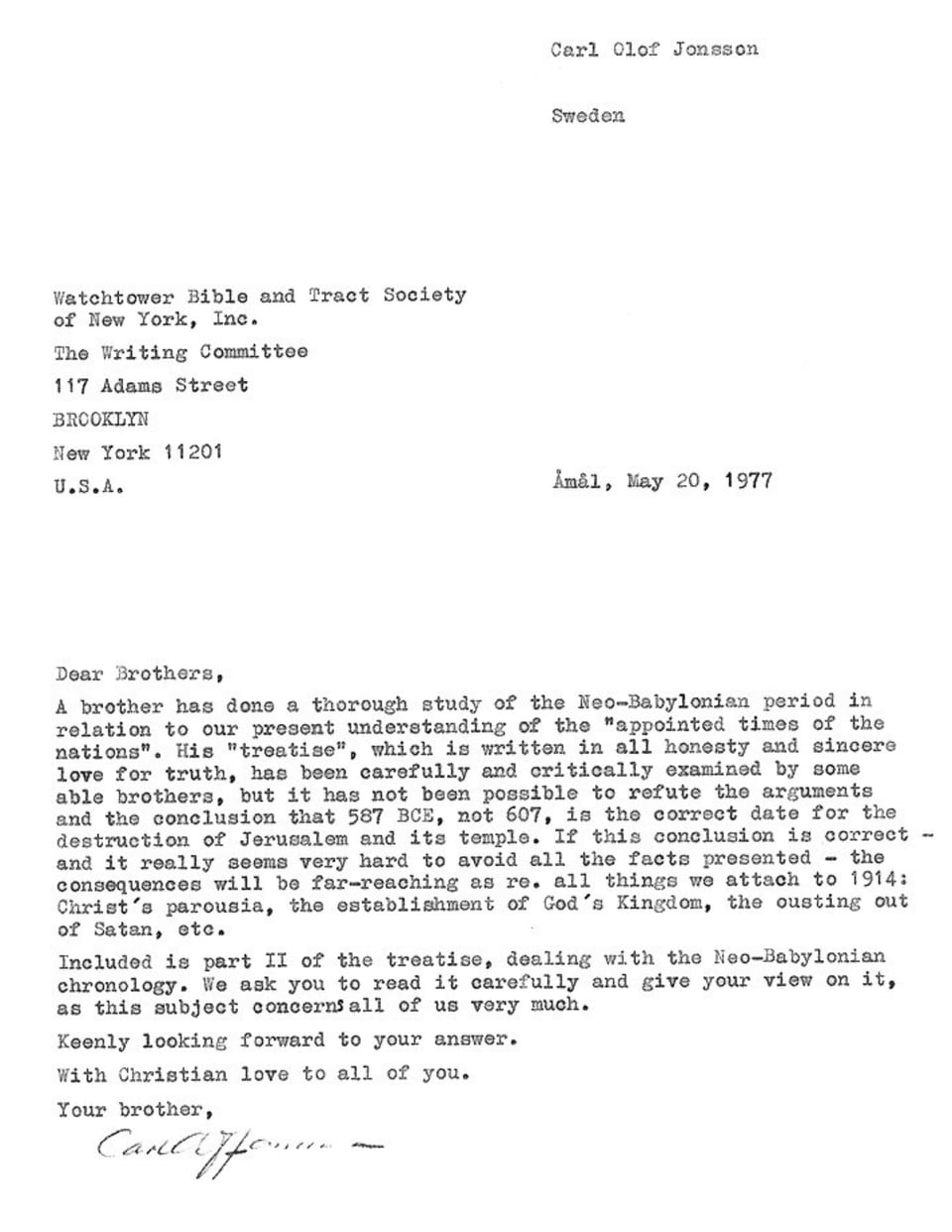
Sweden
Watchtower Bible and Tract Society of New York, Inc.
The Writing Committee
117 Adams Street
BROOKLYN
New York 11201
U.S.A.
Amal, May 20, 1977
Dear Brothers,
A brother has done a thorough study of the Neo-Babylonian period in relation to our present understanding of the "appointed times of the nations". His "treatise", which is written in all honesty and sincere love for truth, has been carefully and critically examined by some able brothers, but it has not been possible to refute the arguments and the conclusion that 587 BCE, not 607, is the correct date for the destruction of Jerusalem and its temple. If this conclusion is correct and it really seems very hard to avoid all the facts presented - the consequences will be far-reaching as re. all things we attach to 1914: Christ's parousia, the establishment of God's Kingdom, the ousting out of Satan, etc.
Included is part II of the treatise, dealing with the Neo-Babylonian chronology. We ask you to read it carefully and give your view on it, as this subject concerns all of us very much.
Keenly looking forward to your answer.
With Christian love to all of you.
Your brother,
Cancellation TELEPHONE (212) 423-1240
CABLE WATCHTOWER
117 ADAMS STREET, BROOKLYN, NEW YORK 11201, U.S.A.
EG:EI August 19, 1977
Mr. Carl Olof Jonsson
Sweden
Dear Brother Jonsson:
Thank you for your letter of May 20 and the material that you sent along with it. We are sorry that the press of work here has not allowed us to give it the attention we would like up to the present time.
In your letter you mention sending us part II of the prepared treatise, but you did submit a page that is called Part I. Is that the extent of Part I? We mention this because we would be interested in obtaining the entire treatise. If that is the extent of Part I, then we would like to obtain Part III, if that is something that has already been prepared.
Also, we would like to get from you the name and address of the brother who has done the research and prepared this treatise. We are now obtaining some of the reference material mentioned in his footnotes and would like to have his name and address available in case we have any questions to ask. You mention that the material has been examined by a number of brothers. So if there are others that you are in contact with who are involved with this undertaking and who might be able to supply observations if we seek such, we would appreciate knowing of these.
Thank you for your kind attention to the above request.
Your brothers,
Walt Whitman B. D. S. Society OF NEW YORK, INC.
EG = Gene Smalley , Writing Dpt.
Carl Olof Jonsson
Sweden
Watchtower Bible and Tract Society of New York, Inc.
The Writing Committee
117 Adams Street
BROOKLYN
New York 11201
Amal, Sept. 5, 1977
U. S.A.
Re. "The Gentile Times Reconsidered"
Dear Brothers,
Thank you greatly for your kind letter of August 19, which I received some days ago. I prepared the above treatise, and as I told you some able brothers have critically examined the manuscript and helped me to make some improvements , especially in Part I. Also, one brother and good friend in U.S.A. has been of great help in correcting my English. I didn't think the names involved in this research to be important, but as I understand that you intend to investigate this subject carefully and objectively (which is really very gratifying) I am prepared to answer all questions I can, and I will also send the other brothers any questions you have. Thus we could work on this together and send you all important information and observations we might come up with.
Included now is Part I of the manuscript, containing a historical survey of the interpretations of the "Gentile times" from the first century and on to and including C.T. Russell. The purpose of this work is to put our present understanding of the subject into a historical setting and prepare the mind for the information presented in Parts II and III. Unfortunately, I am still working on Part III. I have a rough draft written in Swedish and also a lot of notes, but the problem is to write it out clearly and understandably in English. Hopefully, it will be ready in October. This part deals with the scriptures containing the 70-year prophecy (Jer. 25, 29; Dan. 9; 2 Chron. 36; Zech. 1, 7, etc.), the Scriptural basis for the calculation of the Gentile times to be a period of 2,520 years, and a discussion of the 1914 date. Of course, this part of the work just gives some suggested alternatives, and much more research will be needed to clear up all problems. As soon as it is ready, I will send you a copy.
In your letter you mention that you are obtaining some of the reference material mentioned in the footnotes. As I have almost everything of it Keroxed here at my home, I will gladly send you whatever you need, if this will facilitate your investigation.
With Christian love.
Your brother,
Canoniffonsia Sweden
Watchtower Bible and Tract Society of New York, Inc.
Writing Dept., Desk EG
117 Adams Street
BROOKLYN
New York 11201
Amal, Dec. 12, 1977.
Re. "The Gentile Times Reconsidered"
Dear Brothers,
I hope that you received Part I of the above treatise as you requested. It was sent to you on Sept. 5, 1977. I have sent you today, under separate cover (air mail), Part III, which I promised to send you during October, but which has been delayed for several reasons. First of all, the last part turned out to be longer than was intended, in spite of the fact that several things have been touched upon very briefly. The correction of the English took some time, too, and besides, the manuscript has been prepared amidst many other responsibilities, both in the congregation and in my secular work.
Several brothers have now examined the treatise, and most of them tend to agree about the conclusions. We hope, therefore, that you will give the evidence and arguments presented a careful and objective examination. Although some of the evidence may seem to be rather critically presented, it should be borne in mind that the criticism has always reference to an idea which clearly seems to be wrong, never to individuals or an association of individuals. The treatise has been written in a humble state of mind, with love for truth and with a view to the best interests for all of us. I hope, therefore, that the argumentation is not interpreted as being provocative, as this has never been intended.
We are all eagerly looking forward to your comments.
With Christian love to all of you.
Your brother,
PS: On p. 27 of my treatise, the last sentence and footnote 20 referred to a Robert R. Newton, who some years ago exposed Claudius Ptolemy to have "fudged" some of his observations. Perhaps you are aware of the fact that he has now published a book about the matter: The Crime of Claudius Ptolemy, 1977 (John Hopkins University Press). According to Scientific American (Oct. 1977, p.79f) "Newton has also discovered that a large fraction of the observations Ptolemy attributed to other astronomers is not material he has preserved from the past but material he has forged. ... Moreover, Ptolemy's forgery may have extended to inventing the length of reigns of Babylonian kings." Thus the critical attitude taken in the Aid book to Ptolemy is surely justified. "It is clear,' Newton concludes his book, 'that no statement made by Ptolemy can be accepted unless it is confirmed by writers who are totally independent of Ptolemy on the matters in question." This is exactly what has been done in Part II of my treatise, as the Neo-Babylonian chronology is established by several lines of evidence independent of Ptolemy's canon. These show Ptolemy's list to be correct with respect to the Neo-Babylonian period.
124 COLUMBIA HEIGHTS, BROOKLYN, NEW YORK 11201, U.S.A.
GEA:ESB
January 17, 1978
Carl Olof Jonsson
Sweden
Dear Brother Jonsson:
To hand is your letter of December 12, 1977, and also the treatise that you have prepared entitled "The Gentile Times Reconsidered."
We have not had the opportunity of examining this material as yet, as other urgent matters are occupying our attention. However, we will look into this material when we have the opportunity.
We appreciate your sincerity in wanting to set forth your views. However, no matter how strong the argumentation may be in support of these views, they must, for the present, be regarded as your personal viewpoint. It is not something that you should talk about or try to advance among other members of the congregation. We mention this because you state in your letter that several brothers have examined your treatise and that "we are all eagerly looking forward to your comments."
As you can appreciate, what you state in your treatise amounts to a radical departure from the present understanding of chronology by Jehovah's Witnesses. We are sure that you can appreciate that if changes of importance are made they should be made in an orderly way, even as was the case in the first century, with central direction being given. (Acts 15:1, 2) We are also sure that you appreciate that for individuals to advance and advocate such changes would have, not a unifying effect, but a divisive one producing confusion. We mention this to you in view of the fact that the treatise you sent contains a statement on the front page describing it as "prepared by Jehovah's Witnesses, for Jehovah's Witnesses." To say that something is "prepared by Jehovah's Witnesses" implies that it has the sanction of Jehovah's Witnesses as a body, and we are sure you realize that this is not the case with the treatise at hand. This could give a false impression and we are confident that this is not your desire. You can be assured that your views will be examined by responsible Carl Olof Jonsson
January 17, 1978
Page II
brothers, and that if doctrinal change should be made at some time it will come through the proper channels. This is important in preserving the unity of Jehovah's organization.
It is hoped that you will observe the counsel supplied above In due course we hope to look into your treatise and evaluate what is contained therein.
Please be assured of our warm love and best wishes.
Your brothers,
Watch Tower A. G. T. Society
For the Writing Committee of the Governing Body
GEA = W.L.
Barry .
Governor . Body Sweden
Watchtower Bible and Tract Society of New York, Inc.
Writing Dept., Desk GEA
117 Adams Street
BROOKLYN
New York 11201
Amal, February 22, 1978
Re. "The Gentile Times Reconsidered"
Dear Brothers,
I appreciated your letter of January 17 and your promise that my treatise will be examined by "responsible brothers". Surely we all realize the importance of this matter, as it does not concern some little detail only, but the "corner-stone" in our eschatological building. Therefore, as the search for and spreading of truth is the primary reason for our existence as a movement, this subject cannot be handled indifferently or postponed to some indeterminate future. A cook who was notified of the evidence indicating that some of the food he prepares seems to be poisoned would no doubt immediately begin to examine the matter and in the meantime he would be careful not to have the suspected food being brought in to the guests. Doesn't the same hold true of the spiritual food, too?
You evidently misunderstood the statement I made in my former letter that "several brothers have now examined the treatise". I am not talking about or trying to advance the evidence presented in the treatise among members in the congregation, as I am well aware of the disturbing effects this could have on the brothers in general. Love for truth and the brothers does not cause divisions and confusion, but as you know many brothers tend to regard the things written in the Watchtower publications as nearly inspired by God and therefore above critical examination in the light of the Scriptures. (Acts 17:11) I am sure you agree that such an attitude is very unfortunate and should be opposed. Because of this attitude open inquiry has to be avoided, as it time and again is met with irrational reactions. The treatise has been examined by six knowledgeable brothers in Sweden (none of whom belong to our congregation) and about eight brothers in USA and other countries. But as it is probably impossible for everyone involved to keep this delicate question secret, I think it will be spread around more and more as time goes by. There is some evidence of this already. This could in time cause a lot of trouble, but I am sure you will have cleared up the matter before that.
Another thing you comment upon is the statement on the front page that the treatise is "written by and for Jehovah's witnesses". As some brothers have been of great help in examining and correcting the treatise and have given several good suggestions and amendments, I felt it all right to state that the treatise was the result of the research of several witnesses, and also that it was intended for Jehovah's witnesses, not for our opponents who could use it as a forceful weapon against us. None of the brothers who have read the treatise has hitherto misunderstood this statement, concluding that the work "has the sanction of Jehovah's Witnesses as a body". But I understand your feelings about this detail and have changed the statement on the front page of my original. Enclosed is a copy of the new front page which you may exchange for the old one.
Some other minor details, too, have been changed in the treatise especially some statements about Ptolemy which have been corrected in accordance with the evidence presented by R. R. Newton in his book The Crime of Claudius Ptolemy (see the PS in my former letter). These changes do not change any of the lines of evidence presented against the 607 BCE date, but have been done for the sake of exactness.
Another correction refers to footnote 21, page 63, where "8 months" should read "4 months" and "10 months" should read "2 months". The changed pages are enclosed so you may exhange them.
With warm Christian love.
Your brother in the service of Jehovah and his truth,
Cancliffum Albert D.
Schroeder Watchtower Bible and Tract Society of New York, Inc. Writing Dept. 117 Adams Street BROOKLYN New York 11201
Amal, December 6, 1978
Dear Brother,
I suppose that you are aware of (and probably have read) my treatise The Gentile Times Reconsidered, which I sent to the Writing Department last year. This treatise presented a series of arguments demonstrating that Jerusalem was desolated by the Babylonians in 587 B.C.E., not in 607 B.C.E. as we have held hitherto. Although I have not yet received an answer with an appraisement of the evidence presented in the treatise, I understand and have been informed that one reason why the evidence has been disregarded is the importance you attach to a recent work by Robert R. Newton entitled The Crime of Claudius Ptolemy (Baltimore 1977), and especially the statement by the reviewer of this book in Scientific American of Oct. 1977, p. 80, to the effect that "Ptolemy's forgery may have extended to inventing the length of reigns of Babylonian kings". This statement, which was also quoted in the Watchtower of Dec. 15, 1977, p. 747, may be completely disproved, as is shown in the enclosed paper (a table with short comments) on The Reigns of Babylonian Kings: A Comparison of the Canon of Ptolemy with Older Sources, prepared early this year.
There are two reasons, brother Schroeder, why I am approaching you personally in this matter: 1) One of the district overseers here in Sweden, brother Rolf Svensson, told me that you are something of an expert on chronology at the headquarters, and 2) he also told me about a meeting that you held in Europe early in August with a number of prominent brothers. At that meeting you told the audience;
A. that a campaign now is going on in USA both from the outside (the Seventh Day Adventists) and from the inside of our movement in order to overthrow our present 607 BCE -1914 CE chronology,
B. that the Society has no intention at all to abandon the chronology in its present form,
C. that some of the old documents referred to by these "attackers" have been proven to be forged (Ptolemy's king list was mentioned) and that the Society is following this matter with the greatest interest, and
D. that there is nothing in the arguments proposed by these "attackers" that is new to the Society.
This was, of course, very interesting information to me, and I would like to make some comments on it and ask you some questions which I hope you will be kind enough to answer.
A. The campaign. Is it possible that you regard the research I have done on the Neo-Babylonian chronology and the evidence I have presented to the Writing Department as a part of the above-mentioned campaign? At least it seems that brothers in leading positions here in Sweden have understood your statement that way. I have been told by one district overseer that it is against the wishes of the Society to become involved in research of the kind I have done, that the Society does not need it, that a brother on Iceland recently was disfellowshipped because of his research, etc. Warnings of similar kind are also presented from the platform. At a circuit assembly I visited some weeks ago another district overseer spoke ironically of some "presumptuous brothers", who, acting as "small prophets", have worked out "their own little chronology" in opposition to the Society. Another brother, who belongs to the branch office committee, in an address he gives to the congregations, devotes considerable time to warnings against "dangerous elements" in the congregations, among which elements he especially refers to brothers who have no faith in the chronology of the Society. I think you can guess what kind of climate that develops from utterances such as these - a climate of fear, suspiciousness, etc., where you time and again find that some brother has interpreted a harmless remark you have made in a way that may be turned against you.
My research was started more than ten years ago as a result of questions put to me by a man I studied the Bible with. Gradually it dawned upon me that the generally accepted chronology for the Neo- Babylonian period has very strong evidences in support of it. I tried very hard to refute them, but could not, and at last I had to accept them. After having discussed the evidence with some of my closest friends (personally or by letter) for some time, it was decided that they should be presented to the Society. Consequently, I prepared the treatise The Gentile Times Reconsidered and sent it to the Writing Department. This work has been done with the greatest seriousness and in all sincerity. How tragically, then, to observe how a situation develops, where the attention is drawn away from the question raised - the validity of the 607 BCE date - and directed to the person who raised it, and he - not the question - is regarded as the problem! This is really distressing. How is it possible that a situation of this kind develops in our movement?
B. Abandon the chronology or not? I can readily understand the hesitation to abandon the chronology, even if the evidences against it are very strong. Abandonning the 607 BCE - 1914 CE calculation would have very serious consequences for our present understanding of the events since 1914 (as I also demonstrated in Part III of the treatise). And I can also understand the argument used by brother Fred Rusk to a close friend of mine, who recently visited the headquarters and discussed the chronology with him, viz., that "we cannot just take away the 1914 date, if we have nothing to put in its place". On the other hand, love for truth has been one of the most important earmarks of our movement and surely this has been one of the reasons why God has blessed this movement in the past. Those loving the truth will have no problems with even big changes, as they realize that the changes are made in order to conform to truth and facts. I know many brothers (who know nothing of the evidences against the 607 BCE date), who now have increasing problems with our present chronology, just because they see the 1914 date becoming more and more distant and the generation fixed to it extended to the breaking-point, and the critical decade of the 1970s (with the 1975 date) soon behind us. There is a widespread and growing feeling that something is basically wrong, and this is, surely, our chronology.
Do we really need "something to put in its place"? To a Christian the Bible and what is contained therein is enough as a foundation for his faith. And he finds no 607 BCE or 1914 CE dates there. The first Christians had no such dates, and yet what they had was enough for them. When they asked Jesus about the time when the kingdom of God would be set up, he did not give them any dates or chronological calculations, and he did not refer them to Daniel, chapter four. He just told them that "It does not belong to you to get knowledge of the times (kairoi) and seasons which the Father has placed in his own jurisdiction". - Acts 1:6,7. Shouldn't this statement be enough to put in place of the 607-1914 calculation?
C. Forged documents? I was really surprised to hear that some of the documents establishing the chronology of the Neo-Babylonian period have been proven to be forged. I asked myself: If this is true, why wasn't I notified of it as an answer to my treatise? This would surely have been very helpful to me. I know nothing of such forgeries, although I have studied these documents for years and been following the discussions of them in the scientific journals. But soon I realized that the "documents" referred to could only be Ptolemy's king list (which I did not use as an evidence in my treatise). And perhaps you did not say that this king list has been proven to be forged (as it has not), but only that it could be proved. Brother Rusk, too, in his above-mentioned discussion with my friend, referred to the possible invention of Ptolemy's king list, and did not seem to know anything about other forgeries. So I draw the conclusion that this list is the "documents" referred to. Could you confirm this?
Ptolemy's king list was not invented, as I have demonstrated in the enclosed paper on The Reigns of Babylonian Kings, in which Ptolemy's canon is compared with the reigns of the Babylonian kings as found in other and much older documents. Ptolemy evidently got his information from older sources, available to him. On the other hand, R. B. Newton seemed to have demonstrated that Ptolemy had forged many of the astronomical observations attached to this king list in his Almagest. How could it be possible that these observations were forged, if the king list was not? In order to get an answer to this question, I sent my paper on The Reigns of Babylonian Kings to Mr. Newton and asked some questions. I also asked some questions about the solar eclipse in the eponymy of Bur-Sagale, mentioned in the eponym canon.
Mr. Newton is no expert on Assyro-Babylonian chronology and history, which he also readily admits in his book The Crime of Claudius Ptolemy: "I have not attempted to study the evidence available from sources other than Ptolemy for earlier years", that is, before Nebuchadnezzar (p. 375). This also became evident in our correspondence. Although he had examined the astronomical diary VAT 4956 and confirmed the date earlier established for Nebuchadnezzar's 37th regnal year (568/567 BCE), and thus also could fix Nebuchadnezzar's first regnal year to 604/603 BCE, he knew practically nothing about the old documents on which the Assyro-Babylonian chronology is founded. This is clearly demonstrated in his discussion of the Assyrian eponym canon, where he makes a very gross blunder. (Unfortunately, it seems as if the discussion of the eponym lists in the Aid book proceeds from the same mistake, giving the impression that the placing of Sennacherib's eponymy in his 18th regnal year is an invention by modern historians, while this information is given in the eponym lists themselves! p. 326:4,5)
In his answer, Newton admits that "the king list may be genuine", and by this he does not only mean that it was not invented (because this is very apparent from my table), but also that it may be correct. This is two different thing: The canon was not invented, but took its information from older sources. But does it agree with facts? The answer to this question is of course dependent on the question if the older sources agree with facts. And this was what I demonstrated in my treatise, where I presented several lines of independent evidence, demonstrating that the accepted chronology of the Neo-Babylonian period is correct.
There are also other lines of evidence, not included in the treatise, which fix the length of the Neo-Babylonian period, but as it covers different segments of the period and not the whole period I did not include it in the treatise. One of these segments, for example, covers the period from the 16th year of Nabopolassar to the accession-year of Nabonidus. A document from the reign of Nabonidus states that this period was 54 years (610-556 BCE). - I enclose Newton's answer and also a copy of my answer to his letter. He did not answer my last letter, evidently because he could not refute it.
D. Nothing new? Of course you could say so in August, 1978. But when you received Part II of my treatise in May, 1977, didn't you find anything new in it? What about the Harran stele, Nabon. H 1, B? This stele was discovered in 1956, and a translation of it was published by Gadd in 1958. Did you know anything about this stele when the Aid book was published in 1971? I draw the conclusion that you didn't, because if you did, you wouldn't have referred to the damaged copy of the same stele, discovered in 1906, without mentioning the stele with the complete chronological information on it, discovered 50 years later. To discuss the damaged stele in order to demonstrate how little we know about the Neo-Babylonian chronology would not have been honest, if you knew about the new stele in good condition from 1956. As I am convinced that the one who wrote that article was an honest man, I must conclude that he didn't know of the new stele from 1956. To me it also seems very unlikely that you knew anything about the Egibi-tablets and the strong evidence they give for the Neo-Babylonian period, or the evidence from the contemporary chronology of Egypt, independently founded upon a series of Apis-stelae. The three kinds of evidence mentioned above are all contemporary with the Neo-Babylonian period, they are all independent of each other, and yet they all agree as to the length of the Neo-Babylonian period. They are the strongest evidence we have today as respecting the length of the Neo-Babylonian period. Yet, none of them have ever been mentioned in any of our publications, neither in the Aid book nor elsewhere. If this evidence was "nothing new", it seems very curious to me that it has never been discussed or mentioned anywhere, and no attempts have been made to refute it. Are you sure that nothing of this was new when the Aid book was prepared, or when you got my treatise in 1977?
One objection to my arguments against the 607 BCE date is that they are all built upon "worldly" or "profane" sources. To this it is only to point out that a very great part of our present "Bible chronology", too, is built solely on "worldly" sources, viz., the more than 2,500 years from 539 BCE to 1978 CE. And besides, exactly the same kind of evidence (= profane or worldly documents) that makes the 539 BCE date an "absolute date" or a "pivotal date" in our present chronology also makes the 587 date (as the 18th date of Nebuchadnezzar, when Jerusalem was destroyed) an "absolute date" or a "pivotal date". The fact is that our whole "Bible chronology", which is fixed to the 539 BCE date, for that reason is solely founded upon "worldly" sources! Every argument put forth against the documents on which the 587 BCE date is built also hits the 539 BCE date with the same force, and, indirectly, also the 607 BCE date, as that date is derived from the 539 BCE date! This is the real situation, and that is why we should accept the 587 BCE date instead of the 607 BCE date as the correct date for the destruction of Jerusalem.
I am confident that you won't take offence at my outspokenness, but will examine the enclosed material with an open mind. Feel sure that I have the best thoughts of all of you and, in spite of the present difficulties, am praying that Jehovah will continue to lead us all into his truth more fully and to show Christian love to each others. I am looking forward to your answer. Your brother,
Carl Olof Jonsson
Sweden
Dear Brother Jonsson:
We are writing to inform you that your letter of December 6, with enclosure, addressed to Brother A. D. Schroeder, has been safely received and has been passed to the Writing Department. We are not at the moment making any reply or comment on the points raised in your letter.
Please be assured of our best wishes.
Your brothers,
Washington B. D. Society
OF NEW YORK, INC.
EW = E.C.
Caitty.
Writ. Dept.
TELEPHONE (212) 425-1240
CABLE WATCHTOWER
117 ADAMS STREET, BROOKLYN, NEW YORK 11201, U.S.A.
EW:ESE January 1, 1979
Carl Olof Jonsson
Sweden
Dear Brother Jonsson:
Further to our letter of December 22, there are a few comments that we would like to make.
We wish to advise you that we are not disregarding or dismissing what you have written, either in your letter with enclosures addressed to Brother Schroeder or in your previous correspondence sent to us. It is evident that you have done much research and we have no desire to imply that you are not conscientious in your presentation and motives. You clearly feel the secular evidence found is sufficient to reach a positive conclusion. We do not share that firm conviction and, therefore, believe it is better for the present to reserve our judgment.
With regard to doing research on the subject, as mentioned on page 2 of your letter, this is entirely a matter for personal decision and responsibility. It certainly would not be true to say that anyone has been disfellowshiped because of doing research. However, whether or not as a result of doing this, if anyone keeps on pushing his views on a certain subject to the extent of causing public controversy and dispute, and hence disunity, then in the interests of the brothers, it requires that some action be taken. If there is any question about a certain matter, then, until that can be settled and made plain to all beyond any reasonable dispute, it is better to show consideration by not making a big issue over it, giving rise to dissension and debate.--1 Cor. 1:10, 11.
We much appreciate the closing expressions in your letter and assure you of our warm Christian love.
Your brothers,
Watchtower B. V. J. Society
OF NEW YORK, INC.
EW =
E.C. Chitty,
Writ. Dept.
WATCHTOWER BIBLE AND TRACT SOCIETY OF NEW YORK, INC.
CABLE WATCHTOWER
117 ADAMS STREET, BROOKLYN, NEW YORK 11201, U.S.A. PHONE (212) 625-1240 EJ:ESC February 28, 1980
Carl Olof Jonsson
EJ = C. Chain , Writ. Dept .
Sweden
Dear Brother Jonsson:
We are sorry for the long delay in sending a further reply to you with regard to the material you submitted to the Society in 1977 on the subject of ancient chronology. For some years before receiving the information that you provided and even during the years since receiving it the Society has continued to gather materials on the subject of Biblical and secular chronology. We appreciate what you have submitted and have read it and thought about it. In no way has it been forgotten or merely shoved aside as if of no importance. We are also in possession of your material entitled "The Gentile Times Reconsidered." This too has been read and will be subject to further consideration in the future.
We recognize that the research represented by the material that you have given us has required considerable time. Also we recognize that much time and effort went into writing up the information in the form in which you submitted it to us. Since you are quite evidently interested in promoting a better understanding of the inspired Word of God and have put forth so much effort to make a contribution to that end, we feel that it is only fair to make some comments about your material. We would like, though, to mention two problems that present themselves: (1) We do not feel that it would be proper for us to enter into point-for-point debate over every detail where we disagree or remain unconvinced about conclusions to which you have come. This would be out of harmony with the spirit of what is said about "questionings" and "debates" at 1 Timothy 6:3-5; (2) the material that you sent us with regard to chronology in itself covers scores of typewritten pages, and the information entitled "The Gentile Times Reconsidered" runs to 107 typewritten pages. Since those who handle correspondence for the Society have a considerable load of work to process each day, it is neither possible nor would it be fair to others for us to enter into lengthy correspondence with you. We do not mean that any answer you choose to give to this letter would be ignored. Whatever you say will be read and carefully considered. But the Society cannot enter into lengthy and repeated correspondence on these matters. As in the case of any subject, all we can do is endeavor to gather the best and most reliable materials and to draw conclusions from them that harmonize wholly with the inspired Word of God.
We will, however, make an effort to offer a few comments with regard to some points made in the materials that you sent to us. First of all, as to the Canon of Ptolemy, the Society cannot accept Ptolemy's figures for Babylonian kings as an unerring guide for the chronology of that period. The Canon of Ptolemy is composed basically of two things—history and astronomical information. Ptolemy had at his disposal some historical documents that gave the lengths of reign for Babylonian kings and he also had at his disposal astronomical information. When he gives information about eclipses, that information is correct.
But when he synchronizes that information with years of certain kings, that is another matter. There is no evidence that Ptolemy had at his disposal documents contemporary with the Neo-Babylonian period. Possibly he had access to certain "astronomical diaries" that give the name and year of a certain king along with observations of planetary positions during the year. However, all of such astronomical diaries that have been preserved down to our day date from the Seleucid Era. They are copies from earlier documents. The earlier documents themselves may have been copies from originals written during the Neo-Babylonian period. Ptolemy's figures for Babylonian kings agree with other figures available from such copies of astronomical diaries written during the Seleucid Era.
An example is the tablet known as VAT 4956. It appears from the information that you sent us that you are in possession of the article about (and translation into German of) this tablet provided by Paul Neugebauer and Ernst Weidner in 1915. You will note that on page 38 of the German text (as we translate into English) the following: "Our copy of this observation text was not made in the year -567/66 itself. It is rather a copy of a much later time." The authors also point out: "Additionally attention is called to the signature . . . which leads to the first line of the following tablet dealing with Nebuchadnezzar's 38th year. Our tablet therefore belongs to a collection of astronomical observation texts which probably covered a long period of time and were designed to serve as a basis for theoretical astronomical work." It is true that on page 39 the same authors state: "As far as contents are concerned, of course, our copy is a true picture of the original." While this opinion may be correct for the astronomical information on the tablet, it does not necessarily hold true regarding its historical details. While the astronomical information on this tablet points to the year -567/66 (568-567 B.C.E.), attributing the tablet to the 37th year of Nebuchadnezzar may be simply the opinion of a scribe assembling and dating "a collection of astronomical observation texts," working at a "much later" period, who came to accept historical data that corresponds with that later presented by Ptolemy.
We do not mean by this, Brother Jonsson, that the Society views all of Ptolemy's figures as incorrect. For example, Ptolemy allows 43 years for Nebucahdnezzar; and this is confirmed by the Bible itself.
As for chronicle texts that have survived down to our time from ancient Babylon, these cover only relatively small parts of the Neo-Babylonian kingdom. For example, we have information from chronicle texts for the first eleven years of Nebuchadnezzar and for his 37th year, for the third year of Neriglissar, but nothing from Amel Marduk and Labashi Marduk. Only part of the reign of Nabonidus is covered. While the years of Babylonian kings named in these chronicle texts do not contradict the Canon of Ptolemy, in themselves they are not sufficient to constitute full and absolute verification of all of Ptolemy's figures.
What, then, about the Nabonidus Harran Stele designated NABON H1, B. It appears from your correspondence that you have a copy of the article about this document published in Anatolian Studies, Vol. 8, 1958. We note that Ptolemy's Canon allows for the period between Assyrian King Esarhaddon and Nabopolassar of Babylon a period of 42 years. The Nabonidus Harran stele gives 42 years for Assurbanipal, who succeeded Esarhaddon.
But before Nabopolassar this inscription presents a 3-year reign for a certain king Assur-etillu-ili. And there is a contract tablet dated to the fourth year of Assur-etillu-ili. C.J. Gadd, translator into English of NABON H1, B, points out a further problem: "This difficulty is much increased when the reign of Sin-sar-iskun is also taken into consideration, for there has appeared to be sufficient indication that he too was king of Assyria before the accession of Nabopolassar . . Nothing is known about the relations of Assur-etillu-ili and Sin-sar-iskun, both of whom were successors of Assurbanipal, one, probably both, being his son. The former is shown by contracts to have ruled for at least four, the latter for at least seven, years."
The same author also states: "In the present state of our knowledge it is hardly worthwhile elaborating conjectures to account for these seeming discrepancies: (a) that the Harran inscription appears to require about two years more between the death of Assurbanipal and the accession of Nabopolassar than our evidence, including the Ptolemaic Canon, puts at our disposal; (b) that the reign of Sin-sar-iskun, which otherwise should have begun before that of Nabopolassar, is now seemingly excluded from the brief interval then occurring." These chronological difficulties presented by contemporary cuneiform texts as well as the Canon of Ptolemy have engaged the attention of scholars. In view of the facts, we feel neither compelled nor inclined to view the figures in the Canon of Ptolemy as an infallible guide in matters of chronology.
With regard to business documents such as are presented by the Egibi House tablets, we know that there are tablets for all years of Neo-Babylonian kings represented in the Canon of Ptolemy. But can we say without doubt that the tablets from Egibi House represent every year of every king of that period? Can we say with certainty that none of those kings ruled during years not represented by tablets from the Egibi House? Surely we cannot. For example, during the reign of Darius I there are no records from Egibi House for years 7,32,33,34 and 36. But we would not be warranted in saying that this king did not rule during those years simply on the basis of there being no tablets. We cannot say with certainty that Neo-Babylonian kings ruled only during years represented by such tablets.
As to the synchronism of Egyptian chronology with Babylonian kings and also rulers of Judah, the lengths of reign that can be verified by stelae do not extend beyond the time of Nebuchadnezzar's reign. We see no reason to disagree with the figures that synchronize with kings in Babylon and Judah before the time of Nebuchadnezzar. However, for the reigns after that time, for instance, for the reigns of Amasis and Psammetichus III there is some disagreement in historical sources. With regard to Amasis, according to one source, Manetho attributes to him 44 years. However, Syncellus quotes Manetho as giving him only 42 years. The highest date for Amasis known on monuments is year 44. Interestingly, though, Diodorus of Sicily (I, 68) attributes to this king 55 years. With regard to Psammetichus III, Manetho attributes to him a ruler-ship of six months. However, the highest date available from monuments for this king is year 2; and a document mentioned in the publication Notice des papyrus démotiques archaïques (by Revillout) gives four years of rule to a King Psammetichus that the author claims is Psammetichus III. Hence, some historical sources for the kings Amasis and Psammetichus III give more years than the lengths of reign commonly accepted.
As to the years when Psammetichus reigned, some scholars (Unger, Wiedemann, Petrie) state that this king reigned in 526 and 525 B.C.E., whereas other scholars (Krall and Spiegelberg) prefer the years 528 and 527 B.C.E. In view of this, we can say with certainty that the chronology for the 26th dynasty of Egypt absolutely confirms the figures in the Canon of Ptolemy for the Neo-Babylonian period? Surely we cannot make such a claim.
We note that in the material about "The Gentile Times Reconsidered," beginning on page 51, you advance the opinion that the Babylonian captivity began in the accession year of Nebuchadnezzar. As one line of evidence for this you cite the Babylonian chronicle as published by Wiseman, which includes this statement: "At that time Nebuchadrezzar conquered the whole area of the Hatti-country." However, the translation that appears in Assyrian and Babylonian Chronicles, by A. K. Grayson does not have "Hatti-country" in this place, but rather "Ha[ma]th." In a note Grayson says: "Kur Ha-[ma-a]-tu: a restoration Ha-[at]-tu is to be rejected on the grounds that otherwise it appears Hat-tu in this chronicle."
According to Josephus, as acknowledged in your material, at Carchemish Nebuchadnezzar "occupied all Syria, with the exception of Judah." With this the Scriptures agree. Jeremiah states that Nebuchadnezzar took Jews into captivity "in the seventh year," "in the eighteenth year" and in "the twenty-third year" of his reign. (Jer. 52:28-30) The fact that Nebuchadnezzar took "heavy tribute" from Hatti-land does not have to mean that the seventy years of captivity to Babylon had begun. Gentile kings previous to Nebuchadnezzar had also taken tribute from Judah.
Once again, Brother Jonsson, we express appreciation for the hard work that you have done on the material that you have sent to us. There are many valuable observations in it, both from the Scriptures and from secular sources and we will keep it on file for reference. However, at present the Society has no plans for publishing anything additional or different from what already has been published on this subject.
Nevertheless, as information continues to flow in, it may be that something of this type can be done in the future. Once again, thank you for the considerable time and effort that you have put forth in order to promote a clearer understanding of a most difficult subject. We send our love and greetings.
Your brothers,
Marsh Tower B.V. Society
OF NEW YORK, INC.
Watchtower Bible and Tract Society of New York, Ino.
Writing Dept. (EJ:ESC)
Brooklyn, New York 11201
March 31, 1980
Dear Brothers:
Your letter of February 28, 1980, arrived safely about two weeks ago. First, I would like to tell you that I appreciated it, and especially the way in which it was written: discussing - in a spirit of brotherly love and respect - the question of chronology as such, not the questioner, his motives (if he is illoyal, apostate, presumptuous, etc.), his right to examine the subject and question previous conclusions, his right to share his findings with his friends and ask for their reactions, and so on - as if this was the problem. However, when a fire-alarm starts to hoot, it would not be relevant to conclude that something has gone wrong with the alarm and that a close examination of it in order to bring it to silence would solve the problem. I find it encouraging that you, in your most recent letter, turn your whole attention to the "fire", so to speak.
I appreciated also very much the initiative taken by Brother Bengt Hansson in visiting me last December for a private talk, after which he wrote to you about my situation.
Of course, I understand quite well that it is impossible for you to enter into a lengthy correspondence with me on the subject of chronology and debate over every detail in my treatise ("The Gentile Times Reconsidered"). On the other hand, I do not hesitate to answer your letter, partly because the points you brought up against my conclusions are clearly invalid, which is easy to demonstrate, and partly because I will present two additional lines of evidence to the ones earlier presented in the treatise against the 607 BCE date. I am not doing this because I find pleasure in "questionings" and "debates", or because I want to prove that I am right and you are wrong. Who is right is not important. What is right is important. Truth and facts belong to all who love them. That's why I feel I should answer your letter.
A true scientist (and any truth-lover, for that matter) invites reactions and friendly criticism, as that will give him opportunity to correct errors and bring his thoughts closer to the truth. I take it for granted that this is your attitude, too, and as you write in your letter that "whatever you say will be read and carefully considered", I feel confident that the criticism and additional information offered on the following pages will be carefully examined by you without preconceived opinions. Openness to truth, courage to look into and face the truth, and readiness to accept the truth when it is clearly seen, no matter what it turns out to be - these are the marks of a truth-lover, of a true Christian. It would be foolish to spend a lot of time and energy on trying to defend, to the very last, a certain idea or interpretation, only because there is nothing to put in its place, if all the evidences we have indicate it has nothing to do with reality.
If, nevertheless, such an idea or interpretation is published, preached and spread out to millions of people and is presented, not only as a theory, but as a basic Christian truth, the rejection of which is said to arouse the wrath of God, then this would be more than foolish. It would be a grave sin, for which Jehovah would hold us responsible.
The points you brought up will be discussed one by one under different headlines. If you choose to write some lines and tell me what you think and how you feel about the information below, this would be much appreciated. If you believe I could be of any help in your further investigation of this subject, perhaps by giving further information on some detail or sending some material you need, feel free to ask me.
I regret that this letter with the discussion on the following pages has become so long. Yet, I have tried to explain things as briefly as possible. I had intended to add some additional information on the subject, too, but perhaps that could be done in another letter in the future, if necessary.
Brothers, thank you once again for your kind letter! With Christian love.
Your brother,
Conclu tion
Carl Olof Jonsson
Enclosures:
Correspondence Jonsson-Sachs.
Some pages from J.Oates' article in Iraq XXVII, 1965.
THE CANON OF PTOLEMY
Your first comments concern the Canon of Ptolemy, and your statement that his Canon cannot be regarded as an "unerring guide" for the chronology of the Babylonian era is, of course, correct. This was basically what I said in my treatise, too. Ptolemy's figures have been accepted by modern historians, not because his Canon in itself is regarded as an unerring guide for the chronology of the Babylonian and later periods, but because (1) his figures have been confirmed by a number of much older sources for the chronology of that time, some of which are contemporary with the Neo-Babylonian era, and because (2) in his great work Almagest he establishes the chronology presented in his Canon as an absolute chronology with the aid of a large amount of astronomical material gathered from ancient sources. His calculations have been checked and verified by modern astronomers, and more than that: Modern discoveries of ancient astronomical tablets, especially so-called astronomical "diaries", have enabled modern astronomers and historians to establish the absolute chronology of almost the whole period covered by the Canon of Ptolemy, independently of Ptolemy and his eclipses, thus giving an independent confirmation of his chronology. So what matters today is not the Canon of Ptolemy, but the older documents and sources that have confirmed it: astronomical diaries, contract tablets, chronicles, king lists, contemporary Babylonian and Egyptian stelae, etc. - and the Bible.
I noticed with interest your statement about Ptolemy, that "When he gives information about eclipses, that information is correct" (p. 1). One of the ancient eclipses he records is dated to the 5th year of Nabopolassar (Almagest, V 14, p. 340), identified by modern astronomers with the lunar eclipse of April 22, 621 BCE. This, of course, fixes Nebuchadnezzar's 1st year to 604 BCE (as his father Nabopolassar ruled for 21 years), and his 18th year (when he desolated Jerusalem) to 587 BCE. I noticed some years ago that the Aid book makes an attempt to identify this eclipse with one that took place 20 years earlier, on June 1, 641 BCE, to correspond with the chronology of the Aid book. In support of this identification it is added that "This earlier eclipse was total (i.e., 12 digits or more) as compared to the very minor one of only 1.6 digits in 621 BCE" (p. 331:3). This statement proved to me that the author of the Aid article had never read the description recorded by Ptolemy and checked how this description squares with the alternative identification he presents. Ptolemy's source gave a fairly detailed description of this eclipse, including its magnitude. It is clearly stated that it was a minor one, and that only a fourth of the diameter of the moon was eclipsed. Thus the fact that the eclipse of June 1, 641 BCE, was total does not support the identification, it actually makes it impossible! I find this error all the more remarkable, as the author earlier in his article stresses the importance of knowing if an eclipse was total or not. Other details, too (the month, the day, the time of the night, etc.) make the eclipse of June 1, 641 BCE impossible and establish the eclipse of April 22, 621 BCE as the only possible eclipse that fits the description. (R.R. Newton's recent attempt to "prove" that Ptolemy fabricated some of the eclipses he records seems to have been a mistake: his "evidences" have been rejected by all competent scholars, as far as I know). This is only one of several other errors I have come across on examining the "Chronology" article in the Aid book. Excuse me for pointing this out, but I hope such errors will be corrected in future editions of this otherwise excellent and extremely valuable Bible dictionary.
ASTRONOMICAL "DIARIES": VAT 4956 - AND BM 32312!
Commenting on VAT 4956, you repeat your earlier argument (Aid, p. 331:8, discussed in my treatise, p. 39), that "while the astronomical information on this tablet points to the year -567/66 (568-567 B.C.E.), attributing the tablet to the 37th year of Nebuchadnezzar may be simply the opinion of a scribe assembling and dating 'a collection of astronomical observation texts,' working at a 'much later' period" etc. What you suggest is, that the astronomical diaries were not originally dated, but that dates (such as the "37th year of Nebuchadnezzar") were inserted in the texts by later copyists. Is this a plausible explanation, or is it a desperate attempt to explain away a text, which would otherwise once and for all puncture the 607 BCE date and establish 587 BCE as the absolute date for Nebuchadnezzar's 18th regnal year?
The astronomical diaries usually contained very detailed information about the positions of the moon and the five (then known) planets, as well as other information (meteorological events, earthquakes, market prices, and sometimes also historical events). As you point out, VAT 4956 is dated from the beginning of the 37th year to the beginning of the 38th year of Nebuchadnezzar, but this is not enough: throughout, almost all events mentioned in the text are dated, giving the month, the day, the time of the day (or night), etc. About forty dates of this kind are given during Nebuchadnezzar's 37th year, and of course it was not necessary to repeat the regnal year at all these places, as this was given at the beginning of each year (as is done also in other documents, such as annals and chronicles). Do you really think it is likely that the original texts contained all these dates during a year, but not the regnal years at the beginning of each year? Surely it must be regarded as extremely unlikely that the Babylonian astronomers would leave out such an important detail! All texts of this kind that have been discovered (about 1200 fragments of astronomical diaries have been discovered, a third of which are so well-preserved that they may be dated) are dated to the year of the reigning king. Are all these dates inserted by later copyists? Most of the diaries cover the period 385 - 60 BCE, but a number of them are copies from earlier periods. And now I will present another diary, older than VAT 4956, that once again confirms the chronology given by the Canon of Ptolemy and refutes the 607 BCE date.
In an article, entitled "Babylonian observational astronomy" and published in Philos, Trans, Royal Soc, London, ser. A. 276 (1974), pp. 43-50, professor Abraham J. Sachs (the scholar who coined the term "diaries" for these texts and without doubt the foremost authority on astronomical diaries living today) gives a short presentation of the diaries. On p. 48 he mentions that the oldest datable diary is from the year 652 BCE and says: "I found the astronomical contents to be just barely adequate to make this date virtually certain. It was a great relief when I was able to confirm the date by matching up a historical remark in the diary with the corresponding statement for -651 in a well-dated historical chronicle." (My stress). This seemed to be a text of great importance for the question of the Babylonian chronology, and as the text and a translation of it had not yet been published, I wrote to prof. Sachs and asked a couple of questions: "1.
What information in the diary makes the date -651 'virtually certain'?
"2. What kind of historical remark in the diary corresponds with what statement in which well-dated chronicle?
In his answer Prof. Sachs gave me all information I had asked for, and even sent me an IBM copy (almost as good as his photograph) of the diary in question, BM 32312. Of special interest is, that your argument that the diaries may have been dated by copyists from a much later period cannot be applied to this diary, as "year as well as month names are broken away", yet, thanks to the historical remark in the diary, this information can be supplied from another source.
Firstly, the year - 652 BCE - is fixed by the astronomical information. Sachs writes: "The preserved astronomical events (Mercury's last visibility in the east behind the Pisces, Saturn's last visibility behind Pisces, both around the 14th of month I; Mars' stationary point in Scorpio on the 17th of month I; Mercury's first visibility in Pisces on the 6th of month XII) uniquely determine the date." According to the Canon of Ptolemy, 652 BCE corresponds to the 16th year of Shamashshumukin (the predecessor as king of Babylon of Kandalanu, who was followed by Nabopolassar, the father of Nebuchadnezzar).
Secondly, the diary states that the king of Babylon was involved in a battle at a place called Hirit on the 27th day of the 12th month. If Ptolemy's chronology is correct, this battle was fought in the 16th year of Shamashshumukin. Can this be confirmed? Yes, it can. As Sachs points out, we find the same information in a well-known chronicle.
The chronicle is the so-called "Akitu Chronicle", BM 86379, latest translated by A. K. Grayson in Assyrian and Babylonian Chronicles (1975), pp. 131, 132. The chronicle covers a part of the reign of Shamashshumukin, including his 16th year. Not only is the battle at Hirit mentioned, but also the day and the month when it was fought, precisely as in the diary. Obv. 13-16 of the chronicle reads:
"On the twenty-seventh day of Adar (= 12th month) the armies of Assyria and Akkad did battle in Hirit. The army of Akkad retreated from the battlefield and a major defeat was inflicted upon them. (However), there were still hostilities (and) warfare continued."
I am sure you realize what this new evidence means. The astronomical events described in the diary fix the battle at Hirit on Adar 27 to the year 652 BCE. The "Akitu Chronicle" clearly shows that this battle at this place on this day was fought in the 16th year of Shamashshumukin. Thus, Shamashshumukin's 16th year was 652 BCE. But this is also the year given by the Canon of Ptolemy for Shamashshumukin's 16th year! Once again, as so many times before, Ptolemy's Canon is confirmed, and this at a point that also, once again, refutes our 607 BCE date. Dating the destruction of Jerusalem in the 18th year of Nebuchadnezzar to 607 BCE dislocates all dates before Nebuchadnezzar 20 years. It would, for example, put Shamashshumukin's 16th year in 672 BCE, not in 652 BCE. But this is refuted by this new diary, which is another independent witness supporting the 587 BCE date for the desolation of Jerusalem. Prof. Sachs adds in his letter: "I should perhaps add that the absolute chronology of the regnal years of Shamashshumukin was never in doubt, and it is only confirmed again by the astronomical diary."
For your convenience, I have enclosed the correspondence with Prof. Sachs and the material he sent me.
THE NABONIDUS HARRAN STELE - AND THE NABONIDUS BABYLON STELE!
Your comments on the Neo-Babylonian chronicles agree with the more detailed information I presented in my treatise, pp. 28, 29, so I will immediately proceed to your objections to the Harran inscription.
You hold that the Harran inscription is open to doubt, because it seems to present a 3-year reign for the Assyrian king Assur-etillu-ili before Nabopolassar, while contract tablets are dated up to the 4th year of this king. But since Gadd published the translation of the text in 1958, others have examined the difficulties he pointed out and offered solutions to them. The most important studies are the ones by Wolfgang von Soden (ZA, Vol. 58, 1967, pp.241-255), Joan Oates (Iraq, Vol. 28, 1965, pp.135-159), and Julian Beade (JCS, Vol. 23, 1970, pp.1-9).
After the death of Assurbanipal of Assyria and Kandalanu of Babylon (these kings might have been identical, Kandalanu being Assurbanipal's Babylonian throne-name) in 627 BCE, Assur-etillu-ili's legitimate right to the throne was opposed by a general, Sin-Shum-lishir, and then by a brother of Assur-etillu-ili, Sin-shar-ishkun. This caused a civil war, and Nabopolassar, a military commander in the south, took advantage of the situation and seized the throne of Babylon. Then, for some years, at least three armies operated at the same time in Babylonia, and it is understandable that a number of the cities changed sides more than once, as it was no longer evident which authority was to be viewed as the legitimate one. The confusing situation is reflected in all documents dated in this period, Assur-etillu-ili being regarded as king in one city while his brother Sin-shar-ishkun was accepted as king in another.
…