Correspondence Between James Zimmerman and the Watch Tower Society About a Global or Local Flood, 1997–2007
GLOBAL OR LOCAL DELUGE?
"You can let others tell you what you are allowed to think and believe. Or you may wish to investigate some of the evidence yourself and reach your own conclusion."
-Awake! Sept 2006
"It is not persecution for an informed person to expose a certain religion as being false."
The Watchtower, Nov. 15, 1963, page 688
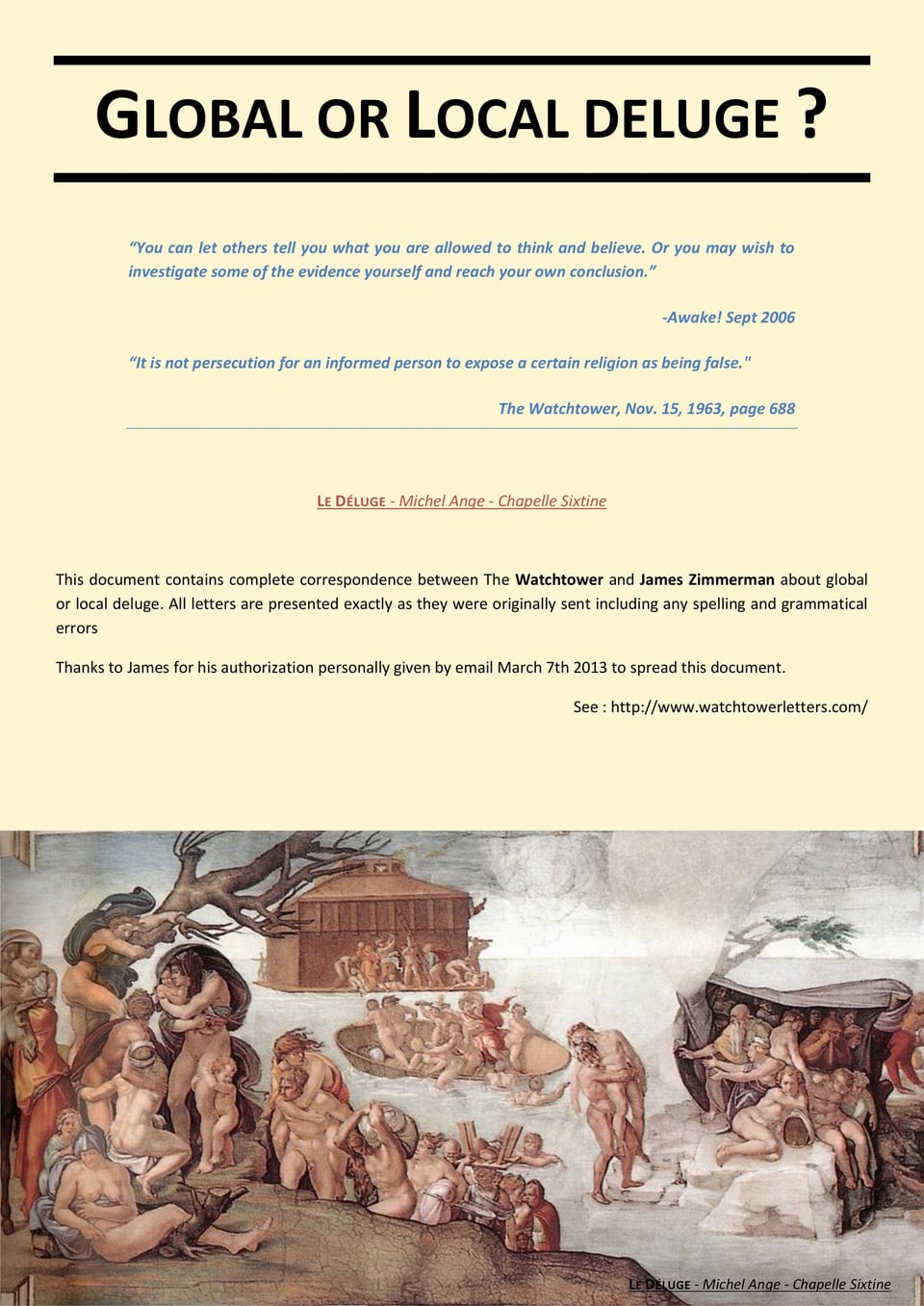
LE DÉLUGE - Michel Ange - Chapelle Sixtine
This document contains complete correspondence between The Watchtower and James Zimmerman about global or local deluge. All letters are presented exactly as they were originally sent including any spelling and grammatical errors
Thanks to James for his authorization personally given by email March 7th 2013 to spread this document.
See : http://www.watchtowerletters.com/
The 1st Letter to the Watchtower Society
Feb. 5th,1997
Dear Brothers:
Greetings! I want to start by thanking you for the informative and fascinating articles you provide. I especially enjoy reading the Awake! magazine, especially the articles about Jehovah's creations.
Lately I have been engaged in much bible study and research. I have two questions, in particular, that I hope you can answer.
The first concerns the use of the word "lands", as used in the January 1, 1997 Watchtower's worldwide report for Jehovah's Witnesses. I am confused as to, what, exactly, the term means. At first, I thought that the term could be used interchangeably with "country", but that can't be quite right. For one thing, Alaska, Hawaii, and Puerto Rico are all listed as separate lands, even though they are all part of the same country (United States). Then I thought that maybe Alaska, Hawaii and Puerto Rico were given separate entries because they are not physically part of the contiguous United States. But using this reasoning, the Florida Keys, Manhattan, Staten Island, Long Island, Nantucket and several other islands off the coast of the United States should also be given separate listings. Likewise, Britain is listed as a single entry, even though Northern Ireland is separated from England, Scotland and Wales.
I also thought, for a time, that each "land" was given its own entry if it had its own Watchtower branch office. But this can't be the case, either. For example, Kosrae, Yap, Pohnpei and Chuuk are each given their own listing even though they do not have their own branch office and, further, are all part of a single country (the Federated States of Micronesia).
So, I am not sure what, exactly, is meant by the word "land". We frequently point to the growing number of "lands" in which we preach as evidence that the work is spreading. But without knowing the precise definition of the term, it's tough to use it as a benchmark. So, I was hoping you could provide me with the answer to what is meant by the Watchtower's use of the word "land" so that I can know what is meant when we say that we've increased our preaching work from 202 lands to 213 lands.
My second question involves the flood of Noah's day. I am attempting to learn everything I can about the Great Flood. One area that I need more information about is the matter of what animals were brought onto the ark.The book Insight on the Scriptures - volume I says "Some investigators have said that just 43 "kinds" of mammals,74 "kinds" of birds,and 10 "kinds" of reptiles could have produced the great variety of species of these creatures that are known today." I have been unable to determine what is meant by a "kind". I don't think it means "species", as there approximately 5,400 species of mammals, not 43.Likewise, I don't think it means "order" as there are only 29 orders of mammals,not 43.
So I would really like to know where those numbers came from. If you can supply a list of the names of the 127 "kinds" of mammals, birds and reptiles, I would really appreciate it. Or, if you do not have this list, can you provide me with the references to where these numbers were obtained from?
Thanks so much for taking the time to read this. Please accept the enclosed money order as a donation to the worldwide preaching work. I eagerly anticipate your reply, and I send you my love and greetings.
Sincerely,
XXXXX WATCHTOWER BIBLE AND TRACT SOCIETY OF NEW YORK, INC.
WRITING DEPARTMENT PHONE (716) 625-3600
25 COLUMBIA HEIGHTS, BROOKLYN, NEW YORK 11201-2483, U.S.A.
EZT:ESM July 7, 1997
Dear Brother :
We are pleased to respond to your letter of February 5,1997 and we apologize for the very long delay in answering. You inquire about the number of lands listed for the 1996 Service Year Report in the January 1,1997, issue of The Watchtower.
With regard to the number of various creature "kinds" that were likely taken along in the ark with Noah, we are enclosing photocopies of pages 14 to 16 of the December 22, 1951, issue of The Watchtower, containing the article entitled "Noah's Passenger List." On pages 15 and 16, sources are noted that may help you in your research.
You will note that the column where the lands are listed in the service report is headed "Country or Territory." The word "territory" is defined in Merriam Webster's Collegiate Dictionary, Tenth Edition, as "1 a: a geographical area belonging to or under the jurisdiction of a governmental authority b: an administrative subdivision of a country." This definition would apply to the lands listed in The Watchtower. Therefore, you may expect the land name list to differ from an atlas listing, reflecting rather the different lands and locations in the world where the Kingdom work is being carried on without legally identifying them as separate countries with their own government.
We trust the above comments will be helpful to you. We send our warm love and Christian greetings.
Your brothers in Jehovah's service,
Enclosure
Noah's Passenger List
What animals made up the ark's "Zoo's Who"?
WITH unwarranted pride, distinguished American families frequently point to an ancestor who arrived in this country aboard the "Mayflower". But the "Mayflower's" contribution to human genealogy is fragmentary when compared with the cruise of Noah's ark. All present earthly life can attribute its existence to this latter vessel's one voyage, upon the crest of a global flood washing out an entire world in the year 2370 B.C.
Thanks to the devastating theory of evolution and the taunts and scorn of higher critics, multitudes have lost faith in the clear record of the flood found in the Bible book of Genesis, chapters seven and eight. Popular objections to the flood link in with genetics, the study of heredity recently treated in these columns. Because facts relative to this science, founded on the now-recognized principles first taught by Gregor Mendel, provide the basis for answering such objections, they are here considered.
In contrast with the idea of special creation, evolution holds that the discontinuities between life kinds rose gradually. Modern exponents of the theory claim that if all life ever in existence could be assembled, it would illustrate this by furnishing all the necessary bridges between kinds. To support this, they like to talk of the constant
changes going on even now between "species" , with new "species" ever making appearances.
This requires a very broad use of the term "species", as becomes evident when one turns to page 290 of the book Man and the Biological World, published in 1942, and reads that there are now known to be "more than one million species" of plants and animals. A footnote reveals: "According to a careful and recent estimate, there are now more than 750,000 described species of animals and more than 600,000 described species of plants."
The gist of the argument is that the changes keep building up until new species are brought forth which in turn also keep changing. Proof of the element of change is easy to find. They may point to Michael F. Guyer, professor of zoology, University of Wisconsin, who says in his book, Animal Biology: 'No two organisms are exactly similar; moreover, changes occur from generation to generation, so that no offspring is precisely like either parent or like any ancestor. Variation is one of the most obvious facts in the animal world.' Ernest Mayr of the American Museum of Natural History presents convincing evidence of infinite variety in life in the book Systematics and the Origin of Species, then adds: "If somebody were to name consistently everything that is different, he would have to give a name eventually to nearly every single individual."
Now then, if every variety, or at least every form dignified by evolutionists with the label of "species", had to be proved an original created "kind", how in the world did Noah ever manage to take the required number into the ark with him? Furthermore, today certain singular varieties (like the red fox, Vulpes alascensis, of Alaska) exist in only one sector on earth. How did their ancestors get to such isolated
spots without previously multiplying and leaving descendants between there and Ararat?
How Large Was the Ark?
In the first place, how large was the ark? Genesis 6:15 answers: "And this is the fashion which thou shalt make it of: The length of the ark shall be three hundred cubits, the breadth of it fifty cubits, and the height of it thirty cubits."
Commonly the cubit was thought to represent the distance from elbow to fingertips, but due to obvious variation of arm lengths, eighteen inches came to be accepted as the equivalent. If this was the cubit of Noah's day, the ark would have measured 450 feet long, 75 feet wide and 45 feet high. However, there is very good reason for believing the cubit of Genesis was a longer unit than this.
Here it is of interest to cite the authority of Clarke's Commentary on the Bible, where it deals with Genesis 6:15: "But that the ancient cubit was more than eighteen inches has been demonstrated by Mr. Greaves, who travelled in Greece, Palestine, and Egypt, in order to be able to ascertain the weights, moneys, and measures of antiquity. He measured the pyramids in Egypt, and comparing the accounts which Herodotus, Strabo, and
others, give of their size, he found the length of a cubit to be twenty-one inches and eight hundred and eighty-eight decimal parts of a thousand, or nearly twenty-two inches. And from this it will appear that the three hundred cubits of the ark's length make five hundred and forty-seven feet; the fifty for its breadth, ninety-one feet two inches; and the thirty for its height, fifty-four feet eight inches." McClintock and Strong's Cyclopedia (Vol. II, p. 598), also backed by authorities on ancient architecture, makes similar observations.
Other features of the ark's construction are of value. Common fancy usually pictures it as an orthodox boat with pointed prow and stern. But while efficient for cutting the waters in normal ocean travel, such construction robs of potential storage and accommodation space, things of utmost importance to Captain Noah. The original Hebrew word for ark, in this case, is tebah, which, McClintock and Strong's Cyclopedia informs us, denotes a chest or ark. It is differentiated from the term aron describing the sacred ark of the covenant, in that it denotes something designed to float upon the water. (See McClintock and Strong's Cyclopedia, Vol. I, p. 400, under Ark.) Further in the same item, this source relates: "If we examine the passage in Gen. vi, 14-16, we can only draw from it the conclusion that the ark was not a boat or ship; but, as Dr. Robinson (in Calmet's Dict.
s.v.) describes it, 'a building in the form of a parallelogram, 300 cubits long, 50 cubits broad, and 30 cubits high. . . So far as the name affords any evidence, it also goes to show that the ark of Noah was not a regularly-built vessel, but merely intended to float at large upon the waters. We may, therefore, probably with justice, regard it as a large oblong, floating house, with a roof either flat or only slightly inclined. It was constructed with three stories, and had a door in the side."
Yet even this learned Cyclopedia betrays its fear of evolution's hundreds of thousands of "species". Apparently holding to the ancient belief that each of these varieties represents an original created kind, this source derides the fact that Noah could have provided for them all, several each of the "clean", two of the "unclean" kinds, in the ark. (Genesis 7:2,3) Thus, while citing ecclesiastical authority for doing so, the authors conclude that the Flood must have been merely local, accomplishing the blotting out of humanity, and necessitating only the preservation of a relatively few local forms of animal life. But the true Christian and believer in God's Word can never accept such a compromise. He reads that 'all the high hills that were under the whole heaven were covered', and that 'all flesh died that moved upon the earth'. (Genesis 8:19,21) So he turns away, as we now do, to consider another more plausible explanation.
Variation 'After Its Kind'
In Genesis 6:20, the account of those life forms saved reads: "Of fowls after their kind, and of cattle after their kind, of every creeping thing of the earth after his kind, two of every sort shall come unto
thee, to keep them alive." This will remind one of the original creation account in the first chapter, except that the "beast of the earth" is there added as well as "the fish of the sea". Of course, this latter class would be unnecessary for the ark. Carefully examine this use of the term "kind". Observe that the Creator makes no effort to itemize the hundreds of thousands of "species" of the evolutionists. True, a large number of original created types would be found within each main division; but there is nothing to show that such Genesis kinds would even approach in number the varieties of them now living.
So it is not necessary to dispute the facts related by learned biologists relative to obvious variation of kinds. What they see is correct, but this simply proves creation of original kinds which have since varied according to their natures. John W. Ritchie, in his book, Biology and Human Affairs, supposes that two animals, male and female of like kind, are "of a kind that would be able if need be to dig a hole, swim a stream, climb among the branches of a fallen tree, live on either animal or vegetable food". Turned loose in a broad land of varied topography and resources, these hypothetical animals would, in what he calls "geologically a very short time", produce many diverse offspring, including some good climbers, some runners, some swimmers, some carnivorous and fierce, etc. Yet, despite the varied progeny, all descendants would remain of the same basic kind as the original pair. Evolution has never proved otherwise. Nor will it ever.
This is not a rash conclusion. According to the Mendelian theory of genetics, now recognized everywhere but in the Soviet Union, variations must always be traced to activities of genes and chromosomes within the living cells of the various organisms. The noted evolutionist, Theodosius Dobzhansky, in his work, Genetics and the Origin of Species, discusses at length every known way in which gene and chromosomal changes can take place.
Yet he concedes, "It must be admitted that in no case have all the differences between two good species been completely resolved into gene changes." Frank L. Marsh, professor of biology, Union College, Lincoln, Nebraska, notes this and adds that then the distinction and immutability of whole groups of species must be even more concrete. Further, Marsh observes of Dobzhansky's work, "Those who have given the second edition of this author's book, Genetics and the Origin of Species, a careful reading will notice that after he very diligently considers all forms of change now known, he still finds no force in operation today which is of the quality to produce the present marked discontinuity. The greatest changes he has found are the mere production of additional modern 'species' within groups already clearly set off in nature."
Fossil Record Verifies "Kinds"
To keep his language clear, Marsh defines a common kind as a division within which cross-fertility is possible. Where failure to accomplish fertilization occurs, a demarcation of a kind is reached. Then he turns to the fossil record of life destroyed by the Noachian deluge. There, he points out, is to be found not the evolutionary continuity of life, bridging from one basic kind to another, but the direct opposite, clear-cut discontinuity of kinds. In support, note the words of George Gaylord Simpson, in his work, Tempo and Mode in Evolution, page 99:
"The facts are that many species and genera, indeed the majority, do appear suddenly in the [fossil] record, differing sharply and in many ways from any earlier group, and that this appearance of
discontinuity becomes more common the higher the level, until it is virtually universal as regards orders and all higher steps in the taxonomic hierarchy."
In his own book, Evolution, Creation and Science, Professor Marsh reconciles the variations within kinds with the stability of the kinds themselves, adding: "If processes of variation today are not erasing the differences between kinds, neither could they do it in one thousand million years." Taking three simple kinds, man kind, horse kind and dog kind, he shows by a chart how relatively few created types of each could produce the great variety of each now known.
Hence, it would seem reasonable that Noah's animal passengers included a rather select "zoo's who", representing original Genesis kinds (or baramins, as Professor Marsh also terms them). Thus would the preservation of all "kinds" of life be assured. Take man as an example. Within the one original man, Adam, resided the genetic make-up able in due time to produce the great spread of humanity now evident. The fact that the great body of the race was destroyed in the flood in no way hindered this, for Noah's sons possessed within their loins the potential for producing this same varied progeny.
Ark Provides for All Passengers
To trace back to each original animal kind that entered the ark would, of course, be impossible. The fact alone that some have since become extinct would prohibit this. However, Clarke's Commentary makes certain interesting observations. Of the six divisions of animal life it assigns, this source eliminates fish, worms and insects as not concerned in the ark calculations. This leaves mammalia, aves and amphibia. Though the Commentary gives the entire naturalist breakdown of each group, it emphasizes that undoubtedly only the basic genera or kinds would be of concern.
With interest we note that they assign only forty-three genera to the mammalia division (excepting the whale kind, certainly of no concern here), seventy-four to the second class, birds (not including web-footed fowls), and ten to the third class, amphibia (reptiles and serpents).
Bishop Wilkins is cited, who believed that but seventy-two kinds of quadrupeds required space in the ark and less than two hundred birds. The bishop even worked out what he considered the space necessary to accommodate all of the meat eaters as equivalent to twenty-seven wolves. The rest he computed as requiring space equivalent to 180 oxen. He allows 1,825 sheep for a year's food supply for the carnivorous kinds and 9,500 cubits of hay for the others. Ample room for such animals and their food was considered available in the ark's first two stories, with the third left for the fowl, Noah and his family.
Note now the following from George Bush, then professor of Hebrew and Oriental literature at New York City University, published in his Critical and Practical Notes on Genesis, in 1844. Taking even the short eighteen-inch cubit, he found the ark a vessel capable of carrying 43,413 tons. Compared to a first-rate man-of-war of his day, Professor Bush observed that "the ark consequently possessed a capacity of storage equal to that of eighteen ships of the line of the largest class, which, upon a very moderate computation, are capable of carrying 20,000 men, with stores and provisions for six months' consumption, besides 1,800 pieces of cannon. As all the various distinct species of four-footed animals may be reduced to two hundred or two hundred and fifty, it cannot for a moment be doubted that the ark would contain the specified proportion of these, of birds,
insects, and eight human beings, with the requisite supplies of food for a year".
The Migration from Ararat
The flood waters subsided, the ark, perched on one of the peaks of the Ararat chain, was opened, releasing its live cargo to scatter in all directions. How then did that red fox, Vulpes alascensis, get to Alaska? The same way its relative, V. cascadensis, managed to make California through a long and extended migration. But none need try to prove that each of these varieties was an original Genesis kind that moved half way around the world from Ararat before trying to reproduce. How much more likely that these and probably a number of other fox varieties are all descendants of an original pair of ancestors that rode out the flood in the ark. As they migrated they multiplied, leaving varieties of their kind all along the way. How far the original pair got is unknown and unimportant. The migration continued until the farthest point of distribution was reached. Time, geographical influence and the normal degree of mutational changes did the rest. Variations occur, the kinds remain, unchanged, immutable. Now science is able to prove the very things the Bible, oldest scientific textbook of our globe, has so long taught.
The part Noah's ark played in the ancient and modern study of genetics has been considered. Whether or not fortune hunters ever find the frozen remains of the craft is unimportant. Its use is over. Testifying to its existence and memorable voyage are the multiplied varieties of life descended from its passengers. Now scientific fact joins hands with Bible truth to slap down God-defying evolution and critics of God's Word. Like grass, vain theories wither and die while "the word spoken by Jehovah endures forever".—1 Peter 1:25, New World Trans.
The 2nd Letter to the Watchtower Society
[date forgotten, sent about spring 2004]
Dear Brothers:
Several years ago, a visiting Circuit Overseer suggested that, should we desire to do more personal study, we try to learn as much about the Great Flood as possible. I wrote to you previously requesting information concerning the passenger list of the ark, and I thank you for the information that you provided me.
Further research I have done on the subject has, of course, led to more questions. My main question is this: Is it possible that the flood of Noah's day was not literally an earth-wide deluge? It seems that there are two items that need to be addressed in answering this question: First, what does the bible say, and second, what does God's book of creation reveal?
The book of Genesis states that the flood was earth wide. The Hebrew word for 'earth' is 'erets'. Other occurrences of erets include:
Exodus 9:33: this verse states that the "rain did not pour down on the earth". Here, the word earth must be understood to mean only in the area of Egypt.
2 Chronicles 36:23: here, Cyrus' empire is said to include "all the kingdoms of the earth". But surely this scripture is not meant to include empires in the Far East, Africa or in the Americas. At other times,the word erets is not even translated as earth, making it even more obvious that the word does not necessarily imply the entire physical globe. Examples of this include:
Genesis 12:1. That reads: "Go your way out of your country...to the country that I shall show you".
Genesis 19:31: here Lot's daughter's state that there is "not a man in the land (earth, King James version) to have relations with us". Obviously, they are not referring to the entire physical globe, only the general area in which they live.
And Genesis 20:1 states "Abraham journeyed from there to the land of the Negeb".
Thus, it appears as though the word erets can be translated as earth, land or country.
What about the book of creation? If the flood was literally planet-wide, where did the waters go? If there was enough water to cover all the earth, where could it drain to? It couldn't simply drain to the oceans, because they would have already been full. If the water covered even the highest mountains, then the waters' height must have been more than six miles above current sea level. And remember, the mountains were formed by this time, so this cannot be explained by stating that the earth was 'flatter' when the flood waters were draining. If there is six miles of water sitting on top of the oceans, where does it drain to? Additionally, if this amount of flood water fell from the sky in only 960 hours (40 days and nights), this would mean the rain fell at a rate of at least 15 feet per hour!
Plants native to land require oxygen and carbon dioxide, which they remove from the atmosphere. Terrestrial plants cannot survive under water for long periods of time. Even if the plant life was able to obtain these gases from the water, most of them need sunlight. Water depth exceeding six miles would block out sunlight entirely.
Fish, which obviously did not need to be brought onto the ark, would also have had a difficult time. Those requiring freshwater would suddenly find the water too salty, as a rise in sea level would cause the ocean salt to mix into freshwater lakes.
Prior to the flood, Noah would need to bring representatives of each kind of animals into the ark. The incredible number of animals needed (if every kind, earthwide, was to be represented) would be impossible for Noah and his family to care for. Modern zoos employee dozens, sometimes hundreds, of employees to care for only a portion of the animal kinds in existence. Although some sources indicate that 'only' a few hundred kinds of animals would be needed to account for the earth's present day variety, this does not seem plausible. For example, two cats would not be sufficient to produce all the species of cats we have today. A minimum of 36 pairs of cats would have needed to board the ark. Any less and it would be impossible to account for the variety in existence today, unless they rapidly evolved from some sort of proto-cat. Additionally, Noah would need to board 27 pairs of seals, 34 pairs of deer, 44 pairs of rabbits and hares, 951 pairs of bats and 1,137 pairs of rats and mice.
After the flood, many animals would have the difficulty of getting back home. How did the kangaroo get back to Australia? How did the dodo get back to Mauritius? How did the sloths return to the Amazon? How did the emperor penguin return to Antarctica? And how did the giant tortoises get halfway around the globe to the Galapagos?
In view of the foregoing, it appears as though there is sufficient evidence to suggest the flood was perhaps a localized event.
I realize we may not know the answer to some of these questions until a future time. However, the flood was a major event in biblical history; much hinges on it.Later bible writers discussed the flood,and all subsequent human history is built upon it.Friends of mine have discussed these issues with me, and it has caused considerable consternation for some. Your thoughts on the matter would be greatly appreciated.
Thank you for your time and effort. I eagerly await your response.
Your brother,
XXXXX Christian Congregation of Jehovah's Witnesses
2821 Route 22, Patterson, NY 12563-2237 Phone: (845) 306-1100
ECJ:ECN July 7,2004
Dear Brother
This is in response to your letter of June 13,2004, in which you ask if it is possible that the Flood of Noah's day was not literally an earthwide Deluge.
As to the Flood of Noah's day, we are aware that some persons will accept this account only if the Flood is viewed as merely a local one. But that is not what the Bible says. If the Flood had been local only, why would not God simply have told Noah to move to another locality? Why all the labor of building a large ark for survival? If the Flood did not cover all the earth, why bring animals and birds into the ark to preserve all the different kinds? Animals elsewhere could have survived to perpetuate their kinds. And the birds could have easily escaped by flying to another area. So we must face the fact that to believe this account means accepting that there was a global flood. In this regard please see chapter 3 of the book Is the Bible Really the Word of God? Furthermore, reading over the enclosed photocopies of the articles "Testimony to a Global Flood," in the July 8, 1977, issue of Awake!, and the "Questions From Readers" from the July 1, 1966, issue and January 15, 1962, issues of The Watchtower will be helpful. Additional information can be found in the Watch Tower Publications Indexes under the subject "Flood (Noachian)."
As to the Hebrew word for our planet, or globe, page 31 of the January 1, 1986, issue of The Watchtower states: "According to A Hebrew and English Lexicon of the Old Testament (Gesenius, Brown, Driver, and Briggs; 1951) e'rets means: '1. a. earth, whole earth ([as opposed] to a part) b. earth, [as opposed] to heaven, sky .c. earth=inhabitants of earth ..2. land=a. country, territory ..b. district, region ..3. a. ground, surface of ground ..b. soil, as productive.' Old Testament Word Studies by William Wilson says of e'rets: 'The earth in the largest sense, both the habitable and uninhabitable parts; with some accompanying word of limitation, it is used of some portion of the earth's surface, a land or country.'" So the first and primary meaning of the Hebrew word is our planet, the earth, as a whole.
We are enclosing also a photocopy of the article "Was There an Earthwide Flood?" in the July 15, 1968, issue of The Watchtower. When some contemplate that the waters covered "all the tall mountains that were under the whole heavens," they think of the more than five-mile-high Himalayan peaks. (Genesis 7:19) However, there is no reason to believe that the pre-Flood mountains had to be nearly as high as that. The article then states: "You may recall that the Scientific Monthly magazine suggested that in earth's earlier days 'there were no high mountains forming physical or climatic barriers.' It was apparently the tremendous weight of the Flood waters that pushed mountain peaks to their high levels and produced more than six-mile-deep valleys in the ocean floor."
We trust the above comments will be helpful to you. It is a pleasure to be associated with you and our brothers around the world in the Kingdom-preaching work Jehovah is having done earth wide today. We all are eagerly looking forward with you to the momentous events just ahead when God will deliver his people into his new world.
Enclosure
Your brothers in Jehovah's service,
Christian Congregation
of Jehovah's Witnesses The 3rd Letter to the Watchtower Society
23 March 2007
Dear Brothers:
Greetings. Thank you for your response to my letter regarding the plausibility of a global flood.I am replying to your letter as I have now completed research of the Watchtower and Awake! articles you kindly enclosed with your letter and have more thoughts on the issue.
In paragraph two of your letter, you ask the questions:
"If the Flood had been local only, why would not God simply have told Noah to move to another locality? Why all the labor of building a large ark for survival? If the Flood did not cover all the earth,why bring animals and birds into the ark to preserve all the different kinds?"
These are questions that I struggled with too. The answers to those questions may not be known until the future, but God's word certainly provides us with similar accounts from whence we can glean possible answers. For instance, in Joshua 6:12-15 Jehovah instructed Joshua, the 'well-equipped force' and the rear guard to march around the city of Jericho a total of thirteen times over the course of a week. The priests marched with them, having the added burden of carrying the Ark of the Covenant on their shoulders. Why would Jehovah make his servants go through all of that trouble when He could have felled the walls regardless? Perhaps Jehovah was attempting to ascertain the faith and trust they had in Him.
Additionally, when seeking a miraculous healing, why was Naaman instructed that he needed to wash in the Jordan seven times (2 Kings 5:14)? Could not Jehovah have just healed him? Perhaps Jehovah was attempting to ascertain the faith and trust Naaman had in Him.
Indeed, when we consider the blood on the doorposts (Exodus 12:22), the Exodus from Egypt (Exodus 13:20, 14:2), the need for Moses to keep his hands raised (Exodus 17:11, 12) and the copper serpent (Numbers 21:9), to name a few; it becomes clear that Jehovah frequently instructed humans to engage in extra labor for the simple purpose of testing their faith. The same can be said of Noah. In fact, even if we concede that the Deluge was global, this still doesn't explain the need for an ark - Jehovah could have easily miraculously transported Noah and any other life forms He wished to preserve to a safe postdiluvian time. Jehovah possibly wanted to test Noah's faith by instructing him to perform works.
So we see that the instruction to build an ark does not preclude a local deluge.
Your reference to the Hebrew word e'rets cites the work A Hebrew and English Lexicon of the Old Testament (Gesenius, Brown, Driver and Briggs; 1951). While it is true that the work states e'rets is commonly defined as "the earth in the largest sense", this is not the only definition and, indeed, emphasis is likely put on the translating of e'rets into earth in the above quotation because this quote is taken from the Lexicon's entry on Earth. But this very entry (found on page 140) provides six different words that can be translated as Earth, or Earthen and even gives a list of over 75 instances where the English words Earth and Earthen are used in the Bible when the original word was not e'rets. Also, this same reference work allows for translation of the Hebrew word e'rets as Common, Field, Ground, Land, Nation, Way and Wilderness (pages 88, 163, 202, 243, 285, 475 and 482; respectively). Thus, the word e'rets is not, by default, translated into English as Earth and, conversely, the appearance of the English word Earth in the Holy Scriptures does not indicate an occurrence, in Hebrew, of e'rets in every instance. As I noted in my previous letter, occurrences of the word Earth in the Scriptures does not necessarily refer to the globe entire (see 2 Chronicles 36:23, for example). Again, it appears as though the context and, where necessary, our knowledge of God's book of creation must be employed in order to ascertain the specific meaning of this word.
The rest of your letter proved rather confusing for me. I had always believed that the Earth was millions of years old, and that life had existed on this planet for millions of years as well. The articles enclosed with the letter, however, gave arguments that only work if we assume the Earth is young. Additionally, the articles quote from sources written by people trying to prove that the earth is only about 6,000 years old. Notable among them is the book The Genesis Flood, by John C. Whitcomb, quoted in the 1968 Watchtower article. This book's author claims that the earth is far less than a million years old and spends several pages arguing why he believes so. If we believe that the earth millions of years old, than arguments in books like Whitcomb's fall flat.
As another example the Awake! article, "Testimony to a Global Flood", quotes extensively from Alexander Catcott's work A Treatise on the Deluge. I am not sure how much stock to put in Catcott's work. Catcott seems sincere, but his book was published in 1761, at a time when the overwhelming consensus among Europeans was that the Earth and all creation were about 6,000 years old. Even the 1768 edition of Catcott's treatise predates (by some twenty years) the evidence of a much older universe that James Hutton put forth in The Transactions of the Royal Society of Edinburgh (volume I). This work is, of course, the publication largely responsible for awakening the learned European community to the facts that the Earth and creation are much older, by orders of magnitude, than previously believed. As someone who believed in a very young Earth, Catcott attributes much to the Deluge that has long been proven to have occurred over eons instead of during a single year, such as the discovery of shells and corals in caves far from the oceans.
In my previous letter, I expressed concern regarding post-Flood conditions enabling animal 'kinds' to arrive at their current habitats. Your letter directed me to the Watchtower's 15 January 1962 and 01 July 1966 "Questions from Readers" articles and the 08 July 1977 Awake! article titled "Testimony to a Global Flood",
The 1962 article cites as its source the 23 September 1956 issue of the New York Times. Specifically, the quote used is taken from the article "New Explanation of Lost Atlantis". In this article, Dr. Malaise does indeed postulate a midAtlantic ridge existed that crossed the ocean above the surface of the water and ran from Europe to Greenland. However, Dr. Malaise's findings indicate that this Ridge existed no more recent than 10,000 years ago it submerged under water and was gone long before humans were created and over 55 centuries before the Deluge began. But even allowing the Mid-Atlantic ridge did exist as recently as 2370 b.c.e., this only solves the problem of bridging Europe to Greenland. It fails to explain how animals managed to get from the ark to the Americas, Australia, Antarctica, Madagascar, Borneo, Great Britain and Taiwan, as well as the Galapagos, Japanese, Indonesian, Polynesian and Philippine archipelagoes; not to mention land masses such as the Hawaiian Islands, which are some 2,300 miles from the nearest continent.
The 1966 "Questions from Readers" article addresses the matter of trees; would they have been ruined in the Deluge? It cites The New Schaff-Herzog Encyclopedia of Religious Knowledge (volume IV, page 404). The "Questions from Readers" quotes this encyclopedia from its entry on the cultivated olive tree thus: "an old stump will continue to send up new stems, as if its vitality were indestructible". However, earlier in the same paragraph, the encyclopedia claims that the cultivated olive requires "calcareous soil and a mean temperature of 1 5° C ( 6 0° F ), and must be protected against strong winds and excessive heat." A global Deluge would, in its inherent cataclysmic nature, wash away the needed soil and subject the tree to high winds (see Genesis 8:1). And that's just the cultivated olive; the wild olive tree would be worse off. The Encyclopedia notes that the cultivated olive was a genetically engineered plant and an improvement over the wild olive and, further, that the wild variety "must not be confused with the cultivate olive". Even if we assume that the hardy olive survived a worldwide Deluge, the encyclopedia is silent regarding such hardiness in the fig, sycamore, mulberry, almond, pomegranate, apple and date-palm trees; all of which also have entries in said work. As it is, many trees suffer from root rot when faced with excess soil moisture. A global deluge, with waters remaining upon the land for over a year, would certainly qualify as excess soil moisture.
In my previous letter I noted that terrestrial plants require oxygen and carbon dioxide, which they extract from the atmosphere. Granted, Jehovah could have miraculously caused land plants to begin extracting such gases from the water. He also would need to alter the basic design of green plants to allow for the continuation of photosynthesis under reduced - and at times totally absent - lighting conditions.
But this leaves us with the converse of the question posed in your letter; why cause a global flood if it would entail all the labor of altering the chemical composition and capabilities of plants?
Regarding the amount of water needed to cover the land, the rate at which it fell, and the logistics of it draining off, the response included the 15 July 1968 The Watchtower article "Was There and Earthwide Flood?" Twice the article quotes Scientific Monthly as saying "there were no high mountains forming physical or climatic borders". This quote, though, taken from the August 1949 article "Evolutionary Growth Rates in the Dinosaurs" refers, not to a time four or five thousand years ago, but to what it calls the 'Mesozoic Era'. This era concluded 65 million years ago. Again, isn't it our belief that the earth is millions of years old? In that case, we should have no trouble accepting this article when it hypothesizes about the planet as it was 65 million years ago and, further, we should not confuse its statements about the early days of the earth as referring to a time approximately six thousand years ago.
Also, according to the Scientific Monthly article, the assertion that "the earth has a tropical or sub-tropical climate over much of its land surface" was due to the fact that much of the land was centered near the equator at that time. It was not due to a water canopy. The same can be said of the Science et Vie quote concerning a warmer Antarctica; that article attributes the warmth to the fact that Antarctica was much nearer the equator at that time rather than to a water canopy. And neither article claims that such warmth was global in nature.
The water canopy itself presents additional problems. I have been unable to find any substantiation of such a canopy. And consider this: even if we assume that mountains as high as the present-day Himalayas did not exist in Noah's day, we still know that there were mountains of significant height at that time of the Deluge. Genesis 7:19 and 8:4 note that the floodwaters covered the tall mountains and the ark itself came to rest upon the Mountains of Ararat after the floodwater had been receding for 150 days. So, the amount of water that fell must have been at least as high as the Mountains of Ararat, otherwise the ark would not have been able to later settle on those mountains. If we conservatively estimate the ark came to rest upon a mountain only one mile high (making it significantly lower than many mountains in the region, and far shorter than John Morris' estimate of 10-12,000 feet in his book Ark on Ararat), this would mean at least enough rain fell from the canopy to cover that mountain (~one mile of rain). Now, the air above our heads exerts pressure on us; it is termed 'atmospheric pressure'. When we are at sea level, there is more pressure on us than when we are high on a mountain because there is more air above our heads. The canopy would add to the atmospheric pressure, because more matter would be above our heads. Specifically, in the conservative estimate above, the canopy would have to contain at least enough water to cover the earth to a depth of one mile. Since every 30 feet of water roughly equals an increase of one atmosphere, this would mean antediluvians were living in a world with approximately 170 times the atmospheric pressure we currently experience (1 mile = 5,280 feet; 5,280 feet ÷ 1 atmosphere for every 30 feet = 176 atmospheres). This is far more than enough to crush any human out of existence.
The belief in such a canopy also contradicts the following statement, speaking of God's creative works on the fourth 'day': "Now, had there been an earthly observer, he would be able to discern the sun, moon and stars, which would serve as signs for seasons and for days and years" (from page 32 of the book Life-How Did it Get Here? By Evolution or by Creation?). Imagine a SCUBA diver under water. If that person were under, say one foot of water, and looked up at the sky, they would see a very blurry picture indeed. Now imagine that this same swimmer under 5,280 feet of water. What would the sun and moon look like then? They would not be merely blurry; they would be totally absent from view. The swimmer would be in almost total darkness. Looking up, they would see nothing like the pictures on page 31 of the same book, wherein the night and day skies are clearly depicted, with no intervening canopy. The canopy theory also contradicts paragraph 4 on page 528 of the book Insight on the Scriptures - Volume 1, which states, in part: "...on the first 'day' diffused light evidently penetrated the swaddling bands, but the sources of that light could not have been seen by an earthly observer. Now, on the fourth 'day', things evidently changed'" (italics mine). Incidentally, a mile of water, falling in a mere 40 days, computes to five and a half feet of rain per hour!
At any rate, the article also quotes from the 16 January 1960 issue of the Saturday Evening Post's article "Riddle of the Frozen Giants". Here is the first part of the quote, as it appears on page 421 of this Watchtower article:
The list of animals that have been thawed out of this mess would cover several pages. ...They are all in the muck. These facts indicated water as the agency which engulfed the creatures. ...Many of these animals were perfectly fresh, whole and undamaged, and still either standing or at least kneeling upright.
Looking at the original Post article, though, reveals that the author was not concluding that water had destroyed these creatures; he merely mentions it as one of a few failed theories. Notice, he uses the word "indicated" - past tense!- suggesting that this is no longer the accepted theory. Indeed, the last portion of the above quote (the part appearing after the second set of ellipses) is, in actuality, a refutation of the sentences before it. As proof, consider the entire paragraph, as it appeared in original form in the Post:
These facts indicated water as the agency which engulfed the creatures. It was explained that they fell into rivers and were then deposited miles away in deltas and estuaries under layers of silt. This sounded splendid at first, but then the next lot of riddles appeared. These animal remains were not in deltas, swamps or estuaries, but were scattered all over the country. Almost without exception, they were stuck in the highest levels of the curious, flat, low plateaus that occur all over the tundra between the river valleys. It was also pointed out that the whole of Northern Asia, Alaska and Western Canada could never have been one vast delta, nor could their rivers have wandered about all over this higher land, depositing much uphill. But last, and worst of all, many of these animals were perfectly fresh, whole and undamaged, and still either standing or at least kneeling upright. [Italics mine.]
Notice the first italicized portion. Here, the author is clearly dismissing water as the cause of death for these creatures. What is more, the water in question involved, not torrential rains, but rivers. Notice, too, the second italicized portion. Here the author is invoking the fact that the creatures were found whole and undamaged as evidence against - not proof of - a watery demise.
The Watchtower article next quotes an entire paragraph from the Post article, which mentions, among other things, that vast herds of enormous beasts were suddenly killed without any visible sign of violence. The paragraph concludes by asking this question (also quoted in the Watchtower): "What, we may well ask, could possibly do this?" The Watchtower proceeds to answer the Post's question by simply stating "the logical answer is that it came with the rapid change that occurred at the time of the Flood". However, the Post article does not agree with this answer. The Post article answers its own question detailing evidence in favor of a volcanic explanation for the 'riddle of the frozen giants'.
Next, I posed a series of questions involving the passenger load of the ark. When I first wrote a letter requesting a list of the animal passengers on the ark, the reply enclosed a copy of a portion of the article "Noah's Passenger List", from the 22 December 1951 Awake! While this article did not provide such a list, it did refer me to the work Clarke's Commentary as the source of the claim that Noah needed to bring only 43 'kinds' of mammals, 74 kind' of birds and 10 'kinds' of amphibia. This eighteenth-century work is extremely outdated, as it states:
The first CLASS, Mammalia, or animals with teats, contains seven orders, and only forty-three genera if we except the seventh order, cete, i.e. all the whale kind, which certainly need not come into this account. The different species in this class amount, the cete excluded, to five hundred and forty-three.
The second CLASS, Aves, birds, contains six orders, and only seventy-four genera, if we exclude the third order, anseres, or web-footed fowls, all of which could very well live in the water. The different species in this class,the anseres excepted, amount to two thousand three hundred and seventy- two.
The third CLASS, Amphibia, contains only two orders, reptiles and serpents; these comprehend ten genera, and three hundred and sixty-six species, but of the reptiles many could live in the water, such as the tortoise, frog, &c. Of the former there are thirty-three species, of the latter seventeen, which excluded reduce the number to three hundred and sixteen.
The whole of these would occupy but little room in the ark, for a small portion of earth, &c., in the hold would be sufficient for their accommodation.
Thus we see that Clarke's basis for claiming such a low number of animal passengers was his (now outdated) belief that,1) inter-genera breeding is possible in every case;2) that many animals,such as web-footed birds,could survive the Deluge by literally floating through the storm; and 3) that there are only 125 genera of mammals,birds and reptiles combined. Even if we ignore the first issue,we are still left with the more recent estimates placing the number of genera at 1,200 mammals,2,600 birds and 866 reptiles.The conclusion here is that Noah would have needed to provide space and care (including very specialized diets in many cases) for approximately 4,600 pairs of animals. But if we say,for argument's sake,that the 'kinds' of Genesis are not equivalent to animal species or genera,but to animal families. Though this is extremely unlikely(since any given member of the same animal family can not reproduce with any other given member),it does agree with Frank Marsh in his book Evolution,Creation and Science,which is quoted in the 22 December 1951 Watchtower article "Noah's Passenger List". Marsh mentions among other things,the 'dog' kind and the horse 'kind' and dogs and horses are both animal families (according to the book Mammals, edited by Dr.David MacDonald). Using animal families as criteria definitely minimizes the passenger list - down to 152 pairs of mammals,202 pairs of birds and 55 pairs of reptiles. But this still leaves Noah with the enormous task of caring for at least 409 animals (the actual number would be far higher,as some of the 'kinds' were represented by seven individuals).
Even proponents of a global flood don't agree that the number was this low. In the book The Genesis Flood: The Biblical Record and Its Scientific Implications, John C. Whitcomb and Henry Morris (whom the 1968 Watchtower article quotes from) propose that an Earth wide deluge would necessitate 25,000 'kinds' (at least 50,000 individual animals) being taken aboard the ark in order to account for the diversity of animal life we see today.
In an interview conducted with professed Christian and biologist Amanda Cook, not only each species, but each subspecies - yes, members of each race of animals- would need to be represented to account for the genetic diversity we see today. She also notes:
The problem with beginning a new ecosystem on an uninhabited planet is that you severely deplete the gene pool that you can select from. The idea behind this diminished gene pool has been coined by geneticists as the founder effect. The founder effect is defined as a reduction of the gene pool and alteration of gene frequencies resulting from the establishment of a new population when a few organisms are isolated from the parental population. With a small gene pool to draw from and a small population there is a greater chance of genetic drift in which an allele may be completely removed from the gene pool. This random elimination of alleles only serves to limit diversity. ...Because of genetic drift and the founder effect it is extremely difficult to maintain diversity in a small population. You must have a representative for all of the alleles you wish to be expressed in you future ecosystem, so you must bring with you a fair sampling of each sub-species and pray that you don't lose any genetic information to disease or infertility.
So we see that not only would a pair of animals from each 'kind',but "a fair sampling of each sub-species"would be needed. Even still, she notes that the founder effect is likely to result in the extinction of the greatly depleted animal unless extraordinary measures were taken to protect the few remaining members from disease.
But let's use the lowest estimate, 409 'kinds', for argument's sake. This presents additional obstacles. Though we do not know for certain the exact number of different 'kinds' of animals during the Flood, we do know that scientists now estimate a total of 5,500 mammal species, 8,800 bird species and 8,200 reptile species, for a total of 22,500 species. While it may be true that some of these species can interbreed and produce fertile offspring, the point still remains that they are separate and distinct members that have descended from the animals on the ark. This results in the conclusion that there have been 55 new species of land-dwelling vertebrates every year during each of the 4,376 years since the Flood. New species would be coming in to existence faster than the gestation rates of some of their members! For example, how can we honestly conclude that the one pair of the mouse kind has produced the 1,514 known species in existence today? This calculates out to an average of nearly 3 new species of rodents each year!
Thus we see that to accept a high number quickly flies in the face of space and time constraints while accepting a low passenger number for the ark necessitates rapid diversification in the millennia since.
Further, in my previous letter, I noted "the incredible number of animals needed would be impossible for Noah and his family to care for. Modern zoos employ dozens, sometimes hundreds, of employees to care for only a portion of the animal kinds in existence." As a comparison, the Minnesota Zoo (at www.mnzoo.org) offers these statistics as of November 2006:
Animal species represented at the zoo: 447
Individual animals: 2,351
Volunteers: 1,133
Hours donated by volunteers: 87,266
These numbers indicate the volunteers spent 240 work-hours every day over a 12 month period (01 July 2005-30 June 2006) and each volunteer at the zoo provided care for approximately 2.2 individual animals! True, some of the volunteers undoubtedly care for peripheral duties, such as handling of guests, setting up displays, managing food and souvenir shops, and so on, with the result that direct animal care-givers cared for a higher number of animals. However, the volunteers at the zoo also had the benefit of a comprehensive infrastructure (e.g., animal feed delivered to the zoo daily) and modern conveniences (e.g., much labor is automated), such that said volunteers are able to care for more animals than otherwise possible. Compare this to Noah and his seven family members who, at most, could have only cared for the animals for 192 work-hours per day - assuming they never slept or spent time on personal care - without plumbing or indoor lighting. Even if we allow each member of Noah's family to provide care for 10 individual animals (far exceeding the zoo's capabilities), the total number cared for amounts to only 80 individual animals-a mere 40 'kinds'-far short of even the most conservative estimates above.
Finally, throughout this letter, and in much of the references provided, other forms of animals have been ignored. Insects, arachnids, centipedes, millipedes, worms, yes, "all moving animals of the ground" (Genesis 6:20) were brought onto the ark, adding to the workload of Noah and his family. And then there are fish. In my previous letter, I noted "fish...requiring freshwater would suddenly find the water too salty, as a rise in sea level would cause the ocean salt to mix into freshwater lakes". The sensitivity of fish regarding the salinity of their watery environment is confirmed on page 844, paragraph 2, of the book Insight on the Scriptures - Volume 2, where, discussing the conditions of the Salt Sea, we read: "The salt concentration is such that no fish, even saltwater varieties, are able to live; the few fish in the brackish water where fresh water mixes with the salt water are killed if they are swept into the sea proper." (Also see page 838, paragraph 6 of the book Insight on the Scriptures-Volume1.)
To summarize: A global Deluge presents insurmountable difficulties for life on the planet. The ark seems to lack sufficient space and human hands to care for those intended to survive the ordeal, and while it may seem desirable to concede a lower number of passengers for the ark, this merely results in the greater problem of how this small pool of 'kinds' so quickly diversified into the great variety we see today. Life outside the ark presents additional problems. Freshwater fish would definitely not survive. Almost all tree species would suffer root rot of the highest degree. Following the Flood, the descendants of the surviving animals eventually flourished on all major (and thousands of minor) landmasses on the planet. Close investigation concerning the possibility of land bridges reveals such bridges did not exist to provide a comprehensive network linking all land masses with all other land masses and further, the few that did exist ceased to do so millennia before the Flood.
If we are to accept Noah's Flood as global, then,the following questions need to be satisfactorily addressed:
1) How did the descendents of animals exiting the ark eventually arrive at thousands of landmasses not connected to Afro-Eurasia nor inter-connected to each other?
2) How did trees survive immense erosion, root rot, and lack of air and sunlight?
3) If we invoke the theory of a water canopy, how do we account for the resulting problem of crushing atmospheric pressure?
4) Did the ark have a relatively small animal passenger list (necessitating rapid diversification - sometimes even outpacing gestation - in intervening millennia), or a comprehensive animal passenger list (flying in the face of space and time constraints)?
5) Since fish are sensitive to salinity alterations, how did any-but specifically the freshwater 'kinds'-survive the Deluge?
Of course, all of these questions are easily and satisfactorily answered by concluding the Flood was localized.
I sincerely hope my tone is not taken as one of arguing, but of one who is attempting to be 'intellectually honest' and who "is characterized by a 'readiness to scrutinize what one believes to be true'" and 'to pay sufficient attention to other evidence available'” (quote is from the book Is There a Creator Who Cares About You?, page 9). Through my research and discussions with others, there is a large body of data strongly indicating the Flood was localized. Would it not be a disservice to all to not at least acknowledge that, at present, the extent of the Flood is unknown? Acknowledging this does not alter the factuality or overall harmony of the bible, nor does it need diminish one's faith.
I eagerly await your response, particularly to the five questions, above. Thank you again for taking the time to read this. I send you my love and greetings.
Sincerely,
XXXXXXXX Christian Congregation of Jehovah's Witnesses
…