The Great Pyramid: Its Scientific Features, Part 1 (1924)
Download: PDF — The Great Pyramid: Its Scientific Features, Part 1 (1924)
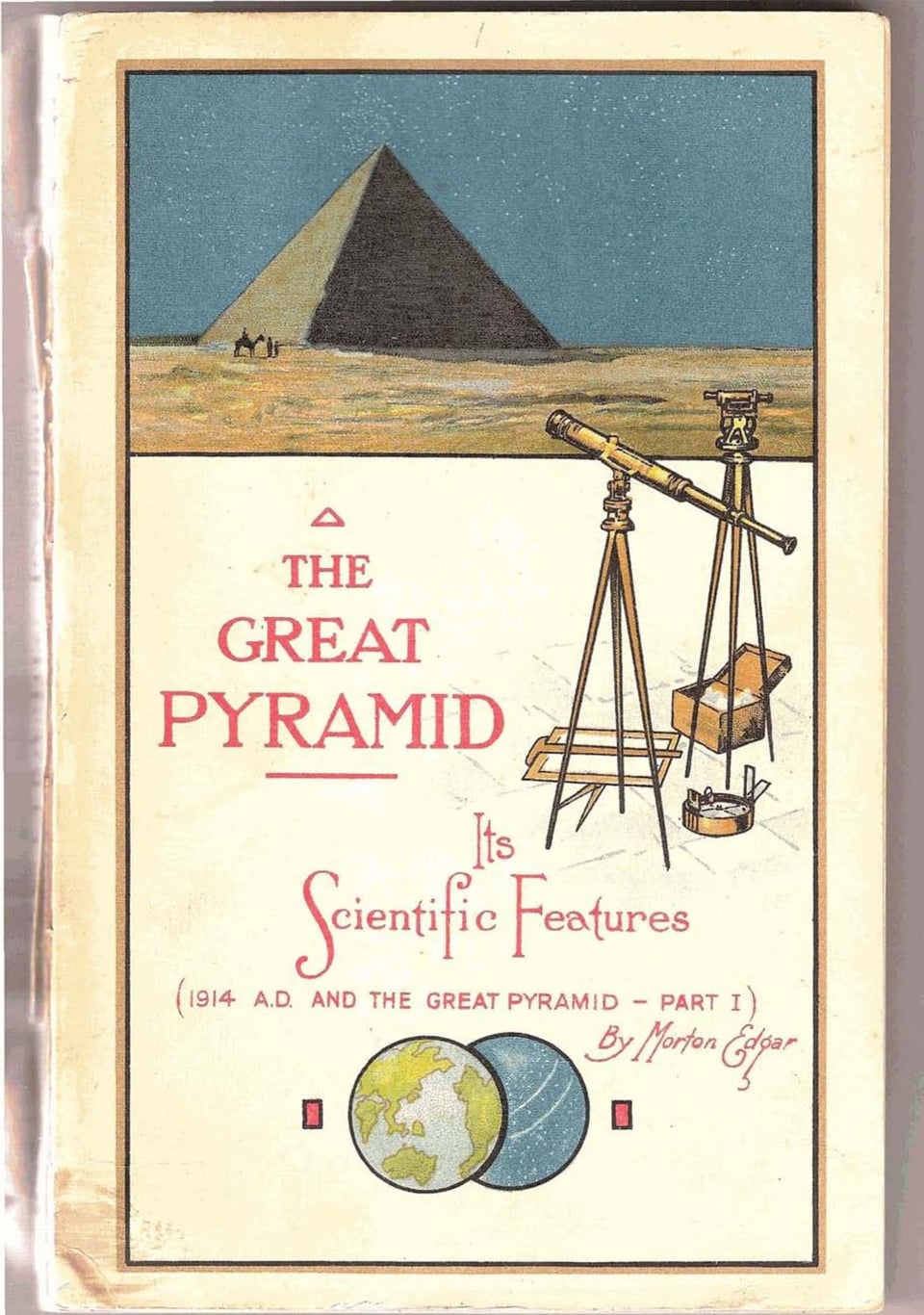
THE GREAT
PYRAMID
Its
Scientific Features
(1914 A.D. AND THE GREAT PYRAMID - PART I)
By Morton Edgar
THE GREAT PYRAMID ITS SCIENTIFIC FEATURES
NOTICE—Further copies of this work may be procured by applying to MORTON EDGAR, 224 West Regent Street, Glasgow, Scotland
27 Aytoun Road
THE GREAT PYRAMID ITS SCIENTIFIC FEATURES
PART I OF 1914 A.D. AND THE GREAT PYRAMID
IN WHICH IS SHOWN HOW THE GREAT PYRAMID OF GIZEH SCIENTIFICALLY CORROBORATES THE PHILOSOPHY OF THE DIVINE PLAN OF THE AGES AS CONTAINED IN THE HOLY SCRIPTURES
BY MORTON EDGAR Author of "Great Pyramid Passages." etc.
COPYRIGHT (All rights of translation reserved)
GLASGOW:
MACLURE, MACDONALD & CO.
1924 CONTENTS
Section Page
I The Great Pyramid of Gizeh in Egypt - - - 13
A Scriptural Declaration; and Historical Notice - 15
The Great Pyramid the First Stone Building - 17
II The Discovery of the Scientific Nature of the Pyramid - 19
III Earth's Standard Unit of Length - - - 22
Earth's Grand Reference-Standard for Length - 24
The Precise Length of the Pyramid Inch - 25
IV The Solar Tropical Year-Length, Monumentalised in the Great Pyramid - - - 27
The King's Chamber Shows the Year-Length - 28
The Pyramid's Interior and Exterior Dimensions agree by a Recognised Proportion - 30
The Pyramid's Passage-angle shows the Day-value of the Solar Tropical Year - 31
V The King's Chamber and the Grand Gallery are Related Proportionately - - - 33
The Vertical Height of the Grand Gallery - 33
The Horizontal Length of the Grand Gallery - 35
VI The Synodic Month Duration Monumentalised in the Great Pyramid - - - 37
The First Ascending Passage and the Synodic Month - 37
The Horizontal Passage Leading to the Queen's Chamber, and the Synodic Month - 41
VII The Four Foundation Corner "Sockets" of the Great Pyramid - - - 42
The Levels of the Four Corner Socket-Foundations - 43
VIII Important Levels in the Great Pyramid - - - 45
IX The Precessional Cycle of the Equinoxes - - - 49
X The Earth's Distance from the Sun, shown by the Great Pyramid's Dimensions - - - 53
XI The Great Pyramid's Orientation - - - 56
XII The Great Pyramid's Geographical Position - - - 59
XIII The Great Pyramid's Connection with Bethlehem in the Holy Land - - - 63
The Scriptures Connect Bethlehem with Egypt - 64
The Great Pyramid-to-Bethlehem Distance and the Period of 2138 Years - - - 66
The Great Pyramid-to-Bethlehem Distance and the Period of 1915 Years - - - 70 Section Page
XIV The Capacity of the King's Chamber 73
The Granite Walls of the King's Chamber 75
The Lunar-Year Duration Indicated by the King's Chamber 75
The Ratio π in the King's Chamber 76
The Precessional Cycle Duration Indicated by the King's Chamber 76
The Second Height of the King's Chamber, and the Grand Gallery's Floor-Length 77
Another Indication of the Solar-Year Duration 77
XV The Harmonious Proportions of the Great Pyramid 80
The King's Chamber and its Dimensions Govern the Whole Pyramid 80
The Floor-Level of the King's Chamber 82
The Top-Surface Level of the Step 83
The Subterranean Chamber Indicates the Dates 1874 and 1914 A.D. 89
Another Method of Measuring to the Pit 92
The Duration of the "World that Was" and the Date of the Flood 95
The Geometric Harmony of the Vertical '‘Flood-Line’' 97
XVI The Coffer in the King's Chamber 101
The Coffer is the Standard Capacity Measure for All Nations 101
The Coffer Presents a Standard for Mean Density and Weight 105
The Pyramid Pint-Measure, Scientifically Accurate, the Origin of the Ancient Saxon Pint 107
The Pyramid's System of Weights and Measures Better than the French Metric System 109
The Pyramid Capacity Measure Contrasted with the Present Imperial British One 111
XVII The Proportions of the Coffer (together with a list of Scientific Features as presented by Professor C. Piazzi Smyth) 114
XVIII Proportionate Features Connected with the Coffer based upon the Set of Standard Measures 118
The Area of the Socket-Level Base of the Great Pyramid Indicated by the Coffer 119
The Grand Gallery Floor-Length 119
The First Ascending Passage Floor-Length 120
Another Grand-Gallery Length Indication 122
The Exterior Dimensions of the Coffer Agree with the King's Chamber's Dimensions 123
Section Page
The Coffer's Indication of the Precessional Cycle 123
The Coffer's Exterior Dimensions are Proportionate to its Interior Capacity 125
The Socket-Level Base Side Length 126
The Socket-to-Apex Vertical Height 126
The Descending Passage Floor-Length 127
The Complete Straight-lined Length of the Descending Passage 127
The Horizontal Passage Floor-Length 128
XIX The Coffer's Standard for Weight 130
Earth's Mean Density 130
The Pyramid Ton and its Subdivisions Indicated by the Coffer's Capacity 131
Professor C. Piazzi Smyth's Table of Weight Measures 135
The Pyramid System of Specific Gravities 135
XX The Cubical Bulk, and Weight, of the Earth agree with the Dimensions of the Great Pyramid 137
The "Earth-Pyramid" Calculations 140
The "Earth-Pyramid" Indication of Earth's Bulk Compared with the Deductions of Science 142
The Mass of the Great Pyramid Compared with the Mass of the Earth 143
The Symmetry of the Mass-Comparison 144
The "Earth-Pyramid" Indication of Earth's Surface Area Compared with the Deductions of Science 145
The Remarkable Harmony Between the Surface-Area of Earth, and the Great Pyramid's Dimensions 146
XXI Further Correspondencies Connected with the Coffer in the King's Chamber 149
The Coffer's Bulk is Proportionate to the Cubic Diagonal of the King's Chamber through the medium of a Sphere 150
Another Indication of the Sphere's Bulk 150
The Day-Duration of the Solar Tropical Year Indicated by the Dimensions of the Coffer 151
Another Indication of the Solar Year Connected with the Coffer's Dimensions 152
The Bulk of the Granite Leaf in the Ante-Chamber and the Interior Capacity of the Coffer 153
The Coffer, and the Days in 1000 Solar Tropical Years 157
Further Correspondencies between the Dimensions of the Coffer and the King's Chamber 158
The Coffer is a "Blind Sarcophagus" 158
The Width of the Queen's Chamber 160 Section Page
The Length of the Granite Plug in the First Ascending Passage 160
The First Ascending Passage’s “Extended” Measure of 1647 Inches shown in the Coffer’s Dimensions 164
Other Coffer Indications of the 1915 and 2915 Periods 166
The 33½ Years of our Lord’s Earthly Sojourn 167
The Number of the Spirit-begotten Overcomers of the Gospel Dispensation 171
XXII The Geometrical Connection of the Numbers 71,250 and 144,000 and 1915 175
Further Development of the Geometrical Figure 177
XXIII The Capacity of the King’s Chamber Related to the Capacity of the Coffer 183
The 50th Part of the Lowest Wall-course Content and the Interior Capacity of the Coffer 185
The Level of the Top of the Coffer in Relation to the First Wall-joint Level 186
The Capacities of the Lowest Wall-course and the Coffer, and a Lunar-Year Indication 188
XXIV Temperature, and other Mensurations 189
Mean Temperature of the King’s Chamber 189
Angle Measure 193
Possible Money-System Indication 195
XXV The Great Pyramid of Gizeh Indicates the Date of its own Erection 200
The Great Pyramid Marks the Date of its Erection by a convincing Time-measurement 201
XXVI The Significance of the “Star-Pointings” of the Lord’s Stone ‘‘Sign’’ and ‘‘Witness’’ in the Land of Egypt 207
Jehovah Intended the Stars to Serve as Signs 207
The Misuse of the Constellation Signs by the Idolatrous Nations not a Contradiction of their Divine Origination 208
Modern Astronomers Annoyed at the Ancient Stellar Figures, but must still Recognise Them 210
The Original 48 Constellations have been carefully Preserved and Transmitted to this Generation 211
The Originators of the Ancient and Authentic 48 Constellations 212
Further Scriptural Allusions to the Constellations 214
The Signification of the Constellations “Hydra” and “Draco” 215
The Great Pyramid’s “Star-Pointings” form a Key to the Decipherment of the Stellar Signs 216 The Great Pyramid of Gizeh, as viewed from the South-east; showing the Sphinx in the foreground to the right
THE GREAT PYRAMID ITS SCIENTIFIC FEATURES
PART I OF
1914 A.D. AND THE GREAT PYRAMID
SECTION I
THE GREAT PYRAMID OF GIZEH IN EGYPT
EGYPT is the only country where the perfect pyramid structure is to be found; that is, a stone building having a square base, with four triangular, sloping sides meeting in a point exactly above the centre of the base.
Although there are over thirty of these monuments, erected in several groups along the western bank of the Nile, only one of them is of importance, namely, the Great Pyramid of Gizeh. It is the most northern of a group of nine pyramids, built at the very border of the Sahara Desert on a low hill of rock, not far from the city of Cairo.
Because of its antiquity and size, the beauty of its masonry, and exclusiveness of design both externally and internally; but above all because of the inscrutability of its purpose, this great edifice has been from the earliest times universally designated the first of the "Seven Wonders" of the world. Owing to its structural durability, the Great Pyramid is the only one of these ancient wonders which now exists.
While the modern world can point with justifiable pride to its achievements in the engineering art, the masterly workmanship of the Great Pyramid's erectors of fully forty centuries ago, the skill everywhere displayed throughout its vast bulk, not only in the preparation and meticulous fitting of the tens of thousands of immense stones, but of its whole design, compels thoughtful admiration.
And this sole survivor of the Seven Wonders of the ancients, even in the midst of the mechanical triumphs of the present epoch, still maintains its unique distinction of being earth's chief structural marvel. The Rev. Joseph A. Seiss named it "A Miracle in Stone"; and recent research proves that the monument justifies this title even more completely than that gifted author could have known.
It is claimed by many students that the architect who designed the Great Pyramid must have been inspired; for it is inconceivable that the numerous Scriptural and scientific truths which are now known to be embodied in the dimensions and angles of the building could have been common knowledge at that early period. By laborious research, and careful accumulation of records taken at intervals during centuries, man has at last ascertained to a near approximation the size of the earth on which he lives, the distance separating the sun and earth, the durations in days of the solar tropical year, and lunar month, and the number of years in the precessional cycle of the equinoxes, along with many other related facts. With man such knowledge is progressive; and what is accepted as truth today may tomorrow require correction as learning and understanding increases.
But with God: surely He knows it altogether. If for some wise purpose, therefore, it was his intention to convince his intelligent and enquiring creatures on earth that He is an unerring Law-giver, and that all things are known to Him and are working harmoniously toward a grand consummation, it is not unreasonable to claim that in the Great Pyramid he monumentalised these very truths which our scientists have all along so eagerly sought to unravel. This is our claim.
Built nearly five and a half centuries before the Tabernacle of Moses was erected in the wilderness, and twice as long before the Temple of David and Solomon appeared in Jerusalem (and both of these edifices were designed under Divine inspiration), the Great Pyramid has withstood the ravages of all the centuries till now, and will probably continue to stand for many more, testifying to earth's inhabitants the omnipotence of Jehovah. Completed two decades before
Abraham was born, it held hidden within its measures and angles a prophetic history of the world, not decipherable until history had run its course.
In addition it contains, by means of its design and proportionate dimensions, important scientific facts, which never could be appreciated until precise knowledge of the laws which govern movement in the universe had sufficiently increased, to prepare the mind of man to unlock them.
A Scriptural Declaration; and Historical Notice
Although the Lord of heaven and earth caused his great stone Witness to be constructed over forty centuries ago, it has pleased him to reserve the understanding of its message to the Millennial Day, which we are now entered upon; as we read: "In that day there shall be an altar to the Lord in the midst of the land of Egypt, even a pillar at the border thereof to the Lord. And it shall be for [shall serve for] a sign, and for a witness, unto the Lord of hosts in the land of Egypt: for they shall cry unto the Lord because of the oppressors, and he shall send them a saviour, and a great one, and he shall deliver them" (Isaiah 19:19,20).
It is, of course, the popular belief that the Great Pyramid is a tomb; for there is no doubt that the other pyramids were intended by their builders for this purpose, as mummies have been found in some of them. And yet it is now a well known fact that the accredited builder of the Great Pyramid, Cheops, whose name has been found on some of the masonry blocks, roughly painted in red by the ancient quarrymen, was not buried inside his great monument.
His tomb, where he was buried, has been identified by Egyptologists with a deep, and elaborately-cut sepulchral pit, which is situated about a thousand feet away from the Pyramid. Cheops (usually pronounced Keops), therefore, did not intend the Great Pyramid to serve as a tomb; nor, indeed, if we are to believe the reasonable deductions which are based upon historical accounts, did he or his Egyptian subjects know what purpose this immense edifice was intended to serve!
When we piece together the fragmentary historical records of this pyramid-building period, preserved to us in the writings of Herodotus and Manetho, it appears that Egypt was at that time invaded by a nation who came from the East, and who easily subdued the Egyptians by their power "without a battle," and compelled them to close their idolatrous temples and engage in the work of building the Great Pyramid. When the work was completed the invaders, who were called "Shepherd Kings," vacated Egypt, and, according to Manetho, went East to Palestine, where they built the city of Jerusalem.
The fact that these Shepherd King's easily subdued the Egyptians without resorting to warfare, and were able to compel them to stop idolatrous worship and exert their energies in constructing the Great Pyramid, proves that they were endowed with a mentality immeasurably higher than that of the Egyptians.
It is believed by some scholars, notably by Professor C. Piazzi Smyth, Astronomer Royal for Scotland, that the leader of the Shepherd Kings was none other than Melchisedec, king of Salem, priest of the most high God. Certain statements by Herodotus, read in conjunction with some historical records in the Bible, support the opinion that the Shepherd Philition, or Philitis, referred to by Herodotus, and Melchisedec were one and the same; and that he was the real architect of the Great Pyramid, being inspired of God. But Cheops, named Khufu by modern Egyptologists, who was the reigning king in Egypt at the time of the extraordinary invasion, was merely enlisted along with his subjects in the actual work of construction.
The historical notice of the builders of the Great, as well as of the Second, Pyramid of Gizeh, as given by Herodotus, shows that the later Egyptians had conceived intense hatred of the two kings associated with that pyramid-building period. It is thought, however, by a number of authorities, such as Professor Rawlinson, that this hatred was engendered by a much later invasion of "Shepherd Kings," who had nothing in common with the earlier Shepherd Kings of the 4th Dynasty (For the other Shepherd Kings were of the 15th to 17th Dynasties, long after the building of the Great and Second Pyramids).
The fact, however, that the original Shepherd Kings of the 4th Dynasty compelled the Egyptians to close their idolatrous temples, may have seemed to the Egyptians of later times to have been an insult to their country; and idolatry being rife in these later Dynasties, priests and people alike could not then understand the godly motives that dictated the suppression of false gods, and hated that "ignoble race," as Manetho named them, who "had the confidence to invade our country," and so easily subdue it without even requiring to fight for it! In any case, both Sir G. Wilkinson and Professor Rawlinson, and others, make it evident that the recorders of Egyptian history had thoroughly mixed up the sequence of events, and named successive kings out of their proper order. But the builder of the Great Pyramid is identified by one named Philition, or Philitis, who at the time the building was being erected "fed his flocks about the place," as Herodotus states; and this item of history is accepted by all critical authorities as being correct.
The Great Pyramid the First Stone Building
In his valuable book, The Antiquity of Intellectual Man, Professor C. Piazzi Smyth brings forward a mass of literary material which establishes the priority of the Great Pyramid as a stone building, proving that this monument must have been reared before any other edifice of importance. He also shows that none of the subsequent stone erections can vie with their great forerunner in fineness of workmanship; and points out that this fact demonstrates a sudden uprise in excellency of masonic construction.
Professor Smyth comments upon the closeness of the masonry joints of the building, especially in the walls of the interior Queen's Chamber: "The joints are so close, that the edges of, the two surfaces of worked stone, and the filling of cement between, are comprisable often within the thickness of a hair." The famous Egyptologist, Professor (now knighted) W. M. Flinders Petrie, adds: "To merely place such stones in exact contact at the sides would be careful work [because the stones are so large and heavy], but to do so with cement in the joints B 17 seems almost impossible."
In another place Professor Petrie again refers to the marvellous skill of the workmen who built the Great Pyramid: "Their skill in cementing joints is hard to understand. How, in the casing of the Great Pyramid, they could fill with cement a vertical joint about 5 feet by 7 feet in area, and only averaging one-fiftieth part of an inch thick is a mystery; more especially as the joint could not be thinned by rubbing, owing to its being a vertical joint, and the block weighing about 16 tons. Yet this was the usual work over 13 acres of surface, with tens of thousands of casing-stones, none less than a ton in weight."
The celebrated architectural authority, Mr. James Fergusson, also, gives his testimony as to the excellency of the workmanship displayed in the Great Pyramid: "No one can possibly examine the interior of the Great Pyramid without being struck with astonishment at the wonderful mechanical skill displayed in its construction. Nothing more perfect mechanically has ever been erected since that time."
SECTION II
THE DISCOVERY OF THE SCIENTIFIC NATURE OF THE GREAT PYRAMID
JOHN TAYLOR of London, to whom Professor C. Piazzi Smyth dedicated all his works on the Great Pyramid, has the honour of being the first to suggest that the Great Pyramid was intended by its builders to monumentalise important scientific truths. He published a book entitled: The Great Pyramid: Why was it built? Who built it? This book appeared as early as 1859, and has commanded the attention of all thoughtful students of the Pyramid.
After drawing attention to the precise angle at which the sloping sides of the Pyramid rise from the rock to the apex of the building, as calculated from the base-side length and vertical height of the whole monument, John Taylor wrote: "What reason, it may be asked, can be assigned for the founders of the Great Pyramid giving it this precise angle, and not rather making each face an equilateral triangle? The only one we can suggest is, that they knew the Earth was a sphere; and they had measured off a portion of one of its great circles; and by observing the motion of the heavenly bodies over the earth's surface, had ascertained its circumference, and were now desirous of leaving behind them a record of that circumference as correct and imperishable as it was possible for them to construct.
"They assumed that the earth was a perfect sphere; and as they knew the radius of a circle must bear a certain proportion to its circumference, they then built a pyramid of such a height in proportion to its base, that its perpendicular would be equal to the radius of a circle equal in circumference to the perimeter of the base.
"To effect this they would make each face of the Pyramid present a certain ascertained angle with reference to its base (supposing a vertical section made of it), which angle would be that of 51° 51′ 14′′ , if modern science were employed in determining it.
.How the thought occurred to them we cannot tell; but a more proper monument for this purpose could not have been devised than a vast Pyramid with a square base, the vertical height of which Pyramid should be the radius of a sphere in its circumference equal to the perimeter of that base.
"It was impossible to build a hemisphere of so large a size. In the form of a Pyramid, all these truths might be declared which they had taken so much pains to learn; and in that form the structure would be less liable to injury from time, neglect, or wantonness, than in any other."
At the period when John Taylor wrote these words (1859), the dimensions of the Great Pyramid were not known to such exactness as they now are. His actual figures can now, therefore, be improved upon; but his suggestion as to the reason why the builders of the ancient Great Pyramid chose the precise angle for the rise of the sides of their edifice, which gives to its vertical height the same proportion to its square base, as the radius of a circle has to its circumference, remains substantially the same. His deductive reasoning has received much confirmation during the years which have passed since
his day; but with this necessary correction, namely, that whatever the actual working-builders may have understood about the shape of the earth, the inspired architect was caused to embody in the monument those dimensions which prove a knowledge by someone of the true shape and size of the earth.
It is Professor C. Piazzi Smyth to whom we are indebted for fuller knowledge of the scientific features monumentalised in the Great Pyramid, as well as to the beginnings of our understanding of the monument's religious teaching. The religious teaching is, in reality, more essential to us than the scientific aspect of the building, for it is a corroboration of the Plan of Salvation contained in the Bible. The value of the purely scientific features, however, is that they prove the correctness of all the measures of the Pyramid, and demonstrate a oneness of design which is too wonderful to be credited to human beings unaided by a higher intelligence. They prove, therefore, that God Himself must have been the true Architect; and proving this establish at once the claim that the Great Pyramid is His "Sign" and "Witness" for the great Day now begun.
John Taylor's work, therefore, laid the foundation for the researches of Professor Smyth and all later students. Not only did he point out the precise mathematical relationship that the Pyramid's vertical height bears to its square base (which mathematicians denote by the symbol of the Greek letter " π " [Pi], i.e., the proportionate ratio between the lengths of the diameter, and the circumference, of a circle), but he also drew attention to the remarkable fact that the unit of linear measure employed in the Great Pyramid is earth-commensurable. That is, this unit is based upon the actual size of the earth. He named it the "Sacred Cubit," believing that it was the cubit communicated by Jehovah to the people of Israel; but it is now more popularly known as the Pyramid cubit. Additionally, John Taylor demonstrated that the inside capacity of the "Coffer," or granite chest which lies in the King's Chamber of the Great Pyramid, was meant by the Architect to serve as the Standard Capacity Measure for all nations of earth. We shall examine some of these matters in detail as we proceed.
SECTION III
EARTH'S STANDARD UNIT OF LENGTH
THE remarkable discovery of John Taylor is this: The polar diameter of the earth, the axis of earth's rotation, is the best possible reference-line upon which to base the standard unit of Long Measure for the daily use of mankind. The even 500-millionth part of this long straight line is the precise length of the Standard Unit, and is named The Inch; and 25 of these inches is named The Cubit. As there are 500-millions of inches in the full length of the polar axis of earth, and 25 of these in the cubit, there is therefore an exact, round, 10-million cubits in earth's semi-axis of rotation.
And because this inch-length, and cubit-length, are everywhere evident in the dimensions of the Great Pyramid of Gizeh, they have been appropriately named The Pyramid Inch, and The Pyramid Cubit. For this reason it is, properly, claimed that the linear unit of measure employed in the construction of the Great Pyramid is earth-commensurable, and thus the most scientific unit that ever could be devised for the use of man, whose everlasting habitation is Earth.
It was in the attempt to create a system of measures which should be regarded as pre-eminently scientific, that the French scientists of the time of the Revolution, discarding the system previously in use, introduced their earth-commensurable metric system, the linear unit of which, they claimed, is the exact, round, 10-millionth part of the quadrant of the earth's circle passing through the poles, that is, the 10-millionth part of the curved line from the north pole, through Paris, to the equator. This linear unit, the French metre, has since been found to be in error; for the French savants did not know what was the precise size of the earth. Their metre is slightly
too short; and instead of being as at present equal to 39.370789916,ought,rather,to be 39.3741576608+,British inches in length, according to the more accurate estimate for the entire quadrant. (This value is about 8 5 5 1⁄2 metres of the present,inaccurate,length,more than the round 10-millions for earth's quadrant.)
Diagram illustrating the length of the Earth's Axis of Rotation, 500,000,000 Pyramid Inches; and its Semi-axis of 10,000,000 Pyramid Cubits
But not only did they err in their estimate of the dimensions of the earth, but they erred in judgment too. For it is much more scientific to base the Standard Unit of length upon the straight line of earth's axis of rotation, than upon a curved line, especially as that curve is not a true quarter circle owing to the flattening of the figure of the earth at the poles.
Furthermore, nothing can be more fitting as the grand reference standard for length than earth's polar diameter; for, unlike the Meridian of Paris upon which the French metre length is based, this straight line upon which the standard inch and cubit are based is common to all nations; for all revolve around it once in every 24 hours.
There is an appropriateness in this connection which characterises it as of Divine arrangement. John Taylor, therefore, did not hesitate to declare his belief in the Divine origination of the system of measures which had as its basis the grand standard length of earth's polar axis of rotation.
Sir Isaac Newton, in his Dissertation on Cubits, proves that the sacred cubit of the nation of Israel was almost exactly 25 British inches in length. Pursuing the investigation as to the origin and length of the sacred cubit, Professor C. Piazzi Smyth came to the conclusion that the cubit used by Moses when Jehovah commanded him to construct the tabernacle, had been used by the builder of the Great Pyramid many centuries before, and earlier still by Noah when making the ark. And as the 25th part of the cubit, namely, the inch, is practically the same as the inch-length in use today by English-speaking peoples, it was his conviction that the British nation had inherited the "Sacred" inch down through the ages from the day when this standard unit was first Divinely communicated to earth.
The fact that there is now a mere one-thousandth part of an inch difference between the length of the present British inch and the original earth-commensurable inch, is explained by the many changes of the official standard-rod used for reference. The present reference rod is the yard of 36 inches; but the yard was not always the length of the reference standard. The now almost forgotten ell of 45 inches, proves that the British inch was originally longer than it is at present.
To show how close are the estimates for the polar-axial length, as computed by modern astronomers, to the theoretical requirement of the Great Pyramid's scientific dimensions, we here repeat what we have said on page 242 of Vol. I Great Pyramid Passages: In the 9th Edition of the Encyclopaedia
Britannica, Vol. II, page 792, Sir John Herschel is noted as having stated the length of the polar axis from the data supplied by Col.A.R. Clarke. (Col. Clarke is the recognised authority on geodesy.) His figure is 41,707,796 British feet.
On the other hand, Sir R. S. Ball, also taking Col. Clarke as his authority, but at a later date, states in his work Elements of Astronomy, paragraph 184, that the polar-axial length is 41,708,954 feet.
Col. Clarke's original data are therefore capable of slightly differing conclusions, according to the method of computing them. But if the earlier estimate of Sir J. Herschel was slightly too short, Sir R. S. Ball's later estimate errs on the opposite side of being too long, as evidenced by the Great Pyramid's scientific indication of the true length of earth's polar diameter.
Remarkably enough, the actual mean of the two careful estimates given above, both of which are based upon the data supplied by the world's recognised authority on geodesy, namely, 41,708,375 British feet, is the precise polar-axial length required by the Great Pyramid's scientific dimensions; for this number of feet, converted to Pyramid units, yields exactly 500,000,000 Pyramid inches.
It is now well established that in a measured length of exactly 1000 British inches, taking these inches at their present value, there are 999 Pyramid inches. Therefore, to convert any known number of British inches into their corresponding value in Pyramid inches, we only require to deduct a 1000th part of the British-inch measure from itself; the remaining 999 parts represent the Pyramid-inch measure.
To convert a known Pyramid-inch measure into the corresponding value in British inches, we divide the Pyramid-inch measure by 999.
It is Pyramid units, and not any other units of length which unlock the symbolic and scientific secrets of the Great Pyramid. Therefore, all measures of the Pyramid must be expressed in Pyramid units.
SECTION IV
THE SOLAR TROPICAL YEAR-LENGTH MONUMENTALISED IN THE GREAT PYRAMID
PROFESSOR C. PIAZZI SMYTH discovered that earth's standard cubit of 25 inch-units, that is, the even 10-millionth part of earth's semi-axis of rotation, divides into the Great Pyramid's base-side length as many times as there are days in the solar tropical year.
He was led to this unique discovery by the presentation to him of one of the building's casing-stones, which a civil engineer, Mr. Waynman Dixon, had rescued from the large mounds of broken stones which lie against the Pyramid on all four sides. This particular casing-stone happened to be exactly one cubit in length; and although the stones originally forming the outside surface of the monument must have varied a great deal in their sizes (as is now known because of the unequal sizes of the long row of nineteen casing-stones laid bare within recent years at the northern foot of the building), the fact of this presentation-stone being one cubit in length suggested the thought that the cubit-length would divide into the entire base-length the exact number of times, to the odd fraction, necessary to agree with the days in the year.
But this was only the beginning. For Professor Smyth himself, and other enthusiastic students of the Pyramid, found, and still continue to find, that this wonderful edifice was constructed in such a way that its dimensions indicate the year-length many times over, and all with mathematical exactitude. What at first, therefore, was put forward as a reasonable suggestion, is now an established certainty, namely, that the great Architect, even in those remote days of over four thousand years ago, had absolute knowledge of the precise day-value of the solar tropical year, to the minutest fraction.
And not only so, but he knew how to monumentalise his wonderful knowledge by methods beyond the origination of man; for not the greatest scientist could have thought of them.
The King's Chamber shows the Year-Length
One of the mathematical methods by which the Great Pyramid was made to show the number of days in the year, is in the size of the King's Chamber. This grand apartment, beautifully constructed with large polished granite stones, was designed to exact geometric proportions. The careful measurings of, first, Professor John Greaves, then of Professor C. Piazzi Smyth, and finally of Professor Flinders Petrie, all of whom published their figures, demonstrate that the ancient Architect arranged that, (1) the length of the chamber should be exactly double its width, and (2) the height of the ceiling above the floor should be exactly one-half the floor-diagonal.
These proportions, quite apart from measures, prove that the builder possessed geometric knowledge of a very high order indeed. For instance, the famous "3,4,5" right-angled triangle is built into this chamber, a feature of interest. Proportionally: the end-wall diagonal is 3, the length of the chamber is 4, and the cubic diagonal is 5. These three dimensions represent the perpendicular, base, and hypotenuse, of the right-angled triangle respectively.
It was Mr. James Simpson of Edinburgh, Scotland, who perceived this symmetric arrangement in the size of the King's Chamber, by carefully studying the measures of the apartment previously published by Professor Smyth. He saw that one-half of the chamber's width (quarter of the chamber's length), when taken as a unit of measure, gives the proportionate measures of all parts of the chamber, through the multiplication by square-roots, in this way:—
Half of chamber's width × square-root of 4 gives the width.
, , , , , × , , , 5 , , , height.
, , , , × , , , 9 , , , end-diagonal.
, , , , × , , , 16 , , , length.
, , , , × , , , 20 , , , floor-diagonal.
, , , , × , , , 21 , , , side-diagonal.
, , , , × , , , 25 , , , cubic-diagonal.
As for the actual number of earth-commensurable, Pyramid inches in the full width of this granite chamber, the inspired architect arranged that this number should be just the exact total of such inches, including a very small fraction of an inch, that when multiplied by the square-root of the ratio π it would agree with the precise day-value of the solar tropical year. (The standard width of the King's Chamber, which is within the limits of the practical measures taken by Professors Greaves, Smyth, and Petrie, is 206.0658+ Pyramid inches. The square-root of the ratio π is 1.7724538509+. The one multiplied by the other equals 365.242198+, the number of days in the solar tropical year.) As all the dimensions of this chamber are proportioned to the width of it, through the medium of square-roots, as shown, it is appropriate that the actual measure of this width should itself be proportioned to the day-value of the year, also through the medium of a square-root, and this square-root the highly scientific one of the ratio of the mathematical π .
And when we remember that the units of measure taken to represent the days in the year are those very units that are based upon the actual size of the earth, a round, even, 500,000,000 of them going to make up the length of earth's polar axis of rotation; and that the earth in revolving once round this axis marks off the duration of the day; and that in completing a circle round its centre the sun it revolves on its axis 365.242198+ times, thus marking off the duration of the solar tropical year, and that all of this is built into the Great Pyramid's principal chamber, we can see clear evidence of intentional design. But no man living four thousand years ago could have of himself known so many scientific truths, nor known how to monumentalise them in masonry, unless directed by a higher intelligence.
And there is no man living even today who knows sufficient to execute a work like this, unless he will acknowledge that the symmetric proportions, and the actual dimensions, of the King's Chamber agree with the polar-axial size of the earth, and the number of days in the year.
Based upon the foregoing proportions, the precise, standard dimensions of the King's Chamber are these:
Length
412·1316879208 + Pyr. ins.
Width
206·0658439604 + ,, ,,
Height
230·3886174681 + ,, ,,
Floor-diagonal
460·7772349363 + ,, ,,
Side-diagonal
472·1561640467 + ,, ,,
End-diagonal
309·0987659406 + ,, ,,
Cubic-diagonal
515·1646099010 + ,, ,,
Except that, in the above list, we have extended the decimal fractions, for the sake of greater accuracy in calculations, Pyramid students have now for many years accepted these measures for the King's Chamber as being theoretically correct. They are all, as Professor Smyth has said, contained within the limits of the actual, practical, measures secured by himself and others who have measured this chamber.
The Pyramid's Interior and Exterior Dimensions agree by a recognised proportion
In the scientific features, the Pyramid sometimes indicates a day, or a year, by an inch, or a cubit. Sometimes, also, a day and year are indicated by an even number of inches or cubits. Thus, the length of one base-side of the monument at the mean Socket-level, the full solar year-length is indicated, each day by one cubit. But if we take all four base-sides as representing the complete cycle of the year, each day is then indicated by an even 100 inches. Or we can say instead, that there are as many inches in the perimeter of the Pyramid's Socket-base level, as there are days in 100 solar tropical years, making it, therefore, that each day is represented by one inch.
(In some time-features a Pyramid unit of measure may represent a week, or a month, or any definite and symmetric period.)
Now, the dimensions of the interior King's Chamber were so proportioned that, by a recognised mathematical method peculiar to the Great Pyramid itself, these dimensions agree with the building's exterior measures. We may, for instance, regard the length of the King's Chamber as being the diameter of a circle. When we compute the area of this particular circle, and then make a square of exactly the same area, we shall find that the side-length of this square is as many inches as there are cubits in the side-length of the Pyramid's Socket-level base. Inches in the small square are reproduced by cubits in the large one. Therefore, there are as many inches in the side-length of the small square as there are days in the solar year.
Here, then, we have a very good example of the Pyramid's proportionate dimensions. That is, while the size of the King's Chamber does not agree in a direct way with the outside size of the building, yet we can see that the agreement is absolutely exact in their mathematical proportions, and according to the Pyramid's own scale of a cubit to an inch, or other even numbers of Pyramid units.
It is by means of these proportions, that the Great Pyramid was made to prove its own dimensions.
The Pyramid's Passage-Angle shows the Day-value of the Solar Tropical Year
Professor C. Piazzi Smyth observed the angle of the Pyramid's interior passage-ways very carefully. He found that the ascending angle of the Grand Gallery is more nearly correct, according to the indicated theory, than the angle of the other passages. This he explained from the fact that the builders bestowed more care in constructing the Grand Gallery, because the angle of this passage was intended by them to be representative. The theory demands that the precise passageangle should be 2 6°1 8′9′ ′·7 ; and the Grand Gallery angle is only about half a minute of arc from this requirement.
Commenting upon his observed angles of the other two passages, the First Ascending, and Descending, Professor Smyth says: "One of them is more, and the other less, than the theoretical quantity; their mean, or 2 6° 1 6′ 3 0′ ′ , being within 2′ distance therefrom; and looking like a case of probable error of construction on the part of honest workmen, who knew the right theoretical angle, and wished to hit, but had practical difficulty in hitting, it exactly." The observations of Professor Flinders Petrie confirmed those of Professor Smyth.
The claim of Professor Smyth, namely, that the theoretical angle of 2 6°1 8′9′ ′·7 is the one clearly intended by the Architect, is abundantly supported by the scientific features of the Great Pyramid. We have therefore no hesitation in accepting this theoretical angle for both ascending and descending passageways.
One of the first of these scientific confirmations of the angle of the Pyramid's passages to be revealed, is connected with the length of the King's Chamber and the day-value of the solar year. When we measure off on the floor-line of, say, the Grand Gallery a section equal to exactly twice the length of the King's Chamber, and regard this measured-off section as the hypotenuse of a right-angled triangle, we shall find that the length of the perpendicular of the triangle is as many inches as there are days in the solar tropical year, Q.E.D. It is manifest that if the angle at which the passage-floor rises had been more or less than the exact 2 6°1 8′9′ ′·7 , or if the length of the King's Chamber were different from that which it is found to be, the precise day-value of the year could not have been monumentalised in the Great Pyramid by this unique method.
SECTION V
THE KING'S CHAMBER AND THE GRAND GALLERY ARE RELATED PROPORTIONATELY
STILL another method by which the Great Pyramid was made to monumentalise the duration in days of the solar tropical year, is in the length of the Grand Gallery. The calculation requires the recognition of the dimensions of the King's Chamber. The longest straight measured line of the King's Chamber, the cubic diagonal, when multiplied by the number of days in the solar tropical year, yields a number which is exactly an even, round, 100 times the floor-length of the Grand Gallery in inches. (When we multiply 515 · 1646+ by 365 · 2421+, and divide the result by 100, we get 1881 · 5985+ Pyramid inches. This is the theoretical, standard, length of the Grand Gallery. But as in all the dimensions of the Great Pyramid, slightly varying measures are permissible, and, indeed, were purposely arranged for by the inspired architect, within limits. A measurement of a passage along the east side is found to be slightly longer or shorter along the west side. This was intended, that a little variation might be provided for in measures of the passage. The standard measure, founded upon a definite scientific calculation, and supported by other calculations, is always, of course, within the limits of the practical measures.)
The Vertical Height of the Grand Gallery
As the practical, measured, floor-length of the Grand Gallery is confirmed by the scientific dimensions of the King's Chamber, through the medium of the day-value of the solar year, so we find that the precise vertical height of this passage is also shown by the measures of the King's Chamber.
Every marked section of the ascending and descending passage-ways has its corresponding vertical and horizontal measures; that is, the perpendicular, and the base-line, measures. For the floor-lines in each of these marked-off sections of the inclined passages can be considered as being the hypotenuse of a right-angled triangle; and hence the perpendicular and base are the vertical height, and horizontal length, of such section.
If we regard the cubic diagonal of the King's Chamber as being the side-length of a square, the vertical height of the Grand Gallery is proportionate to it in this way: Multiply the area of this exact square by the ratio π . The result is equal to precisely 1000 times the Grand Gallery's vertical height. (The square of the King's Chamber's cubic diagonal multiplied by 3· 1415926535+ , which is the value of π , equals 833761· 6480+ Pyramid inches. When we divide this by an even 1000 we get the standard vertical height of the Grand Gallery. But when we multiply it by an even 100, we get the precise area of the Great Pyramid's Socket-level square base in square Pyramid inches. Both of these calculations
are Q.E.D., that is, absolutely exact. They serve as good examples of the proportionate way in which all parts of the Pyramid are related to each other; and also of the decimal system of the whole building's scientific design.)
The Horizontal Length of the Grand Gallery
By still another proportion connected with the length of the King's Chamber, and with the angle at which the floor of the Grand Gallery rises, we get the horizontal length of the Grand Gallery.
Mark off on the inclined floor of the Grand Gallery a section equal to the length of the King's Chamber, and let this be the hypotenuse of a right-angled triangle. The area of this triangle is exactly 20 times the horizontal length of the Grand Gallery. (At the precise angle at which the floor-line of the Grand Gallery is inclined, we can find the area of any right-angled triangle, such as this, by first squaring the length of the hypotenuse, and then multiplying this square by the ratio ·1986179741+ . Thus, the square of the King's Chamber's length multiplied by this ratio, and the result divided by 20, gives us the standard horizontal length of the Grand Gallery, 1686·7882+ Pyramid inches, Q.E.D.)
Another way of stating this feature is as follows: Construct an isosceles triangle. Make the length of its base-line as many inches as there are days in the solar tropical year. Make the length of its two equal sides the same number of inches as the length of the King's Chamber. It will be found that the area of the triangle equals precisely 40 times the Grand Gallery's horizontal length.
SECTION VI
THE SYNODIC MONTH DURATION MONUMENTALISED IN THE GREAT PYRAMID
ONE important scientific feature now found to be embodied in the structural proportions of the Great Pyramid (drawn attention to for the first time in Vol. I of Great Pyramid Passages, 2nd Edition), is the exact duration in days of the Synodic, or Lunar, Month, or that period which the moon apparently takes to complete one revolution round the earth. Professor C. Piazzi Smyth was not aware of this feature; and had he known of it, it must have encouraged him in his well-nigh life-long work of making known to the world the Divine origination of the building of the Great Pyramid. As with all subjects that are worth while, the truth regarding the Great Pyramid has expanded, and has become more convincing, as year by year it has been carefully studied, and further light brought to bear upon it.
The section of the Great Pyramid where the synodic month duration in days was first found to be monumentalised, is in the length of the First Ascending Passage. (We are indebted to a clever student of the Great Pyramid, Hugo Karlén of Stockholm, Sweden, for this feature.) Just as the length of the Grand Gallery is proportionate to the dimensions of the King's Chamber to which it leads, through the medium of the day-value of the solar tropical year, so, by a proportion, the length of the First Ascending Passage is related to the dimensions of the Grand Gallery to which it leads, through the medium of the day-value of the synodic month.
And this relationship of dimensions is, in each case, appropriate to each part of the building; for, in the religious symbolisms of the Pyramid, the King's Chamber represents the heavenly inheritance and Kingdom to which the overcoming saints of the Gospel Age laboriously ascend, the Gospel Age itself being well symbolised by the Grand Gallery, while the
Ascending, by the aid of the side Ramps, the Grand Gallery in the Great Pyramid of Gizeh; showing, also, the low doorway of the Horizontal Passage leading to the Queen's Chamber
First Ascending Passage represents the Age during which the people of Israel were led under the Law "Schoolmaster" to Christ. And Jesus Christ himself is represented as standing, as it were, at the upper terminal of the First Ascending Passage, ready to aid those who were "Israelites indeed" to escape
from under the exacting requirements of the Law, illustrated so graphically by the steep, slippery, low-roofed First Ascending Passage, and usher them into the glorious liberty of faith in the Age of Grace, pictured by the lofty Grand Gallery with its side-ramps (See the first of this series of books entitled: The Great Pyramid: Its Spiritual Symbolism).
For these "Ramps," or low stone benches, run up the whole length of the Grand Gallery on each side of the floor. By means of them one is enabled to ascend the slippery floor of the passage safely, and with some degree of comfort. These ramps represent, in the symbolism of the Pyramid, the "exceeding great and precious promises" of God, by means of which the spirit-begotten called-out ones of the Gospel Age may gain the Divine spirit nature represented by the King's Chamber.
This is in marked contrast to the First Ascending Passage, in which no such aid in ascending is found, so that if one should slip and fall here there is nothing to hold on to, and thus nothing to prevent a rapid descent backward along the steeply inclined floor. There was no hope held out under the old Law Covenant of Moses; for during that Age even a single offence against the perfect Law of God meant condemnation to death.
But the Law of Moses served as a schoolmaster to lead the people of Israel to Christ; and a remnant, we read, received Jesus as the Christ, and therefore were accorded the privileges of the Gospel Age. The rest of the nation were blinded in part, the Apostle explains, until God makes with them the New Covenant, through the operation of which they, as well as all mankind in due time, will attain perfect life on the human plane of being. They will become as father Adam was before the entrance of sin, but with greatly added experience and knowledge. By rightly exercising their experience and knowledge, restored mankind may continue to live into the Ages of Glory to follow; for all the former things, sin, sickness, pain and death, will by then have passed away, and God will make all things new.
As the Old Law Covenant is symbolised by the First Ascending Passage, so the New (Law) Covenant, in operation during the Millennial Age when Christ and his joint-heirs will reign in righteousness, is symbolised by the Horizontal Passage leading to the Queen's Chamber.
The Queen's Chamber, in its turn, symbolises the perfect human nature to which all the repentant and willingly righteous of mankind will ultimately attain, and maintain everlastingly.
In the figures of the Scriptures, the sun represents the Gospel Age, while the moon represents the Law Age of Moses. Therefore, in the proportionate dimensions of the Great Pyramid, the length of the Grand Gallery, which symbolises the Gospel Age, is appropriately connected with the solar tropical year, the duration in days of earth's circuit of the sun. And the length of the First Ascending Passage, which symbolises the Law Age, is fittingly connected with the synodic month, the duration in days of the moon's apparent circuit of earth.
For when we multiply the length of the Grand Gallery to which the First Ascending Passage leads, by the number of days in the synodic month, and divide the result by 36, a special Grand-Gallery number, we get a figure equal to the exact floor-length of the First Ascending Passage. (The precise number of days in the synodic, or lunar, month, that is, the mean period of days between one new moon and the appearing of the next new moon, is given to no less than nine places of decimals by Sir J. Norman Lockyer, the eminent astronomer. His figure is 29·530588715+solar~days. The standard length of the Grand Gallery floor-line is 1881·5985+ Pyramid inches, as already determined. The one figure multiplied by the other, and the result divided by 36, gives us the standard length of the First Ascending Passage, namely, 1543·4642+ Pyramid inches. This is the floor-length, beginning from the "Point of Intersection" on the floor of the Descending Passage, and terminating at the north wall of the Grand Gallery. This standard length is within the limits of the actual, practical, measures of Professors Smyth and Petrie.)
The Horizontal Passage leading to the Queen's Chamber and the Synodic Month
The full floor-length of the Horizontal Passage leading to the Queen's Chamber, like that of the First Ascending Passage, is also regulated by the duration in days of the synodic month. But this time it is not through the medium of the Grand Gallery length, but through the medium of the dimensions of the King's Chamber. And this fact, namely, that the Horizontal Passage length is proportionate to the dimensions of the King's Chamber, and to the number of days in the synodic month, is in keeping with the symbolical meaning of this passage. For, as we have explained, the Horizontal Passage represents the New (Law) Covenant of the Millennial Age; and it is under the righteous rulership of the Kingdom of Christ, as symbolised by the King's Chamber, that the perfect arrangements of that New Covenant will be administered, that restored mankind may reach the Queen's-Chamber condition of human perfection. Hence the Scriptural figure of the Law, namely, the moon, and the dimensions of the King's Chamber (which dimensions, as we have seen, depend directly upon the earth's dimensions, and upon the duration of the solar year), are both recognised in the length of this Horizontal Passage to the Queen's Chamber.
We recall that the floor-length of the Grand Gallery is standardised by the dimensions of the King's Chamber, and the days in the solar year; that is, by the multiplication of the cubic diagonal of the King's Chamber by the number of days in the solar year, and dividing the result by an even 100. So, by the same method of proportions, the floor-length of the Horizontal passage to the Queen's Chamber is standardised by the King's Chamber's dimensions, and the days in the synodic month, as follows: Multiply the cubic diagonal of the King's Chamber by the number of days in the synodic month, and divide the result by 10, and we get 1 5 2 1 · 3 1 1 4+ Pyramid inches as the standard length of the Horizontal Passage. This floor-length is within the limits of Professor Smyth's, Professor Petrie's, and our own, practical measures for this passage.
SECTION VII
THE FOUR FOUNDATION CORNER "SOCKETS" OF THE GREAT PYRAMID
ANOTHER important truth to be first expounded by John Taylor is the identification of a text in the book of Job with the Great Pyramid of Gizeh. And this identification is so pointed, that it establishes the Great Pyramid, to the exclusion of all the other pyramids of Egypt, as the particular altar and pillar, sign and witness, to the Lord of hosts, spoken of by the Prophet Isaiah.
The text in Job reads: "Where wast thou when I laid the foundations of the earth? declare, if thou hast understanding. Who hath laid the measures thereof, if thou knowest? or who hath stretched the line upon it? Whereupon are the sockets thereof made to sink? or who laid the corner stone thereof; when the morning stars sang together, and all the sons of God shouted for joy?"—Job 38:4-7, marginal reading.
The Lord here first refers to the foundations and measures of the earth; and then to the socket-foundations and corner stone of a building, clearly of the form of a square-based pyramid capped with a corner-stone. It was the discovery of four rectangular, flat-bottomed, sinkings into the rock at the four foundational corners of the Great Pyramid, that proves that this Pyramid is the one referred to in the 38th chapter of Job; for none of the other pyramids possesses such socket-foundations. It was in 1799 that the French savants, under Napoleon, discovered two of the sockets; and in 1865 all four were uncovered by Messrs. Aiton and Inglis, civil engineers of Glasgow, Scotland, with the assistance of Professor C. Piazzi Smyth.
And as the Great Pyramid of Gizeh is thus pointedly indicated by the Lord, in connection with a primary reference to the earth
and its measures, we note a still further significance in the fact that the dimensions of the Great Pyramid agree proportionately with the actual dimensions of the earth. And this agreement is very exact, as we have already seen, and as we shall note by other features yet to be considered.
The Levels of the Four Corner Socket-Foundations
Careful measuring has revealed that the floors of the four corner sockets of the Great Pyramid, which sockets, or sinkings into the rock originally contained large foundation cornerstones, each a fitting terminal to the long sloping corner arris-lines of the immense building, are not all on one level. Each socket is cut down to a distinct level of its own. The vertical distance between the highest and lowest of these four levels is nearly 17 inches, according to the levellings of Professor Flinders Petrie.
A close mean of all four levels is that which is generally accepted by Pyramid students as the building's reference base-line; and this is called the Mean Socket Level. From this mean Socket-level base the vertical height of the Pyramid is reckoned. The perimeter of the monument's square base at this Socket-level, also, corresponds in inches with the days in an even 100 solar tropical years.
The mean Socket-level base is nearly 9 inches vertically below the level of the natural rock, and nearly 2 93⁄4 inches vertically below the top surface of the Platform on which the building's outer casing-stones immediately rest.
There are therefore three distinct base-levels of the Great Pyramid, namely, the Platform-level which is the highest, the Rock-level, and the mean Socket-level. Each of these three levels has its own meaning in the scientific and symbolical teachings of the Pyramid, in addition to their architectural use. Also, the four distinct levels of the Socket-floors are required to enable the Pyramid to show further scientific truths.
SECTION VIII
IMPORTANT LEVELS IN THE GREAT PYRAMID
LIKE every dimensional feature of the Great Pyramid, the levels at which prominent parts of the structure are placed are most significant. These levels are so carefully fixed with reference to each other, that their distances apart form still another evidence that the whole structural design of the Great Pyramid was not only scientifically intentional, but of an order far above the origination of uninspired man.
The three base levels, that is, the mean Socket-level, the Rock-level, and the Platform-level, we have already spoken of in Section VII, and will refer to it again later. The level indicated by the north edge of the Descending Passage Basement-sheet is one of the prominent levels. It lies at a vertical distance above the mean Socket-level of the building, which agrees with the dimensions of the King's Chamber; for the precise number of inches which separates these two definite levels is equal to the sum of the length, and the height, of the King's Chamber.
…