Herald of the Morning — Assorted Issues, 1874–1880
Download: PDF — Herald of the Morning — Assorted Issues, 1874–1880
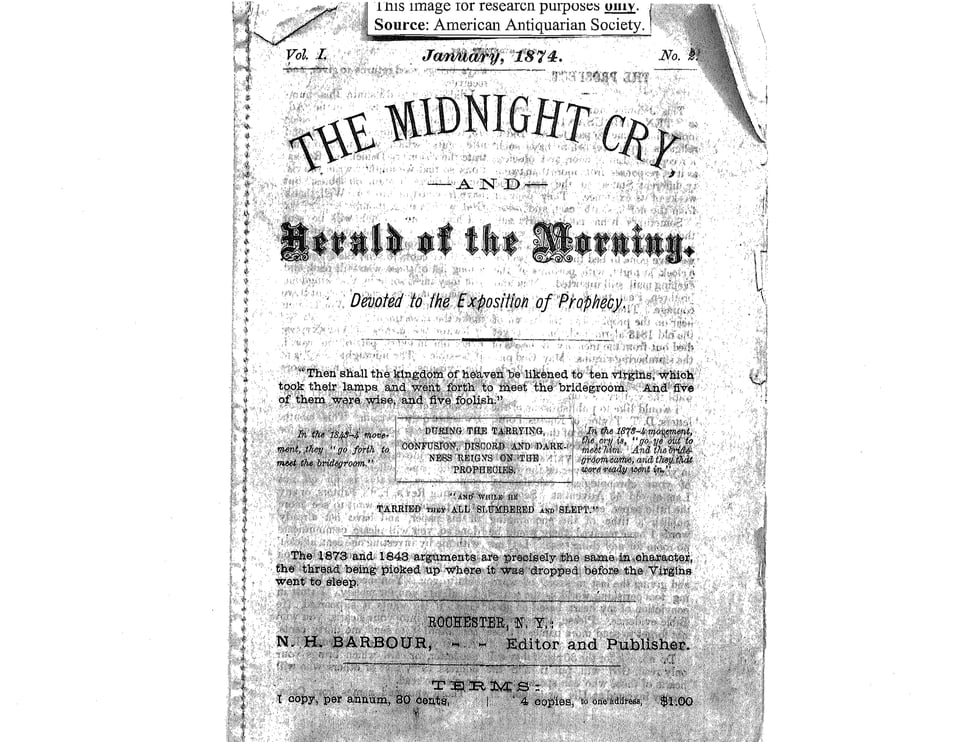
January, 1874.
THE MIDNIGHT CRY
Aerald of the Morning.
Devoted to the Exposition of Prophecy.
"Then shall the kingdom of heaven be likened to ten virgins, which took their lamps and went forth to meet the bridegroom. And five of them were wise, and five foolish."
In the 1843-4 movement, they "go forth to meet the bridegroom."
DURING THE TARRYING, CONFUSION, DISCORD AND DARKNESS REIGNS ON THE PROPHECIES.
In the 1873-4 movement, the cry is, "go ye out to meet him. And the bridegroom came, and they that were ready went in."
TARRIED THEY ALL SLUMBERED AND SLEPT."
The 1873 and 1843 arguments are precisely the same in character, the thread being picked up where it was dropped before the Virgins went to sleep.
N. H. BARBOUR
ROCHESTER, N. Y.::
TERMS:
I copy, per annum, 80 cents, 4 copies, to one address, $1.00 THE PROSPECT.
This January number is increased to TEN THOUSAND, and the money has come to pay for it. Did a religious paper ever before have such a reception? Little, poor, and obscure as it is, responses from more than twenty different States, in the first three weeks of its existence. They pour in from the north, south, east, and west.
Sometimes it has taken nearly half the day, to arrange the names which would come by the morning mail; and we have gone to bed tired, at twelve o'clock at night, with portions of the evening mail, still unsorted. Men and brethren, I can thank God, and take courage. There is an ear, even yet, to hear on the prophecies: the tocsin of the old 1843 alarm bell, has not yet died out from the memory or hearts of the slumbering virgins. May God prolong the sound, " Belhold the Bridegroom cometh; go ye out to meet him," until the victory is won.
I would like to publish some of the letters: D. T. Taylor, of Rouses Point, author of "The Voice of the Church," says, "Your sheet received, and read; I like it! THERE IS A VEIN OF TRUTH in your views, whatever be the result of your chronological calculations. I am an old '43 Adventist. Send me the little paper," etc. But, if I should publish a tithe of the encouraging words I have received, there would be no room for any thing else. Let me say to you, one and all, God bless you.
That we are doing the last work, and giving the last message of warning to a perishing world, is the settled conviction of my heart, based on good Bible evidence. Please, therefore, do not forget to send more names of those who will read.
Do not ask for the 30 cts; if they will only read, God will put it into the hearts of those who can spare it; and money invested at His instigation, always brings good returns to giver and receiver.
I did expect to illustrate this number, and sent to the Editor of the "Advent Herald" a paper continued since '43, to send me some of the old and idle "cuts" which were used to illustrate the visions of Daniel, and Revelations, so that we might "write the vision and make it plain, on tables;" but have received no answer. Well, thank God, we can do without.
I hope names enough will be sent this month, to warrant an edition of 15,000 for Ferbuary. It will cost you only three cents to send the address of a long list of those who will read; and you may meet some in the kingdom, not many months hence, brought there by your three cents. Won't you make the investment?
I want the names of ADVENTISTS; every one in every part of the world, if possible. The midnight "cry," is to the "virgins," first, and as many more as have ears to hear.
A large part of the December number was sent to those of whose address I was not quite certain. This month, that number is very much less, and for February, I hope there will be none.
I do not mean to cast pearls, etc. or send the paper where it is not welcome; hence, and this is for all, not excepting Rev's, Eld's, Editors, or any other person, if you want to see more of this paper, and have not already done so, you will please communicate with me by investing one cent, at least' in a postal card, to inform me that you are willing to receive the paper, if it is sent to you. You need not be afraid I shall ask you for money. I trust in God; if He wants it supported, He will put it into your hearts, you who can afford it, to send me thirty cents. And if you are not selfish, you will let the letter, or card which brings your address, carry that of others who will be glad to read.
Those who send names from Canada, or other foreign part, had better enclose a three cent stamp.
The postage is three cents a quarter, and must be pre-paid. I have sent nearly all, so far, but three dollars a hundred in postage it too heavy a tax. Please remember this.
NOTICE
I have some of the pamphlets published in 1873, which give all the arguments, chronology, etc., of the full year periods, ending in 1873. I can mail them for 15 cents a copy.
THE HISTORY OF THE WORLD.
In the book of Daniel, we find a concise history of the world. And those who will compare these prophecies with the facts in history, will find an antidote to infidelity.
That the prophecy was given prior to the Christian era, no one questions. And the evidence is abundant that it was written at about the close of the sixth century, B. C.
Now go with me over the world's history, and compare it with the prophecy as found in Dan. 7, and then. as an honest man, say it one doubt remains, as to its Divine origin.
The four great empires of the world were shown to Nebuchadnezzar in the form of a great image, or likeness of a man; but are here represented to Daniel, as four great wild beasts.
That Babylon, Medo-Persia, Grecia, and Rome, are the four great empires of the world, is known by the veriest schoolboy.
Prophecy is progressive. "As the shining light, that shineth more and more, unto the perfect day." Dan, 2d. gives a bare outline of the world's history. Dan. 7th. gives many details; and brings us down to the present century. Dan. 8th. gives the prophetic period which brought about this great Advent movement. While Dan. 12th. gives the time of the resurrection.
The first beast, ver. 4th, was like a lion, and represented Babylon. The second beast, ver. 5, "was like a bear," and represented Medo-Persia. The third beast, ver. 6, "was like a leopard," and represented Grecia. The fourth beast "was dreadful and terrible, and strong exceedingly," and represented Rome.
To Nebuchadnezzar, a man of the world, these four kingdoms looked like a glorious image of a man; fit emblem of human empire; but to Daniel, the man of God, they looked like terrible and destructive beasts. And such has ever been the vision, from these two stand-points,. To the man of God, the world is a howling wilderness: where blood. and death, and rebellion against God and His Anointed Son, holds universal sway; and where, to live godly, is to suffer persecution; while the man of the world gives all that he hath, in order to conquer a position there, and share its honors.
What we love is always pleasant to our sight. Does the honor and applause of the world look attractive to you, reader? If so, beware! "Know ye not that the friendship of the world, is enmity, with God?" "Come out and be ye separate."
Babylon, founded by Nimrod, the grandson of Noah, was conquered by Cyrus, about 538. B. C. And the kingdom passed into the hands of Darius the Mede. who was father-in-law to Cyrus. And here, "the lion," Babylon, gave place to "the bear," Medo-Persia.
This second empire continued a little more than two hundred years, and was then conquered by Alexander the Great; who was the "first king," of the third universal empire; represented in the symbol, by the leopard.
This beast had "four wings," and "four heads," denoting a division of the kingdom into four parts, as we are informed.
At the death of Alexander, his four generals shared the kingdom between them Cassander reigned in Greece.
Lysimachus, in Thrace, Ptolemy in Egypt. and Seleucus, in Syria.
This quadrible empire continued about three hundred years, but was eventually subdued by the Romans. B, C. 30.
With the fourth empire, the prophecy enters into very minute detail. Its destructive character, its final division into ten parts, or "horns," the coming up of another power, "diverse from all the others," and which was to "wear out the saints of the Most High," and continue for twelve hundred, and sixty years to hold "times and laws," and afterwards, undergo gradual consumption "unto the end."
Daniel declares that he Beheld, until the thrones, (gentile governments') were cast down, and the Ancient of days did sit; And one like the Son of man, came in the clouds of heaven, and there was given him a kingdom, and dominion, that all people, nations and languages, should serve and obey him. And his kingdom is an everlasting kingdom that shall not pass away."
The end of this fourth beast, was very different from that of the others; they had their dominion taken away, but their lives were prolonged for a season and time." ver. 12. That is to say, Babylon was conquered, but the subjects of the kingdom were absorbed into the Medo-Persian empire; which, in turn, shared a similar fate, under the Grecians; and the Grecians, were eventually merged into the Roman empire. But when the fourth one is subdued, its subjects will have no part, or lot, in the FIFTH universal monarchy, under God's Anointed Son. He "will dash them in pieces, like a potters vessel." "I beheld, until the beast was slain, and his body destroyed, and given to the burning flames."
After Daniel had seen the vision, and sought for the meaning. he was informed
that, "These great beasts, which are four, are four kings which shall arise out of the earth; (king. and kingdom, are here used interchangably, see ver. 23. "Thus. he said, the fourth beast. shall be the fourth kingdom upon earth" ) but the saints of the Most High:shall take the kingdom, and possess the kingdom for ever, even for ever and ever." vers. 17, 18,
Here, the vision, and interpretation ends. But Daniel had a desire to know more of. the fourth beast. He had seen a certain outgrowth from it, which "Had eyes' like the eyes of man, and a mouth, speaking great things;" and observed that the voice of this horn was heard, even "after the judgment sat, and the books were opened."
"Then I would know the truth of the fourth beast, which was diverse from all the others, exceeding dreadful. . . and of the ten horns that were in his head, and of the other that came up, and before whom three fell; even of that horn that had eyes, and a mouth that spake very great things, whose look was more stout than his fellows,
I beheld, and the same horn made war with the saints, and prevailed against them, until the Ancient of days came, and judgment was given to the saints of the Most High; and the time came that the saints possessed the kingdom.
Thus, he said, the fourth beast shall be the fourth kingdom upon earth, . . . and the ten horns are ten kings (kingdoms,) that shall arise, and another shall arise AFTER them, and he shall be diverse from the first, and shall subdue three kings, (kingdoms.) and he shall speak great words against the Most High, and shall wear out the saints of the Most High, and think to change times and laws: and they shall be given into his hand, until a time, and times, and the dividing of time; but the judgment shall sit. and they shall take away his dominion, to consume and to destroy it, unto the end."
This fourth empire has filled a large page in the world's history...
It was Rome, that destroyed God's ancient people. And it is mystio Rome, (or Babylon the great), that has martyred the saints of God. Hence, it fills most of the prophecy of Daniel, and Revelations.
Rome conquered Grecia, and became a universal empire. at about 30. B. C. and so continued, until about the middle of the fifth century, when it was broken into ten fragments. And after that, came up this "little horn," of which we mean to speak more particularly.
The papacy has its history and character so clearly and minutely recorded here, that we cannot be mistaken in the application,
This "little horn," comes up, AFTER the other ten, hence, after the middle of the fifth century. Since "the virgins have been slumbering and sleeping," some of them have called this "little horu," the whole EASTERN EMPIRE. But the eastern empire came up more than a hundred and fifty years before Rome was divided into ten parts.
Constantine removed the seat of empire to Constantinople, at about A. D. 315, while the ten horns did not come up until about 476, A. D. The prophecy does not declare that the "little horn" got its mouth, after the other ten came up, as these expositors would have it, but "it came up, after them, aud plucked up three of the first horns."
The eastern empire, founded in 315, terminated in 1451; when Constantinople passed into Mahometan hands; and therefore existed only 1136 years; while the "little horn," and the "beast" of Rev. 18, which are one and the same, continue "forty and two months."
This horn was to "speak great words, and wear out the saints, and think to change times and laws;" all of which was accomplished by the PAPACY, and not the eastern empire. (Those who have not passed through this
time of darkness and confusion will wonder that we should dwell on a point so self-evident, but since the "slumbering of the virgins" there has been no theory advanced, and no prophecy applied, however absurd, which has not found supporters. The fact that God said the "little horn" came up AFTER the other ten, has no weight; the application of which we speak makes it come up BEFORE, and that must stand. The fact that God said it was a LITTLE horn, is of no force; their theory demands that it should embrace the whole eastern empire, before that empire was divided. If one can start on such premise, and make an application precisely opposite from what the prophecy demands, where could they not end?
After Rome was divided into ten parts, we are to look for a "little horn, diverse from all the others." The papacy exercised ecclesiastical, as well as civil power, hence, it was different "from all that were before it" "He shall subdue three kingdoms.' The popes wear a tiara, or three crown'ed hat; and the map of the Papal States, as they existed a few years since. embraced the territory of three of the original divisions of the Roman empire, viz., Lombardy, the Exarch of Ravenna, and Romania. Sir Isaac Newton, in his dissertation on the prophecies, Bishop Newton; the Encyclopedia of the Royal Society of London for the diffusion of useful knowledge, John Dowling, in his History of Papacy, and all other authorities, outside of certain Adventists, make this same statement in relation to the three horns that were plucked up by this little horn
The papacy subdued the first of these three horns, and obtained their first crown, in the eleventh century, and the other two were added to his dominions during the next one hundred and fifty years. The above mentioned writers, and even Worcester's Dictionary, confirm this statement. Newton says, the fact that the three horns subdued by the popes, were Romania, Lombardy, and Ravenna, is beyond question, while it is more difficult to fix upon the exact date of these events. But that the popes subdued these three kingdoms, and obtained the three crowns, at about the above date, is the universal testimony of history.
Modern Adventista have supposed the Goths, who were expelled from Italy, between A.
D. 538 and 553, were one of the horns which "he," the little horn, subdued. But it was the arms of the eastern empire that drove the Goths from Italy; and the eastern empire was what was left of the "dragon," or imperial Rome. Bellisarius was sent to Italy, by Justinian, the Roman emperor, to expel the Goths, who had conquered Italy and several of these ten divisions, about sixty years before; and give that old original seat of the dragon to the papal beast, as stated that he would. (Rev. 13:2.) "And the dragon gave him his power, and his seat, and great authority."
The next thing mentioned of the little horn is, "He shall speak great words against the Most High." I need not stop here to tell you of the great words spoken by the papacy; its history is too well known. "He shall wear out the saints of the Most High." This also is graven "in blood and flame, and sword and captivity," on the pages of history. "He shall think to change times and laws, and they shall be given into his hand for a time, times, and the dividing of time."
Mark the expression, "they, (times and laws) shall be given into his hands." Who gave them? Let the Bible speak for itself. "These ten kings, . . . these have one mind, and shall give them power and strength un to the beast." Rev. 17:12,13.
Soon after the ten horns came up, they embraced the papal religion, and did "agree and give their kingdom to the beast" until the words of God, viz., "the forty and two months," or "time; times, and the dividing of time," was fulfilled.
When the Gothic power was broken in Italy, about A. D. 588, Rome ceased to have a king; and from that date, and for centuries after, the governing power in Rome was of a very mixed and confused character; so much so in fact, that it was difficult to trace its history. Sometimes the Franks, sometimes the eastern Emperors; sometimes one, and sometimes another of the ten fragments of the Roman empire claimed to hold the "eternal city." But during all this time, the popes were the only real existing, local authority in Rome which was permanent. That power belonged to the "ten kings;" and all that the popes exercised was delegated to them, by one and
another of the kings. And so the papacy existed there and held a very limited amount of civil power, for many centuries. "God had put it into the hearts of these kings to fulfill His will, and agree and give their kingdom to the beast." Rev. 17: 17.
You will notice that the papacy is called a "LITTLE horn;" and yet we are told, "his look was more stout than his fellows." Dan. 7:20.
From 588, when the Goths were driven from Italy, the popes began to exercise civil power. Gibbon informs us that they were permitted "to control weights and measures;" that they collected their own revenue; appointed their own state officers, etc. But it was indeed a little horn. However, as they gained more and more ecclesiastical influence over these ten kings, they became swollen with pride, and kings and emperors finally submitted to kiss their feet. And for many centuries "their look was more stout than their fellows." But when they came to the real struggle and tug of war with any one of these ten kings, unless some other one came to their rescue, they were found, after all, to be but a "little horn."
"Times and laws shall be given into his hands, for a time, times, and the dividing of time." (ver. 26.) The question here arises, why we assume that this period of time is twelve hundred and sixty years? And I shall answer very briefly.
This period occurs here, and in Dan. 12: 7, and Rev. 12: 14. In Rev. 12, it says, "The woman fled into the wilderness, ... and they should feed her there for a thousand two hundred and three score days." In verse 14, it declares, "She flew into the wilderness, where she is nourished for a time, times, and half a time, from the face of the serpent." And in Rev. 13:5, we find this power, from which the true church, or "woman," fled, was to continue forty and two months." In Dan. 11, the margin against verse 13 gives the Hebrew reading, of the meaning of "time," "Heb. At the end of times, even years." In Hebrew, when two "times," or years; were spoken of, the plural was used, "times;" when more than two, the number was given. Hence, a literal rendering of the above text is, "for a year, two years, and the dividing of a year." (Dan. 7:26.) This "dividing of a year," leaves it a little obscure, but in Rev. these three expressions, "time, times, and a half," "forty and two months," "a thousand two hundred and three score days" are used to measure the same period of time, and therefore, these periods must be synonymous.
A year is twelve months, two years twenty-four months, and a half year, six months, and together, make the period of forty and two months." A Bible month is thirty days. (See Gen. 7:11.) Where the fountains of the great deep are broken up on the seventeenth day of the second month. And in the seventh month, on the seventeenth day, the ark rested on Mount Ararat. (Gen. 8:4.) "And the waters prevailed upon the earth a hundred and fifty days." (Gen. 7:24.) From the seventeenth day of the second month, to the seventeenth of the seventh month, is five months; and God said it was "a hundred and fifty days." Five times thirty is a hundred and fifty. Thus we learn that a time, times, and the dividing of time, or an half a time as given in Dan. 12:7, is 1260 "days."
A day, when used in prophecy as a symbol, represents a year. (See Ezek. 4:1-6.) But the best of all proof is, the prophecy has been so fulfilled.
In March, A. D. 538, the power of the Goths in Italy was broken; and somewhere about that time, probably near the end of that year. but we cannot determine the month, the provinces of Italy changed their allegiance from the Goths to the Catholic party. "The provinces of Italy had embraced the party of the emperor," says Gibbon. (See Gib. 1824, page 707.)
Somewhere, then, in the year 538, the provinces, civil power became catholic; and within "one hour," prophetic time, or fifteen days, (as we shall show on another occasion) from that change of allegiance, the last of the "ten kings" joined the confederacy, and "agreed and gave their power and strength unto the beast." Here, then, somewhere in the year 538, the papacy began to exercise civil power. And when that church became a civil power, it was numbered among Gentile governments, and became a "horn," or "beast," in prophetic language.
Twelve hundred and sixty years from that date the prophecy declares, that "the judgment should sit, and they shall take away his dominion, to consume and to destroy it, unto the end." (Verse 26.) Twelve hundred
and sixty years from 538 ended in 1798; and you all know what happened to the papacy. I need not quote history; these facts which I have given, are the outline facts with which all students of history are familiar, and all that is required to establish this application, with absolute certainty is, to establish these two dates, viz., 538, and 1798.
I will quote a few lines from "The French Revolution," by Christopher Kelly, page 243. "The Roman republic was proclaimed on the 15th of Feb., 1798. The pope, however, made one additional effort for the continuance of his temporal existence, by sending an embassy to Berthier, who was encamped outside the walls. The Gen. refused to admit any other deputation than that of the people of Rome, thus dissipating the last hope of the holy father. The arrival of the French army, and the proclamation of the general, HAD GIVEN THE FATAL BLOW TO THE PAPAL SOVEREIGNTY."
"But the judgment shall sit, and they shall take away his dominion, to consume and destroy it, unto the end." is the language of the prophecy. (Verse 26.) "But the judgment shall sit." This expression might convey the idea of the final great judgment, but this is simply the judgment on the papacy, and not the last final judgment at the end of the world, as is made clear by the last clause of the sentence, "to consume and destroy it unto the end." In 1798, or 1260 years from the time papacy began, as a civil power, its dominion was taken away. Now, as "a time, times, and the dividing of time," the period during which he was to hold control of "times and laws," is made synonymous, in Revelation with 1260 days; and in prophecy a day is used to symbolize a year; and this prophecy of Daniel is made in symbolic language, and the time specified has been fulfilled, a year for "a day," it satisfies me, whether it does others or not, that we are on the right track, from Babylon, through Medo-Persia. Greece, Rome-Imperial, and Rome-papal; and in 1798 reached the end of the season during which "the little horn was to hold times and laws."
"They shall take away his dominion to consume and to destroy it unto the end." And now, reader, what has been the history of the papacy since that downfall in 1798? Has he been being "consumed and destroyed?"
Have "the ten kings who were to agree and give their strength and power unto the beast, until the words of God, viz., the forty and two months, or 1260 years, were fulfilled," changed their minds, towards that "little horn," which was both church and state, the harlot of Rome? Are they now stripping her of her possessions, and making her desolate? "And the ten horns which thou sawest upon the beast, these shall hate the whore, and shall make her desolate and naked, and shall eat her flesh and burn her with fire."
It has been a difficult matter to trace the history of the ten divisions of the Roman empire, from first to last, there has been such a mixing and mingling, and confusion among them. Sometimes one of them would conquer a number of others, and sometimes there would appear to be less, and at other times far more than ten fragments of the empire. On several occasions it has appeared as if they would all unite again into one kingdom, as almost transpired under Charlemagne and Bonaparte. But all this was foretold by the prophet. "And whereas thou sawest the feet and toes part of potter's clay and part of iron, the kingdom shall be divided." They shall mingle themselves with the seed of men, BUT THEY SHALL NOT CLEAVE ONE TO ANOTHER, even as iron is not mixed with clay." Still, notwithstanding all this mingling, and though some of them have been subdued for a time, (three of them by the little horn,) still, I say, we have come to the time when we have the right to expect to find them all in existence; for "THESE TEN" were to hate the harlot, and "THESE TEN" shall make war with the Lamb, and the Lamb shall overcome them." (Rev. 17:14.) And now I will give their present names, as given by the pope himself, a few months since, in a letter published in the Catholic New York Freeman's Journal," of July 12, 1873, in answer to an address of the Generals, and Procurator-generals of the religious order of the Most Holy Father. In this letter, the pope complains of having been made "desolate," and closes by the following pious ejaculation: "Finally let us raise our eyes to Him, and the better to console ourselves, let us demand of Him the grace to endure with patience all that which He pleased to impose upon us. Let us recommend to
Him the needs of the entire church, and of this poor old man, that he may be granted strength to pray for all." (Here follows the names of the "ten kings," who have had a part, directly and indirectly, in making him "desolate.") "Strength to pray for all; for GERMANY, for FRANCE, for AUSTRIA, for SWITZERLAND, for ENGLAND, for SPAIN, for PORTUGAL, and for this poor ITALY. Oh, may God come to calm the tempest, to pilot the ship to rest in port, and He will come without fail."
"Benedictio Dei, Omnipotentis." "E."
Seven of the ten are here named, "and for this poor Italy," viz., the "three" who he himself "subdued," and still wears their crowns. But the papacy is not dead yet, notwithstanding times and laws have been taken away, and these ten kings have made him desolate. There is yet too much vitality in that system for it to give up the ghost. "I beheld and the same horn made war with the saints, and prevailed against them until the Ancient of days came, and judgment was given to the saints of the Most High; and the time came that the saints possessed the kingdom. (Verses 21, 22.) Or as it reads in verse 11, after the Ancient of days came, and the judgment set, and the books opened, "I beheld THEN because of the voice of the great words which the horn spake," etc.
The papacy is organized to-day—men, women and children, over twelve years of age, all over the world—for the final death struggle. Labor is organized against capital; the Internationals against governments. There are startling events at hand, a time of trouble such as this world has never yet experienced. The death of one world and the birth of another, and you and I, reader, must fall into the ranks—must pass through the straits. Shall we be for God, and His anointed Son, or against Him. There is no neutral ground. The hosts are marshaling for the last great battle. Both sides call for volunteers. Numbers are against us, but God is for us; many of the virgins still sleep; some have roused up, but found their lamps extinguished. They are satisfied we are near shore, and among breakers, but like men in the dark, they hesitate, and expect light from some angelic hand, and are in doubt. Men and brethren, the harbor.
in full view; the light of eternal day paints all the east with golden hue. We've passed the coast of Babylon, the Medo-Persian line, Greece, pagan Rome and papacy are all now left behind. The man of sin is humbled, and like a giant chained, though fierce may be the struggle, he ne'er will rise again. The antichrist is dying; the true one will appear, and those who share His sufferings, will share the kingdom here.
"And the saints of the Most High shall take the kingdom, and possess the kingdom for ever, even for ever and ever." 1335 prophetic days from where the 1260 began, allowing for certain fractions of a year, which will be made clear in another article, bring us to the end of this world's history; and completes all the symbols as God has drawn them. This is as certain, and can be made as clear, as is the present application of this prophecy. Is there not, therefore, a plausible argument, at least, that we are on the eve of the Gospel dispensation, and the morning of the next, the glorious age? Then, friends, you who have been waiting long for the coming Bridegroom, take heart, and you who are unprepared for these events, get ready, THE GREAT JUDGMENT DAY IS AT HAND!
TIME, AND TIME ARGUMENTS.
The Advent people have had a singular history. It was certainly the subject of Time, which brought them out as a distinct people; and if it was good for that purpose, is it not good to hold them out, as a distinct class? But it is this, to which many object. They do not want to be a distinct people; but rather desire to cultivate pleasant relations with the nominal Churches; and this desire, to a certain extent, may be praiseworthy; but if we are willing to renounce our faith; or put our light under a bushel, to please those Churches, we do a great wrong.
Since 1844, the preaching of Time, has doubtless had a share in causing divisions. So also has the preaching of the sleep of the dead. In fact there is no one thing, which has not been an element of discord, since "The virgins have all slumbered and slept."
Now I would like to know if any person really objects to a careful examination of the prophetic periods; and, if we think they center in any particular year, giving our reasons for so thinking ? Perhaps there are those who are so fearful that the subject may be handled in an uncharitable manner, as to almost wish it to be let alone; but that any Adventist, can be found, bold enough to expunge time from our creed, and shut the door against its investigation, I have my doubts, in spite of present appearances.
To preach the coming of the Lord as an event just in the future, is right; the signs of the times warrant us in so doing. But the prophetic periods are more definite than signs; and if there is evidence that they end here, why not give that evidence?
Because time has been presented in a bad spirit; and men have been dogmatical, and claimed to "know" they were right, and censured those who differed from them, is no reason why we should reject any part of the Scriptures.
None can regret, more deeply than I, that there are such men amongst us; but that fact does not lessen our responsibility before God. In 1854, and 1867-8, that spirit of censure was carried to a great extent, and a little of the same element has found its way into the 1873-4 movement; but thank God, it is dying out.
If the signs of the times bring us down to a little circle of years in which, every thing tells us, Christ must appear, and no Scripture went farther than these, here would be our stopping place. But if the prophetic periods mark the time of that event still more accurately, why should we stop with the signs? The only answer that can be given is, that in case of an error being found in our calculations, we must bear the censure of the world; while, if we only say it is NEAR, our arguments can never be tested, and we may escape that censure.
This spirit of opposition, among our teachers, to the investigation of the prophetic periods, has a bad look. Every one is not called to preach on prophecy, and far be it from me to censure those who do not; let each one do, as God, and his own conscience, may dictate; but do not curtail my liberty.
The question is often asked, brother B.,do you believe we shall ever know the exact time when Christ will appear? My answer is, I do not believe the day, or year, will ever be known. Why then, do you try to convince the world that He will come in the "seventh month" of 1874?
I answer, because I believe He will come, at that time.
The evidences are perfectly overwhelming, not only that it is near, but, that the time is revealed, and will be correctly understood.
Faith, and knowledge, are not the same. It is faith here, but KNOWLEDGE, over there.
If the time is revealed, it is in such a way that we must search as men search for hidden treasures, if we would find it. Like all other Bible truths it is for those, and only those, who earnestly desire it.
The prophetic periods are given in full years, and center, I believe, in the year 1873. But there is a fraction of time which will carry us to the 7th month of '74. And as the evidence is very plain, that He will eventually come in the seventh month, I see no reason as yet, for doubting the truthfulness of the 1873 arguments.
Now, for a moment, admit this whole position. The Lord comes next fall; and we go into the kingdom. You ask, there, brother, did you know we were right while you were preaching the time? My answer would be, no I my brother, I did not. I saw evidence that convinced me, and acted up to that evidence by letting the light shine as far as I could; and to God be all the glory that it did not prove a failure.
Now, friends, to reject this evidence, unheard, or carelessly heard, is not an act of wisdom. What God has revealed in relation to the GREAT DAY OF JUDGMENT. is too important to be passed over lightly Then let me entreat you to entertain this little magazine during the coming months, and carefully examine all the evidences, without favor, and without prejudice.
THE STUDY OF PROPHECY.
There are very few readers of the Bible who have not been puzzled with what appears like extravagant language in prophecy.
They read about Babylon, for instance, and find the language far stronger than the occasion seems to demand. Take the 13th of Isaiah. It begins with "The burden of Babylon; which Isaiah, the son of Amoz did see. Lift up a banner high upon the mountains, exalt the voice above them, shake the hand, that they may go into the gates of the nobles." Evidently referring to the
fact that when Babylon was taken, the gates that barred the Euphrates, where it ran through the great City, were left open, so that Cyrus and his army, after having turned the river from its accustomed channel, could march in. But further on it says, "Behold, the day of the Lord cometh, cruel both with wrath and with fierce anger, to lay the land desolate: and He shall destroy the sinners thereof out of it. For the stars of heaven, and the constellations thereof shall not give their light: the sun shall be darkened, in his going forth, and the moon shall not cause her light to shine. And I will punish the world for their evil, and the wicked for their iniquity... Therefore will I shake the heavens, and the earth shall be removed out of her place, in the wrath of the Lord of hosts, and in the day of his fierce anger. Behold, I will stir up the Medes against them, which shall not regard silver, and as for gold, they shall not delight in it."
Did the simple fact that Cyrus was to conquer Babylon, call for such language? Howl ye, for the day of the Lord is at hand, the stars, and sun. and moon, shall not give their light? And I will shake the heavens, and remove the earth out of her place; and I will punish the world for their evil? And yet it adds, I will stir up the Modes against them. If such language did not puzzle God's people before the application made in the book of Revelation, I cannot understand what would. And it still puzzles a great many readers, though the simple fact is, Babylon was the type, and mystic Babylon the antitype.
A type and antitype, is often spoken of in prophecy, as a single event. Hence the apparent object-point is the type, while the real application, in its fulfillment, belongs to the antitype. This is true of Israel, of Jerusalem, of Egypt, of Babylon, and of many other prominent Scripture subjects.
For the present we will confine our investigation to Babylon. Read the 51st of Jer.
This appears to apply to literal Babylon. But compare the language in Revelation where it is applied to Mystic Babylon, and you will see there can be no doubt as to where it belongs. Jer. 51: "My people, go ye out of the midst of her, and deliver every man his soul from the fierce anger of the Lord." Rev. 18:4. "Come out of her my people, that ye be not partakers of her sins, and receive of her plagues."
This language appears to apply to both type and antitype, in a certain sense; but at the best, very superficially, to the type.
Again: "Babylon hath been a golden cup in the Lord's hand, that made all the earth drunken: the nations have drunken of her wine, therefore the nations are mad." Jer. Mystic Babylon had a golden cup in her hand, "And the inhabitants of the earth have been made drunk with the wine of her fornication." Rev.
"O thou that dwellest upon many waters; abundant in treasures." Jer.
"Come hither; I will show unto thee the judgment of the great harlot, that sitteth upon many waters, . . .-Alas! alas! that great City, that was clothed in fine linen, and purple, and scarlet, and decked with gold, and precious stones, and pearls. Rev.
Here, indeed, are " Abundant treasures;" as Jeremiah affirms.
Babylon is suddenly fallen and destroyed, Jer. "Therefore shall her plagues come in one day, death, and mourning, and famine." Rev. "Howl for her, take balm for her pains, if so be she may be healed." Jer.
"The kings of the earth shall bewail her, and the merchants of the earth shall weep and mourn over her." Rev. "As Babylon has caused the slain of Israel to fall, so at Babylon, shall fall the slain of all the earth." Jer. "And in her was found the blood of prophets, and of saints, and of all that were slain upon the earth." Rev. "Thou shalt bind a stone to it, (the book,) and cast it into the midst of Euphrates; and shalt say, Thus shall Babylon sink, and shall not rise from the evil that I bring upon her." Jer.
And a mighty angel took up a stone, like a great millstone, and cast it into the sea, saying, Thus, with violence, shall that great City, Babylon, be thrown down, and shall be no more found at all." Rev.
Now we may understand why such terrible language was used, in speaking of Babylon, not that it was appropriate to the type, only in a very limited sense; but BABYLON, means a great deal more in prophecy, than simply the capitol of Chaldea.
Those who cannot connect type, with an titype, can no more understand prophecy, than an infant can comprehend the geography of the heavens.
Jerusalem, which is in bondage with her children; is a type of the true Church. And the tribulation of the literal seed, at the destruction of Jerusalem, is a type of the tribulation on the Gospel Church. Hence, the two are spoken of in prophecy as one. See Mat. 24. etc. And many, who call themselves Bible teachers, really suppose this prophecy of our Lord, was fulfilled, at the destruction of Jerusalem: though, as in the case of Babylon, the language does not fit, or at least, only far enough to lead the superficial reader astray.
Why God has so arranged prophecy, and speaks of type, and antitype, as if they were one, we will leave, for Him to answer. But that such is the case, no one can question.
"Unto you it is given to know the mystery of the kingdom of God; but unto them that are without, all things are done in parables; that seeing they may see, and not perceive; and hearing they may hear and not understand." Mark 4: 11.
FANATICISM.
Some of our time brethren are passing through a severe trial. Before this paper is in possession of the reader, the time to which they look will be passed; but be not disheartened, beloved friends, the evidence is clear that 1873-4 must be connected, as was 1843-4. The two movements of the parable are running parallel, thus far; and as there was evidence then, to carry us to 1844, notwithstanding the prophetic period to which we looked ended, in full years, in 1843; so now, the evidence which carries us to the autumn of 1874 is clear, though the full-year periods ended in 1873; and this movement must so terminate, if that parable of the ten virgins belongs to the Advent people. But, aside from this, the evidence is exceedingly clear, as can be proven in many ways, that the tarrying is to be 30 years, as at the first advent.
Dearly beloved, hold out to the end: "let no man take your crown." If you are told that the resurrection has taken place; or, that Christ has come in some obscure way, believe it not, nor follow them. His coming will be as the lightning; and the resurrection will not take place till Jesus comes.
As at the grave of Lazarus, He said, in a loud voice, "Lazarus, come forth," so, at His voice, the grave will again give up its dead.
I write this because I fear some such idea as the above already obtains, among some of our brethren. God keep us from FANATICISM.
MIDNIGHT CRY.
The alternative presented by a writer in a recent number of the World's Crisis, ' that the virgins are all awake, or else the Midnight Cry has not been made,' is not logical Such a position might be correct if it necessarily followed from the language of the parable that as soon as the "cry" was made the virgins sprang to their feet, like a trained band of soldiers. But let us examine the subject a little more carefully.
It is admitted that the parable of the ten virgins applies to, and is being fulfilled by the Advent people. And certainly no prophecy could have a more accurate fulfillment than has this, in the history of Adventism.
They went forth to meet the Bridegroom before the tarrying, and were disappointed. Since 1843-4 the Bridegroom has tarried, "and the virgins have all slumbered and slept." These are features of the application held in common by all.
The going forth prior to the tarrying, occupied many years. The number in that movement were very few at first, but gradually increased until, towards its close, they numbered thousands and tens of thousands.
This gradual growth of the first movement, is also a fact which none will question. "And at midnight there was a cry made; then all the virgins arose and trimmed their lamps." This, it is argued, means that they all arose at one and the same time. Now let us examine the first "then" which occurs in the parable. "THEN shall
the kingdom of heaven be likened to ten virgins which took their lamps and went forth to meet the Bridegroom." Here it is stated that "THEN" the kingdom of heaven should be likened to ten, the whole number, who went forth. The FACTS in the case are, and facts are often worth more than are conjectures, that under the first "THEN" time was consumed; for it was about fifteen years during which they were coming in, one after another, and taking part in that 1843-4 movement Eighteen hundred and forty-three time was preached for many years before one in ten thousand of the "virgins" even so much as heard of it
And this 1873.4 movement, which we claim to be the midnight cry, has been in progress about an equal number of years.
If the "going forth of the virgins to meet the Bridegroom," ver. 1, required fifteen years before they all fell in and made a start, why should not the "go ye out to meet him." ver. 6, require a little time? And, if under the first "THEN," they did not all start together, why insist that they must so start under the second "then?" THEN is an adverb of time, and when used in such connection, simply means the next event in order, without regard to the period of time such event occupies. "The stars shall fall from heaven, and the powers of heaven shall be shaken, and THEN shall appear the sign of the Son of man in heaven."—Mat. 24:30. The stars fell more than forty years ago, while the sign of the Son of man in heaven, has not yet appeared.
Our Lord does not say they all arose at the same moment. The cry is made AT MIDNIGHT, and then follows the fruits of that cry, viz; "the virgins arise and trim their lamps."
Night means DARKNESS, either physical, moral, or prophetic. "And the darkness, he called night."—Gen. 1:6. This was physical darkness. "The night is far spent, the day is at hand."
Rom. 13:12. This is doubtless the night of six thousand years of sin and moral darkness. "Therefore NIGHT shall be unto you that ye shall not have a vision, and it shall be dark unto you, that ye shall not divine," Micah 3:6. This night was prophetic darkness.
There is also a night belonging to the parable, and it has been one of prophetic darkness and confusion. "They who sleep sleep in the night. And while the Bridegroom tarried they all slumbered and slept; and at midnight," etc. The night here spoken of, is clearly a condition of darkness on the subject which brought the "virgins" out, viz; the time of the coming of the Bridegroom; and this darkness covers all alike, both wise and foolish. "And at midnight there was a cry made." Midnight means the middle of the night, and every night, of whatever nature, has a beginning and an end. This one ends with the coming of the Bridegroom and the glorious morning of the resurrection. It will not do to add to His words, and bring in features of an eastern wedding, which He did not require in his own illustration; and try to show that when Christ comes, darkness will prevail. I tell you, when Christ comes it will be morning, and light will prevail; and light and morning never comes at midnight.
The cry is made at midnight, but He does not come at that time, the virgins arise and examine the Bible, as they are, and have been doing since the cry was made, and in doing this, time has been consumed.
As it took fifteen years, in the first movement, to TAKE the lamp and go out to meet the Bridegroom, so in this second movement, it has required about an equal time to "trim the lamp, and go forth to meet him." There are but two movements shown in this parable. The four "watches,"in Mark 13:35, is a subject by itself, and not a
part of this parable. This present movement began, as set forth in the parable, precisely at midnight. The 1873 arguments began to be preached as a persistent "cry," with the BEGINNING of the sixteenth year after 1843-4 time expired, and if He tarries thirty years, or until the seventh month of 1874, that cry will have continued to sound for fifteen years.
Now, reader, here are facts which have transpired within the present generation, and there in Mat. 25, is the prophecy.
The parable is placed in the future tense, and belongs to the generation who are to see the personal coming of the Bridegroom. This Advent people seem to have fulfilled it. They did take their lamps, (Bible,) and go out to meet Christ in the 1843-4 movement. He tarried, and they have all been in darkness on the time question, as the hundred and one different times which have been set, and proved failures, clearly indicate. "At midnight, there was a cry made." This 1873-4, is a midnight cry, for it was made fifteen years after the night, or tarrying and slumber, began, and the cry was that Christ, and the morning was coming, fifteen years in the future, and the "virgins" have been rising and trimming their lamps. Some of them have found no oil, (light) in their vessels (hearts), and hence their lamps have gone out. "There is no definite time for the coming of the Bridegroom in the Bible," they say, hence there can be no "cry" made without a new revelation. There is no oil for them here, and so they are going to look for this new revelation, so that is, for a "cry" to be made by some angelic messenger.
angelic messenger. I fear they have gone too far for "oil." "And while they were gone the Bridegroom came, and they that were ready went in' and the door was shut; and afterwards came the other virgins saying. Lord, Lord, open unto us."
They got their "oil," or light, and perhaps saw the heavenly messenger, and came back, but it was too late.
A clearly marked division is now taking place among Adventists, between those who believe the Bible reveals definite time, and those who do not; and that division has been of a more marked and open character since the time discussion held at Rochester last summer, and the parable is almost finished. This trial in having the time, as given in full round years, pass, will of course cause many to draw back, but that is what trial is designed to do. If that parable belongs to the Advent people this division is clearly the one referred to.
It will be said, Such an application makes a test question of this matter. What of it? Why should not the turning away from the light that brought this people out be a test? Events are speaking for themselves, and they seem to be in exact accordance with the parable; and neither the facts nor the words of Christ can be changed. I simply state them, and leave the reader to judge if they belong to this people. With Adventists whom God has called to give the alarm to a slumbering world, and who, by a long course of training, are more or less familiar with prophecy, with THEM I believe the loss of this light will prove to be a "test question."
"Not all that say Lord, Lord, shall enter in; but they that do the will of my Father which is in heaven." and I humbly submit that "the will of my Father" is, that the watchman whom he has called to sound the alarm of the coming judgment, give that message in all its strength as God has given it, in the "times and seasons" and prophetic periods found in his word; and not that they go back to the first principles of the gospel, and keep this present truth in the background.
There are those who gravely inform us that the midnight cry is to be made at, or about the time of Christ's appearing. Now if there is any one thing made prominent in all the Scriptures, it is that the morning, and such a morning as this world has never seen, will dawn upon the "virgins" at the appearing of Christ. Will some one inform me how a MIDNIGHT cry can be made in the morning?
NAPOLEON.
One would be amused, if it were not so serious a subject, at the fanciful application of prophecy made by the Adventists, during the last twenty-five years. And Napoleon has, perhaps, been the greatest hobby of them all. They have made Napoleon, and France, "The beast that ascendeth out of the bottomless pit, having the seven heads and ten horns." Rev. 17:7,8. They make France, two of its own "heads;" and one of its own "horns." And not satisfied with this, Napoleon was the "antichrist;" he was also, or is to be, "the eighth," or nondescript beast. Rev. 17:11. And to cap the climax, the letters that spell his name come in for their share. They are "the number of the beast." Rev. 18:18.
It is a universal rule, that a prophecy will bear the substitution of the true meaning for the symbol, and make good sense, thus: "I saw four great beasts rise up out of the sea," may be read, "I saw four great kingdoms organised upon the earth."
Now let us try this rule on the Napoleonic theory. "I saw as it were a sea of glass, mingled with fire, and them that had gotten the victory over the Napoleonic dinasty, (the beast.) and over his image, and over his mark, (here I am at a loss to know what their theory would substitute.) and over the letters that spell his name, (the number of the beast), stand on the sea of glass, having the harps of God."
Rev. 15:2.
The Germans got the victory over the Napoleonic dynasty, (the beast) and hence, are entitled to a reward; but how those who get the victory over the letters which spell his name. are entitled to a place among God's ransomed host, is more than I can tell.
Do you wonder, friends, when such application of prophecy can, and does obtain, among Adventists, that Christ should say "While the Bridegroom tarried, they all slumbered and slept?" O when shall we be done with such "wood, hay, and stubble?" And those who have no "gift" to expound prophecy, keep to the milk of the word? or will they continue to build even in the very fire?"
"THE MARK OF THE BEAST." WHAT IS IT?
"And there fell a noisome and grievous sore upon them that had the mark of the beast, and upon them which worshipped his image." Rev. 16:2.
This question has called out a vast deal of speculation. Protestants fixed it upon the papists, because they made a cross on their forehead with "holy water." Some suppose it refers to Masonry, or other secret societies; and our seventh-day brethren, as is well known, think it is keeping the first day of the week for the Sabbath.
Perhaps something may be said in favor of each of these views, while the last, to my thinking, has the most common sense. But they all lack one important element, viz., Bible proof. There is no symbol, or figure, used in the Bible, which is not also explained somewhere in the Bible. "The mark of the beast," is symbolic language, and if we let the Bible explain its own symbol, we shall arrive at the truth.
The work "mark" has a number of meanings, and it is often a stamp of
character. A house has the mark of age, because it is old. A man has the mark of a gentleman, if his associations have been such as to impart the character of a gentleman. Now if we can learn what the symbol of "beast" means, perhaps we can determine what class of men have the character stamped upon them implied by the symbol. "Thus, he said, the fourth beast shall be the fourth kingdom upon earth." Dan. 7:23.
A. "beast," then, in prophetic language, means a kingdom, or earthly government. If a man can have the mark of a gentleman, by possessing those qualities which go to make a gentleman, why cannot a church have the mark of earthly power if it is in possession of these elements which constitute earthly power? If this be true, then we know where to find the "mark of the beast," viz., a church-state organization.
Here is a solution which has world wide meaning, and makes that "mark" worthy the terrible judgments God has pronounced upon the men who have it. The church is the bride of Christ. When that bride turns to the world, and "they twain become one flesh," is she not a harlot? "Come out and be ye separate." "Know ye not that the friendship of the world is enmity with God?" If you are of the world, (Gentile powers, or "beasts") "the world will love its own." "Ye CANNOT serve two masters."
"THE MARK IN THE FOREHEAD, OR IN THE RIGHT HAND." WHAT DOES THIS MEAN?
Again we let the Word of God speak for itself. "Hurt not the earth, neither the sea, nor the trees, till we have sealed the servants of our God in their foreheads." Rev. 7 : 3.
"And the Lord said unto him, Go through the midst of the city, through the midst of Jerusalem, and set a mark upon the foreheads of the men that sigh and cry for all the abominations that are done in the midst thereof.
And to the others he said, in mine hearing, go ye after him, through the city, and smite; let not your eye spare, neither have ye pity. Slay utterly old and young, both maids and little children, but come not near any man upon whom is the mark; and begin at my sanctuary." Ezek. 9:4-6.
Also in the 14th of Rev., the hundred, forty and four thousand have their "Father's name written in their forehead." Again in Rev. 22:4. "And they shall see his face; and his name shall be in their forehead."
It seems from the above, that God has his "mark" in the forehead of his servants; and "the beast," also, has his mark in the forehead of his servants; but less particular than is God, "the beast" will be satisfied if his mark is in the forehead, or in the right hand. Now if we can determine what the character of the "mark" is in one case, we may judge something of the other.
The "sealing of God's servants in their foreheads," is evidently stamping his character upon them, or filling them with His Spirit. "After that ye believed, ye were sealed with the Holy Spirit of promise." Eph. 1:13. This "mark" is only for the true servant of God—one who believes in Him. The mark of the beast in the forehead, then, must be on those who BELIEVE in being of Caesar, as well as of God; while having it in the "right hand," would apparently apply to those who walk hand in hand with the world, knowing in their hearts that it is wrong, and yet try to serve "God and mammon." And the devil is always pleased with such Christians.
The interests of God, and the world; Christ and Caesar; are, and must be, entirely separate. "Render unto Caesar the things that are Caesar's, and to God, the things that are God's;" but do not try to mix them. "Ye CANNOT
serve two masters." How, then, can a true servant of God be a politician?
Union of church and state, politics and religion, is attempting to serve two masters. And whether it is done in the old Roman world, by law, or here, by choice, those who persist, will be found with "the mark of the beast in the right hand," if not "in the forehead." "If you are of the world, the world will love its own."
The day of reckoning is at hand, and it is about time to get the victory over "the mark of the beast."
"THE NUMBER OF HIS NAME."
If we have the true idea of the "MARK of the beast," viz., that it is Church and State, Christ and Cæsar; the bride and the world; then it follows that to "count the number of the beast," we have only to count these political harlot organizations. And whether that MARK, is in their right hand, or forehead, whether it be a Church and State, or only a worldly Church, matters little, for one must get the victory over all these, if he is to stand among the sanctified.
The Lord willing, we purpose to give in the next number, one of the arguments, or reasons, why we look for the Lord at the end of the present Jewish secular year, which commenced the 21st of last September.
There is chronological evidence, amounting to a strong probability, that the six thousand years from Adam terminated last September, and that we have already entered upon "the day of the Lord," and the time of trouble, such as never was since there was a nation."
ADDRESS N. H. BARBOUR, Rochester, N. Y.
Names of subscribers and readers have come in so rapidly, this month, that mistakes may have occurred. If so, please notify us. And those who receive duplicates hand them to others, who will be glad to read. We shall soon see Jesus!
JUNE. 1875.
The seed of the woman shall Come thou and all thy
And ye shali be unto Me
Now the Lord had said to thy country; into a land that thee shall all families of
"Take off the diadem; I will overturn, overturn it shall be no He come whose and I will give
D. GOGSWELL,
Dansville,N.Y.,
Corresponding
bruise the serpant house, into the air
Abram, get thee I will shew thee; the earth be bless
a kingdom of pri
remove the overtur
N. H. BARBOUR, Editor, ROCHESTER N.Y.
One Copy, per annum, 60 Cents; Four Copies,to one address, $2.00.
THE PAPER.
We resume the publication of the paper, as was foreshadowed in the October supplement, in which the statement was made, "If, after the developments of October shall have passed, this paper is continued, it will retain the name of 'The Herald of the Morning." At that time, our views of "the end of the world," or, "the time of harvest," and the way in which these prophetic periods would terminate, were very different from the present. And yet the impression was strong that humanity would go on food and light on these subjects be required and the paper continued.
…