Jehovah's Witnesses — Alternatives to Blood Transfusion (1973)
Download: PDF — Jehovah's Witnesses — Alternatives to Blood Transfusion (1973)
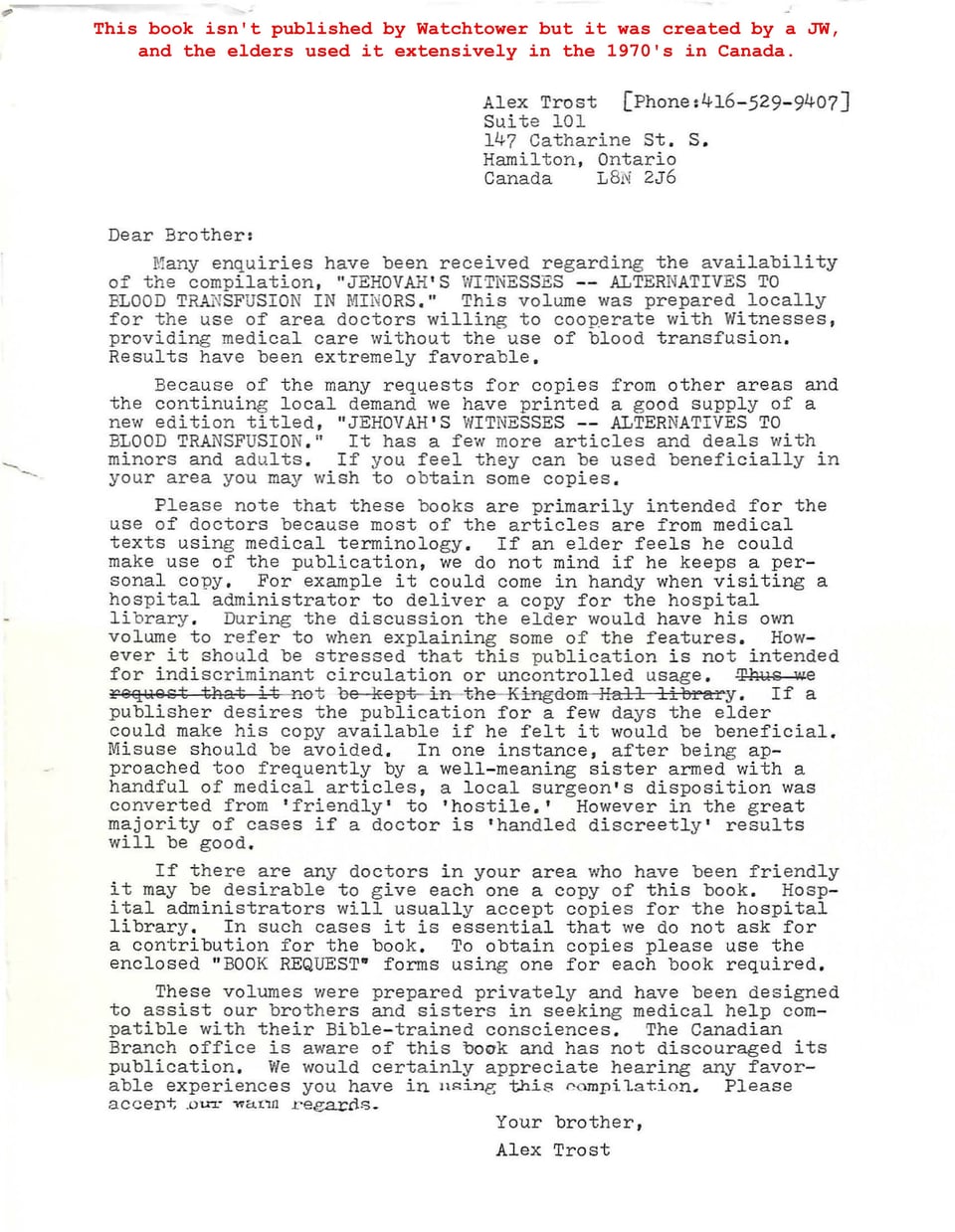
This book isn't published by Watchtower but it was created by a JW, and the elders used it extensively in the 1970's in Canada.
Alex Trost [Phone:416-529-9407]
Suite 101
147 Catharine St. S.
Hamilton, Ontario
Canada L8N 2J6
Dear Brother:
Many enquiries have been received regarding the availability of the compilation, "JEHOVAH'S WITNESSES -- ALTERNATIVES TO BLOOD TRANSFUSION IN MINORS." This volume was prepared locally for the use of area doctors willing to cooperate with Witnesses, providing medical care without the use of blood transfusion. Results have been extremely favorable.
Because of the many requests for copies from other areas and the continuing local demand we have printed a good supply of a new edition titled, "JEHOVAH'S WITNESSES -- ALTERNATIVES TO BLOOD TRANSFUSION." It has a few more articles and deals with minors and adults. If you feel they can be used beneficially in your area you may wish to obtain some copies.
Please note that these books are primarily intended for the use of doctors because most of the articles are from medical texts using medical terminology. If an elder feels he could make use of the publication, we do not mind if he keeps a personal copy. For example it could come in handy when visiting a hospital administrator to deliver a copy for the hospital library. During the discussion the elder would have his own volume to refer to when explaining some of the features. However it should be stressed that this publication is not intended for indiscriminant circulation or uncontrolled usage. Thus we request that it not be kept in the Kingdom Hall library. If a publisher desires the publication for a few days the elder could make his copy available if he felt it would be beneficial. Misuse should be avoided. In one instance, after being approached too frequently by a well-meaning sister armed with a handful of medical articles, a local surgeon's disposition was converted from 'friendly' to 'hostile.' However in the great majority of cases if a doctor is 'handled discreetly' results will be good.
If there are any doctors in your area who have been friendly it may be desirable to give each one a copy of this book. Hospital administrators will usually accept copies for the hospital library. In such cases it is essential that we do not ask for a contribution for the book. To obtain copies please use the enclosed "BOOK REQUEST" forms using one for each book required.
These volumes were prepared privately and have been designed to assist our brothers and sisters in seeking medical help compatible with their Bible-trained consciences. The Canadian Branch office is aware of this book and has not discouraged its publication. We would certainly appreciate hearing any favorable experiences you have in using this compilation. Please accept our warm regards.
Your brother, Alex Trost JEHOVAH'S WITNESSES
alternatives
to blood
transfusion
November 1973
JEHOVAH'S WITNESSES
alternatives
to blood
transfusion
November 1973
PREFACE
When a patient is critically ill, complete recovery is the common desire of the patient, the family, the doctor, the hospital staff and the family's presiding minister.
That is no less true when a patient is one of Jehovah's Witnesses. This religious body does not adhere to so-called 'faith healing' and is not opposed to the practice of medicine. When ill, members seek medical help. They appreciate the growing number of doctors who have responded to their needs with kindness and with consideration for the patient's conscientious beliefs. The ONE AREA of treatment in which there have been some problems at times is in the use of blood and its derivatives.
Purpose of Volume
This volume has been prepared to ease the situation for all involved by making known the good results of accepted medical alternatives to the transfusion of blood or its derivatives. The results have generally been not less successful than where blood is normally used. "The use of Ringer's lactate solution has become as acceptable as whole blood in shock and surgery patients," states the Journal of the American Medical Association. 1 It is admitted that even postoperative complications have usually been fewer. 2
It is not the purpose of this work to try to direct those in health services. It is merely to acquaint them with what their colleagues are doing to meet the needs of a growing segment of the community that conscientiously refuses to allow the ingestion of blood by any means. Even the diet of Jehovah's Witnesses excludes blood, such as in blood puddings or blood sausage.
Famed heart surgeon Denton Cooley and others have developed new techniques in providing major surgery for Jehovah's Witnesses and their offspring. 3 Instead of resorting to time-consuming and unnecessary court actions these specialists have devised procedures acceptable to the patient or guardian and won the respect and confidence of those whose consciences would not permit blood transfusion. Confrontations were avoided. Resulting publicity was extremely favorable. Cooley now considers 'bloodless surgery' as "routine" and "superior" to using techniques utilizing blood 4 and no longer views these patients as "special cases" with liabilities. 2,3
It is believed that there is a good number of doctors desirous of becoming better acquainted with progress being made with 'bloodless' surgery, (not just for Jehovah's Witnesses, but for other patients) where use of blood with its known risks is avoided. Such information could also be useful in situations where blood supplies become exhausted due to catastrophies.
Sooner or later a doctor may be faced with an emergency case where someone refuses blood for himself or a child on religious or conscientious grounds. It is hoped that the information presented here will stimulate preparatory measures on the part of medical teams so that when the Emergency Unit receives a patient who forbids blood transfusion, there can be immediate administration of alternate treatment already familiar to the team on duty. Such advance preparation would eliminate the hesitancy and confusion mentioned by Doctors Minuck and Lambie:
"Often in the case of the Jehovah's Witnesses the surgical team becomes emotional, confused and irrational, because the patient's liability is religious rather than physical. Jehovah's Witnesses are not the only religious group which must refuse to accept certain aspects of accepted medical practice on religious grounds. Other groups such as Roman Catholics also must refuse some forms of medical treatment, and we accept their point of view. Similarly the Jehovah's Witness' beliefs should be respected and tolerated."5
The value of advance preparation and research to meet such emergencies hardly needs emphasis. It is also hoped that some hospital boards will examine the feasibility of offering facilities for alternative treatment to those who seek it and to qualified doctors (though not on their staff) experienced in rendering effective treatment without the use of blood transfusion.
In cases that are not emergencies, we hasten to assure that Jehovah's Witnesses are continually reminded to inform family doctors ahead of time as to their position on the use of blood. This is to avoid last-minute situations creating problems for doctor and patient.
Understanding Witness Patients
Normally patients are not familiar with treatments available. They leave it to the doctor to do what he feels best. It is understandable that having a patient disagree with the doctor on type of therapy can be an unusual experience for the doctor, especially if the patient or parent or religious associate suggests some treatment unknown to the doctor. This is not meant to challenge the doctor's experience or ability, but to respectfully try to resolve the difficult situation for both doctor and patient.
Some Witness patients may not be familiar with alternatives to blood in certain cases; they appreciate the doctor who takes the matter in stride and proceeds to get information about other treatment instead of losing sometimes valuable time in trying to persuade the patient to change his mind or compromise beliefs 'because life is at stake.' Or, where no emergency exists the doctor can offer preventative treatment. (For example: pre-natal therapy to decrease the possibility of a mother giving birth to a newborn suffering from a hemolytic reaction.) 6
The unlikelihood of getting a Witness patient to 'change his mind' about use of blood cannot be overemphasized. They will not renounce their faith. Just how deep-seated and sincerely held are their beliefs may be hard to appreciate in a world of declining faith, but time and life may be saved by recognizing one is dealing with a resolute people. At the same time, they are not unreasonably stubborn. Also due to their faith, the doctor will not be dealing with a people who will be abnormally upset emotionally when faced with a critical situation that calls for courage.
What About Minors?
If Jehovah's Witnesses did not love their children and want them to live they would not go to a doctor or a hospital. As a matter of belief they love life and good health; they consider both as sacred and to be protected and preserved, both for themselves and their offspring. They are life-oriented. That is why they do not smoke, do not seek abortions and have success in keeping adults and children from becoming victims of mind-and-health-destroying drugs.In fact, it is also one of the reasons why they abstain from blood transfusions; they feel them to be a threat to life rather than a means to preserve it. One recent authoritative report shows the annual mortality rate in the United States could be as high as 35,000 from just one complication, namely, hepatitis. 7
It has been the general practice of Witness parents to take their children, when ill, to doctors and hospitals for medical treatment. However they feel that on numerous occasions there has been an unjust trampling of rights when they have requested treatment without blood transfusions. Often in serious illnesses where blood transfusion is commonly used, the doctor: a) purposely delays treatment and avoids communication with the parents, thinking they will succumb to the pressure and anxiety; b) attempts to prevent the parents from taking their child to another doctor who will provide alternate therapy; c) without advising the parents that he will not treat without blood and with no information to them of his present intentions, secretly initiates legal proceedings to remove the child from parental custody, so that when parents are finally given notice (often 24 hours or less!) of the court hearing there is little time to obtain legal counsel and prepare well and it becomes next to impossible to find another doctor to treat the patient (who by now has perhaps reached a critical stage that did not obtain at the outset). The doctor may be acting according to his own conscience, but when he overrides the conscience of the parents and it becomes a matter of conscience vs. conscience, then it has become truly a religious or spiritual matter. After all, in allowing for alternatives one is not agreeing to certain death for the child, as would be the case, many feel, in the matter of an abortion.
Surely doctors recognize that no treatment is 100% effective in all cases. There are failures and successes, with some treatments more effective than others. That is why many cooperative doctors have not sought legal custody of children of Jehovah's Witnesses to enforce a treatment in which they cannot assure success or freedom from complications. When a child is critically ill the doctor may conscientiously feel the use of blood is the best treatment he can offer. However when the parent refuses blood transfusion, in evaluating the total situation, would it not be preferable to administer a treatment compatible with the conscience of the parent or the child even though the doctor sincerely feels it a degree less effective? This is the course suggested by a Council of Judges in the United States of America: "If there is a choice of procedures if, for example, the doctor recommends a procedure which has an 80 per cent chance of success but which the parents disapprove, and the parents have no objection to a procedure which has only a 40 per cent chance of success - the doctor must take the medically riskier but parentally unobjectionable course." 8 Treating the whole patient is the best treatment.
As one medical report 3 puts it: "The challenge of religion versus medicine has been well met, and much has been gained. Doctors have learned that they may be called upon to modify their management of a patient's illness when there are factors more important to the patient than his own health or even his life. The patient's ideals and honor must be respected."
In the Divine arrangement of things the child is born into a family unit and the instinctive tendency is there for the care and well-being of the child. Does either "nature" or experience teach us that a child is better off with decisions involving life being made by institutions or individuals contrary to the wishes of the parents? Dr. Arthur Kelly has argued that the patient "is not to be coerced even though we may think that Big Brother knows best. I am prepared to go further and to state that I believe that parents of minors and the next of kin of unconscious patients possess the right to interpret the will of the patient and that we should accept and respect their wishes ... Enforcement, except by explanation and persuasion, is not our function." He also said: "Holding these views, it should come as no surprise that I do not admire the proceedings of a moot court assembled at 2:00 a.m. to remove a child from his parent's custody."
Where some have not acknowledged the alternatives and have insisted on custody of a minor to do according to their own will the doctor-patient relationship is adversely affected. Will the parent in the future seek medical services, even in an emergency? Will he trust a hospital as a place where his rights and beliefs are respected? In a good number of cases babies have died in spite of blood transfusions given, producing an awkward situation for the doctor who must explain the tragedy to parents whose wishes have been overridden. What if they demanded an autopsy that showed the baby died from a reaction to the blood? Parents in some instances have transferred their child to another hospital or doctor to get alternative treatment that has been successful. Newspapers blow up these incidents all out of proportion and there is bad publicity for doctors, hospitals and Jehovah's Witnesses. This is all avoidable.
For these reasons it is difficult to understand why adult and child patients and parents of the latter have regrettably been subjected to verbal abuse such as threats and ridicule, (even by nurses) and in some cases denied treatment, at a time when all concerned ought to have been most interested in comforting, reassuring and encouraging the patient and rendering the treatment needed, even if an alternative. Minors seeking 'legal' abortions are not taken to court by anti-abortion doctors to 'save a life.' Roman Catholic mothers are not forced to have an abortion that will 'save a life' even when they are unwed minors. Then why the attitude encountered with Witnesses refusing blood?
In some cases parents have been declared guilty of neglect so that custody of the child could be transferred to give a transfusion. In view of the points above this is only pretended neglect and not actual. Is it not odd that in this day one could have the following situation on the same floor of a hospital: In one room, doctors are working with a court order to transfuse, in the uterus, an unborn child to 'save' its life, to prevent its 'neglectful' parents from 'killing' it; in the next room, for some flimsy reason, 'on demand,' a baby is being aborted, being 'killed' by parents and doctors!
It is to avoid any of these unfortunate situations that the following collection of articles is presented. It is not possible for any doctor today to keep up with all that is coming out in the medical field, or to research every specialized problem. Since we are interested in alternatives we are willing to do the research and supply the articles that will make it possible for the doctor to be confident that he can treat Witness patients successfully. Of course, the coverage given in this volume is not exhaustive. Only a few of the many available articles have been selected for each category as these best illustrate the success of alternatives. Additional information can be had in most cases by consulting the bibliography. Alternative treatments appear first. The sections on blood transfusion complications and comments are included to show that some doctors of experience and prestige are repeatedly voicing concern because of the general disregard for the dangers involved in a blood transfusion. The concluding portion produces articles from publications of Jehovah's Witnesses to make clear their official stand on blood transfusion and other medical questions.
Besides the reprints from medical journals in this volume, there are additional articles in a similar compilation entitled: "Jehovah's Witnesses - Alternatives to Blood Transfusion in Adults."
Additional information on specific cases may be had from religious associates of the patient, preferably from the presiding overseer of the local congregation of Jehovah's Witnesses. (See telephone listing under "Jehovah's Witnesses.") It is our sincere hope that the information presented in this volume will be interpreted as a genuine endeavour to improve a situation where there has been some misunderstanding and, as a result, some undesirable consequences for patient and doctor, and at times, the hospital.
May it result in better communication between all concerned. It is our hope that it will help to provide better health care for Jehovah's Witnesses and their families; an improved doctor-patient relationship; improved hospital and medical facilities for those refusing blood transfusion treatment; an appreciable decrease in confrontations over religious beliefs and medical treatment; elimination of unfavorable publicity for doctor and patient, and a restoration of the patient's right to privacy as to his sickness or treatment; a greater awareness of the growing trend to use alternatives to avoid complications in the use of blood; an avoidance of any possible hesitancy on the part of either the medical team to treat without blood or the patient to seek medical care. This should not be difficult if all genuinely are concerned for the patient's recovery.
Respectfully, rather than think their position to be in any way wrong, Jehovah's Witnesses continue to follow the Divine and apostolic direction as stated in Acts 15:28 & 29, according to the New English Bible: "It is the decision of the Holy Spirit, and our decision, to lay no further burden upon you beyond these essentials: You are to abstain from meat that has been offered to idols, from blood, from anything that has been strangled, and from fornication. If you keep yourselves free from these things you will be doing right.'"
References
Fluids Effective in Shock, But Why? JAMA 202:32,33, October 23, 1967. (Section BAB-33)
Simmins, Jr., C.W., et al: Vascular Surgery in Jehovah's Witnesses. JAMA 213:1032-1034, August 10, 1970. (Section BVS-41)
Without Transfusion.Inside Baylor Medicine No.2,1968.(Section AAD-35)
Beall, Jr., A.C., et al: Physiologic Studies during Cardiopulmonary Bypass Eliminating Heparinized Blood. Dis Chest 47:7-16, January 1965.
Minuck, M., et al: Anesthesia and Surgery for Jehovah's Witnesses. Canad Med Assoc J 84:1187-1191, May 27, 1961.
Jacobs, W.M.: The Use of the Bioflavinoid Compounds in the Prevention or Reduction in Severity of Erythroblastosis Fetalis. Surg Gynec Obstet 103:233-236, August 1956. (Section GVTP-18)
Gribbin, A.: Blood That Kills. The National Observer pp.1, 18, January 29, 1972. (Section CAB-64)
Murrah, A.P., et al: Guides to the Judge in Medical Orders Affecting Children. Crime and Delinquency 14:107-120, April, 1968. (Section DLGJ-32)
Kelly, A.D.: Aequanimitas - Two Mistakes. Canad Med Assoc J 96:432, February 18, 1967. (Section AAA-31) CONTENTS
SECTION PAGE
A MEDICAL TREATMENT WITHOUT BLOOD
AA General:
(A) The Reason Why 7
(B) “Release From Liability” form 9
(C) Consent 11
(D) Religion and Medicine 13
AAN Anemia: General 21
(K) Sickle Cell 22
ABR Burns 25
AGI Gastro-intestinal ailments 29
AHM Hemorrhage 36
Hyperbilirubinemia: See Sections F, G, K, L 249
ALK Leukemia 37
AUR Uremia 41
B SURGERY WITHOUT BLOOD
BAB General: Fluids effective in surgery, shock 49
BAN Anesthesia 59
BCR Cardiac surgery: Reports 61
(B) Bleeding tendency therapy 99
(C) Cooling 105
(H) Hazards of blood prime 109
(N) Favorable News reports 121
(P) Other priming fluids 123
BEM Emergency surgery 129
BGI Gastro-intestinal surgery 153
BGY Gynecologic surgery 149
BHG Hemoglobinemia 131
BHM Hemorrhage during surgery 137
BNR Neurosurgery 149
BOR Orthopedic surgery 149
BPL Pulmonary surgery 143
BSB Blood substitutes:
(R) Red cell 147
(V) Volume expanders 149
BUR Urologic surgery 149
BVS Vascular surgery 153
C COMPLICATIONS FROM BLOOD – AVOIDED BY JEHOVAH’S WITNESSES
CAB General 157
CCA Cancer 188
CDS Disease transmission 189
CGV Graft vs Host reaction 191
CHM Hemorrhage after blood transfusion 201
CHP Hepatitis 203
CPE Pulmonary Edema 207
CSN Sensitization 211
D COMMENTS, REPORTS, OPINIONS
DCR Use of blood – self criticism 213
DLG Legal opinion and court actions:
(J) Judicial comment 225
(L) Liability 239
DRT Patient’s right to change doctors or refuse a specific treatment:
(A) Code of Ethics 243
(B) Doctor’s comment 245
(P) Professional comment 248
TREATMENT OF HYPERBILIRUBINEMIA: ALTERNATIVES
F PHOTOTHERAPY
FA General comments 249
FD Essentials for effective phototherapy 256A
FE Efficacy: (AB) ABO factor 257
(NH) Nonhemolytic 258
(PR) Prematurity 273
(RH) Rhesus factor 287 CONTENTS
SECTION PAGE
FL Light source: (F) Fluorescent .291
(I) Sufficient intensity required. .297
(S) Sunlight .305
(V) Natural variations .309
FS Safety: (B) Byproducts harmless .313
(D) Diarrhea .321
(E) Eye safety .323
G MEDICINAL TREATMENT OF HYPERBILIRUBINEMIA
GAB General .325
GAG Agar .327
GBA Phenobarbitone .333
GCH Charcoal .339
GET Ethanol, Prenatal .345
GFD Feeding, early .349
GVTP Vitamins, Prenatal .353
H REDUCING NEWBORN BILIRUBIN, MORBIDITY, MORTALITY
HAB Abortion: (C) Self Criticism .359
(P) Professional comment .360
HCC Clamping of cord .361
HCV Cephalic Version may sensitize .365
HDR Agents increase risk of brain damage: General .367
(A) Aspirin .373
(H) Hexachlorophene .374
HMW Midwife program and infant mortality .375
HPL Air pollution .385
HPS Position of mother during delivery .387
HTB Use of tobacco during pregnancy .389
K COMPLICATIONS OF EXCHANGE TRANSFUSION PROCEDURE
KA Hazards, General .393
KCA Umbilical catheterization hazards .405
KCU Copper contamination .406
KGN Gangrene .407
KHR Cardiac arrest .409
KIP Intestinal perforation .427
KRS Skin rash .461
L COMMENTS ON USE OF EXCHANGE TRANSFUSION
LAB Self criticism .463
LBL Bilirubin – Correlation with brain damage .471
LMR Mortality and morbidity of Exchange Transfusion .489
(E) Has Exchange Transfusion decreased mortality? .497
LOV Overuse of Exchange Transfusion .507
W JEHOVAH'S WITNESSES: BELIEFS RELATING TO MEDICAL TREATMENT
WA Official comment: (B) Blood Transfusion .513
(C) Questions answered .529
WCB Alternatives acceptable .531
WD Stand on other medical procedures:
(AB) Abortion, birth control, sterilization, hysterectomy .538
(AT) Autotransfusion .547
(GL) Globulin .548
(HP) Hypnosis .549
(TR) Organ transplants .553
(VC) Vaccination .548
WGD Only one proper use of blood .555
WHL God’s provision for healing mankind .571
WIN Integrity to superior law .575
WMR Mortality: (A) Examples of critically ill children recovering without blood transfusion .579
(B) Examples of children seized, given a blood transfusion, dying .581
WP Witness parents believe that many do not appreciate how seriously they view their obligation to properly train their young how to avoid mind and body-destroying practices:
(DR) Drug addiction .583
(PR) Prostitution .593
WRT Right to choose medical treatment .595 The Reason Why
by J. Lowell Dixon, M.D.
A major problem for many doctors is the refusal of Jehovah's Witnesses to allow blood transfusions. Neither doctor nor patient seems to find it easy to understand the position of the other, and yet both have the same objective in mind to save the life of the patient.
One Viewpoint
Jehovah's Witnesses are not religious fanatics under some organizational edict which proscribes the ministrations of doctors and hospitals. To the contrary, when medical care is needed, Witnesses are anxious and willing to undergo whatever treatment is necessary to sustain their lives. Doctors are consulted regularly, often noting Witnesses to be very cooperative patients.
The adamant stand of Jehovah's Witnesses regarding blood transfusions arises out of their conviction that the Bible is the inspired and truthful Word of God, Jehovah. Their determination to obey the Bible causes them to dedicate their lives to the worship and service of Jehovah. To them, maintaining faithfulness and integrity to their Creator is of paramount importance. What is a medical issue to the doctors, then, is a scriptural one to the Witnesses. A measure of real understanding, therefore, is necessary for all concerned in the care of Jehovah's Witnesses.
Biblical Injunctions
The sacred respect for blood antedates the Christian era by many centuries. In fact, divine regulation for
the handling of blood dates back to God's pronouncement to Noah immediately after the global flood, over 4,300 years ago. Then, for the first time, God granted permission to man to add meat to his diet, saying, "Every moving animal that is alive may serve as food for you." But at the same time God added, "Only flesh with its soul—its blood—you must not eat." (Genesis 9:3,4) Before that time the blood question had not been raised since man had eaten only bloodless fruits and vegetables.
Later, when the nation of Israel was brought into a covenant relationship with God the restriction on blood was again emphasized. Specific instructions were given for preparing animals that were to be used as food. Man, catching a wild animal or fowl for consumption,was required to pour the blood out of the body and to cover it with dust. "It is a statute to time indefinite for your generations, in all your dwelling places: You must not eat any fat or any blood at all." Again it was stated that one "must not eat the blood of any sort of flesh, because the soul of every sort of flesh, is its blood." (Leviticus 3:17; 17:14) Absolutely no blood, regardless of the source, animal or human, was to
be taken into the body as food. It was not to be eaten, nor to be stored, for the "soul" or the life was in the blood. It belonged to God who demanded that it be poured out, unused, upon the ground.
A Serious Sin
The matter could not be taken lightly. Any violation of the law on blood was a serious sin against God, and God would call the law violator to account, as indicated in Leviticus 17:10: "I shall certainly set my face against the soul that is eating the blood, and I shall indeed cut him off from among his people." This was not a simple dietary regulation, but rather it involved a matter of actually sinning against God, a capital crime worthy of capital punishment. No special dispensations were allowed for times of stress in which one might be justified in taking blood into the body. No exceptions were made for peculiar circumstances or emergencies. Very simply—man was not to take blood into his body.
God's Law
What about non-Jewish people not under the Mosaic Law covenant? They too are bound to obey God's law given to Noah regarding blood, for all mankind are descendents of Noah.
Furthermore, a few years after the death of Jesus, Christians were commanded to "abstain . . . from blood." (Acts 15:20) This served to put non-Jewish Christians on notice regarding Jehovah's law on blood.
To those who question that such command should be given a literal application, Jehovah's Witnesses point to the context of the scripture. There it can be seen that four things are mentioned as being "necessary" for the Christians—abstention from "things sacrificed to idols and from blood and from things strangled and from fornication." (Acts 15:28, 29)
Again, the scope of this decree, like the ones given to Noah and the nation of Israel, is not limited as to time and is not restricted to animal blood, nor to the taking of blood into the body through the mouth. Christians are told simply to keep themselves free from blood—as free, one might well argue, as from idolatry or fornication. Notwithstanding the modern relaxed attitudes on sexual freedom, to Jehovah's Witnesses the Bible's position seems equally and unmistakably clear, both as to fornication and blood transfusion.
Some have mistakenly interpreted
this stand of Jehovah's Witnesses as one in which an individual is exercising his "right to die." In this they are wrong. There is no such suicidal fanaticism in the thinking of Jehovah's Witnesses. The very opposite is true. They are determined to exercise every precaution, at whatever cost, in order to obey God's law and thereby be assured of life, if not now, then in the future under God's kingdom rule.
Significantly, the history of modern blood transfusion therapy has not established blood in a panacea, nor even as an absolutely safe treatment. It is certainly no discredit, therefore, to Jehovah's Witnesses who refused blood transfusions on scriptural grounds, when in the past it was looked upon as the great lifesaver.
Jehovah's Witnesses readily admit that their stand on the blood issue does occasionally work a hardship on their doctors, whose medical training inculcates in them great respect for and confidence in the blood transfusion. Too, the experience of doctors has been that the religious convictions of many patients are, as a rule, not rigidly held. In instances where these beliefs conflict with medical treatment it is ordinarily a simple matter to receive some special permission
from a church official and the treatment in question is instituted. It is easy, therefore, to understand how such professionals, at times, find it difficult to cope with the unwavering stand of Jehovah's Witnesses.
Reasonable Request
Jehovah's Witnesses believe that to ask their doctors to give consideration to their scripturally trained consciences on the matter of blood transfusions is a reasonable request. In making such requests, the Witnesses are willing to relieve their doctors and hospitals of responsibility for any adversity that may be due to their not taking blood transfusions. With all due respect and appreciation for the sincere and well-intentioned efforts of the medical profession, the main concern of Jehovah's Witnesses is the maintenance of their integrity to Jehovah God, whose law is perfect and whose promise is life eternal for those who serve Him faithfully. (Psalms 19:7-11)
Dr. J. Lowell Dixon is a graduate of the University of Oklahoma Medical School, Oklahoma City, Oklahoma. After a surgical fellowship at the University of Minnesota Hospitals, Minneapolis, Minnesota, Dr. Dixon spent many years in private practice in general surgery. He is presently the medical director for the Watchtower Society, Brooklyn, New York.
AEQUANMITAS
TWO MISTAKES
Adjacent columns of my paper a few months ago carried the contrasting stories of the death of 15 civilians when bombs blasted their native village, and of the efforts of doctors in a Detroit hospital to save the life of an injured Canadian youth whose religious convictions forbade the acceptance of blood by transfusion. Five pints were administered despite his repeatedly stated objections and those of his mother. I believe that both incidents are regrettable mistakes, the first occasioned by faulty military intelligence and the second by faulty appreciation on the part of intelligent doctors of their role in treating their patient.
A spokesman for the Detroit hospital is reported to have said that the patient had been "dumped into hospital here because a couple of Canadian hospitals didn't want to be stuck with him." I don't know whether this was the motive for his referral across the river, but I can understand the reluctance of a hospital and its medical staff to become involved in either a religious controversy or an imminent death. Our instinct is to employ all measures to save a life, but there are occasions when primum non nocere is the overriding consideration, and if the Canadian hospitals in question "dumped" the patient to relieve themselves of a moral dilemma they did the patient, and themselves, harm.
Subsequent information establishes the fact that the patient's parents exercised their rights by removing their son from the Henry Ford Hospital, admitting him to another Detroit institution where amputation of an injured leg was performed without the administration of blood.
The dispatch from Detroit quoted the Administration of the Henry Ford Hospital as follows: "There is judicial precedence (sic) which indicates doctors may carry out steps they deem necessary to save a patient's life." This statement was apparently made to justify the treatment of the patient by methods which he declined to accept. If this is actually the state of the law and jurisprudence in Michigan, I think that it is not only bad law but very dangerous doctrine and I propose to state what I conceive to be a doctor's duty and the extent of his authority in administering treatment.
Although victims of highway accidents such as the case under discussion have little option in seeking medical aid, patients usually have not only the right to consult a physician or to refrain from doing so, but they also have the right to accept or reject the treatment recommended. You and I may think that a patient is ignorant, superstitious, wrongheaded, bigoted and stubborn in his attitude, and this may well be the case, but he is the ultimate
custodian of his own person. Unless the law categorizes him as a danger to the public health, as in wilful refusal to accept treatment for such communicable diseases as pulmonary tuberculosis or venereal infection, he is not to be coerced even though we may think that Big Brother knows best. I am prepared to go further and to state that I believe that parents of minors and the next of kin of unconscious patients possess the right to interpret the will of the patient and that we should accept and respect their wishes. Holding these views, it should come as no surprise that I do not admire the proceedings of a moot court assembled at 2:00 a.m. to remove a child from his parent's custody.
The rights of the individual in our society are being impaired and eroded by many laws, customs rules and regulations, and I think it high time that doctors' orders should be recognized for what they are—our best advice according to our current knowledge. Advice and counsel are ours to give and for the patient to accept or disregard. Enforcement, except by explanation and persuasion, is not our function.
I once took a course in medical jurisprudence and ethics taught by the late Gideon Silverthrone, a salty character who brought to his task long experience, considerable wisdom and very good judgment. He described in colourful detail how he, as a young surgeon, attended a child with acute fulminating appendicitis for whom the obvious treatment was appendectomy. The parents, ignorant, inarticulate clods, had an instinctive and unreasoned fear of hospitals and surgeons and they said NO. They persisted in rejecting Dr. Silverthrone's advice despite his best efforts at persuasion, which, I think, included his categorization of them as potential murderers. He did not, however, cease to attend the patient and he watched the disease progress through localized peritonitis to appendiceal abscess which clearly indicated to him his patient's early demise. The dénouement was that the abscess ruptured into the colon, drained itself and the patient recovered. Two lessons were underlined by my teacher: "We can't order people to do what they don't want to do and we can't predict the outcome of a given case even if our superior knowledge is disregarded."
Medical omniscience is a very rare commodity and the dicta of yesterday are being modified and superseded by the new knowledge of today. Let us not, in our pride, become arrogant and demand this subjection of our patient's will. I consider it preferable that certain individuals should die before their time than that we should undermine their ultimate right and duty of being the custodian of their own health. A.D.K.
Terry and the Parents
When 5-year-old Terry Johnson was brought to the Massachusetts General Hospital suffering from a serious congenital heart defect last spring, there was little question that open-heart surgery could make the child well. The trouble was that Terry's parents refused to permit the operation because they are Jehovah's witnesses, and their faith flatly prohibits the use of blood transfusions. Finally, after struggling with the dilemma for months, the Boston doctors worked out an ingenious method of proceeding without transfusions, using a technique that not only makes complex operations possible for Jehovah's witnesses but promises also to reduce the need for often scarce banked blood in the entire field of surgery.
Young Terry's medical problem was Tetralogy of Fallot, a complex of four defects of the heart and its blood vessels. The child had been born with a quarter size hole between the left and right pumping chambers of his heart that permitted blood that had not been adequately replenished with oxygen to circulate through his body. In addition, an overgrowth of muscle tissue in the right pumping chamber restricted blood flow to the artery carrying blood to the lungs, further reducing the oxygenation of his blood. Both of these defects had caused
Newsweek, January 18, 1971
enlargement of the right ventricle and a displacement of the aorta, the main artery leading to the body. As a result of this galaxy of disorders, Terry was chronically short of breath and exhausted, and chances that he would survive to adulthood were slim.
Adamant: The physicians explained to Terry's parents, Mr. and Mrs. Robert Johnson of Athol, Mass., that there was a 90 per cent chance of correcting the child's condition by surgery, but the operation necessitated blood transfusions. Terry's father, a self-employed truck driver, adamantly refused on the ground that his religion proscribes the administration of "animal products," including blood. He even turned down a proposal
Albie Walton
Terry Johnson: His blood ran thin
to remove some of Terry's own blood and store it until it was needed.
The doctors were stymied. Transfusions would be essential in Terry's case because the heart-lung machine that would take over the circulation of his blood while his own heart was being repaired inevitably damages red blood cells and affects the clotting ability of the blood, posing the threat of postoperative bleeding problems. They knew that Houston's famed cardiac specialist Dr. Denton Cooley had performed open-heart surgery on Jehovah's witnesses without transfusions. But Cooley's patients had been adults and the surgery had been done with extraordinary speed, minimizing blood damage. Because of Terry's small size, a greater percentage of his blood would be subjected to the deleterious effects of the heart-lung machine, and the complexity of his condition meant that the operation would take hours.
The doctors considered going to court to obtain temporary custody of the boy so that they could operate without his parents' consent, an alternative that has been used periodically in other Jehovah's witness cases. Then the Johnsons proclaimed that they would not take Terry back into their home if such a course was taken. In the face of this, plus some adverse comment in the local press, the doctors sent Terry back home while they pondered other ways to solve the dilemma. "The parents were very calm and reasonable, even though they were insistent on a strict interpretation of their religious rules," recalls heart surgeon Dr. Mortimer J. Buckley. "We were willing to bend over backward."
By last fall, the physicians had worked out a plan. They would drain 2½ pints of Terry's blood into three plastic bags that would remain connected to a blood vessel in his left arm during the operation. Since the blood had technically never left the child's body, it could be returned to his blood stream after surgery without being considered a transfusion in the religious sense. To replace this blood during surgery, anesthesiologist Dr. Mvron B. Laver recommended administration of a mild salt solution called Ringer's lactate. The solution is often used in the treatment of shock resulting from serious blood loss following injury or burns. And Laver had tested it on dogs several years ago as a potential blood replacement during surgery.
Headline: Terry's operation was on Oct. 1. During the one and a half hours he was on the heart-lung machine, 6 pints of Ringer's lactate were administered through his right arm, diluting the red cells in his circulation from 60 per cent down to 10 per cent. "His blood was thin enough to pass the headline test," notes Laver. "You could read headlines through it." To compensate for the lack of oxygen-carrying red blood cells, the doctors speeded up his circulation with the pump, making the red cells do double duty. When the surgeons had repaired Terry's heart, the pump was switched off and the blood in the plastic bags flowed back into his body. The Ringer's lactate was excreted normally. Soon, Terry's red blood cells were back to normal and since the clotting ability of his blood was unimpaired, his recovery was uneventful. "He was asking for tomato soup the next day," says Laver.
The same technique has now been used on a dozen other patients at the hospital, none of them Jehovah's witnesses, illustrating its promise in many types of surgery. In an account to be published in The New England Journal of Medicine, the doctors predict that the use of the patient's own stored blood and Ringer's lactate will reduce the risk of hepatitis, often transmitted by banked blood. Moreover, it could help surgeons overcome the chronic shortage of precious blood. But had it not been for Terry's unusual dilemma, the method might not have been tried at all.
RELEASE FROM LIABILITY
To. Hospital, and the medical and nursing personnel having anything to do with the case of ...
You are hereby notified and instructed that I do not wish any transfusion of whole blood, blood plasma, packed cells, blood fractions or blood derivatives to be used in the treatment of this patient. I regard the transfusion of blood and blood products as unnecessarily dangerous treatment producing too many bad effects to justify the risk. It is also contrary to my faith as one of Jehovah's witnesses.
I recognize and understand that the attendant physicians have advised that they are of opinion that blood transfusion is necessary perhaps even to save the life of the patient. I do not share their opinion and adhere to the instructions given in this notice.
This restriction leaves open the use by transfusion or otherwise of Ringer's lactate solution, glucose or other volume expanders not derived from blood.
This matter has been carefully considered by me and my instructions are not going to change because I or the above-named patient is unconscious.
The hospital, the medical and nursing personnel caring for the above patient are hereby released from responsibility and liability for any and all untoward effects which flow from the decision not to accept the treatment prohibited in this release.
DATED this day of ,197 .
Patient, Parent or Guardian
MEDICO-LEGAL
Consent for Treatment
T. L. FISHER, M.D., * Ottawa, Ont.
IT IS an axiom of practice that nothing may be done to or for a patient without that patient's permission. Even though a doctor thinks that without treatment a patient may come to harm, without consent he may not administer the treatment he considers necessary. A doctor is not God, nor is he a dictator, and he may not impose treatment against a patient's wishes. A patient ordinarily is his own master. Garrison, J., in a judgment said it this way: "No amount of professional skill can justify a substitution of the will of the surgeon for that of the patient." The dictum would be equally true were the words "the doctor" substituted for "the surgeon".
There is one exception to the rule. When a patient is unable because of his condition to give consent but needs immediate treatment if health or life is to be preserved, the doctor has a duty to administer the emergency treatment even without permission and to continue giving necessary treatment without permission until, and only until, the patient has recovered sufficiently to be made aware of his condition and to have his permission sought; then the patient, once again, becomes his own master.
Under all other circumstances doctors must comply with the wishes of a patient; there must be consent for treatment.
Permission is equally valid whether implied, formally sought and given, or actually written, even though implied permission should be accepted only under circumstances that make it clear that permission actually was implied. The patient for example who, without any prompting, consults a doctor, volunteers a history, supplements the history by answering questions, allows an examination, listens to advice and acts on it, has given implied permission and would have difficulty in maintaining that he had not given consent.
Patients however, like doctors, can change their minds and sometimes do. Then, if a patient be dissatisfied and if circumstances allow the inference that permission for treatment had not been obtained, the patient may claim he had not in fact given permission. Under some circumstances, therefore, a doctor should obtain a patient's consent in writing so that there may be demonstrable evidence of prior consent. Written consent should invariably be sought, and treatment should not be given until it has been obtained: when the treatment is likely to be more than mildly painful; when it carries appreciable risk; when a mutilating procedure is to be done Doctors ordinarily do not think of their work as mutilating. It often is, however. The doctor tends to think of the preservation of health or life rather than of the mutilation that may result from the means to the end, but he must remain aware that procedures like amputation of a limb or of a breast are mutilating procedures. Finally, written consent should be obtained prior to any treatment that will result in the ablation of a body function.
Consent by itself is not enough; it must be informed consent. It should be sought and obtained only after a patient has been given an explanation of the condition from which he suffers, of alternative means of treatment, of the treatment being recommended and of the reason for the recommendation of that particular treatment. If they are significant, risks should be mentioned even though courts have held they need not be so forcefully presented as to frighten a patient away from necessary treatment. Only when such an explanation has preceded a request for consent can the consent be considered an informed consent.
To inform a patient is not always as simple as the simple expression "informed consent" suggests. An explanation must be adapted to the patient so that, to the best of the doctor's judgment, the patient has the fullest possible understanding. It should be obvious, for example, that a technical, involved explanation may not be explanatory, may actually be confusing to the uneducated, dull patient; on the contrary, a non-specific, general explanation may be insufficient and unexplanatory to the highly educated, bright individual who may need, for his understanding, much more detailed reasons. To the best of the doctor's ability to judge the patient, therefore, the explanation must be explanatory, and only after it has been given should consent be sought.
Verbal consent ordinarily is obtained by the doctor. He sees his patient, decides what is the matter, informs the patient and advises the patient what he thinks should be done, either by the patient himself or by the doctor.
If the treatment, commonly an operation, be deferred and done at another time and place, misunderstanding is more likely than when treatment is begun immediately.
Among the services to doctors for which hospitals have commonly, almost universally, accepted responsibility, when patients are admitted to hospital, is that of obtaining signed permission for treatment and for surgery. There can be no doubt that by this routine, permission is obtained much more consistently than would be the case if each individual doctor had to get signed permission himself. Since the hospital ordinarily asks the patient to sign permission because doctors seldom do, the incorrect opinion is held by many doctors that the hospital needs the consent. It does not: doctors do. Hospitals do not give medical treatment and do not perform surgery: doctors do. They should be grateful that hospitals so commonly relieve them of the necessity of getting the consent form
signed but should remain aware of two things: it is they to whom consent must have been given and it is they, the doctors, who must assure themselves that the necessary written consent has been obtained and is on file.
Recently two doctors have been faced with threats of legal action because it has been claimed no consent for surgery had been given. In neither case had written consent been obtained. In one, however, the circumstances leading up to the operation made it amply clear consent must have been given and the patient abandoned the claim. The issue is still uncertain in the other action; it is not yet known whether the doctor can demonstrate that he had given the patient a proper explanation of her condition and had obtained her consent to surgery.
This kind of claim against doctors should never be possible. Doctors should assure themselves the patient has had his condition explained to him, and when doctors review charts before treatment or operation they should confirm that the patient has signed consent and that the completed consent form is on the chart.
See also:
"Life or Death - Whose Decision?"
Section DRT-31
Inside
Baylor Medicine
Number Two, 1968
WITHOUT
TRANSFUSION WITHOUT TRANSFUSION
Whole human blood has saved countless lives, but even when this scarce commodity is avail able it cannot always be used.
modern surgery may seem to the uninitiated, most operations follow a course the surgeon has seen many times. The light banter passing back and forth over the toweldraped form of the patient does not arise from negligence or lack of alertness, but rather from the confident routine of a familiar task. But today's business was not routine.
religious beliefs had won, but physicians were not certain the patient would win also. Lying still on the operating table and breathing lightly under the anesthetic was a 39 year old woman facing open heart surgery to correct a serious heart valve defect. She was a Jehovah's Witness whose religious beliefs forbade the use of blood transfusions—even though she might
The usual relaxed atmosphere in the operating theater was missing. Although major surgery is never a light-hearted attair, it is rarely the grim, tightlipped scene portrayed in films and television. Miraculous as
The atmosphere was not so much tense as intent. The surgical team was not nervous, but they were visibly concerned. A conflict existed between current medical opinion and religious beliefs The
The members of this religious group believe that if they submit to transfusion they will lose all opportunity for life after death. And they will be ostracized by their associ-
ates for the remainder of this life.
Their belief is based on numerous biblical prohibitions against eating blood, "You must not eat the blood of any sort of flesh, because the soul of every sort of flesh is its blood" (Lev. 17:13, 14), and "I shall certainly set my face against the soul that is eating the blood, and I shall indeed cut him off from among his people" (Lev. 17:10). In the eyes of Jehovah's Witnesses, receiving a blood transfusion is the same as feeding on the blood of another.
Baylor surgeons had the task of repairing one valve in the woman's heart and replacing another with an artificial valve, a double procedure not without risk in any patient. They felt the bloodless operation was possible, but it presented two major difficulties. First, they would have to use a heart-lung machine to put oxygen into the blood and to keep that precious supply of oxygen flowing through the patient's brain during the time her heart was stopped. This life-saving device normally needs about three pints of blood to prime its pumps and fill its tubing and blood reservoir before it is connected to the patient.
Secondly, if any emergency arose in which whole blood was needed leaking of a repaired blood vessel, the slightest mis-step in procedure causing a rapid loss of blood, or excessive hemorrhage after surgery—the surgeon's hands would be tied from saving the patient's life. The woman had signed a release absolving the doctors from responsibility in such a situation, but a simple piece of paper could never erase the memory of failure nor release them from a moral responsibility.
To prime the pump of the heartlung machine they used, instead of blood, a five per cent solution of dextrose, a simple sugar, in distilled water. This would dilute the patients blood somewhat, but, hopefully, not beyond her limits of
tolerance. As for emergencies, the only answer was not to let them occur. If they did, it would take more than medical skill to handle them.
The operation began. An incision was made. The breast bone, which would quickly heal after the operation, was sawed through exposing the living, beating heart. Working swiftly, surgeons joined human tissue with the inanimate steel and plastic of the heart-lung machine. This was the critical moment.
"Everything secure?"
"Yes sir, ready to go."
"Pump on."
Ready hands flashed over switches. The hum-click of the heart-lung machine filled the still air of the operating room. The crystal purity of the dextrose solution grew pink-tinged, then red, then
crimson as it mixed with the patient's own blood. A silent, waiting minute ticked by, then another.
"Holding steady. Encephalogram and cardiogram normal. Arterial and venous pressure steady. Look's like we're in good shape."
"How's she doing?"
"Alright, let's get on with it."
The heart was stopped and opened. The first valve was repaired, the second deftly excised and the artificial valve, a small ball in a cage, fitted snugly in place and sutured in. The surgeons worked rapidly, using as little time as possible without crossing that fine line which borders on incautious haste. Every bleeding vessel was quickly clamped and tied. Every drop of blood escaping from the heart was caught up with a suction probe and returned to the artificial circulation.
For those watching through the observation window, the time crept by.
The operating team was too intent to notice its passage. Finally the heart was closed. Electrodes were placed on either side.
"Current!"
The heart, after lying still nearly an hour had begun to function with an uncoordinated, spasmodic twitch when its blood supply was reestablished. In medical terms it was fibrillating-beating, but not pumping blood effectively. The electric jolt came. The heart hesitated. Then, with a firm beat, it resumed the steady contractions it had maintained for a lifetime.
"How's it look?"
"Heart action normal, pressure normal. I think we're in."
"O.K. Let's close up and go home."
row of sutures closed the incision in her chest. The operation was over successfully—but would the patient live?
The reservoir of her own blood remaining in the heart-lung machine was slowly drained back into the patient, returning the irreplaceable, oxygen-carrying red blood cells with a minimum of loss. Excess fluid from the dextrose solution used to prime the pump would be speedily removed from the patient's system by her kidneys. A
Sixteen days later she left the hospital under her own power. Xrays taken six months later showed her heart had shrunk from its overworked, enlarged size to nearly normal, and a full year after her operation she was still doing well.
Since that memorable day, Baylor surgeons have successfully operated on numerous Jehovah's Witnesses and other patients without using the formerly customary blood transfusions. Although it would seem to make surgical procedures more risky, they have found there are actually advantages in not using large amounts of replacement blood. Economically it is a large advantage; the dextrose solution is only a fraction of the cost of whole blood. The complex blood type matching procedure is not needed, eliminating another cost and a possible source of error. And the ever present danger of transfusion hepatitis is removed. The slight temporary anemia resulting from blood dilution seems quite manageable with iron supplement treatment, and it does not appear to retard the patient's recovery. And obviously, any procedure which lessens the drain on scarce blood bank reserves leaves that much more of the priceless substance available for other emergencies.
The challenge of religion versus medicine has been well met, and much has been gained. Doctors have learned that they may be called upon to modify their management of a patient's illness when there are factors more important to the patient than his own health or even his life. The patient's ideals and honor must be respected. Sometimes, as in the case of surgery for Jehovah's Witnesses, the modified procedures developed can be of wide medical benefit to other patients.
Surgeons rest easier when they know a supply of blood is available to them. But "bloodless" open heart surgery is no longer the breath catching phrase it once was. Now,when a surgeon arrives at the operating theater on days when this procedure is to be followed,the atmosphere is relaxed as usual. It is a routine day.
Our Unforgivable Trespass
JACK KEVORKIAN, M.D.
Scene: Saturday night in a city hospital. An anemic six-year-old child must undergo an emergency major operation. Several blood transfusions will be necessary before the surgeon can begin his work. Without the transfusions chances of survival are nil; the outlook is greater than 50-50 if the blood is given. But the parents refuse permission for transfusion! They will allow surgery, but blood is not to be given to their child. Their religious principles absolutely proscribe it. All argumentation is to no avail. Doctors and hospital officials are perplexed, angered, and even outraged. Hurriedly a meeting is held. What to do? The courts are closed till Monday. There's only one recourse. A judge is called, and an emergency "court" session is held in his home. After this due process of law, the child is made a temporary waif and a ward of the court. Authority is immediately granted to the medical personnel to proceed with transfusions and surgery. The blood is given. The operation is performed. And all ends well.
Or does it? One can say only that most ends well, for the will of the majority triumphed in the above dramatic situation—the will of the doctors, nurses, technologists, judges, administrators, and lay masses composing society. They are the "good guys" who saved a life despite the stupid, narrow-minded, misguided, fanatic obstinacy of two pitiful human beings who should know better. These two are part of the antipodal minority who, if they are realistic, do not hope to be
…