Letter From the Watch Tower Society About the Hebrew Word Qadhesh (August 15, 2002)
Download: PDF — Letter From the Watch Tower Society About the Hebrew Word Qadhesh (August 15, 2002)
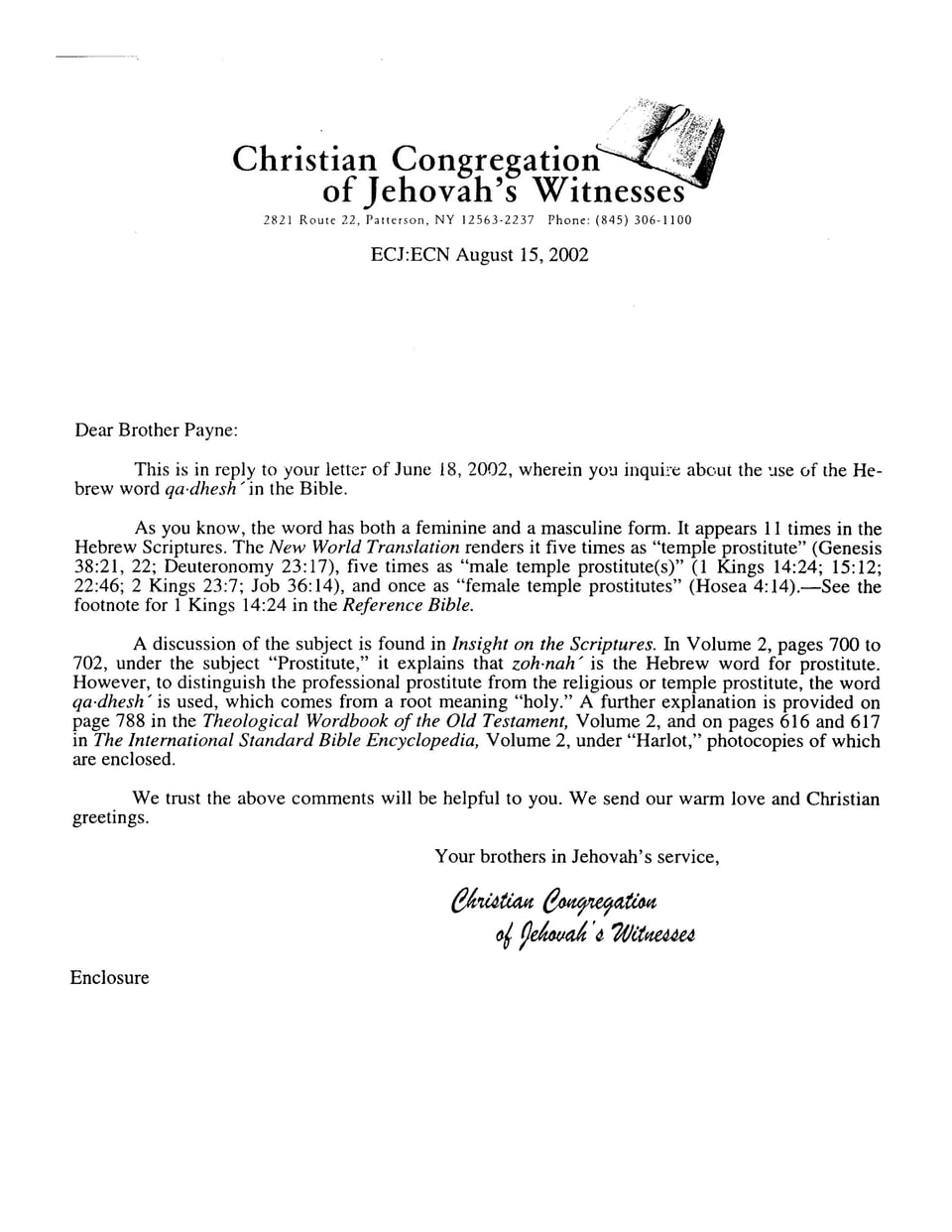
Christian Congregation of Jehovah's Witnesses
2821 Route 22, Patterson, NY 12563-2237 Phone: (845) 306-1100
ECJ:ECN August 15,2002
Dear Brother Payne:
This is in reply to your letter of June 18,2002, wherein you inquire about the use of the Hebrew word qa.dhesh'in the Bible.
As you know, the word has both a feminine and a masculine form. It appears 11 times in the Hebrew Scriptures. The New World Translation renders it five times as "temple prostitute" (Genesis 38:21, 22; Deuteronomy 23:17), five times as "male temple prostitute(s)" (1 Kings 14:24; 15:12; 22:46; 2 Kings 23:7; Job 36:14), and once as "female temple prostitutes" (Hosea 4:14). See the footnote for 1 Kings 14:24 in the Reference Bible.
A discussion of the subject is found in Insight on the Scriptures. In Volume 2, pages 700 to 702, under the subject "Prostitute," it explains that zohnah' is the Hebrew word for prostitute. However, to distinguish the professional prostitute from the religious or temple prostitute, the word qa-dhesh' is used, which comes from a root meaning "holy." A further explanation is provided on page 788 in the Theological Wordbook of the Old Testament, Volume 2, and on pages 616 and 617 in The International Standard Bible Encyclopedia, Volume 2, under "Harlot," photocopies of which are enclosed.
We trust the above comments will be helpful to you. We send our warm love and Christian greetings.
Your brothers in Jehovah's service,
Christian Congregation of Jehovah's Witnesses
Enclosure THEOLOGICAL WORDBOOK OF THE OLD TESTAMENT
Volume 2
© 1980 by THE MOODY BIBLE INSTITUTE OF CHICAGO 1719201816
Gleason L. Archer, Jr., Associate Editor
Bruce K. Waltke, Associate Editor
All rights reserved. No part of this book may be reproduced in any form without permission in writing from the publisher except in the case of brief quotations embodied in critical articles or reviews.
Theological Wordbook of the Old Testament
Includes bibliographies and index
I. Bible, O.T.—Dictionaries—Historie
O.T.—Theology—Dictionarie
II. Archer, Gleason Leconard
Bruce K.
BS440.T49 22144033 88-28627
ISBN 0-8024-8631-2 1967
Printed in : the United States HARE
of human action out of harmony with God's will (cf. Rom. 1:18-32, esp.vv.21,24,26,28). W.L.WALKER
HARE [Heb. 'arnebei] (Lev. 11:6; Dt. 14:7); cf. Akk. annabu, Ugar. anhb, Arab. 'arnab. This animal is mentioned only in the lists of unclean animals in Leviticus and Deuteronomy, where it occurs along with the camel, the coney, and the swine. The camel, the hare, and the coney are unclean "because they chew the cud but do not part the hoof, the swine, because it parts the hoof but does not chew the cud." The hare and the coney are not ruminants, but might be supposed to be from their habit of almost continuously moving their jaws. Although 'arnebei occurs only in the two passages cited, there is no doubt that it is the hare. The LXX has Gk. dasýpous, "rough-footed," which, while not the commonest Greek word for the hare (lagós), refers to the remarkable fact that in hares and rabbits the soles of the feet are densely covered with hair. The commonest Arabic word for "hare," 'arnab, is from the same root as Heb. 'arnebei.
Hares, which are rodents of the Leporidae family, are closely related to the rabbit (Lepus cuniculus), but have longer legs and ears, besides being much swifter than the rabbit. Hares are widely distributed in the northern hemisphere, whereas in Bible times there were no rabbits in Palestine. Tristram regarded the species Lepus syriacus, an animal closely resembling its English counterpart in size and coloring, as native to the northern regions of Palestine, although other species also occur elsewhere in the country. A.E.DAY
R. K. H.
Desert creatures, including a hare, in a reconstruction of Egyptian wall paintings (Royal Ontario Museum, Toronto)
HAREM [Heb. bēt hannāsīm] (Est. 2); AV "house of the women," WOMEN'S HOUSE; NEB WOMEN'S QUARTERS. The young women chosen for Ahasuerus were taken into the women's quarters, under the care of a eunuch, to prepare for their night with the king. Having spent that night, they resided in a separate part of the harem in charge of another eunuch to await the king's command to return. Some might wait in vain. Esther was a favored one.
HAREPH hàr'əf [Heb. hārēp-'scornful']. A chief of Judah, one of the sons of Caleb and father of Beth-gader (1 Ch. 2:51).
HARETH hår'əth [Heb. hareI, in pause]. See HERETH.
HARHAIAH här-hä'yə [Heb. harhnyá]. A goldsmith whose son Uzziel helped to repair the walls of Jerusalem under Zerubbabel (Neh. 3:8).
HARHAS här'has [Heb. harhas]. Grandfather of Shallum, husband of Huldah (2 K. 22:14). The name appears as Hasrah in the parallel passage 2 Ch. 34:22.
HAR-HERES. See HERES 1.
HARHUR här'hur [Heb. harhur; Gk. Hasour]. One of the temple servants whose descendants came from Babylon with Zerubbabel (Ezr. 2:51; Neh. 7:53). 1 Esd. 5:31 has Asur and Pharakim in place of Harhur.
HARIM här'im [Heb. harim]. A family name.
A nonpriestly family that returned from captivity with Zerubbabel (Ezr. 2:32; Neh. 7:35); mentioned among those who married foreign wives (Ezr. 10:31); also mentioned among those who renewed the covenant (Neh. 10:27 [MT 28]).
A priestly family returning with Zerubbabel (Ezr. 2:39; Neh. 7:42; 12:3,15 [see REHUM]; 1 Esd. 5:25; AV CARME, NEB CHARME); members of this family covenanted to put away their foreign wives (Ezr. 10:21; Neh. 10:15 [MT6]). A family of this name appears as the third of the priestly courses in the days of David and Solomon (1 Ch. 24:8).
In Neh. 3:11 is mentioned Malchijah, son of Harim one of the wall-builders. Which family is here designated is uncertain. W.N. STEARNS
HARIPH hår'if [Heb. harip]; NEB also HARIF. One of those who returned from exile under Zerubbabel and helped to seal the covenant under Nehemiah and Ezra (Neh. 7:24 [par. Ezr. 2:18 has "Jorah"]; 10:19 [MT 20]).
HARLOT; PLAY THE HARLOT [Heb. zānā, zōnā (Gen. 34:31; 38:15,24; Ex. 34:15f.; etc.), q'dēša (Gen. 38:21f.); Gk. pórne (Mt. 21:31f.; Lk. 15:30; He. 11:31; Jas. 2:25; Rev. 17:1, 5, 15f.; 19:2)]; AV also WHORE, GO A WHORING, COMMIT FORNICATION, etc.; NEB COMMON WHORE, PROSTITUTE, TEMPLE-PROSTITUTE, etc.
A harlot is a woman who uses her sexual capacity either for gain or for pagan religious purposes. In contrast to the adulteress she is promiscuous and usually shows no regard for who her mate might be.
Prostitution is a very ancient practice. As early as Gen. 38 we read of it as an established custom. In the ancient world the harlot who worked for gain usually belonged to one of two classes of people. She might be a slave whose earnings as a harlot went to her masters. Baby girls were often deserted by their parents to die; these babies were frequently picked up and raised for the purpose of prostitution. On other occasions free women entered the profession. Prostitution was considered a profession, and licenses were often required from the state. Most of these women doubled as banquet musicians. If a prostitute was free she often became very rich. In ancient Greece Solon established houses of prostitution from which the state gained revenues.
The OT pictures the prostitute as having special clothing (Prov. 7:10), which probably included a veil that covered the face (Gen. 38:14f.). On occasions such women THE INTERNATIONAL STAN BIB ENCYCL
$
G E O F F R E Y W
$
EVERETT F
ROLAND K
Q2.7
WILLIAM SA
Biblical Comment
CONSULTED
LAWRENCE
NATIONAL DARD LE OPEDIA
ATED·IN FOUR VOLUMES
TWO: E-J
EDITOR
N. BROWLEY
Harrison
Hurricos
NFOORD LA SON
in mi thirteen
T. Gunem
reproduced in this encyclopedia are used in inscription credited in the captions. A may be credited are included in the copyright in Company
Unless otherwise indicated, Scripture quotations in the Revised Standard Version of the Bible, except those in the Division of Christian Education of the National Crest in the U.S.A. and used by permission.
ISBN 0-8023-S37-15-9
International standard Bible encyclo
Bible — Dictionaries. I. Bromley, Cecil
BS440 16 1979 2313 79
Library of Congress Cataloging-in-Publ
12 11 10 9
00 99 98 97
Printed in the United States of America
Copyright renewed 1956 by Wm. B. Eerdmans Completely revised and reset Volume Two first printing 1982
New and revised edition, edited by Melvin Grove Kyle
copyright 1915 by the Howard-Severence Con
© 1982 Wm. B. Eerdmans Publishing 255 Jefferson Ave. S.E., Grand Rapids, Mich
Company, Chicago.
. copyright 1929 by the Publishing Co.
Africa
Education Data
Specia
Frey William.
(1228)
Publication from the University of the Chartered Society of the Cambridge
English Bible Copyright Society of the Cambridge with permission from the and starts at this volume edited by W. S. Eckert
HARLOT
lived together in houses that might be called brothels (1 K. 3:16). They were available for hire at greatly varying prices. Prov. 6:26 says that a prostitute would make herself available for a loaf of bread, while the price Judah offered Tamar was a kid (Gen. 38:17). Joel illustrates the depth to which Israel's contempt for human life had fallen by saying that they would give a boy for a harlot's wages (Joel 3:3 [MT 4:3]). A harlot's earnings were not an acceptable offering to God (Dt. 23:18 [MT 19]).
The harlot is condemned in numerous places throughout the OT. A priest is excluded from marrying one, since he is allowed to marry only a virgin (Lev. 21:7-14). If at her marriage a young woman could not produce the tokens of her virginity, she could be stoned as a harlot (Dt. 22:21). The child of a harlot also was despised (Isa. 57:3; Hos. 2:4 [MT 6]). Because Jephthah was the son of a harlot, he was forced to withdraw from his clan and was not called to leadership until the situation was desperate (Jgs. 11:1-11).
Throughout the OT there are references to religious prostitution. Heb. q'dešá comes from a root meaning "holy" (qādōs) and carries that connotation. It is the equivalent of the Gk. hieródoulos (lit. "temple slave"). While in the classical world these temple slaves were occasionally prostitutes, this often was not the case. Temple prostitution was a much more common practice in the Near East. The religions of this region commonly deified nature and its reproductive forces, and paid homage to these in licentious rites. The Code of Hammurabi allowed female prostitutes at any temple. The Gilgamesh Epic pictures such a woman in connection with the temple of Ishtar (cf. ANET, p. 75). Herodotus (i.199) says that the Babylonians compelled every native female to attend the temple of Venus once in her life and to prostitute herself in honor of the goddess. While this practice was not so widespread among the Greeks and Romans, Eryx and Corinth are known to have had vast numbers of temple prostitutes. Here they merely shared their gains with the temple with which they were connected.
When the Israelites entered the Promised Land religious prostitution was an immediate problem (Nu. 25:1). The extermination of the inhabitants of the land was commanded so that the Israelites would not fall into this practice (Ex. 34:11-16). Dt. 23:17 [MT 18] forbids cult prostitution for Israel and indicates that this was carried on by men as well as women. "Dog" in v.18 (RSV mg. "sodomite") is usually interpreted to mean "male prostitute." In the period of the judges religious prostitution was one of the basic causes of the degradation of the people (Jgs. 2:17). They came to worship both the priestly ephod and certain Baals by means of sacred prostitution (8:27-35). Samson spent the night with a Philistine harlot (16:1). The captivity of the half-tribe of Manasseh resulted from their participation in the religious prostitution connected with the Canaanite gods (1 Ch. 5:25). The same can be said of the fall of both the northern and southern kingdoms, as the idolatrous practices they followed included such rites (Ezk. 16:16-58).
The degradation of the human being through religious prostitution becomes a figure for the spiritual infidelity that Israel and Judah show to God. The OT pictures Yahweh as the husband of Israel. For example, Israel and Judah are depicted as faithless sisters who play the harlot, being unfaithful to their beloved (see esp. Jer. 3:1-3 and Ezk.23). The deep religious significance of such a figure is apparent when we see the close connection between idolatry and religious prostitution. To demonstrate the faithlessness of Israel, Yahweh commanded the prophet Hosea to take a wife who had been a harlot. Unable to break the habit of her former life, she became a living representation of Israel's faithlessness to Yahweh. Hosea
filled the role of God, who was always willing to forgive. (See GOMER.)
In the NT we do not find the usual Greek word for harlot, hetaira. Though this word is common in the LXX, Christian literature favors pórne. Yet from the story of the Prodigal Son, who spent his inheritance on harlots (Lk. 15:30), and from the references to Rahab the harlot (He. 11:31; Jas. 2:25), we may be sure that the meaning is the same. Mt. 21:31f. shows that Jesus appealed to this class of people with His message. In this passage the harlot is pictured as a part of the lowest class of society, despised along with the tax collector. Although we cannot be sure that the woman taken in adultery (Jn. 8:1-10) belonged to this class, yet Jesus showed her forgiveness. In His statement of forgiveness, however, He commanded the woman to turn from her former ways.
Paul also joins in this condemnation of prostitution. In 1 Cor. 6:15-20 he shows that when the Christian goes to a harlot he actually becomes one flesh with such a sinful person. In a probable reference to the religious prostitution that was so rampant in Corinth, Paul says that one in whom the Holy Spirit dwells should not be joined to a prostitute. Such immorality is a sin against one's own body, which is the temple of God. The Christian should rather glorify God with his body.
In Rev. 17 an angel shows the judgment of the great harlot. In this vision a woman seated upon a great beast is called the mother of harlots. The final verse of the chapter suggests that the harlot is the city of Rome and her government which rules the world. Thus, the harlot here stands for that government which is opposed to God. She is condemned for being drunk with the blood of His saints. God is praised for destroying the one who corrupted the earth with her fornication and for avenging the blood of His saints (Rev. 19:2). In Rev. 18 the same judgment of the harlot is described in hymns. The first declares that Babylon the great (equivalent to the harlot) has fallen. The second hymn (vv.4-8) calls for the people of God to come out from her lest they be charged with her sin. Finally, her fornication with the kings of the earth is portrayed in terms of the great wealth of the city. She is fallen, and within her is found the blood of the saints (Rev. 18:24).
Bibliography.-EB, s.v. (Cheyne); ERE, IV, s.v. "Hierodouloi" (G. Barton); HDB, s.v. (W. P. Peterson). D.W.WEAD
HARLOTRY. See CRIMES.
HAR-MAGEDON här-mə-ged'ən (Rev. 16:16, ASV). See ARMAGEDDON.
HARMON här'mən [Heb. haharmôná] (Am. 4:3); AV PALACE; NEB DUNGHILL. The meaning of this hapax legomenon has been disputed from ancient times. The LXX translates it Gk. toó óros to Remman, "the mountain of Remman." The Targum has Aram. tûrê harmêni, "the mountains of Armenia." The AV apparently reads Heb. armón and the NEB hammaqmēnā in its stead. Modern scholars have also suggested 'a rummôt, "naked," hērem, "devoted to destruction," and hermônâ, "to Hermon," the mountain N of Bashan.
HARMONY [Gk. toi autóphroneín] (Rom. 12:16; 15:5); AV SAME MIND, LIKE-MINDED; NEB EQUAL REGARD, AGREE; [teleiótês] (Col. 3:14); AV "bond of perfection"; NEB "complete whole." Though there are several cognate forms in the NT, Paul is the only one to exhort the churches literally to "think the same thing." Only in the Roman passages does the RSV translate to autóphroneín as "harmony," using "agree" in 2 Cor. 13:11 and Phil. 2:4, and "same mind" in Phil. 2:2.
long as its integrity was strictly maintained. The maintenance of the integrity of the "holy" was a function of the Israelite cultus. The holy God came to man in redeeming love within the context of regulations and proscriptions that were designed to maintain the purity of holiness that characterized God's essential nature. Even before the establishment of the Levitical system, this principle was recognized (see Ex 3:5).
The cultus also effected the holiness of those who participated in it. This was essential to the concept of redemption for, by definition, holiness is separate from all that is sinful and profane. God, therefore, calls man to holiness because he himself is holy (qadosh) (Lev 19:2; cf. I Pet 1:15).
Because of his holiness, God is above the weaknesses and imperfections of mortals and thus can accomplish the deliverance of his people (Ex 15:11-12). Only those who are holy will dwell in God's holy hill (Ps 15:1ff.). Because God is holy by nature and separate from moral imperfection, he can be trusted to be faithful to his promises (Ps 33:21).
Inherent within the redemptive work of God is the promise of the ultimate manifestation of God's holiness in the glorification of his people and the deliverance of the creation from the imperfections resulting from the edenic curse (Rom 8:18-23).
qaddosh. Holy, Holy one, saint (ASV, RSV similar). The adjective qaddosh (holy) denominates that which is intrinsically sacred or which has been admitted to the sphere of the sacred by divine rite or cultic act. It connotes that which is distinct from the common or profane.
God is intrinsically holy and he calls his people to be holy, providing for them the standard of obedience whereby that holiness may be maintained (Lev 19:2ff.). Because God is holy, he is free from the moral imperfections and frailties common to man (Hos 11:9) and can be counted on to be faithful to his promises (Ps 22:3-5). This aspect of God's character forms the basis of Habakkuk's hope that his people would not perish (Hab 1:12).
The title "The Holy One of Israel" is applied to God numerous times in the or, but is especially frequent in the prophecy of Isaiah (in all parts). It serves to place the sins of Isaiah's society in stark contrast to God's moral perfection (Isa 30:11) and expresses God's absolute separation from evil (Isa 17:7).
The inviolability of the spheres of the sacred and the profane forms the ground for the ethical aspects of the concept of holiness. Because God is holy, the Israelites could not serve him when they persisted in their idolatrous practices (Josh 24:19ff.). They were to be separate from all that was unholy (Lev 11:44-45; Deut 14:21). Stipulations were imposed on them that they might not engage in practices common to other peoples (Lev 19:2; 20:7; Num 15:40). Their call to holiness was based on the fact that they had become God's possession by virtue of his separating them from the nations (Lev 20:26; Deut 7:6; 14:2; 26:19).
It is unthinkable that a holy God could condone sin; such a concept would involve a diffusion of the sacred and profane, thus destroying the nature of holiness. The call to be holy was accompanied by the imposition of certain restrictions that served to ensure the continuing holiness of those who believed (Lev 11:44-45; 19:2ff.; Deut 14:2, 21; Num 15:40).
Various aspects of the cultus were denominated holy by virtue of their being conceived of as belonging to the realm of the sacred and were not to be treated as common. This included portions of the sacrifices (Lev 6:16; 7:6), the temple and its aspects (Ps 65:4 [H 5]; Lev 6:16, etc), and the priests (Lev 21:6, 8) and Levites (II Chr 35:3).
The presence of God within the world delineated a sphere that was holy, for God's holiness cannot be diffused by the common (Deut 23:14).
That which is "holy" is not only distinct from the profane but in opposition to it as well. God, therefore, hates and punishes sin (Josh 24:19; Isa 5:16, 24). In the light of God's holiness, Isaiah saw himself and his people as sinners (Isa 6:3; cf. v. 5).
qadesh. Temple prostitute, male or female. The adjective qadesh, like the name Kadesh, means "holy," but holy to what? The female functionaries in the pagan shrines were called qedesha, temple prostitutes, because that is what they were. The name is a sad commentary on the licentiousness of Canaanite worship. The masculine form is used similarly for the male counterpart (Deut 23:17 [H 18]). In Gen 38:21-22 the usage may be extended to refer to prostitution in general.
qedesh. Kedesh. The name of several cities cited in the or. The name kedesh means "holy."
Kedesh in Naphtali. A settlement located in upper Galilee in the hill country of Naphtali. It is generally identified with the modern Tell Qades. Kedesh was designated as one of the cities of refuge in the list in Josh 20 (v. 7), and it was one of the Levitical cities of the Gershonite clan of Levites in the parallel lists in Josh 21:27-33 and I Chr 6:71-76. It was one of the fortified cities of Naphtali according to Josh 19:37.
The king of the Canaanite city of Kedesh is cited in the list of kings defeated by Joshua (Josh 12:22). It is generally thought that this Kedesh was the birthplace of Barak, but for another view see Y. Aharoni, The Land of the Bible, p. 204.