Letter From the Watch Tower Society About Blood Fractions (2006)
Download: PDF — Letter From the Watch Tower Society About Blood Fractions (2006)
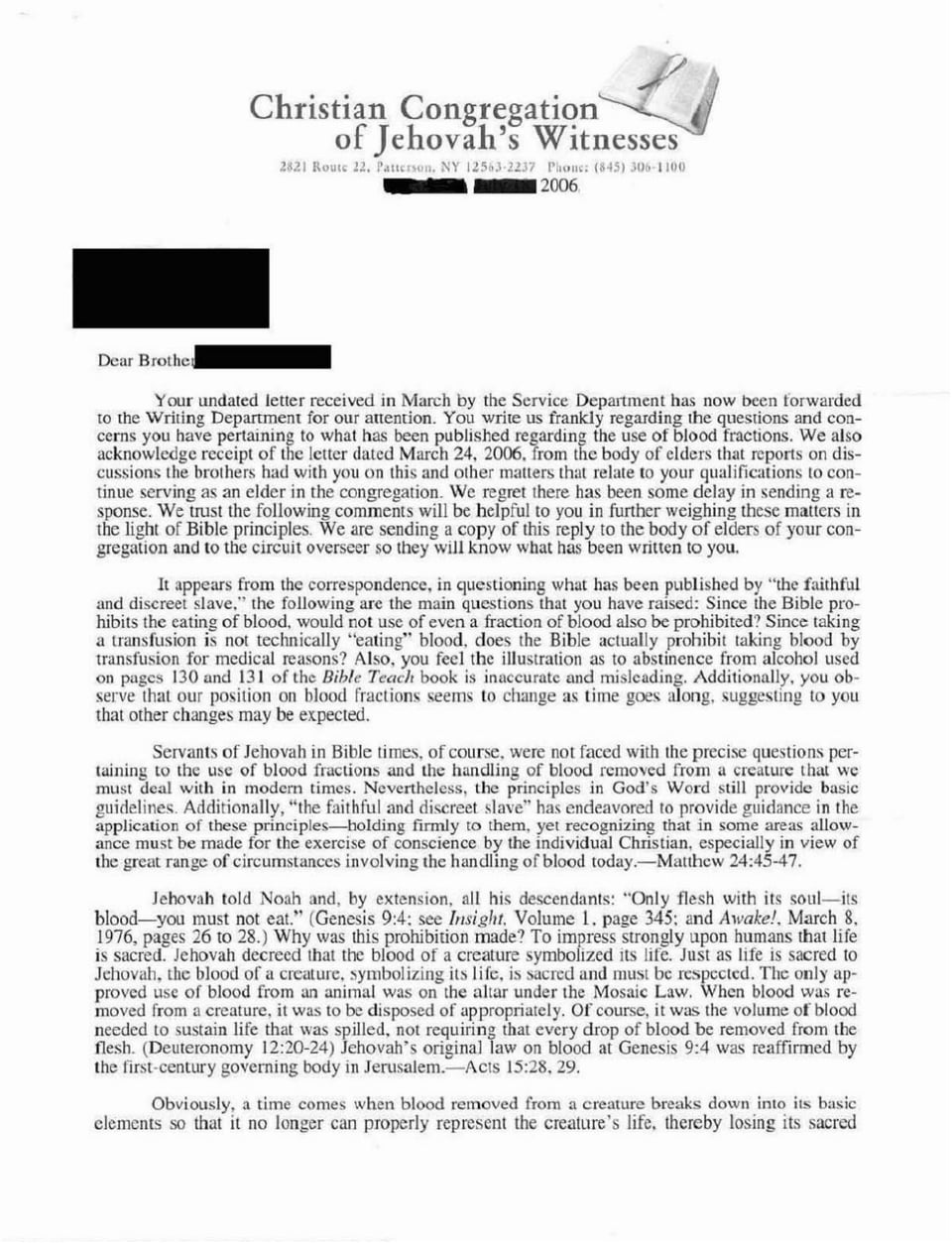
Christian Congregation of Jehovah's Witnesses
2821 Route 22, Patterson, NY 12563-2237 Phone: (845) 306-1100 2006.
Dear Brother
Your undated letter received in March by the Service Department has now been forwarded to the Writing Department for our attention. You write us frankly regarding the questions and concerns you have pertaining to what has been published regarding the use of blood fractions. We also acknowledge receipt of the letter dated March 24, 2006, from the body of elders that reports on discussions the brothers had with you on this and other matters that relate to your qualifications to continue serving as an elder in the congregation. We regret there has been some delay in sending a response. We trust the following comments will be helpful to you in further weighing these matters in the light of Bible principles. We are sending a copy of this reply to the body of elders of your congregation and to the circuit overseer so they will know what has been written to you.
It appears from the correspondence, in questioning what has been published by "the faithful and discreet slave," the following are the main questions that you have raised: Since the Bible prohibits the eating of blood, would not use of even a fraction of blood also be prohibited? Since taking a transfusion is not technically "eating" blood, does the Bible actually prohibit taking blood by transfusion for medical reasons? Also, you feel the illustration as to abstinence from alcohol used on pages 130 and 131 of the Bible Teach book is inaccurate and misleading. Additionally, you observe that our position on blood fractions seems to change as time goes along, suggesting to you that other changes may be expected.
Servants of Jehovah in Bible times, of course, were not faced with the precise questions pertaining to the use of blood fractions and the handling of blood removed from a creature that we must deal with in modern times. Nevertheless, the principles in God's Word still provide basic guidelines. Additionally, "the faithful and discreet slave" has endeavored to provide guidance in the application of these principles—holding firmly to them, yet recognizing that in some areas allowance must be made for the exercise of conscience by the individual Christian, especially in view of the great range of circumstances involving the handling of blood today.-Matthew 24:45-47.
Jehovah told Noah and, by extension, all his descendants: "Only flesh with its soul—its blood—you must not eat." (Genesis 9:4; see Insight, Volume 1, page 345; and Awake!, March 8, 1976, pages 26 to 28.) Why was this prohibition made? To impress strongly upon humans that life is sacred. Jehovah decreed that the blood of a creature symbolized its life. Just as life is sacred to Jehovah, the blood of a creature, symbolizing its life, is sacred and must be respected. The only approved use of blood from an animal was on the altar under the Mosaic Law. When blood was removed from a creature, it was to be disposed of appropriately. Of course, it was the volume of blood needed to sustain life that was spilled, not requiring that every drop of blood be removed from the flesh. (Deuteronomy 12:20-24) Jehovah's original law on blood at Genesis 9:4 was reaffirmed by the first-century governing body in Jerusalem. Acts 15:28, 29.
Obviously, a time comes when blood removed from a creature breaks down into its basic elements so that it no longer can properly represent the creature's life, thereby losing its sacred status.
That happens naturally by decomposition when blood is put on the ground and covered, as was required under the Law, perhaps being used as nutrients by a growing plant from which vegetables or fruits are gathered and eaten. (Leviticus 17:13) Even the volume of blood from sacrificial animals offered on the altar at Jerusalem's temple was washed away after it had served its sacred purpose. According to Jewish authorities, the blood from the temple area passed through conduits to the Kidron Valley where it collected, decomposed, and in time was used as fertilizer. It had lost its sacred value, not representing the life of the sacrificial animals anymore. See Insight on the Scriptures, Volume 1, page 83; The Talmud of the Land of Israel, translated by Jacob Neusner, Volume 14, Yoma 5:6, D-F.
In the modern day, the handling of blood is not always done in accordance with Jehovah's Word. Every day, millions of animals are killed for food or other purposes, and some 90 million units of human blood are donated each year for medical purposes. (See Awake!, August 2006 issue, page 3; The Watchtower, November 15, 1964, pages 680 to 683.) This great volume of animal and human blood is handled in various ways in the process of its eventually being recycled back into the earth, much of it being used in commercial products such as fertilizer, feed for animals, adhesives, and some for medical purposes. Christians face decisions as to the use of any of these products and wisely decide in accord with the principles of God's Word.
As to blood's medical uses, a careful examination of what has been published will reveal that the faithful "slave" has not endorsed the use of any blood fraction or any procedure involving the handling of blood extracorporeally. In weighing matters Scripturally, the "slave" has decided with good basis that blood's four primary components—plasma, red cells, white cells, and platelets—should not be used. That is how unfractionated blood components settle out naturally. In its still unbroken-down state, each separated primary component, regardless of its respective percentage of whole blood, can still represent basically what blood as a whole symbolizes: the life of the creature. This has consistently been the basic position of Jehovah's organization for many decades in reasoning on the Scriptural principles involved. It has not actually changed even though some clarification seemed necessary in recent years because medical science has put on the market products containing fragments of the red cells, white cells, and platelets. At the same time, it has been felt that the use of minor fractions of blood should be left for the individual to decide consciently. Why has this position been taken? On what basis, Scripturally?
The point is made on page 30, paragraph 4, of the June 15, 2004, issue of The Watchtower that some Christians would refuse anything derived from blood. That is how they personally and conscientiously understand God's command to 'abstain from blood,' as they reason also that his law to Israel required that blood removed from a creature be 'poured out on the ground.' (Acts 15:28, 29; Deuteronomy 12:22-24) Thereafter, the following is stated: "Why is that relevant? Well, to prepare gamma globulin, blood-based clotting factors, and so on, requires that blood be collected and processed." So the fact that non-Witness donors have given whole blood to be processed is acknowledged. This statement follows: "Hence, some Christians reject such products, just as they reject transfusions of whole blood or of its four primary components. Their sincere, conscientious stand should be respected."
However, the next paragraph states: "Other Christians decide differently." While rejecting whole blood and its primary components, some reasoning is presented as to why conscientiously they might allow a physician to treat them with a fraction extracted from the primary components. On page 31, the point is made that "when it comes to fractions of any of the primary components each Christian, after careful and prayerful meditation, must conscientiously decide for himself."
In stating matters this way, in effect, a line is placed between what is "unacceptable" and what is left for the "Christian to decide," as reflected by the chart on page 22 of the same issue of The Watchtower. But when a separating line is drawn, obviously items very near the line, on either side of it, will be very close together. In acknowledging that, the point is made in paragraph 16 on pages 23 and 24 that "some products derived from one of the four primary components may be so similar to the function of the whole component and carry on such a life-sustaining role in the body that most Christians would find them objectionable."
For example, see the objections noted in the box "What Are Hemoglobin-Based Oxygen Carriers?" on page 11 of the August 2006 issue of Awake! Nevertheless, in the case of such products, the stroma-free hemoglobin is no longer part of a living cell having a complex membrane. Molecules from the fragmented red cell are polymerized and, if injected into the bloodstream, circulate as basic chemicals, the process being much different from merely taking a medication that has been removed from a capsule, as suggested by you.
We are aware that some would argue that "abstain" would include any blood fractions, no matter how small or broken down. And, as mentioned above, if that is how they conscientiously understand the command to 'abstain from blood,' then they should obey the dictates of their conscience. However, as indicated on page 23, paragraph 16, of the above-mentioned June 15, 2004 issue of The Watchtower, "some have concluded that such minute fractions are, in effect, no longer blood and hence are not covered by the command 'to abstain from blood.'"—Acts 15:29; 21:25.
Why does this reasoning have validity, at least to the point that allowance is made for the individual Christian to determine how he or she will decide matters conscientiously and to accept the responsibility for the decision before Jehovah? Simply because at some point blood that is broken down ceases to represent the life of the creature from which it was taken and thereby loses its sacredness. As discussed above, the four major components are not acceptable. But beyond this, each one can decide conscientiously whether small fractions of these components are to be perceived and treated the same as blood that represents life. In some respects, this is similar to what was allowed in the first century with respect to the injunction "to keep abstaining from things sacrificed to idols," a "necessary" requirement set by the first-century governing body. (Acts 15:20, 28, 29) Eating meat still considered sacred because it had been offered to an idol god was prohibited, this being included in the same decree that commanded "abstaining . . . from blood and from things strangled." But, what if the meat was taken from the idol temple and sold in the meat market? In that case, Paul established that it could lose any perception of religious significance in the minds of some, and if so, a Christian might eat it as mere food with thanks to Jehovah, as long as his conscience was not affected and this did not stumble others.—1 Corinthians 8:4-13; 10:14-22, 25-30.
Could use of a minor fraction make a Christian an accomplice in the wrong use of blood, since it was extracted from donated blood? Some may conscientiously view matters that way, and if so, they would, of course, want to obey their conscience. Other Christians, in considering what occurs by the time a product of this nature is placed on the market, decide differently. The donors and any processors would be responsible for how blood and the major components (that can still clearly represent the life of the creature) are used, but if a component is broken down so extensively that a small fraction of it no longer can appropriately represent the life of the creature, then accepting it would be a matter of conscience.
Regarding the observation that taking a transfusion is not technically "eating" blood, obviously the taking of blood into the circulatory system by transfusion is not "eating" it in the conventional sense as in the case of food or drink that goes into the mouth and passes through the digestive system in providing some nutrients to sustain the body. Hence, to argue with medical personnel or others strictly on the technical aspect that taking a blood transfusion is not the same as eating blood by mouth would be pointless. The important point is that blood, as long as it could represent the life of a creature, should not be used for any purpose. Then, is the taking of alcohol into the veins when told by a doctor to abstain from using it a valid illustration? Yes, because as long as the substance could be defined or understood to be alcohol, it should not be taken into the body, whether by mouth or otherwise. Similarly, Christians should "abstain" from blood or any component of it that could still appropriately represent the creature's life, not taking this into the body in any possible way.
We trust, Brother the above comments will be helpful to you in further reasoning on this sensitive and complex matter. Be assured that what has been published by "the faithful and discreet slave" on the subject of blood has first been carefully and prayerfully weighed in the light of God's Word. Clearly, blood or any part of it that might still appropriately represent the life of a creature should not be made use of. Rather, it has been felt that the use of small fractions that become questionable as to their being able adequately to represent a creature's life should be left as a matter of conscience.
We understand your circuit overseer is scheduled to visit your congregation in the early fall. In the interim you will have opportunity to meditate upon the discussions that have taken place on this matter and the counsel given to you and to seek Jehovah's further direction and guidance. Unwisely, you have let the specious reasoning of an opposer influence and reinforce some of your doubts. Even a question arose as to whether you felt you could accept a blood transfusion. Additionally, we trust the situation involving has now been resolved so that she can be assisted to become associated again. While you evidently acted in good faith to assist initially likely you appreciate that it would have been better to check early on with the branch office to see if before imposing upon the possibility of her breaking the Biblical injunction "to quit mixing in company with" a disfellowshipped person. (1 Corinthians 5:11) A lesson can be learned in that while we want to be merciful, we also want to be obedient and not run ahead.
We note your continued reliance upon Jehovah and your trust that he and his Son are using the anointed remnant today as "the faithful and discreet slave" appointed to provide "food at the proper time." Commendably, you want to be like the Beroeans who 'carefully examined the Scriptures daily as to whether these things were so,' but it is good to note that in becoming believers "they received the word with the greatest eagerness of mind." (Acts 17:11, 12) To the extent necessary, your qualifications to continue serving as an elder and one "holding firmly to the faithful word as respects his art of teaching, that he may be able both to exhort by the teaching that is healthful and to reprove those who contradict," can be reviewed at the time of the circuit overseer's visit. (Titus 1:9; see Organized to Do Jehovah's Will, pages 34 and 35.) We are confident that the brothers will do this with continuing deep love and consideration for you as a friend and brother.
Our prayer is that Jehovah will grant you "wisdom from above." (James 3:17, 18) We take this occasion to send warm Christian love and best wishes.
Your brothers,
Christian Congregation of Jehovah's Witnesses