Letters to the Watch Tower Society About the Integrity of the New World Translation (1980)
Download: PDF — Letters to the Watch Tower Society About the Integrity of the New World Translation (1980)
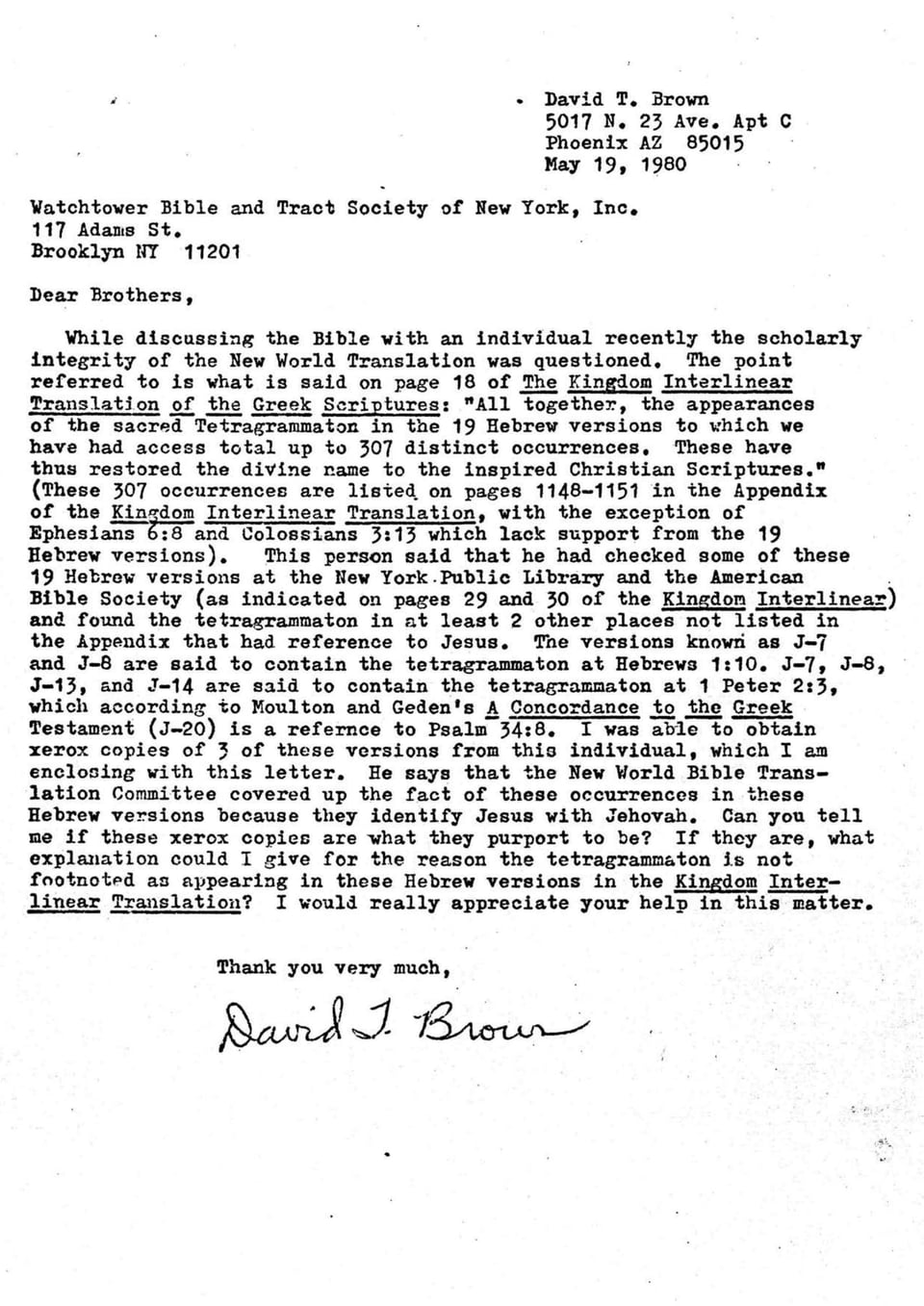
David T. Brown 5017 N.23 Ave.Apt C Phoenix AZ 85015 May 19,1980
Watchtower Bible and Tract Society of New York, Inc. 117 Adams St. Brooklyn NY 11201
Dear Brothers,
While discussing the Bible with an individual recently the scholarly integrity of the New World Translation was questioned. The point referred to is what is said on page 18 of The Kingdom Interlinear Translation of the Greek Scriptures: "All together, the appearances of the sacred Tetragrammaton in the 19 Hebrew versions to which we have had access total up to 307 distinct occurrences. These have thus restored the divine name to the inspired Christian Scriptures." (These 307 occurrences are listed on pages 1148-1151 in the Appendix of the Kingdom Interlinear Translation, with the exception of Ephesians 6:8 and Colossians 3:13 which lack support from the 19 Hebrew versions). This person said that he had checked some of these 19 Hebrew versions at the New York Public Library and the American Bible Society (as indicated on pages 29 and 30 of the Kingdom Interlinear) and found the tetragrammaton in at least 2 other places not listed in the Appendix that had reference to Jesus. The versions known as J-7 and J-8 are said to contain the tetragrammaton at Hebrews 1:10. J-7, J-8, J-13, and J-14 are said to contain the tetragrammaton at 1 Peter 2:3, which according to Moulton and Geden's A Concordance to the Greek Testament (J-20) is a reference to Psalm 34:8. I was able to obtain xerox copies of 3 of these versions from this individual, which I am enclosing with this letter. He says that the New World Bible Translation Committee covered up the fact of these occurrences in these Hebrew versions because they identify Jesus with Jehovah. Can you tell me if these xerox copies are what they purport to be? If they are, what explanation could I give for the reason the tetragrammaton is not footnoted as appearing in these Hebrew versions in the Kingdom Interlinear Translation? I would really appreciate your help in this matter.
Thank you very much,
David J. Brown מה נקרא העובדה?
מה נקרא העובדה? :
N CAP. I.
הערה
נקרא הערה במשפט הזה מהווה בין הערות הבאות:
הערה 3 : מלחמת ישראל ואחריו פורש את הערה הבאה;
הערה 4 : מלחמת ישראל ואחריו פורש את הערה הבאה;
הערה 5 : מלחמת ישראל ואחריו פורש את הערה הבאה;
הערה 6 : מלחמת ישראל ואחריו פורש את הערה הבאה;
הערה 7 : מלחמת ישראל ואחריו פורש את הערה הבאה;
הערה 8 : מלחמת ישראל ואחריו פורש את הערה הבאה;
הערה 9 : מלחמת ישראל ואחריו פורש את הערה הבאה;
הערה 10 : מלחמת ישראל ואחריו פורש את הערה הבאה;
הערה 11 : מלחמת ישראל ואחריו פורש את הערה הבאה;
הערה 12 : מלחמת ישראל ואחריו פורש את הערה הבאה;
ראה כך שהערה 13 היא מלחמת ישראל ואחריו פורש את הערה הבאה;
הערה 14 היא מלחמת ישראל ואחריו פורש את הערה הבאה;
הערה 15 היא מלחמת ישראל ואחריו פורש את הערה הבאה;
הערה 16 היא מלחמת ישראל ואחריו פורש את הערה הבאה;
הערה 17 היא מלחמת ישראל ואחריו פורש את הערה הבאה;
הערה 18 היא מלחמת ישראל ואחריו פורש את הערה הבאה;
הערה 19 היא מלחמת ישראל ואחריו פורש את הערה הבאה;
הערה 20 היא מלחמת ישראל ואחריו פורש את הערה הבאה;
הערה 21 היא מלחמת ישראל ואחריו פורש את הערה הבאה;
הערה 22 היא מלחמת ישראל ואחריו פורש את הערה הבאה;
הערה 23 היא מלחמת ישראל ואחריו פורש את הערה הבאה;
הערה 24 היא מלחמת ישראל ואחריו פורש את הערה הבאה;
הערה 25 היא מלחמת ישראל ואחריו פורש את הערה הבאה;
הערה 26 היא מלחמת ישראל ואחריו פורש את הערה הבאה;
הערה 27 היא מלחמת ישראל ואחריו פורש את הערה הבאה;
הערה 28 היא מלחמת ישראל ואחריו פורש את הערה הבאה;
הערה 29 היא מלחמת ישראל ואחריו פורש את הערה הבאה;
הערה 30 היא מלחמת ישראל ואחריו פורש את הערה הבאה;
הערה 31 היא מלחמת ישראל ואחריו פורש את הערה הבאה;
הערה 32 היא מלחמת ישראל ואחריו פורש את הערה הבאה;
הערה 33 היא מלחמת ישראל ואחריו פורש את הערה הבאה;
הערה 34 היא מלחמת ישראל ואחריו פורש את הערה הבאה;
הערה 35 היא מלחמת ישראל ואחריו פורש את הערה הבאה;
הערה 36 היא מלחמת ישראל ואחריו פורש את הערה הבאה;
הערה 37 היא מלחמת ישראל ואחריו פורש את הערה הבאה;
הערה 38 היא מלחמת ישראל ואחריו פורש את הערה הבאה;
הערה 39 היא מלחמת ישראל ואחריו פורש את הערה הבאה;
הערה 40 היא מלחמת ישראל ואחריו פורש את הערה הבאה;
הערה 41 היא מלחמת ישראל ואחריו פורש את הערה הבאה;
הערה 42 היא מלחמת ישראל ואחריו פורש את הערה הבאה;
הערה 43 היא מלחמת ישראל ואחריו פורש את הערה הבאה;
הערה 44 היא מלחמת ישראל ואחריו פורש את הערה הבאה;
הערה 45 היא מלחמת ישראל ואחריו פורש את הערה הבאה;
הערה 46 היא מלחמת ישראל ואחריו פורש את הערה הבאה;
הערה 47 היא מלחמת ישראל ואחריו פורש את הערה הבאה;
הערה 48 היא מלחמת ישראל ואחריו פורש את הערה הבאה;
הערה 49 היא מלחמת ישראל ואחריו פורש את הערה הבאה;
הערה 50 היא מלחמת ישראל ואחריו פורש את הערה הבאה;
הערה 51 היא מלחמת ישראל ואחריו פורש את הערה הבאה;
הערה 52 היא מלחמת ישראל ואחריו פורש את הערה הבאה;
הערה 53 היא מלחמת ישראל ואחריו פורש את הערה הבאה;
הערה 54 היא מלחמת ישראל ואחריו פורש את הערה הבאה;
הערה 55 היא מלחמת ישראל ואחריו פורש את הערה הבאה;
הערה 56 היא מלחמת ישראל ואחריו פורש את הערה הבאה;
הערה 57 היא מלחמת ישראל ואחריו פורש את הערה הבאה;
הערה 58 היא מלחמת ישראל ואחריו פורש את הערה הבאה;
הערה 59 היא מלחמת ישראל ואחריו פורש את הערה הבאה;
הערה 60 היא מלחמת ישראל ואחריו פורש את הערה הבאה;
הערה 61 היא מלחמת ישראל ואחריו פורש את הערה הבאה;
הערה 62 היא מלחמת ישראל ואחריו פורש את הערה הבאה;
הערה 63 היא מלחמת ישראל ואחריו פורש את הערה הבאה;
הערה 64 היא מלחמת ישראל ואחריו פורש את הערה הבאה;
הערה 65 היא מלחמת ישראל ואחריו פורש את הערה הבאה;
הערה 66 היא מלחמת ישראל ואחריו פורש את הערה הבאה;
הערה 67 היא מלחמת ישראל ואחריו פורש את הערה הבאה;
הערה 68 היא מלחמת ישראל ואחריו פורש את הערה הבאה;
הערה 69 היא מלחמת ישראל ואחריו פורש את הערה הבאה;
הערה 70 היא מלחמת ישראל ואחריו פורש את הערה הבאה;
הערה 71 היא מלחמת ישראל ואחריו פורש את הערה הבאה;
הערה 72 היא מלחמת ישראל ואחריו פורש את הערה הבאה;
הערה 73 היא מלחמת ישראל ואחריו פורש את הערה הבאה;
הערה 74 היא מלחמת ישראל ואחריו פורש את הערה הבאה;
הערה 75 היא מלחמת ישראל ואחריו פורש את הערה הבאה;
הערה 76 היא מלחמת ישראל ואחריו פורש את הערה הבאה;
הערה 77 היא מלחמת ישראל ואחריו פורש את הערה הבאה;
הערה 78 היא מלחמת ישראל ואחריו פורש את הערה הבאה;
הערה 79 היא מלחמת ישראל ואחריו פורש את הערה הבאה;
הערה 80 היא מלחמת ישראל ואחריו פורש את הערה הבאה;
הערה 81 היא מלחמת ישראל ואחריו פורש את הערה הבאה;
הערה 82 היא מלחמת ישראל ואחריו פורש את הערה הבאה;
הערה 83 היא מלחמת ישראל ואחריו פורש את הערה הבאה;
הערה 84 היא מלחמת ישראל ואחריו פורש את הערה הבאה;
הערה 85 היא מלחמת ישראל ואחריו פורש את הערה הבאה;
הערה 86 היא מלחמת ישראל ואחריו פורש את הערה הבאה;
הערה 87 היא מלחמת ישראל ואחריו פורש את הערה הבאה;
הערה 88 היא מלחמת ישראל ואחריו פורש את הערה הבאה;
הערה 89 היא מלחמת ישראל ואחריו פורש את הערה הבאה;
הערה 90 היא מלחמת ישראל ואחריו פורש את הערה הבאה;
הערה 91 היא מלחמת ישראל ואחריו פורש את הערה הבאה;
הערה 92 היא מלחמת ישראל ואחריו פורש את הערה הבאה;
הערה 93 היא מלחמת ישראל ואחריו פורש את הערה הבאה;
הערה 94 היא מלחמת ישראל ואחריו פורש את הערה הבאה;
הערה 95 היא מלחמת ישראל ואחריו פורש את הערה הבאה;
הערה 96 היא מלחמת ישראל ואחריו פורש את הערה הבאה;
הערה 97 היא מלחמת ישראל ואחריו פורש את הערה הבאה;
הערה 98 היא מלחמת ישראל ואחריו פורש את הערה הבאה;
הערה 99 היא מלחמת ישראל ואחריו פורש את הערה הבאה;
הערה 100 היא מלחמת ישראל ואחריו פורש את הערה הבאה;
הערה 101 היא מלחמת ישראל ואחריו פורש את הערה הבאה;
הערה 102 היא מלחמת ישראל ואחריו פורש את הערה הבאה;
הערה 103 היא מלחמת ישראל ואחריו פורש את הערה הבאה;
הערה 104 היא מלחמת ישראל ואחריו פורש את הערה הבאה;
הערה 105 היא מלחמת ישראל ואחריו פורש את הערה הבאה;
הערה 106 היא מלחמת ישראל ואחריו פורש את הערה הבאה;
הערה 107 היא מלחמת ישראל ואחריו פורש את הערה הבאה;
הערה 108 היא מלחמת ישראל ואחריו פורש את הערה הבאה;
הערה 109 היא מלחמת ישראל ואחריו פורש את הערה הבאה;
הערה 110 היא מלחמת ישראל ואחריו פורש את הערה הבאה;
הערה 111 היא מלחמת ישראל ואחריו פורש את הערה הבאה;
הערה 112 היא מלחמת ישראל ואחריו פורש את הערה הבאה;
הערה 113 היא מלחמת ישראל ואחריו פורש את הערה הבאה;
הערה 114 היא מלחמת ישראל ואחריו פורש את הערה הבאה;
הערה 115 היא מלחמת ישראל ואחריו פורש את הערה הבאה;
הערה 116 היא מלחמת ישראל ואחריו פורש את הערה הבאה;
הערה 117 היא מלחמת ישראל ואחריו פורש את הערה הבאה;
הערה 118 היא מלחמת ישראל ואחריו פורש את הערה הבאה;
הערה 119 היא מלחמת ישראל ואחריו פורש את הערה הבאה;
הערה 120 היא מלחמת ישראל ואחריו פורש את הערה הבאה;
הערה 121 היא מלחמת ישראל ואחריו פורש את הערה הבאה;
הערה 122 היא מלחמת ישראל ואחריו פורש את הערה הבאה;
הערה 123 היא מלחמת ישראל ואחריו פורש את הערה הבאה;
הערה 124 היא מלחמת ישראל ואחריו פורש את הערה הבאה;
הערה 125 היא מלחמת ישראל ואחריו פורש את הערה הבאה;
הערה 126 היא מלחמת ישראל ואחריו פורש את הערה הבאה;
הערה 127 היא מלחמת ישראל ואחריו פורש את הערה הבאה;
הערה 128 היא מלחמת ישראל ואחריו פורש את הערה הבאה;
הערה 129 היא מלחמת ישראל ואחריו פורש את הערה הבאה;
הערה 130 היא מלחמת ישראל ואחריו פורש את הערה הבאה;
הערה 131 היא מלחמת ישראל ואחריו פורש את הערה הבאה;
הערה 132 היא מלחמת ישראל ואחריו פורש את הערה הבאה;
הערה 133 היא מלחמת ישראל ואחריו פורש את הערה הבאה;
הערה 134 היא מלחמת ישראל ואחריו פורש את הערה הבאה;
הערה 135 היא מלחמת ישראל ואחריו פורש את הערה הבאה;
הערה 136 היא מלחמת ישראל ואחריו פורש את הערה הבאה;
הערה 137 היא מלחמת ישראל ואחריו פורש את הערה הבאה;
הערה 138 היא מלחמת ישראל ואחריו פורש את הערה הבאה;
הערה 139 היא מלחמת ישראל ואחריו פורש את הערה הבאה;
הערה 140 היא מלחמת ישראל ואחריו פורש את הערה הבאה;
הערה 141 היא מלחמת ישראל ואחריו פורש את הערה הבאה;
הערה 142 היא מלחמת ישראל ואחריו פורש את הערה הבאה;
הערה 143 היא מלחמת ישראל ואחריו פורש את הערה הבאה;
הערה 144 היא מלחמת ישראל ואחריו פורש את הערה הבאה;
הערה 145 היא מלחמת ישראל ואחריו פורש את הערה הבאה;
הערה 146 היא מלחמת ישראל ואחריו פורש את הערה הבאה;
הערה 147 היא מלחמת ישראל ואחריו פורש את הערה הבאה;
הערה 148 היא מלחמת ישראל ואחריו פורש את הערה הבאה;
הערה 149 היא מלחמת ישראל ואחריו פורש את הערה הבאה;
הערה 150 היא מלחמת ישראל ואחריו פורש את הערה הבאה;
הערה 151 היא מלחמת ישראל ואחריו פורש את הערה הבאה;
הערה 152 היא מלחמת ישראל ואחריו פורש את הערה הבאה;
הערה 153 היא מלחמת ישראל ואחריו פורש את הערה הבאה;
הערה 154 היא מלחמת ישראל ואחריו פורש את הערה הבאה;
הערה 155 היא מלחמת ישראל ואחריו פורש את הערה הבאה;
הערה 156 היא מלחמת ישראל ואחריו פורש את הערה הבאה;
הערה 157 היא מלחמת ישראל ואחריו פורש את הערה הבאה;
הערה 158 היא מלחמת ישראל ואחריו פורש את הערה הבאה;
הערה 159 היא מלחמת ישראל ואחריו פורש את הערה הבאה;
הערה 160 היא מלחמת ישראל ואחריו פורש את הערה הבאה;
הערה 161 היא מלחמת ישראל ואחריו פורש את הערה הבאה;
הערה 162 היא מלחמת ישראל ואחריו פורש את הערה הבאה;
הערה 163 היא מלחמת ישראל ואחריו פורש את הערה הבאה;
הערה 164 היא מלחמת ישראל ואחריו פורש את הערה הבאה;
הערה 165 היא מלחמת ישראל ואחריו פורש את הערה הבאה;
הערה 166 היא מלחמת ישראל ואחריו פורש את הערה הבאה;
הערה 167 היא מלחמת ישראל ואחריו פורש את הערה הבאה;
הערה 168 היא מלחמת ישראל ואחריו פורש את הערה הבאה;
הערה 169 היא מלחמת ישראל ואחריו פורש את הערה הבאה;
הערה 170 היא מלחמת ישראל ואחריו פורש את הערה הבאה;
הערה 171 היא מלחמת ישראל ואחריו פורש את הערה הבאה;
הערה 172 היא מלחמת ישראל ואחריו פורש את הערה הבאה;
הערה 173 היא מלחמת ישראל ואחריו פורש את הערה הבאה;
הערה 174 היא מלחמת ישראל ואחריו פורש את הערה הבאה;
הערה
האיברים האחרונים שמתקיים בעלות המרחב הזה
הם עדיין רגילים ומקבלים משוואה כפלטית
בעלות המרחב הזה : 8 ; 9 ; 10 ; 11 ; 12 ; 13 ; 14 ; 15 ; 16 ; 17 ; 18 ; 19 ; 20 ; 21 ; 22 ; 23 ; 24
האיברים האחרונים שמתקיים בעלות המרחב הזה
הם עדיין רגילים ומקבלים משוואה כפלטית
בעלות המרחב הזה : 1 ; 2 ; 3 ; 4 ; 5 ; 6 ; 7 ; 8 ; 9 ; 10 ; 11 ; 12 ; 13 ; 14 ; 15 ; 16 ; 17 ; 18 ; 19 ; 20 ; 21 ; 22 ; 23 ; 24
האיברים האחרונים שמתקיים בעלות המרחב הזה
הם עדיין רגילים ומקבלים משוואה כפלטית
בעלות המרחב הזה : 1 ; 2 ; 3 ; 4 ; 5 ; 6 ; 7 ; 8 ; 9 ; 10 ; 11 ; 12 ; 13 ; 14 ; 15 ; 16 ; 17 ; 18 ; 19 ; 20 ; 21 ; 22 ; 23 ; 24
האיברים האחרונים שמתקיים בעלות המרחב הזה
הם עדיין רגילים ומקבלים משוואה כפלטית
בעלות המרחב הזה : 1 ; 2 ; 3 ; 4 ; 5 ; 6 ; 7 ; 8 ; 9 ; 10 ; 11 ; 12 ; 13 ; 14 ; 15 ; 16 ; 17 ; 18 ; 19 ; 20 ; 21 ; 22 ; 23 ; 24
האיברים האחרונים שמתקיים בעלות המרחב הזה
הם עדיין רגילים ומקבלים משוואה כפלטית
בעלות המרחב הזה : 1 ; 2 ; 3 ; 4 ; 5 ; 6 ; 7 ; 8 ; 9 ; 10 ; 11 ; 12 ; 13 ; 14 ; 15 ; 16 ; 17 ; 18 ; 19 ; 20 ; 21 ; 22 ; 23 ; 24
האיברים האחרונים שמתקיים בעלות המרחב הזה
הם עדיין רגילים ומקבלים משוואה כפלטית
בעלות המרחב הזה : 1 ; 2 ; 3 ; 4 ; 5 ; 6 ; 7 ; 8 ; 9 ; 10 ; 11 ; 12 ; 13 ; 14 ; 15 ; 16 ; 17 ; 18 ; 19 ; 20 ; 21 ; 22 ; 23 ; 24
אם נשתמש בפונקציה הזו להגדיר את האלגוריתם הבא:
פעולה :
11 בַּמְעָת : בַּמְעָת
12 בַּמְעָת : בַּמְעָת
13 בַּמְעָת : בַּמְעָת
14 בַּמְעָת : בַּמְעָת
15 בַּמְעָת : בַּמְעָת
16 בַּמְעָת : בַּמְעָת
17 בַּמְעָת : בַּמְעָת
18 בַּמְעָת : בַּמְעָת
19 בַּמְעָת : בַּמְעָת
20 בַּמְעָת : בַּמְעָת
21 בַּמְעָת : בַּמְעָת
22 בַּמְעָת : בַּמְעָת
23 בַּמְעָת : בַּמְעָת
24 בַּמְעָת : בַּמְעָת
426 J-14 (1 Peter 2:3)
E. 2000. 2001. 2002. 2003. 2004. 2005. 2006. 2007. 2008. 2009. 2010. 2011. 2012. 2013. 2014. 2015. 2016. 2017. 2018. 2019. 2020. 2021. 2022. 2023. 2024. 2025. 2026. 2027. 2028. 2029. 2030. 2031. 2032. 2033. 2034. 2035. 2036. 2037. 2038. 2039. 2040. 2041. 2042. 2043. 2044. 2045. 2046. 2047. 2048. 2049. 2050. 2051. 2052. 2053. 2054. 2055. 2056. 2057. 2058. 2059. 2060. 2061. 2062. 2063. 2064. 2065. 2066. 2067. 2068. 2069. 2070. 2071. 2072. 2073. 2074. 2075. 2076. 2077. 2078. 2079. 2080. 2081. 2082. 2083. 2084. 2085. 2086. 2087. 2088. 2089. 2090. 2091. 2092. 2093. 2094. 2095. 2096. 2097. 2098. 2099
המשתנה
המוצא בין הקלטים
בעלי הקלט :
האלגוריתם
האלגוריתם : יהי שני מודלים ומספרים 11 Ti 2 19 ἀπυστήτων από αδικίας πάς δὲ ονομάζων
όνμα Κυρίον, ib 26, cf. Is. lii. 11
22 μετὰ τ. επικαλουμένων τ. Κυρίον εκ
καθαρὴ καρδίας
24 δούλουν δέ Κυρίον οὐ δεῖ μάχεσθαι
8 11 εκ πάντων με ερύσατο ο Κυρίος
4 δν άποδώσει μοι ο Κυρίος εν έκεινη τ. ήμέρα
14 άποδώσει αὑτῷ ο Κυρίως κατα τὰ εργα αὑτοῦ
17 ό δέ Κυρίώς μοι παρέστη
18 ἕνσεται με ο Κυρίως από παντός εργον
πονηρούν
22 δ Κυρίως μετὰ τ. πνευματός σου
Phm 3 2 3 χάρις υμίν κ. ειρήνη από . . . Κυρίον
'Ιησον Χριστον
5 2 τ. πιστιν ην έχεις είς τ. Κυρίου 'Ιησούν
πρός τ. Κύρ. 'Ιησ., TWH mg. R
16 πόπω δέ μάλλλόν σοι κ. εν σαρκι κ. εν
Κυρίφ
20 εγώ σOV οναιμην εν Κυρίφ
25 2 2 η χάρις τ. Κυρίου 'Ιησούν Χριστον μετα
τ. πνευμatos υμών
He 1 10 σύν κατ' αρχὴς Κυρίε τ. γήν εθεμελίωσαν
הלקוח ישראל, Ps. cii. 26
2 3 ητις αρχήν λαβούνσα λαλείσθαι dià τ. Κυρίον
7 14 8 εξ 'Ioúδα àνατέταλκεν ο Κυρίος ήμών
21 αμοσεv Κυρίos κ. οὓ μεταμεληθήσεται
הלקוח ישראל, Ps. cx. 4
8 2 ην επηξεν ο ΚυρίOS οὕκ ανθρωπος
8 ιδου ημίραι ερχονται λέγει Κυρίos
הלקוח ישראל, Jer. xxxi. 31
9 καγω ημέλησα αὑτῷ λέγει Κυρίos.
הלקוח ישראל, ib. 32
10 οτι αὑτη η διαθήκη ην διαθήσομαι τ. οίκω
'Ισραλή . . . λέγει Κυρίos
הלקוח ישראל, Ps. ib. 33
11 λέγων Γνωθεί τ. Κυρίον
הלקוח ישראל, ib. 34
10 16 αὑτη η διαθήκη ην διαθήσομαι πρός αὑτοῦ
... λέγει Κυρίos, Jer. l.c.
30 κρινεί Κυρίos τ. λαύν αὑτοῦ
הלקוח ישראל, Ps. cxxxxv. 14
12 5 μή ολιγώρει παιδεias Κυρίον
הלקוח ... . . . ראתה לעין, Pr. iii. 11
6 δν γὰρ αγυππᾶ ΚυρίOS παιδεύει
הלקוח ... . . . ראתה לעין, ib. 12
14 οὓ χωρίς οὓδειis οψεται τ. Κυρίον
13 6 ΚυρίOS εμoi βοηθός
הלקוח ... . . . ראתה לעין, Ps. cxviii. 6
20 2 2 τ. πσιμενα τ. προβάττων . . . τ. Κυρίον
ημών 'Ιησον Χριστον
δούλος
7 οτι λήμψεται τι παρα τ. Κυρίον
2 1 2 2 μή εν προσωπληψιας έχειτε τ.
πιστιν τ. Κυρίον ημών 'Ιησον Χριστον
τ. δύξη;s;
Ja 8 9 ἐν αὐτή εὐλογομμεν τ. Κύριον κ. πατέρα
4 10 ταπεινώθηκε ενώπιον Κυρίον κ. υψώσει νμᾶς
15 έὴν ό Κύριος θίλη
6 4 ⁸ ai βικι τ. Θερισάντων eis τὰ δτα Κυρίον Σαβιάωθ είτελήνθαν
7 μακροθυμήστρε οὑν . . . ἐως τ. παρανοίας τ. Κυρίον
8 οτι ή παρουσία τ. Κυρίον ηγγκεν
10 τ. προφήτας οι ελάλησαν εν τ. δνόματι Κυρίον
11 τὸ τέλος Κύριον εἰδετε,
οτι πολύσπλαχνός εστιν ό Κύριος κ. οίκτίρμων
—ό, WH marg.
14 ἀλείψαντες ελαιω ένα τ. δνόματι τ. Κυρίου τ. Kvp., [WH]
15 ἐγερεί αὐτὸν ό Κύριος
1 Pe 1 3 ²³ εὐλογητὸς ό Θεούς κ. πατήρ τ. Κυρίου ημών 'Ιησούν Χριστον
25 τὸ δέ μήμα Κυρίον μένει eis τ. αίωνα
שַפְּלֵי יַד, Is. xl. 5
2 3 ei ἐγείσασθε ότι χρηστὸς ό Κύριος
ΠΡΑΧΙΣΗ ΠΡΑΧΙΑΣ, Ps. xxxiv, 9
13 ἐποτάγητε πάση ανθρωπίνη κτίσει διὰ τ. Κυρίου
8 6 κύριον αὐτὸν καλούνσα
12 οτι ιφθαλμoi Κυρίον επί δικαίους
ΠΡΑΧΙΑΣ ΠΡΑΧΙΑΣ, ib. 16
12 πρόσωπου δέ Κυρίον επί ποιούντας κακά
γυναγγαίου ΠΡΑΧΙΑΣ ΠΡΑΧΙΑΣ, ib. 17
15 ² Κύριον δέ Χριστον Δγιασστε ένα τ. καρδίας νμών
ΠΡΑΧΙΑΣ ΠΡΑΧΙΑΣ, Is. viii. 13
1 Pe 1 2 ²⁵ εν ἐπιγνωσει τ. Θεούν κ. 'Ιησούν τ. Κυρίου ημών
8 ²³ καθίστησιν eis τὸν τ. Κυρίου ημών 'Ιησούν Χριστον έπίγνωσιν
11 ²³ η εἰσδοDOS eis τ. αίωνον βασιλέαν τ. Κυρίου ημών κ. σωτηρρος 'Ιησούν Χριστον
14 ²³ καθώς κ. ο Κυρίον ημών 'Ιησούν Χριστον δύναμιν
16 ²³ ἐγνωρίσαμεν υμίν τὸν τ. Κυρίου ημών 'Ιησούν Χριστον δύναμιν
2 9 οὐ δεν Κύριος εἰσεβεις εκ πεиρασμον φίεσθαι
11 οὐ φίεσονται κατ' αὐτὸν παρ Κυρίω βλύσ-φημον κρίσιν
παρ. Kvp., [WH]
20 ²⁵ εν ἐπιγνωσει τ. Κυρίου κ. σωτηρρος 'Ιησούν Χριστον
8 2 τής τ. ιποστόλων ιμών εντολής τ. Κυρίου κ. σωτηρρος
8 μία ημέρι παρὰ Κυρίω ως χιλία εἱτη
9 οὐ βημάδουμε Κυρίον τ. επαγγελias
10 ηξει δί ημέρα Κυρίον ως κλέπτηs
15 ² τήν τ. Κυρίου ημών μακροθυμίαν σωτηρρία ηγεισθε
18 ²³ αὐξάντε δì εν χάριτι . . . τ. Κυρίου ημών κ. σωτηρρος 'Ιησούν Χριστον
4 ²³ τ. μόνουν δεσπίτην κ. Κυρίου ημών 'Ιησούν Χριστον άρνομένοι
5 Κύριος λύνε εκ γής Λιγνπτοι σώ σας 'ΙησοVs, WH mg. R mg Watchtower Bible and Tract Society, Inc.
117 Adams St. Brooklyn NY 11201 Attention: EF:ESA
Dear Sir,
On July 28, 1980 you replied to a letter of mine dated May 19, 1980. My letter propounded some questions relative to the use of 19 different Hebrew versions in the footnotes of the Kingdom Interlinear Translation. (I am enclosing a copy of my first letter to you). Your reply was sent to the City Overseer of Phoenix, Arizona since as stated in your letter there was doubt I actually was one of Jehovah's Witnesses and if I was an opposer I might photocopy your reply and use it in publications of opposers. At the time I wrote you I was one of Jehovah's Witnesses, but on August 5, 1980 I wrote a letter to the local congregation voluntarily disassociating myself as a Witness. This was not as a result of your letter but because I feel the Watchtower Bible and Tract Society does not teach the truth of the Scriptures, especially on the subject of who Jesus Christ is. I would like to make some observations on your reply to my first letter. (I am also enclosing a copy of my resignation letter, with some scriptures and thoughts that show Christ is much more than the Watchtower Society teaches Him to be).
Your letter mentions the statement on page 18 of the Kingdom Interlinear: "All together, the appearances of the sacred Tetragrammaton in the 19 Hebrew versions to which we have had access total up to 307 distinct occurrences. These have thus restored the divine name to the inspired Christian Scriptures." Then you went on to say to the City Overseer: "While the phrase 'all together' would suggest that the tabulation would include all appearances of the Tetragrammaton in these nineteen versions consulted, we acknowledge that there are several occasions when these Hebrew scholars have put the Tetragrammaton into the Hebrew text of the Christian Greek Scriptures where the context shows that Jesus is meant. And, as he has indicated in his letter, there are a few instances where these scholars have put in the Tetragrammaton but actually the context does not allow for this." I don't believe that I indicated in my letter that the scholars put in the Tetragrammaton in some places where the context does not allow for this. However I do admit these scholars were not inspired in their translating and were capable of error. In any case, I feel this statement of yours is an admission that the Tetragrammaton does occur in J-7 and J-8 at Hebrews 1:10, and that it also appears in J-7, J-8, J-13 and J-14 at 1 Peter 2:3. My concern when I wrote my first letter to you was whether or not there was a lack of scholarly integrity in the New World Translation. From what is stated in the Forward and the Appendix of the Kingdom Interlinear it appears the New World Bible Translation Committee endeavors to list all the appearances of the sacred Tetragrammaton in these 19 Hebrew versions, whether they are justified or not in appearing there. You did not reply to this part of my letter: "He says that the New World Bible Translation Committee covered up the fact of these occurrences in these Hebrew versions because they identify Jesus with Jehovah.
. . What explanation could I give for the reason the tetragrammaton is not footnoted as appearing in these Hebrew versions in the Kingdom Interlinear Translation?"
If there was a lack of scholarly integrity in this matter (and I feel now that there was) that seriously questions the honesty of the Watchtower Society. The Watchtower Society claims to be the "faithful and discreet slave" of Matthew 24:45-47. Can such a faithful slave be dishonest in its scholarship? True, whoever the "slave" of Matthew 24: 45-47 is, it is human and capable of error. But when it is questioned about an apparent dishonesty (and I feel my last letter was respectful in tone), and it evades the question and fails to give a forthright answer I think that casts further doubt on the claim to be the actual faithful and discreet slave of the Bible.
You spent much time in your letter explaining why the New World Translation does not use the name "Jehovah" at Hebrews 1:10 and 1 Peter 2:3. This was interesting to read, but it was not an answer to my questions on the scholastic honesty of the New World Translation. However, I have done some research on your comments on this and I would like to share some thoughts with you. You state regarding the relationship of Psalm 34:8 and 1 Peter 2:3: "But we need not conclude that Peter here is quoting from the Hebrew Scriptures. He may be alluding to the principle discussed, using the word 'taste.' In one case Jehovah is said to be good and in the other case Jesus is said to be kind." Your final statement about this is: "So there is no quotation here." In reply I would like to point out that the apostle Peter, writing in the common Greek of his day, uses the same words here at 1 Peter 2:3 that appear in the Greek Septuagint of Psalm 34:8. The word "kind" or "good" at Psalm 34:8 in the LXX is chrestos, and the same word chrestos is used by Peter at 1 Peter 2:3. Again I would like to point out that whether or not the name "Jehovah" should be used here, honesty should have compelled the New World Bible Translation Committee to footnote the appearance of the Tetragrammaton in J-7, J-8, J-13, J-14 and perhaps also to note its appearance in J-20.
Regarding Hebrews 1:10 and Psalm 102:25-27 you state: "While the psalmist is obviously speaking about Jehovah Paul applied these words also to Jesus Christ." I agree with this. You add, in part: "Coming now to the translation of Hebrews 1:10, in comparing Paul's quotation of the substance of Psalm 102:25-27 with what actually appears in Psalm 102:25-27, you will note that the name of God does not appear, not even the terms 'God' or 'Lord.' Going back to verse 24, we see the term 'God' and the name of God, 'Jehovah,' in verse 22. In view of this, the New World Bible Committee did not feel justified in showing 'Jehovah' instead of 'Lord' at Hebrews 1:10." However, it appears that the writer of Hebrews is using a copy of the Septuagint in making the quotation from the Psalms. This is reasonable since he was writing in Greek and his quotation might be checked by his Greek-speaking readers from the version they could read. In the Septuagint of Psalm 102:25-27 the term "Lord" does appear. Some of the word order is changed a little, but it is very close to what appears in the Greek text at Hebrews 1:10-12. Again I would like to point out that whether or not the name "Jehovah" should be used here, honesty should have compelled the New World Bible Translation Committee to footnote the appearance of the Tetragrammaton in J-7 and J-8.
Why did the New World Bible Translation Committee cover up the fact of these appearances in these Hebrew versions? Was it because they identify Jesus with Jehovah? It is interesting to note some of the statements of the Watchtower Society as to whether the name "Jehovah" can be applied to Jesus Christ or not.
In 1899 Charles Russell wrote the book At-one-ment Between God and Man, which was volume 5 of the series Studies in the Scriptures. On page 66 he made this statement (speaking of the different appellations of deity in the Old Testament): "These are facts, and our quotations from the Common Version Bible will substantiate them thoroughly; and thus will demonstrate the Scriptural propriety and consistency in referring to our Lord Jesus Christ as God (elohim) and as Adon (Master, Lord) and as Adonai (my Lord), and yet never as Jehovah." In a footnote on pages 65 and 66 of this same book it was stated: "The appearance is that the Trinitarians who translated our Common Version Bible feared to render the name Jehovah as a proper name in every instance, lest the people should realize the fact which theology denies - that the title Jehovah belongs only to the great "I AM," the Father. . . The Trinitarian translators probably preferred to use the word Lord instead of Jehovah, in order that Christians accustomed to use the word Lord as a title for our Savior, Jesus, might in reading the Old Testament think that he, and not the Father, Jehovah, is usually referred to." It is true that on page 47 Russell makes this exception (under the subheading "The name Jehovah applied only to the Father of Glory"): "Our present contention is that the name Jehovah does not properly apply to any one except the Heavenly Father, although it may be applied to his special messengers while they are speaking or acting for him representatively in his name." (Emphasis mine)
However on page 52 he again states: "We are confident that the Scriptures do not authorize the use of the great name Jehovah as the appellative for any other being than our Heavenly Father: we are confident that they restrict its use and forbid its application to another."
J. F. Rutherford echoed this belief of Russell. On page 106 of Rutherford's book Reconciliation it says: "The names Jehovah, Almighty God, and Most High are never in the Scriptures applied to Jesus, the Son of God."
Even as late as 1959 in the book Jehovah's Witnesses in the Divine Purpose this statement appears (along with a quotation from Zion's Watch Tower, pages 2,3 of the August 1882 issue):
"In the issue of July, 1882, appeared the seven-page article entitled 'Hear, O Israel! Jehovah Our God Is One - Jehovah,' which article disproved the 'trinity' doctrine or teaching of 'one God in three persons.' In August of 1882 the question was asked whether the name 'Jehovah' is properly applied to the Father or to Christ. The answer was given:
We confidently assert that the name Jehovah is never applied in Scripture to any but the Father. It is for those who claim the reverse to give a text, and show its applicability to Jesus or anyone else than the Father. Here is a way to prove the matter conclusively - the New Testament writers quote much from the Old Testament; do they ever quote a passage in which the word Jehovah occurs and apply it to Jesus? We claim that they do not.
On the contrary, we will give one out of many similar quotations, in which it is clearly applied, not to Jesus, but to the Father. Psa. 110:1, "The Lord (Jehovah) said unto my Lord (adon - master) sit thou," etc. (Note carefully the application of this by Jesus (Luke 20:41-44), and by Peter. (Acts 2:34-36, and 33.) This one text is sufficient until answered. If any one can twist it, we have others ready.
Thus Pastor Russell acted and served as a witness of Jehovah."(page In reply to Russell's challenge I think it is only fair to point out that Trinitarians do believe that the name Jehovah applies to the Father in the New and Old Testament. But Trinitarians also believe the name Jehovah is applied to both Jesus Christ and to the Holy Spirit as well.
So, there would be a problem if it could be clearly shown that the New Testament writers quoted an Old Testament passage where the name Jehovah occurs and they applied it to Christ. It is evident, then, there was reason for the New World Bible Translation Committee to cover up the appearances of the sacred Tetragrammaton in the 19 Hebrew versions it used in producing the New World Translation that had reference to Jesus. This is especially reprehensible because the Forward and the Appendix of the 1950 edition of the New World Translation tell us it is giving us all 307 of the occurrences of the Tetragrammaton in these 19 Hebrew versions, when there are really more
It is interesting to note that the Watchtower Society is backing down from the position taken by Russell, Rutherford and recent publications (as late as 1959) and admitting that there are passages in the Old Testament quoted by New Testament writers and they apply the name Jehovah to Jesus. One surprising example is Romans 10:13, which says in the New World Translation: "For 'everyone who calls on the name of Jehovah will be saved.'" This, of course, is a quote from Joel 2:32 where the Tetragrammaton does occur in the Hebrew text. It is clear when the context is read (Romans 10:8-13) and considering who the "him" of verse 11 is by comparison with Romans 9:33, that the One being spoken of in verses 11-13 is Jesus Christ. (Paraphrasing Paul's words in verses 11-13 might help illustrate this: 'For the Scripture says: "No one (Jew or Greek) who rests his faith on him (Jesus Christ) will be disappointed." For there is no distinction between Jew and Greek, for there is the same Lord over all, who is rich to all those calling upon him. For "everyone who calls upon the name of the Lord (Greek: kyrios) will be saved."' Not only is Paul telling us about salvation by confessing Jesus as Lord and believing that He was resurrected, but Paul is telling us that salvation is open to all, Jewish or not.) For decades this thought from Romans 10:13 has been used by Jehovah's Witnesses with application not to the Son, but to the Father. For example, the statement that appears in the December 8, 1962 Awake! is typical: "In Romans 10:13 the statement is made that 'everyone who calls on the name of Jehovah will be saved.' No mention is made of Jesus in this verse, yet in John 3:16 belief in Jesus is stressed for salvation." (page 28) Even today the majority of times this verse is used in meetings of Jehovah's Witnesses the application is made to the Father. This despite the admission in the May 1, 1978 Watchtower (page 12): "There are verses in the Hebrew Scriptures about Jehovah that are quoted in the 'New Testament' in a context speaking about the Son. (Isa. 40:3 - Matt. 3:3 - John 1:23; Joel 2:32 - Rom. 10:13; Ps. 45:6, 7 - Heb. 1:8, 9) Considering this shift of position from the dogmatic statements of Russell and Rutherford I would like to ask the following questions.
If Romans 10:13 is now admitted to be speaking about the Son, applying the name Jehovah to Him, why is the Society reluctant to admit to a similar situation with regard to Hebrews 1:10 and 1 Peter 2:3? Especially as the Greek text of Hebrews 1:10 and 1 Peter 2:3 practically matches the respective Septuagint passages, Psalm 102:25 and Psalm 34:8? (And these are not the only examples of "verses in the Hebrew Scriptures about Jehovah that are quoted in the 'New Testament' in a context speaking about the Son." Two books are recommended to prove this point. One is entitled Jesus of Nazareth - Who Is He? by Arthur Wallis, printed by Christian Literature Crusade, Fort Washington, Pennsylvania 19034. This publication is only 55 pages in length, but it contains some powerful evidences to prove Christ's Deity. The other book that I would recommend on this point is by Robert A. Morey and was only published this year. It has more evidence that Jesus is called Jehovah in the New Testament. Morey's book is entitled How to Answer a Jehovah's Witness, and is published by Bethany Fellowship of Minneapolis, Minnesota. I would particularly recommend reading the chapter "Is Jesus Christ YHWH?"
That May 1, 1978 Watchtower also acknowledged that Hebrews 1:8, 9 (quoted from Psalm 45:6, 7) falls into the same category of Old Testament passages about Jehovah applied to the Son in the New Testament. If we accept that to be true (and most Bible scholars do accept that), that makes 3 quotations in Hebrews chapter 1 alone applying Old Testament references about Jehovah to Jesus. In Hebrews 1:6 the "him" that all the angels of God must worship is Jehovah in the Old Testament sources (Psalm 97:7 - LXX; Deuteronomy 32:43 - LXX, also in the Deuteronomy Dead Sea Scroll). Hebrews 1:8, 9 is translated in many versions: "Your throne, O God, is forever." Barnes' Notes on the New Testament in commenting on this verse points out that Greek grammar would indicate the phrase in question is addressed to God. And then, of course, there is Hebrews 1:10-12. I point out these 3 passages in Hebrews chapter 1 to illustrate how without hesitation the writer of Hebrews can use Old Testament statements about Jehovah and apply them to Christ. This he did to Jewish Christians who were, no doubt, very familiar with these passages. The writer's aim was to strengen these Jewish believers and give comfort from ridicule from Jewish non-believers. Would there be much comfort from these Old Testament passages establishing Christ's supremacy over the angels if they really weren't valid quotations? Besides these 3 quotations, many Bible scholars and linguists see further evidence of the Deity of Christ in Hebrews 1:1-4, especially verse 3. Many Bible versions point out that the Son "is the radiance of God's glory", like the New International Version. (The Kingdom Interlinear Translation gives the reading "beaming forth from" for the Greek word translated "radiance" in the NIV). The book I mentioned above - Jesus of Nazareth - Who Is He? - gives a very good explanation of the significance of that on pages 45 and 46. To say that the Son is 'the exact representation of the Father's very being' like the impress made by a seal on wax and to say that he 'sustains all things' by his word of power' give strong testimony to Christ's Deity.
If one takes the time to read the 2 books mentioned above and to see how the name Jehovah is applied to the Son in the New Testament some more questions arise. How could the Watchtower Society, as late as 1959, maintain the opposite? True, they seem to be changing now some, but why did it take so long?
By 1959 nearly all the New World Translation had been produced. Considering the evidence in Morey's and Wallis' books and comparing the margin references of the original large-print edition it is plain the facts could not have escaped their notice. To try to explain it by using Russell's "exception" ("although it may be applied to his special messengers while they are speaking or acting representatively in his name" - emphasis mine) would make the other statements by Russell and Rutherford meaningless.
The May 1, 1978 Watchtower explains the use of the name Jehovah for the Son this way: "This is understandable, for Jesus was the Father's foremost representative. In fact, in a similar way even an angel was spoken of as if he were Jehovah, because he was serving for Jehovah in a representative capacity. (Gen. 18:1-33)" (page 12). However, in these several verses where the New Testament writers apply Old Testament passages about Jehovah to Jesus, is there any official appearance to provide some message from God? True, Christ did become man, but these verses (like Romans 10:13, Hebrews 1:6, 8, 9, 10-12, 1 Peter 2:3) are not speaking of his appearing as the Father's representative. They are just passages about Jehovah applied to Jesus (and many of them were written and applied to Him after He ascended to heaven). Arthur Wallis and Robert A. Morey, in the books mentioned above give a good defense of orthodox Christianity's understanding of these appearances of the angel or messenger of Jehovah who is called Jehovah. Space does not permit my presenting their entire argument, but I would like to quote a small part of Wallis' explanation: (speaking of the people who testified after these appearances that they had seen God) "They testified to their conviction, and Scripture endorses but does not explain their testimony. Some believed that they would die, and were surprised that they lived. Their relief when they were spared did not remove their perplexity as to how it was they could see Him and live. If they did not truly see God why does Scripture imply that they did? If they did see God why did they not die according to Exodus 33:20? . . . Why did this angel command Moses and Joshua to take their shoes from off their feet? Why did he receive worship (Joshua 5:14), whereas, when the apostle John fell down before an angel to worship him he was told, 'See thou do it not . . . worship God'? (Revelation 19:10)
"The person of Jesus who is the Christ provides the only solution to this enigma of the seeming appearances of God in the Old Testament in the person of this mysterious angel of the covenant. He it was who, being 'in the beginning with God' (John 1:2), shared his glory before the universe existed. (John 17:5) If this angel of Jehovah (or angel of the covenant) was God's Son, then one thing is clear: the manifestation of the Son is presented in the Old Testament Scriptures as a manifestation of God, and explains why in the New Testament Jesus declared 'He that hath seen me hath seen the Father'(John 14:9). . . This would also explain such a verse as Malachi 3:1, 'The Lord, whom ye seek, shall suddenly come to his temple;' - who could this be but Jehovah? But the prophet continues, 'even the angel of the covenant, whom ye delight in'. We thus conclude that though no mortal eye has gazed or can gaze on God the Father, yet in the person of his Son, who is the very image of his substance, men have truly seen God." Jesus of Nazareth - Who Is He?, pages 12, 13. This may sound strange, but in view of the principle stated at Matthew 19:26 we need to be careful in what we say God cannot do.
I feel the evidence supports the conclusion that the Watchtower Society was not honest in using the 19 Hebrew versions as sources to support their using the name Jehovah in the New Testament.
To avoid an embarrassing situation they covered up some occurrences of the sacred Tetragrammaton in these 19 Hebrew versions, while claiming to give us all of them, so as not to contradict other statements in the Society's literature about the propriety of applying the name Jehovah to Jesus. I do not feel that I have distorted anything you said in the letter you mailed to the City Overseer in reply to my first questions. I am therefore making this letter public, along with a copy of my first letter to you (along with documentation). I do this with no malice towards you or the Watchtower Society. I bear the responsibility for not 'making sure of all things, proving what is good.' (1 Thessalonians 5:21) To other Witnesses who may read this letter I with love pray that you may now really 'make sure of all things.'
In order to show that this is not the only incident of lack of scholarly integrity by the Watchtower Society I will give two more brief examples. One involves the translation of John 14:14, and the other involves the use of a quotation of an eminent Bible scholar.
Please look up John 14:14 in the Kingdom Interlinear. The Greek text of Wescott and Hort reads in the interlinear portion: "If ever anything you should ask me in the name of me this I shall do." The right-hand column of the New World Translation reads: "If you ask anything in my name, I will do it." Notice that the word "me" which occurs in the Wescott and Hort text is not translated in the New World Translation. Why was this done? The Society has not written anything on this subject, but one possible explanation they could give is that there is a textual problem with the word "me" at John 14:14. Greek manuscripts that lean in the direction of the Received Text omit the word "me." But many modern critical refined Greek texts of the New Testament, relying on the older manuscripts, do contain the word "me" here as, for example Wescott and Hort, and the United Bible Societies Greek Text (3 edition, 1975). But notice carefully the statement on page 9 of the Kingdom Interlinear: "The Greek text that we have used as the basis of our New World translation is the widely accepted Westcott and Hort text (1881), by reason of its admitted excellence. But we have also taken into consideration other texts, including that prepared by D. Eberhard Nestle and that compiled by the Spanish Jesuit scholar Jose Maria Bover and that by the other Jesuit scholar A. Merk. Where we have varied from the reading of the Westcott and Hort text, our footnotes show the basis for our preferred reading. We give some definite-ness to the background for the renderings of our text by showing in our footnotes the most ancient manuscripts and versions upon which we call for support." (emphasis mine) No footnote in any edition of the New World Translation gives any indication why the New World Translation left out the word "me" at John 14:14. The only way anyone would see the omission would be by carefully comparing the interlinear translation in the Kingdom Interlinear and comparing it with what appears in the right-hand column. Would it not be embarrassing for the Watchtower Society to have to admit that we can ask Christ for things we desire and He would do it? That would be prayer to Christ. (This would not be the only example of the Scriptures authorizing us to pray to Christ. Compare carefully Acts 7:59 and 1 Corinthians 1:2 in both the Kingdom Interlinear and the 1971 large-print edition. Notice the footnote on Acts 7:59 in the 1971 edition and how the same Greek word is used for "calling upon" in both verses).
Whatever answer the Society might give on why it decided not to translate the word "me" from the Westcott and Hort text into the New World Translation it is clear they did not fulfill the statement made on page 9 of the Kingdom Interlinear providing some footnote to explain the departure from the Westcott and Hort Greek text, along with manuscript support. Is this honest scholarship?
The noted Bible scholar the Society quoted was William Barclay. This was in the May 15, 1977 Watchtower, pages 319 and 320. Please look up the quotation in this Watchtower magazine and notice the ellipses in the quotation from Many Witnesses, One Lord (which is published by Baker Book House, Grand Rapids, Michigan). If someone takes the time to check what William Barclay actually wrote, checking just before and after the quotation made and reading what is ellipsed it is very clear Barclay is quoted out of context. The meaning given by the quotation in that Watchtower is opposite to what Barclay actually wrote. (The current price for Barclay's book is $2.95, which isn't very much to spend to confirm this for yourself).
For other examples of dishonesty I would recommend the book: The Scholastic Dishonesty of the Watchtower, by Michael Van Buskirk. This can be ordered from CARIS, P. O. Box 1783, Santa Ana, Calif. 92702. (Current price $1.35).
To Witnesses who may be reading this letter again I want to state that I am not pointing out these things in a spirit of hate, or to turn you away from Jehovah. My goal is to point out the folly of trusting in men, but to put your trust in Jehovah alone. (Psalm 146:3-5, Micah 7:7). Jesus Christ, who is called Jehovah in the New Testament, is "The Truth."(John 14:6) It is to Him we should go (John 6:66-69, Matthew 11:27-30).
P. S. For any documentation of the above points or for a free copy of my resignation letter please feel free to write me.
I would also like to thank Mr. Rod Bias of Phoenix, Arizona for supplying me with the copies of the appearances of the Tetragrammaton in some of those Hebrew versions at Hebrews 1:10 and 1 Peter 2:3. It was Mr. Bias who took the time and effort to check out these sources in New York city.
προσκυνησάτωσαν αὐτῶ him πάντες all αγγελοι angels
let do obeisance toward θεοῦ.
> God.
και
πρὸς
μὰν
τοὺς
ἀγγέλους
And toward indeed the angels
λέγει
'Ο
ποιῶν
τοὺς
ἀγγέλους
he is saying
The (one)
making
the
angels
πύτοῦ
πνεύματα,
και
τοὺς
λειτουργούς
of him
spirits,
and
the
public workers
πύτοῦ
πυρὸς
φλόγα
πρὸς
δὲ τὸν υιόν
of him
of fire
flame;
toward
but
The Son
'Ο
θρόνος
σου
δ
θεός
εἰς
The throne
of you
the
God
into
the age
τοὺ
αίώνος,
και
η
βάβδος
πὸς
of the age,
and
the
staff
of the
straightness
αββδος
πὸς
βασιλείας
αὐτοῦ.
ήγαπησας
staff
of the
kingdom
of him.
You loved
ἀκαιοσύνην
και
ἐμίσησας
ἀνομίαν
δία
higherness and you hated lawlessness; through
οὺτο
ἐχρισέν
σε
δ
θεός,
δ
this
anointed
you
the
God,
the God of you,
λαιον
ἀγαλλιάσεως
παρὸ
τοὺς
μετόχους
oil
of exultation
beside
the
partners
σου
και
(Σύ)
κατ'
ἀρχάς,
f you;
and
You
according to
beginnings,
ύριε,
πὸν
γήν
ἐθεμελίωσας,
και
ἐργα
lord,
the earth
you founded,
and
works of the
εἰρών
σου
εἰσίν
οἰρρανοί
αὐτοῦ
ands
of you
are
the
heavens;
they
ἀππολούνται,
σύ
δὲ
will destroy themselves,
you
but
δίαμένεις
και
πάντες
ως
you are remaining through;
and
all
as
ἱμάτιον
παλαιωθήσονται,
και
uter garment
will be made old,
and
σει
περιβόλαιον
ελίξεις
αὐτοῦς,
s if thing thrown about
you will wrap up
them,
ιμάτιον
και
ἀλλαγήσονται
σύ
outer garment
and
they will be altered;
you
εὐ
δ
αὐτοῦς
εἰ,
και
τὰ ἐπη
it the very (one)
are,
and
the years of you
not
λείψουσιν.
ill leave out.
let all God's angels worship him."
7 Also, with reference to the angels he says: "And he makes his angels spirits, and his public servants a flame of fire." 8 But with reference to the Son: "God is your throne forever, and [the] scepter of your kingdom is the scepter of uprightness. 9 You loved righteousness, and you hated lawlessness. That is why God, your God, anointed you with [the] oil of exultation more than your partners." 10 And: "You at [the] beginning, O Lord, laid the foundations of the earth itself, and the heavens are [the] works of your hands. 11 They themselves will perish, but you yourself are to remain continually; and just like an outer garment they will all grow old, 12 and you will wrap them up just as a cloak, as an outer garment; and they will be changed, but you are the same, and your years will never run out."
13 But with reference to which one of
13 But with reference to which one of the angels has he ever said: "Sit at my right hand, until I place your enemies
ἡμινου. "Οτι σποδόνωσει αρτον εψαγον, μετὰ κλανθμον ἐκίρνων, ἀπὸ προσώπου τῆς οργής σου και τοῦ
θνμον σου, οτι ἐπάρας κατέρραξάς με.
Αί ημέραι μου ωσει σκιά ἐκλίθησαν, κάγω ωσει χόρτος
εξηράνθην. Σύ δè Κύριε εις τόν αίωva μένεις, και τὸ μυημό-
συνόν σου εις γενεὺν και γενεάν. Σύ ἀναστὰς οικτείρήσεις
τὴν Σιὸν, οἱ καίρὸς του οἱκτειρήσαι αὐτὴν, οἱ ηκει καίρὸς.
14 Οτι εἰδόκησαν οἱ δοῦλοί σου τους λίθους αὐτὴς, καὶ τὴν χοῦν
15 αὐτὴς οἱκτειρήσουσι. Και φοβηθήσονται τὰ ἐθνη τὸ ονομά
σου Κύριε, καὶ πάντες οἱ βασιλείς τὴν δόξav σου.
σου Κύριε, και πάντες οί βασιλείς τήν δόξav σου.
16 'Οτι οικODOμήσει Κύριος τήν Σιών, και οφθήσεται εν τή
17 δύξη αὐτοῦ. 'Επέβλεψεν έπί τήν προσενχήν τών ταπεινών,
18 και οὕκ έξουδένωσε τήν δέησιν αὐτῶν. Γραφήτω αὐτη εἰς
19 γενεὺν έτέραν, και λαὶς ο κτιζόμενος αὐτέσει τόν Κύριον. 'Οτι
εξέκυψεν έξυψους αγίουν αὐτοῦ, Κύριος έξ οιρανοῦ έπί τήν
20 γήν έπέβλεψε, τού ἀκούσαι τού στεναγμού τών πεπεδημένων,
21 τού λίσαι τούς νίούς τών τεθανατωμένων, τού ἀναγγείλαι εν
Σιών τὸ ονομα Κυρίον, και τήν αἰνεσιν αὐτοῦ εν 'Ιερονσαλήμ.
22 εν τώ συναχθήναι λαούς έπίτοαυτο, και βασιλείς τού δουλεύειν
τώ Κυρίω.
23 'Απεκρίθη αὐτῶν ἐν δδῶ ισχύος αὐτον, τήν δλιγότητα τῶν
24 ημερών μου ἀνάγγειλόν μοι· μή ἀναγάγης με ἐν ημίσει ημερών
25 μον, ἐν γενεῖ γενεῖν τὰ ἐτη σου. (Κατ' αρχὲς τήν γήν σὴ
Κίριε ἐθεμελίωσας, και ἐργα τῶν χειρών σου εἰσίγ οἱ οὐρανοί.
26 Αὐτοί ἀπολούνται, σὴ δὲ διαμένεις· και πάντες ως ιμάτιον
παλαιωθήσουνται, και ὡσει περιβόλαιον ἐλίξεις αὐτοὺς, και
27 ἀλλαγήσουνται. Σὴ δὲ οὐτὸς εἰ, και τὰ ἐτη σου οὕκ ἐκλει-
25 ὁνσιν·) Οί νιοί τῶν δούλων σου κατασκηνώσουσι, και τὸ
σπέρμα αὐτῶν εἰς τὸν αἰωva κατανθυνθήσεται.
102 (103)
Tῶ Δaviδ.
Εὐλόγει η ψυχή μου τὸν Κύριον, και πάντα τὰ ἐντός μου
2 τὸ ονομα τὸ αγιον αὐτοῦ. Εὐλόγει η ψυχή μου τὸν Κύριον,
3 και μή ἐπιλανθάνου πάσας τὰς αίνεσεις αὐτοῦ. Tὸν εὐλατεύ-
οντα πάσαις ταίς ἀνομίαις σον, τὸν ιώμενου πάσας τὰς νόσους
4 σον, τὸν λυτροίμενου εκ φθορας τὴν ζωήν σον, τὸν στε-
5 δανοίντά σε εν ἐλέει και οικτιρμοίς, τὸν ἐμπιπλώντα εν αγα-
θοίς τὴν ἐπιθυμίαν σον· ἀνακαίνισθήσεται ως αετοῦ η νεότης
σον.
6 Ποιῶν ἐλεημοσύνας ο Κύριος, και κρίμα πάσι τοίς ἀδικον-
7 μένοις. 'Εγνώρισε τὰς οδούς αὐτον τῷ Μωνσή, τοίς νίος
8 'Ισραήλ τὰ θελήματα αὐτον. Οικτύρμων και ἐλεήμων ο Κύ-
9 μίος, μακρόθυμος και πολνέλεος. Οὕκ εἰς τέλος οργισθήσεται,
10 οὐδέ εἰς τόν αἱωνα μηνειῶι. Οὕκατὰ τὰς ἀμαρτίας ημών ἐποί-
ησεν ημίν, οὐδέ κατὰ τὰς ἀνομίας ημών ἀνταπέδωκεν ημίν.
11 Οτι κατὰ τὰ νψος τού οὐρανού ἀπὸ τῷ γης, ἐκραταίωσε
12 Κύριος τὰ ἐλεος αὐτον ἐπὶ τούς φοβουμένους αὐτον. Kaθόσον
ἀπέχονσιν ἀνατολαι ἀπὸ δυσμών, ἐμάκρινεν αὐφ' ημών τὰς
αὐμίας ημών. Kaθώς οικτείρει πατήρ νίος, ψκτείρησε
13 Κύριος τούς φοβουμένους αὐτον. "Οτι αὐτὸς ἐγνω τὰ πλάσμα
ημών μνήσθητι οὗi χοῦς ἐσμεν.
15 "Ανθρωπος, ωσει χόρτος ai ημέρα aiὸτον, ωσει ἀνθος τοῦ
16 ἀγρον οὐτως ἐξανθήσει. "Οτι πνεῖμα δίηλθεν ἐν αὐτῶ, καὶ
17 οὐχ ἀπάρξει, καὶ οὕκ ἐπιγνώσεται ἐτι τὸν τόπουν αὐτῶ. Tò
ὀδε ἐλεος τοῦ Κυρίον ἀπὸ τοῦ αἰψνος καὶ ἐως τοῦ αἰψνος ἐπὶ
shalt arise, and have mercy upon Sion: for it is time to have mercy upon her, for the set time is come. 14 For thy servants have taken pleasure in her stones, and they shall pity her dust. 15 So the nations shall fear thy name, O Lord, and all kings thy glory.
16 For the Lord shall build up Sion, and shall appear in his glory. 17 He has had regard to the prayer of the lowly, and has not despised their petition. 18 Let this be written for another generation; and the people that shall be created shall praise the Lord. 19 For he has looked out from the height of his sanctuary; the Lord looked upon the earth from heaven; 20 to hear the groaning of the fettered ones, to loosen the sons of the slain; 21 to proclaim the name of the Lord in Sion, and his praise in Jerusalem; 22 when the people are gathered together, and the kings, to serve the Lord.
He answered him in the way of his strength: tell me the fewness of my days. Take me not away in the midst of my days: thy years are through all generations. In the beginning thou, O Lord, didst lay the foundation of the earth; and the heavens are the works of thine hands. They shall perish, but thou remainest: and they all shall wax old as a garment; and as a resture shalt thou fold them, and they shall be changed. But thou art the same, and thy years shall not fail. The children of thy servants shall dwell securely, and their seed shall prosper for ever.
A Psalm of David.
Bless the Lord, O my soul; and all that is within me, bless his holy name. 2 Bless the Lord, O my soul, and forget not all his praises: 3 who forgives all thy transgressions, who heals all thy diseases; 4 who redeems thy life from corruption; who crowns thee with mercy and compassion; 5 who satisfies thy desire with good things: so that thy youth shall be renewed like that of the eagle.
The Lord executes mercy and judgment for all that are injured. He made known his ways to Moses, his will to the children of Israel. The Lord is compassionate and pitiful, long-suffering, and full of mercy. He will not be always angry; neither will he be wrathful for ever. He has not dealt with us according to our sins, nor recompensed us according to our iniquities. For as the heaven is high above the earth, the Lord has so increased his mercy toward them that fear him. As far as the east is from the west, so far has he removed our transgressions from us. As a father pities his children, the Lord pities them that fear him. For he knows our frame: remember that we are dust.
15 As for man, his days are as grass; as a flower of the field, so shall he flourish. 16 For the wind passes over it, and it shall not be; and it shall know its place no more. 17 But the mercy of the Lord is from generation to generation upon them that fear mercy and judgment; the earth is full of the mercy of the Lord.
By the word of the Lord the heavens were established; and all the host of them by the breath of his mouth. Who gathers the waters of the sea as in a bottle; who lays up the deeps in treasuries. Let all the earth fear the Lord; and let all that dwell in the world be moved because of him. For he spoke, and they were made; he commanded, and they were created. The Lord frustrates the counsels of the nations; he brings to nought also the reasonings of the people and brings to nought the counsels of prince But the counsel of the Lord endures forever, the thoughts of his heart from generation. Blessed is the nat whose God is the Lord; the people wha he has chosen for his own inheritance. Lord looks out of heaven; he behold the sons of men. He looks from his pared habitation on all the dwellers of earth; who fashioned their hearts who understands all their works. is not saved by reason of a great hoa giant shall not be delivered by theness of his strength. A horse is safety; neither shall he be deliver greatness of his power.
18 Behold, the eyes of the Lo them that fear him, those that mercy; 19 to deliver their souls f and to keep them alive in fam soul waits on the Lord; for he and defender. 20 For our heart in him, and we have hoped name. 21 Let thy mercy, O Lo according as we have hoped i
A Psalm of David, when countenance before Abir let him go, and he depart
I will bless the Lord praise shall be continual My soul shall 7 boast he let the meek hear, and ye the Lord with me, name together.
2'Αποθέμενοι Having put off from selves therefore πάσαν all badness and all deceitfulness and hypocrisy and envies and all speaking down on, as sorts of backbiting, right now generated infants the belonging to the word non-deceitful in order that ev in αὐτῶν long you after, εις σωτηρίαν, 3 εις εγεύσασθε you tasted that you might grow into salvation, 164πρός δν προσερχόμενοι, λίθον ζώντα, toward whom coming toward, stone living, μέν αποδεδοκιασμένου by men indeed having been disapproved beside but to God εκλεκτον εντιμου 5 και indeed (one) chosen precious also αὐτοί ως λίθοι ζώντες ολκοδομείοθε very (ones) as stones living you are being built up house πνευματικώς εις ιεράτευμα ἀγιον, spiritual into priesthood holy, αὐτοί πνευματικός εις ιεράτευμα ἀγιον, house πνευματικός εις ιεράτευμα ἀγιον, spiritual into priesthood holy, αὐτοί πνευματικός εις ιεράτευμα ἀγιον, spiritual into priesthood holy, αὐτοί πνευματικός εις ιεράτευμα ἀγιον, spiritual into priesthood holy, αὐτοί πνευματικός εις ιεράτευμα ἀγιον, spiritual into priesthood holy, αὐτοί πνευματικός εις ιεράτε
I sought the Lord hearkened to me, and my sojournings. D be enlightened: and your faces shall not by any means be ashamed. This poor man cried, and the Lord hearkened to him, and delivered him out of all his afflictions. The angel of the Lord will encamp round about them that fear him, and will deliver them. Taste and see that the Lord is good: blessed is the man who hopes in him. Fear the Lord, all ye his saints: for there is no want to them that fear him. The rich have become poor and hungry: but they that seek the Lord diligently shall not want any good thing. Pause.
11 Come, ye children, hear me: I will teach you the fear of the Lord. 12 What man is there that desires life, loving to see good days? 13 Keep thy tongue from evil, and thy lips from speaking guile. 14 Turn away from evil, and do good; seek peace, and pursue it.
Δεῖτε τέκνα, ἀκούσατέ μον, φόβον Κυρίον διδάξω ιμὰς. 11
Tίς εστιν ανθρωπος ο θέλων ζωήν, άγαπών ημέρας ιδεῖν αγαθύς; 12
Παὶσον τήν γνωσσάν σου από κακού, και χείλη σουν τού μή 13
λαλήσαι δόλον. "Εκκλινον από κακού, και ποίησον αγαθόν 14
ζήτησον ειρήνην, και δίωξον αὐτήν.
Αλμοί Κυρίον ἐπὶ δικαίους, και ώτα αὐτοῦ εις δέησιν
Πρόσωπον δὲ Κυρίου ἐπὶ ποιοίντας κακà, τοῦ έξολο
. εκ γής τὸ μιτημόσυνου αὐτῷν. Έκέκραξαν οἱ δικάοι
Κύριος εισήκουνσεν αὐτῷν, και ἐκ πασών τῶν θλίψεω
ερρίσαστο αὐτῷς. Εγγύς Κύριος τοῖς συντερμιμένοι
:αρδίαν, και τοῖς ταπεινος τῶν πνεύματι σώσει. Πολλο
λιμείς τῶν δικαίων, και ἐκ πασών αὐτῷν φύσεται αὐτῷ
. υριος. Φυλάσσει πάντα τὰ δστῷ αὐτῷν, εν έξα αὐτῷν οἱ
υτριβήσεται. Θάνατος άμαρτωλών πουρὸς, και οἱ μισοί
s τὰ δικάiov πλημμελήσουνσι. Λυτρώσεαι Κύριος ζυχὴ
οὐλων αὐτοῦ, και οὓ μή πλημμελήσουνσι πάντες οἱ έλπίζονται
π' αὐτόν.
(35)
Tφ Δaviδ.
Δικάσον, Κύριε, τοὺς ἀδικοίντrás με, πολέμησουν τοῖς πολὰ
μοὺντrás με. Έπιαβοὺ οπλον και θυρεοὺ, και ἀναστηθι ε
βοήθείαν μοι. Εκχεονρομφαίαν, και σίγγκλεισον έξει αντί
τών καταδιωκόντων με· είπὸν τήψυχή μου, σωτηρία συν εγ
εἶμι. Αίσχινθείησαν καὶ εντραπείησαν αἱ ζητοίντες τήνψυχή
μου, άποστραφείησαν εἴς τα δπίσω, καὶ κατασχυνθείησαν
λογίζόμενοι μοι κακά. Γενηθήτωσαν ώσει χοῦς κατά πρόστ
πον ανάμένον, καὶ αγγελος Κυρίον εκθλίβων αἱτοίς. Γειηθήτή
η δδός αὐτῶν σκότος καὶ δλισθημα, καὶ αγγελος Κυρίον κατ
διώκων αὐτοίς. Οτι δωρεάν εκρυψάν μοι διαφθορav παγίδ
αὐτῶν, μάτην ώπειδισαν τήνψυχή μου.
8 'Ελθέτω aίτοις παγίς ην οὐ γινώσκουσι, και ή θήρα ην ἀρυψαν, συλλαβετω aίτοις, και εν τή παγίδει πεσοίνται εν aίτοι
9 'H δèψυχή μον άγαλιασεται επί τῷ Κυρίω, τερφθήσεται ι
0 τῷ σωτηριω aίτοι. Πάντα τα οστά μον εροίσι, Κύριε ομοιος σοι; ρυόμενος πτωχόν εκ χειρός στερεωτέρω aίτοι, πτωχόν και τέητητα από τῷν διαρπαζόντων aίτόν.
11 'Αναστάντες μάρτυρες ἀδικοι, à οὕκ ἐγίνωσκον, ἐπηρώτων
12 'Ανταπεδιδοσαν μοι ποίηρὰ ἀντῶ καλών, και ἀτεκνίαν τή γι
13 μου. 'Εγώ δέ εν τῷ αὐτοίς παρενοχλειν μοι, ἐνεδυόμην σάκκ
καί ἀταπειούν εν νηστεία τήν ίχνήν μον, και η προσευχή
14 eis κόλλον μον ἀποσταφήσεται. 'Ωs πλησιον ως άδελ
ημέτερον οἱτως ειρηρέστοιν, ως πενθων και κκυθρωπάζουν οἱ
15 ἀταπειούμην. Kai κατ' εμον ειφράνθησαν, και συνηχητη
συνήχθησαν έπ' εμε μάσιγες και οὕκ ἐγνων διεσχίστησαν
16 οὐ κατανίγησηαν. 'Eπείρασάν με, εξεμvkτήρισάν με μικ
ρισμόν, εβρξav έπ' εμε τούς οδόντας αὐτών.
17 Κίριε πότε ἐπόψη; ἀποκατάστησουν τήν ζυχήν μου άπὸ
18 κακονργίας αἰτῶν, ἀπό λεόντων τήν μονογενή μου. 'Εξομε
γήσομαι σοι και εν ἐκκλησία πολλή, εν λαϊ βαρει αι εσω
19 Μή ἐπιχαρείησάν μου οἱ έχθραίνουντές μου ματαιws, οι μισοί
20 με δωρεάν, και διανεύονται δφθαλμοίς. 'Οτι έμοιο μέν ειρη
21 ἐλάλουν, και ἐπ' δργή δόλους διελογίζοντο. Kai ἐπλατ from one's labor, saying: "Look!
The best thing that I myself have seen, which is pretty, is that one should eat and drink and see good for all his hard work with which he works hard under the sun for the number of the days of his life that the true God has given him, for that is his portion."—Eccl. 5:18.
Commenting on the good effect this has upon the individual, Solomon states: "Also every man to whom the true God has given riches and material possessions, he has even empowered him to eat from it and to carry off his portion and to rejoice in his hard work. This is the gift of God. For not often will he remember the days of his life, because the true God is preoccupying him with the rejoicing of his heart." —Eccl. 5:19, 20.
The man who recognizes his prosperity as a gift from God will not hoard riches
but will use them to bring joy to others. Such a man has a balanced view of his possessions because of allowing himself to be guided by godly wisdom. Therefore, he gets personal enjoyment from what he has. Jehovah God has empowered him to find pleasure in food and drink in the sense that he grants the individual the wisdom to use material things properly. At the same time such an individual is not unduly concerning himself with the brevity of life and its problems and uncertainties. No, he is getting so much enjoyment from doing good in his life that the negative aspects do not dominate his thinking. He is joyful at heart.
Surely one's striving to get wholesome enjoyment in life is the wise course. It shields one from the disappointment experienced by those whose life is fully occupied by materialistic pursuits.
In John 1:1 the term "god" is applied to both the Father and the Son, the Word. But in the Greek text the word for "god" (theos) is written differently in these two instances. Why? What does it mean?
To a person unfamiliar with the Greek language it might seem that there is a significance indicated by the fact that first the word is spelled theon and next theos. But the difference is simply a matter of complying with the Greek grammatical case used.
John 1:1 reads: "In [the] beginning the Word was, and the Word was with God [τὸν θεδὸν, literally, the god], and the Word was a god [θεδῆς]."
Greek has five cases-nominative, genitive, dative, accusative and vocative. How a word is
spelled can vary depending on the case in which it is used. Take, as an example, the definite article "the." In the masculine gender "the" is respectively written in the first four of these cases: δ, τ o u u, τ \varphi, τ o v , in the singular number.
…