Memorandum on the Classification of Jehovah's Witnesses Under the Selective Service Act (October 18, 1950)
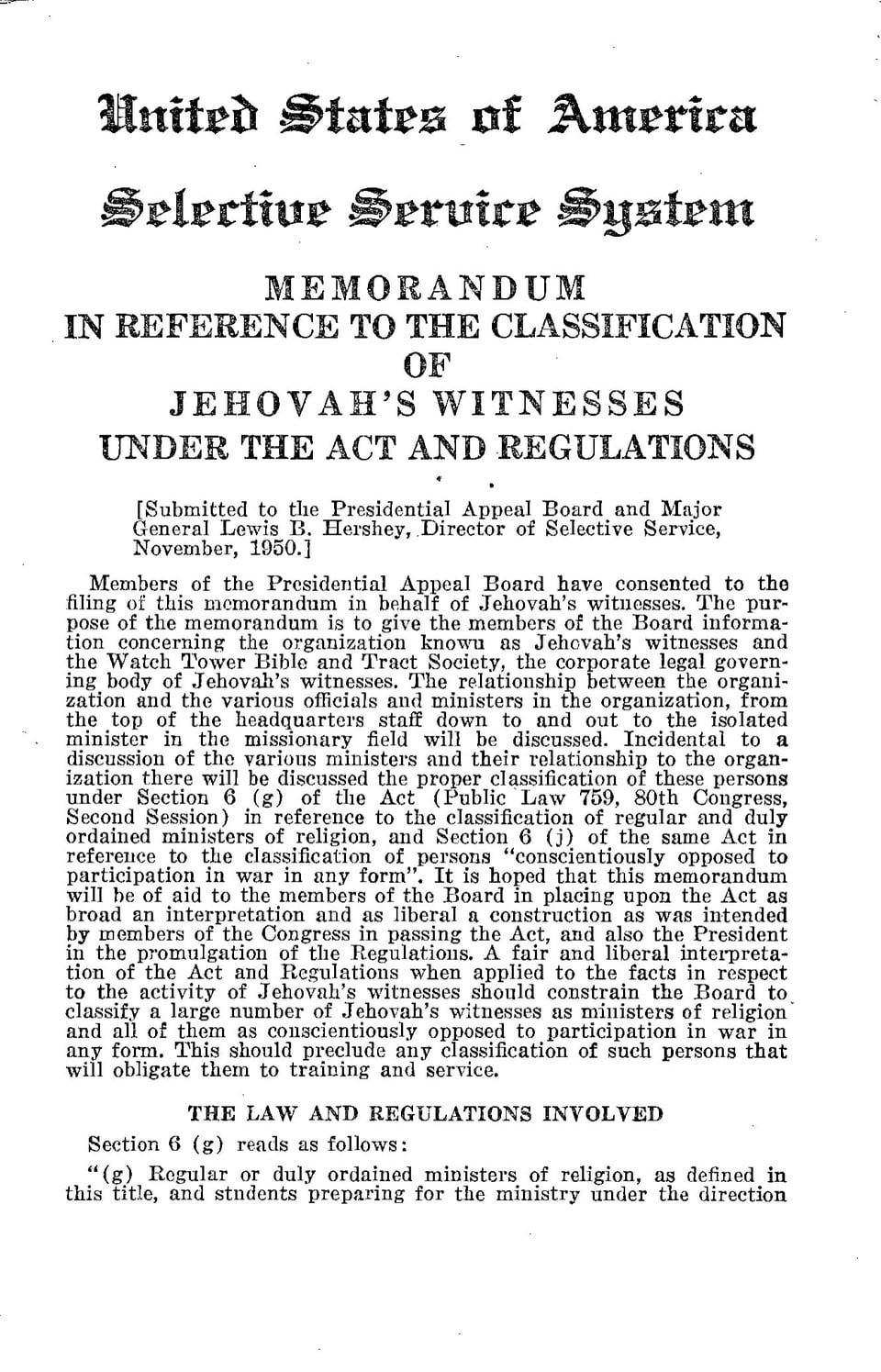
United States of America
Selective Service System
MEMORANDUM IN REFERENCE TO THE CLASSIFICATION OF
JEHOVAH'S WITNESSES UNDER THE ACT AND REGULATIONS
[Submitted to the Presidential Appeal Board and Major General Lewis B. Hershey, Director of Selective Service, November, 1950.]
Members of the Presidential Appeal Board have consented to the filing of this memorandum in behalf of Jehovah's witnesses. The purpose of the memorandum is to give the members of the Board information concerning the organization known as Jehovah's witnesses and the Watch Tower Bible and Tract Society, the corporate legal governing body of Jehovah's witnesses. The relationship between the organization and the various officials and ministers in the organization, from the top of the headquarters staff down to and out to the isolated minister in the missionary field will be discussed. Incidental to a discussion of the various ministers and their relationship to the organization there will be discussed the proper classification of these persons under Section 6 (g) of the Act (Public Law 759, 80th Congress, Second Session) in reference to the classification of regular and duly ordained ministers of religion, and Section 6 (j) of the same Act in reference to the classification of persons "conscientiously opposed to participation in war in any form". It is hoped that this memorandum will be of aid to the members of the Board in placing upon the Act as broad an interpretation and as liberal a construction as was intended by members of the Congress in passing the Act, and also the President in the promulgation of the Regulations. A fair and liberal interpretation of the Act and Regulations when applied to the facts in respect to the activity of Jehovah's witnesses should constrain the Board to classify a large number of Jehovah's witnesses as ministers of religion and all of them as conscientiously opposed to participation in war in any form. This should preclude any classification of such persons that will obligate them to training and service.
Section 6 (g) reads as follows:
"(g)Regular or duly ordained ministers of religion, as defined in this title, and students preparing for the ministry under the direction of recognized churches or religious organizations, who are satisfactorily pursuing full-time courses of instruction in recognized theological or divinity schools, or who are satisfactorily pursuing full-time courses of instruction leading to their entrance into recognized theological or divinity schools in which they have been pre-enrolled, shall be exempt from training and service (but not from registration) under this title."
Section 6 (j) of the Act, among other things, reads as follows:
"(j) Nothing contained in this title shall be construed to require any person to be subject to combatant training and service in the armed forces of the United States who, by reason of religious training and belief, is conscientiously opposed to participation in war in any form. Religious training and belief in this connection means an individual's belief in a relation to a Supreme Being involving duties superior to those arising from any human relation, but does not include essentially political, sociological, or philosophical views or a merely personal moral code. Any person claiming exemption from combatant training and service because of such conscientious objections whose claim is sustained by the local board shall, if he is inducted into the armed forces under this title, be assigned to noncombatant service as defined by the President, or shall, if he is found to be conscientiously opposed to participation in such noncombatant service, be deferred. Any person claiming exemption from combatant training and service because of such conscientious objections shall, if such claim is not sustained by the local board, be entitled to an appeal to the appropriate appeal board. Upon the filing of such appeal, the appeal board shall refer any such claim to the Department of Justice for inquiry and hearing. The Department of Justice, after appropriate inquiry, shall hold a hearing with respect to the character and good faith of the objections of the person concerned, and such person shall be notified of the time and place of such hearing. . .."
Section 16 (g) (1) (2) (3) reads as follows:
"(g)(1)The term 'duly ordained minister of religion' means a person who has been ordained, in accordance with the ceremonial, ritual, or discipline of a church, religious sect, or organization established on the basis of a community of faith and belief, doctrines and practices of a religious character, to preach and to teach the doctrines of such church, sect, or organization and to administer the rites and ceremonies thereof in public worship, and who as his regular and customary vocation preaches and teaches the principles of religion and administers the ordinances of public worship as embodied in the creed or principles of such church, sect, or organization.
"(2) The term 'regular minister of religion' means one who as his customary vocation preaches and teaches the principles of religion of a church, a religious sect, or organization of which he is a member, without having been formally ordained as a minister of religion, and who is recognized by such church, sect, or organization as a regular minister.
"(3) The term 'regular or duly ordained minister of religion' does not include a person who irregularly or incidentally preaches and teaches the principles of religion of a church, religious sect, or organization and does not include any person who may have been duly ordained a minister in accordance with the ceremonial, rite, or discipline of a church, religious sect or organization, but who does not regularly, as a vocation, teach and preach the principles of religion and administer the ordinances of public worship as embodied in the creed or principles of his church, sect, or organization."
Section 1622.19 of the Regulations reads in part as follows:
"1622.19 Class IV-D: Minister of Religion or Divinity Student. (a) In Class IV-D shall be placed any registrant:
“(1) Who is a regular minister of religion;
"(2) Who is a duly ordained minister of religion;
"(3) Who is a student preparing for the ministry under the direction of a recognized church or religious organization and who is satisfactorily pursuing a full-time course of instruction in a recognized theological or divinity school; or
"(4)Who is a student preparing for the ministry under the direction of a recognized church or religious organization and who is satisfactorily pursuing a full-time course of instruction leading to entrance into a recognized theological or divinity school in which he has been pre-enrolled."
Section 1622.20 of the Regulations reads as follows :
"1622.20 Class IV-E: Conscientious Objector Opposed to Both Combatant and Noncombatant Training and Service.—(a) In Class IV-E shall be placed any registrant who, by reason of religious training and belief, is found to be conscientiously opposed to participation in war in any form and to be conscientiously opposed to participation in both combatant and noncombatant training and service in the armed forces.
"(b)Section 6 (j) of title I of the Selective Service Act of 1948 provides in part as follows:
"Religious training and belief in this connection means an individual's belief in a relation to a Supreme Being involving duties superior to those arising from any human relation, but does not include essentially political, sociological, or philosophical views or a merely personal moral code."
JEHOVAH'S WITNESSES
Jehovah's witnesses constitute an unincorporated body or denomination of ministers consecrated to do the will of Almighty God, under the leadership of Christ Jesus. They have drawn together for the purpose of declaring that he whose name alone is Jehovah is the Universal Sovereign, and that he is the Author and Creator of earth's permanent heavenly government of righteousness for which Christ Jesus taught his disciples to pray to Almighty God. To everyone they point out the only way to that kingdom which shall permanently take the place of all earth's present governments that shall be destroyed soon in Jehovah's battle of Armageddon.
Although Jehovah God has had His witnesses on earth for about sixty centuries, only in modern times did they draw together for organized world-wide work. In 1872 in America, at Allegheny near Pittsburgh, Pennsylvania, Charles Taze Russell began a Bible class that met regularly to study the Scriptures about Jehovah's kingdom and the second coming of Christ Jesus. Within a few years thereafter similar groups of students of the Bible, having these same interests, were organized throughout the United States. In due time such Bible-study classes were established in other countries. By following the course of study outlined by the headquarters in the United States those classes were unified and the students became of one mind, throughout the world, on what Almighty God through his Word teaches.
In 1884 the legal servant body of this international association was incorporated under Pennsylvania law. That nonprofit corporation, Watch Tower Bible and Tract Society, and the governing body of Jehovah's witnesses have been inseparably associated ever since. In 1909 the corporate headquarters were transferred from Pittsburgh to New York (Brooklyn) and then an associate charitable corporation was formed and used for carrying on the world-wide publishing work of Jehovah's witnesses. It is a New York corporation now known as Watchtower Bible and Tract Society, Inc. In other lands other associate corporations are used, such as International Bible Students Association in Great Britain and Canada.
Their Name
Since the beginning of their modern-day organization Jehovah's witnesses have been called various names. Their enemies and uninformed persons have falsely called them a "sect", naming them Russellites, Millennial Dawnites, Rutherfordites, etc. Although for nearly half a century these ministers of Almighty God used no distinctive name, referring to themselves as Christians, their friends and other interested persons called them "Bible students" or "international Bible students". In 1931 their representatives from many countries, assembled in convention in America, resolved that they 'desire to be known as and called by the name which the mouth of the Lord God has named, to wit, Jehovah's witnesses': "Ye are my witnesses, saith Jehovah." (Isaiah 43:10; 44:8, AS) Thereafter all local congregations or companies of Jehovah's witnesses throughout the earth declared themselves as recognizing this God-given name. (See 1941 Yearbook of Jehovah's Witnesses, pages 30-35.) True, in recent times men such as C. T. Russell and J. F. Rutherford participated prominently in this world-wide work as Jehovah's witnesses, even as in ancient days Christ Jesus, Paul, Peter, John the Baptist, Moses, Noah, Abraham, Abel and many others participated prominently in the work as Jehovah's witnesses. Yet it is Scripturally and factually manifest that only Almighty God Jehovah himself founded and continues to found or ordain His witnesses, and in proof thereof gives them His name. Jeremiah 15:16.
Manner of Preaching
The method of teaching and preaching employed by Jehovah's witnesses is primitive. That is to say, they use the original method of preaching instituted by Jehovah's Great Witness, Christ Jesus. He and his apostles preached publicly and from house to house. (Acts 20:20) Every true Christian minister of the gospel is commanded to follow in their footsteps and must do likewise.
(1 Peter 2:21; Luke 24:48; Acts 1:8; 10:39-42) Since Jehovah's witnesses take the message to the people, their preaching is distinguishable from that of the religious clergy, who require people to come to them and sit at their feet to be preached to.
Jehovah's witnesses do not confine themselves to building church edifices where they invite people to hear them preach. Experience and statistics prove that not all people can be reached in that manner, because they will not all come to such buildings.
More than 70,000,000 people in the United States do not belong to any religious organization. Many other millions do not attend any church, although they nominally belong to one of the religious organizations. These non-churchgoers are not heathen. The preaching activity of Jehovah's witnesses reaches not only these millions of persons who depend almost entirely upon Jehovah's witnesses to bring them spiritual food. Additionally, their preaching activity from door to door reaches millions of people who belong to religious organizations but who sigh and cry because of the abominations committed therein. (Ezekiel 9:4; Isaiah 61:1-3) Jehovah's witnesses have answered the need of these people by bringing them printed sermons at their homes, which meet their convenience. It is just as important to have primitive ministers and evangelists going from door to door to maintain the morale of these millions as it is to preserve the morale of those who attend some orthodox religious organization's church services. How would these persons who do not attend any church be comforted in their sorrow and obtain spiritual sustenance unless some missionary evangelist brought it to them at their homes? Few, if any, of the orthodox religious clergy call upon the people from door to door. They have their established congregation. They expect the people to come to their church edifices to receive what instruction they have to offer. Accordingly, these millions of persons would starve for want of spiritual food were it not for Jehovah's witnesses who bring Bible instruction to them in their homes. Thus Jehovah's witnesses locate the people of good will toward Almighty God. If they desire further aid in the study of the Bible Jehovah's witnesses establish Bible studies in their homes. In this way Jehovah's witnesses educate the people in the way of life and point them to the avenue of escape from the greatest crisis yet known.
Jehovah's witnesses are an international group of missionary evangelists who get their name from Almighty God, whose name alone is Jehovah. (Psalm 83:18; Isaiah 43:10-12, AS) Their preaching duties are to call from door to door, preaching and presenting Bibles and Bible literature explaining about God's kingdom described in the Bible as the only hope of the world. The whole earth is divided into countries or branches; each branch is divided into districts; each district is divided into circuits; each circuit is divided into areas; each area is assigned to one or more missionary evangelists of Jehovah's witnesses. The ones assigned to each area have a duty to preach from door to door in that area. Persons interested are called back on, for the purpose of establishing regular home Bible studies, which are conducted for a year or more. This is done in order that all such persons may get a complete understanding of the things that the Bible clearly teaches concerning God's kingdom and their relationship to Jehovah and His kingdom by Christ Jesus.
In addition to this method of preaching Jehovah's witnesses also preach on the street corners by distributing Bible literature. They also deliver public lectures and sermons in various buildings engaged by them for that purpose. Primarily the congregations of Jehovah's witnesses are in the homes of the people. Their pulpits may well be said to be at the doorstep of the home of every person of good will throughout the nation.
It is not necessary to know theology, philosophy, art, science and ancient classic languages to preach the gospel. One is not required to wear a distinctive garb, live in a parsonage, ride in an expensive automobile, have a costly edifice in which to preach, and command a high salary, to qualify as a minister of God. Jehovah's witnesses emulate their Leader, Christ Jesus, and His apostles, rather than the ancient or modern scribes and Pharisees. Instead of a program of choir and organ music followed by a discourse on science and philosophy of men, Jehovah's witnesses devote all their time to studying and teaching the Bible and carrying God's message to the people at their homes. They are ministers in the real and true sense and serve all the people. Paul, the apostle, said that the true minister teaches publicly and from house to house. (Acts 20:20) It is written that Christ Jesus "went round about the villages, teaching" and "preaching the gospel of the kingdom". (Mark 6:6; Matthew 9:35; Luke 8:1) The apostle Peter advises each minister of Jehovah God: "For even hereunto were ye called: because Christ also suffered for us, leaving us an example, that ye should follow his steps." (1 Peter 2:21) Jesus expressly commanded His twelve ordained ministers to go from house to house: "And as ye go, preach, saying, The kingdom of heaven is at hand." (Matthew 10:7, 10-14) In the four Gospel accounts of the ministry of Jesus, the words "house" and "home" appear more than 130 times, and in the majority of those times it is in connection with the preaching activity of Jesus, the great Exemplar. His example of carrying the gospel message to the people at their homes and in the public ways was "true worship". He said: "But the hour cometh, and now is, when the true worshippers shall worship the Father in spirit and in truth: for the Father seeketh such to worship him. God is a Spirit: and they that worship him must worship him in spirit and in truth." (John 4:23, 24) His apostle James further describes such worship by ministers of Almighty God at James 1:27. "For the worship that is pure and holy before God the Father, is this: to visit the fatherless and the widows in their affliction, and that one keep himself unspotted from the world."—Syriac New Testament, Murdock's translation.
Each of Jehovah's witnesses is a minister. If he is not a preacher he is not one of Jehovah's witnesses. A person is not a minister because he claims to be such. He is one because he is in fact preaching. If a person is duly trained, prepared and ordained for the ministry, and regularly preaches, teaches, conducts Bible services and performs the duties of his organization, then he is a minister. The work done by such a minister of Jehovah's witnesses cannot be done by a lay worker. Such work requires the training, learning and skill that are given only to ministers, evangelists and missionaries who are footstep followers of Christ Jesus. Persons not ministers, except those preparing for the ministry, are not authorized to engage in such preaching activity. Accordingly, it cannot be said that the work is that of a lay church worker. It is exclusively evangelistic, missionary work that requires training of a minister. Can it be suggested that the apostles were mere lay workers because they went from house to house? May it be argued that they were not ministers of the gospel because they were footstep followers of Christ Jesus employing the primitive method of preaching?
The mere asking of the question resounds the answer. Of course it could not be argued that the apostles were not ministers. If they were ministers, by force of the same reason their modern-day counterparts, Jehovah's witnesses, must be considered as ministers.
It has been argued, because each one of Jehovah's witnesses is a minister, that such is unreasonable. The enemies of Jehovah's witnesses and others have indulged in this argument without making a valid parallel in comparing the making of such a claim by the orthodox churches where there are clergy and laity. Of course, for such orthodox religious organizations it would be unreasonable to say that the laity who do not preach are ministers, the same as the priest or preacher who is the shepherd of the congregation. Such form of activity and religious worship is not that of Jehovah's witnesses. The Board should not apply the orthodox yardstick to Jehovah's witnesses. They cannot be measured by it. There is no comparison between the method employed by Jehovah's witnesses and the methods practiced by the clergy of the orthodox religious denominations. Practices of the orthodox religious groups that are in the majority cannot be used as a gauge for considering a dissentient or altogether differently constructed organization such as Jehovah's witnesses. To use such comparison is discriminatory. It deprives Jehovah's witnesses of their right to be considered according to the peculiar circumstances relating to their organization, which is entirely different from all others.
The clergy of the orthodox religions have their church buildings and edifices. Members of their congregations come there to hear them preach. Members of the congregation are not authorized or ordained to preach. They are the flock.
Jehovah's witnesses gather at their meeting places as a conference of missionary evangelists. Each one assembled is a consecrated evangelist and missionary. All discuss in conference, at such meetings for worship, ways and means of bettering their preaching as missionaries from door to door. Their "flock" and the members of their congregation do not all necessarily or ordinarily attend their meeting places. Such missionary evangelists go forth as did Christ Jesus and His apostles, from house to house and upon highways and byways and there deliver their message to the people. At such places thousands of persons receive spiritual instruction from those ministers as a result of the missionary evangelistic activity of Jehovah's witnesses.
Jehovah's witnesses are a society of missionary evangelists, ministers of religion, all of whom discharge their responsibility by preaching the gospel of God's kingdom as did Christ Jesus and the apostles. It is not unusual to hear of a society of ministers. Indeed there are such among some of the orthodox religious denominations. The Society of Jesus (Jesuits) is an illustration of a society of ministers. Each member is an ordained priest. No person can become a member of that organization without having first become a Roman Catholic priest. According to the comparison and analogy of some that have considered the question, the Jesuits could not be classified as ministers, because they belong to a society or organization where all the members are ministers.
In various Catholic missionary societies, the Baptist Home Missionary Society, and other missionary societies of the orthodox religious denominations, each missionary and evangelist is a minister. No one can be a member of such missionary society unless he is a missionary evangelist.
Each must be a minister. In such organizations they do not have the clergy-and-laity class distinction. Indeed, such missionary societies operate on the same principle as do Jehovah's witnesses. Each of such missionary evangelists goes from place to place, from house to house, in missionary fields of foreign countries, and preaches the tenets, traditions and precepts of his particular religion. Jehovah's witnesses engaged in the same sort of activity function in the same sort of way not only in foreign fields but also on the home front. Such missionary societies depend for their support and sustenance upon the people whom they serve in the homes. Their congregations are located in the homes of the people. So also are the congregations of Jehovah's witnesses located in the house or homes of the people.
Indeed, before modern days Christian congregations were composed entirely of ministers. The first Christian church, located at Jerusalem, was composed exclusively of the apostles and disciples. They studied under Jesus. They followed in his footsteps by preaching publicly and from house to house. Later others studied under the apostles of Jesus. At one time in Jerusalem there were five hundred Christian missionary evangelists, otherwise known as apostles and disciples. There is no record that any clergy-and-laity class distinctions were made in that congregation. Rather, each member of that group was required to participate in the missionary work by evangelizing the people from house to house, as commanded by Christ Jesus. When such early church at Jerusalem met it was as a conference of ministers to discuss ways and means of preaching. Their gatherings, like those held today by Jehovah's witnesses, were those of a congress or congregation of ministers to consider organization instructions and to dispose of interests common to all. They did not gather as a number of laymen gather in a church edifice to listen to sermons by a minister.
It is conceded that Jehovah's witnesses are a religious organization within the meaning of the Act. The Selective Service System has so found. That cannot be denied. Since Jehovah's witnesses are a recognized religious denomination, it must be admitted that they are entitled to have some ministers. It is for Jehovah's witnesses to decide who their ministers are. As long as such ministers are actually teaching and preaching according to the legal governing body of Jehovah's witnesses, it is not for the Board to say that such is an improper method of preaching. Moreover, the Board cannot say that a minister, duly recognized by his organization, is not a minister because he does not preach in the same way that the preacher serving the members of the Board preaches. It has been seen that Jehovah's witnesses preach in the same way that the orthodox clergy preach. That is, they preach from pulpits and from platforms regularly. However, they do more than what the orthodox clergy do. In addition to pulpit preaching they engage in evangelistic work of calling from house to house. Also, they serve the people in their homes by conducting missionary home Bible studies. They perform other functions in discharge of their duties, such as conducting Memorial services, performing baptismal ceremonies, and burying the dead. In the performance of all these duties Jehovah's witnesses act as ministers. They do not work as lay workers. There is no laity among Jehovah's witnesses. The "laity", insofar as Jehovah's witnesses are concerned, are the people of good will who are to be found in the homes.
The fact that Jehovah's witnesses come from all strata of humanity is immaterial. The secular background of a minister of Jehovah's witnesses has nothing whatever to do with whether or not he is actually teaching and preaching as a minister of the gospel.
Whether a man has previously been a carpenter or a fisherman matters not. If he has satisfactorily completed a course of study in the Bible and Bible helps prescribed by the governing body of Jehovah's witnesses and has established his qualifications, that should be sufficient and conclusive upon the executive branch and judicial branch of the Government. The only relevancy that a man's background may have to his qualifications to act as a minister is upon the issue of whether he is fictitiously claiming to be a minister and falsely pretending to possess the necessary qualifications.
Distribution of Literature Preaching
Books and booklets are used by Jehovah's witnesses in their preaching work for the convenience of the people. Such publications contain the truths of the Bible in a permanent form for study by the interested person at his convenience. Today such persons cannot afford to have the minister stay with them hours or days at a time, as was customary centuries ago or in less recent years. Literature used by Jehovah's witnesses is a substitute for the oral sermon or Bible discourse that is available to only the few. The literature is not printed and distributed selfishly for commercial gain or to achieve a large volume of profits. Indeed the literature is offered on a contribution basis. Persons unable to donate toward the work but who are interested may have the literature free or upon such terms as they desire to receive it. (1 Corinthians 9:11-14) Contributions received when the literature is distributed are used to help defray cost of publishing and distributing more like literature. Any deficit is taken care of by Jehovah's witnesses.
The method of preaching employed by Jehovah's witnesses is by making house-to-house calls, and regularly delivering public sermons, preaching in the schools and congregations of Jehovah's witnesses, conducting home Bible studies, preaching on the streets and distributing literature containing explanation of Bible prophecies. It has been argued that Jehovah's witnesses are mere distributors of books. It is asserted that they are colporteurs and no more. It is said then that by reason of this status they are not entitled to claim the benefit of the exemption contained in the Act. It boils down to the argument that Jehovah's witnesses, although a religious organization, are not entitled to have ministers protected by law, even though the protection is extended to the ministers of all other denominations. This is grossly inconsistent with the former Selective Service policy with reference to other religious organizations which are engaged solely in the business of distributing books. For instance, the colporteurs of the Seventh-Day Adventist organization are not ministers in the sacerdotal sense.
Seventh-Day Adventist colporteurs are mere "Gospel workers" whose qualifications are claimed to be equal in standing with those who preach the gospel. (White, The Colporteur Evangelist, Mountain View, Calif., 1930) They are not ordained as are Jehovah's witnesses. They merely sell books. They do not conduct home Bible studies. They do not make revisits; they do not preach before congregations; they do not conduct baptismal ceremonies; they do not participate in the bnrial of the dead; they do not perform other ceremonies, all of which are performed by Jehovah's witnesses, as will be hereinafter shown. Nevertheless the liberal policy of the Government was extended so as to permit these colporteurs of the Seventh-Day Adventist organization to be classified as ministers of religion exempt from all training and service.
In allowing the colporteurs to be classified as ministers no stringent requirement was invoked for the consideration of their classification as is invoked in the consideration of the claim for exemption by Jehovah's witnesses. Compare the requirements: State Director Advice 213-B issued by General Hershey, in determining the ministerial status of these Seventh-Day Adventist colporteurs, among other things, says that "even though they are not ordained" they are entitled to be classified as ministers of religion when any such colporteur is "found to be actually engaged in a bona fide manner in full-time work of this nature and files evidence of possession of a colporteur's license or a colporteur's credentials."
Jehovah's witnesses are more than colporteurs. They preach and teach, in addition to merely distributing literature.
The term "regular minister of religion" as used in the Selective Training and Service Act of 1940 was given a very broad definition by the National Director of the Selective Service System insofar as it applied to most religious organizations and their ministers. "The principle was extended to persons who were not, in any strict sense, ministers or priests in any sacerdotal sense. It included Christian Brothers, who are religious, who live in communities apart from the world and devote themselves exclusively to religious teaching; Lutheran lay teachers who also dedicate themselves to teaching, including religion; to the Jehovah's Witnesses, who sell their religious books, and thus extend the Word. It includes lay brothers in Catholic religious orders, and many other groups who dedicate their lives to the spread of their religion." Selective Service in Wartime, Second Report of the Director of Selective Service 1941-42, Government Printing Office, 1943, p. 241.
The Director of Selective Service did not confine the preaching and teaching to oral sermons from the pulpit or platform. He said that such is not the test. "Preaching and teaching have neither locational nor vocal limitations. The method of transmission of knowledge does not determine its value or affect its purpose or goal. One may preach or teach from the pulpit, from the curbstone, in the fields, or at the residential fronts. He may shout his message 'from housetops' or write it 'upon tablets of stone.' He may give his 'sermon on the mount,' heal the eyes of the blind, write upon the sands while a Magdalene kneels, wash disciples' feet or die upon the Cross. He may carry his message with the gentleness of a Father Damien to the bedside of a leper, or hurl inkwells at the devil with all the crusading vigor of a Luther. But if in saying the word or doing the thing which gives expression to the principles of religion, he conveys to those who 'have ears to hear' and 'eyes to see', the concept of those principles, he both preaches and teaches. He may walk the streets in daily converse with those about him telling them of those ideals that are the foundation of his religious conviction, or he may transmit his message on the written or printed page, but he is none the less the minister of religion if such method has been adopted by him as the effective means of inculcating in the minds and hearts of men the principles of religion.
"But to be a 'regular minister' of religion he must have dedicated himself to his task to the extent that his time and energies are devoted to it to the substantial exclusion of other activities and interests." Selective Service in Wartime, pp. 240-241.
Training and Ordination
One does not become a minister of Jehovah's witnesses upon suddenly declaring his intention to preach the gospel. He cannot abandon secular work and take up preaching as one of Jehovah's witnesses without first having received instruction and training for the ministry. He must first be a student preparing himself for the ministry before he undertakes to act as an ordained minister of Jehovah's witnesses. His period of preparation may vary, depending upon his diligence, aptitude, concentration and previous education. Ordinarily he must attend the study classes in one of the congregational schools established and operated by Jehovah's witnesses to prepare others for the ministry. The schools operated for the purpose of preparing Jehovah's witnesses for the ministry are continuous.
While Jehovah's witnesses of today do not attend any theological seminary or religious university in preparing for their ministry, neither did Christ Jesus nor his apostles nor any others of Jehovah's witnesses who performed their God-given ministry even in the many centuries before Christ Jesus' days on earth. Today, however, they do receive an adequate and regular course of instruction and training before their ordination as ministers of Jehovah God and Christ Jesus. Each congregation or company of Jehovah's witnesses maintains regular classes for instruction of ministers and for students preparing for the ministry. The main textbook is the Bible. Other books and courses of instruction, free of all erroneous traditions and false dogmas, are provided to thoroughly equip the student for the good works of the ministry he expects to enter. Moreover, actual practice in the ministry is provided the student under the direction of a mature miuister in order that the training provided will be complete.
Although school classes for ministers and students preparing for the ministry are continuous, considerable time must be spent by the student preparing for the ministry before he becomes equipped to enter the ministry. Some establish their qualifications quicker than others. To acquire the needed knowledge might take many months, or even years, for some; while others may become informed adequately in a few months. The time required depends entirely upon the diligence and ability of the student. In every case the student must show that he has consecrated himself to Jehovah to do His will under leadership of Christ Jesus, primarily, and that he is apt to teach and preach. Such prime requirement is essential before the student is recognized and sent forth as a regularly ordained minister of Jehovah's witnesses. 2 Timothy 2:24, 25.
Each one of Jehovah's witnesses is usually ordained. If he has not been ordained it is due to the fact that he is engaged in studying in preparation for the ministry or may enter into activity as a regular minister who has not undergone the regular ordination ceremony. The ordination is in accordance with the regulations of the legal governing body of Jehovah's witnesses. They are therefore ordained ministers of religion within the meaning of the Act and Regulations. The Director of Selective Service declared that while ordination in many of the large orthodox denominations is accompanied by elaborate ceremonies, in many other organizations, including the dissentients and unorthodox groups, "it is the simplest of ceremonies or acts without any preliminary serious or prolonged theological training. The determinations of this status by the Selective Service System have been generous in the extreme." Selective Service in Wartime, Second Report of the Director of Selective Service 1941-42, p. 240.
It has been held that the term "ordained minister", as used in the statute licensing ministers to solemnize marriage ceremonies, "has no regard to any particular form of administering the rite or any special form of ceremony. . . It has been the practice of this court, therefore to grant the license to authorize the solemnization of marriages to duly commissioned officers in the Salvation Army who are engaged under such authority in ministering in religious affairs; to all Protestant ministers, Catholic priests, Jewish rabbis, teachers and ministers of spiritualistic philosophy, and in fact all persons who can prove to the satisfaction of the court that they have been duly appointed or recognized in the manner required by the regulations of their respective denominations, and are devoting themselves generally to the work of officiating and ministering in the religious interest and affairs of such societies or bodies." In re Reinhart, 9 Ohio Dec. 441, 445.
The word "ordain" (ordained) means "to establish by appointment", "to appoint or establish." Webster's New International Dictionary; Funk & Wagnalls' Practical Standard Dictionary.
The Encyclopedia Americana (1942 Ed., vol. 20, p. 770) defines ordination as "The ceremony by which priests, deacons, subdeacons, candidates for the minor orders and ministers of any denomination are admitted to their specific office in the church." See also The Encyclopaedia Britannica (11th Ed., vol. 28, p. 527 et seq.).
The Cyclopedia of Biblical, Theological and Ecclesiastical Literature defines ordination as "the ceremony by which an individual is set apart to an order or office of the Christian ministry. . . In a broader, and in fact its only important sense, . . . the appointment or designation of a person to a ministerial office, whether with or without attendant ceremonies. The term ordination is derived directly from the Latin ordinatio, signifying, with reference to things or affairs, a setting in order, an establishment, an edict, and with reference to men, an appointment to office. . . A scriptural investigation of this subject can hardly fail to impress any ingenuous mind with the great significance of the fact that neither the Lord Jesus Christ nor any of his disciples gave specific commands or declaration in reference to ordination." (Vol. VII, p. 411, McClintock and Strong, 1877, Harper & Brothers, New York)
The system of ordination according to the doctrine of apostolic succession was practiced by the Roman Catholic Hierarchy from about the tenth century. It was fully restated by the Council of Trent as well as in the formularies of the Roman pontifical, the characteristics of which are: (1) that clerical orders constitute a sacrament; (2) that seven clerical orders (exclusive of seven grades of bishops, of which the pope is supreme) are those of priest, deacon, subdeacon, acolyte, exorcist, reader and porter; (3) that bishops only are competent to confer ordination; (4) that the effect of ordination is to impress on the recipient an indelible mark; (5) that the priest has authority to offer sacrifice for living and dead. In passing, it must be noticed that the Roman Catholic Hierarchy ordains its ministers several times. An individual is ordained when he becomes a priest and each time he is elevated to a higher office, such as bishop, archbishop and cardinal. Op. cit.; see Encyclopedia Americana, 1942 Ed., vol. 2, p. 70; The Catholic Encyclopedia (1911, Robert Appleton Company, New York), Vol. 11, p. 279 et seq.
The above-stated theory of ordination had universal prevalence throughout Christendom from the sixth to the sixteenth century. A prominent factor of the Reformation was a violent reaction against the dogmas and abuses of the Roman Catholic system of ordination.
Without exception Protestants rejected the "five sacraments" of the Roman Catholic Church as fictitious. Almost all such churches forsook those ordination ceremonies during the Reformation and fell back on the Scriptural precedent as their sole guide for modes of appointing and ordaining ministers.
Among the independents and Baptists the power of ordination is considered to adhere to any given congregation of believers. The qualifications of a candidate are first ascertained and he is approved by a church, called and accepted. The congregation proceeds to confer ordination upon him by prayer. Op.Cit., p. 417.
This same broad and liberal interpretation of the term "ordained minister" as it relates to exemption of a minister of a religious denomination under the National Selective Service Mobilization Regulations of Canada has been considered by Mr. Justice McLean of the Supreme Court of Saskatchewan in the case of Bien v. Cooke (1944), 1 W. W. R. 237. In that case he said: "Although the whole congregation is very indefinite considered from a secular point of view and they appear to be without any prescribed procedure in the matter of ordaining the minister, yet various denominations use various forms of ordination and if the procedure is satisfactory to the congregation, as appears to be in this instance, that should be considered sufficient form of ordination."
With the exception of the Roman Catholic Church and the Church of England, the term "ordained minister" means an appointed minister and is not confined to any particular kind of ceremony or formalism. Many groups, such as the Society of Friends, Disciples of Christ, Plymouth Brethren and Jehovah's witnesses do not recognize any human right of ordination. They recognize the ordination as coming only from Almighty God Jehovah. This may be recognized and certified by men. Man-made institutions and legal corporations that act as governing bodies of such may declare one to be duly ordained, and issue credentials of authority or ordination. The ordination proceeds only from Jehovah God and His Son, Christ Jesus.
Compare the history of the method of ordination in the following churches: Baptist, Congregationalist, Methodist. Disciples of Christ, Society of Friends (Quakers), Lutheran, Presbyterian.
The ordination of Jehovah's witnesses emanates from the Most High God "whose name alone is JEHOVAH". (Psalm 83:18; Isaiah 61:1-3) He is the Source of all power and authority and the One who authorizes ordination of His ministers. The ceremony used by Jehovah's witnesses to establish by public witness the ordination of a minister is identical with the ceremony that Christ Jesus underwent after He was ordained. A very simple ceremony marked the beginning of His ministry. He symbolized His consecration by undergoing the ceremony of water baptism in the River Jordan. (Matthew 3:13-17) It is this same simple ceremony that every one of Jehovah's witnesses goes through as a public symbolizing of his consecration to preach and of his ordination. No other ceremony is prescribed. After His ordination ceremony by baptism in the River Jordan, Christ Jesus publicly stated the Source of His ordination by quoting from Isaiah 61:1,2. He said: "The spirit of the Lord is upon me, because he hath anointed me to preach the gospel to the poor; he hath sent me to heal the broken-hearted, to preach deliverance to the captives, and recovering of sight to the blind, to set at liberty them that are bruised, to preach the acceptable year of the Lord.
. . This day is this scripture fulfilled in your ears."—Luke 4:18-21.
The submission to the ordination ceremony of public immersion in water brands the minister of Jehovah's witnesses. It marks him as a person who has dedicated his entire life to the service of Jehovah God as a minister, bound to preach the gospel of God's kingdom as long as he lives prior to Armageddon. His ordination implies the acceptance of the obligations which it imposes. A complete, unbreakable agreement on the part of the minister thus ordained, to follow in the footsteps of Christ Jesus, is entered into. The one ordained cannot turn aside from his covenant to preach, for any reason. The covenant requires faithful preaching, even to the point of death. An ordained minister of Jehovah God cannot turn back without violating his covenant. The turning back from preaching will result in his everlasting death, because God declares that covenant-breakers are worthy of death. Acts 3:23; Romans 1:31, 32.
While no particular worldly education or a degree from a theological school is required as a condition precedent to the enrollment of a minister in the full-time pioneer missionary evangelistic work, there are certain requirements that must be complied with. The minister desiring to enter the full-time missionary work as a pioneer must satisfactorily establish that he possesses the necessary qualifications. He must show that he has a thorough knowledge of the Bible and is apt to teach and preach. He must have studied thoroughly the publications of the Watch Tower Bible and Tract Society explaining the doctrines and teachings of the Bible as viewed by Jehovah's witnesses. Ordinarily it will be found that a pioneer has regularly attended, for a satisfactory period of time, one of the ministry schools conducted by Jehovah's witnesses.
Youthfulness of Jehovah's Witnesses No Disqualification
The ministry is not confined to adult persons or to the aged. Youths not only are permitted to preach, but are invited to do so. (Joel 2:28, 29; Psalm 148:12,13) All children of Jehovah's witnesses should be brought up in the nurture and admonition of the Lord, being trained for the ministry at a very early age. After being thoroughly schooled, they may enter the ministry, if they so desire, although yet children or youths. Ancient outstanding examples are Samuel, Jeremiah and Timothy, whose faithfulness as Jehovah's witnesses in very early youth is proof of the propriety of children's acting as ministers. (1 Samuel 1:24; 2:11; 3:1; Jeremiah 1:4-7) Paul the apostle declares that he sent Timothy forth as a minister. (1 Corinthians 4:17) Timothy was instructed by Paul to let none despise his youthfulness.—1 Timothy 4:12.
The youthfulness of any of Jehovah's witnesses does not affect his qualifications for the ministry. If he is old enough to be taken into the armed forces and assume such responsibilities he is old enough to be a minister. Preaching at an early age is not unusual to followers of Christ. Jesus' parents reared him "in the nurture and admonition of the Lord" as required by Jehovah and as commanded in His statutes recorded at Deuteronomy 6:4-7. They found him teaching in the temple at an early age. See Ephesians 6:1-4:"Children, obey your parents in the Lord: for this is right. Honour thy father and mother; which is the first commandment with promise; that it may be well with thee, and thou mayest live long on the earth.
And, ye fathers, provoke not your children to wrath: but bring them up in the nurture and admonition of the Lord." See also Ecclesiastes 12:1; Psalm 71:17; Genesis 18:19.
Christ Jesus, when but twelve years of age, was already about his "Father's business", discussing the Scriptures. (Luke 2:46-49) When preaching the gospel later on, He said: "Suffer little children to come unto me, and forbid them not: for of such is the kingdom of God." (Luke 18:16; see also Matthew 18:1-6.) Psalm 8:2: "Out of the mouth of babes and sucklings hast thou ordaiued strength"; Psalm 148:12,13: "Both young men, and maidens; old men, and children: let them praise the name of the Lord: for his name alone is excellent; his glory is above the earth and heaven." See also Proverbs 8:32.
Regardless of the age at which the person began his ministry, there is nothing to show that he was disqualified to act as a minister of Almighty God at the time of his classification, and, as a minister, he is entitled to complete exemption.
Moreover, the fact that one may be of military age and in good health has nothing to do with his liability for training and service if the evidence shows that he is engaged in the performance of his duties as a minister of religion. Every person knows that even a man with a leg amputated can be a duly qualified and acting minister of religion. Therefore the physical condition of the registrant is entirely irrelevant and immaterial to the issues.
STRUCTURE OF ORGANIZATION
Jehovah's witnesses constitute the visible part of the theocratic organization of Almighty God. The invisible part of the organization is composed of Jehovah God, His Son, Christ Jesus, and the multitudes of angels and other spirit creatures invisible to human eyes. The organization is ruled by Jehovah God from the top down. Jehovah's witnesses believe that Almighty God directs, through his Son, Christ Jesus, the preaching activity they do world-wide.
Headquarters Staff
Jehovah's witnesses believe that the "higher powers" are Jehovah God and Christ Jesus and that they direct their preaching work, using as the earthly instrument therefor the international headquarters of Jehovah's witnesses. The visible organization is directed by the headquarters staff, known as the Bethel Family. The Bethel Family is comprised of persons living and working at the institutions maintained by the Watchtower Bible and Tract Society, Inc., located at 124 Columbia Heights, Brooklyn, New York (known as the Bethel Home), 117 Adams Street, Brooklyn (the publishing plant), 1111 Woodrow Road, Staten Island. New York (the radio transmitter location and the gardens providing food for the Bethel Family), Kingdom Farm, South Lansing, New York, where there is operated the Watchtower Bible School of Gilead (a foreign missionary training school) and the farms used to produce food for the sustenance of the Bethel Family, and Mountain Farm in New Jersey (a truck and dairy farm).
All persons residing at any and all of the above-named institutions are ordained ministers. They carry out their ordination by full-time service in various capacities at the Society's institutions.
At the Bethel Home (124 Columbia Heights, Brooklyn, New York) are located the executive offices, including the office of the president, the office of the secretary-treasurer and the office of the general counsel for Watch Tower Bible and Tract Society and Jehovah's witnesses. Also located at the Bethel Home are living quarters, kitchen, dining room, laundry, tailor shop, shoe shop, hospital and other service facilities and the office of the Bethel servant who supervises the operation of the institution. The living quarters house the members of the Bethel Family working either at 124 Columbia Heights or at 117 Adams Street. These living rooms are maintained by consecrated women who are also missionaries and ministers. Also located at the Bethel Home are the office and broadcasting studios of Radio Station WBBR, which is devoted exclusively to religious and charitable broadcasting, and its programs and broadcasting are confined to carrying out the chartered purposes of the Watchtower Bible and Tract Society, Inc., and to further generally the preaching work of Jehovah's witnesses.
The general offices of the Society and the main printing plant of Jehovah's witnesses are located at 117 Adams Street, Brooklyn, New York. From this building are carried on the general correspondence work and the general supervision of the preaching activity by Jehovah's witnesses throughout the United States. Persons are here engaged in this supervisory work in various capacities. Also from this general office the Society sends out throughout the United States traveling ministers who visit congregations and assemblies and who supervise directly the preaching activity carried on by Jehovah's witnesses in this country.
In addition to the general offices there is also located a large printing plant in this building. The printing plant is equipped with its own power plant and presses, machinery and other instruments to print and publish Bibles, the Watchtower magazine, Awake! magazine (official journals of Jehovah's witnesses), books, booklets and leaflets. All contain printed sermons used by Jehovah's witnesses in the field for preaching.
At 1111 Woodrow Road, Staten Island, New York, is located another branch of the Bethel Family. Here there is situated a small "Bethel Home" where provision is made for the housing and feeding of ministers assigned to carry out the chartered purposes of the Society on such property. Some of such persons are engaged in raising truck garden produce, fruit and other food needed to feed them as well as members of the Bethel Family at the Bethel Home in Brooklyn. Other persons located at such institution are engaged in the operation and maintenance of the radio broadcasting transmitter for the broadcasting of the religious and educational programs which emanate from the studios at the Bethel Home in Brooklyn.
At South Lansing, New York, the Society maintains and operates a large farm of more than one thousand acres. Located on this farm are several buildings housing the living quarters and classrooms of the Watchtower Bible School of Gilead, where one hundred students in each class attend the foreign missionary training school conducted by instructors who are ministers. The buildings also house the offices of the school and the office of the Farm servant who has the general supervision of the farm. Also in these buildings are sleeping rooms for the housing of members of the Bethel Family assigned to do work at the farm. Here also the members of the Bethel Family, the students and the faculty are provided meals. Barns and other farm buildings are located on the farm for the housing of equipment and animals.
The persons residing on this farm who do not attend the missionary school or teach in it are engaged in raising large amounts of food for the feeding of the one hundred and fifty persons located at the farm, the thirty persons located at Staten Island and the three hundred and fifty persons located at 124 Columbia Heights, Brooklyn, all of whom comprise the Bethel Family.
At the small truck garden and dairy farm located near Hackettstown, New Jersey (known as Mountain Farm), four or five persons reside whose duties are raising vegetables and operating the dairy maintained on the property. The milk is used for the feeding of members of the Bethel Family at Brooklyn and Staten Island.
All persons who are members of the Bethel Family residing at any of the above institutions are duly ordained ministers. No person who is not a duly ordained minister is called to perform work at the headquarters or to become a member of the Bethel Family. All persons who are members of the Bethel Family devote eight and three-quarters hours daily to the performance of the various assigned duties at one of the Society's institutions. At nighttime following the performance of his assigned task at the institution, on Sundays, and on holidays each member of the Bethel Family engages regularly and customarily in preaching and teaching the doctrines and principles of Jehovah's witnesses as a missionary evangelist from door to door and on the streets.
Some of the men who are members of the Bethel Family are assigned to serve assemblies and congregations for preaching from the pulpit and delivery of public talks before the congregations in various parts of the eastern part of the United States. Such persons are sent out on week-end assignments to serve Jehovah's witnesses as speakers. Also some of such persons are sent out to supervise and visit the congregations as described above. No person who is not an ordained minister of Jehovah's witnesses is permitted to reside upon the premises or perform work at the headquarters of the Society or become a member of the Bethel Family.
The position of the headquarters staff (Bethel Family) and the work of the various individuals constituting the Bethel Family at the various institutions above described are fully explained in the official publication of Jehovah's witnesses known as the Yearbook of Jehovah's Witnesses. See 1944 Yearbook of Jehovah's Witnesses, pages 23-48, 1945 Yearbook of Jehovah's Witnesses, pages 31-42, 1946 Yearbook of Jehovah's Witnesses, pages 22-32, 1947 Yearbook of Jehovah's Witnesses, pages 19-30.
The Bethel Family has been described by General Lewis B. Hershey, National Director of the Selective Service System, in his State Director's Advice 213-B, as follows:
"Members of the Bethel Family are those members of Jehovah's Witnesses who devote their full time and effort to the manufacture and production of books, pamphlets, and supplies for the religious benefit of Jehovah's Witnesses, the purpose of which is to present the beliefs of Jehovah's Witnesses and to convert others. For their religious services, the members of this group are said to receive their subsistence and lodging and in addition a very modest monthly allowance. This group of individuals consists of the office and factory workers at 117 Adams Street, Brooklyn, New York, and workers in the executive offices at 124 Columbia Heights, Brooklyn, New York, and at the Farms."
There is nothing whatever to indicate a narrow interpretation of the term "minister of religion" so as to exclude ministers like the members of the Bethel Family whose lives are devoted to the furtherance of the chartered purposes of the religious organization. Ministers could not be recognized without having a religious denomination. A religious denomination cannot operate without a head. A head need not be confined to one person. Facts and history show that every recognized religious denomination has hundreds and sometimes thousands of persons associated with the head of the body to direct the preaching activity of the ministers in the field. The Roman Catholic Hierarchy has the cardinals and priests at Vatican City. It has its archbishops, bishops and priests ruling down the ladder of the Hierarchy above the priests who preach from the pulpit. A religious organization cannot operate without a headquarters staff. To function the headquarters staff may properly be filled from among the ordained ministers in the field. The ordained ministers performing the various functions at the headquarters of a religious organization are usually recognized by the members of the denomination in the field to be of a higher order even than the preacher in the local congregation. The law should maintain the same recognition as is maintained by the religious organization within itself.
An organization operated on a theocratic basis like Jehovah's witnesses or on a hierarchial basis like the Roman Catholic Church must have the privilege of assigning its ministers who are members of the headquarters staff to do ministerial work in the execution of the chartered purposes of the organization different from and instead of preaching in the pulpit. Without the performance of such services by ministers exempt from training and service the headquarters of a religious organization could not be maintained.
…