Morton Edgar and Charles Taze Russell at the Great Pyramid (1912)
Download: PDF — Morton Edgar and Charles Taze Russell at the Great Pyramid (1912)
LETTER NO.7.
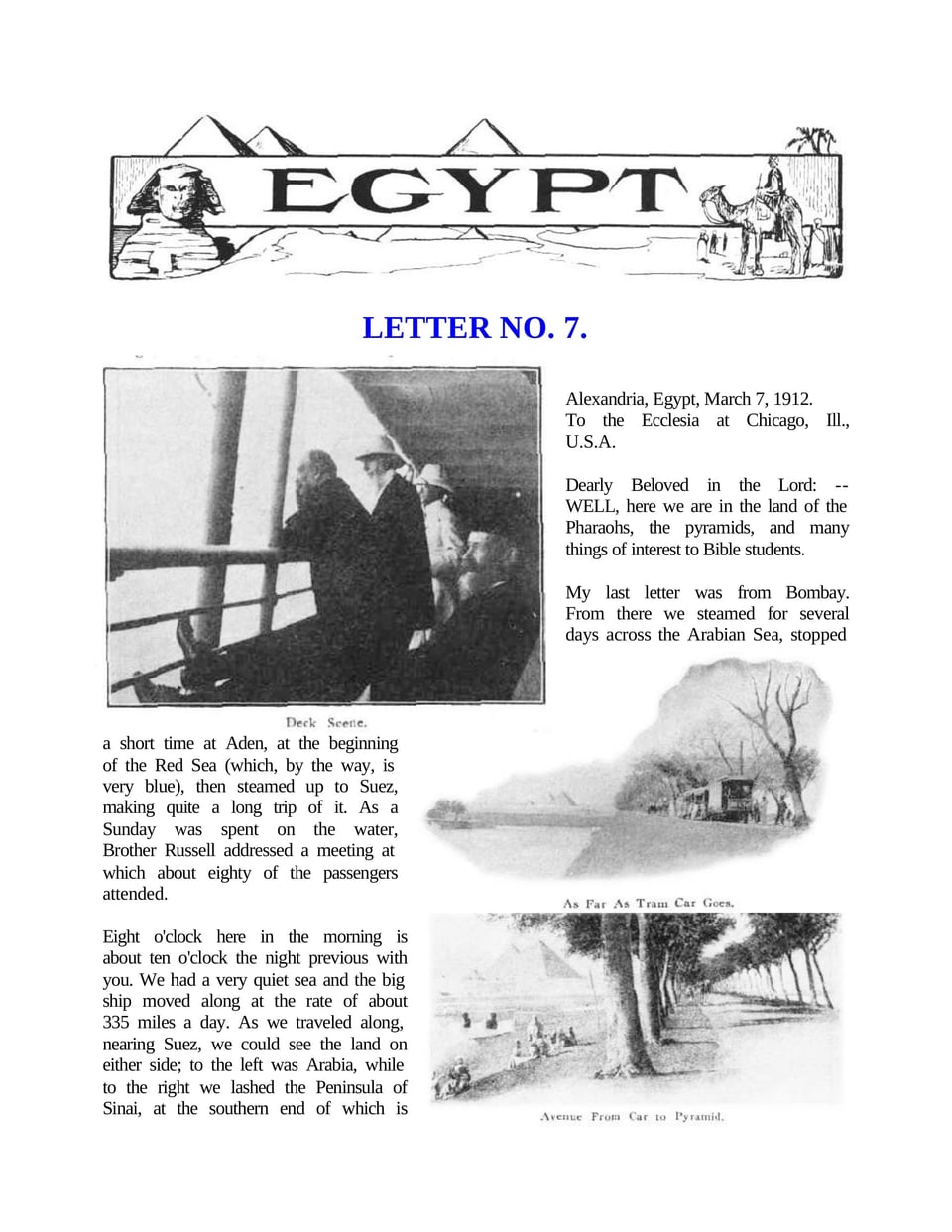
Deck Scene.
a short time at Aden, at the beginning of the Red Sea (which, by the way, is very blue), then steamed up to Suez making quite a long trip of it. As a Sunday was spent on the water Brother Russell addressed a meeting at which about eighty of the passengers attended.
Eight o'clock here in the morning is about ten o'clock the night previous with you. We had a very quiet sea and the big ship moved along at the rate of about 335 miles a day. As we traveled along, nearing Suez, we could see the land on either side; to the left was Arabia, while to the right we lashed the Peninsula of Sinai, at the southern end of which is
Alexandria, Egypt, March 7, 1912. To the Ecclesia at Chicago, Ill., U.S.A.
Dearly Beloved in the Lord: -- WELL, here we are in the land of the Pharaohs, the pyramids, and many things of interest to Bible students.
My last letter was from Bombay. From there we steamed for several days across the Arabian Sea, stopped
As Far As Tram Car Goes.
Avenue From Car to Pyramid.
Mt. Sinai, where the Law Covenant was entered into, etc. A little farther on we passed near the place where the Seventy Palm Trees were, under which the Israelites rested, after crossing the Red Sea. Then farther on were the Twelve Wells of Moses, still known as such.
Upon leaving the ship and passing through the various experiences with custom officials and health officers, we took train up to Ishmalia, this journey being along the Suez Canal. Ishmalia is quite close to the place where the children of Israel must have crossed. From here we went direct to Cairo, reaching there about midnight.
THE GREAT PYRAMID.
Judah.
THE next day matters of business occupied the attention of all until after lunch, then we boarded the trolley car for a trip to the pyramids. As we reached the outskirts of the city we could see the three pyramids in the distance, becoming more and more visible as we neared them. It caused a strange feeling to come over us as we realized that now we were actually seeing and would soon more closely examine that great Witness which has stood there so proudly these many centuries. From the end of the car line it is about half a mile to the pyramid; we walked it, but many of the travelers prefer to ride on a little donkey or on camels.
To our great pleasure we found Brother Morton Edgar there at the pyramid, he having come from Scotland a short time before to make further excavations, measurements, etc., preparatory to issuing the
Bro. Morton Edgar Pointing Out Interesting Features.
second volume of his work on the pyramid. We were very glad indeed to have him there, for we knew that he could tell us more about that Witness than any one living. The Arab guides know absolutely nothing of the teachings of the pyramid, and as Brother Edgar knows every foot of the inside and also had with him his chief helper, Judah, w e did not require the services of any of the guides. This was quite a surprise to these Arabs, however, and they thought it very strange that we would go inside without them.
Rro. Pyle: "I Would Give a Dollar If I Had Not Started."
At a distance the great pyramid does not show off what a mighty structure it is, but as one gets alongside, he is soon convinced that it is the greatest building in the world.
this height made some feel a little queer, and Brother Pyles remarked, "I would give a dollar if I had not started." However, helping hands were extended to him, and soon we were in front of the entrance. We stood around this for some time, Bro. Edgar in the meantime pointing out and explaining various things of interest. In his first volume on the Great Pyramid Passages he shows a number of excellent illustrations of just how this entrance looked.
The entrance is on the north side and about fifty feet up the sloping side. To reach this we found it necessary to climb over about fifty feet of rubbish. With no railing, fire escapes, or anything else to support one, even
We then went into the Descending Passage, passed under the Granite Plug which stops up the lower end of the First Ascending Passage. We kept on down until we came to the Subterranean Chamber or Pit. On the way, however, we, of course, passed the lower end of the Well. This Subterranean Chamber is about 250 feet from the entrance, and the whole passage to it is very slippery,
Just Outside Entrance to Descending Passage.
and would be difficult to travel over, were it not for holes that have been cut in the floor of the passage about every four feet. Of course it was dark in here, but we each carried a candle.
After examining this Pit, Brothers Wilson, Kuehn and I thought we would like to go to the end of the Blind Passage, which extends from the south wall of the pit; this is about fifty feet in length, and at its farther end would seem to represent the Second Death, or the end of the Millennium. It is a continuation, so to speak, of the Chamber or Pit, but is only a passage about two and a half feet square.
We then came back up the Descending Passage to the Forced Passage around the Plug, climbed it into the First Ascending Passage, representing the Jewish age. This is quite steep and slippery.
At the top we came to the beginning of the Grand Gallery, and at our right was the opening to the Well 200 feet above the lower opening, which we saw near the Subterranean Chamber.
Brother Edgar gave us a fine point about this with respect to the New Covenant. It was a fine thing to have him with us for two hours, giving us lessons on the pyramid while being right there on the spot.
The rest of the party had become exhausted, so only Brothers Wilson, Kuehn and I were making the trip with Brother Edgar -- Judah, of course, accompanied us.
We then went through the long Horizontal Passage, which caused us to stoop a good deal, to the Queen's Chamber. The first six-sevenths of that long passage represents the first 6,000 years of the world's groaning under the curse, and it made our backs and knees groan, so to speak. The last one-seventh is 21 inches deeper, representing the Millennial age, when the average man, or perfect man, can stand erect.
Then we came into the Queen's Chamber, made of very large limestones,the joints between which are very fine and decidedly different from what we see in the construction work of our government buildings in America or Great Britain. If you look at any of our buildings there is no difficulty to find the cracks.
ASCENDING GREAT PYRAMID AT NORTHEAST CORNER. Then we went up the Grand Gallery, under the
ASCENDING GREAT PYRAMID AT NORTHEAST CORNER.
Granite Leaf, into the Ante-chamber, and then stooping considerably and passing through a small passage we entered the wonderful King's Chamber, built of very heavy, dark granite blocks. We, of course, saw the Coffer, hollowed out of a great solid block of granite. A remarkable thing about it is that the cubic inches of its sides, ends and bottom, which are about four inches thick, represent as many cubic inches as there are cubic inches of capacity in the Coffer itself.
In other words, if this Coffer were cut into small squares and piled together, the pile would exactly equal the inside measurement of the Coffer. While in this King's Chamber we sang some of the song, "Come all ye saints to Pisgah's Mountain."
En Route to Sakkara Pyramids.
Our descent was more difficult than the ascent, and it was a long and slippery journey from the upper end down through the Grand Gallery and First Ascending Passage to the Descending Passage. We finally reached it, however, and then climbed up the Descending Passage and out the Entrance Passage, then down the side of the pyramid fifty feet to the ground.
The rest of the friends decided to go back to the hotel at Cairo, but I arranged to remain with Brother Edgar at the Mena Hotel, near the pyramid. I was quite able to take some nourishment after our climb, and so Brother Edgar and I ate a good dinner, and then started out to make an inspection of things by night, as the moon was just at its full and the stars were shining brightly. We walked around the Great Pyramid, nearly a mile, and also went over and took a view of the old Sphinx. While this is a large thing, it is nothing in comparison with the Pyramid. Many of the photographs of it are taken at close range with the Pyramid in the background, and thus it is made to appear to be as large as the Pyramid. There were a great many tourists there, and they seem to make a special point of coming out to the Sphinx at night. To reach it they must pass the Pyramid, but that has little attraction for them. I heard one lady who sat on a camel near where I was standing remark to a friend that the Virgin Mary sat on the Sphinx with the infant Jesus when on their flight into Egypt. That is one of the traditions of Catholics.
After a night's rest Brother Edgar and I soon dispatched breakfast and then went out and climbed a hill near the hotel, from which we had a fine view of the Delta of the Nile.
This hill is quite close to the Pyramids, and is covered with small, smoothly polished stones, showing that once they had been in water. There are different theories as to how they got on top of those hills. Some think they were in the last ring of water around the earth, and that when it broke these stones were precipitated to the earth. One fact is very evident, they are there. All the desert, in fact, is covered with them.
Party Photographed Near Sphinx.
There were some things I forgot to look for while in the Pyramid and some other things I wished to look at again, so Brother Edgar and I started over to the Pyramid again, but on looking down the road where the tram-car stops, we saw five dromedaries (one hump camels) coming up the road, and on their backs we saw Brothers Russell, Pyles, Maxwell, Kuehn and Wilson. They were on their way to visit other Pyramids and the old city of Memphis, of historic interest, fifteen miles away. They asked us to join them. As we wished to make other examinations inside the Pyramid, we said we would join them later.
First and Second Pyramids Left Behind.
Viewing Routes of Old Memphis.
We then re-entered the Pyramid, and Brother Edgar pointed out and explained many interesting points. We made another inspection of the Subterranean Chamber or Pit. He is having that completely excavated and the rubbish taken outside. The bottom of this has never been thoroughly explored, and he expects to find some interesting measurements in connection with it.
Coming from the Pit we reached the lower entrance of the Well, so decided to make the ascent. It is 200 feet long, quite irregular, and much like a crooked chimney, and presents about the same difficulties one would experience in trying to climb up the inside of such a chimney. If it was straight up, its vertical height would be about 165 feet. I would not have missed that climb for a good deal. Sometime when you are going up a high building, take a look up the elevator, or lift shaft, and imagine climbing up in it in the dark, except for a tallow candle in your hand, and nothing to hold on to except a small rope, and some rough niches in the sides, in which to stick the toes of your shoes, and at times being obliged to brace your feet on one side and your back on the
Bro. Jones, Judah and Bro. Edgar.
other side.
We were glad to reach the Grotto, which is a natural grotto or cave in the solid rock -- not cut out. Think of the Great Pyramid being built over this natural Grotto, and it being in just the right position so that it would harmonize with all the measurements of this Great Stone Witness. In this Grotto we rested a little and penned a word of greetings home, which was signed by Brother Edgar in Scotch, by Judah in Arabic, and by myself in United States writing.
THE THREE LARGE PYRAMIDS WITH SPRING IN FOREGROUND TO THE LEFT.
We then ascended the rest of the distance, the last 25 feet of which is vertical and the most difficult to get up. This well illustrates the fact that the end or last part of the course for both the Church and the world will be the most difficult. We, of course, came out at the upper opening of the Well, near the junction of the First Ascending Passage with the Grand Gallery and the Horizontal Passage to the Queen's Chamber. Here I received further lessons from Brother Edgar.
It was also at this point where we were making some investigations the day before when some guides came along pulling a tourist through the Pyramid. One guide gets in front, takes one hand of the tourist and another takes the other hand or pushes and up he goes, dodging his head now, then stooping low, then he comes into a larger opening, etc., past the Well, and finally out again, and knows no more about what the Pyramid teaches than does a rabbit. This well illustrates the point that "The world knows us not, even as it knew Him not." There we were right near the Well making our examinations, etc., but this traveler passed right by and I doubt if he even saw that there was a hole there. So it is with the world; they pass right by the International Bible Students and can see
A General Revision of the Class Personnel from a Database Note: Here should the Record appear to Contain only a Time or Count Range—see Page 28.
little to interest them in what we are examining. We, however, can see God's gracious Plan which is being worked out, and so that Great Stone Witness also contained, to us, a wonderful outline of that same Plan.
We then descended the Law Age Passage, being abruptly stopped by the Granite Plug which is composed of three sections,the length of the three being about fifteen feet. We then climbed down around this to the Descending Passage,but
just before reaching it we took a look into the Forced Passage made by Al Mamoun. Reaching the Descending Passage we took note of the fact that its floor directly under the base of the Granite Plug was not worn as much as the rest of the floor and found it to be a large piece of limestone, much harder than the rest of it. This seems to teach the firm footing the Jewish nation had at the time their Law Covenant was instituted. The Jews had a better standing because the Law itself is perfect.
Going up the Descending Passage to within 25 or 30 feet of the entrance, we noted the finely ruled line on the side which marks the date of the building of the Pyramid, by measuring back from near the upper opening of the Well down to the First Ascending and up the Descending Passages to this line.
We then went outside with the thought of going up the outside of the Pyramid, but as there is nothing to be gained by so doing except a fine view of the country, and as it would have been a hard climb, we decided not to do so, but instead went and got some lunch.
View of Emerson to Dustanding Passage Fifty Feet Up the Side of the Great Pyramid. Note the Great Sides of the Stuana, In the meantime Judah had made arrangements for three "Ships of the desert," and off we started to try to catch up with the others of our party.
It was an interesting trip across the desert, but I would prefer to ride in a Pullman car to riding on camels, and we all had enough of it before we reached the end of our journey. The camel on which one brother was riding started to run away. I will not say who he was, but he is well known to you all. Our party finally reached the ruins of Old
Memphis, and we looked at a number of these. We saw the big statue of Rameses, part of him being missing, but that part still remaining was in an excellent state of preservation and demonstrated the great skill of those sculptors. It was around that vicinity that the Israelites used to make bricks without straw. Near here also, on the banks of the Nile, is where Moses was found in the rushes. A little further on we came to a railroad station, and we were glad to leave our camels and take the train back to Cairo, a happy lot, but sore and tired.
A Women with Head Covered.
Egyptian Way of Carrying Children
COLOSSAL STATUE AT MEMPHIS (NOPH)
The Memphis of Hosea 9:6 is the Noph of Isaiah 19:13; Jeremiah 2:16; Ezekiel 30:13. Its sacred name was Ha-ptah, "house of Ptah." It stood on the Nile 10 miles south of Cairo, and 5 from the Great Pyramid. Its ruins are supposedly older than those of Thebes. Numerous pyramids are found near its site. The most imposing local ruins are those of the broken statues which once composed the temple of Ptah. One of these, reproduced here, is a find coloissus of Rameses II. It stood forty feet high, and is of white chart, beautifully carved. It has lost both its legs, but is still regarded as one of the finest specimens of Egyptian art. Though the property of England, it has never been removed.
The next day we left for Alexandria. Brother Edgar and Brother Pfund remained over night in Cairo, so as to say good-bye to us, and this is where we left Brother Edgar on the station platform, waving to us as far as we could see him, until the train was out of sight. Brother Pfund went on with us to Greece.
Waiting for Car at Alexandria.
Viewing the sun through the trees
Good-bye to Bro. Edgar