The Watch Tower: or, Man in Death; and the Hope for a Future Life (1850)
Download: PDF — The Watch Tower: or, Man in Death; and the Hope for a Future Life (1850)
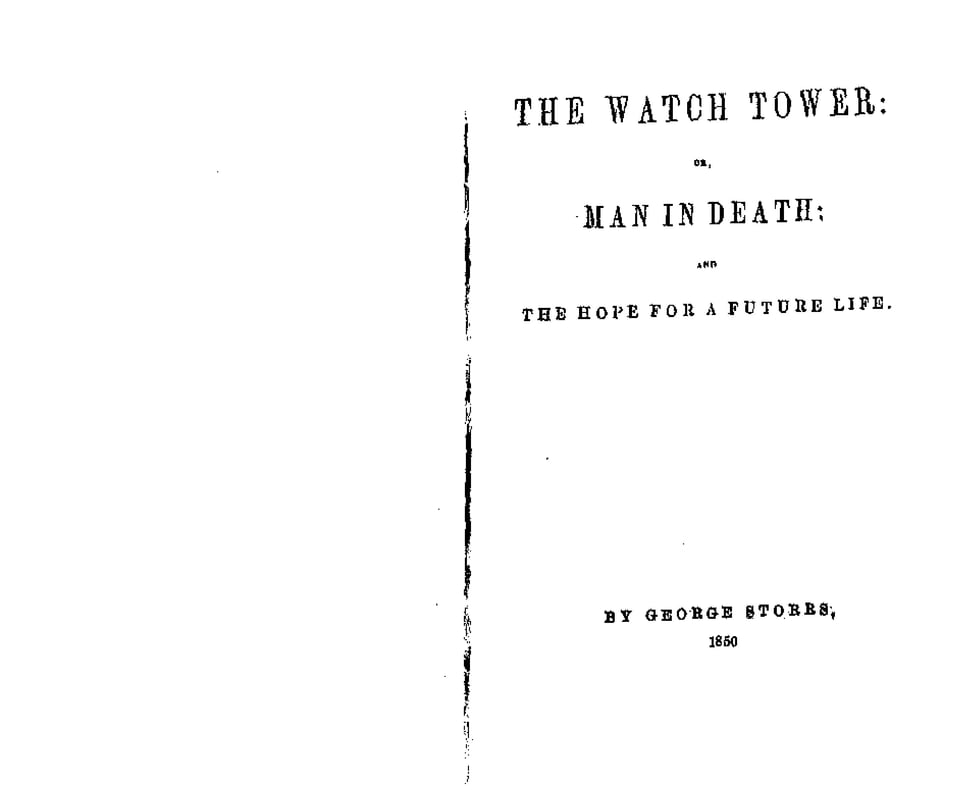
THE WATCH TOWER:
AND
MAN IN DEATH;
THE HOPE FOR A FUTURE LIFE.
BY GEORGE STORBS;
1850 THE WATCH TOWER:
OR,
MAN IN DEATH:
AND
THE HOPE FOR A FUTURE LIFE.
BEING AN EXAMINATION OF THE TEACHINGS OF THE HOLY SCRIPTURES ON THE STATE OF MAN IN DEATH, AND HIS HOPE FOR LIFE HEREAFTER.
"IF A MAN DIE SHALL HE LIVE AGAIN?"
"HE THAT HATH THE SON OF GOD HATH LIFE."
"I WILL RAISE HIM UP AT THE LAST DAY."
HE THAT HATH NOT THE SON OF GOD HATH NOT LIFE."
BY HOMO.
New- York: PUBLISHED BY THE AUTHOR.
CONTENTS.
CHAPTER I.
The questions discussed, 7.—Extracts from Bishops Whately and Law, 8 —Terms referring to the locality of the dead, sheol and hades, 10.—Extract from Kitto on hades, 11.—Bishop Lowth's admission, 12.—Scripture descriptions of sheol, 15.
CHAPTER II.
Positive Scripture testimony, 16.—Resort of the advocates of the common theory, 16.—Men's "plans and purposes" do not always fail in death, 17.—David's case considered, 18.—Solomon's teaching, 19.—Hezekiah's case considered, 21.—Eccl. 12:7 noticed, 24.
Teachings of the New Testament, 25.—Facts of New Testament history, 25.—Revival of dead persons by our Lord and his Apostles, 25.—The death and re-living of Jesus, 28.—Our Lord and the Sadducees, 29.
CHAPTER IIL
Teachings of New Testament continued, 34.—Resurrection or translation the only hope of future life, 34.—Jesus points to that as our hope, 35.—Paul's hope, 36.—Peter harmonizes with Paul, 38.
CHAPTER IV.
CHAPTER V.
This world and "that world, even the resurrection from the dead," is all Jesus reveals of life, 40.—Paul's writings examined, 41. Phil. 1:23,p.41.-2 Corth.5:1-8,p.44.-2 Corth.12:2-5,p. 51.-Heb.12:18-24,p.52.-Acts 23:6-8,p.54.-Acts 7:59 Stephen's case, 56.
CHAPTER VI.
Rich man and Lazarus, 57.—Is it a parable ? 57.—Lightfoot, Whitby, and Wakefield on its parabolical character, 59.—Dr. Clarke and Bishop Lowth, 60.—Parables not always founded on facts, 60. The Hebrews speak of things without life as if possessed of it. 61.—Dr. Gill on it, 62.—Theophylact's remarks, 63.—James Bates, 64.—The key to it, 66.—True exposition of it, 68.
CHAPTER VII.
Rev. 6: 9-11 considered, 73. The dying thief, 74. Moses at the transfiguration, 76. THE CONTRAST, or comparative views of the different theories of consciousness and unconsciousness in death 77-84.
THE GOSPEL HOPE.
A Sermon, 85.—Hope defined, 85.—The true gospel hope shown from the teaching of Christ and his Apostles, to be the resurrection from the dead, 86-96.
THE WATCH TOWER:
OR, MAN IN DEATH;
AND THE HOPE FOR A FUTURE LIFE.
"Watchman, what of the Night?"
"The morning cometh."—Isa. 21: 11, 12.
CHAPTER I.
The chief Watchman of the flock, in ancient times, had his "Watch Tower," from which he could survey the most distant field where his flock ranged. Concern for them would cause him to give many anxious looks in the direction they had gone; and night might sometimes overtake them in the field. Still he keeps a vigilant look-out for them. He watched the going down of the sun, and looked for the morning, when that glorious orb would re-appear. Under-shepherds might often inquire—"Watchman, what of the night?" At length he responds—"The morning cometh."
So, looking out upon the setting sun of this life, the watchful mind may be led to inquire, "Will the orb of day ever return?" or, "If a man die, shall he live again?" Job 14:14. "Will he be revived into life?" Night has closed in upon him, and all is dark and cheerless in death, unless there are good and sufficient reasons for faith in a future life; and the anxious Watcher cries out—"I wait for the Lord, my soul doth wait, and in His word do I hope. My soul waiteth for the Lord more than they that watch for the morning : I say, more than they that watch for the morning."
Psa. 130: 5, 6.
From the Watch Tower we observe the night closing in on our friends and fellow-travelers; and our anxious hearts long to see clearly through the darkness thrown over them by the closing tomb. Fancy cannot, and will not satisfy thoughtful minds in this matter.
What is it to be in the state of death? is an inquiry to which no man can well be indifferent. Job gave utterance to language common to all men, when he asked concerning man in death, "Where is he?" Job 14:10. Unaided by Revelation an awful uncertainty must rest upon the human mind on this question. Had we to occupy the position of the wisest heathen, when we commit our friends to the tomb, we should still inquire in vain, "Where is he?" Men have indeed dreamed their departed loved ones into some paradise: but it has been one of imagination only; and one which they would much rather have kept them from entering, if they could possibly have retained them here.
So far from any man being able to penetrate the gloom of death, to find comfort or life for any in that state, the Lord has asked the solemn and significant question "Have the gates of death been opened to thee? or hast thou seen the doors of the shadow of death?" Job 38:17. If, then, living men have not, and cannot enter into that state, to explore those dark regions, what folly to talk of knowledge there.
The knowledge of that state, as to the condition of those who descend into it, must be a matter of direct revelation from God, if possessed at all. Human reason, and philosophical speculations are just as unavailing here, as they are in relation to man's origin. Unaided by revelation, who could ever have found from whence man derived his being? Men, Christian men, talk loud and long about man's dignity! Pray, where do they learn such a lesson?
Is it from revelation, or the vain speculations of philosophy? or that "wisdom by which the world knew not God?" 1 Cor. 1 : 21. They talk of the separate existence of a human soul—its immateriality, its immortality, and conscious existence in death, as if these matters were facts not to be questioned or denied. A denial of these points is denounced as infidelity; no matter how closely we may adhere to scripture authority in our denials. It seems as if Platonic speculations, with them, outweighed the plainest scripture testimony. We do not accuse them of knowingly thus preferring human to divine testimony. Early religious training has created a prejudice in favor of the Platonic theory, which thereby has become interwoven in all their religious experiences, so that fear of final apostacy prevents their allowing themselves to doubt the truth of any of these topics in relation to "the soul."
By this course they shut themselves up to a stereotyped theory, without ever seriously considering that it may, ultimately, prove disastrous to themselves, or their posterity. This theory, it is evident to our mind, as men advance in means of information, must lead to real infidelity, or to the equally fatal scheme of spirit-rapping—or, to speak more truthfully, animalism—which is now sweeping over the earth.
That the doctrine held by most professed Christians, concerning man's duality-or double-being-one part of which is immortal, and survives in a conscious state in death, is not the doctrine of scripture, we trust will be made apparent by a careful examination of those texts relied on for its support, and the opposing testimony of Scripture. The question we are to discuss, is not, "What is the soul?" or "What is the constitution of the soul?" These questions are purely philosophical, and for answers to them philosophy may be consulted, by such as are anxious to know what God has not seen fit to reveal. The Bible nowhere propounds nor answers such questions Every assertion, by man, about a human soul—as a separate existence—and every statement of the nature, capabilities, and mode of existence of such a soul, is neither more nor less than a human opinion.
Just what that is worth, all such speculations are worth, and no more. The Bible propounds no such topics, and gives no countenance to them. The question before us, then, is not "What is the separate state of the soul after death?" but "What is the state of man in death?" and "What the hope for him in the future?" The soul or spirit of man—as those terms are theologically employed—as a disembodied personality, is an idea unknown to inspiration. Archbishop Whately, in his "Revelation of a Future State," says—"To the Christian, indeed, all this doubt would be instantly removed, if he found that the immortality of the soul, as a disembodied spirit, were revealed in the Word of God." * "In fact, however, no such doctrine is revealed to us; the Christian's hope, as founded on the promises contained in the Gospel, is the resurrection of the body."
DR. LAW, BISHOP OF CARLISLE, speaks as follows :—
"It will be necessary to attend to the true meaning of the word Death, as it is strictly and properly applied in scripture; and this may be best seen, by looking back to the remarkable passage where it is first used, in that denunciation which brought Adam and his posterity under it; and where we must suppose it used in all the plainness and propriety of speech imaginable. And, accordingly, we find the original here, as full and emphatical as words can make it. They are translated—Thou shalt surely—but might with more strictness have been rendered—Thou shalt utterly die; which one would think sufficiently explained in the sentence passed on our first parents, where they are reminded of their original, and of that state to which this change should reduce them. 'In the sweat of thy face shalt thou eat bread, till thou return unto the ground, for out of it wast thou taken; dust thou art, and unto dust shalt thou return.' Now what do we imagine they could possibly understand by this denunciation but a resumption of that natural life or conscious being, which
their Creator had been lately pleased to bestow upon them? the forfeiting which must necessarily include a total loss of all those benefits that then did, or ever could proceed from him? This surely, and nothing less, must be implied in that most solemn sentence; nor can we well conceive the unhappy subjects of it to have been at that time so very ingenious as to explain it away by distinguishing upon the several component parts of their constitution, and concluding, that by death no more was intended than only a separation of these parts, while the principle of them was still living in some different manner, or that it was a continuation of their consciousness and real existence, though in some other place. No, this was the philosophy of after ages; concerning which, all I shall say at present is, that some of its most eminent patrons cannot help observing, that they 'do not find it in the scriptures.' [Tillotson, vol. ii. Ser. 100.] These, in their obvious meaning, represent the whole man, individual, person, or being, as included in the sentence addressed to him; nor do they seem to take notice of any other circumstance in the case, beside that, so often mentioned, of his returning to the 'dust or ground from whence he was taken'; and might not the first pair as well expect, that the same 'breath of life, which the Lord God had breathed into their nostrils, whereby man became a living soul,' should still survive the execution of that sentence, or that the dust itself should praise God; as that any kind of knowledge of, or communication with him, should continue in that state of darkness and destruction to which they were then doomed?"—From Sermon on Heb. 2: 14, 15, "Forasmuch then," &c.; Carlisle Edition, 1784.
The scriptures everywhere regard man as an undivided personality—as one being, to whom are addressed commands, promises, threatenings, warnings and encouragements. Whatever may enter into man's nature, as an organized being, alters not his oneness: and nothing which may go to make up his manhood is to be considered, separately, as constituting his personality. An organized being, endowed with life, constitutes him a living being. His disorganization, with deprivation of life, leaves him where he was before living; his personality ceases, except in the purpose of God to re-organize him, and restore life.
But such a "purpose" can only be known by revelation: nature has never shown such a result; and there is no voice in it to encourage such a hope.
Job has put the matter in its true light. "Man giveth up the ghost, and where is he?" Not where is his soul? but where is ne—the man? To this inquiry, it is replied—"As the waters fail from the sea, and the flood decayeth and drieth up: so man lieth down and riseth not; till the heavens be no more they shall not awake, nor be raised out of their sleep." Job 14:10-12. Surely this language is expressive of the entire dissolution of man, so that he is no longer a living being. This view is confirmed by the question which follows, viz.:—"If a man die shall he live again?" To which Job responds—"All the days of my appointed time will I wait till my change come. Thou shalt call and I will answer thee," &c. The Septuagint reads thus—"Though a man die he may be revived, after finishing the days of this his life. I would wait patiently till I come again into existence. Then shalt thou call and I will answer thee; thou wilt have a desire to the work or thy hands."
We will now notice
TERMS REFERRING TO THE LOCALITY OF THE DEAD.
"Have the gates of death been opened unto thee? or hast thou seen the doors of the shadow of death?" Such is Jehovah's challenge to the patriarch Job, and which occurs among that wonderful series of questions by which the Almighty impressed His tried servant with the extreme narrowness and insignificance of human knowledge. The interrogation is equivalent to, "What knowest thou of death, or the dead?" And well had it been for mankind, and for the integrity and practical efficiency of Christianity, had they been content with the knowledge of their
ignrance in this solemnly profound direction. We cannot explore the place of the dead,—we know not even if there be a place, except in the imaginations of men, who because they know that all mankind share a common experience in this matter, speak of them as having gone to one place. It is the necessity of human thought which is compelled to localize the departed, that has originated a place, and a name for the place, of the dead. The Hebrews called it Sheol, the Greeks Hades, and the Saxons Hell; words most aptly chosen, since while they subserve the necessity of human thought, they express at the same time the modesty of the human mind, which in its election of terms, would, in this instance, appear to approve of the wisdom of not being wise above what is written. The Greek word Hades, is of very common occurrence in the Greek classics, but its classical signification is no criterion of its meaning in the sacred writings. We are referred back to the Hebrew Sheol for the strict sense in which it is employed by the inspired writers. "The Greek term did not come to the Hebrews from any classical source, or with any classical meaning, but through the Septuagint as a translation of their own word; and whether correctly translating it or not, is a matter of critical opinion. The word Hades is, therefore, in nowise binding upon us in any classical meaning which may be assigned to it. Hence the real question is, what is the meaning which Sheol bears in the Old Testament, and Hades in the New? A careful examination of the passages in which these words occur will probably lead to the conclusion, that they afford no real sanction to the notion of an intermediate place of the kind indicated, but are used by the inspired writers to denote the grave, the resting place of the bodies, both of the righteous and the wicked."—Kitto. Let it be borne in mind that nothing relative to the state of the dead can be ascertained by these words simply, and separately considered. In all the three languages, they have a common signification —their etymological meaning being, the unseen, hidden, or unknown place, or state.
These terms, then, so far from conveying to us any information concerning the place or state of the dead, only express our own ignorance of these matters, and ought on this account to operate as a per petual check upon the indiscretion of the rash speculator Whatever sense the word Sheol has in the Old Testament, Hades, as its Greek equivalent, will have in the New. The Hebrew prophets, in their allusions to the place and state of the dead, conveyed their ideas in the imagery which was suggested by their mode of sepulture. It is not to the Hebrew writers, but to the Greek philosophy, that we trace the birth of those opinions concerning the state and place of the dead, which at the present time prevail as the orthodox creed of modern Christianity. Such opinions must necessarily be defective, and destitute of any claim on our religious belief, since they partake of the imperfection and uncertainty which characterize all human investigation. They are philosophical traditions—not scriptural informations—and as such, ought to be jealously excluded from the sacred domain of inspired authority. It is evident that the Hebrew prophets were strangers to these philosophical opinions,—their poetical descriptions of death and the dead show whence their imagery was derived, and suggest that they could form no other conceptions of the condition of the departed, than what the analogies of their mode of interment presented to their view. Bishop Lowth, in his "Lectures on Hebrew Poetry," p. 78, says, "That which struck their senses they delineated in their descriptions: we there find no exact account, no explicit mention of immortal spirits." A very significant testimony! This testimony is the more important, since the Bishop considered that the immortality of the soul, as a disembodied existence, was a doctrine known to, and acknowledged by the prophets; and he accounts for their uniform silence on this subject, "because
they had no clear idea or perception by which they might explain where or in what manner it existed; and they were not possessed of that subtility of language which enables men to speak with plausibility on subjects abstruse and remote from the apprehension of the senses, and to cover their ignorance with learned disputation. The condition, the form, the habitation of departed spirits were, therefore, concealed from the Hebrews, equally with the rest of mankind. Nor did revelation afford them the smallest assistance on this subject."
We would beg the reader's special attention to this paragraph from the pen of the learned Bishop. He acknowledges that the writings of the prophets contain "no explicit mention of immortal spirits,"—that they never alluded to disembodied spiritual existence,—and that "revelation" did not "afford them the smallest assistance on this subject." Is his inference then a reasonable one, that the prophets who make no "mention of immortal spirits," therefore believed in immortal spirits? and that, although they make no allusion to disembodied spiritual existence, this is to be explained by their inability to express suitably their ideas? And that, notwithstanding "revelation' afforded not "the smallest assistance on this subject,"—the soul's disembodied existence, as the human personality, and the intermediate state, as popularly understood and held, were yet doctrines of revelation? By what unknown process could the Bishop arrive at such conclusions? The sacred writers have said nothing about these doctrines, therefore, says Bishop Lowth, they believed them! We humbly suggest that this negative premise would be more logically connected with a negative inference; that since the sacred writers have said nothing about these doctrines, the probability is that they knew nothing about them. Their word Sheol, drew a veil over the departed state, and involved it in concealment and darkness. If ever they have occasion to refer to the departed, their thoughts are not directed upwards, as if they believed that the personality, as a disembodied soul, had ascended to God,—they think of the body and the tomb, and associate the departed with that which is buried.
Thus, "they shall go down to the bars of the pit, when our rest together is in the dust." Job 17:16. "Let not the pit shut her mouth upon me." Psa. 69:15. "My life draweth nigh unto the grave. I am counted with them that go down into the pit. Free among the dead, like the slain that lie in the grave, whom thou rememberest no more; and they are cut off from thy hand. Thou hast laid me in the lowest pit, in darkness, in the deep." Psa. 88:3-6. "Therefore, Sheol hath enlarged herself, and opened her mouth without measure, and their glory, and their multitude, and their pomp, and he that rejoiceth shall descend into it." Isa. 5:14. "When I shall bring thee down with them that descend into the pit, with the people of old time, and shall set thee in the low parts of the earth, in places desolate of old, with them that go down to the pit, that thou be not inhabited." Ezk. 26:20. It seems sufficiently plain that the prophete associate the personality of the departed with the buried body; and since the words which they utter are not always their own, but they are frequently the message-bearers of Jehovah, as in the citation last given,—it seems also plain that God Himself points to the grave, as the temporary abode of the human personality: "Dust thou art, and to dust shalt thou return." Gen. 3:19.
The only means we have of estimating the real opinions of the sacred writers on this subject, is the language in which they convey their thoughts. Their opinions must necessarily be of a very indefinite and general character, since the subject is involved in so much obscurity. So much, however, is beyond dispute, that their language, instead of indicating their belief in the soul's disembodied and conscious existence, suggests their utter ignorance of such ideas. They spoke as if they believed that the outward image of death, and its circumstances, were not the fictitious, but the real semblance of the state of the departed. Their descriptions of Sheol or Hades are utterly irreconcilable with the supposition that they believed the state of death to be a condition of consciousness and activity. All, irrespective of character, are dismissed to Sheol:—"All go unto one place; all are of the dust, and all turn to dust again." Eccl. 3:20. "All things come alike to all; there is one event to the righteous and to the wicked." Eccl. 9:2. Sheol is a place of inaction and silence. "Let them be silent in Sheol." Psa. 31:17. "There is no work, nor device, nor knowledge, nor wisdom in Sheol whither thou goest." Eccl. 9:10.
Sheol is never described except in the imagery of terror; and is always regarded as a great evil. It is never spoken of as the portal of heaven,—the gate of immediate bliss to the righteous. On the contrary, it is described as an awful unfathomable abyss, extending deep into the heart of the earth, to indicate the completeness of its dominion. "Deeper than Sheol, what canst thou know?" Job 11:8. It stands in contrast with heaven; and therefore, the inhabitants of the one must be distinct and separate from the other. "If I ascend up into heaven, thou art there; if I make my bed in Sheol, behold thou art there." Psa. 139:8. "Though they dig into Sheol, thence shall my hand take them; though they climb up to heaven, thence will I bring them down." Amos 9:2.
Now, whatever may be the opinions of uninspired Jewish writers, whether ancient or modern, they can be of no authority in determining the opinions of the Hebrew prophets, whose thoughts, inspired by the Holy Spirit, are conveyed in language sufficiently explicit to indicate their faith and doctrinal instruction on this subject. It is to introduce a novel and dangerous canon of biblical interpretation, to affirm, in reference to the present question, that the silence of the sacred writers speaks consent. W presume it will be apparent that the terms denoting the locality of the dead, suggests nothing in favor, but rather involve the denial of the doctrines of the disembodied soul, and an intermediate state of consciousness for man, between the night of his death and the morning of resurrection; and, therefore, the logical conclusion is, so far as these terms are concerned, that the origin of such opinions is purely traditional.
CHAPTER II.
MAN IN DEATH.—POSITIVE SCRIPTURE TESTIMONY.
We have seen that the terms Sheol and Hades used in relation to the state of the dead, give no evidence, even amounting to a probability, that dead men are in a conscious disembodied existence. On the contrary, we shall find the Scripture description of the state of the dead excludes all idea of their consciousness.
The account of man's creation compared with the statements of man's dissolution in death, forbids the idea. Thus—"The Lord God formed man of the dust of the ground, and breathed into his nostrils the breath of life, and man became a living soul." Gen. 2:7. "His breath goeth forth," [that which God breathed into him;] "he returneth to his earth;" [he, man, formed of the dust of the ground: "the body," if you will have it so;] "in that very day his thoughts perish." Whatever may be said of the soul or mind, as a distinct entity, the text clearly announces the fact, that it ceases to think in the very day of man's death, and therefore all consciousness ceases.
To avoid this conclusion, the advocates of the common theory have resorted to one or other of the following in
terpretations . —First, that it is the body that ceases from thought, or no longer evolves thoughts when dead. Second, that the term, thoughts, signifies purposes, plans, &c.
On the first view, we remark, That supposing man to be dual, as they maintain, the body never did think—it was incapable of any such work, because it was matter, and "matter cannot think," they tell us. To say then, that it is "the body that ceases to think," in death, is a denial of their own premises: for that which cannot think, cannot cease to think. Hence, if there is a cessation of thoughts in death, it must be what they call the soul that ceases to think.
The first position, therefore, is utterly untenable; and the second may be found equally so, on examination: for it is not true, as a general rule, that a man's plans or purposes perish when he dies; or, if they perish, or come to naught at all, it is not true that this always happens "in that very day" of his death.
For an illustration. Washington, and others, purposed to make the colonies of America a body of independent and prosperous States. Now, their plans, or purposes did not perish in the very day they died; even should they hereafter do so. It really seems to us as if the Spirit of God caused the words—"in that very day"—to be inserted in the text to bind down the sense to the action of the mind of the dead man; rendering it impossible to make any other application of the expression than that of the entire and total extinction of man's conscious existence, when he is dead.
That "holy men of old," who spake as they were moved by the Holy Spirit," did affirm the incapacity of the dead to perform any good or evil while in a state of death, it seems to us, is as evident as any other truth of inspiration. In this view only can we account for the fact of their language being so expressive of deep lamentation in
prospect of death, taken in connection with their utterances in relation to that state.
David, Psa. 6th, cries out—"O Lord, rebuke me not in thine anger" "have mercy upon me, O Lord, for I am weak: O Lord, heal me, for my bones are sore vexed. My soul is sore vexed" "return, O Lord, deliver my soul: oh save me for thy mercies' sake: FOR in death there is NO REMEMBRANCE of Thee: in sheol who shall give Thee thanks?"
This language expresses the Psalmist's regret at the prospect of death: an earnest appeal to God to save him from it; and a special plea against dying, viz: His memory of God would come to a total end; and hence, praise to God in that state was utterly impossible: none can give thanks to the Lord in sheol. Sheol is the original word, in this text, translated grave in our version. It is the word of the Old Testament used to denote the state of the entire man when dead. In that state the Psalmist, speaking by the Spirit, tells us what men cannot do; and it is entirely adverse to the idea of a living conscious existence.
This same idea is expressed fully and distinctly, Psalm 115:17, "The dead praise not the Lord, neither any that go down to silence." Surely here is no ground for doubt as to the fact that death is a state of unconsciousness; a state where no exercise of mind can be called into action. Add to this, the clear affirmation of Psa. 146, already considered—"in that very day his thoughts perish"--and we have a "threefold cord" that cannot be broken, as to the mind of the Spirit regarding the state of the dead, revealed to the Psalmist.
If anything more is needed in confirmation of this matter, relating to David's particular case, we have it in the Spirit's testimony, by the mouth of Peter, on the day of Pentecost, Acts 2:34—"David is not ascended into the heavens." Peter had previously said, "The patriarch
David is both dead and buried," &c. Not David's body merely; David himself. It was the personality of that patriarch of which Peter spake, and that was dead and buried; hence could not have ascended into heaven, and could not therefore be the cause of the wonderful outpouring of the Spirit realized on that occasion; but Jesus, the Son of David, though he was slain, "God raised up," and he "being exalted" from death, by his resurrection, to the "right hand" of God, "shed forth" the promised Spirit—the demonstration that Christ was alive from the dead.
This inspired discourse, of Peter, is a clear New Testament confirmation of David's own testimony, that a state of death is not a condition for any work, even of good. The resurrection state, only, was that which could restore to the knowledge and service of God.
Passing from David to Solomon, his son, we shall find a perfect harmony. In Ecclesiastes, ninth chapter, we have as clear a statement as could well be made, that in death there is no capacity for the performance of any good or evil. Solomon first states the condition of mind of evil men while alive, verse 3—"The heart of the sons of men is full of evil, and madness is in their hearts while they live, and after that they go to the dead." He then goes on to say:—"For to him that is joined to all the living there is hope: for a living dog is better than a dead lion. For the living know that they shall die; but the dead know not anything, neither have they any more a reward; for the memory of them is forgotten."
In the controversy on the state of the dead, much has been said on this text: yet we doubt if the full force of it has been seen. The perfect ignorance of the dead is clearly the grand idea it is designed to communicate. Mark well the language. "To him that is joined to all the living there is hope," however unimproved and ignorant he may be. If he is alive, he may improve; but if he is dead, there is no improvement; and he is of no use while dead: hence, "a living dog is better than a dead lion."
The most unim proved and ignorant man alive, is of more value than the most intelligent, wise, and powerful man when dead. That dead man might, while living, have been as superior to the uneducated and ignorant survivor as the lion among beasts is superior to the dog; but when dead, he is infinitely inferior to him; "FOR the living" [however ignorant and lacking in intelligence in other matters] "KNOW" [have knowledge enough to know] "that they shall die:" [a truth which any man, though but one remove above an idiot, possesses intelligence enough to know:] "but the dead" [are inferior to such persons, as much as a dead lion is inferior to a living dog, because the dead] "know not ANYTHING:" total ignorance is the state of all the dead. No language can more absolutely and unequivocally affirm the entire unconsciousness of the dead, however powerful their intellect might have been while living.
It is said, however, if our view of the state of the dead, as indicated from this text, is true, "it proves the dead will never have any more a reward :" and hence it is concluded, our view must be incorrect; and we are asked, why we overlook or pass by the expression—"neither have they any more a reward?"
We neither overlook nor pass it by. To our mind, it is a further confirmation of the truth that dead men are unconscious. The objector refers to the clause under consideration as if it read "neither shall they ever have any more a reward." But such is not the fact. It does not speak of the unlimited future, but of the present state of the dead—"Neither have they"—in their state of death—"any more a reward." The reader will not fail to see the wise man's climax, in argument. It is as follows: A living man, however humble his condition, is better than a dead one; for the dead know not anything: there is no reward in that state; for the memory of them is forgotten; that is, they cease to have memory; hence, know nothing
and can receive no reward while in death. The memory spoken of, is surely not the memory of the living in relation to the dead; for that remains among some of the friends or admirers from generation to generation, sometimes for thousands of years; but the mind of the dead having ceased—their thoughts perished—their memory perishes also. Such was, unquestionably, the sense in which the son of David here speaks; which is further evident from what follows—"Also their love, and their hatred, and their envy is now perished." These dispositions are all exercises of the mind: hence when all such exercises cease, the mind itself must have lost all power to act; it must be utterly unconscious.
A further confirmation of this view is found in the tenth verse : "There is no work, nor device, NOR KNOWLEDGE, nor wisdom, in sheol whither thou goest." Here is definiteness, one would think, sufficient to satisfy all, who believe Solomon spake by the Spirit, that a state of death is a state of entire incapacity for good or evil, either of body or mind : hence, is an unconscious one. In this matter, Solomon and his inspired father, David, are in perfect agreement.
Hezekiah, as a third witness, confirming the views of David and Solomon, will next be examined. He was "sick unto death." The Prophet Amos came to him with this message—"Thus saith the Lord, Set thine house in order, for thou shalt die, and not live." On hearing this, Hezekiah was deeply affected and afflicted. He prayed and wept sore; and, in answer to that prayer, he had fifteen years added to his life. After his recovery, in praising God, he assigns one important reason for his reluctance to die: "For," saith he, "sheol cannot praise Thee, death cannot celebrate Thee," &c. Here the container is put for the contained. Sheol and death stand for those who are in them. It is but another mode of saying, "Men when dead cannot praise Thee or celebrate Thy goodness." Why? Because there is "no knowledge in sheol," as Solomon had plainly declared, and Hezekiah confirms that view of the subject.
On what other view can we account for Hezekiah's extreme reluctance to die? The common view, which represents men as "going to heaven" at death; or, at any rate, to a state of conscious existence far better than the present, does not explain this case. The state of the pious dead is better than the present, all the advocates of the common theory maintain. But, when Hezekiah was told he should go into it, he "turned his face toward the wall, and prayed" that he might not be sent there; and distress at the thought caused him to weep sore. This could not have been from any apprehension that he would "go to hell;" for he could appeal to God, and say—"I have walked before Thee with a perfect heart, and have done that which was good in Thy sight." Why, then, such a reluctance to go into that "better land?" Is not that state one where sin, sorrow and death come no more? where temptation and trial cannot reach the happy soul? Why, then, does Hezekiah pray so earnestly to remain longer away? Why wept he sore in view of his nearness to such a happy end? And what did he gain by his weeping and praying so earnestly? Do you say, he gained an addition of fifteen years to his life? Truly! But did he not take those years from the sum of his heavenly felicity? Did he not lose fifteen years of heavenly enjoyment, and turn those years back to be spent in the sorrows, trials, and dangers of this life? Did he arrive at the very gate of heaven, and then weep and pray to be permitted to come back to this world of sorrow and sin?
In fact, however, on the common theory, nothing was added to the life of Hezekiah! Can you add to the years of an "undying and immortal soul?" It was only an exchange, in which the royal supplicant and weeper gave up fifteen years of his heavenly felicity for that period here, in this world of trial! What an exchange! If a man
should exchange a purse of gold for one of trash; or if he should exchange, willingly, and with earnest desire, health and beauty for sickness and deformity, who would not be astonished at his folly? But all comparison fails; for Hezekiah is, by the common theory, represented as exchang ing fifteen years of heaven, with all its safety, riches, society, and joys, for that period in the earthly dangers, trials, sorrows and sufferings, to which human life is here liable! Surely no rational satisfaction can be given why a sane man should make such an exchange, unless it could be made to appear that God, whom he served, desired him to make such a sacrifice. But the will of God, as a first choice, seems to have been that Hezekiah should "die, and not live."
If Hezekiah understood—as his words, after his recovery clearly affirm—that in death he could not praise God, nor celebrate Him, then there is a rational ground upon which to account for his desire not to die. In this view, we can see why he mourned and wept sore at the prospect before him. It was just such a feeling as must naturally arise in the mind of a lover of God and His service. He could not but prefer to remain here, where he could see something of the works of God, and "behold the inhabitants of the world," even though attended with many sorrows and sufferings, to lying down in the dust of the earth, to remain in the silence of death, till a distant day of resurrection. In view of death, as such a state, Hezekiah had an object worthy of desire; and he gained a real boon; fifteen years were actually added to the sum of his conscious existence. No wonder he praised God so sincerely and heartily after being brought back from the gates of "the pit of corruption." He understood the value and desirableness of life: and he knew when dead he could "not praise the Lord."
In the mouth of three witnesses—and such witnesses too, as three eminent kings of Israel—we consider the fact established, so far as the Old Testament testimony is concerred—that in death, man is without knowledge, and without any capacity or power for good or evil.
No inference can nullify or destroy such plain and positive testimony as that we have produced. The inspiration of these men must be impeached, or their testimony remains in full force. It is thus summed up :—
"In death there is no remembrance of God"—"In sheol" none can "give Thee thanks"—"The dead praise not the Lord"—"In that very day" of death, "their thoughts perish"—"The dead know not anything"—"There is no knowledge in sheol"—Those in "sheol cannot praise Thee;" and those who are in "death cannot celebrate Thee." See Psa. 6:5; 115:17, and 146:4. Eccl. 9:5, 10. Isa. 38:1-19 inclusive.
The only text we need to notice, in the Old Testament which is supposed to be adverse to our view, is Eccl. 12 7, "The spirit shall return to God who gave it." Without entering into any arguments now, on the nature of the spirit, here spoken of, it is sufficient to say, whatever is its nature, its conscious or unconscious condition must be established by testimony, or else we know nothing of its condition. But the writer of Eccl. has, himself, settled the state of those in sheol—or in the state of the dead; and he has decided it to be one without knowledge, thus forever depriving our opposers of any right to use this text in proof of a conscious state in death.
CHAPTER III.
MAN IN DEATH. THE TEACHINGS OF THE NEW TESTAMENT.
In approaching the New Testament on this subject we must bring along with us the fact that inspired men, speaking by the Spirit under the previous dispensation, have distinctly announced death to be a state where there is "no knowledge," and where men "praise not the Lord." Hence, no inferences from the language of the inspired men of the Christian dispensation can be permitted to reverse the positive declarations of the Old Testament writers. If no positive testimony appears, affirming the living, conscious state of dead men, in the New Testament, we have a right to the conclusion that no such doctrine is taught there. But we shall find on examination, very likely, that the inspired Jews of the Christian dispensation do not contradict the inspired Jews of the previous one. Both harmonize in the fact of a future life to the people of God by a resurrection, or a reliving from the dead.
A few facts of New Testament history may first be examined, which go to confirm the idea that life after death is only by a resurrection from the dead.
I. THE REVIVAL OF DEAD PERSONS BY OUR LORD AND HIS APOSTLES.
On this subject, it may be remarked, that in no case was there any language used indicating that the essential being of the dead was in any other place than what appeared obvious to the actors, and to beholders of these revivals. In other words, There was no calling of "souls" from heaven, or from above, to reenter the bodies of the dead: there is no such language employed as indicated that a surviving entity—called, soul—must return to reinhabit the body, before it could live again.
When Jesus raised to life the daughter of Jairus, a ruler of the synagogue, Mark 5:22-43, he "entered in where the damsel was lying" and took her "by the hand, and said unto her, Damsel, I say unto thee arise."
The personality—the damsel herself—was there. It was to her who was "lying" before them, that was the damsel, to whom Jesus spake, and not to an entity, or being invisible, in some other state or place.
So likewise Luke 7:11-15, as Jesus was going into the city of Nain he met a funeral train: the only son of a widow was dead, and being carried forth to his burial. Jesus came near and touched the bier, and they who bare the dead man made a halt. What now occurred? Simply, Jesus addressing the dead man, said, "Young man, I say unto thee, Arise." What follows? "And he that was dead sat up and began to speak." All the circumstances, and the language, forbid the idea that a disembodied soul, which had gone to heaven at death, was called back to reenter the body. It was the dead man, borne upon the bier, to whom Jesus spake, and whom he called "Young man," and bade him "arise," and who immediately "sat up and began to speak."
How far the whole transaction is removed from the idea of a living soul being recalled from some distant world on this occasion. There is not one circumstance or sign—one look, prayer, or command, that gives any indication of the absence of any part of this man. He is there, really, personally; and at Jesus' voice awakes from the death-sleep that had come over him; his manhood resumes its living existence, which it had not till Jesus spake in his ears.
The case of Lazarus, John 11th, may next be noticed. "Lazarus is dead," said Jesus. This death he calls sleep.
Before our Lord came to the grave, he asks, "Where have ye laid him?" Thus recognizing the fact that the personality of Lazarus was there. When he came to the grave, he utters not a word calculated to lead any one to suppose Lazarus was anywhere else than there. No calling upon an invisible entity to return and reinhabit "the body!" But looking into the grave, "He cried with a loud voice, Lazarus, come forth." Did Jesus call him from where he was not? But he did call him from the grave; then Lazarus was there. To say, "his body was there, but his soul had gone to heaven," is to assume the whole question, not only without any evidence, but against the clearest evidence of the falsity of such a position. Lazarus was dead: Lazarus was laid in the grave; and from the grave Jesus bade Lazarus come forth, and he did come. The whole transaction is adverse to the idea of the duality of man—one entity of whom does not die—does not go into the grave, but in conscious living existence departs to some far-off sphere, in common language, "above the stars."
The case of the female disciple, named Tabitha, or Dorcas, who was dead, and restored to life by Peter, Acts 9: 36-41, is another example where the evidence is against the idea of the personality being found anywhere except in "the body" alone. After Peter had prayed, "Turning to the body, he said, Tabitha, arise; and she opened her eyes, and when she saw Peter she sat up," &c. Peter calls "the body," Tabitha. Showing that the personality was there, and not somewhere else. "He presented her alive" to the saints and widows present. She—Tabitha herself—had been dead—now she is alive. No hint—no intimation that a separate, living entity had been recalled from heaven, or from any other state or place. Her personality was dead, but now is restored to life. Such an idea as a double entity is not found in the scene.
THE DEATH AND RE-LIVING OF JESUS.
The death and revival of our Lord Jesus Christ himself will be found, on examination, equally adverse to the idea of the survival of his soul in conscious existence when dead. It will be no part of our inquiry now what his sou was. That soul was made an "offering for sin," Isa. 53:10; it was "poured out unto death," verse 12. In agreement with this, the Saviour said to his disciples—"My soul is exceeding sorrowful, even unto death," Matt. 26:38. His soul descended into sheol, Psa. 16:10; and we have already shown that "in sheol there is no knowledge." Paul declares "Christ died." He uses no such language as modern theology employs, such as—"Separation of soul and body," to denote the death of Christ. He speaks not of his soul as departing to heaven when he died, but—"Christ died:" the personality died. That his death was a reality, and not a mere separation of a living soul from the body, must be evident, from the fact that the death is spoken of the soul, and our Lord's own testimony, three days after his death occurred—"I am not yet ascended to my Father," John 20:17. Here is the personality that was dead, embracing his entire manhood, and whom God had raised up from the dead, according to the prophecy—"Thou wilt not leave my soul in sheol"—in the state of death. Furthermore, Jesus said to John, when he appeared to him on the Isle of Patmos—"I am he that liveth: and was dead; and behold, I am alive forever more, amen; and have the keys of hades and of death," Rev. 1:18.
There was no manifestation of the Christ, either spiritually or otherwise, while he was dead : and without a reliving from the dead, he himself is perished, and with him all the race of Adam. Hence, upon his revival into life or resurrection from the dead—depended all the hope for a dying race, for a life to come. This view gives a tremendous importance to the resurrection of the dead ; just
such an importance as the Scriptures attach to it; and such as the advocates of the common theory—of the living survival of the soul—never did, and never can see or feel. "CHRIST DIED"—"God raised him from the dead"—"Knowing that CHRIST being raised from the dead, dieth no more; death hath no more dominion over Him."
Such testimony shows, in an unmistakable manner, that the personality of Christ actually died; was unconscious in sheol, in hades. His life-giving power to his followers all depended on the fact of his revival from the dead: so that, "if Christ be not raised, your faith is vain: ye are yet in your sins: then they also which are fallen asleep in Christ are PERISHED." 1 Corth. 15:17, 18. There is no future life for any man, if Christ is not restored from death. Such is the clear testimony of the New Testament: all turns on the fact, whether Christ is alive: but he is not alive unless God raised him up from the dead; hence there was no living survivance of his soul in death.
OUR LORD AND THE SADDUCEES.
The discourse of our Lord with the Sadducees is further proof that dead men are unconscious, and that a future life depends on the resurrection, or re-living from the dead.
We would ask very especial attention to that part of the Evangelical history which records the interview of our Lord with the Sadducees. Luke xx. This sect was evidently one of very great consideration among the Jews, since, notwithstanding the very serious errors which they professed, they were sufficiently numerous and influential to share the dignities of office with their rival countrymen, the Pharisees. With both these sects Christ was at issue; and, therefore, his opposition to the one is not to be regarded as identifying him with the other. The Sadducees were very prominently opposed by the teaching of Christ, the grand theme of whose ministry was resurrection from the dead, a doctrine which this sect especially repudiated.
The success of our Lord's mission as a teacher was, therefore, so much loss of influence to them; and in this respect, gain to that of the Pharisees. Under these circumstances they adventured to publicly confront him. and imagined that they should successfully perplex him, by instancing, what they supposed, an insuperable difficulty in the way of the doctrine in question.
It is not undeserving our notice that no allusion is made by the Sadducees to a state intermediate between death and the resurrection, to which their objection would also have been applicable; but they proceed from the time of the death of the woman of seven husbands to that of the resurrection. It would seem that, if our Lord had taught the doctrine of the conscious disembodied soul existing in a state intermediate between death and the resurrection, these philosophico-religious controvertists would scarcely have traveled over this long interval to a future event; it would have been more to their purpose to have inquired, "What relation does this woman sustain to her seven husbands now?" There would have been no greater absurdity in this question than that which they proposed, since, if it be affirmed that the soul is the human personality, capable of a separate existence, then relationships of some kind might be presumed to obtain in the intermediate state, as likely as in the resurrection. It would have answered their end equally well, to have asked the general question, "What relation does she now sustain to these husbands?" as the more specific one, "Whose wife will she be in the resurrection?" This form of the question, indeed, would have been the more useful, because it would have embraced the two obnoxious articles of the Pharisaic creed, and like a two-edged sword have cut both ways at once. The Sadducees not only denied the resurrection, but the Pharisaic philosophy of the existence of separate souls. Their silence with respect to this subject of disembodied existence, in an intermediate state, makes
it highly probable that whatever the Pharisees may have taught, Christ's ministry comprehended no such doctrine. Their inquiry is only in reference to the resurrection—they ask—"Therefore, in the resurrection whose wife of them is she?"
And Christ's reply, although it does not formally contradict the popular doctrine of the conscious intermediate state, yet certainly seems to imply that there is no such state. "The children of this world," he says, "marry and are given in marriage: but they which shall be accounted worthy to obtain that world, and the resurrection from the dead, neither marry nor are given in marriage: neither can they die any more: for they are equal unto the angels; and are the children of God, being the children of the resurrection." Here are but two states spoken of—"the children of this world," and "they which shall be accounted worthy to obtain that world." Not the remotest allusion is made to any other state in which man exists. On the contrary, it is affirmed of them "which shall be accounted worthy to obtain that world, neither can they die any more." It might be plausibly replied that our Lord used this word "die" in allusion to the event of death, the mere experience of dying; but it seems more natural and more in harmony with the context to suppose that he meant by it the state of death, the whole period between dying to "this world," and arising in "that world" of which he had previously been speaking. And the very phrases by which the redeemed are designated, seem to exclude any intermediate state of conscious existence between death and the resurrection. They are called in reference to their two states, "the children of this world," and "the children of the resurrection."
But further, having exhibited to them the futility of their supposed unanswerable argument against the doctrine in question, and placed its possibility before them by the announcement that the new condition of the future life will dispense with many of the relations and circumstances of the present, he proceeds to appeal to their sacred books, and their acknowledged authority, Moses, in vindication of the doctrine of resurrection from the dead.
"Now that the dead are raised, even Moses showed at the bush, when he called the Lord, the God of Abraham, and the God of Isaac, and the God of Jacob. For he is not a God of the dead but of the living, for all live unto him." This allusion to the writings of Moses, let it be carefully observed, is for this especial purpose—to prove to the Sadducees the certainty of the resurrection. Its purpose is thus formally announced by Christ—"Now that the dead are" [will be] "raised." Obviously the future, according to a common idiom of language, is here put in the present tense. We inquire, how does this appeal to the words of Moses prove the disputed doctrine? Moses called the Lord, the God of Abraham, and the God of Isaac, and the God of Jacob. But Abraham, and Isaac, and Jacob, are dead! Is God the God of the dead? Said Christ, "He is not a God of the dead, but of the living; for all live unto him." Does this last statement, "all live unto him," mean, that Abraham, Isaac, and Jacob were actually alive as disembodied spirits? If so, how does it prove the point in debate? Christ is arguing with the object of proving the certainty of the resurrection—"Now that the dead are raised," is the position which he undertakes to prove. Such an interpretation of his words, makes our Lord's argument pointless; it then contains no proof "that the dead are raised." But the argument is logical, and the proof triumphant. As if our Lord had said—True, Abraham, Isaac, and Jacob are dead, but their death is only temporary, they will live again; this brief cessation of their existence is nothing to Him "who calls those things which be not as though they were." All live unto God, whom He designs shall live, though they live not now. Abraham, Isaac, and Jacob, although dead, yet
live in God's affections and purposes; and at the appointed time they shall live in His actual presence. God would not be called "the God of Abraham, and of Isaac, and of Jacob," were they dead for ever, as you Sadducees believe: "for he is not a God of the dead, but of the living." Jesus Christ, as "the Resurrection and the Life" promised—and the Patriarchs are interested in that promise—"Whosoever liveth and believeth in me shall not die for ever;" he shall die for a time, but not for ever; he shall rise again. Because, therefore, the Patriarchs, Abraham, Isaac, and Jacob, will live again at the resurrection of the just, God, the "God of the living," is appropriately called, by Moses, their God. The proof of resurrection from the dead is complete and irresistible. The point to be proved, "Now that the dead are raised," is triumphantly reached. "Then certain of the Scribes answering said, Master, thou hast well said."
This grand argument, however, involves much more than is at first apparent. It affirms, by implication, that Abraham, Isaac, and Jacob are dead: that they are not now in possession of conscious life. Our Lord's argument demands this supposition; it is an essential step upon which he rises to his consummate proof of the resurrection of the dead. Where, then, is the Great Teacher's recognition of the doctrine of the disembodied spirit, and the intermediate state of consciousness of the dead? This one instruction, the more valuable on account of its argumentative form, and proceeding from him who has "the keys of hades and of death," is sufficient alone to scare away the human traditions against which we contend.
CHAPTER IV.
TEACHING OF THE NEW TESTAMENT, CONTINUED
As the facts of revival from the dead, under the ministry of Christ and his apostles, are adverse to the idea of a survival in conscious existence, during the period of death, of a disembodied entity—and as the teaching of Christ, in his controversy with the Sadducees, is equally opposed to such doctrine, so are all the promises of a future life, given by Christ and his apostles. They do not use the language so prevalent in the current theology—such as, "going to heaven at death"—"Christ comes at death"—"death is the gate to endless joy"—"he has joined the happy spirits in the presence of God"—"he is now walking the streets of the New Jerusalem"—"he has gone home to heaven"—"he knows more than all the world"—"the immortal soul took its flight to realms of glory," &c. No such language did Christ or his apostles ever utter.
THE RESURRECTION, OR TRANSLATION THE ONLY HOPE OF FUTURE LIFE.
Our Lord's teaching is summed up in the sixth chapter of John, in plain language, on this subject. He holds up no hope to his followers of an immediate entrance into the bliss of a future life at death; but he does promise them in the most emphatic and unequivocal language, that if any man believe on the Son, "I will raise him up at the last day." So full was his testimony on this point,
that he four times uses these identical words in that one chapter, at the same time, declaring, that those who believe not on him, "have no life in" them. He proclaims himself as "the resurrection and the life:" thus pointing his followers to a re-living from the dead as their only hope of a future life. He never once speaks of their " souls" as conscious while they are dead, or as in possession of heavenly bliss while death holds dominion over them. We do not say but that the advocates of the common theory may infer such doctrine from some expressions; but we do say, that our Lord never taught such doctrine in the plain and unmistakable language which its advocates employ to express their ideas of the matter.
Not one solitary text can be found where Jesus promised his followers that they should go to heaven at death, or to any other place of conscious delight. Even the case of the dying thief will be found, on examination, to afford no such promise. A promise is essential to build hope upon. Without it, the assumption of possessing unmerited blessings is the height of presumption, and a most unwarrantable encroachment on the gifts of God.
But Jesus does give his friends great and precious promises : such as, " Thou shalt be recompensed at the resurrection of the just." Luke 14:14. "I will raise him up at the last day." John 6:39,40,44,54. " When the Son of Man shall sit upon the throne of his glory" * "every one that hath forsaken houses," &c., "for my name's sake, shall receive an hundred fold, and shall inherit everlasting life." Math. 19:28,29. When shall Christ "sit upon the throne of his glory?" See Math. 25:31, "When the Son of Man shall come in his glory, and all the holy angels with him, THEN shall he sit upon the throne of his glory." Then it is, he crowns his followers with life eternal, and not at death. Mark saith, "In the world to come eternal life:" and Jesus said to the Sadducees, Luke 20, "They which shall be accounted worthy to obtain that world, [kai], even the resurrection from the dead," &c.
…