Mankinds search for God (2006 printing) (1990)
Download: PDF — Mankinds search for God (2006 printing) (1990)
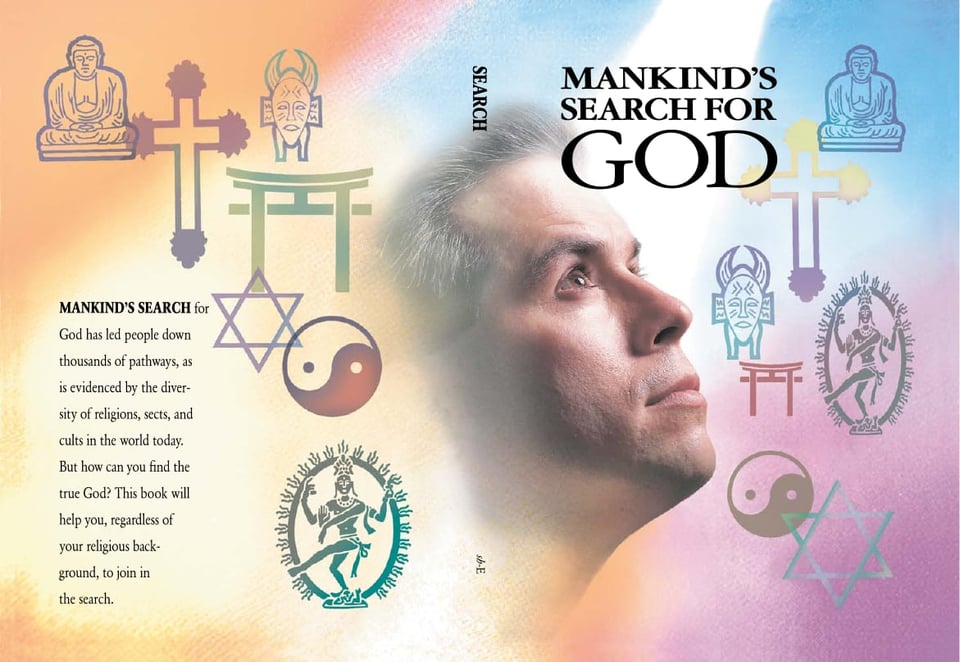
MANKIND'S SEARCH
MANKIND'S SEARCH for
God has led people down thousands of pathways, as is evidenced by the diversity of religions, sects, and cults in the world today. But how can you find the true God? This book will help you, regardless of your religious background, to join in the search.
SEARCH
MANKIND'S SEARCH FOR GOD
MANKIND'S SEARCH FOR GOD
During the thousands of years of mankind's history, man's search for God has led down many pathways. The result has been the enormous diversity of religious expression found worldwide from the endless variety of Hinduism to the monotheism of Judaism, Islam, and Christendom and to the Oriental philosophies of Shinto, Taoism, Buddhism, and Confucianism. In other vast regions, mankind has turned to animism, magic, spiritism, and shamanism. Has this search for God been successful? Through this book we invite you, regardless of your religious background, to join in this fascinating search for the true God.-The Publishers © 1990
WATCH TOWER BIBLE AND TRACT SOCIETY OF PENNSYLVANIA All Rights Reserved
Publishers
WATCHTOWER BIBLE AND TRACT SOCIETY OF NEW YORK, INC. Brooklyn, New York, U.S.A.
2006 Printing
This publication is provided as part of a worldwide Bible educational work supported by voluntary donations.
Symbols for translations of the Bible and for other religious books used herein:
AS - American Standard Version, American Revision Committee (1901)
AYA - The Holy Qur'an, translation by Abdullah Yusuf Ali (1934)
BG - Bhagavad gita as It Is, Abridged Edition, translation by A. C. Bhaktivedanta Swami Prabhupada (1976)
Int - The Kingdom Interlinear Translation of the Greek Scriptures (1985)
JP -The Holy Scriptures, The Jewish Publication Society of America (1955)
KJ King James Version (1611)
MMP - The Glorious Qur'an, translation by Muhammad M. Pickthall (1977)
NAB - The New American Bible, Saint Joseph Edition (1970)
NJD - The Koran, translation by N.J. Dawood (1974)
NW - New World Translation of the Holy Scriptures—With References (1984)
RS - Revised Standard Version, Catholic Edition (1966)
Ta - Tanakh, The Holy Scriptures, The New Jewish Publication Society Translation (1985)
Unless otherwise stated, Bible quotations or citations are from the New World Translation of the Holy Scriptures.
Bibliography of Some Major Works Consulted
Abhrington Dictionary of Living Religions, K. Gin, editor. 1969. Ancient Near Eastern Texts Relating to the Old Testament, J. B. Pritchard, editor. 1969. Ancient Sun Kingdom of the Americas, The. 1970. The Book of Genesis, K. Gin, editor. 1939. Buddhism, Richard A. Gard, editor. 1961. Culebrum of Christianity, The. O. Bailo
Mankind's Search for God English (sh-E)
Made in the United States of America CONTENTS
Chapter Page
Why Be Interested in Other Religions? 5
Religion—How Did It Begin? 19
Common Threads in Mythology 41
Searching for the Unknown Through Magic and Spiritism 69
Hinduism—A Search for Liberation 95
Buddhism—A Search for Enlightenment Without God 129
Taoism and Confucianism—A Search for Heaven’s Way 161
Shinto—Japan’s Search for God 187
Judaism—Searching for God Through Scripture and Tradition 205
Christianity—Was Jesus the Way to God? 235
Apostasy—The Way to God Blocked 261
Islām—The Way to God by Submission 284
The Reformation—The Search Took a New Turn 306
Modern Disbelief—Should the Search Continue? 329
A Return to the True God 344
The True God and Your Future 366
Subject Index 380
Picture Credits 383 Hindus revere the river Ganges called Ganga Ma, or Mother Ganga
Sincere Catholics ▶ turn to Mary in their use of the rosary
▼ In some Buddhist countries, most males serve some time as saffron-robed monks
Faithful Muslims ▼ make a pilgrimage to Mecca at least once Why Be Interested in Other Religions?
REGARDLESS of where you live, you have no doubt seen for yourself how religion affects the lives of millions of people, maybe yours too. In countries where Hinduism is practiced, you will often see people doing puja—a ceremony that may include making offerings to their gods, in the form of coconut, flowers, and apples. A priest will apply a spot of red or yellow pigment, the tilak, to the foreheads of the believers. Millions also flock each year to the river Ganges to be purified by its waters.
2 In Catholic countries, you will see people praying in churches and cathedrals while holding a crucifix or a rosary. The beads of the rosary are used for counting prayers offered in devotion to Mary. And it is not difficult to identify nuns and priests, distinctive in their black garb.
3 In Protestant lands, chapels and churches abound, and on Sunday parishioners usually put on their best clothes and congregate to sing hymns and hear sermons. Often their clergy wear a black suit and a distinguishing clerical collar.
4 In Islamic countries, you can hear the voices of the muezzins, the Muslim criers who make the call from minarets five times a day, summoning the faithful to the Jehovah's Witnesses, known worldwide for their preaching activity, in a Japanese city
salat, or ritual prayer. They view the Holy Qur'an as the Islamic book of scripture. According to Islamic belief, it was revealed by God and was given to the prophet Muhammad by the angel Gabriel in the seventh century C.E.
5 On the streets of many Buddhist lands, the monks of Buddhism, usually in saffron, black, or red robes, are seen as a sign of piety. Ancient temples with the serene Buddha on display are evidence of the antiquity of the Buddhist faith.
Practiced mainly in Japan, Shinto enters into daily life with family shrines and offerings to ancestors. The Japanese feel free to pray for the most mundane things, even success in school examinations.
7 Another religious activity known the world over is that of people going from house to house and standing on the streets with Bibles and Bible literature. With the Watchtower and Awake!
magazines in evidence, nearly everyone recognizes these people as Jehovah's Witnesses.
8 What does this great worldwide variety of religious devotion indicate? That for thousands of years mankind has had a spiritual need and yearning. Man has lived with his trials and burdens, his doubts and questions, including the enigma of death. Religious feelings have been expressed in many different ways as people have turned to God or their gods, seeking blessings and solace. Religion also tries to address the great questions: Why are we here? How should we live? What does the future hold for mankind?
9 On the other hand, there are millions of people who profess no religion nor any belief in a god. They are atheists. Others, agnostics, believe that God is unknown and probably unknowable. However, that obviously does not mean that they are people without principles or ethics, any more than professing a religion means that one does have them. However, if one accepts religion as being "devotion to some principle; strict fidelity or faithfulness; conscientiousness; pious affection or attachment," then most people, including atheists and agnostics, do have some form of religious devotion in their lives.—The Shorter Oxford English Dictionary.
10 With so many religions in a world that gets smaller and smaller by virtue of ever faster travel and communication, the impact of various faiths is felt worldwide, whether we like it or not. The outrage that broke out in 1989 over the book The Satanic Verses, written by what some people termed 'an apostate Muslim,' is clear evidence of how religious sentiment can manifest itself on a global scale.
There were calls from Islamic leaders for the book to be banned and even for the author to be put to death. What makes people react so vehemently in matters of religion?
11 To answer that, we need to know something about the background of the world's religions. As Geoffrey Parrinder states in World Religions—From Ancient History to the Present: "To study different religions need not imply infidelity to one's own faith, but rather it may be enlarged by seeing how other people have sought for reality and have been enriched by their search." Knowledge leads to understanding, and understanding to tolerance of people with a different viewpoint.
Why Investigate?
12 Have you ever thought or said, I have my own religion. It is a very personal matter. I do not discuss it with others? True, religion is very personal—virtually from birth religious or ethical ideas are implanted in our mind by our parents and relatives. As a consequence, we usually follow the religious ideals of our parents and grandparents. Religion has become almost a matter of family tradition. What is the result of that process? That in many cases others have chosen our religion for us. It has simply been a matter of where we were born and when. Or, as historian Arnold Toynbee indicated, an individual's adherence to a certain faith is often determined by "the geographical accident of the locality of his birth-place."
A baby being baptized in one of Christendom's churches. Is the religion of one's birth necessarily the true one?
13 Is it reasonable to assume that the religion imposed at one's birth is necessarily the whole truth? If you were born in Italy or South America, then, without any choice, you were probably raised a Catholic. If you were born in India, then likely you automatically became a Hindu or, if from the Punjab, perhaps a Sikh. If your parents were from Pakistan, then you would obviously be a Muslim.
And if you were born in a Socialist country over the last few decades, you might have had no choice but to be raised an atheist.—Galatians 1:13, 14; Acts 23:6.
14 Therefore, is the religion of one's birth automatically the true one, approved by God? If that had been the concept followed over the millenniums, many among mankind would still be practicing primitive shamanism and ancient fertility cults, on the premise that 'what was good enough for my ancestors is good enough for me.'
15 With the wide diversity of religious expression that has developed around the world over the past 6,000 years, it is at least educational and mind broadening to understand what others believe and how their beliefs originated. And it might also open up vistas of a more concrete hope for your future.
16 In many countries now, owing to immigration and population movement, people of different religions share the same neighborhood. Therefore, understanding one another's viewpoint can lead to more meaningful communication and conversation between people of different faiths. Perhaps, too, it may dissipate some of the hatred in the world that is based on religious differences. True, people may strongly disagree about their religious beliefs, but there is no basis for hating a person just because he or she holds a different viewpoint.—1 Peter 3:15; 1 John 4:20, 21; Revelation 2.6.
17 The ancient Jewish law stated: "You shall not hate your kinsfolk in your heart.
Reprove your kinsman but incur no guilt because of him. You shall not take vengeance or bear a grudge against your countrymen. Love your fellow as yourself: I am the LORD [Jehovah]." (Leviticus 19:17, 18, Ta) The Founder of Christianity stated: "But I say to you who are listening, Continue to love your enemies, to do good to those hating you, . . . and your reward will be great, and you will be sons of the Most High, because he is kind toward the unthankful and wicked." (Luke 6:27, 35) Under the heading "She That Is To Be Examined," the Qur'an states a similar principle (surah 60:7, MMP): "It may be that Allah will bring about friendship between you and those of them whom you hold as enemies. And Allah is Powerful; and Allah is Forgiving, Merciful."
Aztec human sacrifice
—are all religions really "equal ways to the truth"?
18 However, while tolerance and understanding are needed, that does not imply that it makes no difference what one believes. As historian Geoffrey Parrinder stated: "It is sometimes said that all religions have the same goal, or are equal ways to the truth, or even that all teach the same doctrines . . . Yet the ancient Aztecs, who held up the beating hearts of their victims to the sun, surely did not have as good a religion as that of the peaceful Buddha." Furthermore, when it comes to worship, is it not God himself who should determine what is and is not acceptable?—Micah 6.8.
How Should Religion Be Measured?
19 While most religions have a body of beliefs or doctrines, these can often form a very complicated theology, beyond the understanding of the average layperson. Yet the principle of cause and effect applies in every case. The teachings of a religion should influence the personality and the daily conduct of each believer. Thus, each person's conduct will normally be a reflection, to a greater or lesser degree, of that one's religious background. What effect does your religion have on you? Does your religion produce a kinder person? More generous, honest, humble, tolerant, and compassionate? These are reasonable questions, for as one great religious teacher, Jesus Christ, stated: "Every good tree produces fine fruit, but rotten tree produces worthless fruit; a good tree cannot bear worthless fruit, neither can a rotten tree produce fine fruit. Every tree not producing fine fruit gets cut down and thrown into the fire. Really, then, by their fruits you will recognize those men." —Matthew 7:17-20.
In the name of religion, millions have killed and been killed
20 Certainly world history must give us pause and make us wonder what role religion has played in the many wars that have devastated mankind and caused untold suffering. Why have so many people killed and been killed in the name of religion? The Crusades, the Inquisition, the conflicts in the Middle East and Northern Ireland, the slaughter between Iraq and Iran (1980-88), the Hindu-Sikh clashes in India—all these events certainly make thinking people raise questions about religious beliefs and ethics.
See box below.
21 The realm of Christendom has been noteworthy for its hypocrisy in this field. In two world wars, Catholic has killed Catholic and Protestant has killed Protestant at the
What are some examples of Christendom's fruitage?
Religion, Love, and Hatred
"Religious wars tend to be extra furious. When people over territory for economic advantage, they reach the point where the battle isn't worth the cost and so compromise. When the cause is religious, compromise and conciliation seem to be evil." - Roger Shinn, professor of social ethics, Union Theological Seminary, New York.
"Men will wangle for religion, write for it, fight for it, die for it; anything but live for it . . . Where true religion has prevented one crime, false religions have afforded a pretext for a thousand."—Charles Caleb Colton (1825).
"We have just enough religion to make us hate, but not enough to make us love one another."—Jonathan Swift (1667-1745).
"Men never do evil so completely and cheerfully as when they do it from religious conviction." -Blaise Pascal (1623-62).
"The true purpose of a higher religion is to radiate the spiritual counsels and truths that are its essence into as many souls as it can reach, in order that each of these souls may be enabled thereby to fulfil the true end of Man. Man's true end is to glorify God and to enjoy Him for ever."—Arnold Toynbee, historian.
behest of their "Christian" political leaders. Yet the Bible clearly contrasts the works of the flesh and the fruitage of the spirit. Regarding the works of the flesh, it states: "They are fornication, uncleanness, loose conduct, idolatry, practice of spiritism, enmities, strife, jealousy, fits of anger, contentions, divisions, sects, envies, drunken bouts, revelries, and things like these. As to these things I am forewarning you, the same way as I did forewarn you, that those who practice such things will not inherit God's kingdom." Yet so-called Christians have practiced these things for centuries, and their conduct has often been condoned by their clergy.—Galatians 5:19-21.
22 In contrast, the positive fruitage of the spirit is described as: "love, joy, peace, long-suffering, kindness, goodness, faith, mildness, self-control. Against such things there is no law." All religions ought to be producing this kind of peaceable fruitage. But do they? Does yours?—Galatians 5:22, 23.
23 Therefore, this book's examination of mankind's search for God through the world's religions should serve to answer some of our questions. But by what criteria should a religion be judged? By whose standard?
'My Religion Is Good Enough for Me'
24 Many people dismiss religious discussion by saying, 'My religion is good enough for me. I don't do any harm to anyone else, and I help when I can.' But does that go far enough? Are our personal criteria on religion sufficient?
25 If religion is "the expression of man's belief in and reverence for a superhuman power recognized as the creator and governor of the universe," as one dictionary states, then surely the question should be, Is my religion good enough for the creator and governor of the universe? Also, in that case, the Creator would have the right to establish what is acceptable conduct, worship, and doctrine and what is not. To do that, he must reveal his
All religions ought to produce peaceable fruitage. But do they?
will to mankind, and that revelation must be easily available and accessible to all. Furthermore, his revelations, even though provided
centuries apart, should always be harmonious and consistent. This presents a challenge to each person—to examine the evidence and prove for oneself what the acceptable will of God is.
26 One of the most ancient books claiming inspiration by God is the Bible. It is also the most widely circulated and translated book in all history. Nearly two thousand years ago, one of its writers stated: "Quit being fashioned after this system of things, but be transformed by making your mind over, that you may prove to yourselves the good and acceptable and perfect will of God." (Romans 12.2) What would be the source of such proof? The same writer stated: "All Scripture is inspired of God and beneficial for teaching, for reproving, for setting things straight, for disciplining in righteousness, that the man of God may be fully competent, completely equipped for every good work."
Therefore, the inspired Bible should serve as a reliable measuring rod for true and acceptable worship. —2 Timothy 3:16, 17.
27 The oldest portion of the Bible predates all of the world's other religious writings. The Torah, or first five books of the Bible, the Law written under inspiration by Moses, dates back to the 15th and 16th centuries B.C.E. By comparison, the Hindu writings of the Rig-Veda (a collection of hymns) were completed about 900 B.C.E. and do not claim divine inspiration. The Buddhist "Canon of the Three Baskets" dates back to the fifth century B.C.E. The Qur'an, claimed to have been transmitted from God through the angel Gabriel, is a product of the seventh century C.E. The Book of Mormon, reportedly given to Joseph Smith in the United States by an angel called Moroni, is a product of the 19th century. If some of these works are divinely inspired as some assert, then what they offer in terms of religious guidance should not contradict the teachings of the Bible, which is the original inspired source. They should also answer some of mankind's most intriguing questions.
Questions That Require an Answer
28 (1) Does the Bible teach what the majority of religions teach and what many people believe, namely, that humans have an immortal soul and that at death it moves on to another realm, the "hereafter," heaven, hell, or purgatory, or that it returns in a reincarnation?
universe is nameless? Does it teach that he is one God? or three persons in one God? or many gods?
(3) What does the Bible say was God's original purpose in creating mankind for life on earth?
(4) Does the Bible teach that the earth will be destroyed? Or does it point only to an end, or conclusion, for the corrupt world system?
(5) How can inner peace and salvation really be achieved?
29 Each religion has different answers, but in our search for the "pure religion," we should eventually reach the conclusions that God wants us to reach. (James 1:27; AS; KJ) Why can we say that? Because our basic principle will be: "Let God be found true, though every man be found a liar, even as it is written: 'That you might be proved righteous in your words and might win when you are being judged.'"—Romans 3:4.*
30 Now that we have a basis for examining the world's religions, let us turn to mankind's early quest for spirituality. What do we know about how religion began? What patterns of worship were established among the ancient and perhaps primitive peoples?
Religion How Did It Begin?
HE history of religion is as old as the history of man himself. That is what archaeologists and anthropologists tell us. Even among the most "primitive," that is to say, undeveloped, civilizations, there is found evidence of worship of some form. In fact The New Encyclopedia Britannica says that "as far as scholars have discovered, there has never existed any people, anywhere, at any time, who were not in some sense religious."
2 Besides its antiquity, religion also exists in great variety. The headhunters in the jungles of Borneo, the Eskimos in the frozen Arctic, the nomads in the Sahara Desert, the urban dwellers in the great metropolises of the world—every people and every nation on earth has its god or gods and its way of worship. The diversity in religion is truly staggering.
3 Logically, questions come to mind. From where did all these religions come? Since there are marked differences as well as similarities among them, did they start independently, or could they have developed from one source? In fact we might ask: Why did religion begin at all? And how? The answers to these questions are of vital importance to all who are interested in finding the truth about religion and religious beliefs.
Question of Origin
4 When it comes to the question of origin, people of different religions think of names such as Muhammad, the Buddha, Confucius, and Jesus. In almost every religion, we can find a central figure to whom credit is given for establishing the 'true faith'. Some of these were iconoclastic reformers. Others were moralistic philosophers. Still others were selfless folk heroes. Many of them have left behind writings or sayings that formed the basis of a new religion. In time what they said and did was elaborated, embellished, and given a mystic aura. Some of these leaders were even deified.
Even though these individuals are considered founders of the major religions that we are familiar with, it must be noted that they did not actually originate religion. In most cases, their teachings grew out of existing religious ideas, even though most of these founders claimed divine inspiration as their source. Or they changed and modified existing religious systems that had become unsatisfactory in one way or another.
For example, as accurately as history can tell us, the Buddha had been a prince who was appalled by the suffering and deplorable conditions he found surrounding him in a society dominated by Hinduism. Buddhism was the result of his search for a solution to life's agonizing problems. Similarly, Muhammad was highly disturbed by the idolatry and immorality he saw in the religious pracMen such as the Buddha,
Confucius, and Luther changed existing
religious systems; they did not
originate religion
tices around him. He later claimed to have received special revelations from God, which formed the Qur'an and became the basis of a new religious movement, Islam. Protestantism grew out of Catholicism as a result of the Reformation that began in the early 16th century, when Martin Luther protested the sale of indulgences by the Catholic church at that time.
7 Thus, as far as the religions now in existence are concerned, there is no lack of information regarding their origin and development, their founders, their sacred writings, and so on. But what about the religions that existed before them? And the ones even before those? If we go back far enough in history, we will sooner or later be confronted with the question: How did religion begin?
Clearly, to find the answer to that question, we must look beyond the confines of the individual religions.
Many Theories
8 The study of the origin and development of religion is a comparatively new field. For centuries, people more or less accepted the religious tradition into which they were born and in which they were brought up. Most of them were satisfied with the explanations handed down to them by their forefathers, feeling that their religion was the truth. There was seldom any reason to question anything, nor the need to investigate how, when, or why things got started. In fact, for centuries, with limited means of travel and communication, few people were even aware of other religious systems.
9 During the 19th century, however, the picture began to change. the theory of evolution was sweeping through intellectual circles. That, along with the advent of scientific inquiry, caused many to question established systems, including religion. Recognizing the limitations of looking for clues within existing religion, some scholars turned to the remains of early civilizations or to the remote corners of the world where people still lived in primitive societies. They tried to apply to these the methods of psychology, sociology, anthropology, and so forth, hoping to discover a clue as to how religion began and why.
10 What was the outcome? Suddenly, there burst upon the scene many theories—as many as there were investigators, it seemed—with each investigator contradicting the other, and each endearing to outdo the other in daring and originality.
Some of these researchers arrived at important conclusions; the work of others has simply been forgotten. It is both educational and enlightening for us to get a glimpse of the results of this research. It will help us to gain a better understanding of the religious attitudes among people we meet.
11 A theory, commonly called animism, was proposed by the English anthropologist Edward Tylor (1832-1917).
The advent of scientific inquiry and the theory of evolution caused many to question religion
He suggested that experiences such as dreams, visions, hallucinations, and the lifelessness of corpses caused primitive people to conclude that the body is inhabited by a soul (Latin, anima).
According to this theory, since they frequently dreamed about their deceased loved ones, they assumed that a soul continued living after death, that it left the body and dwelt in trees, rocks, rivers, and so on. Eventually, the dead and the objects the souls were said to inhabit came to be worshiped as gods. And thus, said Tylor, religion was born.
12 Another English anthropologist, R. R. Marett (1866-1943), proposed a refinement of animism, which he called animatism. After studying the beliefs of the Melanesians of the Pacific islands and the natives of Africa and America, Marett concluded that instead of having the notion of a personal soul, primitive people believed there was an impersonal force or supernatural power that animated everything; that belief evoked emotions of awe and fear in man, which became the basis for his primitive religion.
To Marett, religion was mainly man's emotional response to the unknown. His favorite statement was that religion was "not so much thought out as danced out."
13 In 1890 a Scottish expert in ancient folklore, James Frazer (1854-1941), published the influential book The Golden Bough, in which he argued that religion grew out of magic. According to Frazer, man first tried to control his own life and his environment by imitating what he saw happening in nature. For example, he thought that he could invoke rain by sprinkling water on the ground to the accompaniment of thunderlike drumbeats or that he could cause his enemy harm by sticking pins in an effigy. This led to the use of rituals, spells, and magical objects in many areas of life. When these did not work as expected, he then turned to placating and beseeching the help of the supernatural powers, instead of trying to control them. The rituals and incantations became sacrifices and prayers, and thus religion began. In Frazer's words, religion is "a propitiation or conciliation of powers superior to man."
14 Even the noted Austrian psychoanalyst Sigmund Freud (1856-1939), in his book Totem and Taboo, tried to explain the origin of religion. True to his profession, Austrian
psychoanalyst
Sigmund Freud
attributed religion
to fear of a
father figure
Freud explained that the earliest religion grew out of what he called a father-figure neurosis. He theorized that, as was true with wild horses and cattle, in primitive society the father dominated the clan. The sons, who both hated and admired the father, rebelled and killed the father. To acquire the father's power, Freud claimed, 'these cannibalistic savages ate their victim.' Later, out of remorse, they invented rites and rituals to atone for their action. In Freud's theory, the father figure became God, the rites and rituals became the earliest religion, and the eating of the slain father became the tradition of communion practiced in many religions.
15 Numerous other theories that are attempts to explain the origin of religion could be cited. Most of them, however, have been forgotten, and none of them have really stood out as more credible or acceptable than the others. Why? Simply because there was never any historical evidence or proof that these theories were true. They were purely products of some investigator's imagination or conjecture, soon to be replaced by the next one that came along.
What has happened to most of the proposed theories on the origin of religion?
A Faulty Foundation
16 After years of struggling with the issue, many have now come to the conclusion that it is most unlikely that there will be any breakthrough in finding the answer to the question of how religion began. First of all, this is because bones and remains of ancient peoples do not tell us how those people thought, what they feared, or why they worshiped. Any conclusions drawn from these artifacts are educated guesses at best. Second, the religious practices of today's so-called primitive people, such as the Australian Aborigines, are not necessarily a reliable gauge for measuring what people of ancient times did or thought. No one knows for sure if or how their culture changed over the centuries.
17 Because of all the uncertainties, the book World Religions—From Ancient History to the Present concludes that "the modern historian of religions knows that it is impossible to reach the origins of religion." Regarding the historians' efforts, however, the book makes this observation: "In the past too many theorists were concerned not simply to describe or explain religion but to explain it away, feeling that if the early forms were shown to be based upon illusions then the later and higher religions might be undermined."
18 In that last comment lies the clue as to why various "scientific" investigators of the origin of religion have not come up with any tenable explanations. Logic tells us that a The premise that the earth was the center of the universe led to erroneous conclusions about planetary movements
correct conclusion can be deduced only from a correct premise. If one starts off with a faulty premise, it is unlikely that one will reach a sound conclusion. The repeated failure of the "scientific" investigators to come up with a reasonable explanation casts serious doubts on the premise upon which they based their views. By following their preconceived notion, in their efforts to 'explain religion away' they have attempted to explain God away.
19 The situation can be compared to the many ways astronomers prior to the 16th century tried to explain the movement of the planets.
There were many theories, but none of them were really satisfactory. Why? Because they were based upon the assumption that the earth was the center of the universe around which the stars and planets revolved. Real progress was not made until scientists—and the Catholic Church—were willing to accept the fact
Why Is Man Religious?
■ John B. Noss points out in his book Man's Religions:
"All religions say in one way or another that man does not, and cannot, stand alone. He is vitally related with and even dependent on powers in Nature and Society external to himself. Dimly or clearly, he knows that he is not an independent center of force capable of standing apart from the world."
Similarly, the book World Religions—From Ancient History to the Present says: "The study of religion reveals that an important feature of it is a longing for value in life, a belief that life is not accidental and meaningless. The search for meaning leads to faith in a power greater than the human, and finally to a
universal or superhuman mind which has the intention and will to maintain the highest values for human life."
So religion satisfies a basic human need, much as food satisfies our hunger. We know that eating indiscriminately when we are hungry may stop the pangs of hunger; in the long run, however, it will damage our health. To lead a healthy life, we need food that is wholesome and nutritious. Likewise, we need wholesome spiritual food to maintain our spiritual health. That is why the Bible tells us: "Not by bread alone does man live but by every expression of Jehovah's mouth."—Deuteronomy 8:3.
that the earth was not the center of the universe but revolved around the sun, the center of the solar system. The failure of the many theories to explain the facts led open-minded individuals, not to try to come up with new theories, but to reexamine the premise of their investigations. And that led to success.
20 The same principle can be applied to the investigation of the origin of religion. Because of the rise of atheism and the widespread acceptance of the theory of evolution, many people have taken for granted that God does not exist. Based on this assumption, they feel that the explanation for the existence of religion is to be found in man himself—in his thought processes, his needs, his fears, his "neuroses." Voltaire stated, "If God did not exist, it would be necessary to invent him"; so they argue that man has invented God.—See box, page 28.
21 Since the many theories have failed to provide a truly satisfying answer, is it not time now to reexamine the premise upon which these investigations were based? Instead of laboring fruitlessly in the same rut, would it not be logical to look elsewhere for the answer? If we are willing to be open-minded, we will agree that to do so is both reasonable and scientific. And we have just such an example to help us see the logic behind this course.
An Ancient Inquiry
22 In the first century of our Common Era, Athens, Greece, was a prominent center of learning.
Among the Athenians, however, there were many different schools of thought, such as the Epicureans and the Stoics, each with its own idea about the gods. Based on these various ideas, many deities were venerated, and different ways of worship developed. As a result, the city was full of manmade idols and temples.—Acts 17:16.
23 In about the year 50 C.E., the Christian apostle Paul visited Athens and presented to the Athenians a totally different point of view. He told them: "The God that made the world and all the things in it, being, as this One is, Lord of heaven and earth, does not dwell in hand-made temples, neither is he attended to by human hands as if he needed anything, because he himself gives to all persons life and breath and all things."—Acts 17: 24, 25.
24 In other words, Paul was telling the Athenians that the true God, who "made the world and all the things in it," is not a fabrication of man's imagination, nor is he served by ways that man might devise. True religion is not just a one-sided effort by man to try to fill a certain psychological need or quell a certain fear. Rather, since the true God is the Creator, who gave man thinking ability and power of reason, it is only logical that He would provide a way for man to come into a satisfying relationship with Him. That, according to Paul, was exactly what God did. "He made out of one man every nation of men, to dwell upon the entire surface of the earth, . . . for them to seek God, if they might grope for him and really find him, although, in fact, he is not far off from each one of us."—Acts 17:26, 27.
25 Notice Paul's key point: God "made out of one man every nation of men." Even though today there are many nations of men, living all over the earth, scientists know that, indeed, all mankind is of the same stock. This concept is of great significance because when we speak of all mankind's being of the same stock, it means much more than their being related just biologically and genetically. They are related in other areas as well.
26 Note, for instance, what the book Story of the World's Worship says about man's language. "Those who have studied the languages of the world and compared them with each other have something to say, and it is this: All languages can be grouped into families or classes of speech, and all these families are seen to have started from one common source." In other words, the languages of the world did not originate separately and independently, as evolutionists would have us believe. They theorize that cave-dwelling men in Africa, Europe, and Asia started with their grunts and growls and eventually developed their own languages. That was not the case. Evidence is that they "started from one common source."
27 If that is true of something as personal and as uniquely human as language, then would it not be reasonable to think that man's ideas about God and religion should also have started from one common source?
After all, religion is related to thinking, and thinking is related to man's ability to use language. It is not that all religions actually grew out of one religion, but the ideas and concepts should be traceable to some common origin or pool of religious ideas. Is there evidence to support this? And if, indeed, man's religions did originate in one single source, what might it be? How can we find out?
Different yet Similar
28 We can get the answer in the same way that linguistic experts got their answers about the origin of language. By placing the languages side by side and noting their similarities, an etymologist can trace the various languages back to their source. Similarly, by placing the religions side by side, we can examine their doctrines, legends, rituals, ceremonies, institutions, and so on, and see if there is any underlying thread of common identity and, if so, to what that thread leads us.
29 On the surface, the many religions in existence today seem quite different from one another. However, if we strip them of the things that are mere embellishments and later additions, or if we remove those distinctions that are the result of climate, language, peculiar conditions of their native land, and other factors, it is amazing how similar most of them turn out to be.
Chinese Buddhist goddess of mercy with infant
Tibetan Buddhist using prayer wheel and rosary
Buddhism and Roman Catholicism — why do they appear to have many things in common?
Catholic Madonna with infant Jesus
Catholic using rosary 30 For example, most people would think that there could hardly be any two religions more different from each other than the Roman Catholic Church of the West and Buddhism of the East.
However, what do we see when we put aside the differences that could be attributed to language and culture? If we are objective about it, we have to admit that there is a great deal that the two have in common. Both Catholicism and Buddhism are steeped in rituals and ceremonies. These include
It is as if there was a common pool from which each religion drew its basic beliefs
the use of candles, incense, holy water, the rosary, images of saints, chants and prayer books, even the sign of the cross. Both religions maintain institutions of monks and nuns and are noted for celibacy of priests, special garb, holy days, special foods. This list is by no means exhaustive, but it serves to illustrate the point. The question is, Why do two religions that appear to be so different have so many things in common?
31 As enlightening as the comparison of these two religions turns out to be, the same can be done with other religions. When we do so, we find that certain teachings and beliefs are almost universal among them. Most of us are familiar with such doctrines as the immortality of the human soul, heavenly reward for all good people, eternal torment for the wicked in an underworld, purgatory, a triune god or a godhead of many gods, and a mother-ofgod or queen-of-heaven goddess.
Beyond these, however, there are many legends and myths that are equally commonplace. For example, there are legends about man's fall from divine grace owing to his illicit attempt to achieve immortality, the need to offer sacrifices to atone for sin, the search for a tree of life or fountain of youth, gods and demigods who lived among humans and produced superhuman offspring, and a catastrophic flood that devastated nearly all of humanity.*
32 What can we conclude from all of this? We note that those who believed in these myths and legends lived far from one another geographically. Their culture and traditions were different and distinct. Their social customs bore no relationship to one another. And yet, when it comes to their religions, they believed in such similar ideas. Although not every one of these peoples believed in all the things mentioned, all of them believed in some of them. The obvious question is, Why? It was as if there was a common pool from which each religion drew its basic beliefs, some more, some less. With the passage of time, these basic ideas were embellished and modified, and other teachings developed from them. But the basic outline is unmistakable.
33 Logically, the similarity in the basic concepts of the many religions of the world is strong evidence that they Chinese legends speak of a golden age during the reign of Huang-Ti (Yellow Emperor) in mythical times
did not begin each in its own separate and independent way. Rather, going back far enough, their ideas must have come from a common origin. What was that origin?
An Early Golden Age
34 Interestingly, among the legends common to many religions is one that says humankind began in a golden age in which man was guiltless, lived happily and peacefully in close communion with God, and was free from sickness and death. While details may differ, the same concept of a perfect paradise that once existed is found in the writings and legends of many religions.
35 The Avesta, the sacred book of the ancient Persian Zoroastrian religion, tells about "the fair Yima, the good shepherd," who was the first mortal with whom Ahura Mazda (the creator) conversed. He was instructed by Ahura Mazda "to nourish, to rule, and to watch over my world."
To do so, he was to build "a Vara," an underground abode, for all the living creatures. In it, there "was neither overbearing nor mean-spiritedness, neither stupidity nor violence, neither poverty nor deceit, neither puniness nor deformity, neither huge teeth nor bodies beyond the usual measure. The inhabitants suffered no defilement from the evil spirit. They dwelt among odoriferous trees and golden pillars; these were the largest, best and most beautiful on earth; they were themselves a tall and beautiful race."
36 Among the ancient Greeks, Hesiod's poem Works and Days speaks of the Five Ages of Man, the first of which was the "Golden Age" when men enjoyed complete happiness. He wrote:
"The immortal gods, that tread the courts of heaven,
First made a golden race of men.
Like gods they lived, with happy, careless souls,
From toil and pain exempt; nor on them crept
Wretched old age, but all their life was passed
In feasting, and their limbs no changes knew."
That legendary golden age was lost, according to Greek mythology, when Epimetheus accepted as wife the beautiful Pandora, a gift from the Olympian god Zeus. One day Pandora opened the lid of her great vase, and suddenly there escaped from it troubles, miseries, and illness from which mankind was never to recover.
37 Ancient Chinese legends also tell of a golden age in the days of Huang-Ti (Yellow Emperor), who is said to have ruled for a hundred years in the 26th century B.C.E.
He was credited with inventing everything having to do with civilization—clothing and shelter, vehicles of transportation, weapons and warfare, land management, manufacturing, silk culture, music, language, mathematics, the calendar, and so on. During his reign, it is said, "there were no thieves nor fights in China, and the people lived in humility and peace. Timely rain and weather resulted in abundant harvest year after year. Most amazing was that even the wild beasts did not kill, and birds of prey did no harm. In short, the history of China began with a paradise." To this day, the Chinese still claim to be the descendants of the Yellow Emperor.
38 Similar legendary accounts of a time of happiness and perfection at the beginning of man's history can be found in the religions of many other peoples—Egyptians, Tibetans, Peruvians, Mexicans, and others. Was it just by accident that all these peoples, who lived far from each other and who had totally different cultures, languages, and customs, entertained the same ideas about their origin? Was it just by chance or coincidence that all of them chose to explain their beginnings in the same way? Logic and experience tell us that this could hardly be so. On the contrary, interwoven in all these legends, there must be some common elements of truth about the beginning of man and his religion.
39 Indeed, there are many common elements discernible among all the different legends about man's beginning. When we put them together, a more complete picture begins to emerge. It tells how God created the first MEDIA
SYRIA
BABYLON
ELAM
EGYPT
PERSIA
As the human race dispersed from Mesopotamia, their religious ideas and memories went with them
man and woman and placed them in a paradise. They were very content and very happy at first, but soon they became rebellious. That rebellion led to the loss of the perfect paradise, only to be replaced by labor and toil, pain and suffering. Eventually mankind became so bad that God punished them by sending a great deluge of waters that destroyed all but one family. As this family multiplied, some of the offspring banded together and started to build an immense tower in defiance of God. God thwarted their scheme by confusing their language and dispersing them to the far corners of the earth.
40 Is this composite picture purely the result of someone's mental exercise? No. Basically, that is the picture presented in the Bible, in the first 11 chapters of the book of Genesis. While we will not go into a discussion of the authenticity of the Bible here, let it be noted that the Bible's account of man's early history is reflected in the key elements found in many legends.* The record reveals that as the human race began to disperse from Mesopotamia, they carried with them their memories, experiences, and ideas everywhere they went.
In time these were elaborated and changed and became the warp and woof of religion in every part of the world. In other words, going back to the analogy used earlier, the account in Genesis constitutes the original, crystal-clear pool from which stemmed the basic ideas about the beginning of man and worship found in the various religions of the world. To these they added their particular doctrines and practices, but the link is unmistakable.
41 In the following chapters of this book, we will discuss in greater detail how specific religions began and developed. You will find it enlightening to note not only how each religion is different from the others but also how it is similar to them. You will also be able to note how each religion fits into the time scheme of human history and the history of religion, how its sacred book or writings relate to the others, how its founder or leader was influenced by other religious ideas, and how it has influenced mankind's conduct and history. Studying mankind's long search for God with these points in mind will help you to see more clearly the truth about religion and religious teachings.
Common Threads in Mythology
WHY consider myths? Are they not just fictions from the distant past? While it is true that many are based on fiction, others are based on fact. Take for example the myths and legends found worldwide that are based on the fact of the world Deluge, or Flood, that the Bible relates.
2 A reason for considering myths is that they are the foundation for beliefs and rites still found in religions today. For example, belief in an immortal soul can be traced from ancient Assyro-Babylonian myths through Egyptian, Greek, and Roman mythology to Christendom, where it has become an underlying tenet in her theology. Myths are evidence that ancient man was searching for gods, as well as for a meaning in life. In this chapter we will briefly cover some of the common themes that arise in the myths of the world's major cultures. As we review these mythologies, we will note how creation, the Flood, false gods and demigods, the immortal soul, and sun worship crop up regularly as common threads in the patchwork of mythology. But why should this be the case?
3 Very often there is a kernel of historical fact, a person, or an event that has later been exaggerated or distorted to form the myth.
One of these historical facts is the Bible's record of creation.*
Fact and Fiction About Creation
4 Creation myths abound, but none have the simple logic of the Bible's creation record. (Genesis, chapters 1, 2) For example, the account given in Greek mythology sounds barbaric. The first Greek to put myths in writing in a systematic way was Hesiod, who wrote his Theogony in the eighth century B.C.E. He explains how the gods and the world began. He starts off with Gaea, or Gaia (Earth), who gives birth to Uranus (Heaven). What follows is explained by scholar Jasper Griffin in The Oxford History of the Classical World:
5 Hesiod tells the story, known to Homer, of the succession of sky gods. First Uranus was supreme, but he Greek and Roman Divinities
Many gods and goddesses of Greek mythology held similar positions in Roman mythology. The table below lists some of them.
<tr><th>Greek
Roman
Role
Aphrodite
Venus
Goddess of love
Apollo
Apollo
God of light, medicine, and poetry
Ares
Mars
God of war
Artemis
Diana
Goddess of hunting and childbirth
Asclepius
Aesculapius
God of healing
Athena
Minerva
Goddess of crafts, war, and wisdom
Cronus
Saturn
To the Greeks, ruler of the Titans and father of Zeus. In Roman mythology, also the god of agriculture
Demeter
Ceres
Goddess of growing things
Dionysus
Bacchus
God of wine, fertility, and wild behavior
Eros
Cupid
God of love
Gaea
Terra
Symbol of the earth, and mother and wife of Uranus
Hephaestus
Vulcan
Blacksmith for the gods and god of fire and metalworking
Hera
Juno
Protector of marriage and women. To the Greeks, sister and wife of Zeus; to the Romans, wife of Jupiter
Hermes
Mercury
Messenger for the gods; god of commerce and science; and protector of travelers, thieves, and vagabonds
Hestia
Vesta
Goddess of the hearth
Hypnos
Somnus
God of sleep
Pluto, Hades
Pluto
God of the underworld
Poseidon
Neptune
God of the sea. In Greek mythology, also god of earthquakes and horses
Rhea
Ops
Wife and sister of Cronus
Uranus
Uranus
Son and husband of Gaea and father of the Titans
Zeus
Jupiter
Ruler of the gods
Based on The World Book Encyclopedia, 1987, Volume 13.
suppressed his children, and Gaia encouraged his son Cronos to castrate him. Cronos in turn devoured his own children, until his wife Rhea gave him a stone to eat in place of Zeus; the child Zeus was brought up in Crete, compelled his father to disgorge his siblings, and with them and other aid defeated Cronos and his Titans and cast them down into Tartarus."
From what source did the Greeks get this strange mythology? The same author answers: "Its ultimate origin seems to have been Sumerian. In these eastern stories we find a succession of gods, and the motifs of castration, of swallowing, and of a stone recur in ways which, though varying, show that the resemblance with Hesiod is no coincidence." We have to look to ancient Mesopotamia and Babylon as the source of many myths that permeated other cultures.
7 The ancient mythology of Chinese folk religion is not always easy to define, since many written records were destroyed in the period 213-191 B.C.E." Some myths have remained, however, such as the one describing how the earth was formed. A professor of Oriental art, Anthony Christie, writes: "We learn that Chaos was like a hen's egg. Neither Heaven nor Earth existed. From the egg P'an-ku was born, while of its heavy elements Earth was made and Sky from the light elements.
P'an-ku is represented as a dwarf, clad in a bearskin or a cloak of leaves. For 18,000 years the distance between Earth and Sky grew daily by ten feet, and P'an-ku grew at the same rate so that his body filled the gap. When he died, different parts of his body became various natural elements... His body fleas became the human race."
8 From South America an Inca legend explains how a mythical creator gave speech to each nation. "He gave to each nation the language it was to speak . . . He gave
According to Inca mythology, how did languages come about?
Assyro-Babylonian Gods and Goddesses
Anu—the supreme god, reigning over the heavens; father of Ishtar
Asshur-national warrior-god of the Assyrians; also god of fertility
Ea god of water. Father of Marduk. Warned Utnapishtim of the flood
Enilil (Bel)—lord of the air; later paralleled in Greek mythology by Zeus. Assimilated by the Babylonians into Marduk (Bel)
Ishtar—divine personification of the planet Venus; sacred prostitution a part of her cult. She was Astarte in Phoenicia, Atargatis in Syria, Athoreth in the Bible (1 Kings 11:5, 33), Aphrodite in Greece, Venus in Rome
Marduk—first among the Babylonian gods; "absorbed all the other gods and took over all their various functions." Called Merodach by the Israelites
Shamash—sun-god of light and justice. Forerunner of the Greek Apollo
Sin—moon-god, member of the triad that included Shamash (the sun) and Ishtar (the planet Venus)
Tammuz (Dumuzi)—the harvest-god. Ishtar's lover
(Based on the New Larousse Encyclopedia of Mythology) being and soul to each one as well [as] the men and the women and commanded each nation to sink below the earth.
Thence each nation passed underground and came up in the places to which he assigned them." (The Fables and Rites of the Yncas, by Cristóbal de Molina of Cuzco, quoted in South American Mythology) In this case it appears that the Bible's account of the confusion of languages at Babel is the factual kernel for this Inca myth. (Genesis 11:1-9) But now let us turn our attention to the Deluge described in the Bible at Genesis 7:17-24.
The Flood—Fact or Myth?
9 Taking us back to some 4,500 years ago, to about 2,500 B.C.E., the Bible tells us that rebel spirit sons of God materialized in human form and "went taking wives for themselves." This unnatural interbreeding produced the violent Nephilim, "the mighty ones who were of old, the men of fame." Their lawless conduct affected the pre-Flood world to the point that Jehovah said: "I am going to wipe men whom I have created off the surface of the ground . . . because I do regret that I have made them.' But Noah found favor in the eyes of Jehovah." The account then continues with the specific and practical steps Noah had to take to save himself, as well as his family and a variety of animal kinds, from the Flood.—Genesis 6:1-8, 13-8:22; 1 Peter 3:19, 20; 2 Peter 2:4; Jude 6.
10 The record of pre-Flood events related in Genesis is Clay tablet in cuneiform writing that presents part of the Epic of Gilgamesh
branded as myth by modern critics. Yet, the history of Noah was accepted and believed by faithful men, such as Isaiah, Ezekiel, Jesus Christ, and the apostles Peter and Paul. It is also supported by the fact that it is reflected in so many mythologies worldwide, including the ancient Epic of Gilgamesh as well as the myths of China and of the Aztecs, Incas, and Maya. With the Bible record in mind, let us now consider the Assyro-Babylonian mythology and its references to a flood.*—Isaiah 54:9;
Ezekiel 14:20; Matthew 24:37; Hebrews 11:7.
The Flood and the God-Man Gilgamesh
11 Going back in history possibly some 4,000 years, we encounter the famous Akkadian myth called the Epic of Gilgamesh. Our knowledge of this is based mainly on a cuneiform text that came from the library of Ashurbanipal, who reigned 668-627 B.C.E., in ancient Nineveh.
12 It is the story of the exploits of Gilgamesh, described as being two-thirds god and one-third man, or a demigod. One version of the epic states: "In Uruk he built walls, a great rampart, and the temple of blessed Eanna for the god of the firmament Anu, and for Ishtar the goddess of love . . . , our lady of love and war." (See box, page 45, for a listing of Assyro-Babylonian gods and goddesses.) However, Gilgamesh was not exactly a pleasant creature to have around. The inhabitants of Uruk complained to the gods: "His lust leaves no virgin to her lover, neither the warrior's daughter nor the wife of the noble."
13 What action did the gods take in response to the people's protest? The goddess Aruru created Enkidu to be the human rival of Gilgamesh. However, instead of being enemies, they became close friends.
In the course of the epic, Enkidu died. Shattered, Gilgamesh cried: "When I die, shall I not be like Enkidu? Woe has entered my belly. Fearing death, I roam over the steppe." He wanted the secret of immortality and set out to find Utnapishtim, the deluge survivor who had been given immortality with the gods.
14 Gilgamesh eventually finds Utnapisthim, who tells him the story of the flood. As found in Epic tablet XI, known as the Flood Tablet, Utnapisthim recounts instructions given to him concerning the flood: "Tear down (this) house, build a ship! Give up possessions, seek thou life. ... Aboard the ship take thou the seed of all living things." Does this not sound somewhat similar to the Bible's reference to Noah and the Flood? But Utnapisthim cannot bestow immortality upon Gilgamesh. Gilgamesh, disappointed, returns home to Uruk. The account concludes with his death. The overall message of the epic is the sadness and frustration of death and the hereafter. Those ancient people did not find the God of truth and hope. However, the epic's link to the Bible's simple account of the pre-Flood era is quite evident. Now let us turn to the Flood account as it appears in other legends.
Flood Legend in Other Cultures
15 Even earlier than the account in the Epic of Gilgamesh is the Sumerian myth that presents "Ziusudra, the counterpart of the biblical Noah, who is described as a pious, a god-fearing king, constantly on the lookout for Anubis, the jackal-headed god, weighs a heart-soul, on the left scale, against Maat, the goddess of truth and justice, symbolized by a feather; Thoth writes the result on a tablet before announcing it to Osiris
divine revelations in dreams or incantations." (Ancient Near Eastern Texts Relating to the Old Testament) According to the same source, this myth "offers the closest and most striking parallel to biblical material as yet uncovered in Sumerian literature." The Babylonian and Assyrian civilizations, which came later, were influenced by the Sumerian.
16 The book China—A History in Art tells us that one of the ancient rulers of China was Yü, "the conqueror of the Great Flood. Yü channeled flood waters into rivers and seas to resettle his people." Mythology expert Joseph Campbell wrote about the Chinese "Period of the Great Ten," saying: "To this important age, which terminates in a Deluge, ten emperors were assigned in the early Choutime mythology.
…