Uncovered (1937)
Download: PDF — Uncovered (1937)
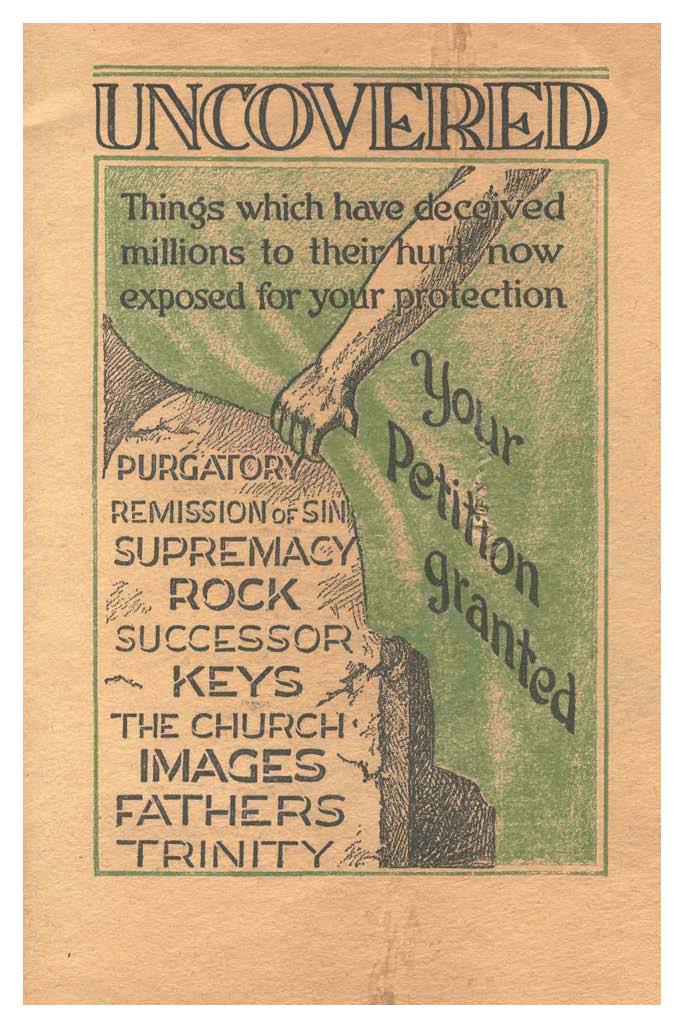
THEY HAVE NOT SIGNED IN VAIN, those 2,630,000 honest Catholics, Protestants, Jews and churchless people, who signed that 1936 petition to the U. S. Federal Communications Commission and Radio Stations of America. They petitioned for public debate, by radio, on those issues vital to the salvation of mankind, between a high official of the Roman Catholic Hierarchy and the one whom the Hierarchy accuses, Judge Rutherford. No action having followed, to date, since Petition was presented to the Commission at Washington, D.C., on November 2, 1936, therefore Judge Rutherford, in this booklet, offers his side of the proposed debate by appeal to the very ^ame Holy Scriptures and also Catholic authorities to which the Hierarchy kys claim. UNCOVERED! ________________c.__
Copyrighted 1937 and Published by
WATCH TOWER BIBLE AND TRACT SOCIETY International Bible Students Association
Brooklyn, N. Y., U. S. A.
Made in the United States of America
Branch Offices
London, Buenos Aires, Paris, Toronto, Strathfield, Cape Town, Berne, Copenhagen, Shanghai, and other cities.
UNCOVERED
Fraud Exposed
AN HONEST PERSON desires to know the truth because falsehood works to his injury. To first gain one’s confidence and then to induce that person to believe a false representation which affects his liberty, property or life is a work of fraud upon the person deceived.
The original liar and author of fraud and deception is Satan the Devil. He has induced men to publicly teach falsehoods which directly affect the liberty, property and life of the people, and thereby millions of sincere and credulous persons have been deceived, defrauded and greatly injured. Falsehoods are veiled for the purpose of deceiving the people.
The truth uncovers fraud, thereby enabling honest persons to protect themselves. Jesus Christ, the great exponent of truth, said concerning God’s Word as contained in the Bible: “Thy word is truth.” (John 17:17) He also said: “There is nothing veiled which will not be uncovered, nor secret which will not become known.”—Matthew 10: 26, Weymouth's translation.
For centuries the people have been deceived and defrauded by being induced to believe falsehoods, but the time must come when the truth is made known, thereby enabling honest persons to avoid that which works to their injury. That time has now come because it is God’s due time. Carefully consider the pages following with an unbiased mind, and let every question be determined by God’s Word, which is the truth.
PETITION FOR DEBATE
Men who deceive the public never desire their statements or teachings to be publicly discussed, for fear the truth will expose them to ridicule and contempt. The Roman Catholic Hierarchy is composed of a body of men, the controlling power of which members resides in Italy, and which Hierarchy rules over millions of sincere people whom the Hierarchy designates as “the Catholic population”. The Hierarchy vigorously opposes the use of the radio to broadcast any Bible truths that expose them and their fraudulent teachings; and to prevent the people from hearing the truth they resort to all manner of wrongful practices. The Hierarchy have made public the following charge: “Judge Rutherford attacks the Catholic church, misrepresents her teachings, and foments religious hatred and bigotry.”
The charge is false. Responding to that charge 2,630,000 of the “Catholic population” and of other sincere persons signed a petition demanding a public debate of the Roman Catholic teachings, and that a high official of the Catholic Hierarchy support such charges and defend the Catholic teachings. The petition had a wide publication throughout the United States, a copy being served upon high officials of the Hierarchy. Being unable to make good their wrongful charge the Hierarchy have flatly refused to publicly debate and defend the teachings of the Catholic organization. They have spurned your petition.
For the benefit of the millions who signed the petition, and others who desire to learn the truth, I here cite the principal teachings of the Catholic church and discuss the same. I contend that such doctrines hereinafter named, and which are taught by the Catholic organization, find no support in the Bible, but are based upon the theories of men and the tradition of men, and therefore are false and injurious to the liberty, property and life of the people.
PURGATORY
The doctrine of “purgatory” taught by the Roman Catholic Hierarchy, and which millions of sincere persons have been induced to believe, is in brief this: “That when a Catholic dies he is not in fact dead, but that his soul is conscious in a place of temporary punishment called ‘purgatory’; and that the duration of punishment
in ‘purgatory’ may be shortened and the soul therein detained helped by the prayers and sacrifices of the living.”
I refute the charge most emphatically that I misrepresent the Catholic teachings. I have no desire to misrepresent anyone. The truth is far more important than the teachings of any man or organization. Concerning “purgatory” I quote from admitted Catholic authority as follows. Under imprimatur of the archbishop of New York, The Catholic Encyclopedia, Volume XII, under subhead “Purgatory”, says:
“I. CATHOLIC DOCTRINE. — Purgatory (Lat., purgare, to make clean, to purify) in accordance with Catholic teaching is a place or condition of temporary punishment for those who, departing this life in God’s grace, and not entirely free from venial faults, have not fully paid the satisfaction due to their transgressions. . . . The souls therein detained are helped by the suffrages of the faithful, but principally by the acceptable sacrifice of the altar.”
James Cardinal Gibbons, a well-known Catholic authority, in his book The Faith of Our Fathers, Chapter XVI, page 205, 78th edition, says: “The Catholic Church teaches that, besides a place of eternal torments for the wicked and of everlasting rest for the righteous, there exists in the next life a middle state of temporary punishment, allotted for those who have died in venial sin, or who have not satisfied the
justice of God for sins already forgiven. She also teaches us that, although the souls consigned to this intermediate state, commonly called purgatory, cannot help themselves, they may be aided by the suffrages of the faithful on earth. The existence of purgatory naturally implies the correlative dogma—the utility of praying for the dead—for the souls consigned to this middle state have not reached the term of their journey. They are still exiles from heaven and fit subjects for Divine clemency.”
In order to find that the doctrine concerning “purgatory” is true it must appear from the indisputable evidence (1) that every man has a soul separate and distinct from the creature which we see; (2) that there is no death of the soul or creature, and only the body dies and the soul continues to live; (3) that those who have died are conscious; (4) that those in “purgatory” can be aided and benefited by money contributed by their earthly friends and applied towards prayers and masses.
If the doctrine of “purgatory” is false, then millions of persons have been deceived and have been held in bondage by fear and have been induced to wrongfully part with their money and property and have been misled concerning life everlasting. Whether you are a Catholic or a non-Catholic, being an honest person you sincerely desire to learn the truth. Jesus says: “The truth shall make you free” (John 8:32)
You ask, How may I determine what is the truth? Can I rely upon the opinion of man? No; because all men are imperfect and the opinion of imperfect man is worth nothing unless that opinion is supported by what is known to be true; and for that reason it is written in the Scriptures: “Put not your trust in princes, nor in the son of man, in whom there is no help.” —Psalm 146: 3.
The Bible is the expressed Word of God. That Word of God is the truth. The Bible was written to be read and understood by all sincere persons on earth at the end of the world. (1 Corinthians 10:11) We are now at the end of the world. (Romans 15:4) The Bible was not written for the benefit of a few only who are called “the clergy”, but for all those persons who love and desire to serve God; as stated by the apostle: “All scripture is given by inspiration of God, and is profitable for doctrine, for reproof, for correction, for instruction in righteousness; that the man of God may be perfect, throughly furnished unto all good works.” (2 Timothy 3:16,17) No one needs to have some person interpret the Bible for him, because the Scriptures are not of private interpretation. (2 Peter 1: 20) We apply the physical facts (well known to be true) to the texts of the Scriptures, and thereby readily see whether the same agree or not; and if they agree, they are true. Let God’s
Word, therefore, answer each of the propositions herein considered.
Does every man possess a soul separate and distinct from the body? No; for the reason that every living creature that breathes and moves is a soul. A man is a soul, but he does not possess a soul. “And the Lord God formed man of the dust of the ground, and breathed into his nostrils the breath of life; and man became a living soul.” (Genesis 2:7) The body and the breath of life, which animates the organism, together constitute the soul, that is to say, the creature that lives. When the man dies the soul dies, because such is the decree of God. (Genesis 2:17) “For dust thou art, and unto dust shalt thou return.” (Genesis 3:19) “All they that go down to the dust shall bow before him: and none can keep alive his own soul.”—Psalm 22: 29.
Is it true that the body dies and the soul lives on? No. The Devil’s first lie, recorded and told to Eve, was: “Ye shall not surely die” (Genesis 3:4); in other words, ‘There is no death.’ Eve being deceived by that lie, and Adam joining her in the transgression, both were sentenced to death and put to death. Therefore Jesus said of the Devil: ‘He is a liar and a murderer.’ (John 8:44) It is the soul, that is, the man or creature, that dies; as it is written: “The soul that sin-neth, it shall die.”—Ezekiel 18:4.
When a person dies, is the soul conscious anywhere? No. It is the soul or creature that is con-
scions, and when a man or soul dies, that creature has no more consciousness. Such is the indisputable Bible proof. “For the living know that they shall die; but the dead know not any thing, neither have they any more a reward, for the memory of them is forgotten. Whatsoever thy hand, findeth to do, do it with thy might; for there is no work, nor device, nor knowledge, nor wisdom, in the grave, whither thou goest.” (Ecclesiastes 9:5,10) The dead man has no more thoughts: “His breath goeth forth, he re-turneth to his earth; in that very day his thoughts perish.” (Psalm 146:4) “The dead praise not the Lord, neither any that go down into silence.”—Ps. 115:17.
Will my contribution of money and my assistance at the sacrifice of masses or my prayers or the prayers of anyone else aid or benefit my friend in “purgatory” and shorten the duration of his punishment there? No; for the reason, there is no one in “purgatory”. Your dead friends are not in “purgatory”. As Jesus stated, they are dead, in the grave, awaiting the resurrection.—John 5:28.
It is well known by all those of the “Catholic population” that money is solicited, contributed and received upon the representation and claim that such money is used in connection with masses and prayers for the benefit of those in “purgatory”. As a sample, the following is quoted from a letter issued by the “Franciscan
Fathers”, dated Louisville, Kentucky, September 21, 1936, signed by Fr. Anthony, O.M.C., Provincial, in which the following statement is made: “The enclosed scroll affords you the opportunity of discharging in a loving and beautiful manner, your duty towards your dear departed who, helpless in their purgatorial prison, crave the relief only Masses and Prayers can bring to them. . . . Please do your full share to complete the Purgatorial Purse during the month of November.”
Attached to that letter is a slip to be filled out by the contributor, which reads as follows: “Very Reverend and Dear Father Provincial: In fond remembrance of ray dear ones, living and departed, and in gratitude for their daily participation in the Prayers, Masses and Good Works of the Franciscan Fathers, I enclose (or pledge) my offering of $......for the......
names listed above.”
Millions of sincere persons have responded to similar appeals and contributed much money to help their friends in “purgatory” and which resulted in no good to anyone whatsoever.
WHEN DISCOVERED
The Catholic Bible generally used is known as the Douay Version. Nowhere in that Bible is purgatory even mentioned. No text makes mention of a soul in purgatory. From the year 595 to 604 (A.D.) Gregory, known as “Gregory the Great”, served in the office of pope of the Roman Catholic Hierarchy. He was the first man to ‘discover purgatory’ and to advance the idea of the souls there being tormented with fire. Says the McClintock and Strong Cyclo-pcedia, Volume VIII, 1879 edition, under the title “Purgatory”: “But whatever the views of some Church fathers on the subject, as a doctrine it was unknown in the Christian Church for the first 600 years, and it does not appear to have been made an article of faith until the 10th century. . . . ‘Purgatory as a burningaway of sins,’ said Doellinger at the Bonn Conference of Old Catholics in 1875, ‘was an idea unknown in the East as well as the West till Gregory the Great [pope 595-604] introduced it. . . . Gregory the Great added the idea of a tormenting fire.’ ”
The doctrine concerning “purgatory” finds authority only in the opinion and interpretation of men, that is, in the voice or opinion of men who lived centuries ago and who are called “fathers”. The eminent Catholic authority, James Cardinal Gibbons, in his book above cited, page 208, says concerning “purgatory”: “This interpretation is not mine. It is the unanimous voice of the Fathers of Christendom.” Then he gives the names of some of the early men in the Catholic church who advanced the theory. Cardinal Gibbons also cites in support of the purgatorial theory the prayer books of
the church and also the practices of the Jewish rabbis in praying for the dead. Are such authorities of any weight or support to the purgatorial theory? Is the fact that men centuries ago taught certain things concerning "purgatory” any proof of the existence of the same? Let Jesus answer concerning the tradition of such men. The clergy who were the Pharisees in Jesus’ day based their teachings upon tradition. They said to Jesus: "Why do thy disciples transgress the tradition of the elders?” “But he [Jesus] answered and said unto them, Why do ye also transgress the commandment of God by your tradition? . . . Thus have ye made the commandment of God of none effect by your tradition. Ye hypocrites! well did Esaias prophesy of you, saying, This people draweth nigh unto me with their mouth, and honoureth me with their lips: but their heart is far from me. But in vain they do worship me, teaching for doctrines the commandments of men.”—Matthew 15:1-9.
Jesus here shows that the teachings of men make void the Word of God. The apostle Paul expresses the same conclusion. Paul, when he practiced the Jewish religion, was guided by the tradition of the elders or fathers. When he became a true follower of Christ Jesus he cast away religion and the tradition of the fathers and followed only the commandments of God as taught by Jesus Christ. (Galatians 1:10-16)
Then Paul specifically warned all Christians to avoid the teachings of men and to adhere solely to the teaching of Christ Jesus: “Beware lest any man spoil you through philosophy and vain deceit, after the tradition of men, after the rudiments of the world, and not after Christ— Colossians 2:8.
The theory of ‘burning in purgatory’, wherein numerous creatures are supposed to suffer in torment, has frightened millions of sincere persons, causing them to bring forth large sums of hard-earned money and to contribute it toward the saying of mass, believing that by so doing they might render aid to those in “purgatory” and be in position themselves thereafter to receive benefits. Such sincere persons have thereby been greatly defrauded in their property and entirely misled concerning the way to life everlasting. Who is chargeable and responsible for that doctrine of “purgatory”, by which so many persons have been deceived and are still deceived ? Are the members of the Roman Catholic Hierarchy and the priests wholly responsible therefor? No, it would not be fair to claim that they are entirely responsible. Does the responsibility then rest entirely upon the early elders of the Catholic organization? Not entirely there, either. The father and promulgator of the “purgatory” lie is none other than the Devil himself. The Devil has overreached and induced men to believe and teach the doctrine of “purgatory”, and the Devil’s purpose in so doing is to turn the attention of man away from Jehovah God, with the ultimate expectation that he could lead all mankind into destruction. That wicked creature, designated in the Scriptures as the Old Serpent, Satan, and the Devil, is the arch deceiver and chief enemy of God and man. Both Satan and his ministers claim to be the enlighteners of the people and often pose as the representatives of Christ, and thereby deceive and practice fraud upon credulous persons. Concerning this it is written in the Bible: “For such are false apostles, deceitful workers, transforming themselves into the apostles of Christ. And no marvel; for Satan himself is transformed into an angel of light. Therefore it is no great thing if his ministers also be transformed as the ministers of righteousness; whose end shall be according to their works.”—2 Corinthians 11:13-15.
In the early days the elders, called “fathers”, were deceived by the Devil, and those deluded elders or clergy transmitted their conclusions to others; and so men have continued to be deceived by the Devil, and both the clergy and millions of persons have thereby been deceived and misled. The masses of the people have been kept in ignorance of the Bible; but now the time has arrived when, by the grace of God, the light of truth is shining clearer than ever before, and such is Jehovah God’s provision that all sincere
persons may have an opportunity to learn the truth and to give their devotion to God and his kingdom, and not to any human or devilish organization.
But does not the Catholic Bible support the theory of ‘conscious souls suffering in purgatory’? No, it does not. A text cited in support of the purgatorial theory is that found in 2 Macha-bees 12:43-46 (Machabees is no part of the inspired Bible, but is one of the Apocrypha books): “And making a gathering, he [Judas] sent twelve thousand drachms of silver to Jerusalem for sacrifice to be offered for the sins of the dead, thinking well and religiously concerning the resurrection; (for if he had not hoped that they that were slain should rise again, it wrould have seemed superfluous and vain to pray for the dead) and because he considered that they who had fallen asleep with godliness, had great grace laid up for them. It is therefore a holy, and wholesome thought to pray for the dead, that they may be loosed from sins.” Even this text does not mention purgatory fire or suffering, but it supports the Scriptural truth that “there shall be a resurrection of the just and [the] unjust” in God’s due time.—See Acts 24:15, Douay.
Another text of the Bible, which conclusively proves that there are no living souls suffering in any place called “purgatory”, and which text reads: “Behold all souls are mine: as the soul
of the father, so also the soul of the son is mine; the soul that sinneth, the same shall die.” (Ezekiel 18:4, 20, Douay) The term “soul” is used as synonymous with the word “creature”, and this and other texts prove that the creature, soul, or man who dies is dead, entirely unconscious. There is hope, however, for such in the day of the resurrection, when the Lord will awaken out of death those who have died.
RESURRECTION
The dead are in the grave, that is, the condition of non-existence, and God’s promise concerning them is that they shall he awakened out of death. The sacrificial death and resurrection of Jesus Christ is a guarantee that the dead shall be raised up again. Concerning this Jesus said: “Marvel not at this: for the hour cometh, in which all that are in the tombs shall hear his voice, and shall come forth; they that have done good, unto the resurrection of life; and they that have done evil, unto the resurrection of judgment.” (John 5:28,29, A.R.V.) Had any dead been in “purgatory” Jesus would have said so. “Resurrection” means to raise up again to life. If the creature or soul is in “purgatory”, conscious and suffering, he must be alive, and therefore there could be no resurrection, for the reason, you cannot resurrect a live creature. The doctrine of “purgatory” makes void the Word of God concerning the resurrection of the dead;
and that doctrine being based upon the traditions of men, this alone proves that the purgatorial theory is an invention of the Devil employed for the very purpose of deceiving men and holding them in ignorance concerning God’s purpose to resurrect the dead.
REMISSION OF SINS
The Catholic doctrine is that the church is composed of the organized elect called “the Hierarchy”, and that all Catholics, aside from the Hierarchy, are children of the church and otherwise called the “Catholic population”, therefore that the church or priests of the church can remit sins. Upon this point, says Cardinal Gibbons : “And the Church, having power to remit the greater obstacle, which is sin, has power also to remove the smaller obstacle, which is the temporal punishment due on account of it.”— The Faith of Our Fathers, page 365.
That conclusion or doctrine is absolutely contrary to the Bible teaching. God alone can remit sins through the merit of the sacrifice of Christ Jesus. Said Jesus concerning his own blood: “For this is my blood of the new testament, which is shed for many for the remission of sins.” (Matthew 26:28) The lifeblood of Christ Jesus shed at Calvary provided the basis for the remission of sin. No priest or company of priests has any power whatsoever to remit sins. No organization on earth has such power.
"The blood of Jesus Christ his [God's] Son cleanseth us from all sin.” (1 John 1: 7) “If any man sin, we have an advocate with the Father, Jesus Christ the righteous: and he is the pro. pitiation [satisfaction] for our sins.” (1 John 2:1,2) With authority the apostle Peter said: “And he commanded us to preach to the people, and to testify that it is he who was appointed by God to be judge of the living and of the dead. To him all the prophets give testimony, that by (his name all receive remission of sins, who believe in him.”—Acts 10:42,43, Douay.
The “sacrifice” (so called) of the mass is a bloodless and therefore ineffective sacrifice. You pay your money, which is claimed to be an “offering” in behalf of your friends that are in “purgatory”, and, based upon that claim and offering, prayers are offered for the souls in “purgatory”, but which prayers do no good, for the reason that there are no souls in “purgatory” and the mass would do no good because it is a bloodless offering; and concerning this it is written in the Bible: “Because the life of the flesh is in the blood: and I have given it to you, that you may make atonement with it upon the altar for your souls, and the blood may be for an expiation of the soul.” (Leviticus 17:11, Douay) “And without shedding of blood there is no remission.”—Hebrews 9: 22, Douay.
The practice of saying prayers for souls supposed to be in “purgatory” is a religious practice
handed down from generations past based upon tradition and unsupported by the Word of God. It makes void the Word of God, and is therefore false. Regardless of the time when and by whom it originated, it is false, deceptive and fraudulent, working to the injury of mankind. It results in holding sincere persons in restraint to an earthly organization, and therefore deprives them of their liberty. It improperly and unjustly takes away from the people their hard-earned money, for which they receive nothing, and is therefore injurious to them and their property. Above all, it Irides from man the great truth of God’s provision for mankind by which man may obtain everlasting life; and the purgatorial doctrine, therefore, endangers one’s everlasting life.
God's provision is this: All men, by reason of Adam’s sin, inherited death; Christ Jesus, by the shedding of his lifeblood, provided redemption of man from sin and death; all who believe God’s Word and believe on Christ Jesus and devote themselves to God and Christ and . continue faithful therein, have God’s promise of resurrection to life. There is no other means by which man can get life. (Acts 4:12) The Devil well knows that for man to follow any other course than that pointed out by the Lord means everlasting death to man, and therefore the Devil invents and causes men to practice fraudulent doctrines to keep the truth hidden from men. You must determine, therefore, whether you wish to follow the traditions of men originating with the Devil, and suffer the results, or will believe God and Christ Jesus and find life everlasting in happiness.
Why should the Roman Catholic Hierarchy decline to publicly discuss a question of such great importance as “purgatory”? If the theory of “purgatory” is true, the Hierarchy should desire to have everyone know about it and to take all possible steps to learn about it. If their theory of “purgatory” is false, then, to be sure, they should want the people to learn the truth, as set forth in the Bible. Christ Jesus is the light of the world and gives light to mankind. He taught only the commandments of Jehovah God. Christ has now come for judgment, and by reason thereof greater light shines upon the Word of God for the benefit of the people. The false doctrine of “purgatory” is uncovered and exposed by the truth, because it is clearly God’s time when all hidden things shall be uncovered. The light reproves this devilish doctrine, and the opportunity is given the people to learn the truth concerning the same. “But all things that are reproved are made manifest by the light: for whatsoever doth make manifest is light.”— Ephesians 5:13.
SUPREMACY
The Roman Catholic Hierarchy teaches that our Lord Christ Jesus conferred upon Peter the place of spiritual supremacy in his church and that such supremacy has always, since then, resided in the popes of Rome. That is another vicious and erroneous conclusion, wholly unsupported by the Word of God and misleading and detrimental to all sincere persons.
In proof that I do not misrepresent the Catholic doctrine I quote the following from Cardinal Gibbons: “The Catholic Church teaches also, that our Lord conferred on St. Peter the first place of honor and jurisdiction in the government of His whole Church, and that the same spiritual supremacy has always resided in the Popes, or Bishops of Rome, as being the successors of St. Peter. Consequently, to be true followers of Christ all Christians, both among the clergy and the laity, must be in communion with the See of Rome, where Peter rules in the person of his successor.”—The Faith of Our Fathers, page 92.
Keep in mind always the Devil’s defiant challenge to Jehovah and this will enable you to more clearly see the reason for the promulgation of certain false doctrines. The Devil boastfully declared that he could cause all men to turn away from God and to curse God to his face. (Job 2:5) From then till now the Devil has employed divers means to accomplish his boastful challenge. The Devil is a subtle foe resorting to deception and fraud to carry out his wicked schemes. The chief means employed by
the Devil to accomplish his purpose is religion and the teaching of religious doctrines, which have some appearance of truth but which are in fact fraudulent. The doctrine of supremacy as above stated not only is false, but has deceived and caused many persons unwittingly to become the instruments of the Devil. Without prejudice now examine the Scriptural evidence (concerning the ‘supremacy of Peter and the popes’.
There is no Scriptural evidence whatsoever in the Bible that the Lord conferred upon Peter the place of supremacy in the church, and certainly none that Peter ever had a successor. The proof texts relied upon to support the doctrine of “supremacy” is said to be Matthew 16:17-19, and particularly that part which says: “Upon this rock I will build my church.” It is of first importance to determine what is meant by “this rock”, and then to determine what is the building erected thereon. Manifestly the word “rock” Jesus used symbolically.
Jehovah God is symbolically mentioned in the Bible as the great Rock, because he is the eternal and immovable One, from everlasting to everlasting. (Psalm 90:2) Concerning Jehovah the Bible says: “He is the Rock, his work is perfect; for all his ways are judgment; a God of truth and without iniquity, just and right is he.” (Deuteronomy 32:4) Jehovah God is “the Rock of . . . salvation”. (Deuteronomy 32:15) “There is none holy as the Lord: for there is none beside thee: neither is there any rock like our God.” (1 Samuel 2:2) “Truly my soul waiteth upon God: from him cometh my salvation. He only is my rock and my salvation.”—Psalm 62:1, 2.
When God expelled man from Eden because man had yielded to the Devil’s deception God gave his word that he would raise up a Seed which he would use to destroy Satan and his organization. Later God gave his word to Abraham that from that same Seed God would provide for the blessing of all obedient ones of mankind. (Genesis 3:15; 12:3; 22:17,18) That promised Seed is Christ, the Messiah. (Galatians 3:16-29) The Seed, Christ, is the Chief Officer of Jehovah and the One whom Jehovah uses to redeem mankind and to vindicate His name. That Seed is also designated in the Scriptures as a “rock” or “stone”. He is the anointed King of Jehovah God. In the prophecy of Daniel God foretold that he would take out from his universal organization (which he likens unto a great mountain) “a stone” or rock, and that such stone would smite the devilish image, picturing the Devil’s organization, and that the stone would become “a great mountain”, symbolic of the Kingdom, and would fill the earth. That stone or rock is Christ the Messiah, the One whom Jehovah God makes King over all Die nations of the world, and concerning which it is written; “And in the days of these kings shall the God of heaven set up a kingdom which shall never be destroyed; and the kingdom shall not be left to other people, but it shall break in pieces and consume all these kingdoms, and it shall stand for ever.”—Daniel 2: 29-45.
Jehovah’s capital organization is his kingdom under Christ Jesus and is called “Zion”; and Christ Jesus is the Head and Chief Foundation Stone of Zion, concerning which it is written: “Therefore thus saith the Lord God, Behold, I lay in Zion for a foundation a stone, a tried stone, a precious corner stone, a sure foundation : he that believeth shall not make haste.” (Isaiah 28:16) That same rock or stone, Christ the Messiah, is the One whom the worldly religious leaders have refused, and have set up doctrines contrary to Him; and therefore it is written: “The stone which the builders refused is become the head stone of the corner.” (Psalm 118: 22) By his prophet Jehovah again mentions the Messiah as a “stone” upon which His building is erected: “Hear now, O Joshua the high priest, thou and thy fellows that sit before thee: for they are men wondered at; for behold, I will bring forth my servant, The BRANCH. For, behold, the stone that I have laid before Joshua; upon one stone shall be seven eyes: behold, I will engrave the graving thereof, saith the Lord of hosts, and I will remove the iniquity of that land in one day.” (Zechariah 3:8,9) In the prophecy of Isaiah the mighty Messiah is called both a rock and a stone: “A stone of stumbling” and “a rock of offence”. (Isaiah 8:14) This shows that the words “stone” and “rock” are used synonymously and in a symbolic way. The apostle specifically applies the “stone” or “rock” to Christ Jesus: “As it is written, Behold, I lay in Sion a stumblingstone and rock of offence; and whosoever believeth on him shall not be ashamed.”—Romans 9:33.
Peter, being a Jew, was familiar with the text of the prophecies concerning the coming Messiah, the Rock. All Israel was at that time looking for the coming of the Messiah in fulfillment of Jehovah’s promise. The names Messiah and Chrisf mean the same thing, that is, the Anointed and Chief One of Jehovah God. Andrew was one of the devout Jews, and when be had seen Jesus Andrew expressed himself in these words: ‘We have found the Messiah, the Christ.’ (John 1:41) When Jesus saw Peter he said to him: “Thou art Simon the son of Jona: thou shalt be called Cephas, which is by interpretation, A stone.” (John 1:42) Peter then became a disciple of Jesus.
ROCK IDENTIFIED
The Pharisees, who were the clergy of that day, practiced the Jews’ religion and they continually tried to entrap Jesus. They were hypocrites, claiming to represent God, but, as Jesus told them, they represented the Devil. (John 8:44) Jesus warned his disciples to beware of the doctrines of those religious clergymen. Then Jesus, addressing himself to his disciples, said: ‘Who do men say that I am?’ Some, they answered, said that he was one of the prophets. Then Jesus said to them: “But whom say ye that I am?” Jesus had not told the Jews that he was the Messiah. Peter answered: “Thou art the Christ [(Hebrew) Messiah; the Anointed of God], the Son of the living God.” (Matthew 16:13-16) Thus Jesus was identified as the Rock or Stone, about whom the prophets had written.
Previously, as above stated, Jesus had named Peter “Cephas”, which also means a stone. When Peter gave the answer above quoted Jesus addressed Peter: “Blessed art thou, Simon Barjona; for flesh and blood hath not revealed it unto thee, but my Father which is in heaven. And I say also unto thee, That thou art Peter; and upon this rock I will build my church; and the gates of hell shall not prevail against it.” (Matthew 16:17,18) The very language here employed by Jesus shows that he did not refer to Peter as the Stone upon which his church will be built. Why should Jesus use the word “also” if the stone referred to Peter? Clearly this is what the words mean, which I paraphrase: ‘Peter, my father in heaven has revealed to you that I am the Stone or Rock, Christ the Messiah, whom my Father foretold by his prophets; also your name means a stone; upon this Stone
[Himself, the anointed of God and commissioned by Jehovah God] I will build my church.’
In view of the repeated prophecy of Jehovah that the Messiah, Christ, is the Foundation Stone or Rock of His kingdom, how could anyone seriously consider that Jesus would attempt to change the announced purpose of Jehovah and use Peter as the foundation of His church, contrary to God’s expressed purpose? To conclude that another would be substituted in the place of Jehovah’s anointed King not only is wholly unreasonable, but is blasphemous. It is a subtle trick of the Devil to turn the attention of men to the creature and away from the great Creator, and to becloud the Creator’s purpose.
The apostle definitely identified Christ Jesus as the Rock, of which Moses was a type, when he wrote: “And did all drink the same spiritual drink; for they drank of that spiritual Rock that followed them: and that Rock was Christ.” (1 Corinthians 10:4) Jesus Christ is the great Executive and Builder of Jehovah. He is the builder of His church, of which Christ Jesus is Head and Foundation Stone. (Isaiah 28:16) There is a total absence of proof that the church is built upon Peter, but all the proof is that the church is builded upon Christ Jesus. The church is the temple of God and spiritual house, as it is written in the Bible: “Ye are the temple of God.” (1 Corinthians 3:16; 2 Corinthians 6:16) “Jesus Christ himself being the chief corner stone; in whom all the building, fitly framed together, groweth unto an holy temple in the Lord: in whom ye also are builded together for an habitation of God through the spirit.”— Ephesians 2:20-22.
Each one who becomes a member of Jehovah’s temple organization, of which Jesus is the Head and Foundation, is symbolically designated as a “stone”, even as Jesus named Peter. The testimony of Peter himself, written under inspiration, conclusively shows that Jesus did not refer to Peter as the primary one, the stone upon [which the church is builded. Said the apostle: “Ye also, as lively stones, are built up a spiritual house, an holy priesthood, to offer up spiritual sacrifices, acceptable to God by Jesus Christ. K Wherefore also it is contained in the scripture, Behold, I lay in Sion a chief corner stone, elect, precious: and he that believeth on him shall not be confounded.” (1 Peter 2:5,6) Here Peter identifies Christ Jesus as the Foundation Stone of the building. Those professed Christians who have advanced a contrary theory, such as the Roman Catholic Hierarchy, are, in the language of the Scriptures, disobedient and have stumbled over Christ the Stone, as Peter said.—1 Peter 2:7,8.
SUCCESSOR
The apostle Peter was never a pope. Peter never had a successor. For these two reasons no man could by God’s approval ever assume the office of pope, as claimed by the Roman Catholic Hierarchy. The doctrine of the Roman Catholic church concerning the pope is stated by their own literature as follows: “Pope.—The title pope, once used with far greater latitude, is at present employed solely to denote the bishop of Rome, who in virtue of his position as successor of St. Peter, is the chief priest of the whole church, the vicar of Christ upon earth.”—The Catholic Encyclopedia, Volume XII.
“Apostolic succession. — Roman Claim. — The principle underlying the Roman claim is contained in the idea of succession. ‘To succeed’ is to be the successor of, specially to be the heir of, or to occupy an official position just after, as Victoria succeeded William IV. Now the Roman pontiffs come immediately after, occupy the position, and perform the functions of St. Peter; therefore they are his successors. We must prove (a) that St. Peter came to Rome, and ended there his pontificate; (b) that the bishops of Rome who came after him held bis official position in the church.”—The Catholic Encyclopedia, Volume I.
There is no absolute historical proof that Peter ever went to Rome. Even if he went to Rome, that would be no proof in support of his primacy or the pope’s being his successor. The Scriptural texts cited by the Roman Catholic Hierarchy in support of their claim are found at Matthew 16:19 and John 21:15-17. Neither of these Scriptural texts in the least supports the Hierarchy’s conclusion.
KEYS
To Peter Jesus said: “And I will give unto thee the keys of the kingdom of heaven: and whatsoever thou shalt bind on earth, shall be bound in heaven; and whatsoever thou shalt loose on earth, shall be loosed in heaven.” (Matthew 16:19) This text does not mean that Peter was supreme over and above the other apostles. Paul, addressing the Corinthians, says of himself : “I was not a whit behind the very chiefest apostles.” (2 Corinthians 11:5) In fact, if there was any difference, the position of Paul was one of greater responsibility than that of the others, because he was made a special apostle to the Gentiles, chosen and commissioned by the Lord as such. (Romans 11:13) He wrote the far greater amount of instruction to the church under the Lord’s direction. The words of Jesus to Peter concerning the “keys of the kingdom of- heaven” assigned to Peter specific work to perform, and when Peter performed that work it could never be performed again by himself or by any other.
The word “key”, as used in the Scriptures, means the privilege of unlocking, disclosing and making known certain truths concerning the kingdom of heaven. Jesus says that such is the proper meaning of the word as here used. It was the duty of the Jewish priests to make known to the people the contents of the Scriptures. Instead of the commandments of God, those clergy substituted the teachings of men, and to them Jesus said: “Ye have taken away the key of knowledge.”—Luke 11: 52.
It pleased God to withhold the knowledge of the kingdom of heaven and keep it a mystery until after the coming of Christ Jesus; as it is written: ‘The mystery [of the kingdom of heaven] which was hidden for ages and generations, but is now made manifest to the saints.’ (Colos-sians 1:26,27) It was to the saints, the apostles, that the Lord revealed the fact that the kingdom of heaven consists of Christ Jesus, the chief foundation Rock and Head, together with 144,000 members of his body. (Ephesians 1: 20-23; Revelation 7:4) Our Lord did not reveal this to his disciples until after his ascension into heaven. After they received the holy spirit at Pentecost, then they began to understand. Prior to that time even the apostles expected the Lord to set up a kingdom entirely with the people of Israel. Before the ascension of Christ he was with his disciples, and “when they therefore were come together, they asked of him, saying, Lord, wilt thou at this time restore again the kingdom to Israel? and he said unto them, It is not for you to know the times or the seasons, which the Father hath put in his own power.
But ye shall receive power, after that the holy [spirit] is come upon you: and ye shall be witnesses unto me, both in Jerusalem, and in all Judaea, and in Samaria, and unto the uttermost part of the earth.”—Acts 1: 6-8.
Jesus spoke the word “keys” in the plural, showing that he meant more than one key. Following the gift of the holy spirit at Pentecost Peter, by the grace of the Lord, was permitted to use the first of these keys by unlocking and making known God’s purposes to select from the Jews some of those who should be made members of the kingdom of heaven. That gospel of Christ Jesus was preached exclusively to the Jews for three and one-half years, and from the Jews the Lord selected a remnant. (Romans 11:1-5) At the end of that time the Lord handed to Peter the other “key”, by which he unlocked and made known to the non-Jews that from amongst them God would select some who should be made members of the kingdom of heaven. This account is stated fully in the tenth chapter of The Acts.
Cornelius, a Gentile, prayed and sought to know the Lord, and the Lord sent him to Peter. And then Cornelius told Peter of a vision and a message that he had received from the Lord. Up to that time Peter did not know the meaning of the second “key” the Lord had given him; but now the Lord revealed to him the meaning thereof, showing how the gospel was to go to the
Gentiles as well as the Jews: “Then Peter opened his mouth, and said, Of a truth I perceive that God is no respecter of persons: but in every nation he that feareth him, and work-eth righteousness, is accepted with him.”— Acts 10: 34, 35.
The privilege of the kingdom of heaven was then opened to the Gentiles, as well as the Jews. Later Peter so informed his fellow disciples, when he said to them at Jerusalem that God had also visited the Gentiles to take out from them a people for His name. (Acts 15:14) The two keys had then been used by Peter to unlock and make known to others the mystery of the kingdom of heaven, that is, that God would take out a “remnant” of the Jews, and some from the Gentiles, who together constitute the heavenly kingdom or church. The use of the “keys” by Peter as he had been commissioned was then and there completed, and no other man could possibly be successor of Peter in doing a work already completed. This conclusively proves that no one succeeded Peter.
But what of the words of Jesus to Peter: “Whatsoever thou shalt bind on earth, shall be bound in heaven; and whatsoever thou shalt loose on earth, shall be loosed in heaven.” The clear and undoubted meaning thereof is that Jesus promised to confirm the acts of Peter in using the keys and that He did fully confirm and approve the same. Such confirmation was absolutely necessary because Peter could act only by authority from the Lord. These words’ being spoken in connection with the keys shows that the Lord agreed to approve what Peter did with the keys, and not what he should do with reference to other matters.
It is wholly unreasonable to conclude that the commission given to Peter meant that Peter was to have a perpetual successor and that whatsoever that successor might bind or loose on earth, whether good or bad or indifferent, would be confirmed by the Lord. Here is disclosed another fraudulent scheme of the Devil to induce sincere people to believe that Peter had an unlimited commission and power and that he has successors who likewise have unlimited commission and power. By this fraudulent scheme Satan has caused men to give homage and devotion and honor to imperfect man, which is contrary to the Word of Almighty God. No occasion ever arose for Peter to have a successor. There is no evidence that he ever had a successor.
The other text cited in support of the “supremacy” of Peter and his alleged successors is found at John 21:15-17. At the time of the crucifixion Peter had denied the Lord, and thus he had stumbled by reason of Satan’s influence. (John 18:15-17; Luke 22:31,32) Jesus had given him warning and said to Peter: “And when thou art converted [turned into the right course], strengthen thy brethren” (Luke 22:32); ' almost the identical language Jesus employed in speaking to Peter at John 21:15-17.
After his resurrection and appearance to Peter Jesus propounded to Peter this question: “Lovest thou me?” To love means to be wholly and unselfishly devoted to the Lord in obedience to his commandments, as Jesus had previously stated. (John 14:15; 15:10) Asking the same question three times proves that Jesus was fully impressing upon Peter the importance of love, or unselfish obedience. Peter declared his love for the Lord, and then Jesus replied: “Feed my sheep”; that is, prove your love by going and telling your fellow man the truth as it has been revealed to you. Every follower of Christ Jesus is commissioned and admonished to do the same thing. (Isaiah 61:1, 2; 43:10-12) Instead of this text’s proving supreme authority in Peter and others following, it proves exactly the contrary. The church is God’s organization, and over that God is supreme. Christ Jesus is the Head of the church, and God and Christ are the teachers and rulers, and they alone constitute “the higher powers”.—Bomans 13:1-3; 1 Corinthians 12:18.
THE CHURCH
The Catholic doctrine claims that the Catholic church is the true church, and was built upon Peter, and that the pope is the head of the church, is the successor of Peter, is infallible, and is the only one authorized to interpret the Scriptures. On this point Cardinal Gibbons says: “The true Church must be Apostolical. Hence in the Creed framed in the first Ecumenical Council of Nicaea, in the year 325, we find these words: ‘I believe in the One, Holy, Catholic and Apostolic Church.’ ” “The Catholic Church . . . can easily vindicate the title of Apostolic, because she derives her origin from the Apostles.” (The Faith of Our Fathers, pages 38, 48) Such doctrines of the Roman Catholic Church are at variance with the Word of God.
The church is Jehovah God’s organization, as it is written: “The church of the living God.” (1 Timothy 3:15) Christ Jesus is the Head, Chief Corner Stone, Foundation and Ruler of the church. 'God hath raised up Christ Jesus from the dead and made Christ Jesus the Head over the church.’ (Ephesians 1: 20-22) “For the husband is the head of the wife, even as Christ is the head of the church: and he is the saviour of the body.” (Ephesians 5: 23) “And he is the head of the body, the church: who is the beginning, the firstborn from the dead; that in all things he might have the pre-eminence. For it pleased the Father that in him should all fulness dwell.” (Colossians 1:18,19) “But now hath God set the members every one of them in the body, as it hath pleased him.”—1 Corinthians 12:18.
The names of those who are members of the church are written in heaven, and not on some worldly book. (Hebrews 12:23) Jehovah God and Christ Jesus are the teachers of the church. (Isaiah 30:20; 54:13) The prophets of old wrote the prophecies as they were moved upon by the spirit of Jehovah. (2 Peter 1:21) The apostles wrote instruction to the church at the dictation and inspiration from God through Christ Jesus. The prophecies and the teachings of the apostles are the means employed by the Lord to teach those who are of the church; therefore the apostle Paul wrote that Christ Jesus is the Chief Corner Stone of the church, the temple of God, constructed upon Christ by and through the teachings which God furnishes through the holy prophets and the apostles.— Ephesians 2:18-22.
There being a complete absence of proof that the apostle Peter was the only one of the apostles to give instruction to the church, and, furthermore, there being no proof whatsoever that Peter or any other of the apostles has had any successors, the claim made by the Roman Catholic Hierarchy that the pope is the vicegerent of Christ, the head or chief one of the church, the successor of the apostle Peter, and that he is the infallible teacher in the church, falls completely flat. Such doctrine is another subtle scheme of Satan to direct the attention of sincere persons to a man or creature and to turn the people away from God and Christ
The Roman Catholic doctrine is that the Hierarchy is the church, composed of a few men, and that all other Catholics are merely supporters or children of the church, and are called the “Catholic population”. (See the Official Catholic Directory, 1935.) On the contrary, the Scriptures show that the only possible way to become a member of the church is by exercising faith in God and Christ Jesus, fully consecrating one* self to do the will of God, and then faithfully following in the footsteps of Jesus, obeying God’s commandments, even unto death, and that this privilege is not gained by being selected to office by men, but is given by the Lord to each one who fully obeys the Lord. (Hebrews 11:6; 1 Peter 2: 21; Romans 8:29; Revelation 2:10) The church is the heavenly kingdom organization of God. The fact that one claims to be a member of his church is no proof of it whatsoever. “Not every one that saith unto me, Lord, Lord, shall enter into the kingdom of heaven; but he that doeth the will of my Father which is in heaven.”—Matthew 7:21.
WORLD
Satan is the invisible ruler of this wicked world, as stated in the Scriptures. (John 12: 31; 14: 30; 16:11) Satan blinds the minds of those who believe and follow the teachings of men, thereby denying the Word of God: “In whom the god of this world hath blinded the minds of them which believe not, lest the light of the glorious gospel of Christ, who is the image of God, should shine unto them.” (2 Corinthians 4:4) The leaders in the Catholic church organization teach the traditions of men, make void the Word of God, and are therefore blind to the truth and are blindly leading others in the wrong way, and all such are destined for the ditch of destruction. (Matthew 15:6,14) Jesus says: “My kingdom is not of this world,” because his kingdom is a righteous kingdom. (John 18:36; Isaiah 32:1; 9:6,7) Exactly contrary to the words of Jesus, the Romau Catholic Hierarchy or church makes itself a part of this wicked world and is a friend of and participates in the politics of every nation on earth. Therefore the Roman Catholic Hierarchy is the enemy of God and his kingdom; as it is written: “Ye adulterers and adulteresses, know ye not that the friendship of the world is enmity with God ? whosoever therefore will be a friend of the world, is the enemy of God.”—James 4:4.
It is a well-known fact that the order of Jesuits is an instrument of and a part of the Roman Catholic organization, and that it is such organization that now dictates to and rules Germany, Austria, Italy and other nations and is now vigorously prosecuting a bloody war in Spain to obtain control of that country. The abundant literature or propaganda issued by the Roman Catholic Hierarchy concerning “Catholic action” overwhelmingly proves that the Roman Catholic Hierarchy is vigorously attempting to gain control of and rule all the nations of the earth. Such alone is conclusive proof that the Catholic church is not the church of God, and does not act with authority from God and Christ, but that it is the instrument of the Devil, used to blind sincere persons and turn them away from God and Christ.
This world is now filled with wickedness, and the principal or leading ones among the wicked are the religionists, who are the chief advocates of and the prosecutors of war and bloodshed. The church of God, of which Christ Jesus is Head, will reign in righteousness and peace, as it is plainly stated in Isaiah 9: 6, 7.
The Christian is specifically commanded to hold himself aloof from this world and to patiently wait for the setting up of the kingdom of God under Christ Jesus, under whose rule of righteousness the will of God will be done on earth as it is done in heaven. It was for such that the Lord Jesus taught his followers to pray. The Roman Catholic Hierarchy falsely tells the people that Jehovah’s witnesses are advocating the setting up of a kingdom by some man. Nothing is farther from the truth. Jehovah’s witnesses are merely calling attention to the fact that God promised to establish a kingdom of righteousness, with Christ Jesus at the head, and that such kingdom is now at the door and that the people should be informed about it.
IMAGES
In the Roman Catholic church organization images and paintings are used. Such is a religious practice, and all religion emanates from the Devil, as Jesus stated. (Matthew 15:1-9; John 8:44) Concerning images the Catholic authority says: “Religion.—In every form of religion is implied the conviction that the mysterious, supernatural Being (or beings) has control over the lives and destinies of men. . . . Thus, in its strictest sense, religion on its subjective side is the disposition to acknowledge our dependence on God, and on the objective side it is the voluntary acknowledgment of that dependence through acts of homage. . . . The Christian religion has allowed the use of statues and paintings to represent the incarnate Son of God, the saints, and angels, and these images are a legitimate aid to devotion, since the honour that is given them is but relative, being directed through them to the beings'they represent. It is like the relative honour given to the flag of the nation.”—The Catholic Encyclopedia, Volume XII.
Such practice is in direct violation of God’s law, and therefore shows that the same originated with the Devil to deceive the people.
Jehovah gives the unchangeable command to all who will please him, to wit: “Thou shalt have no other gods before me. Thou shalt not make unto thee any graven image, or any likeness of any thing that is in heaven above, or that is in the earth beneath, or that is in the water under the earth: thou shalt not bow down thyself to them, nor serve them: for 1 the Lord thy God am a jealous God, visiting the iniquity of the fathers upon the children unlo the third and fourth generation of them that hate me.”—Exodus 20: 3-5.
Jehovah God- promulgated this law to safe-guard his people from Devil worship. The purpose of the Devil is to turn mankind away from God, and anything that has a tendency to divert the mind from Jehovah and Christ Jesus is clearly the Devil’s scheme. The Catholic doctrine concerning images used in worship is wholly unsupported by the Scriptures. On the contrary, every text relating to images shows that such are an abomination in the sight of God. (Exodus 32: 7-11; Habakkuk 2:18) “Every man is brutish in his knowledge: every founder is confounded by the graven image: for his molten image is falsehood, and there is no breath in them. They are vanity, and the work of errors: in the time of their visitation they shall perish.” —Jeremiah 10:14,15.
Why should anyone pray to or before an image of Christ Jesus, who is alive and to whom and through whom prayer is properly addressed to Jehovah? Jesus gave a model prayer to his followers, as set forth in Matthew 6: 9-15. It is the privilege of each Christian, without the aid of priests or any other person or of any image, to address his prayer to Jehovah God in the name of Christ Jesus. “And whatsoever ye shall ask in my name, that will I do, that the Father may be glorified in the Son.” (John 14:13) “Whatsoever ye shall ask of the Father in my name, he may give it you.”—John 15:16.
The Catholic Encyclopedia above cited likens such use of images to giving honor to the flag of a nation. This shows that flag saluting is a religious ceremony, because such saluting attributes salvation to what the flag represents. Salvation can come only through Jehovah God by Christ Jesus. (Acts 4:12) An effort is now being made at the instance of the Catholic Hierarchy to compel school children, contrary to the Bible, to salute the flag; and the purpose is to compel them to engage in a form of religion, which is in direct violation of God’s law. This of itself shows that it is a subtle scheme of the wily Devil to turn creatures away from Jehovah and to thereby carry out the Devil’s challenge, boastfully made to God, that he could turn them away.—Job 2:4-6.
Images were not used by the apostles and the early Christians, but were brought into use by the Roman Catholic organization. Says a well-known authority: “Image-worship, ... II. In the Christian church.—Images were unknown in the worship of the primitive Christians; and this fact was, indeed, made the ground of a charge of atheism on the part of the heathen against the Christians. . . . III. Image worship in the Roman Catholic Church. . . . Bellarmine says that ‘the images of Christ and the saints are to be adored not only in a figurative manner, but quite positively, so that the prayers are directly addressed to them, and not merely as the representatives of the original . . . The image itself is in some degree holy, namely, by its likeness to one holy, its consecration and its use in worship; from whence it follows that the images themselves are not entitled to the same honor as God, BUT TO LESS’ (De Imaginibus, 1. ii, c. x.), . . . Bonaventura drew a correct conclusion from the principle: ‘Since all veneration shown to the image of Christ is shown to Christ himself, then the image of Christ is also entitled to be prayed to’ (Cultus latriae, 1. iii, dist. 9, art. 1, qu. 2) . . . The same arguments now used by the Romish church to defend image-worship were rejected by the Christians of the first three centuries when used in the defence of idol-worship. The heathen said, We do not worship the images themselves, but those whom they represent.”— McClintock & Strong’s Cyclopedia, Volume IV, 1876 edition.
FATHERS
In the Roman Catholic organization all priests are addressed by the term “father” and the pope is called “the holy father”. Says The Catholic Encyclopedia, Volume IV: “Fathers of the Church.— . . • St. Irenaeus defines that a teacher is a father, and a disciple is a son (iv, 41,2), and so says Clement of Alexandria (Strom., I,i,l). A bishop is emphatically a ‘father in Chrisf, both because it is he, in early times, who baptized all his flock, and because he is the chief teacher of his church. . . . The name ‘Father’, which originally belonged to bishops, has been as it were delegated to priests, specially as ministers of the Sacrament of Penance. It is now a form of address to all priests in Spain, in Ireland, and, of recent years, in England and the United States.”
…