Questions young people ask - Answers that work (2006 printing) (1989)
Download: PDF — Questions young people ask - Answers that work (2006 printing) (1989)
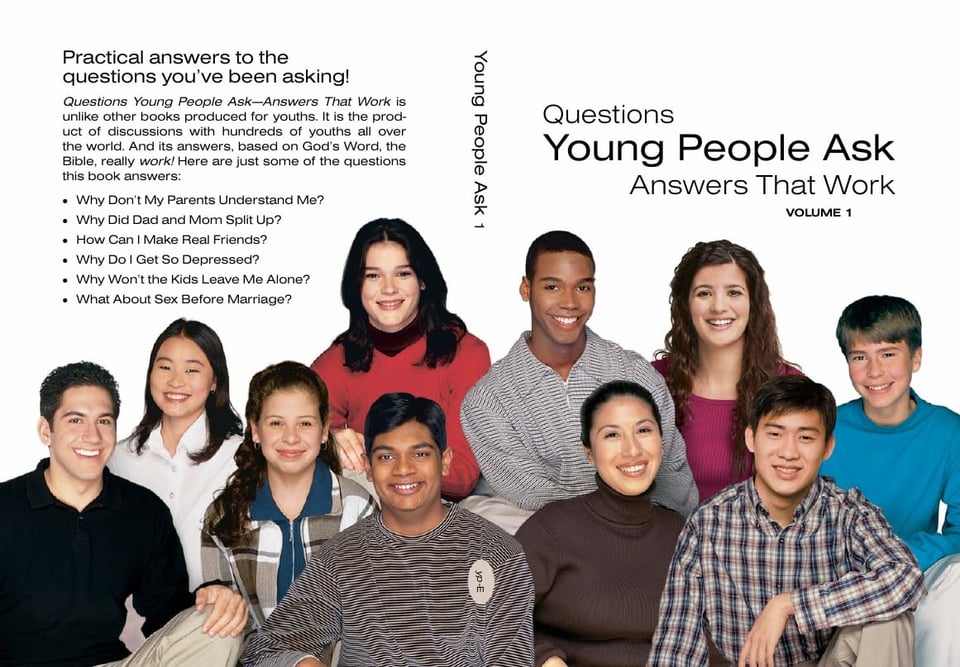
Practical answers to the questions you've been asking!
Questions Young People Ask-Answers That Work is unlike other books produced for youths. It is the product of discussions with hundreds of youths all over the world. And its answers, based on God's Word, the Bible, really work! Here are just some of the questions this book answers:
Why Don't My Parents Understand Me?
Why Did Dad and Mom Split Up?
How Can I Make Real Friends?
Questions Young People Ask Answers That Work
VOLUME 1
QUESTIONS
YOUNG
PEOPLE
ASK
ANSWERS THAT WORK
QUESTIONS YOUNG PEOPLE ASK ANSWERS THAT WORK © 1989 WATCH TOWER BIBLE AND TRACT SOCIETY OF PENNSYLVANIA All Rights Reserved
Publishers
WATCHTOWER BIBLE AND TRACT SOCIETY OF NEW YORK, INC.
Brooklyn, New York, U.S.A.
2006 Printing
Unless otherwise indicated, Scripture quotations are from the modern-language New World Translation of the Holy Scriptures—With References, 1984 Edition
Picture Credits
Pictures are listed by page number and by order of appearance on page, top to bottom. Bronz Zoon: photographed and used with the kind cooperation of; page 95 (2) National Aeronautics and Space Administration, Washington, D.C.; 371, Background, WASHINGTON; National Archives, Washington, D.C.; page 304 (background)
Questions Young People Ask
Answers That Work
English (yp E)
Made in the United States of America Answers That Work
'WHY DON'T my parents understand me?' 'Should I give drugs and alcohol a try?' 'What about sex before marriage?' 'How do I know if it's real love?' 'What does the future hold for me?'
You are neither the first—nor the last—youth to ask such questions. However, when young people raise these basic issues, they are often barragged with conflicting answers. For example, drinking alcoholic beverages. Parents may discourage it—though indulging in it themselves. Magazines and TV shows glorify it. Peers encourage you to try it. No wonder, then, that many youths are genuinely perplexed as to just what they should do.
Recognizing the need for honest, workable answers to the questions of today's youth, Awake! magazine* inaugurated a feature entitled "Young People Ask . . ." in January 1982. The series immediately drew a favorable reader response. "The series is evidence of your continued interest in the plight of young people today," wrote one appreciative reader. "I hope and pray that these articles never end," wrote another.
Yet another young reader put it this way: 'I am 14 years old and I never knew growing up could be so hard. There is so much pressure on young kids today. That is why I am very grateful for the articles. Every night I thank God for having them published.' The articles, however, were not childish, nor was any attempt made to "write down" to our readers. "Young People Ask . . ." thus found an appreciative audience among adults. 'I am 40 years of age," wrote one parent.
"These articles are truly godsends to us parents." Christian elders found them particularly useful in understanding young ones in congregations of Jehovah's Witnesses and in dealing with them.
Why has "Young People Ask . . . " triggered such enthusiastic response? The answers given really work! Each article is the product of extensive research. Furthermore, in order to determine just how young people really think and feel, Awake! reporters have spoken to hundreds of young people all over the world! Their candid expressions have been of great help in making the articles realistic and practical.
However, the real secret to the success of "Young People Ask . . ." lies in the fact that the answers given have been based, not upon theory or personal opinion, but upon the eternal truths found in God's Word, the Bible. "The Bible?" you may ask. Yes, it has much to say to young people. (See Proverbs, chapters 1-7; Ephesians 6:1-3.) It was inspired by our Creator, who is keenly aware of "the desires incidental to youth." (2 Timothy 2:20-22; 3:16) And while human society has changed much since Bible times, youthful desires have changed little. The Bible is thus as current as ever. We have endeavored, though, to present the Bible's counsel in such a way that youths do not feel preached to, but, rather, reasoned with. And while the material has been written primarily with youths among Jehovah's Witnesses in mind, it can be read and enjoyed by anyone who has respect for the practical wisdom contained in the Bible.
In response to the requests of many readers, we have compiled a number of "Young People Ask . . ." articles in book form. The 39 chapters herein represent, in condensed form, information from over 100 of the nearly 200 articles that appeared in Awake! between 1982 and 1989.
Some fresh material has been added. Furthermore, it is richly illustrated with photographs of youths of different lands and races.
Feel free to scan the table of contents and go right to the questions that concern you the most. We recommend, though, that you later take the time to read the book through in its entirety, looking up the scriptures in your own copy of the Bible.
In some families, parent-child communication is lacking or awkward at best. We have thus added a feature called Questions for Discussion, which appears at the end of each chapter. The questions are not designed for paragraph-by-paragraph analysis. Nor are they a vehicle for parents to quiz their children. They are designed to stimulate discussions between youths and parents. Many of the questions allow you to give your own point of view or to apply the material under discussion to your own situation.
Many families may therefore want to use this book at times as a basis for family study. Family members might do so by taking turns reading paragraphs, looking up any scriptures cited. The Questions for Discussion can be asked intermittently, as appropriate subheadings are completed or after the whole chapter has been completed. All can be encouraged to express their feelings openly and honestly. Young people may enjoy discussing the book among themselves.
These are "critical times hard to deal with," even for young people. (2 Timothy 3:1) With a knowledge of God's Word, however, you can successfully pass through that difficult time of life. (Psalm 119:9) It is our pleasure, therefore, to provide this collection of practical, Bible-based answers to questions that may perplex you.
The Publishers Section 1 The Home Front: Dealing With Family Members
<tr><th>Chapter
Page
Question
Why Should I 'Honor My Father and My Mother'?
Why Don't My Parents Understand Me?
How Can I Get My Folks to Give Me More Freedom?
Why Did Dad and Mom Split Up?
How Can I Deal With My Parent's Remarriage?
Why Are My Brother and Sister So Hard to Get Along With?
Should I Leave Home?
Section 2 You and Your Peers
<tr><th>Chapter
Page
Question
How Can I Make Real Friends?
How Can I Cope With Peer Pressure?
Section 3 A Look at How You Look
<tr><th>Chapter
Page
Question
How Important Are Looks?
Do My Clothes Reveal the Real Me?
Section 4 Why Do I Feel This Way?
<tr><th>Chapter
Page
Question
Why Don't I Like Myself?
Why Do I Get So Depressed?
How Can I Make My Loneliness Go Away?
Why Am I So Shy?
Is It Normal to Grieve the Way I Do?
Section 5 School and Work
<tr><th>Chapter
Page
Question
Should I Quit School?
How Can I Improve My Grades?
Why Won't the Kids Leave Me Alone?
How Can I Get Along With My Teacher?
How Can I Get (and Keep!) a Job?
What Career Should I Choose?
Section 6 Sex and Morals
<tr><th>Chapter
Page
Question
What About Sex Before Marriage?
How Can I Say No to Premarital Sex?
Masturbation—How Serious Is It?
Masturbation—How Can I Fight the Urge?
Honesty—Is It Really the Best Policy?
Section 7 Dating, Love, and the Opposite Sex
<tr><th>Chapter
Page
219 How Can I Get Over a Crush?
225 Am I Ready to Date?
236 Am I Ready for Marriage?
242 How Do I Know If It's Real Love?
252 How Can I Carry On a Successful Courtship?
Section 8 The Trap of Drugs and Alcohol
<tr><th>Chapter
Page
262 Drinking—Why Not?
272 Why Say No to Drugs?
Section 9 Leisure Time
<tr><th>Chapter
Page
Does It Matter What I Read?
How Can I Control My TV Viewing Habits?
Why Can't I Have a Good Time Once in a While?
Section 10 Your Future
<tr><th>Chapter
Page
What Does the Future Hold for Me?
How Can I Get Close to God?
The Home Front: Dealing With Family Members
"Home Sweet Home." This familiar saying expresses a sentiment that nowadays seems hopelessly outmoded. Unrelenting family conflicts turn many homes into veritable battlefields. And a yawning communication gap often frustrates any attempts at calling a truce.
Do you want your home to be a haven of peace instead of a hotbed of hostility? True, other family members must do their part. But by mastering a few Bible principles, there is much you can do to contribute to the peace of your home.
Why Should I 'Honor My Father and My Mother'?
"HONOR your father and your mother." To many youths these words sound like something out of the Dark Ages.
Young Veda declared open rebellion against her father by dating a boy who abused drugs and alcohol. Defiantly, she would also go out dancing till the early morning hours. "I felt that he was too strict," Veda explains. "I was 18 years old, and I thought I knew it all. I felt my father was mean and just didn't want me to have a good time, so I went out and did what I wanted to do."
Most youths would probably disapprove of Veda's actions. Yet, if their parents ordered them to clean their room, do their homework, or be in by a certain hour, many would seethe with resentment or, worse yet, would openly defy their parents! How a youth views his parents, though, can ultimately mean not only the difference between war and peace at home but also his very life. For the command to 'honor your parents' comes from God, and he attaches the following incentive to heeding this commandment: "That it may go well with you and you may endure a long time on the earth." (Ephesians 6:2, 3) The stakes are high. Let us, therefore, take a fresh look at what honoring your father and your mother really means.
"Honor" involves recognizing duly constituted authority. For instance, Christians are commanded to How should you view your parents' rules?
"have honor for the king." (1 Peter 2:17) While you may not always agree with a national ruler, his position or office is still to be respected. Similarly, God has vested parents with certain authority in the family. This means that you must recognize their God-given right to make rules for you. True, other parents may be more lenient than yours are. Your parents, though, have the job of deciding what is best for you—and different families may have different standards.
It is also true that even the best of parents can occasionally be arbitrary—even unfair. But at Proverbs 7:1, 2 one wise parent said: "My son [or daughter], . . . keep my commandments and continue living." Likewise, your parents' rules, or "commandments," are usually intended for your good and are an expression of their genuine love and concern.
John, for example, had repeatedly been told by his mother that he should always use the walkway over the six-lane highway near their home.
One day, two girls from school dared him to take the shortcut across the road itself. Ignoring their taunts of "chicken!" John took the walkway. Partway across, John heard the sound of screeching tires. Looking down, he watched in horror as the two girls were hit by a car and hurled into the air! Granted, obeying your parents is seldom a matter of life and death. Nevertheless, obedience usually benefits you.
'Honoring your parents' also means accepting correction, not sulking or throwing tantrums when it is administered. Only a fool "disrespects the discipline of his father," says Proverbs 15:5.
Finally, showing honor means more than just rendering formal respect or begrudging obedience. The original Greek verb rendered "honor" in the Bible basically means to consider someone as of great value. Parents should thus be viewed as precious, highly esteemed, and dear to you. This involves having warm, appreciative feelings for them. However, some youths have anything but warm feelings toward their parents.
Problem Parents—Worthy of Honor?
A youth named Gina wrote: "My dad drank so much, and I couldn't sleep because my parents would argue and shout a lot. I would lie on the bed and just cry. I could not tell them how I felt about it because my mom would probably hit me. The Bible says 'honor thy father,' but I can't."
Parents who are hot-tempered or immoral, who are drunkards, or who bicker with each other—are they really worthy of honor? Yes, for the Bible condemns holding any parent "in derision." (Proverbs 30:17) Proverbs 23:22 further reminds us that your parents have "caused your birth."
This alone is reason to honor them. Gregory, who at one time was very disrespectful, now says: "I thank Jehovah God that [my mother] didn't abort me or dump me in a garbage can as a baby. She is a single parent, and there were six of us. I know it was tough on her."
Though they are less than perfect, your parents have also made many sacrifices for you. "One time all we had left to eat was a can of corn and some grits," continues Gregory. "My mom fixed it for us kids, but she didn't eat. I went to bed full, but I kept wondering why Mom didn't eat. Now that I have my own family, I
Must you honor parents whose conduct is reproachful?
realize she was sacrificing for us." (One research study puts the cost of raising a child to age 18 at $66,400.)
Realize, too, that just because a parent's example is not the best, this does not mean that everything he or she tells you is wrong. In Jesus' day, the religious leaders were corrupt. Yet, Jesus told the people: "All the things they tell you, do and observe, but do not do according to their deeds." (Matthew 23:1-3, 25, 26) Could not this principle be applied to some parents?
Dealing With Feelings of Resentment
What if you feel that a parent is seriously abusing his or her authority?* Stay calm. Rebelling accomplishes nothing, neither does hateful, spiteful behavior. (Ecclesiastes 8:3, 4; compare Ecclesiastes 10:4.) One 17-year-old girl came to resent her parents because they were preoccupied with their own squabbles and seemed indifferent toward her. Resentment toward them was then directed toward the Bible principles her parents had tried to teach her. Out of sheer spite, she ventured into sexual immorality and drug abuse. "I felt I owed my parents one," was her bitter explanation. But by being spiteful, she only hurt herself.
The Bible warns: "Take care that rage does not allure you into spiteful [actions] . . . Be on your guard that you do not turn to what is hurtful." (Job 36:18-21) Realize that parents are responsible before Jehovah for their conduct and will answer for any serious injustices. —Colossians 3:25.
Proverbs 19:11 says: "The insight of a man certainly slows down his anger, and it is beauty on his part to pass over transgression." At times it is best to try to forgive and forget a parent's hurtful actions.
Rather than dwell on his faults, focus on his good qualities. Dody, for example, had an insensitive mom and an alcoholic stepdad. Notice how her insight into their shortcomings stifled bitterness. She says: "Perhaps my mom never showed us love because, as an abused child, she was never taught how. My stepfather showed an
"I felt my father was mean and just didn't want me to have a good time, so I went out and did what I wanted to do"
interest in our activities when he was sober, but that wasn't very often. Yet, my sister and I always had a roof over our heads and food in the refrigerator."
Fortunately, wayward or neglectful parents are a minority. More than likely your parents take an interest in you and try to set a good example. Even so, you may feel some resentment toward
them at times. "Sometimes when I was discussing a problem with Mom and she couldn't see my point," admits a young man named Roger, "I'd get mad and say something out of spite just to hurt her. It was my way of getting back at her. But when I walked away, I felt so bad, and I knew she didn't feel good either."
Thoughtless words may 'stab' and 'cause pain,' but they will not solve your problems. "The tongue of the wise ones is a healing." (Proverbs 12:18; 15:1) "Though it was hard, I would go back and apologize," explains Roger. "I could then discuss the problem more calmly, and we could get it solved."
'What My Dad Said Was Right'
Interestingly, some youths wear themselves and their parents out resisting parental instructions, only to find out later that their parents were right all along.
Consider Veda (mentioned at the outset), for example. She went out riding with her boyfriend one day. He was high on marijuana and beer. The car went out of control and struck a lamppost at 60 miles per hour. Veda survived—with a deep gash on her forehead. The boyfriend fled the scene, never even showing up at the hospital to help her.
"When my parents arrived at the hospital," confessed Veda. "I told them that everything my dad had said was right and that I should have listened a long time ago. . . . I had made a big mistake, and it almost cost my life." After that, Veda made some big changes in her attitude toward her parents.
Perhaps some changes would be appropriate on your part too. 'Honoring your parents' may indeed seem to be an old-fashioned idea. But not only is it the smart thing to do it is also the right thing to do in the eyes of God. What, though, if you want to show your parents respect but feel misunderstood or perhaps hemmed in by restrictions? Let's examine how you can improve your lot in such situations.
Questions for Discussion
Chapter 1
What does it mean to honor one's parents?
Why do parents make so many rules? Can those rules benefit you?
Do you have to honor your parents if their conduct is reproachful? Why?
What are some productive ways of dealing with the resentment you might occasionally feel toward your parents? What are some foolish ways?
Why Don't My Parents Understand Me?
IT'S only human to want to be understood. And if your parents are critical of—or uninterested in—things you love or think are important, you can feel very frustrated.
Sixteen-year-old Robert feels that his father does not understand his choice of music. "All he does is scream and say, 'Turn it off!'" said Robert. "So I turn it and him off." Many youths similarly withdraw emotionally into their own private world when parental understanding seems to be lacking. In one extensive study of youths, 26 percent of the youths surveyed admitted, "I try to stay away from home most of the time."
A huge rift, or gap, between youths and parents thus exists in many homes. What causes it?
"Power" Versus "Gray-Headedness"
Proverbs 20:29 states: "The beauty of young men [or women] is their power." This strength, or "power," though, can lay the groundwork for all sorts of conflicts between you and your parents. The proverb continues: "And the splendor of old men is their gray-headedness." Your parents may not literally be 'gray-headed,' but they are older and tend to view life differently. They realize that not every situation in life has a happy ending. Bitter personal experience may have tempered the idealism they once had as youths. Because of this wisdom born of experience—"grayheadedness," as it were—they just may not share your enthusiasm over certain matters.
Says young Jim: "My parents (depression-era children) feel that money should be saved to buy or spend on things of importance. But I am living right now too. . . . I want to travel a lot." Yes, between one's youthful "power" and one's parents' "gray-headedness" may lie a huge gap. Many families are thus bitterly divided over issues such as dress and grooming, behavior with the opposite sex, use of drugs and alcohol, curfews, associates, and chores. The generation gap can be bridged. But before you can expect your parents to understand you, you must try to understand them.
"When I was younger, I naturally felt that Mom was 'perfect' and didn't have any of the weaknesses and feelings I had," says John. Then his parents divorced, leaving his mother to care for seven children alone. John's sister April recalls: "I remember seeing her cry because of the frustration of trying to keep up with everything. Then I realized we had a wrong viewpoint. She can't do everything always at the right time and in the right way. We saw that she had feelings and was human too."
Recognizing that your parents are simply humans with feelings like yours is a big step toward your How Can I Tell My Parents?
The task of confessing a wrong to your folks is not pleasant. Young Vince says: "I always sensed that my parents had a lot of trust in me and that made it difficult for me to approach them because I didn't want to hurt them."
Youths who resort to coverups often suffer the pangs of a wounded conscience. (Romans 2:15) Their errors can become "a heavy load," too weighty to bear. (Psalm 38:4) Almost inevitably, they are forced to deceive their parents by lying, thereby committing further wrongs. Their relationship with God is thus damaged.
The Bible says: "He that is covering over his transgressions will not succeed, but he that is confessing and leaving them will be shown mercy." (Proverbs 28:13) As 19-year-old Betty put it: "Jehovah sees everything anyway."
If the matter involves serious wrongdoing, seek Jehovah's forgiveness, confessing your wrong in prayer. (Psalm 62:8) Next, tell your parents. (Proverbs 23:26) They have experience in life and can often help you leave your mistakes behind and avoid repeating them. "It really can help you to talk about it," reports 18-year-old Chris. "It's finally a relief to get it off your mind." The problem is, how do you tell your parents?
The Bible speaks of "a word spoken at the right time for it." (Proverbs 25:11; compare Ecclesiastes 3:1, 7.) When might be that? Chris continues: "I wait until suppertime and then tell Dad that I need to talk to him." The son of a single parent tried yet another time: "I would usually talk to Mom right before bedtime; she'd be more relaxed then. When she came home from work, she was all wound up."
Perhaps you might say something like, "Mom and Dad, something is troubling me." And what if your parents seem too busy to care? You might say, "I know you're busy, but something is really troubling me. Can we talk?" You might then ask: "Did you ever do Choose a time when your parents might be in a more receptive frame of mind
something that you were too ashamed to talk about?"
Now comes the hard part: telling your parents about the wrong itself. Be humble and "speak truth," not watering down the seriousness of your error or trying to withhold some of the more unpleasant details. (Ephesians 4:25; compare Luke 15:21). Use words your folks will understand, not expressions that carry a special meaning only to young people.
Naturally, your parents may feel hurt and disappointed at first. So don't be surprised or indignant if you are hit with an emotion-packed volley of words! If you had heeded their earlier warnings, you probably wouldn't be in this situation. So stay calm. (Proverbs 17: 27) Listen to your folks and answer their questions, regardless of how they ask them.
No doubt your earnestness about setting matters straight will make a deep impression on them. (Compare 2 Corinthians 7:11). Nevertheless, be prepared to accept some well-deserved discipline. "True, no discipline seems for the present to be joyous, but grievous; yet afterward to those who have been trained by it it yields peaceable fruit, namely, righteousness." (Hebreus 12:11) Remember, too, that this will not be the last time you will need your parents' help and mature advice. Get into the habit of confiding in them about small problems so that when the big problems come along, you won't fear telling them what's on your mind.
understanding them. They might, for example, feel very insecure about their ability to rear you properly. Or, feeling overwhelmed by all the moral dangers and temptations you face, they may tend to overreact to things at times. They also may be contending with physical, financial, or emotional hardships. A father, for instance, may hate his job but may never complain. So when his child says, "I can't stand school," it is no wonder that rather than respond sympathetically, he retorts, "What's the matter with you? You kids have it easy!"
Take a "Personal Interest"
How, then, can you find out how your parents feel? By "keeping an eye, not in personal interest upon just your own matters, but also in personal interest upon those of the others." (Philippians 2:4) Try asking your mother what she was like as a teenager. What were her feelings, her goals? "Chances are," said 'Teen magazine, "that if she feels that you're interested in, and aware of the reasons for some of her feelings, she'll try to be more aware of yours." The same would no doubt be true of your father.
"If[your mother] feels that you're interested in, and aware of the reasons for some of her feelings, she'll try to be more aware of yours."—"Teen magazine
If a conflict arises, do not be quick to accuse your folks of being insensitive. Ask yourself: 'Was my parent not feeling well or worried about something?' Was he or she perhaps hurt over some thoughtless deed or word on my part? Do they simply misunderstand what I mean?' (Proverbs 12:18) Showing such empathy is a good start at closing that generation gap. Now you can work on getting your parents to understand you!
Many youths, though, make that extremely difficult. How?
Living a Double Life
Seventeen-year-old Vickie was doing just that by secretly dating a boy against her parents' wishes. She was sure her parents just wouldn't understand her feelings for her boyfriend. Naturally, the gap between her and them widened. "We were making each other miserable." says Vickie. "I hated coming home." She decided she would get married—anything to get away from home!
Many youths similarly live double lives—doing things unknown to and forbidden by their parents—and then bemoan the fact that their parents 'do not understand them!' Fortunately, Vickie was helped by an older Christian woman who told her: "Vickie, just think about your parents . . . They raised you. If you can't handle this relationship, how can you handle one with someone of your own age that hasn't put 17 years of love into you?"
Vickie took an honest look at herself. She soon realized that her parents were right and that her own heart was wrong. She terminated her association with her boyfriend and began closing the breach between her and her parents. If you have similarly kept an important part of your life secret from your parents, isn't it time to be honest with them?—See insert "How Can I Tell My Parents?"
Take the Time to Talk
'It was the best time I ever had with my dad' said John of a trip he and his father made together. "I'd never spent six hours alone with him in my whole life. Six hours up, six hours back. No car radio. We really talked. It's as if we discovered each other. There's more to him than I thought.
It made us friends." Why not similarly try to have a good talk with your mom or dad —regularly?
It also helps to make friends with other adults. Recalls Vickie: "I had absolutely no rapport with older ones. But I made a point of tagging along with my parents when they associated with other adults. In time I developed friendships with these who were my parents' age, and this gave me a more rounded outlook. It was easier to carry on conversations with my parents. The atmosphere at home improved dramatically."
Associating with those who have gained wisdom over the years will also prevent you from adopting a narrow, limited outlook on life, which can happen if you keep company only with your youthful peers. Proverbs 13:20.
Communicate Your Feelings
"I talk straight from my heart and speak sincerely the knowledge coming from my lips," said young Elihu. (Job 33:3, The Holy Bible in the Language of Today, by William Beck) Is that how you talk with your parents when you clash over such matters as clothes, curfews, or music?
Young Gregory felt that his mom was totally unreasonable. He coped with the heated conflict between them by staying away from home as much as he could. But then he acted on the advice of some Christian elders. He says, "I began to tell Mom how I felt. I told her why I wanted to do things and did not just assume she knew. Often I poured out my heart and explained that I wasn't trying to do anything wrong and how bad I felt because she treated me like a little child. Then she began to understand and slowly things got a whole lot better."
You may likewise find that speaking 'straight from the heart' can help settle many misunderstandings.
Handling Disagreements
This does not mean, however, that your parents will immediately come to view things your way. You must therefore keep a grip on your emotions. "All his spirit [impulses] is what a stupid one lets out, but he that is wise keeps it calm to the last." (Proverbs 29:11) Calmly discuss the merits of your viewpoint. Stick to the issues instead of arguing that "everybody else does it!"
At times your parents are going to say no. This does not mean they do not understand you. They may simply want to forestall disaster. "My mother is strict on me," admits one 16-year-old girl. "It bothers me that she tells me I can't do something, or [that I must] come into the house at a certain time. But deep down inside, she really cares. . . . she looks out for me."
The security and warmth that mutual understanding brings to a family is beyond words. It makes the home a haven in times of anguish. But real effort is needed on the part of everyone involved.
Questions for Discussion
Chapter 2
Why do youths and parents often conflict?
How might a better understanding of your parents affect your view of them?
How can you come to understand your parents better?
Why does leading a double life deepen the rift between you and your parents?
Why is it best to let parents know when you are having serious problems? How can you go about telling them?
How can you help your parents understand you better?
How Can I Get My Folks to Give Me More Freedom?
YOU say you're old enough to stay out late on weekends. They say you have to be home early. You say you want to see that new movie everybody is talking about. They say you can't see it. You say you've met some nice kids you'd like to go out with. They say they'd like to meet your friends first.
When you're a teenager, it can sometimes feel as if your parents have a choke hold on your life. It seems that every "I want to" you say is followed by an inevitable "No, you can't." Nor is any part of your life safe from the "prying eyes" of your parents. Says 15-year-old Debbie: "My dad always wants to know where I am, what time I'm going to be home. Most parents do that. Do they have to know everything? They should give me more freedom."
Youths further complain that their parents do not respect them. Instead of being trusted, they are judged guilty without a trial when something goes wrong. Instead of being allowed to choose for themselves, they are hemmed in by rules.
"Mental Distress"
Do your folks sometimes treat you like a small child? If so, remember that not too long ago you really wore a child. Your parents' image of you as a helpless infant is quite fresh in their minds and not so easily set aside.
They still remember the childish mistakes you used to make and thus want to protect you—whether you want such protection or not.
That urge to protect you is a powerfully strong one. When Mom and Dad aren't busy putting a roof over your head, clothing you, or feeding you, they are often grappling with the problems of how to teach, train, and, yes, protect you. Their interest in you is far from casual. They are responsible before God for the way in which they bring you up. (Ephesians 6:4) And when something seems to threaten your well-being, they worry.
Consider Jesus Christ's parents. After a visit to Jerusalem, they unknowingly left for home without him. When they became aware of his absence, they made a diligent—even frantic—search for him! And when they finally "found him in the temple," Jesus' mother exclaimed,
Do you feel that your parents fence you in?
"Child, why did you treat us this way? Here your father and I in mental distress have been looking for you." (Luke 2:41-48) Now if Jesus—a perfect child—caused his parents anxiety, think of how much worry you must cause your parents!
Take, for example, that never-ending conflict over what time you should come home. Perhaps you see no reason to be restricted in this way. But have you ever looked at matters from your parents' point of view? The school-age authors of the book The Kids' Book About Parents tried to do so. They compiled a list of what they called "the fantasies that must go on in parents' heads about what their kids are doing if they are not home at the proper time." Included in this list were such things as 'doing drugs, getting in a car accident, hanging out in parks, getting arrested, going to porno movies, selling dope, getting raped or mugged, winding up in jail, and disgracing the family name.'
Not all parents would jump to such seemingly farfetched conclusions. But is it not true that many young people are involved in such things? So should you present the suggestion that keeping both late hours and the wrong kind of company could be harmful? Why even Jesus' parents wanted to know his whereabouts!
Why They Smother
Some youths say that their parents' fear of harm coming to them borders on paranoia! But remember, much time and emotion have been invested in you. The thought of your growing up and eventually leaving may disturb your parents. Wrote one parent: "My only child, a son, is nineteen now, and I can hardly bear the idea of his moving out."
Some parents thus tend to smother or to overprotect their children. It would be a real mistake, though, for you to overreact in turn.
One young woman recalls: "Until I reached the age of about 18, my mother and I were very close. . . . [But] as I got older we started to have problems. I wanted to exert some independence, which she must have seen as a threat to our relationship. She, in turn, started to try to hold on to me tighter, and I reacted by pulling away more."
A measure of independence is fine, but don't obtain it at the cost of your family ties. How can you set
your relationship with your parents on a more adult footing, based on mutual understanding, tolerance, and respect? For one thing, respect begets respect. The apostle Paul once recalled: "We used to have fathers who were of our flesh to discipline us, and we used to give them respect." (Hebrews 12:9) The parents of these early Christians were not infallible. Paul continued (verse 10): "Our human fathers . . . could only do what they thought best." —The Jerusalem Bible.
"My dad always wants to know where I am, what time I'm going to be home. . . Do they have to know everything?"
At times these men erred in their judgment. Yet they merited their children's respect. So do your parents. The fact that they may be the smothering type is no reason to be rebellious. Give them the same respect you want for yourself.
Misunderstandings
Have you ever been late getting home because of circumstances beyond your control? Did your parents overreact? Such misunderstandings provide another opportunity for you to win respect. Recall how young Jesus handled himself when his upset parents finally Remaining calm when misunderstandings have occurred is one way to gain respect
found him in the temple, innocently discussing God's Word with some teachers. Did Jesus launch into an emotional tirade, cry, or whine about how unfair it was of them to impugn his motives? Note his calm reply: "Why did you have to go looking for me? Did you not know that I must be in the house of my Father?" (Luke 2:49) No doubt Jesus' parents were impressed by the maturity he here displayed. "An answer, when mild," thus not only "turns away rage" but can also help win your parents' respect.—Proverbs 15:1.
Rules and Regulations
How you respond to your parents' demands also has a lot to do with how you will be treated. Some youths sulk, lie, or openly disobey. Try a more adult approach. If you want permission to stay out late, don't make childish demands or whine that "all the other kids can stay out late." Writer Andrea Eagan advises: "[Tell] them as much as you can about what it is you want to do, so that they really understand the situation. . . . If you tell them all about where you'll be and with whom and why it's important to you to stay out later .
. . , they just might say yes."
Or if your parents want to screen your friends—as well they should—don't whimper like a child. Recommended Seventeen magazine: "Bring friends home with you from time to time, so that when you say you're going to the movies with Bill, your father has no reason to roar from the other room, 'Bill? Bill who?'"
"More Will Be Given"
Jim smiles when he talks about his younger brother Ron. "There's only 11 months difference between us," he says, "but our parents treated us so differently. They gave me a lot of freedom. I had the use of the family car. One year they even allowed me to take one younger brother on a trip to New York City.
"It was different with Ron, though," Jim continues. "He wasn't given much freedom at all. Dad didn't even bother teaching him how to drive when he came of age. And when he felt he was old enough to start dating, my folks wouldn't let him."
Favoritism? No. Explains Jim: "Ron tended to be irresponsible. He lacked initiative. He often failed to do what was assigned him. And although I never talked back to my parents, Ron would let them know he disagreed. This invariably backfired on him." Jesus said at Matthew 25:29: "For to everyone that has, more will be given and he will have abundance; but as for him that does not have, even what he has will be taken away from him."
Do you want more freedom and responsibility? Then prove yourself responsible. Take seriously whatever tasks your folks assign you. Don't be like the youth in one of Jesus' parables.
After being told by his father,
"Child, go work today in the vineyard," he said, "I will,
sir," but he "did not go out." (Matthew 21:28, 29) Convince your parents that if they ask you to do something,
no matter how small, it is as good as done.
"I showed my folks I could handle responsibility," Jim recalls. "They would send me to the bank, let me pay our utilities bills, go to the supermarket and shop. And when Mom had to go out and get a job, I even cooked the family meals."
Taking the Initiative
What if your parents simply haven't assigned you such tasks to do? Pursue various initiatives. Seventeen magazine suggested: "Offer to cook your family a meal, and tell your folks you want to do everything: plan the meal, make the grocery list, budget, shop, cook, clean up." And if cooking is not your forte, look around and see what else can be cared for. You don't need a specific decree from your parents to act when there are dishes to be washed, floors to be swept, or rooms to be straightened up.
Many youths take on part-time work during the summer or on weekends. If this is true in your case, have you proved that you are capable of saving and managing your money? Have you volunteered to make a contribution for your room and board? (You might find it eye-opening to check the going rate for renting a room in your community.) Doing so might mean less pocket money, but as your folks observe your grown-up way of handling money, they will no doubt be inclined to give you more freedom.
Loosening the Apron Strings
Parents should be our confidential friends, rich sources of advice and counsel. (Compare Jeremiah 3:4.) However, this does not mean that you must rely on them to make every petty decision.
It is only through using your "perceptive powers" that you gain confidence in your ability to make decisions.—Hebrews 5:14.
So instead of running to your parents at the first sign of minor distress, try first to work out the problem in your own mind. Rather than be "overhasty," or impulsive, about matters, follow the Bible's advice to "consider knowledge" first. (Isaiah 32:4) Do some research, especially if Bible principles are involved. After calmly weighing matters, then approach your parents. Instead of always saying, 'Dad, what should I do?' or, 'Mom, what would you do?' explain the situation. Let them hear the way you have reasoned the situation out. Then ask for their observations.
Your parents now see you talking not as a child but as an adult. You have taken a big step toward proving that you are becoming an adult deserving of a measure of freedom. Your folks may very well begin to treat you like an adult.
Questions for Discussion
Chapter 3
Why are parents often so concerned about protecting their children and knowing their whereabouts?
Why is it important that you treat your parents with respect?
How can misunderstandings with your parents be best handled?
How can you cooperate with your parents' rules and regulations and still have some freedom?
What are some ways you can prove to your parents that you are responsible?
Why Did Dad and Mom Split Up?
"I remember when my dad left us. We really didn't know what was going on. Mom had to go to work and left us alone all the time. Sometimes we'd just sit by the window and worry whether she had left us too. . . ."
-A girl from a divorced family.
THE divorce of one's parents can seem like the end of the world, a catastrophe that generates enough misery to last forever. It often triggers an onslaught of feelings of shame, anger, anxiety, fear of abandonment, guilt, depression, and profound loss—even a desire for revenge.
If your parents have recently split up, you too might be experiencing such feelings. After all, our Creator meant for you to be raised by both a father and a mother. (Ephesians 6:1-3) Yet, now you have been deprived of the daily presence of a parent you love. "I really looked up to my father and wanted to be with him," laments Paul, whose folks split up when he was seven. "But Mom got custody of us."
Why Parents Break Up
Often parents have kept their problems well hidden. "I don't remember my folks fighting," says Lynn, whose parents divorced when she was a child. "I thought they got along." And even when parents do squabble, it may still come as a shock when they actually split up!
In many cases, the split-up occurs because one parent is guilty of sexual misconduct. God does Watching the breakup of your parents' marriage can be one of the most painful experiences imaginable
permit the innocent mate to obtain a divorce. (Matthew 19:9) In other cases, "wrath and screaming and abusive speech" have erupted into violence, causing one parent to fear for his or her physical well-being and that of the children.—Ephesians 4:31.
Some divorces, admittedly, are obtained on flimsy grounds. Rather than work
out their problems, some selfishly divorce because they claim they are 'unhappy' or 'no longer in love.' This is displeasing to God, who "has hated a divorcing." (Malachi 2:16) Jesus also indicated that some would break up their marriages because their mates became Christians. —Matthew 10:34-36.
Whatever the case, the fact that your parents may have chosen to be silent or to give you only vague answers to your questions regarding the divorce does not mean they do not love you.* Wrapped up in their own hurt, your parents may simply find it hard to talk about the divorce. (Proverbs 24:10) They may also find 'Will the Divorce Ruin My Life?'
In the wake of their parents' divorce, some youths virtually ruin their lives. Some make rash decisions, such as to quit school. Others vent their frustration and anger by misbehaving—as if to punish their parents for getting the divorce. Recalls Denny: "I was unhappy and depressed after my parents' divorce. I started having problems in school and failed one year. After that ... I became the class clown and got into a lot of fights."
Shocking behavior may very well get the attention of one's parents. But what is really accomplished, other than adding stress to an already stressful situation? Really, the only one punished by wrongdoing is the wrongdoer. (Galatians 6:7) Try to understand that your parents are also suffering and that their seeming neglect of you is not malicious. Confessed Denny's mother: "I definitely neglected my kids. After the divorce, I was such a mess myself, I just couldn't help them."
The Bible advises at Hebrews 12:13: "Keep making straight paths for your feet, that what is lame may not be put out of joint." Even if parental discipline is absent, there is no excuse for misconduct. (James 4:17) Assume responsibility for your actions and exercise self-discipline. 1 Corinthians 9:37
—1 Corinthians 9:27.
Avoid, too, making rash decisions, for example, to leave home. "The shrewd one considers his steps." (Proverbs 14:15) If your parents seem too distracted at this point to lend you their ear, why not talk your decisions over with an older friend?
Still, you may have a number of concerns about your future. Since your parents have failed at marriage, it's understandable that you might worry about your own prospect of enjoying a successful marriage. Fortunately, marital unhappiness is not something you inherit from your parents—like freckles. You are a unique individual, and how any future marriage of yours turns out will depend, not on your parents' failings, but on the extent to which you and your mate apply God's Word.
You may also find yourself worrying about things you for-
houh is "a father of fatherless boys." (Psalm 68:5) You can be sure that he is deeply concerned about your needs.
Jeremiah observed: "Good it is for an able-bodied man that he should carry the voke dur-
merly took for granted—food, clothing, shelter, money. Parents, however, usually work out some means of supporting their children after a divorce, even if Mom has to take on secular work. Nevertheless, the book Surviving the Breakup realistically warns: "What once supported one family unit must now support two
ing his youth." (Lamentations 3:27) True, there is little "good" in watching parents split up. But it is possible to turn even this negative experience to your advantage.
Researcher Judith Wallerstein observed: "The emotional and intellectual growth [among children of divorced
families, forcing a decline in standard of living for every family member."
It may well be, therefore, that you'll have to get used to doing without things you used to enjoy, like new clothes. But the Bible reminds us: "We have brought nothing into the world, and neither can we carry anything out. So, having
parents] that was catalyzed by the family crisis was impressive and sometimes moving. The youngsters . . . soberly considered their parents' experiences and drew thoughtful conclusions for their own futures. They were concerned with finding ways to avoid the mistakes their parents had made."
sustenance and covering, we shall be content with these things." (1 Timothy 6:7, 8) Perhaps you can even assist in working out a new family budget. Remember, too, that Je-
No doubt about it, your parents' breakup is sure to make its mark on your life. But whether that mark is a fading blemish or a festering wound is to a great extent up to you.
it awkward and embarrassing to admit to their mutual failures.
What You Can Do
Try to discern the right time to discuss calmly your concerns with your parents. (Proverbs 25:11) Let them know how saddened and confused you are over the divorce. Perhaps they will give you a satisfactory explanation. If not, do not despair. Did not Jesus withhold information that he felt his disciples were not ready to handle? (John 16:12) And do not your parents have a right to privacy?
Finally, appreciate that the divorce, whatever the reason for it, is a dispute between them—not with you! In their study of 60 divorced families, Wallerstein and Kelly found that couples blamed each other, their employers, family members, and friends for the divorce. But, say the researchers: "No one, interestingly enough, blamed the children." Your parents' feelings toward you are unchanged.
Dwelling on memories of how life used to be may only depress you The Healing Effects of Time
There is "a time to heal." (Ecclesiastes 3:3) And just as a literal wound, like a broken bone, can take weeks or even months to heal completely, emotional wounds take time to heal.
Divorce researchers Wallerstein and Kelly found that within just a couple of years after a divorce "the widespread fears, the grief, the shocked disbelief . . . faded or disappeared altogether." Some experts feel that the worst of a divorce is over within just three years. This may seem like a long time, but a lot has to happen before your life can stabilize.
For one thing, the household routine—disrupted by the divorce—must be reorganized. Time will also pass before your parents are back on their feet emotionally. Only then may they finally be able to give you needed support. As your life regains some semblance of regularity, you will begin to feel normal again.
However, Solomon gave this warning: "Do not say: 'Why has it happened that the former days proved to be better than these?' for it is not due to wisdom that you have asked about this." (Ecclesiastes 7:10) Dwelling on the past can blind you to the present. What was your family situation like before the divorce? "There were always a lot of fights—screaming and name-calling," admits Annette. Could it be that you now enjoy domestic peace?
'I Can Get Them Back Together'
Some youths nurture dreams of reuniting their parents, perhaps clinging to such fantasies even after their parents have remarried!
However, denying the divorce changes nothing. And all the tears, pleading, and scheming in the world probably won't get your folks back together again. So why torment yourself by dwelling on the unlikely?
(Proverbs 13:12) Solomon said that there is "a time to give up as lost." (Ecclesiastes 3:6) So accept both the reality and the permanence of the divorce. This is a big step toward your getting over it.
Coming to Terms With Your Parents
You may rightly be angry with your parents for disrupting your life. As one young man bitterly put it: "My parents were selfish. They didn't really think about us and how what they did would affect us. They just went ahead and made their plans." This may be true. But can you go through life carrying a load of anger and bitterness and not harm yourself?
The Bible counsels: "Let all malicious bitterness and anger and wrath . . . be taken away from you . . . But become kind to one another, tenderly compassionate, freely forgiving one another." (Ephesians 4:31, 32) How can you forgive someone who has hurt you so deeply? Try to view your parents objectively—as fallible, imperfect humans. Yes, even parents 'sin and fall short of the glory of God.' (Romans 3:23) Realizing this can help you come to terms with your parents.
Talk Out Your Feelings
"I've never really discussed how I felt about my parents' divorce," one young man said when interviewed by us. Though initially impassive, the youth became increasingly emotional—even tearful—as he spoke about his parents' divorce. Feelings that had long been buried were unearthed. Surprised at this, he confessed: "Talking it out really helped me."
You may likewise find it helpful to confide in someone, instead of isolating yourself. Let your parents know just how you feel, what your fears and anxieties are. (Compare Proverbs 23:26.) Mature Christians can also help.
Keith, for example, got little or no support from his family, which was torn apart by divorce. Yet he found support elsewhere. Says Keith: "The Christian congregation became my family."
Above all, you can find a hearing ear with your heavenly Father, the "Hearer of prayer." (Psalm 65:2) A youth named Paul recalls what helped him get over his parents' divorce: "I prayed all the time and always felt that Jehovah was a real person."
Getting On With Your Life
After a divorce, things may never be the same. This does not mean, though, that your life cannot be a fruitful and happy one. The Bible advises, "Do not loiter at your business." (Romans 12:11) Yes, instead of allowing yourself to become immobilized by grief, hurt, or anger, get on with your life! Get involved in your schoolwork. Pursue a hobby. Have "plenty to do in the work of the Lord."—1 Corinthians 15:58.
It will take work, determination, and the passing of time. But eventually the breakup of your parents' marriage will no longer be the dominant thing in your life.
Questions for Discussion
Chapter 4
What are some of the reasons why parents break up?
Why might it be hard for your parents to talk about it? What can you do if they show such a reluctance to talk?
Why is it pointless to dwell on the past or fantasize about getting your parents back together again?
□ What are some positive things you can do to help yourself get over the divorce?
How can you deal with the anger you might feel toward your parents?
How Can I Deal With My Parent's Remarriage?
"The day Dad married Rita was the worst day of my life." recalled Shane. "I was mad. Mad at Dad for being a traitor to my Mom. Mad at Mom for going off to law school and leaving us alone. Mad at the two brats, Rita's kids, who were going to come live in our house . . . But most of all, I was mad at Rita . . . I hated her. And because I believed it's not right to hate, I was mad at myself, too." —Stepfamilies—New Patterns in Harmony, by Linda Craven.
THE remarriage of a parent destroys the hope that your parents will ever get back together. It can make you feel insecure, betrayed, and jealous.
The remarriage can be particularly hurtful if it comes on the heels of the death of a beloved parent. "The death of my mother made me turn very bitter," admitted 16-year-old Missy. "I thought my father's fiancée was taking my mother's place so I was very mean to her." Loyal to your natural parent, you may even feel guilty if you begin to feel love toward a stepparent.
Little wonder, then, that many youths vent their emotional pain in destructive ways. Some even scheme to break up their parent's new marriage. But remember, your natural parent and stepparent have exchanged vows before God. "Therefore, what God has yoked together let no man [or child] put apart." (Matthew 19:6) And even if you could break them up, this would not reunite your natural parents.
A parent's remarriage often ignites feelings of anger, insecurity, and jealousy
Nor does it make any sense to be in constant conflict with a stepparent. Proverbs 11:29 warns: "He who brings trouble on his family will inherit only wind," that is, end up with nothing. (New International Version) Fifteen-year-old Gerri's resentment of her stepmother finally culminated in a bitter fight. The result? Her stepmother demanded that Gerri's father choose between her and his daughter. Gerri ended up moving back in with her natural mother—who had also remarried.
Love Helps You Cope
What is the secret to coping successfully with a parent's remarriage? Exercising principled love as described at 1 Corinthians 13:4-8:
Love "does not look for its own interests." This means 'seeking not our own advantage, but that of the other person.' (1 Corinthians 10:24) If a parent has decided that he or she may needs the companionship of a marriage partner, should you resent this?
"Love is not jealous." Often youths do not want to share their natural parent's love with anyone else. But you need not fear that your parent will run out of love, as love can expand.
(Compare 2 Corinthians 6:11-13.) Your natural parent can expand his or her love to include a new mate without losing any affection for you! Will you open your heart to include a stepparent? Doing so in no way means that you are disloyal to your departed parent.
Love "does not behave indecently." Living with new brothers or sisters of the opposite sex can create moral pressures. Reportedly, illicit sexual relations take place among family members in 25 percent of stepfamilies.
Says David, whose mother's remarriage brought four teenage stepisters into the house, "It was necessary to put up a mental block concerning sexual feelings." You will also want to be careful to avoid undue familiarity, making sure that neither your dress nor your behavior is sexually provocative. —Colossians 3:5.
Love "bears up under anything . . . It gives us power to endure in anything." (Charles B. Williams' translation) At times nothing seems to make your painful feelings go away! Marla admitted: "I felt that I had no place in the home. I even told my mom that I wished I had never been born." Marla rebelled and even ran away! However, she now says: "The best thing is to endure." If you likewise endure, in time the bitterness, bewilderment, and pain you initially felt will subside.
'You're Not My Real Mother/Father!'
Coming under the discipline of a new parent is not easy, and when asked to do something by a stepparent, it may be tempting to blurt out, 'You're not my real mother/father!' But recall the principle stated at 1 Corinthians 14:20: "Grow up in your thinking." —The Holy Bible in the Language of Today, by William Beck.
Accepting the authority of your stepparent to discipline you is one way to show that you have 'grown up in your thinking.'
He or she performs the duties of a natural parent and deserves your respect. (Proverbs 1:8; Ephesians 6:1-4) In Bible times Esther was reared by an adoptive father, or "caretaker," when her parents died. Though he was not her natural parent,
"I thought my father's fiancee was taking my mother's place so I was very mean to her"
Mordecai 'laid commandments on her,' which she obeyed even as an adult! (Esther 2:7, 15, 17, 20) Really, a stepparent's discipline is usually an expression of his or her love and concern for you.—Proverbs 13:24.
Still, legitimate complaints are
bound to occur. If so, prove yourself to be 'grown up' by doing as Colossians 3:13 urges: "Continue putting up with one another and forgiving one another freely if anyone has a cause for complaint against another."
Learn to Share, Learn to Compromise
When 15-year-old Jamie lived alone with her mother, she had her own room and wore expensive clothes. When her mother remarried and Jamie found herself in a family with four children, things changed. "Now I don't even have my own room anymore," she lamented. "I have to share everything."
You may also have to relinquish your position as the oldest or the only child. If you are a son, for a long time you may have served as the man of the house—a position now occupied by your stepfather. Or if you are a daughter, it may be that you and your mother were like sisters, even sleeping in the same room, but now you have been moved out by your stepdad.
"Let your reasonableness become known to all Discipline from a stepparent is often resented
men," recommends the Bible. (Philippians 4:5) The original word used meant "yielding" and conveyed the spirit of one
who did not insist on all his lawful rights. So, try to be yielding, compromising. Make the most of your new situation, and avoid dwelling on the past. (Ecclesiastes 7:10) Be willing to share with stepbrothers and step-sisters, not treating them as outsiders. (1 Timothy 6:18) The sooner you begin treating one another as real brothers and sisters, the sooner your feelings for one another will grow. And as for the new man of the house, don't resent him. Be glad that he is there to help carry the load of household responsibilities.
Coping With Unequal Treatment
After admitting that her stepfather shows love, one young girl added: "But there is a difference. He expects more, disciplines more, has less understanding towards us . . . than he does of his own children at the same age. This is a sore spot with us."
Realize that a stepparent usually will not feel the same way toward a stepchild as he does toward his natural one. This is due, not so much to the blood tie with his natural child, but to their shared experience in living. After all, even a blood-related parent may love one child more than another. (Genesis 37:3) There is, however, an important distinction between equal and fair.
…